Question bank

Q&A: practice questions with answers

Search questions on any topic. Filter by exam category, exam, subject and topic, try the question, then open the answer and explanation.

Courses – airGurukul

20,719 questions found.

Q4301.
What will come in place of the question mark (?) in the given series?
90 87 83 78 72 ?
दी गई श्रृंखला में प्रश्न चिह्न (?) के स्थान पर क्या आएगा?
90 87 83 78 72 ?
  1. A63
  2. B67
  3. C66
  4. D65
Show answer

Concept: Look at the differences between consecutive terms.

  1. 90−3=87, 87−4=83, 83−5=78, 78−6=72
  2. Next subtract 7: 72−7=65

Trick: Subtractions 3, 4, 5, 6, 7 — consecutive numbers.

Answer: (D) 65

अवधारणा: क्रमागत पदों का अंतर देखें।

  1. 90−3=87, 87−4=83, 83−5=78, 78−6=72
  2. अगला 72−7=65

ट्रिक: घटाई जाने वाली संख्याएँ 3, 4, 5, 6, 7।

उत्तर: (D) 65
RRB NTPC Undergraduate CBT 1General Intelligence and ReasoningNumber seriesRRB NTPC Undergraduate CBT 1 2024 · 9 Sep Shift 1 →
Q4302.
If 1 is added to each odd digit and 2 is subtracted from each even digit in the number 3174658, then how many digits will appear more than once in the new number thus formed?
यदि संख्या 3174658 में प्रत्येक विषम अंक में 1 जोड़ा जाए और प्रत्येक सम अंक में से 2 घटाया जाए, तो इस प्रकार बनी नई संख्या में कितने अंक एक से अधिक बार आएँगे?
  1. AOneएक
  2. BThreeतीन
  3. CTwoदो
  4. DNoneकोई नहीं
Show answer

Concept: Change each digit as told (odd +1, even −2) and then count repeats.

  1. 3174658 → 3→4, 1→2, 7→8, 4→2, 6→4, 5→6, 8→6
  2. New number: 4282466
  3. 4 (twice), 2 (twice), 6 (twice), 8 (once) → three digits repeat

Yaad rakhein: Count the digits that repeat, not the number of repeated places.

Answer: (B) Three

अवधारणा: हर अंक बदलें (विषम +1, सम −2), फिर दोहराए गए अंक गिनें।

  1. 3174658 → 4, 2, 8, 2, 4, 6, 6
  2. नई संख्या: 4282466
  3. 4, 2 और 6 दो-दो बार → तीन अंक

याद रखें: दोहराए जाने वाले अलग-अलग अंक गिनें।

उत्तर: (B) Three (तीन)

RRB NTPC Undergraduate CBT 1General Intelligence and ReasoningNumber operationsRRB NTPC Undergraduate CBT 1 2024 · 9 Sep Shift 1 →
Q4303.
In a certain code language, 'NOPE' is coded as '6712' and 'NOTE' is coded as '2178'. What is the code for 'T' in the given code language?
एक निश्चित कूट भाषा में, 'NOPE' को '6712' के रूप में कूटबद्ध किया जाता है और 'NOTE' को '2178' के रूप में कूटबद्ध किया जाता है। दी गई कूट भाषा में 'T' के लिए कूट क्या है?
  1. A7
  2. B8
  3. C1
  4. D6
Show answer

Concept: Letters common to both words take the digits common to both codes.

  1. NOPE = 6712, NOTE = 2178
  2. Common letters N, O, E ↔ common digits 1, 2, 7
  3. Left over: P = 6 and T = 8

Trick: Remove the common part; the unique letter gets the unique digit.

Answer: (B) 8

अवधारणा: दोनों शब्दों के समान अक्षरों को दोनों कोड के समान अंक मिलते हैं।

  1. NOPE = 6712, NOTE = 2178
  2. समान अक्षर N, O, E ↔ समान अंक 1, 2, 7
  3. शेष: P = 6, T = 8

ट्रिक: समान भाग हटाएँ; बचा अक्षर = बचा अंक।

उत्तर: (B) 8

RRB NTPC Undergraduate CBT 1General Intelligence and ReasoningCoding-decodingRRB NTPC Undergraduate CBT 1 2024 · 9 Sep Shift 1 →
Q4304.
Based on the English alphabetical order, CFJP is related to FINT in a certain way. In the same way, ORZF is related to RUDJ. Following the same logic, to which of the given options is XALR related?
अंग्रेज़ी वर्णमाला क्रम के आधार पर, CFJP एक निश्चित प्रकार से FINT से संबंधित है। उसी प्रकार, ORZF, RUDJ से संबंधित है। समान तर्क का अनुसरण करते हुए, XALR दिए गए विकल्पों में से किससे संबंधित है?
  1. AAPOI
  2. BADPV
  3. CADVP
  4. DPOID
Show answer

Concept: Find the shift of each letter position.

  1. CFJP → FINT: +3,+3,+4,+4
  2. ORZF → RUDJ: +3,+3,+4,+4 ✓
  3. XALR: X+3 = A, A+3 = D, L+4 = P, R+4 = V → ADPV

Yaad rakhein: After Z the alphabet wraps round to A (X + 3 = A).

Answer: (B) ADPV

अवधारणा: हर अक्षर का स्थान-अंतर देखें।

  1. CFJP → FINT: +3,+3,+4,+4
  2. ORZF → RUDJ: वही नियम ✓
  3. XALR → A, D, P, V = ADPV

याद रखें: Z के बाद फिर A आता है (X + 3 = A)।

उत्तर: (B) ADPV

RRB NTPC Undergraduate CBT 1General Intelligence and ReasoningLetter analogyRRB NTPC Undergraduate CBT 1 2024 · 9 Sep Shift 1 →
Q4305.
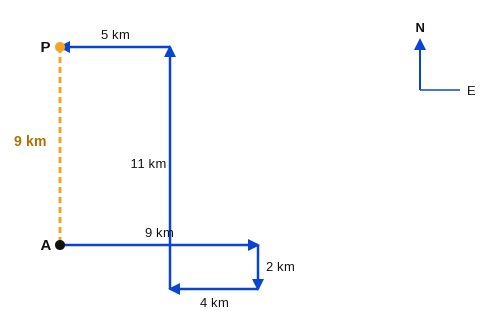
Manish starts from Point A and drives 9 km towards east. He then takes a right turn, drives 2 km, turns right and drives 4 km. He then takes a right turn and drives 11 km. He takes a final left turn, drives 5 km and stops at Point P. How far (shortest distance) and towards which direction should he drive in order to reach Point A again? (All turns are 90° turns only unless specified.)
मनीष बिंदु A से चलना शुरू करता है और पूर्व की ओर 9 km गाड़ी चलाता है। फिर वह दाएँ मुड़ता है, 2 km गाड़ी चलाता है, दाएँ मुड़ता है और 4 km गाड़ी चलाता है। फिर वह दाएँ मुड़ता है और 11 km गाड़ी चलाता है। वह अंतिम बार बाएँ मुड़ता है, 5 km गाड़ी चलाता है और बिंदु P पर रुक जाता है। पुनः बिंदु A पर पहुँचने के लिए उसे कितनी दूरी (न्यूनतम दूरी) तक और किस दिशा में गाड़ी चलानी चाहिए? (जब तक निर्दिष्ट न हो, सभी मोड़ केवल 90° के मोड़ हैं।)
  1. A9 km towards northउत्तर की ओर 9 km
  2. B9 km towards southदक्षिण की ओर 9 km
  3. C12 km towards eastपूर्व की ओर 12 km
  4. D12 km towards northउत्तर की ओर 12 km
Show answer

Concept: Track the position on x–y axes (East +x, North +y).

  1. A(0, 0) → 9 km East → (9, 0)
  2. Right → South 2 → (9, −2); right → West 4 → (5, −2)
  3. Right → North 11 → (5, 9); left → West 5 → P(0, 9)
  4. P is 9 km due North of A, so he must drive 9 km South.

Trick: Net east–west: 9−4−5=0; net north–south: 11−2=9 North → go back South.

Answer: (B) 9 km towards south

अवधारणा: स्थिति को x–y अक्ष पर रखें (पूर्व +x, उत्तर +y)।

  1. A(0, 0) → 9 km पूर्व → (9, 0)
  2. दाएँ → दक्षिण 2 → (9, −2); दाएँ → पश्चिम 4 → (5, −2)
  3. दाएँ → उत्तर 11 → (5, 9); बाएँ → पश्चिम 5 → P(0, 9)
  4. P, A से 9 km उत्तर में है; अतः 9 km दक्षिण जाना होगा।

ट्रिक: पूर्व–पश्चिम: 9−4−5=0; उत्तर–दक्षिण: 11−2=9 उत्तर → वापसी दक्षिण।

उत्तर: (B) 9 km towards south (दक्षिण)

RRB NTPC Undergraduate CBT 1General Intelligence and ReasoningDirection and distanceRRB NTPC Undergraduate CBT 1 2024 · 9 Sep Shift 1 →
Q4306.
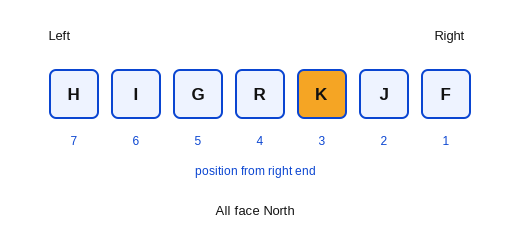
Seven people, F, G, H, I, J, K and R, are sitting in a row facing North. Only two people sit between H and R. Only F sits to the right of J. Only one person sits between R and J. G sits at some place to the right of I but at some place to the left of K. Who sits third from the right end of the line?
सात व्यक्ति, F, G, H, I, J, K और R, उत्तर की ओर मुख करके एक पंक्ति में बैठे हैं। H और R के बीच केवल दो व्यक्ति बैठे हैं। J के दाएँ केवल F बैठा है। R और J के बीच केवल एक व्यक्ति बैठा है। G, I के दाएँ किसी स्थान पर लेकिन K के बाएँ किसी स्थान पर बैठा है। पंक्ति के दाएँ छोर से तीसरे स्थान पर कौन बैठा है?
  1. AI
  2. BJ
  3. CK
  4. DG
Show answer

Concept: Start with the most definite clue and number seats 1–7 from the left (all face North).

  1. Only F is to the right of J → J is 6th, F is 7th (right end).
  2. One person between R and J → R is 4th. Two between H and R → H is 1st (7th is taken).
  3. I … G … K in seats 2, 3, 5 → I = 2, G = 3, K = 5.
  4. Row: H I G R K J F → third from right = K.

Trick: "Only F to the right of J" fixes the two right-end seats at once.

Answer: (C) K

अवधारणा: सबसे निश्चित सूचना से शुरू करें; बाएँ से स्थान 1–7 (सभी उत्तर की ओर मुख)।

  1. J के दाएँ केवल F → J 6वें, F 7वें स्थान पर।
  2. R और J के बीच एक → R 4था; H और R के बीच दो → H 1ला।
  3. I, G, K क्रम से 2, 3, 5 पर।
  4. पंक्ति: H I G R K J F → दाएँ से तीसरा = K।

ट्रिक: "J के दाएँ केवल F" से दायाँ छोर तुरंत तय हो जाता है।

उत्तर: (C) K

RRB NTPC Undergraduate CBT 1General Intelligence and ReasoningLinear seating arrangementRRB NTPC Undergraduate CBT 1 2024 · 9 Sep Shift 1 →
Q4307.
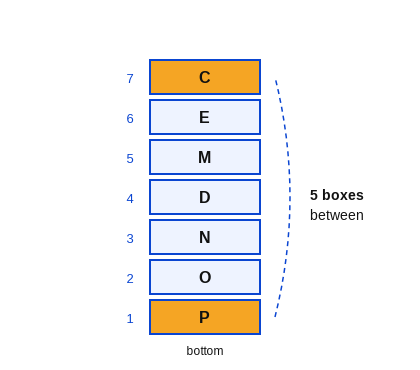
Seven boxes C, D, E, M, N, O and P are kept one over the other but not necessarily in the same order.
O is kept second from the bottom. Only three boxes are kept between O and E. P is kept at one of the positions below O. Only M is kept between E and D. C is kept at one of the positions above E.
How many boxes are kept between P and C?
सात बक्से C, D, E, M, N, O और P एक के ऊपर एक रखे गए हैं, लेकिन आवश्यक नहीं कि इसी क्रम में हों।
O को नीचे से दूसरे स्थान पर रखा गया है। O और E के बीच केवल तीन बक्से रखे गए हैं। P को O के नीचे के स्थानों में से किसी एक पर रखा गया है। E और D के बीच केवल M रखा गया है। C को E के ऊपर के स्थानों में से किसी एक पर रखा गया है।
P और C के बीच कितने बक्से रखे गए हैं?
  1. AOneएक
  2. BThreeतीन
  3. CFiveपाँच
  4. DFourचार
Show answer

Concept: Number positions 1 (bottom) to 7 (top) and fix boxes clue by clue.

  1. O = 2; three boxes between O and E → E = 6.
  2. P below O → P = 1.
  3. Only M between E and D → M = 5, D = 4 (8 does not exist).
  4. C above E → C = 7; N takes 3.
  5. Between P(1) and C(7): O, N, D, M, E = 5 boxes.

Trick: Boxes between positions a and b =|a−b|−1=7−1−1=5.

Answer: (C) Five

अवधारणा: स्थान 1 (नीचे) से 7 (ऊपर) तक लिखें और एक-एक सूचना से बॉक्स रखें।

  1. O = 2; O और E के बीच तीन → E = 6।
  2. P, O से नीचे → P = 1।
  3. E और D के बीच केवल M → M = 5, D = 4।
  4. C, E से ऊपर → C = 7; N = 3।
  5. P(1) और C(7) के बीच 5 बॉक्स।

ट्रिक: बीच के बॉक्स =|a−b|−1=5।

उत्तर: (C) Five (पाँच)

RRB NTPC Undergraduate CBT 1General Intelligence and ReasoningBox arrangementRRB NTPC Undergraduate CBT 1 2024 · 9 Sep Shift 1 →
Q4308.
What will come in place of the question mark (?) in the given series?
271 216 172 139 117 ?
दी गई श्रृंखला में प्रश्न चिह्न (?) के स्थान पर क्या आएगा?
271 216 172 139 117 ?
  1. A106
  2. B111
  3. C82
  4. D95
Show answer

Concept: Look at the differences between consecutive terms.

  1. 271−216=55, 216−172=44, 172−139=33, 139−117=22
  2. Differences fall by 11; next is 11
  3. 117−11=106

Trick: Differences are multiples of 11: 55, 44, 33, 22, 11.

Answer: (A) 106

अवधारणा: क्रमागत पदों का अंतर देखें।

  1. अंतर: 55, 44, 33, 22
  2. अगला अंतर 11
  3. 117−11=106

ट्रिक: अंतर 11 के गुणज में घट रहे हैं।

उत्तर: (A) 106

RRB NTPC Undergraduate CBT 1General Intelligence and ReasoningNumber seriesRRB NTPC Undergraduate CBT 1 2024 · 9 Sep Shift 1 →
Q4309.
This question is based on the five, three-digit numbers given below.
(Left) 285 106 346 349 408 (Right)
(Example- 697 – First digit = 6, second digit = 9 and third digit = 7)
(NOTE: All operations to be done from left to right.)
What will be the resultant if the third digit of the highest number is added to the third digit of the lowest number?
यह प्रश्न नीचे दी गई तीन अंकों वाली पाँच संख्याओं पर आधारित है।
(बाएँ) 285 106 346 349 408 (दाएँ)
(उदाहरण- 697 – पहला अंक = 6, दूसरा अंक = 9 और तीसरा अंक = 7)
(ध्यान दें: सभी संक्रियाएँ बाएँ से दाएँ की जानी हैं।)
यदि सबसे बड़ी संख्या के तीसरे अंक को सबसे छोटी संख्या के तीसरे अंक में जोड़ा जाए, तो परिणाम क्या होगा?
  1. A12
  2. B8
  3. C11
  4. D14
Show answer

Concept: Identify the highest and lowest numbers first, then pick the required digits.

  1. Highest number = 408 → third digit 8
  2. Lowest number = 106 → third digit 6
  3. 8+6=14

Yaad rakhein: "Third digit" = units digit of the three-digit number.

Answer: (D) 14

अवधारणा: पहले सबसे बड़ी और सबसे छोटी संख्या पहचानें, फिर आवश्यक अंक लें।

  1. सबसे बड़ी = 408 → तीसरा अंक 8
  2. सबसे छोटी = 106 → तीसरा अंक 6
  3. 8+6=14

याद रखें: "तीसरा अंक" = इकाई का अंक।

उत्तर: (D) 14

RRB NTPC Undergraduate CBT 1General Intelligence and ReasoningThree-digit number operationsRRB NTPC Undergraduate CBT 1 2024 · 9 Sep Shift 1 →
Q4310.
If '÷' and '×' are interchanged and '+' and '−' are interchanged, what will come in place of the question mark (?) in the following equation?
38 − 8 ÷ 2 + 16 × 8 = ?
यदि '÷' और '×' को आपस में बदल दिया जाए तथा '+' और '−' को आपस में बदल दिया जाए, तो निम्नलिखित समीकरण में प्रश्न चिह्न (?) के स्थान पर क्या आएगा?
38 − 8 ÷ 2 + 16 × 8 = ?
  1. A52
  2. B54
  3. C55
  4. D53
Show answer

Concept: Swap the signs, then use BODMAS.

  1. 38−8÷2+16×8 becomes 38+8×2−16÷8
  2. 8×2=16, 16÷8=2
  3. 38+16−2=52

Yaad rakhein: Do × and ÷ before + and −.

Answer: (A) 52

अवधारणा: चिह्न बदलें, फिर BODMAS लगाएँ।

  1. 38−8÷2+16×8 बनता है 38+8×2−16÷8
  2. 8×2=16, 16÷8=2
  3. 38+16−2=52

याद रखें: पहले × और ÷, फिर + और −।

उत्तर: (A) 52

RRB NTPC Undergraduate CBT 1General Intelligence and ReasoningMathematical operations (symbol interchange)RRB NTPC Undergraduate CBT 1 2024 · 9 Sep Shift 1 →
Q4311.
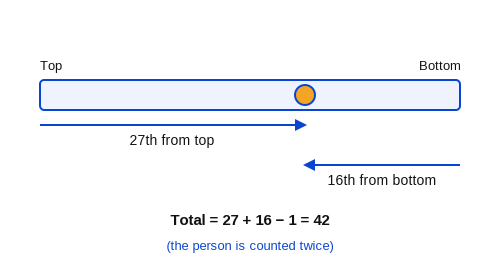
Karan is 27th from the top and 16th from the bottom in his class. How many students are there in his class?
करण अपनी कक्षा में ऊपर से 27वें और नीचे से 16वें स्थान पर है। उसकी कक्षा में कितने विद्यार्थी हैं?
  1. A41
  2. B44
  3. C42
  4. D43
Show answer

Concept: Total = rank from top + rank from bottom − 1 (the person is counted in both).

  1. Total =27+16−1
  2. =42 students

Trick: Add the two ranks and subtract 1.

Answer: (C) 42

अवधारणा: कुल = ऊपर से स्थान + नीचे से स्थान − 1 (व्यक्ति दो बार गिना जाता है)।

  1. कुल =27+16−1
  2. =42 विद्यार्थी

ट्रिक: दोनों स्थान जोड़ें और 1 घटाएँ।

उत्तर: (C) 42

RRB NTPC Undergraduate CBT 1General Intelligence and ReasoningRankingRRB NTPC Undergraduate CBT 1 2024 · 9 Sep Shift 1 →
Q4312.
Which of the following letter-number clusters will replace the question mark (?) to complete the series logically?
A25D E36H I49L M64P ?
निम्नलिखित में से कौन-सा अक्षर-संख्या समूह श्रृंखला को तार्किक रूप से पूरा करने के लिए प्रश्न चिह्न (?) का स्थान लेगा?
A25D E36H I49L M64P ?
  1. AR81U
  2. BS81T
  3. CQ81T
  4. DR81S
Show answer

Concept: Track the first letter, the number and the last letter separately.

  1. First letters: A, E, I, M → +4 → Q
  2. Numbers: 52,62,72,82 → 92=81
  3. Last letter = first letter +3: Q +3 = T
  4. Answer: Q81T

Trick: In each term the last letter is 3 ahead of the first (A→D, E→H, …).

Answer: (C) Q81T

अवधारणा: पहला अक्षर, संख्या और अंतिम अक्षर अलग-अलग देखें।

  1. पहले अक्षर: A, E, I, M → +4 → Q
  2. संख्याएँ: 52,62,72,82 → 92=81
  3. अंतिम अक्षर = पहला +3: T
  4. उत्तर: Q81T

ट्रिक: हर पद में अंतिम अक्षर पहले से 3 आगे है।

उत्तर: (C) Q81T

RRB NTPC Undergraduate CBT 1General Intelligence and ReasoningAlphanumeric seriesRRB NTPC Undergraduate CBT 1 2024 · 9 Sep Shift 1 →
Q4313.
In a certain way, TG 21 is related to OE 4. In the same way, LE 18 is related to GC 1. Following the same logic, to which of the following is RT 26 related?
एक निश्चित प्रकार से, TG 21, OE 4 से संबंधित है। उसी प्रकार, LE 18, GC 1 से संबंधित है। समान तर्क का अनुसरण करते हुए, RT 26 निम्नलिखित में से किससे संबंधित है?
  1. ALS 11
  2. BLR 11
  3. CMR 9
  4. DLR 9
Show answer

Concept: Compare letter positions and the number separately.

  1. TG 21 → OE 4: T(20)−5 = O, G(7)−2 = E, 21−17=4
  2. LE 18 → GC 1: L−5 = G, E−2 = C, 18−17=1 ✓
  3. RT 26: R−5 = M, T−2 = R, 26−17=9 → MR 9

Trick: Rule: (−5,−2,−17).

Answer: (C) MR 9

अवधारणा: अक्षरों के स्थान और संख्या अलग-अलग देखें।

  1. TG 21 → OE 4: −5, −2, 21−17=4
  2. LE 18 → GC 1: वही नियम ✓
  3. RT 26 → M, R, 26−17=9 → MR 9

ट्रिक: नियम: (−5,−2,−17)।

उत्तर: (C) MR 9

RRB NTPC Undergraduate CBT 1General Intelligence and ReasoningLetter-number analogyRRB NTPC Undergraduate CBT 1 2024 · 9 Sep Shift 1 →
Q4314.
Read the given statements and conclusions carefully. Assuming that the information given in the statements is true, even if it appears to be at variance with commonly known facts, decide which of the given conclusions logically follow(s) from the statements.
Statements:
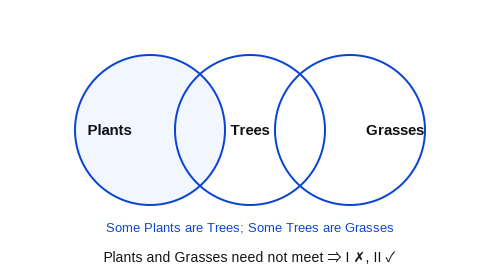
Some plants are trees.
Some trees are grasses.
Conclusions:
(I) Some plants are grasses.
(II) Some trees are plants.
दिए गए कथनों और निष्कर्षों को ध्यानपूर्वक पढ़िए। यह मानते हुए कि कथनों में दी गई जानकारी सत्य है, भले ही वह सामान्य रूप से ज्ञात तथ्यों से भिन्न प्रतीत होती हो, निर्णय कीजिए कि दिए गए निष्कर्षों में से कौन-सा/से निष्कर्ष कथनों का तार्किक रूप से अनुसरण करता है/करते हैं।
कथन:
कुछ पौधे, पेड़ हैं।
कुछ पेड़, घास हैं।
निष्कर्ष:
(I) कुछ पौधे, घास हैं।
(II) कुछ पेड़, पौधे हैं।
  1. AOnly conclusion (I) follows.केवल निष्कर्ष (I) अनुसरण करता है।
  2. BOnly conclusion (II) follows.केवल निष्कर्ष (II) अनुसरण करता है।
  3. CNeither conclusion (I) nor (II) follows.न तो निष्कर्ष (I) और न ही (II) अनुसरण करता है।
  4. DBoth conclusions (I) and (II) follow.निष्कर्ष (I) और (II) दोनों अनुसरण करते हैं।
Show answer

Concept: Two "Some" statements give no definite conclusion between the end terms; a "Some" statement can be converted.

  1. Some plants are trees → converse: Some trees are plants. So II follows.
  2. Plants and grasses are linked only through trees with two "Some" statements → no definite relation, so I does not follow.

Yaad rakhein: Some + Some = no conclusion; "Some A are B" ⇔ "Some B are A".

Answer: (B) Only conclusion (II) follows.

अवधारणा: दो "कुछ" कथनों से अंतिम पदों के बीच निश्चित निष्कर्ष नहीं निकलता; "कुछ" कथन उलटा जा सकता है।

  1. कुछ पौधे पेड़ हैं → कुछ पेड़ पौधे हैं। II अनुसरण करता है।
  2. पौधे और घास केवल पेड़ों से "कुछ + कुछ" द्वारा जुड़े हैं → I निश्चित नहीं।

याद रखें: कुछ + कुछ = कोई निष्कर्ष नहीं; "कुछ A, B हैं" ⇔ "कुछ B, A हैं"।

उत्तर: (B) केवल निष्कर्ष (II) अनुसरण करता है।

RRB NTPC Undergraduate CBT 1General Intelligence and ReasoningSyllogismRRB NTPC Undergraduate CBT 1 2024 · 9 Sep Shift 1 →
Q4315.
Which of the following letter-number clusters will replace the question mark (?) to complete the series logically?
WDK 84, BIP 79, GNU 74, LSZ 69, QXE 64, ?
निम्नलिखित में से कौन-सा अक्षर-संख्या समूह श्रृंखला को तार्किक रूप से पूरा करने के लिए प्रश्न चिह्न (?) का स्थान लेगा?
WDK 84, BIP 79, GNU 74, LSZ 69, QXE 64, ?
  1. AVCJ 59
  2. BVCI 49
  3. CVYJ 61
  4. DUCJ 59
Show answer

Concept: Each letter moves +5 and the number decreases by 5.

  1. WDK → BIP → GNU → LSZ → QXE: each letter +5
  2. Q+5 = V, X+5 = C, E+5 = J → VCJ
  3. Numbers: 84, 79, 74, 69, 64 → 59

Yaad rakhein: After Z, continue from A (X + 5 = C).

Answer: (A) VCJ 59

अवधारणा: हर अक्षर +5 और संख्या 5 कम होती है।

  1. WDK → BIP → … → QXE: हर अक्षर +5
  2. Q → V, X → C, E → J = VCJ
  3. संख्या: 64 − 5 = 59

याद रखें: Z के बाद फिर A से गिनें (X + 5 = C)।

उत्तर: (A) VCJ 59

RRB NTPC Undergraduate CBT 1General Intelligence and ReasoningAlphanumeric seriesRRB NTPC Undergraduate CBT 1 2024 · 9 Sep Shift 1 →
Q4316.
Refer to the following number and symbol series and answer the question given below. Counting is to be done from left to right only.
(Left) 2 @ 2 # * 0 8 μ π 3 σ 1 δ 6 9 $ 4 & 9 β 9 (Right)
How many such symbols are there each of which is immediately preceded by a perfect square number and also immediately followed by a perfect square number?
निम्नलिखित संख्या और प्रतीक श्रृंखला को देखिए और नीचे दिए गए प्रश्न का उत्तर दीजिए। गिनती केवल बाएँ से दाएँ की जानी है।
(बाएँ) 2 @ 2 # * 0 8 μ π 3 σ 1 δ 6 9 $ 4 & 9 β 9 (दाएँ)
ऐसे कितने प्रतीक हैं जिनमें से प्रत्येक के ठीक पहले एक पूर्ण वर्ग संख्या है और ठीक बाद भी एक पूर्ण वर्ग संख्या है?
  1. AFiveपाँच
  2. BTwoदो
  3. CThreeतीन
  4. DOneएक
Show answer

Concept: Perfect squares among single digits: 0, 1, 4, 9. Check every symbol’s left and right neighbours.

  1. @ (2, 2), # (2, *), * (#, 0), μ (8, π), π (μ, 3), σ (3, 1), δ (1, 6) → none qualify
  2. $ (9, 4) ✓, & (4, 9) ✓, β (9, 9) ✓
  3. Total = 3

Yaad rakhein: Both neighbours must be numbers — a symbol next to a symbol is rejected at once.

Answer: (C) Three

अवधारणा: एक अंक वाले पूर्ण वर्ग: 0, 1, 4, 9। हर प्रतीक के दोनों पड़ोसी देखें।

  1. @ (2, 2), # (2, *), * (#, 0), μ, π, σ (3, 1), δ (1, 6) → कोई नहीं
  2. $ (9, 4) ✓, & (4, 9) ✓, β (9, 9) ✓
  3. कुल = 3

याद रखें: दोनों पड़ोसी संख्या होने चाहिए — प्रतीक के पास प्रतीक हो तो तुरंत अस्वीकार।

उत्तर: (C) तीन

RRB NTPC Undergraduate CBT 1General Intelligence and ReasoningNumber-symbol seriesRRB NTPC Undergraduate CBT 1 2024 · 9 Sep Shift 1 →
Q4317.
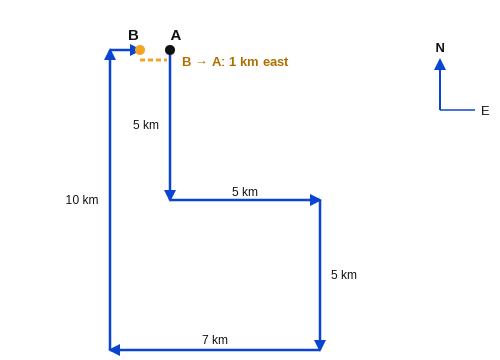
Person X starts from point A and drives 5 km towards the south. He then takes a left turn, drives 5 km, turns right and drives 5 km. He then takes a right turn and drives 7 km. He then takes a right turn, drives 10 km. He then takes a final right turn and drives 1 km and stops at point B. How far (shortest distance) and towards which direction should he drive in order to reach point A again? (All turns are 90 degrees unless specified)
व्यक्ति X बिंदु A से चलना शुरू करता है और दक्षिण की ओर 5 km गाड़ी चलाता है। फिर वह बाएँ मुड़ता है, 5 km गाड़ी चलाता है, दाएँ मुड़ता है और 5 km गाड़ी चलाता है। फिर वह दाएँ मुड़ता है और 7 km गाड़ी चलाता है। फिर वह दाएँ मुड़ता है, 10 km गाड़ी चलाता है। फिर वह अंतिम बार दाएँ मुड़ता है और 1 km गाड़ी चलाता है और बिंदु B पर रुक जाता है। पुनः बिंदु A पर पहुँचने के लिए उसे कितनी दूरी (न्यूनतम दूरी) तक और किस दिशा में गाड़ी चलानी चाहिए? (जब तक निर्दिष्ट न हो, सभी मोड़ 90 डिग्री के हैं)
  1. A2 km east2 km पूर्व
  2. B1 km east1 km पूर्व
  3. C1 km north1 km उत्तर
  4. D2 km west2 km पश्चिम
Show answer

Concept: Track the position on x–y axes (East +x, North +y). A left turn while facing South means facing East.

  1. A(0, 0) → South 5 → (0, −5); left → East 5 → (5, −5)
  2. Right → South 5 → (5, −10); right → West 7 → (−2, −10)
  3. Right → North 10 → (−2, 0); right → East 1 → B(−1, 0)
  4. B is 1 km West of A → drive 1 km East.

Trick: Net: East 5−7+1=−1 (1 km West), North −5−5+10=0 → go 1 km East.

Answer: (B) 1 km east

अवधारणा: स्थिति को x–y अक्ष पर रखें (पूर्व +x, उत्तर +y)। दक्षिण की ओर मुख करके बाएँ मुड़ने पर पूर्व।

  1. A(0, 0) → दक्षिण 5 → (0, −5); बाएँ → पूर्व 5 → (5, −5)
  2. दाएँ → दक्षिण 5 → (5, −10); दाएँ → पश्चिम 7 → (−2, −10)
  3. दाएँ → उत्तर 10 → (−2, 0); दाएँ → पूर्व 1 → B(−1, 0)
  4. B, A से 1 km पश्चिम में → 1 km पूर्व जाना होगा।

ट्रिक: शुद्ध: पूर्व 5−7+1=−1, उत्तर −5−5+10=0 → 1 km पूर्व।

उत्तर: (B) 1 km east (पूर्व)

RRB NTPC Undergraduate CBT 1General Intelligence and ReasoningDirection and distanceRRB NTPC Undergraduate CBT 1 2024 · 9 Sep Shift 1 →
Q4318.
In a certain code language, 'FORM' is coded as '4629' and 'RISE' is coded as '1395'. What is the code for 'R' in the given code language?
एक निश्चित कूट भाषा में, 'FORM' को '4629' के रूप में कूटबद्ध किया जाता है और 'RISE' को '1395' के रूप में कूटबद्ध किया जाता है। दी गई कूट भाषा में 'R' के लिए कूट क्या है?
  1. A6
  2. B5
  3. C1
  4. D9
Show answer

Concept: The letter common to both words gets the digit common to both codes.

  1. FORM = 4629, RISE = 1395
  2. Common letter: R; common digit: 9
  3. So R = 9

Trick: Find the single common letter and the single common digit.

Answer: (D) 9

अवधारणा: दोनों शब्दों के समान अक्षर को दोनों कोड का समान अंक मिलता है।

  1. FORM = 4629, RISE = 1395
  2. समान अक्षर: R; समान अंक: 9
  3. अतः R = 9

ट्रिक: एक समान अक्षर ↔ एक समान अंक।

उत्तर: (D) 9

RRB NTPC Undergraduate CBT 1General Intelligence and ReasoningCoding-decodingRRB NTPC Undergraduate CBT 1 2024 · 9 Sep Shift 1 →
Q4319.
Based on the English alphabetical order, three of the following four letter-cluster pairs are alike in a certain way and thus form a group. Which letter-cluster pair DOES NOT belong to that group? (Note: The odd letter-cluster pair is not based on the number of consonants/vowels or their position in the letter-cluster.)
अंग्रेज़ी वर्णमाला क्रम के आधार पर, निम्नलिखित चार अक्षर-समूह युग्मों में से तीन किसी निश्चित प्रकार से एकसमान हैं और इस प्रकार एक समूह बनाते हैं। कौन-सा अक्षर-समूह युग्म उस समूह से संबंधित नहीं है? (ध्यान दें: असंगत अक्षर-समूह युग्म, उस अक्षर-समूह में व्यंजनों/स्वरों की संख्या या उनके स्थान पर आधारित नहीं है।)
  1. AMQ-PT
  2. BNR-OU
  3. CIM-LP
  4. DEI-HL
Show answer

Concept: Check the gap inside each group and between the two groups.

  1. MQ-PT: M+4 = Q, M+3 = P, P+4 = T
  2. IM-LP and EI-HL: same (+4,+3,+4)
  3. NR-OU: N+4 = R, N+1 = O, O+6 = U ✗

Trick: Pattern (+4∣+3∣+4) — only NR-OU breaks it.

Answer: (B) NR-OU

अवधारणा: हर समूह के अंदर और दोनों समूहों के बीच का अंतर देखें।

  1. MQ-PT: +4, +3, +4
  2. IM-LP और EI-HL: वही पैटर्न
  3. NR-OU: +4, +1, +6 ✗

ट्रिक: पैटर्न (+4∣+3∣+4) — केवल NR-OU अलग।

उत्तर: (B) NR-OU

RRB NTPC Undergraduate CBT 1General Intelligence and ReasoningOdd one out (letter pairs)RRB NTPC Undergraduate CBT 1 2024 · 9 Sep Shift 1 →
Q4320.
Based on the English alphabetical order, three of the following four letter-cluster pairs are alike in a certain way and thus form a group. Which letter-cluster pair DOES NOT belong to that group? (Note: The odd letter-cluster pair is not based on the number of consonants/vowels or their position in the letter-cluster.)
अंग्रेज़ी वर्णमाला क्रम के आधार पर, निम्नलिखित चार अक्षर-समूह युग्मों में से तीन किसी निश्चित प्रकार से एकसमान हैं और इस प्रकार एक समूह बनाते हैं। कौन-सा अक्षर-समूह युग्म उस समूह से संबंधित नहीं है? (ध्यान दें: असंगत अक्षर-समूह युग्म, उस अक्षर-समूह में व्यंजनों/स्वरों की संख्या या उनके स्थान पर आधारित नहीं है।)
  1. AXN - DK
  2. BQG - WD
  3. CKA - QX
  4. DDS - JO
Show answer

Concept: Compare corresponding letters of the two clusters.

  1. XN-DK: X+6 = D, N−3 = K
  2. QG-WD: Q+6 = W, G−3 = D; KA-QX: K+6 = Q, A−3 = X
  3. DS-JO: D+6 = J but S−4 = O ✗

Trick: Rule (+6,−3); remember the wrap: A −3 = X.

Answer: (D) DS - JO

अवधारणा: दोनों समूहों के संगत अक्षरों की तुलना करें।

  1. XN-DK: +6, −3
  2. QG-WD और KA-QX: +6, −3
  3. DS-JO: +6 पर S−4 = O ✗

ट्रिक: नियम (+6,−3); A −3 = X (चक्र)।

उत्तर: (D) DS - JO

RRB NTPC Undergraduate CBT 1General Intelligence and ReasoningOdd one out (letter pairs)RRB NTPC Undergraduate CBT 1 2024 · 9 Sep Shift 1 →