Question bank

Q&A: practice questions with answers

Search questions on any topic. Filter by exam category, exam, subject and topic, try the question, then open the answer and explanation.

Courses – airGurukul

20,719 questions found.

Q4401.
H, I, J, K, U, V and W are sitting around a circular table facing the centre of the table. Only two people sit between V and I when counted from the right of V. Only three people sit between H and J when counted from the right of J. I sits to the immediate right of J. W sits to the immediate right of K.
Who sits fourth to the right of U?
H, I, J, K, U, V और W एक वृत्ताकार मेज़ के चारों ओर केंद्र की ओर मुख करके बैठे हैं। V के दाईं ओर से गिनने पर V और I के बीच केवल दो व्यक्ति बैठे हैं। J के दाईं ओर से गिनने पर H और J के बीच केवल तीन व्यक्ति बैठे हैं। I, J के ठीक दाईं ओर बैठा है। W, K के ठीक दाईं ओर बैठा है।
U के दाईं ओर चौथे स्थान पर कौन बैठा है?
  1. AW
  2. BK
  3. CH
  4. DJ
Show answer

Concept: Facing the centre, 'right' means moving anticlockwise. Fix J and place others.
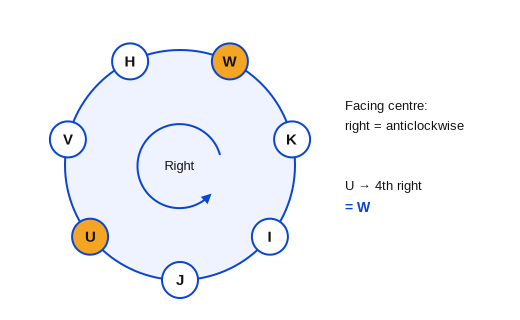
  1. I is immediate right of J; H is 4th to the right of J (three between)
  2. V: I is 3rd to the right of V → V is 3rd to the left of I
  3. Remaining seats for K, W, U: W immediate right of K → K, W adjacent; U takes the last seat
  4. Order to the right from J: J, I, K, W, H, V, U; 4th to the right of U: J, I, K, W → W

Trick: In a circle of 7, 4th to the right = 3rd to the left.

Answer: (A) W

अवधारणा: केंद्र की ओर मुख हो तो 'दाएँ' = वामावर्त (anticlockwise)। J को स्थिर करें।

  1. I, J के ठीक दाएँ; H, J के दाएँ 4था (बीच में तीन)
  2. V से दाएँ गिनने पर I तीसरा → V, I के बाएँ तीसरा
  3. शेष स्थानों पर K, W साथ (W, K के ठीक दाएँ) और U अंतिम स्थान पर
  4. J से दाएँ क्रम: J, I, K, W, H, V, U; U के दाएँ 4था: J, I, K, W → W

ट्रिक: 7 के वृत्त में दाएँ 4था = बाएँ 3रा।

उत्तर: (A) W

RRB NTPC Undergraduate CBT 1General Intelligence and ReasoningCircular seating arrangementRRB NTPC Undergraduate CBT 1 2024 · 8 Sep Shift 3 →
Q4402.
Based on the English alphabetical order, three of the following four letter-cluster pairs are alike in a certain way and thus form a group. Which letter-cluster pair DOES NOT belong to that group?
(Note: The odd one out is not based on the number of consonants/vowels or their position in the letter-cluster.)
अंग्रेज़ी वर्णमाला क्रम के आधार पर, निम्नलिखित चार अक्षर-समूह युग्मों में से तीन किसी निश्चित प्रकार से एकसमान हैं और इस प्रकार एक समूह बनाते हैं। कौन-सा अक्षर-समूह युग्म उस समूह से संबंधित नहीं है?
(नोट: असंगत अक्षर-समूह युग्म, व्यंजनों/स्वरों की संख्या या अक्षर-समूह में उनकी स्थिति पर आधारित नहीं है।)
  1. AMI-TX
  2. BTP-AE
  3. CJF-QU
  4. DCY-JM
Show answer

Concept: Check the jumps: in each pair, 1st letter +7 and 2nd letter +15.

  1. MI-TX: M+7=T, I+15=X ✓
  2. TP-AE: T+7=A, P+15=E ✓; JF-QU: J+7=Q, F+15=U ✓
  3. CY-JM: C+7=J ✓ but Y+15=N, not M ✗

Trick: Use positions: Y(25)+15=40−26=14 = N.

Answer: (D) CY-JM

अवधारणा: हर युग्म में पहला अक्षर +7 और दूसरा अक्षर +15।

  1. MI-TX: M+7=T, I+15=X ✓
  2. TP-AE ✓, JF-QU ✓
  3. CY-JM: C+7=J ✓ पर Y+15=N, M नहीं ✗

ट्रिक: Y(25)+15=40−26=14 = N।

उत्तर: (D) CY-JM

RRB NTPC Undergraduate CBT 1General Intelligence and ReasoningLetter pair odd one outRRB NTPC Undergraduate CBT 1 2024 · 8 Sep Shift 3 →
Q4403.
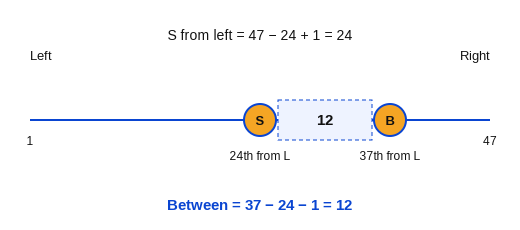
47 people are standing in a row facing north. Suhana is 24th from the right end, while Bimla is 37th from the left end. How many people are there between Suhana and Bimla?
47 व्यक्ति उत्तर की ओर मुख करके एक पंक्ति में खड़े हैं। सुहाना दाएँ छोर से 24वें स्थान पर है, जबकि बिमला बाएँ छोर से 37वें स्थान पर है। सुहाना और बिमला के बीच कितने व्यक्ति हैं?
  1. A12
  2. B13
  3. C11
  4. D10
Show answer

Concept: Convert both positions to the same end: from left =N−right+1.

  1. Suhana from left =47−24+1=24
  2. Bimla from left =37
  3. Between =37−24−1=12

Trick: People between = difference of positions −1.

Answer: (A) 12

अवधारणा: दोनों स्थान एक ही सिरे से लें: बाएँ से =N−दाएँ+1।

  1. सुहाना बाएँ से =47−24+1=24
  2. बिमला बाएँ से =37
  3. बीच में =37−24−1=12

ट्रिक: बीच वाले = स्थानों का अंतर −1।

उत्तर: (A) 12

RRB NTPC Undergraduate CBT 1General Intelligence and ReasoningPosition in a rowRRB NTPC Undergraduate CBT 1 2024 · 8 Sep Shift 3 →
Q4404.
If + means −, − means ×, × means ÷ and ÷ means +, then what will come in place of the question mark (?) in the following equation?
72 × 6 ÷ 18 + 10 − 2 = ?
यदि + का अर्थ −, − का अर्थ ×, × का अर्थ ÷ और ÷ का अर्थ + है, तो निम्नलिखित समीकरण में प्रश्नवाचक चिह्न (?) के स्थान पर क्या आएगा?
72 × 6 ÷ 18 + 10 − 2 = ?
  1. A10
  2. B18
  3. C12
  4. D5
Show answer

Concept: Replace the symbols, then apply BODMAS.

  1. 72×6÷18+10−2 becomes 72÷6+18−10×2
  2. =12+18−20
  3. =10

Trick: Write the new expression fully before calculating – avoids sign mistakes.

Answer: (A) 10

अवधारणा: चिह्न बदलें, फिर BODMAS लगाएँ।

  1. 72÷6+18−10×2
  2. =12+18−20
  3. =10

ट्रिक: गणना से पहले पूरा नया व्यंजक लिख लें।

उत्तर: (A) 10

RRB NTPC Undergraduate CBT 1General Intelligence and ReasoningMathematical operationsRRB NTPC Undergraduate CBT 1 2024 · 8 Sep Shift 3 →
Q4405.
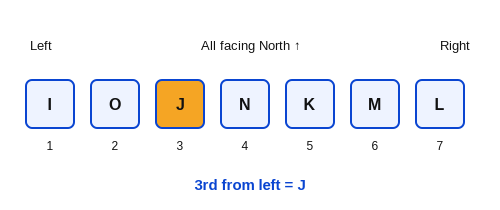
Seven people, I, J, K, L, M, N and O, are sitting in a row, facing north. Only two people sit to the right of K. Only two people sit between K and O. Only two people sit between I and N. N sits to the immediate left of K. L sits to the immediate right of M. Who sits at the third position from the left end of the line?
सात व्यक्ति, I, J, K, L, M, N और O, उत्तर की ओर मुख करके एक पंक्ति में बैठे हैं। K के दाईं ओर केवल दो व्यक्ति बैठे हैं। K और O के बीच केवल दो व्यक्ति बैठे हैं। I और N के बीच केवल दो व्यक्ति बैठे हैं। N, K के ठीक बाईं ओर बैठा है। L, M के ठीक दाईं ओर बैठा है। पंक्ति के बाएँ छोर से तीसरे स्थान पर कौन बैठा है?
  1. AI
  2. BO
  3. CL
  4. DJ
Show answer

Concept: Seats 1–7 from the left, all facing north (their right = our right).

  1. Two people to the right of K → K at 5; N immediate left of K → N at 4
  2. Two between K and O → O at 2; two between I and N → I at 1 or 7
  3. M, L adjacent (L right of M): if I =7, seats 1,3,6 have no adjacent pair; so I =1, M =6, L =7, J =3

Trick: Place the most fixed person (K) first, then use 'immediate' clues.

Answer: (D) J

अवधारणा: बाएँ से स्थान 1–7, सभी उत्तरमुखी (उनका दायाँ = हमारा दायाँ)।

  1. K के दाएँ दो → K स्थान 5; N, K के ठीक बाएँ → 4
  2. K और O के बीच दो → O स्थान 2; I और N के बीच दो → I स्थान 1 या 7
  3. M-L साथ (L, M के दाएँ): I =7 पर खाली 1,3,6 में जोड़ी नहीं बनती; अतः I =1, M =6, L =7, J =3

ट्रिक: सबसे निश्चित व्यक्ति (K) को पहले बैठाएँ।

उत्तर: (D) J

RRB NTPC Undergraduate CBT 1General Intelligence and ReasoningLinear seating arrangementRRB NTPC Undergraduate CBT 1 2024 · 8 Sep Shift 3 →
Q4406.
Read the given statements and conclusions carefully. Assuming that the information given in the statements is true, even if it appears to be at variance with commonly known facts, decide which of the given conclusions logically follow(s) from the statements.
Statements:
All pages are crows.
Some crows are remotes.
Conclusion:
(I): Some pages are remotes.
(II): All crows are pages.
दिए गए कथनों और निष्कर्षों को ध्यानपूर्वक पढ़िए। यह मानते हुए कि कथनों में दी गई जानकारी सत्य है, भले ही वह सामान्यतः ज्ञात तथ्यों से भिन्न प्रतीत होती हो, निर्णय लीजिए कि दिए गए निष्कर्षों में से कौन-सा/से निष्कर्ष तार्किक रूप से कथनों का अनुसरण करता है/करते हैं।
कथन:
सभी पेज, कौए हैं।
कुछ कौए, रिमोट हैं।
निष्कर्ष:
(I): कुछ पेज, रिमोट हैं।
(II): सभी कौए, पेज हैं।
  1. ANeither conclusion (I) nor (II) followsन तो निष्कर्ष (I) और न ही (II) अनुसरण करता है
  2. BOnly conclusion (I) followsकेवल निष्कर्ष (I) अनुसरण करता है
  3. CBoth conclusions (I) and (II) followनिष्कर्ष (I) और (II) दोनों अनुसरण करते हैं
  4. DOnly conclusion (II) followsकेवल निष्कर्ष (II) अनुसरण करता है
Show answer

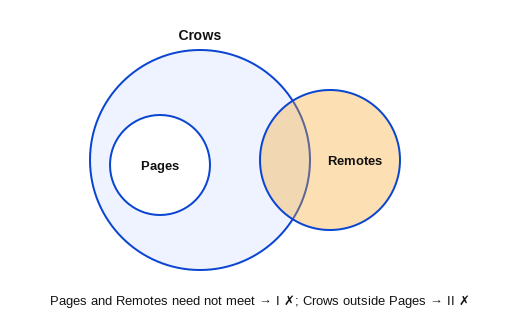
Concept: Draw the least-overlap Venn diagram and test each conclusion.

  1. All pages are crows → Pages inside Crows
  2. Some crows are remotes → Remotes may overlap only the non-page part of Crows
  3. I: Pages and Remotes need not meet ✗; II: Crows outside Pages are possible ✗

Trick: 'All A are B' never gives 'All B are A'.

Answer: (A) Neither conclusion (I) nor (II) follows

अवधारणा: न्यूनतम ओवरलैप वाला वेन आरेख बनाकर हर निष्कर्ष जाँचें।

  1. सभी pages, crows हैं → Pages, Crows के अंदर
  2. कुछ crows, remotes हैं → Remotes, Crows के उस भाग से मिल सकता है जहाँ Pages नहीं
  3. I: Pages और Remotes का मिलना ज़रूरी नहीं ✗; II: Pages के बाहर भी Crows हैं ✗

ट्रिक: 'सभी A, B हैं' से 'सभी B, A हैं' कभी नहीं निकलता।

उत्तर: (A) Neither conclusion (I) nor (II) follows (कोई निष्कर्ष नहीं)

RRB NTPC Undergraduate CBT 1General Intelligence and ReasoningSyllogismRRB NTPC Undergraduate CBT 1 2024 · 8 Sep Shift 3 →
Q4407.
In a certain code language,
'A % B' means ‘A is the daughter of B’,
'A = B' means ‘A is the wife of B’,
'A ¥ B' means ‘A is the father of B’ and
'A # B' means ‘A is the brother of B’.
How is S related to T if 'S % M = A ¥ R # T'?
एक निश्चित कूट भाषा में,
'A % B' का अर्थ है ‘A, B की पुत्री है’,
'A = B' का अर्थ है ‘A, B की पत्नी है’,
'A ¥ B' का अर्थ है ‘A, B का पिता है’ और
'A # B' का अर्थ है ‘A, B का भाई है’।
यदि 'S % M = A ¥ R # T' है, तो S का T से क्या संबंध है?
  1. ABrotherभाई
  2. BFatherपिता
  3. CMotherमाता
  4. DSisterबहन
Show answer

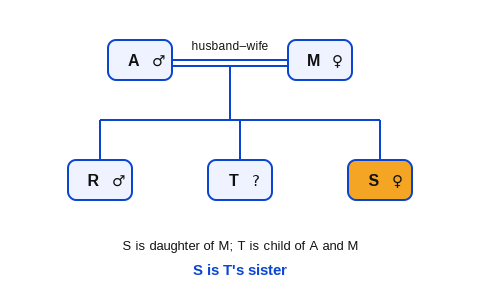
Concept: Decode each symbol step by step and build the family tree.

  1. S % M: S is daughter of M (S female)
  2. M = A: M is wife of A; A ¥ R: A is father of R
  3. R # T: R is brother of T → T is also a child of A and M
  4. S and T are children of the same parents, S female → sister

Trick: Gender of S comes from 'daughter'; T's gender is not needed.

Answer: (D) Sister

अवधारणा: हर चिह्न को क्रम से खोलें और वंश-वृक्ष बनाएँ।

  1. S % M: S, M की बेटी (S स्त्री)
  2. M = A: M, A की पत्नी; A ¥ R: A, R के पिता
  3. R # T: R, T का भाई → T भी A और M की संतान
  4. S और T के माता-पिता समान, S स्त्री → बहन

ट्रिक: S का लिंग 'बेटी' से मिलता है; T का लिंग ज़रूरी नहीं।

उत्तर: (D) Sister (बहन)

RRB NTPC Undergraduate CBT 1General Intelligence and ReasoningCoded blood relationRRB NTPC Undergraduate CBT 1 2024 · 8 Sep Shift 3 →
Q4408.
BYAZ is related to AXZY in a certain way based on the English alphabetical order. In the same way, CZBA is related to BYAZ. To which of the given options is SPRQ related, following the same logic?
अंग्रेज़ी वर्णमाला क्रम के आधार पर BYAZ एक निश्चित प्रकार से AXZY से संबंधित है। उसी प्रकार, CZBA, BYAZ से संबंधित है। समान तर्क का अनुसरण करते हुए, SPRQ दिए गए विकल्पों में से किससे संबंधित है?
  1. AROPP
  2. BRNPP
  3. CROQP
  4. DRPPW
Show answer

Concept: Each letter is shifted 1 step back.

  1. B→A, Y→X, A→Z, Z→Y: BYAZ → AXZY
  2. C→B, Z→Y, B→A, A→Z: CZBA → BYAZ
  3. S→R, P→O, R→Q, Q→P: SPRQ → ROQP

Trick: A shifts back to Z (circular alphabet).

Answer: (C) ROQP

अवधारणा: हर अक्षर 1 स्थान पीछे।

  1. BYAZ → AXZY
  2. CZBA → BYAZ
  3. S→R, P→O, R→Q, Q→P: SPRQ → ROQP

ट्रिक: A पीछे जाकर Z बनता है (चक्रीय वर्णमाला)।

उत्तर: (C) ROQP

RRB NTPC Undergraduate CBT 1General Intelligence and ReasoningLetter analogyRRB NTPC Undergraduate CBT 1 2024 · 8 Sep Shift 3 →
Q4409.
What should come in place of the question mark (?) in the given series based on the English alphabetical order?
AFH LQS WBD HMO ?
अंग्रेज़ी वर्णमाला क्रम के आधार पर दी गई शृंखला में प्रश्नवाचक चिह्न (?) के स्थान पर क्या आना चाहिए?
AFH LQS WBD HMO ?
  1. ASXZ
  2. BZXS
  3. CSZX
  4. DZSX
Show answer

Concept: Each letter of a cluster moves +11 in the next cluster.

  1. A(1)→L(12)→W(23)→H(8)→S(19)
  2. F(6)→Q(17)→B(2)→M(13)→X(24)
  3. H(8)→S(19)→D(4)→O(15)→Z(26)

Trick: Inside each cluster the gaps are +5, +2 (A F H, L Q S …) – S X Z fits.

Answer: (A) SXZ

अवधारणा: हर समूह का प्रत्येक अक्षर अगले समूह में +11।

  1. A→L→W→H→S
  2. F→Q→B→M→X
  3. H→S→D→O→Z

ट्रिक: समूह के भीतर अंतर +5, +2 (A F H, L Q S …) – S X Z सही।

उत्तर: (A) SXZ

RRB NTPC Undergraduate CBT 1General Intelligence and ReasoningLetter seriesRRB NTPC Undergraduate CBT 1 2024 · 8 Sep Shift 3 →
Q4410.
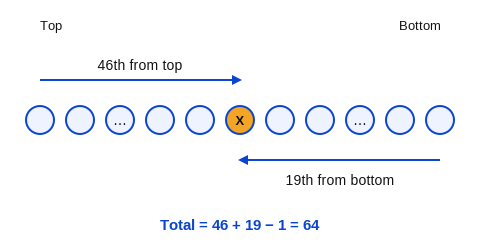
Kartik ranked 46th from the top and 19th from the bottom in his class. How many students are there in his class?
कार्तिक अपनी कक्षा में ऊपर से 46वें और नीचे से 19वें स्थान पर था। उसकी कक्षा में कितने विद्यार्थी हैं?
  1. A62
  2. B64
  3. C65
  4. D63
Show answer

Concept: Total = rank from top + rank from bottom −1.

  1. 46+19=65
  2. 65−1=64

Trick: The person is counted twice, so subtract 1.

Answer: (B) 64

अवधारणा: कुल = ऊपर से रैंक + नीचे से रैंक −1।

  1. 46+19=65
  2. 65−1=64

ट्रिक: व्यक्ति दो बार गिना गया, इसलिए 1 घटाएँ।

उत्तर: (B) 64

RRB NTPC Undergraduate CBT 1General Intelligence and ReasoningRankingRRB NTPC Undergraduate CBT 1 2024 · 8 Sep Shift 3 →
Q4411.
Based on the English alphabetical order, three of the following four letter-cluster pairs are alike in a certain way and thus form a group. Which letter-cluster pair DOES NOT belong to that group?
(Note: The odd one out is not based on the number of consonants/vowels or their position in the letter-cluster.)
अंग्रेज़ी वर्णमाला क्रम के आधार पर, निम्नलिखित चार अक्षर-समूह युग्मों में से तीन किसी निश्चित प्रकार से एकसमान हैं और इस प्रकार एक समूह बनाते हैं। कौन-सा अक्षर-समूह युग्म उस समूह से संबंधित नहीं है?
(नोट: असंगत अक्षर-समूह युग्म, व्यंजनों/स्वरों की संख्या या अक्षर-समूह में उनकी स्थिति पर आधारित नहीं है।)
  1. AMP-KO
  2. BKN-IM
  3. CGJ-EH
  4. DOR-MQ
Show answer

Concept: Rule: 1st letter −2, 2nd letter −1.

  1. MP-KO: M−2=K, P−1=O ✓
  2. KN-IM ✓, OR-MQ ✓
  3. GJ-EH: G−2=E but J−2=H (should be I) ✗

Trick: Compare only the second letters: P→O, N→M, R→Q are −1; J→H is −2.

Answer: (C) GJ-EH

अवधारणा: नियम: पहला अक्षर −2, दूसरा अक्षर −1।

  1. MP-KO ✓
  2. KN-IM ✓, OR-MQ ✓
  3. GJ-EH: G−2=E पर J−2=H (होना चाहिए I) ✗

ट्रिक: केवल दूसरे अक्षर देखें: J→H में −2 है।

उत्तर: (C) GJ-EH

RRB NTPC Undergraduate CBT 1General Intelligence and ReasoningLetter pair odd one outRRB NTPC Undergraduate CBT 1 2024 · 8 Sep Shift 3 →
Q4412.
What will come in the place of the question mark (?) in the following equation, if ‘+’ and ‘−’ are interchanged and ‘×’ and ‘÷’ are interchanged?
22 ÷ 3 + 81 × 9 − 12 = ?
यदि ‘+’ और ‘−’ को आपस में बदल दिया जाए तथा ‘×’ और ‘÷’ को आपस में बदल दिया जाए, तो निम्नलिखित समीकरण में प्रश्नवाचक चिह्न (?) के स्थान पर क्या आएगा?
22 ÷ 3 + 81 × 9 − 12 = ?
  1. A67
  2. B71
  3. C69
  4. D65
Show answer

Concept: Interchange +↔− and ×↔÷, then BODMAS.

  1. 22×3−81÷9+12
  2. =66−9+12
  3. =69

Trick: Do the swap carefully sign-by-sign before calculating.

Answer: (C) 69

अवधारणा: +↔− और ×↔÷ बदलें, फिर BODMAS।

  1. 22×3−81÷9+12
  2. =66−9+12
  3. =69

ट्रिक: गणना से पहले हर चिह्न ध्यान से बदलें।

उत्तर: (C) 69

RRB NTPC Undergraduate CBT 1General Intelligence and ReasoningMathematical operationsRRB NTPC Undergraduate CBT 1 2024 · 8 Sep Shift 3 →
Q4413.
Based on the English alphabetical order, three of the following four letter-clusters are alike in a certain way and thus form a group. Which letter-cluster DOES NOT belong to that group?
(Note: The odd one out is not based on the number of consonants/vowels or their position in the letter-cluster.)
अंग्रेज़ी वर्णमाला क्रम के आधार पर, निम्नलिखित चार अक्षर-समूहों में से तीन किसी निश्चित प्रकार से एकसमान हैं और इस प्रकार एक समूह बनाते हैं। कौन-सा अक्षर-समूह उस समूह से संबंधित नहीं है?
(नोट: असंगत अक्षर-समूह, व्यंजनों/स्वरों की संख्या या अक्षर-समूह में उनकी स्थिति पर आधारित नहीं है।)
  1. APJF
  2. BHBW
  3. CFZV
  4. DWQM
Show answer

Concept: Pattern: −6 then −4 (backward, circular).

  1. PJF: P(16)→J(10)→F(6): −6,−4 ✓
  2. FZV: F(6)→Z(26)→V(22): −6,−4 ✓; WQM: −6,−4 ✓
  3. HBW: H(8)→B(2)→W(23): −6,−5 ✗

Trick: B −4 would be X, not W.

Answer: (B) HBW

अवधारणा: पैटर्न: −6 फिर −4 (पीछे, चक्रीय)।

  1. PJF: −6,−4 ✓
  2. FZV ✓, WQM ✓
  3. HBW: −6,−5 ✗

ट्रिक: B से 4 पीछे X आता है, W नहीं।

उत्तर: (B) HBW

RRB NTPC Undergraduate CBT 1General Intelligence and ReasoningLetter cluster odd one outRRB NTPC Undergraduate CBT 1 2024 · 8 Sep Shift 3 →
Q4414.
In a certain code language, ‘LISE’ is coded as ‘0873’ and ‘SITE’ is coded as ‘8763’. What is the code for ‘T’ in the given code language?
एक निश्चित कूट भाषा में, ‘LISE’ को ‘0873’ के रूप में और ‘SITE’ को ‘8763’ के रूप में कूटबद्ध किया जाता है। दी गई कूट भाषा में ‘T’ का कूट क्या है?
  1. A7
  2. B8
  3. C3
  4. D6
Show answer

Concept: The letter present in only one word takes the digit present only in that code.

  1. LISE → 0873, SITE → 8763
  2. Common: I, S, E ↔ 8, 7, 3
  3. L ↔ 0 and T ↔ 6

Trick: Eliminate the common letters/digits; the leftover pair gives the answer.

Answer: (D) 6

अवधारणा: जो अक्षर केवल एक शब्द में है, उसे केवल उसी कोड वाला अंक मिलेगा।

  1. LISE → 0873, SITE → 8763
  2. उभयनिष्ठ: I, S, E ↔ 8, 7, 3
  3. L ↔ 0 और T ↔ 6

ट्रिक: उभयनिष्ठ अक्षर/अंक हटाएँ; बचा हुआ जोड़ा उत्तर है।

उत्तर: (D) 6

RRB NTPC Undergraduate CBT 1General Intelligence and ReasoningCoding–decodingRRB NTPC Undergraduate CBT 1 2024 · 8 Sep Shift 3 →
Q4415.
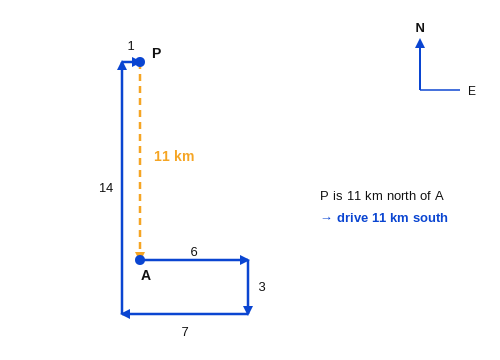
Mr. Sol starts from Point A and drives 6 km towards the east. He then takes a right turn and drives 3 km, then turns right and drives 7 km. He then takes a right turn and drives 14 km. He takes a final right turn, drives 1 km and stops at Point P. How far (shortest distance) and in which direction should he drive in order to reach Point A again? (All turns are 90-degree turns only unless specified.)
श्री सोल बिंदु A से चलना शुरू करते हैं और पूर्व की ओर 6 km गाड़ी चलाते हैं। फिर वे दाएँ मुड़ते हैं और 3 km गाड़ी चलाते हैं, फिर दाएँ मुड़ते हैं और 7 km गाड़ी चलाते हैं। फिर वे दाएँ मुड़ते हैं और 14 km गाड़ी चलाते हैं। वे अंतिम बार दाएँ मुड़ते हैं, 1 km गाड़ी चलाते हैं और बिंदु P पर रुक जाते हैं। पुनः बिंदु A पर पहुँचने के लिए उन्हें कितनी दूरी (न्यूनतम दूरी) और किस दिशा में गाड़ी चलानी चाहिए? (जब तक निर्दिष्ट न हो, सभी मोड़ केवल 90 डिग्री के हैं।)
  1. A13 km to the northउत्तर की ओर 13 km
  2. B11 km to the eastपूर्व की ओर 11 km
  3. C12 km to the southदक्षिण की ओर 12 km
  4. D11 km to the southदक्षिण की ओर 11 km
Show answer

Concept: Track coordinates with A at (0,0); East =+x, North =+y.

  1. 6 E → (6,0); right (S) 3 → (6,−3)
  2. Right (W) 7 → (−1,−3); right (N) 14 → (−1,11)
  3. Right (E) 1 → P =(0,11)
  4. P is 11 km north of A → drive 11 km south

Trick: Net east–west =6−7+1=0; net north =14−3=11.

Answer: (D) 11 km to the south

अवधारणा: A को (0,0) मानें; पूर्व =+x, उत्तर =+y।

  1. 6 पूर्व → (6,0); दाएँ (दक्षिण) 3 → (6,−3)
  2. दाएँ (पश्चिम) 7 → (−1,−3); दाएँ (उत्तर) 14 → (−1,11)
  3. दाएँ (पूर्व) 1 → P =(0,11)
  4. P, A से 11 km उत्तर → 11 km दक्षिण जाना होगा

ट्रिक: पूर्व-पश्चिम का शुद्ध =6−7+1=0; उत्तर =14−3=11।

उत्तर: (D) 11 km to the south (दक्षिण)

RRB NTPC Undergraduate CBT 1General Intelligence and ReasoningDirection and distanceRRB NTPC Undergraduate CBT 1 2024 · 8 Sep Shift 3 →
Q4416.
What will come in the place of the question mark (?) in the following equation, if ‘+’ and ‘−’ are interchanged and ‘×’ and ‘÷’ are interchanged?
91 × 13 − 9 ÷ 8 + 18 = ?
यदि ‘+’ और ‘−’ को आपस में बदल दिया जाए तथा ‘×’ और ‘÷’ को आपस में बदल दिया जाए, तो निम्नलिखित समीकरण में प्रश्नवाचक चिह्न (?) के स्थान पर क्या आएगा?
91 × 13 − 9 ÷ 8 + 18 = ?
  1. A63
  2. B59
  3. C65
  4. D61
Show answer

Concept: Interchange +↔− and ×↔÷, then BODMAS.

  1. 91÷13+9×8−18
  2. =7+72−18
  3. =61

Trick: 91÷13=7 – spot easy divisions first.

Answer: (D) 61

अवधारणा: +↔− और ×↔÷ बदलें, फिर BODMAS।

  1. 91÷13+9×8−18
  2. =7+72−18
  3. =61

ट्रिक: 91÷13=7 – आसान भाग पहले देखें।

उत्तर: (D) 61

RRB NTPC Undergraduate CBT 1General Intelligence and ReasoningMathematical operationsRRB NTPC Undergraduate CBT 1 2024 · 8 Sep Shift 3 →
Q4417.
Each of the digits in the number 95423671 is arranged in ascending order from left to right. The position(s) of how many digits will remain unchanged as compared to that in the original number?
संख्या 95423671 के प्रत्येक अंक को बाएँ से दाएँ आरोही क्रम में व्यवस्थित किया जाता है। मूल संख्या की तुलना में कितने अंकों का/के स्थान अपरिवर्तित रहेगा/रहेंगे?
  1. ATwoदो
  2. BThreeतीन
  3. CNoneएक भी नहीं
  4. DOneएक
Show answer

Concept: Write the original and sorted numbers one below the other and compare position-wise.

  1. Original: 9 5 4 2 3 6 7 1
  2. Ascending: 1 2 3 4 5 6 7 9
  3. Same at position 6 (digit 6) and position 7 (digit 7) → two digits

Trick: Compare column by column; don't just look for digits that 'seem' in place.

Answer: (A) Two

अवधारणा: मूल और व्यवस्थित संख्या को एक के नीचे एक लिखकर स्थानवार तुलना करें।

  1. मूल: 9 5 4 2 3 6 7 1
  2. आरोही: 1 2 3 4 5 6 7 9
  3. स्थान 6 (अंक 6) और स्थान 7 (अंक 7) समान → दो अंक

ट्रिक: कॉलम-दर-कॉलम मिलान करें।

उत्तर: (A) Two (दो)

RRB NTPC Undergraduate CBT 1General Intelligence and ReasoningDigit arrangementRRB NTPC Undergraduate CBT 1 2024 · 8 Sep Shift 3 →
Q4418.
Read the given statements and conclusions carefully. Assuming that the information given in the statements is true, even if it appears to be at variance with commonly known facts, decide which of the given conclusions logically follow(s) from the statements.
Statements:
Some bottle are plastic.
Some plastic are glass.
Conclusions:
(I): Some bottle are glass.
(II): All glass are plastic.
दिए गए कथनों और निष्कर्षों को ध्यानपूर्वक पढ़िए। यह मानते हुए कि कथनों में दी गई जानकारी सत्य है, भले ही वह सामान्यतः ज्ञात तथ्यों से भिन्न प्रतीत होती हो, निर्णय लीजिए कि दिए गए निष्कर्षों में से कौन-सा/से निष्कर्ष तार्किक रूप से कथनों का अनुसरण करता है/करते हैं।
कथन:
कुछ बोतल, प्लास्टिक हैं।
कुछ प्लास्टिक, काँच हैं।
निष्कर्ष:
(I): कुछ बोतल, काँच हैं।
(II): सभी काँच, प्लास्टिक हैं।
  1. ABoth conclusions (I) and (II) follow.निष्कर्ष (I) और (II) दोनों अनुसरण करते हैं।
  2. BOnly conclusion (I) follows.केवल निष्कर्ष (I) अनुसरण करता है।
  3. COnly conclusion (II) follows.केवल निष्कर्ष (II) अनुसरण करता है।
  4. DNeither conclusion (I) nor (II) follows.न तो निष्कर्ष (I) और न ही (II) अनुसरण करता है।
Show answer

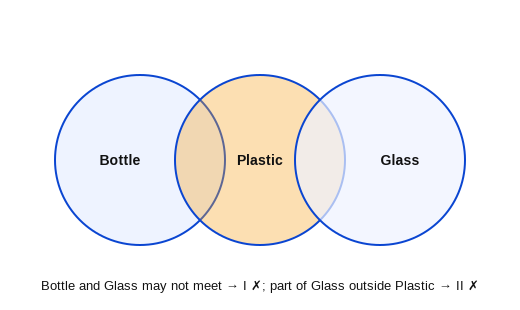
Concept: Two 'some' statements give no definite link between the end terms.

  1. Bottle–Plastic overlap; Plastic–Glass overlap
  2. Bottle and Glass may not meet → I does not follow
  3. Part of Glass can lie outside Plastic → II does not follow

Trick: Some + Some → no conclusion between the extreme terms.

Answer: (D) Neither conclusion (I) nor (II) follows.

अवधारणा: दो 'कुछ' कथनों से अंतिम पदों के बीच कोई निश्चित संबंध नहीं बनता।

  1. Bottle–Plastic और Plastic–Glass में ओवरलैप
  2. Bottle और Glass का न मिलना संभव → I नहीं
  3. Glass का कुछ भाग Plastic के बाहर संभव → II नहीं

ट्रिक: कुछ + कुछ → कोई निष्कर्ष नहीं।

उत्तर: (D) Neither conclusion (I) nor (II) follows. (कोई निष्कर्ष नहीं)

RRB NTPC Undergraduate CBT 1General Intelligence and ReasoningSyllogismRRB NTPC Undergraduate CBT 1 2024 · 8 Sep Shift 3 →
Q4419.
What should come in place of the question mark (?) in the given series?
7 9 14 24 41 ?
दी गई शृंखला में प्रश्नवाचक चिह्न (?) के स्थान पर क्या आना चाहिए?
7 9 14 24 41 ?
  1. A75
  2. B78
  3. C71
  4. D67
Show answer

Concept: Differences follow n2+1.

  1. Differences: 2,5,10,17 =12+1,22+1,32+1,42+1
  2. Next difference =52+1=26
  3. 41+26=67

Trick: Second differences 3,5,7 → next 9: 17+9=26.

Answer: (D) 67

अवधारणा: अंतर n2+1 के रूप में हैं।

  1. अंतर: 2,5,10,17 =12+1,…,42+1
  2. अगला अंतर =52+1=26
  3. 41+26=67

ट्रिक: द्वितीय अंतर 3,5,7 → अगला 9: 17+9=26।

उत्तर: (D) 67

RRB NTPC Undergraduate CBT 1General Intelligence and ReasoningNumber seriesRRB NTPC Undergraduate CBT 1 2024 · 8 Sep Shift 3 →
Q4420.
What should come in place of the question mark (?) in the given series?
1600, 2025, 2500, 3025, 3600, ?
दी गई शृंखला में प्रश्नवाचक चिह्न (?) के स्थान पर क्या आना चाहिए?
1600, 2025, 2500, 3025, 3600, ?
  1. A3825
  2. B4025
  3. C4225
  4. D5625
Show answer

Concept: Terms are squares of numbers increasing by 5.

  1. 402=1600, 452=2025, 502=2500, 552=3025, 602=3600
  2. Next: 652=4225

Trick: Square of a number ending in 5: 652=6×7 then 25 → 4225.

Answer: (C) 4225

अवधारणा: पद 5 के अंतर वाली संख्याओं के वर्ग हैं।

  1. 402,452,502,552,602
  2. अगला: 652=4225

ट्रिक: 5 पर ख़त्म संख्या का वर्ग: 6×7=42, फिर 25 → 4225।

उत्तर: (C) 4225

RRB NTPC Undergraduate CBT 1General Intelligence and ReasoningNumber seriesRRB NTPC Undergraduate CBT 1 2024 · 8 Sep Shift 3 →