Question bank

Q&A: practice questions with answers

Search questions on any topic. Filter by exam category, exam, subject and topic, try the question, then open the answer and explanation.

Courses – airGurukul

20,719 questions found.

Q4561.
Arthashastra, which formed the basis of governance and administration during the Mauryan period, discussed which of the following problems of the citizens?
मौर्य काल के दौरान शासन और प्रशासन का आधार रहे अर्थशास्त्र में नागरिकों की निम्नलिखित में से किन समस्याओं पर चर्चा की गई थी?
  1. ACross-border and educational issuesसीमा-पार और शैक्षिक मुद्दे
  2. BSocio-economic problemsसामाजिक-आर्थिक समस्याएँ
  3. CEthical and morality issues of the rulersशासकों के नैतिक और नैतिकता संबंधी मुद्दे
  4. DGeo-political problems of the kingdomराज्य की भू-राजनीतिक समस्याएँ
Show answer

Concept: Kautilya's Arthashastra is a treatise on statecraft, economy and administration.

  1. It deals with the welfare of subjects – agriculture, trade, taxation, prices, labour, famine relief, law and order – i.e. socio-economic problems of citizens.
  2. Foreign policy (mandala theory) is also covered, but the citizens' problems discussed are mainly social and economic.

Yaad rakhein: Artha = wealth/economy → socio-economic.

Answer: (B) Socio-economic problems

अवधारणा: कौटिल्य का अर्थशास्त्र राज्यशासन, अर्थव्यवस्था और प्रशासन पर ग्रंथ है।

  1. यह प्रजा के कल्याण — कृषि, व्यापार, कर, मूल्य, श्रम, अकाल राहत, कानून-व्यवस्था — अर्थात नागरिकों की सामाजिक-आर्थिक समस्याओं पर चर्चा करता है।
  2. विदेश नीति (मंडल सिद्धांत) भी है, पर नागरिकों की समस्याएँ मुख्यतः सामाजिक-आर्थिक हैं।

याद रखें: अर्थ = धन/अर्थव्यवस्था → सामाजिक-आर्थिक।

उत्तर: (B) सामाजिक-आर्थिक समस्याएँ
RRB NTPC Undergraduate CBT 1General AwarenessMauryan administration – ArthashastraRRB NTPC Undergraduate CBT 1 2024 · 8 Sep Shift 1 →
Q4562.
Which private firm produced the first rear fuselage for Light Combat Aircraft Mk1A that was handed over to Hindustan Aeronautics Limited (HAL) in Bengaluru?
किस निजी फर्म ने हल्के लड़ाकू विमान (LCA) Mk1A का पहला रियर फ्यूज़लाज (पिछला धड़) तैयार किया, जिसे बेंगलुरु में हिंदुस्तान एयरोनॉटिक्स लिमिटेड (HAL) को सौंपा गया?
  1. AMahindra Defence
  2. BAlpha Tocol Engineering Services
  3. CLarsen & Toubro
  4. DTata Advanced Systems
Show answer

Concept: HAL is outsourcing major LCA Tejas Mk1A assemblies to private industry to speed up production.

  1. Alpha Tocol Engineering Services (Bengaluru) produced and handed over the first rear fuselage of LCA Mk1A to HAL in 2025.
  2. Other private partners supply different Mk1A assemblies; this first rear fuselage came from Alpha Tocol.

Yaad rakhein: Rear fuselage → Alpha Tocol.

Answer: (B) Alpha Tocol Engineering Services

अवधारणा: उत्पादन तेज़ करने के लिए HAL तेजस Mk1A के प्रमुख भाग निजी उद्योग से बनवा रहा है।

  1. बेंगलुरु की अल्फ़ा टोकोल इंजीनियरिंग सर्विसेज़ ने 2025 में LCA Mk1A का पहला रियर फ़्यूज़लेज बनाकर HAL को सौंपा।
  2. अन्य निजी साझेदार Mk1A के दूसरे भाग बनाते हैं; यह पहला रियर फ़्यूज़लेज अल्फ़ा टोकोल से आया।

याद रखें: रियर फ़्यूज़लेज → अल्फ़ा टोकोल।

उत्तर: (B) अल्फ़ा टोकोल इंजीनियरिंग सर्विसेज़

RRB NTPC Undergraduate CBT 1General AwarenessLCA Tejas Mk1A – private industryRRB NTPC Undergraduate CBT 1 2024 · 8 Sep Shift 1 →
Q4563.
Who was the sole representative of the Indian National Congress in the 2nd Round Table Conference of 1931?
1931 के द्वितीय गोलमेज सम्मेलन में भारतीय राष्ट्रीय कांग्रेस के एकमात्र प्रतिनिधि कौन थे?
  1. ADr B R Ambedkarडॉ. बी. आर. अंबेडकर
  2. BChittaranjan Dasचित्तरंजन दास
  3. CMahatma Gandhiमहात्मा गांधी
  4. DJawaharlal Nehruजवाहरलाल नेहरू
Show answer

Concept: After the Gandhi–Irwin Pact (March 1931), the Congress agreed to attend the Second Round Table Conference in London (Sept–Dec 1931).

  1. Mahatma Gandhi was the sole representative of the Indian National Congress.
  2. Dr B R Ambedkar attended all three conferences, but as the representative of the depressed classes, not the Congress.

Yaad rakhein: Congress attended only the 2nd RTC – through Gandhi alone.

Answer: (C) Mahatma Gandhi

अवधारणा: गांधी–इरविन समझौते (मार्च 1931) के बाद कांग्रेस लंदन में द्वितीय गोलमेज सम्मेलन (सितंबर–दिसंबर 1931) में जाने को तैयार हुई।

  1. महात्मा गांधी भारतीय राष्ट्रीय कांग्रेस के एकमात्र प्रतिनिधि थे।
  2. डॉ. बी. आर. अंबेडकर तीनों सम्मेलनों में गए, पर दलित वर्गों के प्रतिनिधि के रूप में, कांग्रेस के नहीं।

याद रखें: कांग्रेस केवल दूसरे गोलमेज में — केवल गांधी के माध्यम से।

उत्तर: (C) महात्मा गांधी

RRB NTPC Undergraduate CBT 1General AwarenessRound Table ConferencesRRB NTPC Undergraduate CBT 1 2024 · 8 Sep Shift 1 →
Q4564.
Between 1991 and 2020, India’s export-import trends show:
1991 और 2020 के बीच भारत के निर्यात-आयात रुझान क्या दर्शाते हैं?
  1. AExport-to-import ratio remaining at 1:1निर्यात-आयात अनुपात 1:1 पर बना रहना
  2. BTrade surplus every yearप्रत्येक वर्ष व्यापार अधिशेष
  3. CRising imports outpacing exports and widening the trade deficitबढ़ते आयात का निर्यात से आगे निकलना और व्यापार घाटे का बढ़ना
  4. DContinuous decline of importsआयात में निरंतर गिरावट
Show answer

Concept: Trade balance = exports − imports; a negative value is a trade deficit.

  1. After 1991 both exports and imports grew strongly, but imports (crude oil, gold, electronics, machinery) grew faster.
  2. India has had a trade deficit every year, which widened over time – so no yearly surplus, no 1:1 ratio and no continuous fall in imports.

Yaad rakhein: Oil + gold imports keep India in merchandise trade deficit.

Answer: (C) Rising imports outpacing exports and widening the trade deficit

अवधारणा: व्यापार संतुलन = निर्यात − आयात; ऋणात्मक मान व्यापार घाटा है।

  1. 1991 के बाद निर्यात और आयात दोनों तेज़ी से बढ़े, पर आयात (कच्चा तेल, सोना, इलेक्ट्रॉनिक्स, मशीनरी) अधिक तेज़ी से बढ़ा।
  2. भारत में हर वर्ष व्यापार घाटा रहा जो समय के साथ बढ़ता गया — न वार्षिक अधिशेष, न 1:1 अनुपात, न आयात में लगातार गिरावट।

याद रखें: तेल + सोने का आयात भारत को व्यापार घाटे में रखता है।

उत्तर: (C) आयात का निर्यात से तेज़ बढ़ना और बढ़ता व्यापार घाटा

RRB NTPC Undergraduate CBT 1General AwarenessIndia's foreign tradeRRB NTPC Undergraduate CBT 1 2024 · 8 Sep Shift 1 →
Q4565.
Clear skies, rising temperatures, and moist land — conditions commonly referred to as ‘October heat’ — are associated with which of the following in the Indian context?
साफ़ आसमान, बढ़ता तापमान और नम भूमि — वे परिस्थितियाँ जिन्हें सामान्यतः ‘अक्टूबर की गर्मी’ (October heat) कहा जाता है — भारतीय संदर्भ में निम्नलिखित में से किससे संबंधित हैं?
  1. ACyclonic Depressions of Arabian Seaअरब सागर के चक्रवाती अवदाब
  2. BMonsoon Wind striking the Western Coastपश्चिमी तट से टकराने वाली मानसूनी पवनें
  3. CCyclonic Depressions of Bay of Bengalबंगाल की खाड़ी के चक्रवाती अवदाब
  4. DRetreating Monsoonलौटता हुआ मानसून
Show answer

Concept: In October–November the south-west monsoon withdraws from north India – the season of the retreating monsoon.

  1. As the rains stop, skies become clear and temperatures rise, while the land is still moist from the monsoon.
  2. The high temperature with high humidity makes the weather oppressive – called 'October heat'. Bay of Bengal cyclones in this season mainly affect the east coast.

Yaad rakhein: Monsoon goes back → October heat.

Answer: (D) Retreating Monsoon

अवधारणा: अक्टूबर–नवंबर में दक्षिण-पश्चिम मानसून उत्तर भारत से लौटता है — यह लौटते मानसून की ऋतु है।

  1. वर्षा रुकने पर आकाश साफ़ होता है और तापमान बढ़ता है, जबकि भूमि मानसून से अब भी नम रहती है।
  2. उच्च तापमान और उच्च आर्द्रता से मौसम उमस भरा हो जाता है — इसे 'अक्टूबर की गर्मी' (October heat) कहते हैं। इस ऋतु के बंगाल की खाड़ी के चक्रवात मुख्यतः पूर्वी तट को प्रभावित करते हैं।

याद रखें: मानसून लौटे → अक्टूबर की गर्मी।

उत्तर: (D) लौटता मानसून (Retreating Monsoon)

RRB NTPC Undergraduate CBT 1General AwarenessSeasons of India – October heatRRB NTPC Undergraduate CBT 1 2024 · 8 Sep Shift 1 →
Q4566.
The product of two consecutive natural numbers is 650. The greater of the two numbers is:
दो क्रमागत प्राकृत संख्याओं का गुणनफल 650 है। दोनों संख्याओं में से बड़ी संख्या है:
  1. A29
  2. B31
  3. C43
  4. D26
Show answer

Concept: For consecutive numbers n(n+1)=650, n is close to 650.

  1. 650≈25.5, so try 25 and 26.
  2. 25×26=650 ✓
  3. Greater number =26.

Trick: Product ending in 0 with numbers near N: 25×26 (5 × even → ends in 0).

Answer: (D) 26

अवधारणा: क्रमागत संख्याओं के लिए n(n+1)=650, n लगभग 650 के बराबर होगा।

  1. 650≈25.5, अतः 25 और 26 लें।
  2. 25×26=650 ✓
  3. बड़ी संख्या =26।

ट्रिक: N के आसपास की दो संख्याएँ जाँचें: 25×26=650।

उत्तर: (D) 26

RRB NTPC Undergraduate CBT 1MathematicsNumber system – consecutive numbersRRB NTPC Undergraduate CBT 1 2024 · 8 Sep Shift 1 →
Q4567.
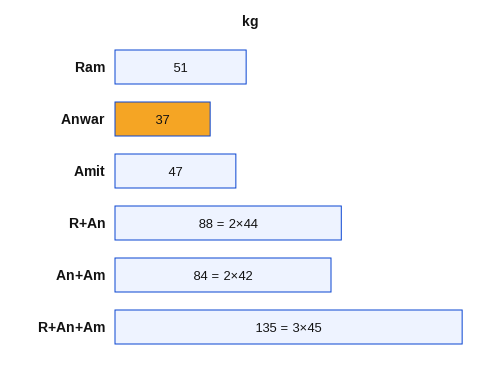
The average weight of Ram, Anwar and Amit is 45 kg. If the average weight of Ram and Anwar is 44 kg and that of Anwar and Amit is 42 kg, then the weight of Anwar (in kg) is:
राम, अनवर और अमित का औसत भार 45 kg है। यदि राम और अनवर का औसत भार 44 kg है और अनवर और अमित का औसत भार 42 kg है, तो अनवर का भार (kg में) है:
  1. A37
  2. B52
  3. C57
  4. D47
Show answer

Concept: Total = average × number of persons.

  1. R+An+Am=3×45=135
  2. R+An=2×44=88, An+Am=2×42=84
  3. Adding: R+2An+Am=172
  4. An=172−135=37kg

Trick: Common person = (sum of pair totals) − (total of all) =88+84−135=37.

Answer: (A) 37

अवधारणा: कुल योग = औसत × व्यक्तियों की संख्या।

  1. R+An+Am=3×45=135
  2. R+An=2×44=88, An+Am=2×42=84
  3. जोड़ने पर: R+2An+Am=172
  4. An=172−135=37kg

ट्रिक: साझा व्यक्ति = दोनों जोड़ियों का योग − कुल =88+84−135=37।

उत्तर: (A) 37

RRB NTPC Undergraduate CBT 1MathematicsAverageRRB NTPC Undergraduate CBT 1 2024 · 8 Sep Shift 1 →
Q4568.
Find the value of: 69−4÷ 6915× 69−9
मान ज्ञात कीजिए: 69−4÷ 6915× 69−9
  1. A69−23
  2. B69−38
  3. C69−37
  4. D69−28
Show answer

Concept: am÷an=am−n and am×an=am+n (left to right).

  1. 69−4÷6915=69−4−15=69−19
  2. 69−19×69−9=69−19−9=69−28

Trick: Add the powers with their signs: −4−15−9=−28.

Answer: (D) 69−28

अवधारणा: am÷an=am−n तथा am×an=am+n (बाएँ से दाएँ)।

  1. 69−4÷6915=69−4−15=69−19
  2. 69−19×69−9=69−19−9=69−28

ट्रिक: चिह्न सहित घातें जोड़ें: −4−15−9=−28।

उत्तर: (D) 69−28

RRB NTPC Undergraduate CBT 1MathematicsLaws of indicesRRB NTPC Undergraduate CBT 1 2024 · 8 Sep Shift 1 →
Q4569.
The price of a laptop is ₹46,000, and a trade discount of 16% is available. What will be the final amount the customer pays?
एक लैपटॉप का मूल्य ₹46,000 है, और उस पर 16% की व्यापारिक छूट उपलब्ध है। ग्राहक द्वारा भुगतान की जाने वाली अंतिम राशि कितनी होगी?
  1. A₹38,640
  2. B₹38,685
  3. C₹38,625
  4. D₹38,610
Show answer

Concept: Selling price = marked price × 100−discount%100.

  1. SP=46000×84100
  2. =460×84=38640

Trick: 16% of 46000=7360; 46000−7360=38640.

Answer: (A) ₹38,640

अवधारणा: विक्रय मूल्य = अंकित मूल्य × 100−छूट%100।

  1. SP=46000×84100
  2. =460×84=38640

ट्रिक: 46000 का 16%=7360; 46000−7360=38640।

उत्तर: (A) ₹38,640

RRB NTPC Undergraduate CBT 1MathematicsDiscountRRB NTPC Undergraduate CBT 1 2024 · 8 Sep Shift 1 →
Q4570.
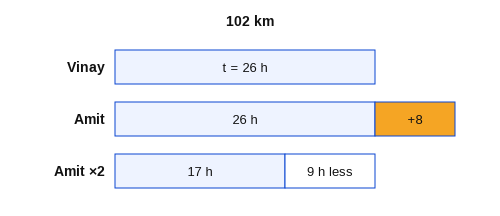
In covering a distance of 102 km, Amit takes 8 hours more than Vinay. If Amit doubles his speed, then he would take 9 hours less than Vinay. Amit's speed is:
102 km की दूरी तय करने में अमित, विनय से 8 घंटे अधिक लेता है। यदि अमित अपनी चाल दोगुनी कर दे, तो वह विनय से 9 घंटे कम लेगा। अमित की चाल है:
  1. A10 km/hr10 km/घंटा
  2. B3 km/hr3 km/घंटा
  3. C8 km/hr8 km/घंटा
  4. D11 km/hr11 km/घंटा
Show answer

Concept: Let Vinay take t hours. Doubling the speed halves the time.

  1. Amit's time =t+8; with double speed t+82=t−9
  2. t+8=2t−18⇒t=26
  3. Amit's time =34h
  4. Amit's speed =10234=3km/h

Trick: Check options: speed 3⇒34h and 17h; difference 34−17=17=8+9 ✓.

Answer: (B) 3km/h

अवधारणा: मान लें विनय को t घंटे लगते हैं। चाल दुगुनी करने पर समय आधा हो जाता है।

  1. अमित का समय =t+8; दुगुनी चाल पर t+82=t−9
  2. t+8=2t−18⇒t=26
  3. अमित का समय =34h
  4. अमित की चाल =10234=3km/h

ट्रिक: विकल्प जाँचें: चाल 3⇒34h व 17h; अंतर 34−17=17=8+9 ✓।

उत्तर: (B) 3km/h

RRB NTPC Undergraduate CBT 1MathematicsTime and distanceRRB NTPC Undergraduate CBT 1 2024 · 8 Sep Shift 1 →
Q4571.
Simplify: (1+sinA)(secA−tanA)cosecA(1−cosA)(cosecA+cotA)
सरल कीजिए: (1+sinA)(secA−tanA)cosecA(1−cosA)(cosecA+cotA)
  1. AtanA
  2. B1
  3. C2
  4. DcosA
Show answer

Concept: Use secA−tanA=1−sinAcosA, cosecA+cotA=1+cosAsinA and 1−sin2A=cos2A, 1−cos2A=sin2A.

  1. Numerator: (1+sinA)1−sinAcosA=cos2AcosA=cosA
  2. Denominator: cosecA(1−cosA)1+cosAsinA=cosecA·sin2AsinA=cosecAsinA=1
  3. Value =cosA1=cosA

Trick: Put A=60∘: numerator =12, denominator =1 → 12=cos60∘.

Answer: (D) cosA

अवधारणा: secA−tanA=1−sinAcosA, cosecA+cotA=1+cosAsinA तथा 1−sin2A=cos2A, 1−cos2A=sin2A का प्रयोग करें।

  1. अंश: (1+sinA)1−sinAcosA=cos2AcosA=cosA
  2. हर: cosecA(1−cosA)1+cosAsinA=cosecA·sin2AsinA=cosecAsinA=1
  3. मान =cosA1=cosA

ट्रिक: A=60∘ रखें: अंश =12, हर =1 → 12=cos60∘।

उत्तर: (D) cosA

RRB NTPC Undergraduate CBT 1MathematicsTrigonometric identitiesRRB NTPC Undergraduate CBT 1 2024 · 8 Sep Shift 1 →
Q4572.
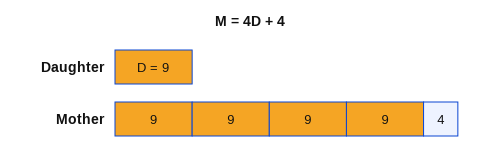
If 2 times a mother's present age is 26 years more than 6 times her daughter's present age, and 4 times the daughter's present age is 4 years less than the mother's present age, then what is the difference (in years) between the ages of the mother and the daughter?
यदि माँ की वर्तमान आयु का 2 गुना, उसकी पुत्री की वर्तमान आयु के 6 गुने से 26 वर्ष अधिक है, और पुत्री की वर्तमान आयु का 4 गुना, माँ की वर्तमान आयु से 4 वर्ष कम है, तो माँ और पुत्री की आयु में अंतर (वर्षों में) कितना है?
  1. A29
  2. B32
  3. C31
  4. D36
Show answer

Concept: Form two equations in mother's age M and daughter's age D.

  1. 2M=6D+26⇒M=3D+13
  2. 4D=M−4⇒M=4D+4
  3. 4D+4=3D+13⇒D=9, M=40
  4. Difference =40−9=31 years

Trick: Check: 2×40=80=6×9+26 ✓ and 4×9=36=40−4 ✓.

Answer: (C) 31

अवधारणा: माँ की आयु M और बेटी की आयु D लेकर दो समीकरण बनाएँ।

  1. 2M=6D+26⇒M=3D+13
  2. 4D=M−4⇒M=4D+4
  3. 4D+4=3D+13⇒D=9, M=40
  4. अंतर =40−9=31 वर्ष

ट्रिक: जाँच: 2×40=80=6×9+26 ✓ तथा 4×9=36=40−4 ✓।

उत्तर: (C) 31

RRB NTPC Undergraduate CBT 1MathematicsProblems on agesRRB NTPC Undergraduate CBT 1 2024 · 8 Sep Shift 1 →
Q4573.
The simple interest on a certain sum for 278 years at the rate of 2.9% per annum is ₹8,671.
What will be the amount payable on the same sum at the rate of 4.5% per annum simple interest in 425 years?
किसी निश्चित राशि पर 278 वर्षों के लिए 2.9% वार्षिक दर से साधारण ब्याज ₹8,671 है।
उसी राशि पर 4.5% वार्षिक साधारण ब्याज की दर से 425 वर्षों में देय मिश्रधन कितना होगा?
  1. A₹1,24,608
  2. B₹1,24,574
  3. C₹1,24,590
  4. D₹1,24,592
Show answer

Concept: SI=P×R×T100, Amount =P+SI.

  1. 278=238 years: 8671=P×2.9×23800⇒P=8671×80066.7=104000
  2. New SI =104000×4.5×4.4100=104000×0.198=20592
  3. Amount =104000+20592=124592

Trick: Rate × time =4.5×4.4=19.8% of P; P×1.198=124592.

Answer: (D) ₹1,24,592

अवधारणा: SI=P×R×T100, मिश्रधन =P+SI।

  1. 278=238 वर्ष: 8671=P×2.9×23800⇒P=8671×80066.7=104000
  2. नया SI =104000×4.5×4.4100=104000×0.198=20592
  3. मिश्रधन =104000+20592=124592

ट्रिक: दर × समय =4.5×4.4=19.8%; P×1.198=124592।

उत्तर: (D) ₹1,24,592

RRB NTPC Undergraduate CBT 1MathematicsSimple interestRRB NTPC Undergraduate CBT 1 2024 · 8 Sep Shift 1 →
Q4574.
Find the value of x satisfying: 3(3x2 − 6) − 3(3x2 + 5x − 7) = 19
x का वह मान ज्ञात कीजिए जो संतुष्ट करता है: 3(3x2 − 6) − 3(3x2 + 5x − 7) = 19
  1. A−1315
  2. B−2615
  3. C−1615
  4. D−1415
Show answer

Concept: Expand the brackets; the x2 terms cancel, leaving a linear equation.

  1. 9x2−18−9x2−15x+21=19
  2. 3−15x=19
  3. −15x=16⇒x=−1615

Trick: Watch the sign: −3×(−7)=+21.

Answer: (C) −1615

अवधारणा: कोष्ठक खोलें; x2 वाले पद कट जाते हैं और रैखिक समीकरण बचता है।

  1. 9x2−18−9x2−15x+21=19
  2. 3−15x=19
  3. −15x=16⇒x=−1615

ट्रिक: चिह्न पर ध्यान: −3×(−7)=+21।

उत्तर: (C) −1615

RRB NTPC Undergraduate CBT 1MathematicsLinear equationsRRB NTPC Undergraduate CBT 1 2024 · 8 Sep Shift 1 →
Q4575.
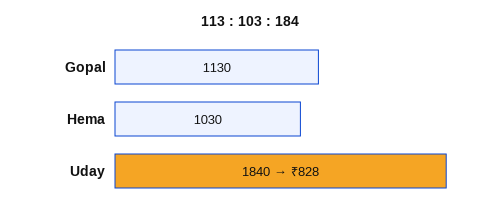
Gopal, Hema, and Uday invest ₹1,130, ₹1,030, and ₹1,840, respectively, to start a business. If the profit at the end of the year is ₹1,800, then what is the share of Uday in the profit?
गोपाल, हेमा और उदय एक व्यवसाय शुरू करने के लिए क्रमशः ₹1,130, ₹1,030 और ₹1,840 का निवेश करते हैं। यदि वर्ष के अंत में लाभ ₹1,800 है, तो लाभ में उदय का हिस्सा कितना है?
  1. A₹830
  2. B₹825
  3. C₹831
  4. D₹828
Show answer

Concept: For equal time periods, profit is shared in the ratio of investments.

  1. Ratio =1130:1030:1840=113:103:184 (sum 400)
  2. Uday's share =184400×1800=184×4.5=828

Trick: Uday's fraction =18404000=46%; 46% of 1800=828.

Answer: (D) ₹828

अवधारणा: समान अवधि के लिए लाभ निवेश के अनुपात में बँटता है।

  1. अनुपात =1130:1030:1840=113:103:184 (योग 400)
  2. उदय का हिस्सा =184400×1800=184×4.5=828

ट्रिक: उदय का भाग =18404000=46%; 1800 का 46%=828।

उत्तर: (D) ₹828

RRB NTPC Undergraduate CBT 1MathematicsPartnershipRRB NTPC Undergraduate CBT 1 2024 · 8 Sep Shift 1 →
Q4576.
A man makes a monthly payment equal to 36% of his monthly salary towards debt repayment. He spends 50% of the remaining salary and saves ₹704. His monthly salary (in ₹) is:
एक व्यक्ति अपने मासिक वेतन के 36% के बराबर राशि का मासिक भुगतान ऋण चुकाने में करता है। वह शेष वेतन का 50% खर्च करता है और ₹704 बचाता है। उसका मासिक वेतन (₹ में) है:
  1. A2,104
  2. B2,116
  3. C2,200
  4. D2,202
Show answer

Concept: Work on the part of salary left after each payment.

  1. Let salary =S. After debt: S−36%S=0.64S.
  2. He spends 50% of this, so savings =0.5×0.64S=0.32S.
  3. 0.32S=704⇒S=7040.32=2200.

Trick: Savings fraction =0.64×0.5=0.32 of salary; divide savings by 0.32 directly.

Answer: (C) ₹2,200

अवधारणा: हर भुगतान के बाद बची सैलरी पर काम करें।

  1. मान लें वेतन =S। कर्ज़ के बाद बचा: S−36%S=0.64S।
  2. इसका 50% खर्च, तो बचत =0.5×0.64S=0.32S।
  3. 0.32S=704⇒S=7040.32=2200।

ट्रिक: बचत = वेतन का 0.64×0.5=0.32 भाग; सीधे 704÷0.32 करें।

उत्तर: (C) ₹2,200

RRB NTPC Undergraduate CBT 1MathematicsPercentage – income & expenditureRRB NTPC Undergraduate CBT 1 2024 · 8 Sep Shift 1 →
Q4577.
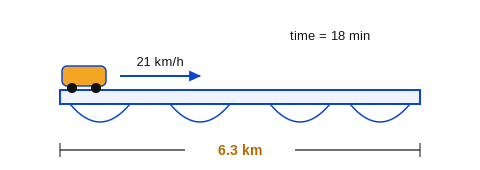
A man driving a car at a speed of 21 km/hr crosses a bridge in 18 minutes. Find the length of the bridge.
21 km/घंटा की चाल से कार चलाने वाला एक व्यक्ति एक पुल को 18 मिनट में पार करता है। पुल की लंबाई ज्ञात कीजिए।
  1. A4.7 km
  2. B15.2 km
  3. C6.3 km
  4. D2.5 km
Show answer

Concept: Distance=Speed×Time, with time in hours.

  1. Time =18 min =1860=0.3 h.
  2. Length of bridge =21×0.3=6.3km.

Trick: 18 min =310 h, so distance =310 of the speed: 3×2110=6.3.

Answer: (C) 6.3 km

अवधारणा: दूरी=चाल×समय (समय घंटों में)।

  1. समय =18 मिनट =1860=0.3 घंटा।
  2. पुल की लंबाई =21×0.3=6.3km।

ट्रिक: 18 मिनट =310 घंटा, इसलिए दूरी =3×2110=6.3।

उत्तर: (C) 6.3 km

RRB NTPC Undergraduate CBT 1MathematicsSpeed, time & distanceRRB NTPC Undergraduate CBT 1 2024 · 8 Sep Shift 1 →
Q4578.
Find the value of: [138 ÷ {13 + 7 × (3 − 4)}].
मान ज्ञात कीजिए: [138 ÷ {13 + 7 × (3 − 4)}]।
  1. A23
  2. B18
  3. C20
  4. D27
Show answer

Concept: Follow BODMAS: innermost bracket first, then multiplication, then addition, then division.

  1. (3−4)=−1.
  2. 7×(−1)=−7, so {13−7}=6.
  3. 138÷6=23.

Yaad rakhein: Solve brackets from inside out: ( ) → { } → [ ].

Answer: (A) 23

अवधारणा: BODMAS: पहले सबसे अंदर का कोष्ठक, फिर गुणा, फिर जोड़, फिर भाग।

  1. (3−4)=−1।
  2. 7×(−1)=−7, अतः {13−7}=6।
  3. 138÷6=23।

याद रखें: कोष्ठक अंदर से बाहर हल करें: ( ) → { } → [ ]।

उत्तर: (A) 23

RRB NTPC Undergraduate CBT 1MathematicsSimplification (BODMAS)RRB NTPC Undergraduate CBT 1 2024 · 8 Sep Shift 1 →
Q4579.
A can do a work in 11 days and B can do the same work in 23 days. If they work on it together for 2 days, then what fraction of the work is left?
A किसी कार्य को 11 दिनों में कर सकता है और B उसी कार्य को 23 दिनों में कर सकता है। यदि वे 2 दिनों तक एक साथ कार्य करते हैं, तो कार्य का कितना भाग शेष रहेगा?
  1. A193253
  2. B192253
  3. C185253
  4. D181253
Show answer

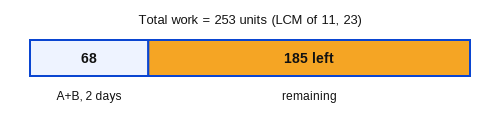
Concept: Take total work = LCM of the days; find the work done together and subtract.

  1. Total work =LCM(11,23)=253 units.
  2. A does 25311=23 units/day, B does 25323=11 units/day; together 34 units/day.
  3. In 2 days: 68 units. Left =253−68=185 units =185253.

Trick: Work left =1−2(111+123)=1−68253.

Answer: (C) 185253

अवधारणा: कुल कार्य = दिनों का LCM लें; साथ में किया कार्य घटाएँ।

  1. कुल कार्य =LCM(11,23)=253 इकाई।
  2. A: 25311=23 इकाई/दिन, B: 25323=11 इकाई/दिन; मिलकर 34 इकाई/दिन।
  3. 2 दिन में 68 इकाई; शेष =253−68=185 इकाई =185253।

ट्रिक: शेष कार्य =1−2(111+123)=1−68253।

उत्तर: (C) 185253

RRB NTPC Undergraduate CBT 1MathematicsTime and workRRB NTPC Undergraduate CBT 1 2024 · 8 Sep Shift 1 →
Q4580.
The LCM of the numbers 2.9 and 0.031 is:
संख्याओं 2.9 और 0.031 का LCM (लघुत्तम समापवर्त्य) है:
  1. A89.9
  2. B0.899
  3. C8.99
  4. D899
Show answer

Concept: Make decimal places equal, find LCM of the whole numbers, then put back the decimal places.

  1. Write with 3 decimal places: 2.900 and 0.031 → 2900 and 31.
  2. 2900=22×52×29 and 31 is prime, so LCM=2900×31=89900.
  3. Put back 3 decimal places: 89.900=89.9.

Trick: LCM of decimals =LCM of numeratorsHCF of denominators: LCM(29,31)HCF(10,1000)=89910=89.9.

Answer: (A) 89.9

अवधारणा: दशमलव स्थान बराबर करें, पूर्ण संख्याओं का LCM निकालें, फिर दशमलव वापस लगाएँ।

  1. 3 दशमलव स्थान: 2.900 और 0.031 → 2900 और 31।
  2. 2900=22×52×29, 31 अभाज्य, अतः LCM=2900×31=89900।
  3. 3 दशमलव स्थान वापस: 89.900=89.9।

ट्रिक: भिन्नों का LCM =अंशों का LCMहरों का HCF: LCM(29,31)HCF(10,1000)=89910=89.9।

उत्तर: (A) 89.9

RRB NTPC Undergraduate CBT 1MathematicsLCM of decimalsRRB NTPC Undergraduate CBT 1 2024 · 8 Sep Shift 1 →