Question bank

Q&A: practice questions with answers

Search questions on any topic. Filter by exam category, exam, subject and topic, try the question, then open the answer and explanation.

Courses – airGurukul

20,719 questions found.

Q4981.
Find the value of 50−13÷ 5015× 50−11.
50−13÷ 5015× 50−11 का मान ज्ञात कीजिए।
  1. A50−35
  2. B50−39
  3. C50−49
  4. D50−36
Show answer

Concept: am÷an=am−n and am×an=am+n (work left to right).

  1. 50−13÷5015=50−13−15=50−28.
  2. 50−28×50−11=50−28−11=50−39.

Trick: Just add/subtract the powers: −13−15−11=−39.

Answer: (B) 50−39

अवधारणा: am÷an=am−n तथा am×an=am+n (बाएँ से दाएँ हल करें)।

  1. 50−13÷5015=50−13−15=50−28।
  2. 50−28×50−11=50−28−11=50−39।

ट्रिक: केवल घातों को जोड़ें/घटाएँ: −13−15−11=−39।

उत्तर: (B) 50−39

RRB NTPC Undergraduate CBT 1MathematicsLaws of exponentsRRB NTPC Undergraduate CBT 1 2024 · 7 Aug Shift 3 →
Q4982.
A number, when increased by 70%, gives 3910. The number is:
एक संख्या में 70% की वृद्धि करने पर 3910 प्राप्त होता है। संख्या है:
  1. A6900
  2. B1150
  3. C4600
  4. D2300
Show answer

Concept: A number increased by r% becomes x×100+r100.

  1. x×1.7=3910.
  2. x=39101.7=2300.

Trick: Check: 2300+70% of 2300=2300+1610=3910.

Answer: (D) 2300

अवधारणा: किसी संख्या में r% वृद्धि करने पर वह x×100+r100 हो जाती है।

  1. x×1.7=3910।
  2. x=39101.7=2300।

ट्रिक: जाँच: 2300+2300 का 70%=2300+1610=3910।

उत्तर: (D) 2300

RRB NTPC Undergraduate CBT 1MathematicsPercentage increaseRRB NTPC Undergraduate CBT 1 2024 · 7 Aug Shift 3 →
Q4983.
If 2 times the mother's age is 26 years more than 4 times her daughter's age, and 3 times the daughter's age is 2 years less than the mother's age, then what is the difference (in years) between the ages of the mother and the daughter?
यदि माँ की आयु का 2 गुना उसकी बेटी की आयु के 4 गुने से 26 वर्ष अधिक है, और बेटी की आयु का 3 गुना माँ की आयु से 2 वर्ष कम है, तो माँ और बेटी की आयु में अंतर (वर्षों में) क्या है?
  1. A24
  2. B25
  3. C22
  4. D27
Show answer

Concept: Write each statement as a linear equation in M (mother) and D (daughter).

  1. 2M=4D+26 and 3D=M−2⇒M=3D+2.
  2. Substitute: 2(3D+2)=4D+26⇒6D+4=4D+26⇒D=11.
  3. M=3×11+2=35; difference =35−11=24.

Trick: Check: 2×35=70=44+26 ✓ and 3×11=33=35−2 ✓.

Answer: (A) 24

अवधारणा: प्रत्येक कथन को माँ (M) और बेटी (D) के रैखिक समीकरण में लिखें।

  1. 2M=4D+26 तथा 3D=M−2⇒M=3D+2।
  2. रखने पर: 2(3D+2)=4D+26⇒6D+4=4D+26⇒D=11।
  3. M=3×11+2=35; अंतर =35−11=24 वर्ष।

ट्रिक: जाँच: 2×35=70=44+26 ✓ तथा 3×11=33=35−2 ✓।

उत्तर: (A) 24

RRB NTPC Undergraduate CBT 1MathematicsProblems on agesRRB NTPC Undergraduate CBT 1 2024 · 7 Aug Shift 3 →
Q4984.
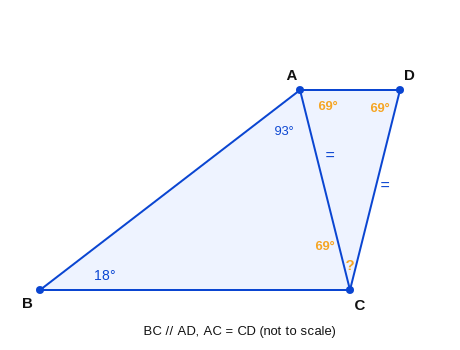
ABCD is a trapezium in which BC∥AD and AC=CD. If ∠ABC=18∘ and ∠BAC=93∘, then what is the measure of ∠ACD (in degree)?
ABCD एक समलंब चतुर्भुज है जिसमें BC∥AD और AC=CD है। यदि ∠ABC=18∘ और ∠BAC=93∘ है, तो ∠ACD की माप (डिग्री में) क्या है?
  1. A37°
  2. B42°
  3. C51°
  4. D50°
Show answer

Concept: Angle sum of a triangle is 180∘; alternate angles between parallel lines are equal; angles opposite equal sides are equal.

  1. In △ABC: ∠BCA=180∘−18∘−93∘=69∘.
  2. BC∥AD with transversal AC: ∠CAD=∠BCA=69∘ (alternate angles).
  3. AC=CD⇒∠CDA=∠CAD=69∘.
  4. In △ACD: ∠ACD=180∘−69∘−69∘=42∘.

Trick: ∠ACD=180∘−2(180∘−18∘−93∘)=180∘−138∘=42∘.

Answer: (B) 42∘

अवधारणा: त्रिभुज के कोणों का योग 180∘; समांतर रेखाओं के एकांतर कोण (alternate angles) बराबर; बराबर भुजाओं के सामने के कोण बराबर।

  1. △ABC में: ∠BCA=180∘−18∘−93∘=69∘।
  2. BC∥AD तथा तिर्यक रेखा AC: ∠CAD=∠BCA=69∘ (एकांतर कोण)।
  3. AC=CD⇒∠CDA=∠CAD=69∘।
  4. △ACD में: ∠ACD=180∘−69∘−69∘=42∘।

ट्रिक: ∠ACD=180∘−2(180∘−18∘−93∘)=42∘।

उत्तर: (B) 42∘

RRB NTPC Undergraduate CBT 1MathematicsTrapezium and triangle anglesRRB NTPC Undergraduate CBT 1 2024 · 7 Aug Shift 3 →
Q4985.
Given that 40.72 = x, 40.86= y and xz = y8, then the value of z is close to:
दिया गया है कि 40.72 = x, 40.86= y और xz = y8, तो z का मान लगभग है:
  1. A9.56
  2. B11.98
  3. C8.43
  4. D9.68
Show answer

Concept: With the same base, (am)n=amn; equate the powers.

  1. xz=(40.72)z=40.72z.
  2. y8=(40.86)8=46.88.
  3. 0.72z=6.88⇒z=6.880.72≈9.56.

Trick: 68872=869=9.555…≈9.56.

Answer: (A) 9.56

अवधारणा: समान आधार हो तो (am)n=amn; घातों को बराबर करें।

  1. xz=(40.72)z=40.72z।
  2. y8=(40.86)8=46.88।
  3. 0.72z=6.88⇒z=6.880.72≈9.56।

ट्रिक: 68872=869=9.555…≈9.56।

उत्तर: (A) 9.56

RRB NTPC Undergraduate CBT 1MathematicsExponentsRRB NTPC Undergraduate CBT 1 2024 · 7 Aug Shift 3 →
Q4986.
The average weight (in kg) of a family of five members whose weights are 40 kg, 49 kg, 56 kg, 75 kg and 39 kg is:
पाँच सदस्यों वाले एक परिवार का औसत भार (kg में), जिनके भार 40 kg, 49 kg, 56 kg, 75 kg और 39 kg हैं, है:
  1. A50.8
  2. B51.8
  3. C52.8
  4. D53.8
Show answer

Concept: Average=Sum of observationsNumber of observations.

  1. Sum =40+49+56+75+39=259.
  2. Average =2595=51.8 kg.

Trick: Assume 50: deviations −10,−1,+6,+25,−11 sum to +9; 50+95=51.8.

Answer: (B) 51.8

अवधारणा: औसत=प्रेक्षणों का योगप्रेक्षणों की संख्या।

  1. योग =40+49+56+75+39=259।
  2. औसत =2595=51.8 kg।

ट्रिक: 50 मान लें: विचलन −10,−1,+6,+25,−11 का योग +9; 50+95=51.8।

उत्तर: (B) 51.8

RRB NTPC Undergraduate CBT 1MathematicsAverageRRB NTPC Undergraduate CBT 1 2024 · 7 Aug Shift 3 →
Q4987.
The marked price of a stainless-steel bottle is ₹1,200. After applying two successive discounts of 10% and 5%, what is the selling price?
एक स्टेनलेस-स्टील की बोतल का अंकित मूल्य ₹1,200 है। 10% और 5% की दो क्रमागत छूटें देने के बाद, विक्रय मूल्य क्या है?
  1. A₹1,106
  2. B₹1,052
  3. C₹1,026
  4. D₹1,116
Show answer

Concept: Successive discounts multiply: SP=MP×(1−d1)(1−d2).

  1. After 10%: 1200×0.9=1080.
  2. After 5%: 1080×0.95=1026.

Trick: Equivalent single discount =10+5−10×5100=14.5%; 1200×0.855=1026.

Answer: (C) ₹1,026

अवधारणा: क्रमागत बट्टे गुणा होते हैं: विक्रय मूल्य=अंकित मूल्य×(1−d1)(1−d2)।

  1. 10% के बाद: 1200×0.9=1080।
  2. 5% के बाद: 1080×0.95=1026।

ट्रिक: समतुल्य एकल बट्टा =10+5−10×5100=14.5%; 1200×0.855=1026।

उत्तर: (C) ₹1,026

RRB NTPC Undergraduate CBT 1MathematicsSuccessive discountsRRB NTPC Undergraduate CBT 1 2024 · 7 Aug Shift 3 →
Q4988.
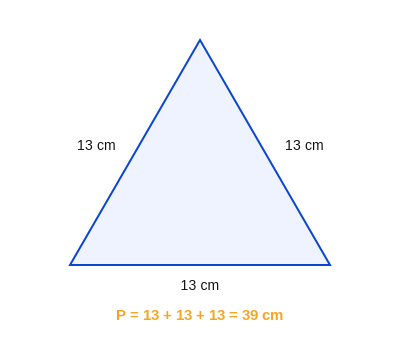
An equilateral triangle has each side measuring 13 cm; find its perimeter.
एक समबाहु त्रिभुज की प्रत्येक भुजा की माप 13 cm है; इसका परिमाप ज्ञात कीजिए।
  1. A30 cm
  2. B39 cm
  3. C26 cm
  4. D42 cm
Show answer

Concept: Perimeter of an equilateral triangle =3×side.

  1. Side =13 cm.
  2. Perimeter =3×13=39 cm.

Yaad rakhein: Equilateral triangle: perimeter =3a, area =34a2.

Answer: (B) 39 cm

अवधारणा: समबाहु त्रिभुज का परिमाप =3×भुजा।

  1. भुजा =13 cm।
  2. परिमाप =3×13=39 cm।

याद रखें: समबाहु त्रिभुज: परिमाप =3a, क्षेत्रफल =34a2।

उत्तर: (B) 39 cm

RRB NTPC Undergraduate CBT 1MathematicsPerimeter of triangleRRB NTPC Undergraduate CBT 1 2024 · 7 Aug Shift 3 →
Q4989.
Anjali can do a certain piece of work in 30 days. Anjali and Ayushi can together do the same work in 18 days, and Anjali, Ayushi and Ankita can do the same work together in 9 days. In how many days can Anjali and Ankita do the same work together?
अंजलि एक निश्चित कार्य को 30 दिनों में कर सकती है। अंजलि और आयुषी मिलकर उसी कार्य को 18 दिनों में कर सकती हैं, और अंजलि, आयुषी और अंकिता मिलकर उसी कार्य को 9 दिनों में कर सकती हैं। अंजलि और अंकिता मिलकर उसी कार्य को कितने दिनों में कर सकती हैं?
  1. A454
  2. B354
  3. C445
  4. D536
Show answer

Concept: One-day work =1days; subtract combined rates to get an individual rate.

  1. Anjali + Ayushi =118; all three =19.
  2. Ankita =19−118=118.
  3. Anjali + Ankita =130+118=3+590=890.
  4. Days =908=454.

Trick: Take total work =90 units: Anjali 3/day, Ankita 10−5=5/day; together 908=454 days.

Answer: (A) 454 days

अवधारणा: एक दिन का काम =1दिन; संयुक्त दर से घटाकर व्यक्तिगत दर निकालें।

  1. अंजलि + आयुषी =118; तीनों =19।
  2. अंकिता =19−118=118।
  3. अंजलि + अंकिता =130+118=3+590=890।
  4. दिन =908=454।

ट्रिक: कुल काम =90 इकाई: अंजलि 3/दिन, अंकिता 10−5=5/दिन; साथ में 908=454 दिन।

उत्तर: (A) 454 दिन

RRB NTPC Undergraduate CBT 1MathematicsTime and workRRB NTPC Undergraduate CBT 1 2024 · 7 Aug Shift 3 →
Q4990.
A can lay railway track between two given stations in 19 days and B can do the same job in 16 days. With the help of C, they did the job in 5 days only. Then, C alone can do the job in
A दो दिए गए स्टेशनों के बीच रेलवे ट्रैक 19 दिनों में बिछा सकता है और B वही कार्य 16 दिनों में कर सकता है। C की सहायता से, उन्होंने यह कार्य केवल 5 दिनों में पूरा कर लिया। तो, C अकेले यह कार्य कितने दिनों में कर सकता है?
  1. A11101129 days11101129 दिन
  2. B13101129 days13101129 दिन
  3. C20101129 days20101129 दिन
  4. D9101129 days9101129 दिन
Show answer

Concept: C’s one-day work =(A+B+C)−A−B.

  1. A+B+C =15, A =119, B =116.
  2. C =15−119−116=304−80−951520=1291520.
  3. C alone =1520129=11101129 days.

Trick: C must take more than 5 days but less than A or B alone (16 days); 1520÷129≈11.8, so option A.

Answer: (A) 11101129 days

अवधारणा: C का एक दिन का काम =(A+B+C)−A−B।

  1. A+B+C =15, A =119, B =116।
  2. C =15−119−116=304−80−951520=1291520।
  3. C अकेले =1520129=11101129 दिन।

ट्रिक: C को 5 दिन से अधिक पर 16 दिन से कम लगेंगे; 1520÷129≈11.8, अतः विकल्प A।

उत्तर: (A) 11101129 दिन

RRB NTPC Undergraduate CBT 1MathematicsTime and workRRB NTPC Undergraduate CBT 1 2024 · 7 Aug Shift 3 →
Q4991.
A, B and C invest a sum in the ratio of 63 : 35 : 42, respectively. If they earned a total profit of ₹5,120 at the end of the year, then what is the difference between share of B and C?
A, B और C क्रमशः 63 : 35 : 42 के अनुपात में राशि निवेश करते हैं। यदि वर्ष के अंत में उन्होंने कुल ₹5,120 का लाभ अर्जित किया, तो B और C के हिस्से में क्या अंतर है?
  1. A₹274
  2. B₹340
  3. C₹221
  4. D₹256
Show answer

Concept: Profit is shared in the ratio of investments (same time period).

  1. 63:35:42=9:5:6 (divide by 7); total =20 parts.
  2. One part =512020=256.
  3. B − C difference =6−5=1 part =256.

Trick: Simplify the ratio first — a difference of 1 part means the answer is just one part.

Answer: (D) ₹256

अवधारणा: समान अवधि में लाभ, निवेश के अनुपात में बँटता है।

  1. 63:35:42=9:5:6 (7 से भाग); कुल =20 भाग।
  2. एक भाग =512020=256।
  3. B और C का अंतर =6−5=1 भाग =256।

ट्रिक: पहले अनुपात सरल करें — 1 भाग का अंतर हो तो उत्तर सीधे एक भाग।

उत्तर: (D) ₹256

RRB NTPC Undergraduate CBT 1MathematicsPartnershipRRB NTPC Undergraduate CBT 1 2024 · 7 Aug Shift 3 →
Q4992.
The number 245015 is divisible by which of the following?
संख्या 245015 निम्नलिखित में से किससे विभाज्य है?
  1. A2
  2. B15
  3. C5
  4. D11
Show answer

Concept: Divisible by 5 if the last digit is 0 or 5; by 15 only if divisible by both 3 and 5.

  1. 245015 ends in 5 → divisible by 5.
  2. Digit sum =2+4+5+0+1+5=17, not divisible by 3 → not by 15.
  3. Odd → not by 2; for 11: alternate digit sums 2+5+1=8 and 4+0+5=9 differ by 1 → not by 11.

Trick: 15 is the tempting trap — always check the 3-rule too.

Answer: (C) 5

अवधारणा: अंतिम अंक 0 या 5 हो तो 5 से विभाज्य; 15 से तभी जब 3 और 5 दोनों से विभाज्य हो।

  1. 245015 का अंतिम अंक 5 → 5 से विभाज्य।
  2. अंकों का योग =2+4+5+0+1+5=17, 3 से विभाज्य नहीं → 15 से नहीं।
  3. विषम → 2 से नहीं; 11 के लिए एकांतर अंकों के योग 2+5+1=8 और 4+0+5=9 का अंतर 1 → 11 से नहीं।

ट्रिक: 15 आकर्षक जाल है — 3 का नियम भी जाँचें।

उत्तर: (C) 5

RRB NTPC Undergraduate CBT 1MathematicsDivisibility rulesRRB NTPC Undergraduate CBT 1 2024 · 7 Aug Shift 3 →
Q4993.
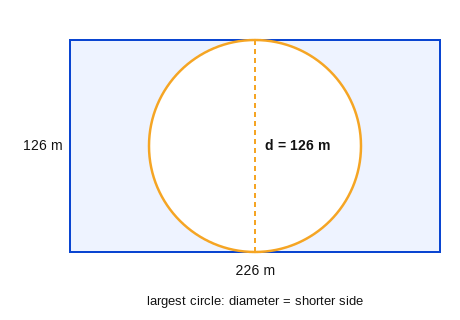
Find the circumference (in m) of the largest circle that can be drawn completely inside a rectangle whose dimensions are given as 126 m and 226 m.
(Take π=227.)
उस सबसे बड़े वृत्त की परिधि (m में) ज्ञात कीजिए जो 126 m और 226 m विमाओं वाले एक आयत के पूर्णतः अंदर खींचा जा सकता है।
(π=227 लीजिए।)
  1. A395
  2. B396
  3. C401
  4. D389
Show answer

Concept: The largest circle inside a rectangle has diameter equal to the shorter side.

  1. Shorter side =126 m, so d=126 m.
  2. Circumference =πd=227×126.
  3. =22×18=396 m.

Trick: 126 is a multiple of 7 → 126÷7=18, then ×22.

Answer: (B) 396

अवधारणा: आयत के अंदर सबसे बड़े वृत्त का व्यास छोटी भुजा के बराबर होता है।

  1. छोटी भुजा =126 m, अतः d=126 m।
  2. परिधि =πd=227×126।
  3. =22×18=396 m।

ट्रिक: 126, 7 का गुणज है → 126÷7=18, फिर ×22।

उत्तर: (B) 396

RRB NTPC Undergraduate CBT 1MathematicsCircle inside rectangleRRB NTPC Undergraduate CBT 1 2024 · 7 Aug Shift 3 →
Q4994.
A man goes to Lucknow from Kanpur at a speed of 72 km/hr and returns to Kanpur at speed of 90 km/hr, through the same route. What is his average speed (in km/hr) of the entire journey?
एक व्यक्ति कानपुर से लखनऊ 72 km/hr की चाल से जाता है और उसी मार्ग से 90 km/hr की चाल से कानपुर लौटता है। पूरी यात्रा में उसकी औसत चाल (km/hr में) क्या है?
  1. A80
  2. B83
  3. C76
  4. D79
Show answer

Concept: For equal distances at speeds a and b: Average speed=2aba+b.

  1. a=72, b=90.
  2. Average =2×72×9072+90=12960162.
  3. =80km/h.

Trick: Average speed is always a little less than the simple mean 72+902=81 → 80.

Answer: (A) 80

अवधारणा: समान दूरी a और b चाल से: औसत चाल=2aba+b।

  1. a=72, b=90।
  2. औसत =2×72×9072+90=12960162।
  3. =80km/h।

ट्रिक: औसत चाल हमेशा साधारण माध्य 72+902=81 से थोड़ी कम होती है → 80।

उत्तर: (A) 80

RRB NTPC Undergraduate CBT 1MathematicsAverage speedRRB NTPC Undergraduate CBT 1 2024 · 7 Aug Shift 3 →
Q4995.
Simplify: sec2β−1cosec2β−1
सरल कीजिए: sec2β−1cosec2β−1
  1. A0
  2. Bsecβ
  3. C1
  4. Dcosecβ
Show answer

Concept: cosec2β−1=cot2β and sec2β−tan2β=1.

  1. 1cosec2β−1=1cot2β=tan2β.
  2. Expression =sec2β−tan2β.
  3. =1.

Trick: Put β=45∘: 2−12−1=1.

Answer: (C) 1

अवधारणा: cosec2β−1=cot2β तथा sec2β−tan2β=1।

  1. 1cosec2β−1=1cot2β=tan2β।
  2. व्यंजक =sec2β−tan2β।
  3. =1।

ट्रिक: β=45∘ रखें: 2−12−1=1।

उत्तर: (C) 1

RRB NTPC Undergraduate CBT 1MathematicsTrigonometric identitiesRRB NTPC Undergraduate CBT 1 2024 · 7 Aug Shift 3 →
Q4996.
Refer to the following number and symbol series and answer the question that follows. Counting to be done from left to right only.
(Left) © & 9 4 5 # 6 2 $ © 8 2 £ @ & # 5 £ % & # 1 (Right)
How many such symbols are there each of which is immediately preceded by a number and also immediately followed by a symbol?
निम्नलिखित संख्या और प्रतीक श्रृंखला का संदर्भ लें और उसके बाद आने वाले प्रश्न का उत्तर दें। गिनती केवल बाएँ से दाएँ की जानी है।
(बाएँ) © & 9 4 5 # 6 2 $ © 8 2 £ @ & # 5 £ % & # 1 (दाएँ)
ऐसे कितने प्रतीक हैं जिनमें से प्रत्येक के ठीक पहले एक संख्या है और ठीक बाद भी एक प्रतीक है?
  1. A2
  2. B3
  3. C5
  4. D4
Show answer

Concept: Check each symbol: the element just before it must be a number and the one just after it must be a symbol (pattern: number–SYMBOL–symbol).

  1. Scan left to right for “number, symbol, symbol”.
  2. 2 $ © ✓; 2 £ @ ✓; 5 £ % ✓.
  3. 5 # 6 fails (followed by a number); others are preceded by symbols.
  4. Total =3.

Trick: First mark every symbol followed by a symbol, then keep only those with a number before them.

Answer: (B) 3

अवधारणा: हर प्रतीक जाँचें: उसके ठीक पहले संख्या और ठीक बाद प्रतीक होना चाहिए (संख्या–प्रतीक–प्रतीक)।

  1. बाएँ से दाएँ “संख्या, प्रतीक, प्रतीक” खोजें।
  2. 2 $ © ✓; 2 £ @ ✓; 5 £ % ✓।
  3. 5 # 6 नहीं (बाद में संख्या); बाकी प्रतीकों से पहले प्रतीक हैं।
  4. कुल =3।

ट्रिक: पहले वे प्रतीक चिह्नित करें जिनके बाद प्रतीक है, फिर उनमें से जिनके पहले संख्या है।

उत्तर: (B) 3

RRB NTPC Undergraduate CBT 1General Intelligence and ReasoningNumber-symbol seriesRRB NTPC Undergraduate CBT 1 2024 · 7 Aug Shift 3 →
Q4997.
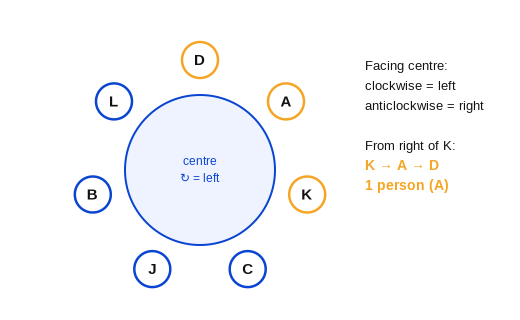
A, B, C, D, J, K and L are sitting around a circular table, facing the centre of the table. L sits to the immediate right of D. Only three people sit between L and C when counted from the left of L. Only three people sit between D and J. A sits to the immediate right of K.
How many people sit between D and K when counted from the right of K?
A, B, C, D, J, K और L एक वृत्ताकार मेज़ के चारों ओर मेज़ के केंद्र की ओर मुख करके बैठे हैं। L, D के ठीक दाएँ बैठा है। L के बाएँ से गिनने पर L और C के बीच केवल तीन व्यक्ति बैठे हैं। D और J के बीच केवल तीन व्यक्ति बैठे हैं। A, K के ठीक दाएँ बैठा है।
K के दाएँ से गिनने पर D और K के बीच कितने व्यक्ति बैठे हैं?
  1. AThreeतीन
  2. BFourचार
  3. CTwoदो
  4. DOneएक
Show answer

Concept: Facing the centre, a person’s left is clockwise and right is anticlockwise.

  1. Fix D; L is immediately right (anticlockwise) of D.
  2. Going left (clockwise) from L, three people sit before C: D and two more seats, then C.
  3. Three between D and J places J next to C (other side is C’s seat).
  4. A is immediate right of K → only possible in the two seats after D: D, A, K, C; B fills the last seat.
  5. From the right of K (anticlockwise): K → A → D, so 1 person.

Trick: In circular puzzles, place the most fixed pair (D–L) first and read “from the right/left” as anticlockwise/clockwise.

Answer: (D) One

अवधारणा: केंद्र की ओर मुख होने पर व्यक्ति का बायाँ दक्षिणावर्त (clockwise) और दायाँ वामावर्त (anticlockwise) होता है।

  1. D को स्थिर करें; L, D के ठीक दाएँ (वामावर्त) है।
  2. L के बाएँ (दक्षिणावर्त) से गिनने पर तीन लोगों के बाद C: D, दो सीटें, फिर C।
  3. D और J के बीच तीन → J, C के बगल में (दूसरी ओर C पहले से है)।
  4. A, K के ठीक दाएँ → क्रम D, A, K, C; बची सीट पर B।
  5. K के दाएँ से (वामावर्त): K → A → D, अतः 1 व्यक्ति।

ट्रिक: सबसे निश्चित जोड़ी (D–L) पहले बैठाएँ; “दाएँ/बाएँ से” को वामावर्त/दक्षिणावर्त पढ़ें।

उत्तर: (D) एक

RRB NTPC Undergraduate CBT 1General Intelligence and ReasoningCircular seating arrangementRRB NTPC Undergraduate CBT 1 2024 · 7 Aug Shift 3 →
Q4998.
Based on the English alphabetical order, three of the following four letter-cluster pairs are alike in a certain way and thus form a group. Which letter-cluster pair DOES NOT belong to that group?
(Note: The odd one out is not based on the number of consonants/vowels or their position in the letter-cluster.)
अंग्रेज़ी वर्णमाला क्रम के आधार पर, निम्नलिखित चार अक्षर-समूह युग्मों में से तीन किसी निश्चित प्रकार से एकसमान हैं और इस प्रकार एक समूह बनाते हैं। कौन-सा अक्षर-समूह युग्म उस समूह से संबंधित नहीं है?
(ध्यान दें: असंगत अक्षर-समूह, उस अक्षर-समूह में व्यंजनों/स्वरों की संख्या या उनके स्थान पर आधारित नहीं है।)
  1. AGL-HF
  2. BKP-LI
  3. CMR-NK
  4. DIN-JG
Show answer

Concept: Compare the letter gaps in each pair using positions (A = 1 … Z = 26).

  1. KP-LI: K+1=L, P(16)−7=I(9).
  2. MR-NK: M+1=N, R(18)−7=K(11); IN-JG: I+1=J, N(14)−7=G(7).
  3. GL-HF: G+1=H but L(12)−6=F(6) — gap 6, not 7.

Trick: First letters all move +1, so the odd one hides in the second letter.

Answer: (A) GL-HF

अवधारणा: अक्षरों की स्थिति (A = 1 … Z = 26) से प्रत्येक जोड़ी का अंतर देखें।

  1. KP-LI: K+1=L, P(16)−7=I(9)।
  2. MR-NK: M+1=N, R(18)−7=K(11); IN-JG: I+1=J, N(14)−7=G(7)।
  3. GL-HF: G+1=H पर L(12)−6=F(6) — अंतर 6, 7 नहीं।

ट्रिक: सभी पहले अक्षर +1 हैं, अतः विषम दूसरे अक्षर में छिपा है।

उत्तर: (A) GL-HF

RRB NTPC Undergraduate CBT 1General Intelligence and ReasoningLetter-cluster odd one outRRB NTPC Undergraduate CBT 1 2024 · 7 Aug Shift 3 →
Q4999.
If 3 is added to each odd digit and 1 is subtracted from each even digit in the number 6243514, what will be difference between the highest and lowest digits in the number thus formed?
यदि संख्या 6243514 में प्रत्येक विषम अंक में 3 जोड़ दिया जाए और प्रत्येक सम अंक में से 1 घटा दिया जाए, तो इस प्रकार बनी संख्या में सबसे बड़े और सबसे छोटे अंक के बीच कितना अंतर होगा?
  1. A6
  2. B7
  3. C8
  4. D5
Show answer

Concept: Apply the rule digit-wise: odd digit +3, even digit −1.

  1. 6 2 4 3 5 1 4 → 5 1 3 6 8 4 3.
  2. Highest digit =8, lowest =1.
  3. Difference =8−1=7.

Trick: Only the extremes matter: largest odd (5) gives 8, smallest result comes from 2 → 1.

Answer: (B) 7

अवधारणा: हर अंक पर नियम लगाएँ: विषम अंक +3, सम अंक −1।

  1. 6 2 4 3 5 1 4 → 5 1 3 6 8 4 3।
  2. सबसे बड़ा अंक =8, सबसे छोटा =1।
  3. अंतर =8−1=7।

ट्रिक: केवल चरम मान देखें: सबसे बड़ा विषम (5) → 8, सबसे छोटा 2 → 1।

उत्तर: (B) 7

RRB NTPC Undergraduate CBT 1General Intelligence and ReasoningDigit operationsRRB NTPC Undergraduate CBT 1 2024 · 7 Aug Shift 3 →
Q5000.
What should come in place of the question mark (?) in the given series?
84, 85, 87, 91, 99, ?
दी गई श्रृंखला में प्रश्न चिह्न (?) के स्थान पर क्या आना चाहिए?
84, 85, 87, 91, 99, ?
  1. A511
  2. B115
  3. C125
  4. D254
Show answer

Concept: Differences doubling: +1,+2,+4,+8,…

  1. 84+1=85, 85+2=87, 87+4=91, 91+8=99.
  2. Next: 99+16=115.

Trick: Differences are powers of 2: 20,21,22,23,24.

Answer: (B) 115

अवधारणा: अंतर दोगुने होते हैं: +1,+2,+4,+8,…

  1. 84+1=85, 85+2=87, 87+4=91, 91+8=99।
  2. अगला: 99+16=115।

ट्रिक: अंतर 2 की घातें हैं: 20,21,22,23,24।

उत्तर: (B) 115

RRB NTPC Undergraduate CBT 1General Intelligence and ReasoningNumber seriesRRB NTPC Undergraduate CBT 1 2024 · 7 Aug Shift 3 →