Question bank

Q&A: practice questions with answers

Search questions on any topic. Filter by exam category, exam, subject and topic, try the question, then open the answer and explanation.

Courses – airGurukul

20,719 questions found.

Q5101.
Veer starts from Point Y and drives 34 km towards north. He then takes a left turn, drives 20 km. He then turns left and drives 40 km. He takes a final left turn, drives 20 km and stops at Point Z. How far (shortest distance) and towards which direction should he drive in order to reach Point Y again? (All turns are 90° turns only unless specified.)
वीर बिंदु Y से शुरू करता है और उत्तर की ओर 34 km गाड़ी चलाता है। फिर वह बाएँ मुड़ता है और 20 km गाड़ी चलाता है। फिर वह बाएँ मुड़ता है और 40 km गाड़ी चलाता है। वह अंतिम बार बाएँ मुड़ता है, 20 km गाड़ी चलाता है और बिंदु Z पर रुक जाता है। बिंदु Y पर पुनः पहुँचने के लिए उसे कितनी दूरी (न्यूनतम दूरी) और किस दिशा में गाड़ी चलानी चाहिए? (जब तक निर्दिष्ट न हो, सभी मोड़ केवल 90° के मोड़ हैं।)
  1. A6 km towards northउत्तर की ओर 6 km
  2. B7 km towards southदक्षिण की ओर 7 km
  3. C4 km towards eastपूर्व की ओर 4 km
  4. D8 km towards westपश्चिम की ओर 8 km
Show answer

Concept: Track the net north–south and east–west movement.
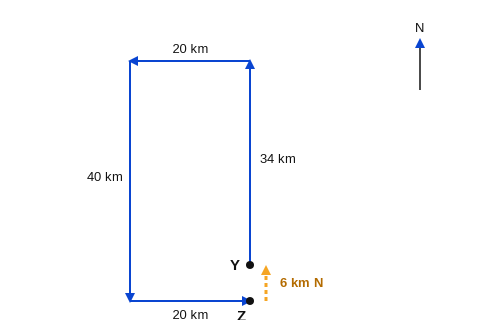
  1. North 34, left (west) 20, left (south) 40, left (east) 20.
  2. East–west: −20+20=0.
  3. North–south: 34−40=−6 ⇒ Z is 6 km south of Y.
  4. So drive 6 km towards north.

Trick: Opposite legs cancel; only 40−34=6 remains.

Answer: (A) 6 km towards north

अवधारणा: शुद्ध उत्तर–दक्षिण और पूर्व–पश्चिम चाल निकालें।

  1. उत्तर 34, बाएँ (पश्चिम) 20, बाएँ (दक्षिण) 40, बाएँ (पूर्व) 20।
  2. पूर्व–पश्चिम: −20+20=0।
  3. उत्तर–दक्षिण: 34−40=−6 ⇒ Z, Y से 6 km दक्षिण।
  4. अतः 6 km उत्तर की ओर जाना होगा।

ट्रिक: विपरीत भुजाएँ कट जाती हैं; केवल 40−34=6 बचता है।

उत्तर: (A) 6 km उत्तर की ओर
RRB NTPC Undergraduate CBT 1General Intelligence and ReasoningDirection and distanceRRB NTPC Undergraduate CBT 1 2024 · 7 Aug Shift 2 →
Q5102.
What should come in place of the question mark (?) in the given series?
178 142 117 101 92 ?
दी गई श्रृंखला में प्रश्न चिह्न (?) के स्थान पर क्या आना चाहिए?
178 142 117 101 92 ?
  1. A63
  2. B75
  3. C81
  4. D88
Show answer

Concept: Check the differences.

  1. 178−142=36, 142−117=25, 117−101=16, 101−92=9.
  2. Differences are 62,52,42,32; next 22=4.
  3. 92−4=88.

Trick: Falling squares in the differences.

Answer: (D) 88

अवधारणा: अंतर देखें।

  1. 178−142=36, 142−117=25, 117−101=16, 101−92=9।
  2. अंतर 62,52,42,32; अगला 22=4।
  3. 92−4=88।

ट्रिक: अंतर में घटते वर्ग।

उत्तर: (D) 88

RRB NTPC Undergraduate CBT 1General Intelligence and ReasoningNumber seriesRRB NTPC Undergraduate CBT 1 2024 · 7 Aug Shift 2 →
Q5103.
What should come in place of the question mark (?) in the given series?
499 500 502 505 509 ?
दी गई श्रृंखला में प्रश्न चिह्न (?) के स्थान पर क्या आना चाहिए?
499 500 502 505 509 ?
  1. A515
  2. B513
  3. C514
  4. D516
Show answer

Concept: Check the differences.

  1. Differences: +1,+2,+3,+4.
  2. Next +5: 509+5=514.

Trick: Consecutive natural-number additions.

Answer: (C) 514

अवधारणा: अंतर देखें।

  1. अंतर: +1,+2,+3,+4।
  2. अगला +5: 509+5=514।

ट्रिक: क्रमागत प्राकृत संख्याएँ जोड़ी जा रही हैं।

उत्तर: (C) 514

RRB NTPC Undergraduate CBT 1General Intelligence and ReasoningNumber seriesRRB NTPC Undergraduate CBT 1 2024 · 7 Aug Shift 2 →
Q5104.
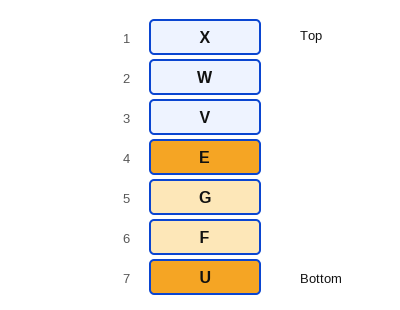
Seven boxes U, V, W, X, E, F and G are kept one over the other but not necessarily in the same order.
Only X is kept above W. Only two boxes are kept between W and G. Only U is kept below F. V is not kept immediately above G. How many boxes are kept between E and U?
सात बक्से U, V, W, X, E, F और G एक के ऊपर एक रखे गए हैं, लेकिन आवश्यक नहीं कि इसी क्रम में हों।
केवल X, W के ऊपर रखा है। W और G के बीच केवल दो बक्से रखे हैं। केवल U, F के नीचे रखा है। V, G के ठीक ऊपर नहीं रखा है। E और U के बीच कितने बक्से रखे हैं?
  1. AOneएक
  2. BThreeतीन
  3. CFourचार
  4. DTwoदो
Show answer

Concept: Use “only” clues to fix exact positions (1 = top, 7 = bottom).

  1. Only X above W ⇒ X = 1, W = 2.
  2. Only U below F ⇒ U = 7, F = 6.
  3. Two boxes between W and G ⇒ G = 5.
  4. V not immediately above G ⇒ V = 3, E = 4. Between E (4) and U (7): G, F ⇒ two.

Trick: “Only one above/below” fixes the box at position 2 or 6 directly.

Answer: (D) Two

अवधारणा: “केवल” वाले संकेतों से सटीक स्थान तय करें (1 = सबसे ऊपर, 7 = सबसे नीचे)।

  1. केवल X, W के ऊपर ⇒ X = 1, W = 2।
  2. केवल U, F के नीचे ⇒ U = 7, F = 6।
  3. W और G के बीच दो ⇒ G = 5।
  4. V, G के ठीक ऊपर नहीं ⇒ V = 3, E = 4। E (4) और U (7) के बीच: G, F ⇒ दो।

ट्रिक: “केवल एक ऊपर/नीचे” से बॉक्स सीधे स्थान 2 या 6 पर तय होता है।

उत्तर: (D) दो

RRB NTPC Undergraduate CBT 1General Intelligence and ReasoningBox arrangementRRB NTPC Undergraduate CBT 1 2024 · 7 Aug Shift 2 →
Q5105.
Refer to the following number and symbol series and answer the question that follows. All numbers are single-digit numbers. Counting to be done from left to right only. (Left) # 1 * £ 5 6 4 + 7 $ 8 2 @ % & 3 Ω 9 (Right)
How many such symbols are there each of which is immediately preceded by a number and also immediately followed by another number?
निम्नलिखित संख्या और प्रतीक श्रृंखला को देखिए और उसके बाद आने वाले प्रश्न का उत्तर दीजिए। सभी संख्याएँ एक-अंकीय संख्याएँ हैं। गिनती केवल बाएँ से दाएँ की जानी है। (बाएँ) # 1 * £ 5 6 4 + 7 $ 8 2 @ % & 3 Ω 9 (दाएँ)
ऐसे कितने प्रतीक हैं जिनमें से प्रत्येक के ठीक पहले एक संख्या है और ठीक बाद भी एक अन्य संख्या है?
  1. A4
  2. B1
  3. C3
  4. D2
Show answer

Concept: Find symbols with a number immediately before and after.

  1. Series: # 1 * £ 5 6 4 + 7 $ 8 2 @ % & 3 Ω 9.
  2. 4 + 7 ✓, 7 $ 8 ✓, 3 Ω 9 ✓.
  3. Others fail (1 * £, 2 @ %). Count =3.

Trick: Look for “number – symbol – number” in one scan.

Answer: (C) 3

अवधारणा: ऐसे प्रतीक खोजें जिनके ठीक पहले और बाद संख्या हो।

  1. श्रृंखला: # 1 * £ 5 6 4 + 7 $ 8 2 @ % & 3 Ω 9।
  2. 4 + 7 ✓, 7 $ 8 ✓, 3 Ω 9 ✓।
  3. बाकी नहीं (1 * £, 2 @ %)। कुल =3।

ट्रिक: एक बार में “संख्या – प्रतीक – संख्या” खोजें।

उत्तर: (C) 3

RRB NTPC Undergraduate CBT 1General Intelligence and ReasoningNumber-symbol seriesRRB NTPC Undergraduate CBT 1 2024 · 7 Aug Shift 2 →
Q5106.
Based on the English alphabetical order, three of the following four letter-cluster pairs are alike in a certain way and thus form a group. Which letter-cluster pair DOES NOT belong to that group?
(Note: The odd one out is not based on the number of consonants/vowels or their position in the letter-cluster.)
अंग्रेज़ी वर्णमाला क्रम के आधार पर, निम्नलिखित चार अक्षर-समूह युग्मों में से तीन किसी निश्चित प्रकार से एकसमान हैं और इस प्रकार एक समूह बनाते हैं। कौन-सा अक्षर-समूह युग्म उस समूह से संबंधित नहीं है?
(ध्यान दें: असंगत अक्षर-समूह, अक्षर-समूह में व्यंजनों/स्वरों की संख्या या उनके स्थान पर आधारित नहीं है।)
  1. ANK-PL
  2. BJG-LI
  3. CFC-HD
  4. DRO-TP
Show answer

Concept: Compare the change from the first cluster to the second, letter by letter.

  1. NK→PL: +2,+1; FC→HD: +2,+1; RO→TP: +2,+1.
  2. JG→LI: +2,+2 – different.

Trick: Check the second letter shift – that is where the odd pair breaks.

Answer: (B) JG-LI

अवधारणा: पहले से दूसरे समूह में अक्षरवार बदलाव देखें।

  1. NK→PL: +2,+1; FC→HD: +2,+1; RO→TP: +2,+1।
  2. JG→LI: +2,+2 – भिन्न।

ट्रिक: दूसरे अक्षर का खिसकाव जाँचें – वहीं अंतर है।

उत्तर: (B) JG-LI

RRB NTPC Undergraduate CBT 1General Intelligence and ReasoningLetter-cluster pair odd one outRRB NTPC Undergraduate CBT 1 2024 · 7 Aug Shift 2 →
Q5107.
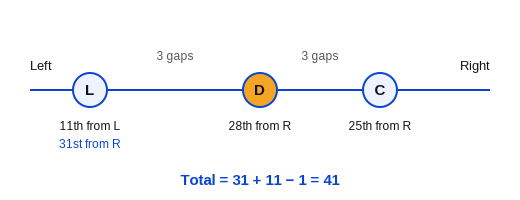
In a row of people all facing north, Cherry is 25th from the right end. Dinesh is 28th from the right end. Dinesh is exactly between Cherry and Lina. If Lina is 11th from the left end of the line, how many people are there in the row?
उत्तर की ओर मुख करके खड़े व्यक्तियों की एक पंक्ति में, चेरी दाएँ छोर से 25वें स्थान पर है। दिनेश दाएँ छोर से 28वें स्थान पर है। दिनेश, चेरी और लीना के ठीक बीच में है। यदि लीना पंक्ति के बाएँ छोर से 11वें स्थान पर है, तो पंक्ति में कितने व्यक्ति हैं?
  1. A40
  2. B41
  3. C42
  4. D39
Show answer

Concept: Convert all positions to the same end, then Total = (position from left) + (position from right) −1.

  1. Cherry 25th, Dinesh 28th from right; Dinesh is midway ⇒ Lina is 28+3=31st from right.
  2. Lina is 11th from left.
  3. Total =31+11−1=41.

Trick: Equal gaps on both sides of the middle person.

Answer: (B) 41

अवधारणा: सभी स्थान एक ही छोर से लें, फिर कुल = (बाएँ से स्थान) + (दाएँ से स्थान) −1।

  1. चेरी दाएँ से 25वीं, दिनेश 28वाँ; दिनेश बीच में ⇒ लीना दाएँ से 28+3=31वीं।
  2. लीना बाएँ से 11वीं।
  3. कुल =31+11−1=41।

ट्रिक: बीच वाले व्यक्ति के दोनों ओर समान अंतर।

उत्तर: (B) 41

RRB NTPC Undergraduate CBT 1General Intelligence and ReasoningRanking in a rowRRB NTPC Undergraduate CBT 1 2024 · 7 Aug Shift 2 →
Q5108.
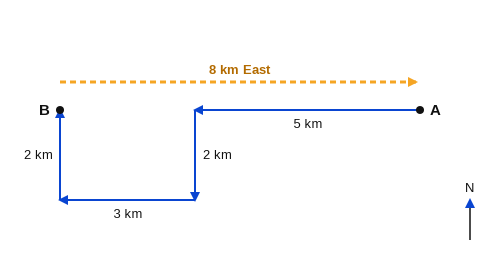
Deepti starts from point A and walks 5 km towards west. She takes a left turn and walks 2 km. She then takes a right turn and walks 3 km. She then takes a final right turn and walks 2 km and reaches a point B. How far (shortest distance) and towards which direction should she walk in order to reach point A again? (All turns are 90 degrees turns only unless specified.)
दीप्ति बिंदु A से शुरू करती है और पश्चिम की ओर 5 km चलती है। वह बाएँ मुड़ती है और 2 km चलती है। फिर वह दाएँ मुड़ती है और 3 km चलती है। फिर वह अंतिम बार दाएँ मुड़ती है और 2 km चलकर बिंदु B पर पहुँचती है। बिंदु A पर पुनः पहुँचने के लिए उसे कितनी दूरी (न्यूनतम दूरी) और किस दिशा में चलना चाहिए? (जब तक निर्दिष्ट न हो, सभी मोड़ केवल 90 डिग्री के मोड़ हैं।)
  1. A2 km west2 km पश्चिम
  2. B8 km east8 km पूर्व
  3. C2 km east2 km पूर्व
  4. D5 km east5 km पूर्व
Show answer

Concept: Track net east–west and north–south movement.

  1. West 5, left (south) 2, right (west) 3, right (north) 2.
  2. North–south: −2+2=0.
  3. West total =5+3=8 ⇒ B is 8 km west of A.
  4. So walk 8 km east.

Trick: The two 2 km legs cancel; add the westward legs.

Answer: (B) 8 km east

अवधारणा: शुद्ध पूर्व–पश्चिम और उत्तर–दक्षिण चाल निकालें।

  1. पश्चिम 5, बाएँ (दक्षिण) 2, दाएँ (पश्चिम) 3, दाएँ (उत्तर) 2।
  2. उत्तर–दक्षिण: −2+2=0।
  3. कुल पश्चिम =5+3=8 ⇒ B, A से 8 km पश्चिम।
  4. अतः 8 km पूर्व की ओर चलना होगा।

ट्रिक: 2 km वाली दोनों भुजाएँ कट जाती हैं; पश्चिम वाली जोड़ें।

उत्तर: (B) 8 km पूर्व

RRB NTPC Undergraduate CBT 1General Intelligence and ReasoningDirection and distanceRRB NTPC Undergraduate CBT 1 2024 · 7 Aug Shift 2 →
Q5109.
Kartik ranked 19th from the top and 27th from the bottom in his class. How many students are there in his class?
कार्तिक अपनी कक्षा में ऊपर से 19वें और नीचे से 27वें स्थान पर है। उसकी कक्षा में कितने विद्यार्थी हैं?
  1. A45
  2. B47
  3. C44
  4. D46
Show answer

Concept: Total = rank from top + rank from bottom −1.

  1. Total =19+27−1=45.

Trick: Subtract 1 because Kartik is counted twice.

Answer: (A) 45

अवधारणा: कुल = ऊपर से रैंक + नीचे से रैंक −1।

  1. कुल =19+27−1=45।

ट्रिक: कार्तिक दो बार गिना गया, इसलिए 1 घटाएँ।

उत्तर: (A) 45

RRB NTPC Undergraduate CBT 1General Intelligence and ReasoningRankingRRB NTPC Undergraduate CBT 1 2024 · 7 Aug Shift 2 →
Q5110.
Each of the digits in the number 8357416 is arranged in ascending order from left to right. What will be the sum of the digits which are second from the left and second from the right in the new number thus formed?
संख्या 8357416 के प्रत्येक अंक को बाएँ से दाएँ आरोही क्रम में व्यवस्थित किया जाता है। इस प्रकार बनी नई संख्या में बाएँ से दूसरे और दाएँ से दूसरे अंकों का योग क्या होगा?
  1. A12
  2. B10
  3. C9
  4. D11
Show answer

Concept: Arrange digits in ascending order and read the positions.

  1. 8357416 → 1345678.
  2. Second from left =3, second from right =7.
  3. Sum =10.

Trick: In ascending order, 2nd from left = 2nd smallest, 2nd from right = 2nd largest.

Answer: (B) 10

अवधारणा: अंकों को आरोही क्रम में लगाकर स्थान पढ़ें।

  1. 8357416 → 1345678।
  2. बाएँ से दूसरा =3, दाएँ से दूसरा =7।
  3. योग =10।

ट्रिक: आरोही क्रम में बाएँ से दूसरा = दूसरा सबसे छोटा, दाएँ से दूसरा = दूसरा सबसे बड़ा।

उत्तर: (B) 10

RRB NTPC Undergraduate CBT 1General Intelligence and ReasoningDigit arrangementRRB NTPC Undergraduate CBT 1 2024 · 7 Aug Shift 2 →
Q5111.
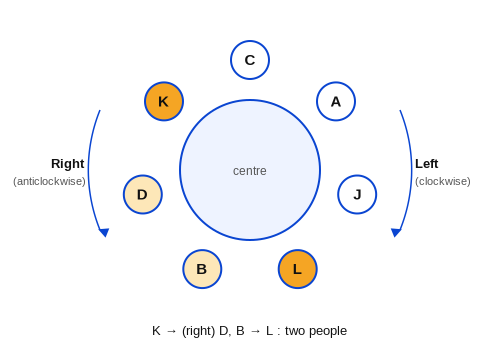
A, B, C, D, J, K and L are sitting around a circular table, facing the centre of the table. Only four people sit between C and J when counted from the right of C. C sits third to the left of B. A sits third to the left of D. L is an immediate neighbour of both J and B. How many people sit between K and L when counted from the right of K?
A, B, C, D, J, K और L एक वृत्ताकार मेज़ के चारों ओर मेज़ के केंद्र की ओर मुख करके बैठे हैं। C के दाएँ से गिनने पर C और J के बीच केवल चार व्यक्ति बैठे हैं। C, B के बाएँ से तीसरे स्थान पर बैठा है। A, D के बाएँ से तीसरे स्थान पर बैठा है। L, J और B दोनों का निकटतम पड़ोसी है। K के दाएँ से गिनने पर K और L के बीच कितने व्यक्ति बैठे हैं?
  1. AFourचार
  2. BThreeतीन
  3. CTwoदो
  4. DOneएक
Show answer

Concept: Facing the centre: left = clockwise, right = anticlockwise.

  1. Fix C. B is 3rd to the right of C (C is 3rd to the left of B).
  2. J is 5th to the right of C (four between); L sits between J and B.
  3. Remaining 3 seats: only D with A 3rd to its left fits; K takes the last seat.
  4. From K moving right: D, B, then L ⇒ two people.

Trick: Same structure as other 7-person puzzles: fixed gaps first, neighbour clue next.

Answer: (C) Two

अवधारणा: केंद्र की ओर मुख: बायाँ = दक्षिणावर्त, दायाँ = वामावर्त।

  1. C को स्थिर करें। B, C के दाएँ तीसरा (C, B के बाएँ तीसरा)।
  2. J, C के दाएँ पाँचवाँ (बीच में चार); L, J और B के बीच।
  3. बचे 3 स्थानों में केवल वही व्यवस्था चलती है जिसमें A, D के बाएँ तीसरा हो; K अंतिम स्थान पर।
  4. K से दाईं ओर: D, B, फिर L ⇒ दो व्यक्ति।

ट्रिक: पहले निश्चित दूरी वाले जोड़े, फिर पड़ोसी संकेत।

उत्तर: (C) दो

RRB NTPC Undergraduate CBT 1General Intelligence and ReasoningCircular seating arrangementRRB NTPC Undergraduate CBT 1 2024 · 7 Aug Shift 2 →
Q5112.
In a certain code language, ‘OPEN’ is coded as ‘4627’ and ‘EARS’ is coded as ‘1375’. What is the code for ‘E’ in the given code language?
एक निश्चित कूट भाषा में, 'OPEN' को '4627' के रूप में और 'EARS' को '1375' के रूप में कूटबद्ध किया जाता है। दी गई कूट भाषा में 'E' के लिए कूट क्या है?
  1. A6
  2. B1
  3. C5
  4. D7
Show answer

Concept: A letter common to both words gets the digit common to both codes.

  1. OPEN and EARS share only E.
  2. 4627 and 1375 share only 7.
  3. So E =7.

Trick: Common letter ↔ common digit.

Answer: (D) 7

अवधारणा: दोनों शब्दों में समान अक्षर का कूट, दोनों कोड में समान अंक होता है।

  1. OPEN और EARS में केवल E समान।
  2. 4627 और 1375 में केवल 7 समान।
  3. अतः E =7।

ट्रिक: समान अक्षर ↔ समान अंक।

उत्तर: (D) 7

RRB NTPC Undergraduate CBT 1General Intelligence and ReasoningCoding-decodingRRB NTPC Undergraduate CBT 1 2024 · 7 Aug Shift 2 →
Q5113.
In a certain code language, ‘KNOW’ is coded as ‘8901’ and ‘KNOT’ is coded as ‘9028’. What is the code for ‘W’ in the given code language?
एक निश्चित कूट भाषा में, 'KNOW' को '8901' के रूप में और 'KNOT' को '9028' के रूप में कूटबद्ध किया जाता है। दी गई कूट भाषा में 'W' के लिए कूट क्या है?
  1. A8
  2. B9
  3. C1
  4. D0
Show answer

Concept: Common letters take the common digits; the unmatched letter takes the leftover digit.

  1. KNOW and KNOT share K, N, O; codes 8901 and 9028 share 8, 9, 0.
  2. So W gets the remaining digit of 8901, i.e. 1.

Trick: Leftover letter ↔ leftover digit.

Answer: (C) 1

अवधारणा: समान अक्षरों को समान अंक; बचा अक्षर बचे अंक से।

  1. KNOW और KNOT में K, N, O समान; 8901 और 9028 में 8, 9, 0 समान।
  2. अतः W = 8901 का बचा अंक 1।

ट्रिक: बचा अक्षर ↔ बचा अंक।

उत्तर: (C) 1

RRB NTPC Undergraduate CBT 1General Intelligence and ReasoningCoding-decodingRRB NTPC Undergraduate CBT 1 2024 · 7 Aug Shift 2 →
Q5114.
What should come in place of the question mark (?) in the given series?
260, 310, 460, 710, 1060, ?
दी गई श्रृंखला में प्रश्न चिह्न (?) के स्थान पर क्या आना चाहिए?
260, 310, 460, 710, 1060, ?
  1. A1560
  2. B1510
  3. C1460
  4. D1410
Show answer

Concept: Check the differences.

  1. Differences: 50, 150, 250, 350 (each +100).
  2. Next difference 450: 1060+450=1510.

Trick: Second differences constant (100).

Answer: (B) 1510

अवधारणा: अंतर देखें।

  1. अंतर: 50, 150, 250, 350 (हर बार +100)।
  2. अगला अंतर 450: 1060+450=1510।

ट्रिक: द्वितीय अंतर स्थिर (100)।

उत्तर: (B) 1510

RRB NTPC Undergraduate CBT 1General Intelligence and ReasoningNumber seriesRRB NTPC Undergraduate CBT 1 2024 · 7 Aug Shift 2 →
Q5115.
In the following number-pairs, the second number is obtained by applying certain mathematical operations to the first number. Select the pair in which the numbers are related in the same way as are the numbers of the following pairs.
(Note: Operations should be performed on the whole numbers, without breaking down the numbers into its constituent digits. E.g., 13 – Operations on 13 such as
adding/subtracting/multiplying etc. to 13 can be performed. Breaking down 13 into 1 and 3 and then performing mathematical operations on 1 and 3 is not allowed.) 24, 16
48, 32
निम्नलिखित संख्या-युग्मों में, पहली संख्या पर कुछ गणितीय संक्रियाएँ करके दूसरी संख्या प्राप्त की जाती है। उस युग्म का चयन कीजिए जिसमें संख्याएँ उसी प्रकार संबंधित हैं जिस प्रकार निम्नलिखित युग्मों की संख्याएँ संबंधित हैं।
(ध्यान दें: संख्याओं को उनके घटक अंकों में विभक्त किए बिना, संक्रियाएँ पूर्ण संख्याओं पर की जानी चाहिए। उदाहरण के लिए, 13 – 13 पर संक्रियाएँ जैसे 13 में
जोड़ना/घटाना/गुणा करना आदि की जा सकती हैं। 13 को 1 और 3 में विभक्त करके फिर 1 और 3 पर गणितीय संक्रियाएँ करने की अनुमति नहीं है।) 24, 16
48, 32
  1. A72, 36
  2. B84, 56
  3. C60, 20
  4. D96, 62
Show answer

Concept: Find the operation: 24→16 and 48→32 are both ×23.

  1. 84×23=56 ✓.
  2. 72→36 is ×12, 60→20 is ×13, 96×23=64≠62.

Trick: Second number = first −13 of first.

Answer: (B) 84, 56

अवधारणा: संक्रिया पहचानें: 24→16 और 48→32 दोनों में ×23।

  1. 84×23=56 ✓।
  2. 72→36 में ×12, 60→20 में ×13, 96×23=64≠62।

ट्रिक: दूसरी संख्या = पहली − पहली का 13।

उत्तर: (B) 84, 56

RRB NTPC Undergraduate CBT 1General Intelligence and ReasoningNumber-pair analogyRRB NTPC Undergraduate CBT 1 2024 · 7 Aug Shift 2 →
Q5116.
Based on the English alphabetical order, three of the following four letter-clusters are alike in a certain way and thus form a group. Which letter-cluster DOES NOT belong to that group?
(Note: The odd one out is not based on the number of consonants/vowels or their position in the letter-cluster.)
अंग्रेज़ी वर्णमाला क्रम के आधार पर, निम्नलिखित चार अक्षर-समूहों में से तीन किसी निश्चित प्रकार से एकसमान हैं और इस प्रकार एक समूह बनाते हैं। कौन-सा अक्षर-समूह उस समूह से संबंधित नहीं है?
(ध्यान दें: असंगत अक्षर-समूह, अक्षर-समूह में व्यंजनों/स्वरों की संख्या या उनके स्थान पर आधारित नहीं है।)
  1. ARWS
  2. BOTP
  3. CUZV
  4. DMRO
Show answer

Concept: Check the gaps between consecutive letters.

  1. RWS: +5,−4; OTP: +5,−4; UZV: +5,−4.
  2. MRO: +5,−3 – different.

Trick: Third letter = first letter +1 in the group (R→S, O→P, U→V); M→O breaks it.

Answer: (D) MRO

अवधारणा: क्रमागत अक्षरों के अंतर देखें।

  1. RWS: +5,−4; OTP: +5,−4; UZV: +5,−4।
  2. MRO: +5,−3 – भिन्न।

ट्रिक: समूह में तीसरा अक्षर = पहला +1 (R→S, O→P, U→V); M→O अलग।

उत्तर: (D) MRO

RRB NTPC Undergraduate CBT 1General Intelligence and ReasoningLetter-cluster odd one outRRB NTPC Undergraduate CBT 1 2024 · 7 Aug Shift 2 →
Q5117.
Read the given statement(s) and conclusions carefully. Assuming that the information given in the statement(s) is true, even if it appears to be at variance with commonly known facts, decide which of the given conclusions logically follow(s) from the statement(s).
Statements:
All detergents are towels.
All detergents are conditioners.
Conclusions:
(I) Some towels are conditioners.
(II) All conditioners are detergents.
दिए गए कथन/कथनों और निष्कर्षों को ध्यानपूर्वक पढ़िए। कथन/कथनों में दी गई जानकारी को सत्य मानते हुए, भले ही वह सामान्यतः ज्ञात तथ्यों से भिन्न प्रतीत होती हो, निर्णय लीजिए कि दिए गए निष्कर्षों में से कौन-सा/से निष्कर्ष तार्किक रूप से कथन/कथनों का अनुसरण करता है/करते हैं।
कथन:
सभी डिटर्जेंट, तौलिए हैं।
सभी डिटर्जेंट, कंडीशनर हैं।
निष्कर्ष:
(I) कुछ तौलिए, कंडीशनर हैं।
(II) सभी कंडीशनर, डिटर्जेंट हैं।
  1. AOnly conclusion (II) follows.केवल निष्कर्ष (II) अनुसरण करता है।
  2. BOnly conclusion (I) follows.केवल निष्कर्ष (I) अनुसरण करता है।
  3. CNeither conclusion (I) nor (II) follows.न तो निष्कर्ष (I) और न ही (II) अनुसरण करता है।
  4. DBoth conclusions (I) and (II) follow.निष्कर्ष (I) और (II) दोनों अनुसरण करते हैं।
Show answer

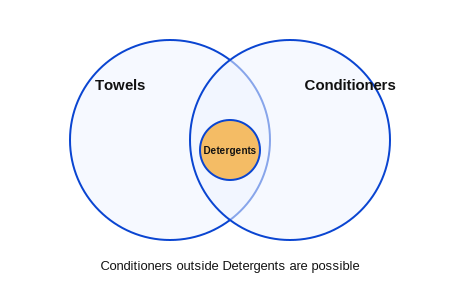
Concept: Draw the least-overlap diagram and test each conclusion.

  1. Detergents lie inside both Towels and Conditioners.
  2. So towels and conditioners share at least the detergents ⇒ I follows.
  3. Conditioners may extend beyond detergents ⇒ II does not follow.

Trick: All A are B + All A are C ⇒ Some B are C (always).

Answer: (B) Only conclusion (I) follows.

अवधारणा: न्यूनतम ओवरलैप वाला चित्र बनाकर हर निष्कर्ष जाँचें।

  1. डिटर्जेंट, तौलिये और कंडीशनर दोनों के अंदर।
  2. अतः तौलिये और कंडीशनर में कम से कम डिटर्जेंट समान ⇒ I अनुसरण करता है।
  3. कंडीशनर, डिटर्जेंट से बाहर भी हो सकते हैं ⇒ II नहीं।

ट्रिक: सभी A, B हैं + सभी A, C हैं ⇒ कुछ B, C हैं (हमेशा)।

उत्तर: (B) केवल निष्कर्ष (I) अनुसरण करता है।

RRB NTPC Undergraduate CBT 1General Intelligence and ReasoningSyllogismRRB NTPC Undergraduate CBT 1 2024 · 7 Aug Shift 2 →
Q5118.
Which of the following letter-number clusters will replace the question mark (?) in the given series to make it logically complete?
VPM 153, QUJ 145, LZG 137, GED 129, BJA 121, ?
दी गई श्रृंखला को तार्किक रूप से पूर्ण करने के लिए निम्नलिखित में से कौन-सा अक्षर-संख्या समूह प्रश्न चिह्न (?) का स्थान लेगा?
VPM 153, QUJ 145, LZG 137, GED 129, BJA 121, ?
  1. AWOX 113
  2. BVOY 115
  3. CUPY 115
  4. DXNW 113
Show answer

Concept: Track each letter position and the number separately.

  1. 1st letters V, Q, L, G, B: −5 ⇒ W (wrap-around).
  2. 2nd letters P, U, Z, E, J: +5 ⇒ O.
  3. 3rd letters M, J, G, D, A: −3 ⇒ X.
  4. Numbers: −8 ⇒ 121−8=113.

Trick: Use wrap-around: B −5 ⇒ W, A −3 ⇒ X.

Answer: (A) WOX 113

अवधारणा: हर अक्षर-स्थान और संख्या को अलग-अलग देखें।

  1. पहले अक्षर V, Q, L, G, B: −5 ⇒ W (चक्रीय)।
  2. दूसरे अक्षर P, U, Z, E, J: +5 ⇒ O।
  3. तीसरे अक्षर M, J, G, D, A: −3 ⇒ X।
  4. संख्या: −8 ⇒ 121−8=113।

ट्रिक: चक्रीय क्रम: B −5 ⇒ W, A −3 ⇒ X।

उत्तर: (A) WOX 113

RRB NTPC Undergraduate CBT 1General Intelligence and ReasoningAlphanumeric seriesRRB NTPC Undergraduate CBT 1 2024 · 7 Aug Shift 2 →
Q5119.
What will come in place of the question mark (?) in the following equation, if ‘+’ and ‘÷’ are interchanged and ‘−’ and ‘×’ are interchanged?
11 − 3 × 88 + 8 ÷ 10 = ?
यदि '+' और '÷' को आपस में बदल दिया जाए तथा '−' और '×' को आपस में बदल दिया जाए, तो निम्नलिखित समीकरण में प्रश्न चिह्न (?) के स्थान पर क्या आएगा?
11 − 3 × 88 + 8 ÷ 10 = ?
  1. A38
  2. B23
  3. C32
  4. D16
Show answer

Concept: Interchange the signs, then apply BODMAS.

  1. 11−3×88+8÷10 becomes 11×3−88÷8+10.
  2. =33−11+10=32.

Trick: Rewrite the whole expression first, then solve – avoids sign mix-ups.

Answer: (C) 32

अवधारणा: चिह्न बदलें, फिर BODMAS लगाएँ।

  1. 11−3×88+8÷10 बनता है 11×3−88÷8+10।
  2. =33−11+10=32।

ट्रिक: पहले पूरा व्यंजक दोबारा लिखें, फिर हल करें।

उत्तर: (C) 32

RRB NTPC Undergraduate CBT 1General Intelligence and ReasoningMathematical operationsRRB NTPC Undergraduate CBT 1 2024 · 7 Aug Shift 2 →
Q5120.
MOLK is related to RTQP in a certain way based on the English alphabetical order. In the same way, GIFE is related to LNKJ. To which of the given options is VXUT related, following the same logic?
अंग्रेज़ी वर्णमाला क्रम के आधार पर MOLK एक निश्चित प्रकार से RTQP से संबंधित है। उसी प्रकार, GIFE, LNKJ से संबंधित है। समान तर्क का अनुसरण करते हुए, VXUT दिए गए विकल्पों में से किससे संबंधित है?
  1. AAYZC
  2. BAYZS
  3. CACZY
  4. DACYZ
Show answer

Concept: Compare positions letter by letter.

  1. M→R, O→T, L→Q, K→P: each +5.
  2. G→L, I→N, F→K, E→J: each +5.
  3. V→A, X→C, U→Z, T→Y ⇒ ACZY.

Trick: Wrap-around: V +5 ⇒ A, X +5 ⇒ C.

Answer: (C) ACZY

अवधारणा: अक्षरों के स्थान एक-एक करके मिलाएँ।

  1. M→R, O→T, L→Q, K→P: प्रत्येक +5।
  2. G→L, I→N, F→K, E→J: प्रत्येक +5।
  3. V→A, X→C, U→Z, T→Y ⇒ ACZY।

ट्रिक: चक्रीय क्रम: V +5 ⇒ A, X +5 ⇒ C।

उत्तर: (C) ACZY

RRB NTPC Undergraduate CBT 1General Intelligence and ReasoningLetter analogyRRB NTPC Undergraduate CBT 1 2024 · 7 Aug Shift 2 →