Question bank

Q&A: practice questions with answers

Search questions on any topic. Filter by exam category, exam, subject and topic, try the question, then open the answer and explanation.

Courses – airGurukul

20,719 questions found.

Q5201.
Satish starts from Point Y and drives 19 km towards west. He then takes a right turn, drives 10 km. He then turns right and drives 11 km. He takes a final right turn, drives 10 km and stops at Point Z. How far (shortest distance) and towards which direction should he drive in order to reach Point Y again? (All turns are 90° turns only unless specified.)
सतीश बिंदु Y से चलना शुरू करता है और पश्चिम की ओर 19 km गाड़ी चलाता है। फिर वह दाएँ मुड़ता है और 10 km गाड़ी चलाता है। फिर वह दाएँ मुड़ता है और 11 km गाड़ी चलाता है। वह अंतिम बार दाएँ मुड़ता है, 10 km गाड़ी चलाता है और बिंदु Z पर रुक जाता है। बिंदु Y पर फिर से पहुँचने के लिए उसे कितनी दूर (न्यूनतम दूरी) और किस दिशा में गाड़ी चलानी चाहिए? (जब तक निर्दिष्ट न किया जाए, सभी मोड़ केवल 90° के मोड़ हैं।)
  1. A7 km towards southदक्षिण की ओर 7 km
  2. B5 km towards northउत्तर की ओर 5 km
  3. C6 km towards westपश्चिम की ओर 6 km
  4. D8 km towards eastपूर्व की ओर 8 km
Show answer

Concept: Trace the path on axes; opposite moves cancel.
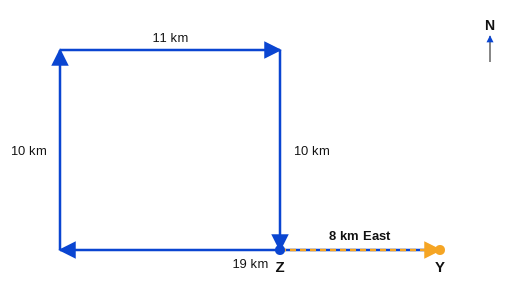
  1. 19 km West, then right (North) 10 km, right (East) 11 km, right (South) 10 km.
  2. North 10 and South 10 cancel → Z lies on the same line as Y.
  3. Net West =19−11=8 km, so Y is 8 km East of Z.

Trick: Net displacement: West–East =19−11=8; North–South =0.

Answer: (D) 8 km towards east

अवधारणा: रास्ता अक्षों पर बनाएँ; विपरीत दिशाएँ कट जाती हैं।

  1. 19 km पश्चिम, फिर दाएँ (उत्तर) 10 km, दाएँ (पूर्व) 11 km, दाएँ (दक्षिण) 10 km।
  2. उत्तर 10 और दक्षिण 10 कट जाते हैं → Z, Y की ही रेखा पर है।
  3. शुद्ध पश्चिम =19−11=8 km, अतः Y, Z से 8 km पूर्व में है।

ट्रिक: शुद्ध विस्थापन: पश्चिम–पूर्व =19−11=8; उत्तर–दक्षिण =0।

उत्तर: (D) 8 km पूर्व की ओर

RRB NTPC Undergraduate CBT 1General Intelligence and ReasoningDirection and DistanceRRB NTPC Undergraduate CBT 1 2024 · 7 Aug Shift 1 →
Q5202.
Based on the English alphabetical order, three of the following four letter-clusters are alike in a certain way and thus form a group. Which letter-cluster DOES NOT belong to that group? (Note: The odd one out is not based on the number of consonants/vowels or their position in the letter-cluster.)
अंग्रेज़ी वर्णमाला क्रम के आधार पर, निम्नलिखित चार अक्षर-समूहों में से तीन किसी निश्चित प्रकार से एकसमान हैं और इस प्रकार एक समूह बनाते हैं। कौन-सा अक्षर-समूह उस समूह से संबंधित नहीं है? (ध्यान दें: असंगत अक्षर-समूह, उस अक्षर-समूह में व्यंजनों/स्वरों की संख्या या उनके स्थान पर आधारित नहीं है।)
  1. AHLF
  2. BMQK
  3. CKOI
  4. DFJC
Show answer

Concept: Use alphabet positions and compare the gaps between letters.

  1. HLF: 8→12→6 (+4, −6). MQK: 13→17→11 (+4, −6).
  2. KOI: 11→15→9 (+4, −6).
  3. FJC: 6→10→3 (+4, −7) ✗.

Trick: First-to-last gap is −2 in HLF, MQK, KOI (H–F, M–K, K–I) but −3 in FJC.

Answer: (D) FJC

अवधारणा: अक्षरों के स्थानीय मान लेकर अंतर की तुलना करें।

  1. HLF: 8→12→6 (+4, −6)। MQK: 13→17→11 (+4, −6)।
  2. KOI: 11→15→9 (+4, −6)।
  3. FJC: 6→10→3 (+4, −7) ✗।

ट्रिक: पहले से अंतिम अक्षर का अंतर HLF, MQK, KOI में −2 है पर FJC में −3।

उत्तर: (D) FJC

RRB NTPC Undergraduate CBT 1General Intelligence and ReasoningOdd One Out – Letter ClustersRRB NTPC Undergraduate CBT 1 2024 · 7 Aug Shift 1 →
Q5203.
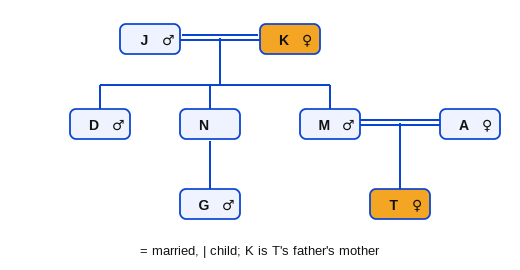
T is the daughter of A. A is married to M. M is the son of K. K is married to J. J is the father of D. D is the brother of N. G is the son of N. How is K related to T?
T, A की पुत्री है। A का विवाह M से हुआ है। M, K का पुत्र है। K का विवाह J से हुआ है। J, D का पिता है। D, N का भाई है। G, N का पुत्र है। K का T से क्या संबंध है?
  1. AFather's motherपिता की माता
  2. BMother's brotherमाता का भाई
  3. CFather's fatherपिता के पिता
  4. DMother's fatherमाता के पिता
Show answer

Concept: Fix genders from words like son/father, then draw the family tree.

  1. M is a son (male) and is married to A, so A is female; T is their daughter → M is T's father.
  2. J is a father (male) and married to K, so K is female; M is K's son → K is M's mother.
  3. K is T's father's mother (paternal grandmother).

Yaad rakhein: D, N and G are distractors — they do not affect the K–T link.

Answer: (A) Father's mother

अवधारणा: son/father जैसे शब्दों से लिंग तय करें, फिर वंश-वृक्ष बनाएँ।

  1. M पुत्र (पुरुष) है और A से विवाहित, अतः A महिला; T उनकी पुत्री → M, T का पिता।
  2. J पिता (पुरुष) है और K से विवाहित, अतः K महिला; M, K का पुत्र → K, M की माँ।
  3. K, T के पिता की माँ (दादी) है।

याद रखें: D, N और G भ्रमित करने के लिए हैं — K–T संबंध पर इनका असर नहीं।

उत्तर: (A) पिता की माँ

RRB NTPC Undergraduate CBT 1General Intelligence and ReasoningBlood RelationsRRB NTPC Undergraduate CBT 1 2024 · 7 Aug Shift 1 →
Q5204.
In a certain code language, ‘like his attitude’ is coded as ‘nt yg fr’ and ‘his first salary’ is coded as ‘kt lo yg’. How is ‘his’ coded in the given language?
एक निश्चित कूट भाषा में, ‘like his attitude’ को ‘nt yg fr’ के रूप में कूटबद्ध किया जाता है और ‘his first salary’ को ‘kt lo yg’ के रूप में कूटबद्ध किया जाता है। दी गई भाषा में ‘his’ को किस प्रकार कूटबद्ध किया जाता है?
  1. Ayg
  2. Bfr
  3. Ckt
  4. Dnt
Show answer

Concept: A word common to two sentences takes the code common to both.

  1. 'like his attitude' → nt yg fr.
  2. 'his first salary' → kt lo yg.
  3. Common word: his; common code: yg.

Trick: Match one common word with one common code — no further work needed.

Answer: (A) yg

अवधारणा: दो वाक्यों में उभयनिष्ठ शब्द का कोड भी दोनों में उभयनिष्ठ होता है।

  1. 'like his attitude' → nt yg fr।
  2. 'his first salary' → kt lo yg।
  3. उभयनिष्ठ शब्द: his; उभयनिष्ठ कोड: yg।

ट्रिक: एक उभयनिष्ठ शब्द = एक उभयनिष्ठ कोड — और कुछ नहीं करना।

उत्तर: (A) yg

RRB NTPC Undergraduate CBT 1General Intelligence and ReasoningCoding-Decoding – Common WordsRRB NTPC Undergraduate CBT 1 2024 · 7 Aug Shift 1 →
Q5205.
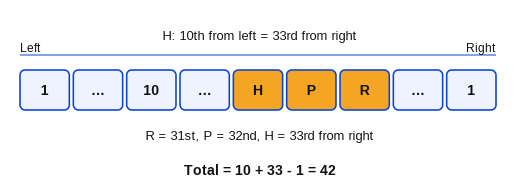
In a row of people all facing north, Rikshit is 31st from the right end and Palak is 32nd from the right end. The number of people between Palak and Rikshit is same as the number of people between Palak and Huma. If Huma is 10th from the left end of the row, how many people are there in the row?
उत्तर की ओर मुख करके खड़े लोगों की एक पंक्ति में, रिक्षित दाएँ छोर से 31वें स्थान पर है और पलक दाएँ छोर से 32वें स्थान पर है। पलक और रिक्षित के बीच लोगों की संख्या उतनी ही है जितनी पलक और हुमा के बीच लोगों की संख्या है। यदि हुमा पंक्ति के बाएँ छोर से 10वें स्थान पर है, तो पंक्ति में कितने लोग हैं?
  1. A43
  2. B41
  3. C44
  4. D42
Show answer

Concept: Total = position from left + position from right −1.

  1. Rikshit 31st and Palak 32nd from right → they are adjacent, 0 people between.
  2. So 0 people between Palak and Huma → Huma is next to Palak on the other side: 33rd from right.
  3. Huma is 10th from left → total =10+33−1=42.

Trick: Huma cannot be 31st (Rikshit's place), so she must be 33rd from right.

Answer: (D) 42

अवधारणा: कुल = बाएँ से स्थान + दाएँ से स्थान −1।

  1. रिक्षित दाएँ से 31वाँ, पलक 32वीं → दोनों पास-पास, बीच में 0 व्यक्ति।
  2. अतः पलक और हुमा के बीच भी 0 → हुमा पलक के दूसरी ओर: दाएँ से 33वीं।
  3. हुमा बाएँ से 10वीं → कुल =10+33−1=42।

ट्रिक: हुमा 31वें स्थान (रिक्षित का) पर नहीं हो सकती, अतः दाएँ से 33वीं।

उत्तर: (D) 42

RRB NTPC Undergraduate CBT 1General Intelligence and ReasoningRanking and OrderRRB NTPC Undergraduate CBT 1 2024 · 7 Aug Shift 1 →
Q5206.
If ‘A’ stands for ‘÷’, ‘B’ stands for ‘×’, ‘C’ stands for ‘+’ and ‘D’ stands for ‘−’, what will come in place of the question mark (?) in the following equation?
46 A 2 C 21 D 8 B 3 = ?
यदि ‘A’ का अर्थ ‘÷’, ‘B’ का अर्थ ‘×’, ‘C’ का अर्थ ‘+’ और ‘D’ का अर्थ ‘−’ है, तो निम्नलिखित समीकरण में प्रश्न चिह्न (?) के स्थान पर क्या आएगा?
46 A 2 C 21 D 8 B 3 = ?
  1. A33
  2. B20
  3. C26
  4. D41
Show answer

Concept: Replace letters by signs, then follow BODMAS.

  1. 46÷2+21−8×3.
  2. =23+21−24.
  3. =20.

Trick: Do ÷ and × first: 23 and 24, then 23+21−24=20.

Answer: (B) 20

अवधारणा: अक्षरों को चिह्नों से बदलें, फिर BODMAS लगाएँ।

  1. 46÷2+21−8×3।
  2. =23+21−24।
  3. =20।

ट्रिक: पहले ÷ और ×: 23 और 24, फिर 23+21−24=20।

उत्तर: (B) 20

RRB NTPC Undergraduate CBT 1General Intelligence and ReasoningMathematical OperationsRRB NTPC Undergraduate CBT 1 2024 · 7 Aug Shift 1 →
Q5207.
This question is based on the five, three-digit numbers given below.
(Left) 324 523 643 136 441 (Right)
(Example- 697 – First digit = 6, second digit = 9 and third digit = 7)
(NOTE: All operations to be done from left to right.)
If 3 is added to the first digit of every number, in how many numbers will the first digit be exactly divisible by the second digit?
यह प्रश्न नीचे दी गई पाँच, तीन अंकों वाली संख्याओं पर आधारित है।
(बाएँ) 324 523 643 136 441 (दाएँ)
(उदाहरण- 697 – पहला अंक = 6, दूसरा अंक = 9 और तीसरा अंक = 7)
(ध्यान दें: सभी संक्रियाएँ बाएँ से दाएँ की जानी हैं।)
यदि प्रत्येक संख्या के पहले अंक में 3 जोड़ दिया जाए, तो कितनी संख्याओं में पहला अंक, दूसरे अंक से पूर्णतः विभाज्य होगा?
  1. A1
  2. B4
  3. C3
  4. D2
Show answer

Concept: Change only the first digit, then test divisibility by the second digit.

  1. 324 → first 6, second 2: 6÷2=3 ✓.
  2. 523 → 8, 2: 8÷2=4 ✓.
  3. 643 → 9, 4 ✗; 136 → 4, 3 ✗; 441 → 7, 4 ✗.
  4. Count =2.

Trick: Second digit 2 always divides an even first digit — only 324 and 523 have it.

Answer: (D) 2

अवधारणा: केवल पहला अंक बदलें, फिर दूसरे अंक से विभाज्यता जाँचें।

  1. 324 → पहला 6, दूसरा 2: 6÷2=3 ✓।
  2. 523 → 8, 2: 8÷2=4 ✓।
  3. 643 → 9, 4 ✗; 136 → 4, 3 ✗; 441 → 7, 4 ✗।
  4. संख्या =2।

ट्रिक: दूसरा अंक 2 हो तो सम पहला अंक विभाज्य — केवल 324 और 523 में।

उत्तर: (D) 2

RRB NTPC Undergraduate CBT 1General Intelligence and ReasoningNumber Puzzle – DigitsRRB NTPC Undergraduate CBT 1 2024 · 7 Aug Shift 1 →
Q5208.
Seven boxes, A, B, C, D, M, N and O, are kept one over the other but not necessarily in the same order.
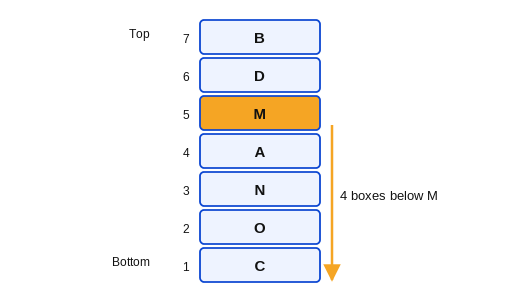
No box is kept above B. Only three boxes are kept between B and N. Only one box is kept between D and A. Only C is kept below O. A is kept immediately above N. Only four boxes are kept between D and C. How many boxes are kept below M?
सात बक्से, A, B, C, D, M, N और O, एक के ऊपर एक रखे गए हैं, लेकिन ज़रूरी नहीं कि इसी क्रम में हों।
B के ऊपर कोई बक्सा नहीं रखा गया है। B और N के बीच केवल तीन बक्से रखे गए हैं। D और A के बीच केवल एक बक्सा रखा गया है। O के नीचे केवल C रखा गया है। A, N के ठीक ऊपर रखा गया है। D और C के बीच केवल चार बक्से रखे गए हैं। M के नीचे कितने बक्से रखे गए हैं?
  1. AFiveपाँच
  2. BFourचार
  3. CTwoदो
  4. DThreeतीन
Show answer

Concept: Number positions 1 (bottom) to 7 (top) and place the fixed clues first.

  1. No box above B → B = 7. Three between B and N → N = 3; A just above N → A = 4.
  2. Only C below O → C = 1, O = 2.
  3. One between D and A → D = 2 or 6; 2 is taken → D = 6 (four between D and C ✓).
  4. M = 5 → boxes below M: A, N, O, C = 4.

Trick: 'Only C is below O' fixes the bottom two boxes at once.

Answer: (B) Four

अवधारणा: स्थान 1 (नीचे) से 7 (ऊपर) तक मानें और पहले निश्चित संकेत रखें।

  1. B के ऊपर कोई नहीं → B = 7। B और N के बीच तीन → N = 3; A, N के ठीक ऊपर → A = 4।
  2. O के नीचे केवल C → C = 1, O = 2।
  3. D और A के बीच एक → D = 2 या 6; 2 भरा → D = 6 (D और C के बीच चार ✓)।
  4. M = 5 → M के नीचे: A, N, O, C = 4।

ट्रिक: 'O के नीचे केवल C' से नीचे के दो बॉक्स तुरंत तय।

उत्तर: (B) चार

RRB NTPC Undergraduate CBT 1General Intelligence and ReasoningBox ArrangementRRB NTPC Undergraduate CBT 1 2024 · 7 Aug Shift 1 →
Q5209.
In a certain code language, ‘GALE’ is coded as ‘7513’ and ‘FLEA’ is coded as ‘5197’. What is the code for ‘F’ in that language?
एक निश्चित कूट भाषा में, ‘GALE’ को ‘7513’ के रूप में कूटबद्ध किया जाता है और ‘FLEA’ को ‘5197’ के रूप में कूटबद्ध किया जाता है। उस भाषा में ‘F’ का कूट क्या है?
  1. A1
  2. B9
  3. C5
  4. D7
Show answer

Concept: Codes are jumbled; compare common letters with common digits.

  1. GALE → {7, 5, 1, 3}; FLEA → {5, 1, 9, 7}.
  2. Common letters A, L, E ↔ common digits 7, 5, 1.
  3. Leftover: G → 3 and F → 9.

Trick: The only letter unique to FLEA gets the only digit unique to its code: 9.

Answer: (B) 9

अवधारणा: कोड क्रम में नहीं हैं; उभयनिष्ठ अक्षरों की तुलना उभयनिष्ठ अंकों से करें।

  1. GALE → {7, 5, 1, 3}; FLEA → {5, 1, 9, 7}।
  2. उभयनिष्ठ अक्षर A, L, E ↔ उभयनिष्ठ अंक 7, 5, 1।
  3. बचे: G → 3 और F → 9।

ट्रिक: FLEA का अकेला अलग अक्षर F, उसके कोड का अकेला अलग अंक 9 पाता है।

उत्तर: (B) 9

RRB NTPC Undergraduate CBT 1General Intelligence and ReasoningCoding-Decoding – Letter CodesRRB NTPC Undergraduate CBT 1 2024 · 7 Aug Shift 1 →
Q5210.
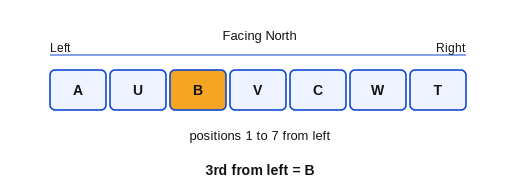
Seven people, A, B, C, T, U, V and W are sitting in a row, facing north. Only two people sit to the right of C. Only two people sit between C and U. Only two people sit between A and V. V sits to the immediate left of C. T sits to the immediate right of W. Who sits at third position from the left end of the line?
सात व्यक्ति, A, B, C, T, U, V और W उत्तर की ओर मुख करके एक पंक्ति में बैठे हैं। C के दाईं ओर केवल दो व्यक्ति बैठे हैं। C और U के बीच केवल दो व्यक्ति बैठे हैं। A और V के बीच केवल दो व्यक्ति बैठे हैं। V, C के ठीक बाईं ओर बैठा है। T, W के ठीक दाईं ओर बैठा है। पंक्ति के बाएँ छोर से तीसरे स्थान पर कौन बैठा है?
  1. AT
  2. BU
  3. CA
  4. DB
Show answer

Concept: Number seats 1–7 from the left (all face north) and place definite clues first.

  1. Two to the right of C → C = 5. V immediately left of C → V = 4.
  2. Two between C and U → U = 2. Two between A and V → A = 1 or 7.
  3. W, T must be adjacent (T right of W): if A = 7, free seats 1, 3, 6 have no adjacent pair ✗. So A = 1, W = 6, T = 7, B = 3.

Trick: Use the W–T pair to decide where A goes.

Answer: (D) B

अवधारणा: बाएँ से सीट 1–7 मानें (सभी उत्तर की ओर) और पहले निश्चित संकेत रखें।

  1. C के दाएँ केवल दो → C = 5। V, C के ठीक बाएँ → V = 4।
  2. C और U के बीच दो → U = 2। A और V के बीच दो → A = 1 या 7।
  3. W, T पास-पास (T, W के दाएँ): A = 7 हो तो खाली सीटें 1, 3, 6 में कोई जोड़ी नहीं ✗। अतः A = 1, W = 6, T = 7, B = 3।

ट्रिक: W–T जोड़ी से तय करें कि A कहाँ बैठेगा।

उत्तर: (D) B

RRB NTPC Undergraduate CBT 1General Intelligence and ReasoningLinear Seating ArrangementRRB NTPC Undergraduate CBT 1 2024 · 7 Aug Shift 1 →
Q5211.
Read the given statement(s) and conclusions carefully. Assuming that the information given in the statements is true, even if it appears to be at variance with commonly known facts, decide which of the given conclusion(s) logically follow(s) from the statement(s).
Statements:
All Cabbages are Peas.
No Peas are Broccolis.
Conclusions:
I: No Broccolis are Cabbages.
II: Some Broccolis are Cabbages.
दिए गए कथन/कथनों और निष्कर्षों को ध्यानपूर्वक पढ़िए। यह मानते हुए कि कथनों में दी गई जानकारी सत्य है, भले ही वह सामान्यतः ज्ञात तथ्यों से भिन्न प्रतीत होती हो, निर्णय कीजिए कि दिए गए निष्कर्षों में से कौन-सा/कौन-से निष्कर्ष तार्किक रूप से कथन/कथनों का अनुसरण करता है/करते हैं।
कथन:
सभी पत्तागोभी, मटर हैं।
कोई मटर, ब्रोकली नहीं है।
निष्कर्ष:
I: कोई ब्रोकली, पत्तागोभी नहीं है।
II: कुछ ब्रोकली, पत्तागोभी हैं।
  1. AOnly conclusion (I) follows.केवल निष्कर्ष (I) अनुसरण करता है।
  2. BNeither conclusion (I) nor (II) follows.न तो निष्कर्ष (I) और न ही (II) अनुसरण करता है।
  3. COnly conclusion (II) follows.केवल निष्कर्ष (II) अनुसरण करता है।
  4. DBoth conclusions (I) and (II) follow.निष्कर्ष (I) और (II) दोनों अनुसरण करते हैं।
Show answer

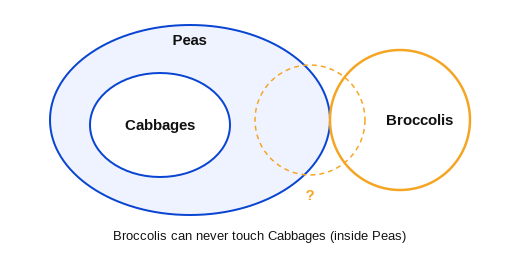
Concept: If A is inside B and B has nothing in common with C, then A has nothing in common with C.

  1. Cabbages lie completely inside Peas.
  2. Broccolis are completely outside Peas, so they can never touch Cabbages.
  3. I: 'No broccolis are cabbages' — definitely true ✓. II: 'Some broccolis are cabbages' — impossible ✗.

Yaad rakhein: All + No → No (All A are B, No B is C ⇒ No A is C).

Answer: (A) Only conclusion (I) follows.

अवधारणा: यदि A, B के अंदर है और B का C से कुछ भी उभयनिष्ठ नहीं, तो A का भी C से कुछ उभयनिष्ठ नहीं।

  1. Cabbages पूरी तरह Peas के अंदर।
  2. Broccolis पूरी तरह Peas के बाहर, अतः Cabbages को कभी नहीं छू सकते।
  3. I: 'कोई broccoli, cabbage नहीं' — निश्चित सत्य ✓। II: 'कुछ broccolis, cabbages हैं' — असंभव ✗।

याद रखें: सभी + कोई नहीं → कोई नहीं (सभी A, B हैं; कोई B, C नहीं ⇒ कोई A, C नहीं)।

उत्तर: (A) केवल निष्कर्ष (I) अनुसरण करता है।

RRB NTPC Undergraduate CBT 1General Intelligence and ReasoningSyllogismRRB NTPC Undergraduate CBT 1 2024 · 7 Aug Shift 1 →
Q5212.
What should come in place of the question mark (?) in the given series?
779 780 784 793 809 ?
दी गई शृंखला में प्रश्न चिह्न (?) के स्थान पर क्या आना चाहिए?
779 780 784 793 809 ?
  1. A831
  2. B837
  3. C834
  4. D841
Show answer

Concept: Look at the differences between consecutive terms.

  1. Differences: 1, 4, 9, 16 = 12,22,32,42.
  2. Next difference =52=25.
  3. 809+25=834.

Trick: Differences being perfect squares is a very common pattern.

Answer: (C) 834

अवधारणा: क्रमागत पदों के अंतर देखें।

  1. अंतर: 1, 4, 9, 16 = 12,22,32,42।
  2. अगला अंतर =52=25।
  3. 809+25=834।

ट्रिक: अंतरों का पूर्ण वर्ग होना बहुत आम पैटर्न है।

उत्तर: (C) 834

RRB NTPC Undergraduate CBT 1General Intelligence and ReasoningNumber SeriesRRB NTPC Undergraduate CBT 1 2024 · 7 Aug Shift 1 →
Q5213.
Select the triad that follows the same pattern as that followed by the two triads given below. Both triads follow the same pattern.
GN-JQ-MP
DK-GN-JM
उस त्रयी का चयन कीजिए जो उसी पैटर्न का अनुसरण करती है जिसका अनुसरण नीचे दी गई दो त्रयी करती हैं। दोनों त्रयी एक ही पैटर्न का अनुसरण करती हैं।
GN-JQ-MP
DK-GN-JM
  1. AJQ-MT-PR
  2. BJQ-MT-PS
  3. CIQ-NT-PR
  4. DIQ-MT-PR
Show answer

Concept: Compare each pair of letters with the next pair.

  1. GN → JQ: +3, +3. JQ → MP: +3, −1.
  2. DK → GN: +3, +3. GN → JM: +3, −1.
  3. JQ → MT (+3, +3) → PS (+3, −1) ✓.

Trick: (A) ends PR (T−2), so check the last letter carefully: T → S.

Answer: (B) JQ-MT-PS

अवधारणा: हर अक्षर-जोड़ी की अगली जोड़ी से तुलना करें।

  1. GN → JQ: +3, +3। JQ → MP: +3, −1।
  2. DK → GN: +3, +3। GN → JM: +3, −1।
  3. JQ → MT (+3, +3) → PS (+3, −1) ✓।

ट्रिक: (A) में PR (T−2) है, अतः अंतिम अक्षर ध्यान से जाँचें: T → S।

उत्तर: (B) JQ-MT-PS

RRB NTPC Undergraduate CBT 1General Intelligence and ReasoningLetter TriadsRRB NTPC Undergraduate CBT 1 2024 · 7 Aug Shift 1 →
Q5214.
Which of the following letter-number clusters will replace the question mark (?) in the given series to make it logically complete?
FJN 45, DHL 40, BFJ 35, ZDH 30, XBF 25, ?
निम्नलिखित में से कौन-सा अक्षर-संख्या समूह दी गई शृंखला में प्रश्न चिह्न (?) के स्थान पर आकर उसे तार्किक रूप से पूर्ण करेगा?
FJN 45, DHL 40, BFJ 35, ZDH 30, XBF 25, ?
  1. AVZD 20
  2. BVUD 20
  3. CVZE 20
  4. DUZD 20
Show answer

Concept: Each letter moves back by 2 (with wrap-around Z after A) and the number falls by 5.

  1. 1st letters: F, D, B, Z, X → V.
  2. 2nd letters: J, H, F, D, B → Z.
  3. 3rd letters: N, L, J, H, F → D.
  4. Numbers: 45, 40, 35, 30, 25 → 20.

Trick: B −2 wraps around to Z.

Answer: (A) VZD 20

अवधारणा: हर अक्षर 2 पीछे जाता है (A के बाद Z पर लौटता है) और संख्या 5 घटती है।

  1. पहले अक्षर: F, D, B, Z, X → V।
  2. दूसरे अक्षर: J, H, F, D, B → Z।
  3. तीसरे अक्षर: N, L, J, H, F → D।
  4. संख्याएँ: 45, 40, 35, 30, 25 → 20।

ट्रिक: B −2 घूमकर Z बनता है।

उत्तर: (A) VZD 20

RRB NTPC Undergraduate CBT 1General Intelligence and ReasoningLetter-Number SeriesRRB NTPC Undergraduate CBT 1 2024 · 7 Aug Shift 1 →
Q5215.
If 2 is added to each odd digit and 3 is subtracted from each even digit in the number 7843651, how many digits will appear more than once in the new number thus formed?
यदि संख्या 7843651 के प्रत्येक विषम अंक में 2 जोड़ दिया जाए और प्रत्येक सम अंक में से 3 घटा दिया जाए, तो इस प्रकार बनी नई संख्या में कितने अंक एक से अधिक बार आएँगे?
  1. AThreeतीन
  2. BTwoदो
  3. COneएक
  4. DNoneकोई नहीं
Show answer

Concept: Apply the rule to every digit separately, then count digits that occur more than once.

  1. Odd digit +2, even digit −3.
  2. 7843651 → 9 5 1 5 3 7 3.
  3. 5 and 3 appear twice → two digits repeat.

Trick: Note that 3 → 5 and 8 → 5 both give 5; 6 → 3 and 1 → 3 both give 3.

Answer: (B) Two

अवधारणा: हर अंक पर अलग-अलग नियम लगाएँ, फिर एक से अधिक बार आने वाले अंक गिनें।

  1. विषम अंक +2, सम अंक −3।
  2. 7843651 → 9 5 1 5 3 7 3।
  3. 5 और 3 दो-दो बार → दो अंक दोहराए गए।

ट्रिक: 3 → 5 और 8 → 5 दोनों 5 देते हैं; 6 → 3 और 1 → 3 दोनों 3 देते हैं।

उत्तर: (B) दो

RRB NTPC Undergraduate CBT 1General Intelligence and ReasoningNumber Operations – DigitsRRB NTPC Undergraduate CBT 1 2024 · 7 Aug Shift 1 →
Q5216.
Based on the English alphabetical order, three of the following four letter-clusters are alike in a certain way and thus form a group. Which letter-cluster DOES NOT belong to that group?
(Note: The odd one out is not based on the number of consonants/vowels or their position in the letter-cluster.)
अंग्रेज़ी वर्णमाला क्रम के आधार पर, निम्नलिखित चार अक्षर-समूहों में से तीन किसी निश्चित प्रकार से एकसमान हैं और इस प्रकार एक समूह बनाते हैं। कौन-सा अक्षर-समूह उस समूह से संबंधित नहीं है?
(ध्यान दें: असंगत अक्षर-समूह, उस अक्षर-समूह में व्यंजनों/स्वरों की संख्या या उनके स्थान पर आधारित नहीं है।)
  1. AHDK
  2. BFBJ
  3. CMIP
  4. DJFM
Show answer

Concept: Use alphabet positions and compare the gaps.

  1. HDK: 8→4→11 (−4, +7). MIP: 13→9→16 (−4, +7).
  2. JFM: 10→6→13 (−4, +7).
  3. FBJ: 6→2→10 (−4, +8) ✗.

Trick: First to last letter is +3 in HDK, MIP, JFM but +4 in FBJ.

Answer: (B) FBJ

अवधारणा: अक्षरों के स्थानीय मान लेकर अंतर की तुलना करें।

  1. HDK: 8→4→11 (−4, +7)। MIP: 13→9→16 (−4, +7)।
  2. JFM: 10→6→13 (−4, +7)।
  3. FBJ: 6→2→10 (−4, +8) ✗।

ट्रिक: पहले से अंतिम अक्षर HDK, MIP, JFM में +3 पर FBJ में +4।

उत्तर: (B) FBJ

RRB NTPC Undergraduate CBT 1General Intelligence and ReasoningOdd One Out – Letter ClustersRRB NTPC Undergraduate CBT 1 2024 · 7 Aug Shift 1 →
Q5217.
In the following triads, each group of letters is related to the subsequent one following a certain logic. Select from the given options, the one which follows the same logic. RACK - AKCR - KCAR
LOAD - ODAL - DAOL
निम्नलिखित त्रयी में, अक्षरों का प्रत्येक समूह एक निश्चित तर्क का अनुसरण करते हुए अगले समूह से संबंधित है। दिए गए विकल्पों में से उस त्रयी का चयन कीजिए जो समान तर्क का अनुसरण करती है। RACK - AKCR - KCAR
LOAD - ODAL - DAOL
  1. AABLE - BALE - EBLA
  2. BNAPS - NPAS - SPAN
  3. CITEM - TMEI - METI
  4. DFLAT - LFAT - TLAF
Show answer

Concept: Find the position pattern: word 1 (1234) → word 2 → word 3.

  1. RACK → AKCR: letters 2, 4, 3, 1. LOAD → ODAL: same.
  2. Third word is the first word reversed: RACK → KCAR, LOAD → DAOL.
  3. ITEM → TMEI (2, 4, 3, 1) → METI (ITEM reversed) ✓.

Trick: Reversal test first: NAPS → SPAN and ITEM → METI pass; NAPS → NPAS fails the 2, 4, 3, 1 rule (should be APSN).

Answer: (C) ITEM - TMEI - METI

अवधारणा: स्थान-क्रम पहचानें: शब्द 1 (1234) → शब्द 2 → शब्द 3।

  1. RACK → AKCR: अक्षर 2, 4, 3, 1। LOAD → ODAL: वही।
  2. तीसरा शब्द पहले का उल्टा है: RACK → KCAR, LOAD → DAOL।
  3. ITEM → TMEI (2, 4, 3, 1) → METI (ITEM उल्टा) ✓।

ट्रिक: पहले उल्टा-जाँच: NAPS → SPAN और ITEM → METI पास; पर NAPS → NPAS, 2, 4, 3, 1 नियम पर असफल (APSN होना चाहिए)।

उत्तर: (C) ITEM - TMEI - METI

RRB NTPC Undergraduate CBT 1General Intelligence and ReasoningLetter Triads – RearrangementRRB NTPC Undergraduate CBT 1 2024 · 7 Aug Shift 1 →
Q5218.
What should come in place of the question mark (?) in the given series?
456 457 455 456 454 455 453 ?
दी गई शृंखला में प्रश्न चिह्न (?) के स्थान पर क्या आना चाहिए?
456 457 455 456 454 455 453 ?
  1. A454
  2. B453
  3. C456
  4. D455
Show answer

Concept: Alternating differences.

  1. 456 → 457 (+1) → 455 (−2) → 456 (+1) → 454 (−2) → 455 (+1) → 453 (−2).
  2. Next: 453+1=454.

Trick: Every second term (457, 456, 455, …) falls by 1, so after 453 comes 455−1=454.

Answer: (A) 454

अवधारणा: एकांतर अंतर।

  1. 456 → 457 (+1) → 455 (−2) → 456 (+1) → 454 (−2) → 455 (+1) → 453 (−2)।
  2. अगला: 453+1=454।

ट्रिक: सम स्थानों के पद (457, 456, 455, …) 1-1 घटते हैं, अतः 453 के बाद 455−1=454।

उत्तर: (A) 454

RRB NTPC Undergraduate CBT 1General Intelligence and ReasoningNumber SeriesRRB NTPC Undergraduate CBT 1 2024 · 7 Aug Shift 1 →
Q5219.
A, B, C, D, E, F and G are sitting around a circular table facing the centre. B sits second to the right of C. E sits third to the left of B. D is the immediate neighbour of G and A. F sits second to the left of G. How many people sit between A and B when counted from the left of A?
A, B, C, D, E, F और G एक वृत्ताकार मेज़ के चारों ओर केंद्र की ओर मुख करके बैठे हैं। B, C के दाईं ओर दूसरे स्थान पर बैठा है। E, B के बाईं ओर तीसरे स्थान पर बैठा है। D, G और A का निकटतम पड़ोसी है। F, G के बाईं ओर दूसरे स्थान पर बैठा है। A के बाईं ओर से गिनने पर A और B के बीच कितने व्यक्ति बैठे हैं?
  1. AFourचार
  2. BTwoदो
  3. CThreeतीन
  4. DOneएक
Show answer

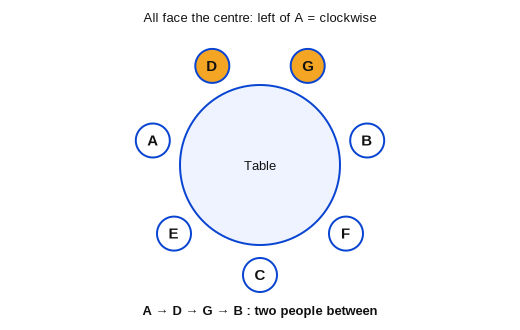
Concept: Facing the centre, a person's right is anticlockwise and left is clockwise.

  1. Fix C; B is second to the right of C; E is third to the left of B.
  2. Three seats remain together for G, D, A with D in the middle; F second to the left of G works only when G is next to B.
  3. Order (anticlockwise from C): C, F, B, G, D, A, E.
  4. Going left (clockwise) from A: D, G, then B → two people.

Trick: D–G–A block must fit in the three empty consecutive seats.

Answer: (B) Two

अवधारणा: केंद्र की ओर मुख होने पर दायाँ = वामावर्त (anticlockwise), बायाँ = दक्षिणावर्त (clockwise)।

  1. C तय करें; B, C के दाएँ दूसरे स्थान पर; E, B के बाएँ तीसरे स्थान पर।
  2. G, D, A के लिए तीन लगातार सीटें बचती हैं, D बीच में; F, G के बाएँ दूसरा तभी होगा जब G, B के पास हो।
  3. क्रम (C से वामावर्त): C, F, B, G, D, A, E।
  4. A के बाएँ (दक्षिणावर्त) चलें: D, G, फिर B → दो व्यक्ति।

ट्रिक: D–G–A समूह तीन खाली लगातार सीटों में ही आएगा।

उत्तर: (B) दो

RRB NTPC Undergraduate CBT 1General Intelligence and ReasoningCircular Seating ArrangementRRB NTPC Undergraduate CBT 1 2024 · 7 Aug Shift 1 →
Q5220.
What should come in place of the question mark (?) in the given series?
6 9 15 24 36 ?
दी गई शृंखला में प्रश्न चिह्न (?) के स्थान पर क्या आना चाहिए?
6 9 15 24 36 ?
  1. A51
  2. B41
  3. C75
  4. D52
Show answer

Concept: Differences form a table of 3.

  1. Differences: 3, 6, 9, 12.
  2. Next difference =15.
  3. 36+15=51.

Trick: Each term =6+3×(1+2+…): 6+3×15=51.

Answer: (A) 51

अवधारणा: अंतर 3 का पहाड़ा बनाते हैं।

  1. अंतर: 3, 6, 9, 12।
  2. अगला अंतर =15।
  3. 36+15=51।

ट्रिक: हर पद =6+3×(1+2+…): 6+3×15=51।

उत्तर: (A) 51

RRB NTPC Undergraduate CBT 1General Intelligence and ReasoningNumber SeriesRRB NTPC Undergraduate CBT 1 2024 · 7 Aug Shift 1 →