Question bank

Q&A: practice questions with answers

Search questions on any topic. Filter by exam category, exam, subject and topic, try the question, then open the answer and explanation.

Courses – airGurukul

20,719 questions found.

Q5281.
The value of 196+0.0324−5.76=
196+0.0324−5.76= का मान
  1. A16.52
  2. B11.78
  3. C3.21
  4. D8.04
Show answer

Concept: Square root of a decimal: take the root of the digits and halve the number of decimal places.

  1. 196=14.
  2. 0.0324=0.18 (since 182=324, 4 decimal places → 2).
  3. 5.76=2.4 (since 242=576).
  4. 14+0.18−2.4=11.78.

Yaad rakhein: Decimal places in the root = half of those under the root sign.

Answer: (B) 11.78

अवधारणा: दशमलव संख्या का वर्गमूल: अंकों का वर्गमूल लें और दशमलव स्थान आधे कर दें।

  1. 196=14।
  2. 0.0324=0.18 (182=324, 4 दशमलव स्थान → 2)।
  3. 5.76=2.4 (242=576)।
  4. 14+0.18−2.4=11.78।

याद रखें: वर्गमूल में दशमलव स्थान = मूल चिह्न के अंदर वाले स्थानों का आधा।

उत्तर: (B) 11.78
RRB NTPC Undergraduate CBT 1MathematicsSquare RootsRRB NTPC Undergraduate CBT 1 2024 · 4 Sep Shift 3 →
Q5282.
The sum of two numbers is 81 and their L.C.M. is 420. What are the two numbers?
दो संख्याओं का योग 81 है और उनका ल.स.प. (L.C.M.) 420 है। वे दो संख्याएँ कौन-सी हैं?
  1. A14, 67
  2. B26, 55
  3. C19, 62
  4. D21, 60
Show answer

Concept: Check options: the pair must add to 81 and have LCM 420.

  1. 420=22×3×5×7; both numbers must divide 420.
  2. 14 + 67, 26 + 55, 19 + 62: 67, 55, 26, 19, 62 do not divide 420.
  3. 21=3×7, 60=22×3×5; LCM =22×3×5×7=420 and 21+60=81.

Trick: Each number must be a factor of the LCM — eliminate options instantly.

Answer: (D) 21, 60

अवधारणा: विकल्प जाँचें: जोड़ी का योग 81 और LCM 420 होना चाहिए।

  1. 420=22×3×5×7; दोनों संख्याएँ 420 की गुणनखंड होनी चाहिए।
  2. 67, 55, 26, 19, 62 — ये 420 को विभाजित नहीं करतीं।
  3. 21=3×7, 60=22×3×5; LCM =420 और 21+60=81।

ट्रिक: प्रत्येक संख्या LCM का गुणनखंड होनी चाहिए — विकल्प तुरंत हटते हैं।

उत्तर: (D) 21, 60

RRB NTPC Undergraduate CBT 1MathematicsLCM and HCFRRB NTPC Undergraduate CBT 1 2024 · 4 Sep Shift 3 →
Q5283.
M and N started a business. M invested ₹66,000 more than N for 5 months, while N invested for 7 months. M's share is ₹205 more than that of N, out of a total profit of ₹3,895. Find the capital contributed by M.
M और N ने एक व्यवसाय आरंभ किया। M ने N से ₹66,000 अधिक राशि 5 माह के लिए निवेश की, जबकि N ने 7 माह के लिए निवेश किया। ₹3,895 के कुल लाभ में से M का हिस्सा N के हिस्से से ₹205 अधिक है। M द्वारा लगाई गई पूँजी ज्ञात कीजिए।
  1. A₹1,84,910
  2. B₹1,84,849
  3. C₹1,84,800
  4. D₹1,84,602
Show answer

Concept: Profit share ∝ capital × time.

  1. M's share =3895+2052=2050, N's =1845; ratio 2050:1845=10:9.
  2. Let N's capital =x: 5(x+66000)7x=109.
  3. 45x+2970000=70x⇒x=118800.
  4. M's capital =118800+66000= ₹1,84,800.

Trick: Divide both shares by their difference (205) to get the ratio fast: 10:9.

Answer: (C) ₹1,84,800

अवधारणा: लाभ का हिस्सा ∝ पूँजी × समय।

  1. M का हिस्सा =3895+2052=2050, N का =1845; अनुपात 2050:1845=10:9।
  2. N की पूँजी =x: 5(x+66000)7x=109।
  3. 45x+2970000=70x⇒x=118800।
  4. M की पूँजी =118800+66000= ₹1,84,800।

ट्रिक: दोनों हिस्सों को अंतर (205) से भाग दें, अनुपात तुरंत 10:9।

उत्तर: (C) ₹1,84,800

RRB NTPC Undergraduate CBT 1MathematicsPartnershipRRB NTPC Undergraduate CBT 1 2024 · 4 Sep Shift 3 →
Q5284.
The sum of two numbers is 115 and their L.C.M. is 600. What are the two numbers?
दो संख्याओं का योग 115 है और उनका ल.स.प. (L.C.M.) 600 है। वे दो संख्याएँ कौन-सी हैं?
  1. A38, 77
  2. B45, 70
  3. C33, 82
  4. D40, 75
Show answer

Concept: Both numbers must be factors of the LCM and add up to 115.

  1. 600=23×3×52.
  2. 77, 38, 33, 82, 70, 45 are not factors of 600 → options A, B, C fail.
  3. 40=23×5, 75=3×52; LCM =23×3×52=600 and 40+75=115.

Trick: Use the factor test on the LCM to eliminate options.

Answer: (D) 40, 75

अवधारणा: दोनों संख्याएँ LCM की गुणनखंड हों और योग 115 हो।

  1. 600=23×3×52।
  2. 77, 38, 33, 82, 70, 45 — 600 के गुणनखंड नहीं → A, B, C गलत।
  3. 40=23×5, 75=3×52; LCM =600 और 40+75=115।

ट्रिक: LCM के गुणनखंड वाली जाँच से विकल्प हटाएँ।

उत्तर: (D) 40, 75

RRB NTPC Undergraduate CBT 1MathematicsLCM and HCFRRB NTPC Undergraduate CBT 1 2024 · 4 Sep Shift 3 →
Q5285.
The value of 72+102−264−6 is
72+102−264−6 का मान है
  1. A38
  2. B29
  3. C37
  4. D46
Show answer

Concept: Evaluate powers and roots first (BODMAS), then add/subtract.

  1. 72=49, 102=10, 264=2×8=16.
  2. 49+10−16−6=37.

Yaad rakhein: a2=a for positive a.

Answer: (C) 37

अवधारणा: पहले घात और मूल (BODMAS), फिर जोड़-घटाव।

  1. 72=49, 102=10, 264=2×8=16।
  2. 49+10−16−6=37।

याद रखें: धनात्मक a के लिए a2=a।

उत्तर: (C) 37

RRB NTPC Undergraduate CBT 1MathematicsSimplificationRRB NTPC Undergraduate CBT 1 2024 · 4 Sep Shift 3 →
Q5286.
The product of two consecutive natural numbers is 30. The greater of the two numbers is:
दो क्रमागत प्राकृत संख्याओं का गुणनफल 30 है। दोनों संख्याओं में से बड़ी संख्या है:
  1. A12
  2. B3
  3. C6
  4. D24
Show answer

Concept: Consecutive natural numbers: n(n+1)=30.

  1. 5×6=30.
  2. Greater number = 6.

Trick: Take 30≈5.5 — the two numbers lie on either side: 5 and 6.

Answer: (C) 6

अवधारणा: क्रमागत प्राकृत संख्याएँ: n(n+1)=30।

  1. 5×6=30।
  2. बड़ी संख्या = 6।

ट्रिक: 30≈5.5 — दोनों संख्याएँ इसके दोनों ओर: 5 और 6।

उत्तर: (C) 6

RRB NTPC Undergraduate CBT 1MathematicsNumber SystemRRB NTPC Undergraduate CBT 1 2024 · 4 Sep Shift 3 →
Q5287.
Aryan has to reach Ahmedabad which is 977 km away in 11 hours. His starting speed for 4 hours was 39 km/hr. For the next 140 km his speed was 35 km/hr. By what speed he must travel now so as to reach Ahmedabad in the decided time of 11 hours?
आर्यन को 977 km दूर स्थित अहमदाबाद 11 घंटे में पहुँचना है। प्रारंभिक 4 घंटों में उसकी चाल 39 km/hr थी। अगले 140 km के लिए उसकी चाल 35 km/hr थी। निर्धारित 11 घंटे के समय में अहमदाबाद पहुँचने के लिए अब उसे किस चाल से यात्रा करनी होगी?
  1. A227 km/hr
  2. B231 km/hr
  3. C221 km/hr
  4. D229 km/hr
Show answer

Concept: Required speed = remaining distance ÷ remaining time.

  1. First part: 39×4=156 km in 4 h.
  2. Next 140 km at 35 km/h → 14035=4 h.
  3. Used: 8 h, 296 km. Left: 977−296=681 km in 3 h.
  4. Speed =6813=227km/h.

Trick: Track both distance and time used so far in one line: (296 km, 8 h).

Answer: (A) 227 km/hr

अवधारणा: आवश्यक चाल = शेष दूरी ÷ शेष समय।

  1. पहला भाग: 39×4=156 km, 4 घंटे में।
  2. अगले 140 km, 35 km/h से → 14035=4 घंटे।
  3. उपयोग: 8 घंटे, 296 km। शेष: 977−296=681 km, 3 घंटे में।
  4. चाल =6813=227km/h।

ट्रिक: अब तक की दूरी और समय एक साथ लिखें: (296 km, 8 घंटे)।

उत्तर: (A) 227 km/hr

RRB NTPC Undergraduate CBT 1MathematicsSpeed, Time and DistanceRRB NTPC Undergraduate CBT 1 2024 · 4 Sep Shift 3 →
Q5288.
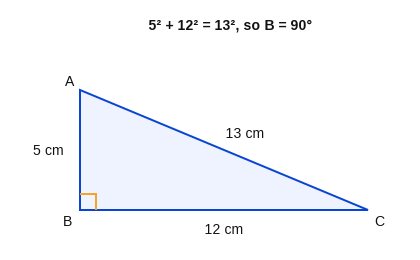
Find the area of a triangle whose sides are of lengths 5 cm, 12 cm and 13 cm.
उस त्रिभुज का क्षेत्रफल ज्ञात कीजिए जिसकी भुजाओं की लंबाई 5 cm, 12 cm और 13 cm है।
  1. A32.5 cm2
  2. B78 cm2
  3. C30 cm2
  4. D60 cm2
Show answer

Concept: 5, 12, 13 is a Pythagorean triplet, so the triangle is right-angled; area =12×base×height.

  1. 52+122=25+144=169=132 → right angle between sides 5 and 12.
  2. Area =12×5×12=30cm2.

Trick: Remember triplets (3,4,5), (5,12,13), (8,15,17), (7,24,25) — no Heron's formula needed.

Answer: (C) 30cm2

अवधारणा: 5, 12, 13 पाइथागोरस त्रिक (Pythagorean triplet) है, अतः त्रिभुज समकोण है; क्षेत्रफल =12×आधार×ऊँचाई।

  1. 52+122=25+144=169=132 → 5 और 12 के बीच समकोण।
  2. क्षेत्रफल =12×5×12=30cm2।

ट्रिक: त्रिक याद रखें: (3,4,5), (5,12,13), (8,15,17), (7,24,25) — हीरोन सूत्र की ज़रूरत नहीं।

उत्तर: (C) 30cm2

RRB NTPC Undergraduate CBT 1MathematicsMensuration – TriangleRRB NTPC Undergraduate CBT 1 2024 · 4 Sep Shift 3 →
Q5289.
Simplify: 3((43)x2−25x+12)−4(x2+7x−18).
सरल कीजिए: 3((43)x2−25x+12)−4(x2+7x−18)।
  1. A103x+108
  2. B103x−108
  3. C−103x−108
  4. D−103x+108
Show answer

Concept: Expand each bracket and combine like terms.

  1. 3(43x2−25x+12)=4x2−75x+36.
  2. −4(x2+7x−18)=−4x2−28x+72.
  3. Add: (4x2−4x2)+(−75x−28x)+(36+72)=−103x+108.

Trick: The x2 terms cancel; just check the constant: 36+72=108 (positive) → only option D.

Answer: (D) −103x+108

अवधारणा: प्रत्येक कोष्ठक खोलें और समान पद जोड़ें।

  1. 3(43x2−25x+12)=4x2−75x+36।
  2. −4(x2+7x−18)=−4x2−28x+72।
  3. जोड़ें: (4x2−4x2)+(−75x−28x)+(36+72)=−103x+108।

ट्रिक: x2 पद कट जाते हैं; x का गुणांक −103 और अचर +108 → विकल्प D।

उत्तर: (D) −103x+108

RRB NTPC Undergraduate CBT 1MathematicsAlgebra – SimplificationRRB NTPC Undergraduate CBT 1 2024 · 4 Sep Shift 3 →
Q5290.
The LCM of the numbers 14.2 and 0.05 is:
संख्याओं 14.2 और 0.05 का ल.स.प. (LCM) है:
  1. A142
  2. B1.42
  3. C0.142
  4. D14.2
Show answer

Concept: Make decimal places equal, find the LCM of the whole numbers, then put back the decimal places.

  1. 14.20 and 0.05 → 1420 and 5 (2 decimal places).
  2. LCM(1420,5)=1420 (as 1420 is a multiple of 5).
  3. LCM =14.20=14.2.

Trick: If the larger number is a multiple of the smaller, it is itself the LCM: 14.2÷0.05=284.

Answer: (D) 14.2

अवधारणा: दशमलव स्थान बराबर करें, पूर्णांकों का LCM निकालें, फिर दशमलव वापस लगाएँ।

  1. 14.20 और 0.05 → 1420 और 5 (2 दशमलव स्थान)।
  2. LCM(1420,5)=1420।
  3. LCM =14.20=14.2।

ट्रिक: यदि बड़ी संख्या छोटी की गुणज है तो वही LCM है: 14.2÷0.05=284।

उत्तर: (D) 14.2

RRB NTPC Undergraduate CBT 1MathematicsLCM of DecimalsRRB NTPC Undergraduate CBT 1 2024 · 4 Sep Shift 3 →
Q5291.
The marked price of a ceiling fan is ₹2,500. During off season, it is sold for ₹1,360. Find the discount percentage.
एक सीलिंग फैन का अंकित मूल्य ₹2,500 है। ऑफ-सीज़न के दौरान, इसे ₹1,360 में बेचा जाता है। छूट प्रतिशत ज्ञात कीजिए।
  1. A44.5%
  2. B45%
  3. C45.6%
  4. D42%
Show answer

Concept: Discount%=MP−SPMP×100.

  1. Discount =2500−1360= ₹1,140.
  2. 11402500×100=45.6%.

Trick: Divide by 25: 114025=45.6.

Answer: (C) 45.6%

अवधारणा: छूट%=अंकित मूल्य−विक्रय मूल्यअंकित मूल्य×100।

  1. छूट =2500−1360= ₹1,140।
  2. 11402500×100=45.6%।

ट्रिक: 25 से भाग दें: 114025=45.6।

उत्तर: (C) 45.6%

RRB NTPC Undergraduate CBT 1MathematicsDiscountRRB NTPC Undergraduate CBT 1 2024 · 4 Sep Shift 3 →
Q5292.
The LCM of the numbers 10.8 and 0.06 is:
संख्याओं 10.8 और 0.06 का ल.स.प. (LCM) है:
  1. A108
  2. B1.08
  3. C10.8
  4. D0.108
Show answer

Concept: Equalise decimal places, take LCM of the integers, restore the decimal.

  1. 10.80 and 0.06 → 1080 and 6.
  2. LCM(1080,6)=1080.
  3. LCM =10.80=10.8.

Trick: 10.8÷0.06=180 (whole number), so the larger number itself is the LCM.

Answer: (C) 10.8

अवधारणा: दशमलव स्थान बराबर करें, पूर्णांकों का LCM लें, फिर दशमलव लगाएँ।

  1. 10.80 और 0.06 → 1080 और 6।
  2. LCM(1080,6)=1080।
  3. LCM =10.80=10.8।

ट्रिक: 10.8÷0.06=180 (पूर्ण संख्या), अतः बड़ी संख्या ही LCM है।

उत्तर: (C) 10.8

RRB NTPC Undergraduate CBT 1MathematicsLCM of DecimalsRRB NTPC Undergraduate CBT 1 2024 · 4 Sep Shift 3 →
Q5293.
The average runs scored by a batsman in 23 matches is 44. In the next 10 matches, the batsman scored an average of 14 runs. Find his average runs scored (rounded off to two decimal places) in all the 33 matches.
एक बल्लेबाज़ द्वारा 23 मैचों में बनाए गए रनों का औसत 44 है। अगले 10 मैचों में बल्लेबाज़ ने 14 रन का औसत बनाया। सभी 33 मैचों में उसके द्वारा बनाए गए रनों का औसत (दो दशमलव स्थानों तक पूर्णांकित) ज्ञात कीजिए।
  1. A36.91
  2. B33.91
  3. C35.91
  4. D34.91
Show answer

Concept: Overall average = total runs ÷ total matches.

  1. First 23 matches: 23×44=1012 runs.
  2. Next 10: 10×14=140 runs.
  3. Average =1012+14033=115233=34.909…≈34.91.

Trick: Deviation method: 44−10×3033=44−9.09=34.91.

Answer: (D) 34.91

अवधारणा: कुल औसत = कुल रन ÷ कुल मैच।

  1. पहले 23 मैच: 23×44=1012 रन।
  2. अगले 10: 10×14=140 रन।
  3. औसत =115233=34.909…≈34.91।

ट्रिक: विचलन विधि: 44−10×3033=44−9.09=34.91।

उत्तर: (D) 34.91

RRB NTPC Undergraduate CBT 1MathematicsAverageRRB NTPC Undergraduate CBT 1 2024 · 4 Sep Shift 3 →
Q5294.
The sum of all interior angles of a regular polygon is equal to twice the sum of all its exterior angles. The number of sides of the polygon is:
एक सम बहुभुज के सभी अंतः कोणों का योग उसके सभी बाह्य कोणों के योग के दोगुने के बराबर है। बहुभुज की भुजाओं की संख्या है:
  1. A6
  2. B4
  3. C3
  4. D8
Show answer

Concept: Sum of exterior angles of any polygon =360∘; sum of interior angles =(n−2)×180∘.

  1. Interior sum =2×360∘=720∘.
  2. (n−2)×180=720⇒n−2=4⇒n=6.

Trick: Interior sum = k×360∘ gives n=2k+2; here k=2 → n=6.

Answer: (A) 6

अवधारणा: किसी भी बहुभुज के बाह्य कोणों का योग =360∘; अंतः कोणों का योग =(n−2)×180∘।

  1. अंतः कोणों का योग =2×360∘=720∘।
  2. (n−2)×180=720⇒n=6।

ट्रिक: अंतः योग =k×360∘ हो तो n=2k+2; यहाँ k=2 → n=6।

उत्तर: (A) 6

RRB NTPC Undergraduate CBT 1MathematicsPolygonsRRB NTPC Undergraduate CBT 1 2024 · 4 Sep Shift 3 →
Q5295.
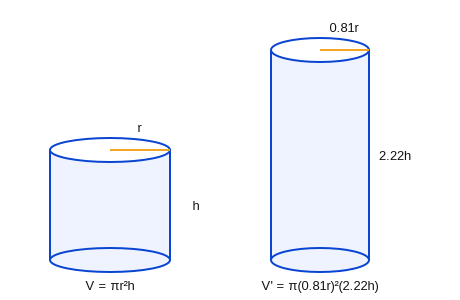
If the radius of the base of a right circular cylinder is decreased by 19% and its height is increased by 122%, then what is the percentage increase (closest integer) in its volume?
यदि एक लंब वृत्तीय बेलन के आधार की त्रिज्या में 19% की कमी की जाती है और उसकी ऊँचाई में 122% की वृद्धि की जाती है, तो उसके आयतन में कितने प्रतिशत की वृद्धि (निकटतम पूर्णांक) होगी?
  1. A33%
  2. B40%
  3. C50%
  4. D46%
Show answer

Concept: V=πr2h; new volume factor =(radius factor)2×height factor.

  1. Radius factor =0.81, height factor =2.22.
  2. 0.812×2.22=0.6561×2.22=1.4565.
  3. Increase ≈45.65%≈46%.

Trick: Successive %: −19% twice =−34.39%; then −34.39+122−34.39×122100=45.65%.

Answer: (D) 46%

अवधारणा: V=πr2h; नया आयतन गुणक =(त्रिज्या गुणक)2×ऊँचाई गुणक।

  1. त्रिज्या गुणक =0.81, ऊँचाई गुणक =2.22।
  2. 0.812×2.22=0.6561×2.22=1.4565।
  3. वृद्धि ≈45.65%≈46%।

ट्रिक: क्रमिक %: −19% दो बार =−34.39%; फिर −34.39+122−34.39×122100=45.65%।

उत्तर: (D) 46%

RRB NTPC Undergraduate CBT 1MathematicsMensuration – CylinderRRB NTPC Undergraduate CBT 1 2024 · 4 Sep Shift 3 →
Q5296.
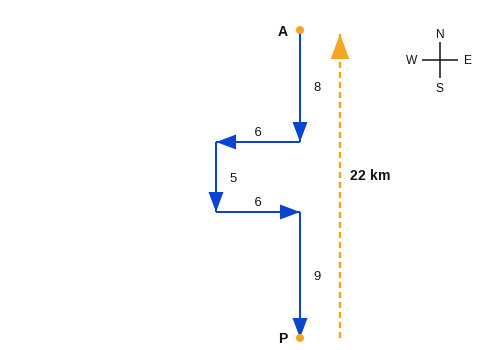
Sophie starts from Point A and drives 8 km towards south. She then takes a right turn, drives 6 km, turns left and drives 5 km. She then takes a left turn and drives 6 km. She takes a final right turn, drives 9 km and stops at Point P. How far (shortest distance) and towards which direction should she drive in order to reach Point A again? (All turns are 90° turns only unless specified.)
सोफी बिंदु A से आरंभ करती है और दक्षिण की ओर 8 km गाड़ी चलाती है। फिर वह दाएँ मुड़ती है, 6 km गाड़ी चलाती है, बाएँ मुड़ती है और 5 km गाड़ी चलाती है। फिर वह बाएँ मुड़ती है और 6 km गाड़ी चलाती है। वह अंतिम बार दाएँ मुड़ती है, 9 km गाड़ी चलाती है और बिंदु P पर रुक जाती है। पुनः बिंदु A पर पहुँचने के लिए उसे कितनी दूर (न्यूनतम दूरी) और किस दिशा में गाड़ी चलानी चाहिए? (जब तक निर्दिष्ट न हो, सभी मोड़ केवल 90° के मोड़ हैं।)
  1. A18 km towards southदक्षिण की ओर 18 km
  2. B22 km towards southदक्षिण की ओर 22 km
  3. C18 km towards eastपूर्व की ओर 18 km
  4. D22 km towards northउत्तर की ओर 22 km
Show answer

Concept: Draw the path step by step; a right turn while facing south means heading west.

  1. 8 km south, right → west 6 km, left → south 5 km.
  2. Left → east 6 km (back in line with A), right → south 9 km to P.
  3. East–west moves cancel (6−6=0); south total =8+5+9=22 km.
  4. So P is 22 km south of A → drive 22 km north.

Trick: Net displacement = (sum of east − west, sum of north − south).

Answer: (D) 22 km towards north

अवधारणा: रास्ता क्रम से बनाएँ; दक्षिण की ओर मुँह करके दाएँ मुड़ने पर दिशा पश्चिम होती है।

  1. 8 km दक्षिण, दाएँ → पश्चिम 6 km, बाएँ → दक्षिण 5 km।
  2. बाएँ → पूर्व 6 km, दाएँ → दक्षिण 9 km तक P।
  3. पूर्व–पश्चिम कट जाते हैं (6−6=0); कुल दक्षिण =8+5+9=22 km।
  4. P, A से 22 km दक्षिण में → 22 km उत्तर जाना होगा।

ट्रिक: शुद्ध विस्थापन = (पूर्व − पश्चिम, उत्तर − दक्षिण)।

उत्तर: (D) 22 km उत्तर की ओर

RRB NTPC Undergraduate CBT 1General Intelligence and ReasoningDirection and DistanceRRB NTPC Undergraduate CBT 1 2024 · 4 Sep Shift 3 →
Q5297.
Based on the English alphabetical order, three of the following four letter-cluster pairs are alike in a certain way and thus form a group. Which letter-cluster pair DOES NOT belong to that group?
(Note: The odd one out is not based on the number of consonants/vowels or their position in the letter-cluster pair.)
अंग्रेज़ी वर्णमाला क्रम के आधार पर, निम्नलिखित चार अक्षर-समूह युग्मों में से तीन किसी निश्चित प्रकार से एक समान हैं और इस प्रकार एक समूह बनाते हैं। कौन-सा अक्षर-समूह युग्म उस समूह से संबंधित नहीं है?
(नोट: असंगत युग्म, अक्षर-समूह युग्म में व्यंजनों/स्वरों की संख्या या उनके स्थान पर आधारित नहीं है।)
  1. ASV-YD
  2. BBE-HM
  3. CDG-JO
  4. DFI-LO
Show answer

Concept: Use letter positions (A = 1 … Z = 26) and find the gaps.

  1. SV-YD: S→V +3, S→Y +6, V→D +8 (22 + 8 = 30 − 26 = 4).
  2. BE-HM: +3, +6, +8; DG-JO: +3, +6, +8.
  3. FI-LO: F→I +3, F→L +6, but I→O +6 (not +8).

Trick: Write gaps as a triple (+3, +6, +8) for each pair; the one with a different triple is odd.

Answer: (D) FI-LO

अवधारणा: अक्षरों की स्थिति (A = 1 … Z = 26) से अंतर देखें।

  1. SV-YD: S→V +3, S→Y +6, V→D +8 (22 + 8 = 30 − 26 = 4)।
  2. BE-HM: +3, +6, +8; DG-JO: +3, +6, +8।
  3. FI-LO: +3, +6, पर I→O +6 (+8 नहीं)।

ट्रिक: हर जोड़ी के अंतर (+3, +6, +8) लिखें; अलग वाला विषम है।

उत्तर: (D) FI-LO

RRB NTPC Undergraduate CBT 1General Intelligence and ReasoningLetter Analogy / Odd One OutRRB NTPC Undergraduate CBT 1 2024 · 4 Sep Shift 3 →
Q5298.
In the following number-pairs, the second number is obtained by applying certain mathematical operations to the first number. Select the pair in which the numbers are related in the same way as are the numbers of the following pairs.
(Note: Operations should be performed on the whole numbers, without breaking down the numbers into its constituent digits. E.g., 13 – Operations on 13 such as
adding/subtracting/multiplying etc. to 13 can be performed. Breaking down 13 into 1 and 3 and then performing mathematical operations on 1 and 3 is not allowed.) 96, 12
184, 23
निम्नलिखित संख्या-युग्मों में, पहली संख्या पर कुछ गणितीय संक्रियाएँ करके दूसरी संख्या प्राप्त की जाती है। उस युग्म का चयन कीजिए जिसमें संख्याएँ उसी प्रकार संबंधित हैं जिस प्रकार निम्नलिखित युग्मों की संख्याएँ संबंधित हैं।
(नोट: संख्याओं को उनके घटक अंकों में विभाजित किए बिना, पूर्ण संख्याओं पर संक्रियाएँ की जानी चाहिए। उदाहरण के लिए, 13 – 13 पर संक्रियाएँ जैसे
13 में जोड़ना/घटाना/गुणा करना आदि किया जा सकता है। 13 को 1 और 3 में विभाजित करना और फिर 1 और 3 पर गणितीय संक्रियाएँ करना वर्जित है।) 96, 12
184, 23
  1. A164, 20
  2. B144, 18
  3. C172, 21
  4. D130, 16
Show answer

Concept: Find the single operation linking the two numbers.

  1. 96÷8=12, 184÷8=23.
  2. 144÷8=18 ✓; 164÷8=20.5, 172÷8=21.5, 130÷8=16.25.

Trick: Second number = first ÷ 8, i.e. first =8× second.

Answer: (B) 144, 18

अवधारणा: दोनों संख्याओं को जोड़ने वाली क्रिया खोजें।

  1. 96÷8=12, 184÷8=23।
  2. 144÷8=18 ✓; 164÷8=20.5, 172÷8=21.5, 130÷8=16.25।

ट्रिक: दूसरी संख्या = पहली ÷ 8।

उत्तर: (B) 144, 18

RRB NTPC Undergraduate CBT 1General Intelligence and ReasoningNumber Pair AnalogyRRB NTPC Undergraduate CBT 1 2024 · 4 Sep Shift 3 →
Q5299.
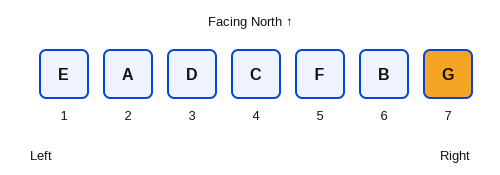
Seven people A, B, C, D, E, F and G are sitting in a row, facing the north. Only five people sit to the left of B. Only five people sit to the right of A. C sits to the immediate left of F but right of D. E does not sit to the right of D. How many people sit to the right of G?
सात व्यक्ति A, B, C, D, E, F और G एक पंक्ति में उत्तर की ओर मुख करके बैठे हैं। B के बाईं ओर केवल पाँच व्यक्ति बैठे हैं। A के दाईं ओर केवल पाँच व्यक्ति बैठे हैं। C, F के ठीक बाईं ओर लेकिन D के दाईं ओर बैठा है। E, D के दाईं ओर नहीं बैठा है। G के दाईं ओर कितने व्यक्ति बैठे हैं?
  1. AFiveपाँच
  2. BZeroशून्य
  3. CThreeतीन
  4. DFourचार
Show answer

Concept: Fix the definite positions first (counted from the left for north-facing people).

  1. 5 people left of B → B is 6th; 5 people right of A → A is 2nd.
  2. E is left of D, D left of C, and C is immediately left of F.
  3. C–F at 3–4 leaves no room for both E and D before C; so E = 1, D = 3, C = 4, F = 5, G = 7.
  4. Order: E A D C F B G → nobody is right of G.

Trick: Place the people with exact positions first; the chain E < D < C-F then fits only one way.

Answer: (B) Zero

अवधारणा: पहले निश्चित स्थान तय करें (उत्तर की ओर मुख वालों के लिए बाएँ से गिनती)।

  1. B के बाएँ 5 → B छठा; A के दाएँ 5 → A दूसरा।
  2. E, D के बाएँ; D, C के बाएँ; C, F के ठीक बाएँ।
  3. अतः E = 1, D = 3, C = 4, F = 5, G = 7।
  4. क्रम: E A D C F B G → G के दाएँ कोई नहीं।

ट्रिक: पहले निश्चित स्थान भरें; फिर श्रृंखला E < D < C-F केवल एक तरह बैठती है।

उत्तर: (B) शून्य (Zero)

RRB NTPC Undergraduate CBT 1General Intelligence and ReasoningLinear Seating ArrangementRRB NTPC Undergraduate CBT 1 2024 · 4 Sep Shift 3 →
Q5300.
If 1 is added for each even digit and 1 is subtracted from each odd digit of the number 56218643, how many digits are repeated more than once in the new number thus formed?
यदि संख्या 56218643 के प्रत्येक सम अंक में 1 जोड़ा जाए और प्रत्येक विषम अंक में से 1 घटाया जाए, तो इस प्रकार बनी नई संख्या में कितने अंक एक से अधिक बार आएँगे?
  1. ATwoदो
  2. BNoneकोई नहीं
  3. CThreeतीन
  4. DOneएक
Show answer

Concept: Apply the rule digit by digit: even → +1, odd → −1.

  1. 5 6 2 1 8 6 4 3 → 4 7 3 0 9 7 5 2.
  2. Count each digit in 47309752: only 7 appears twice; the rest once.
  3. So one digit is repeated.

Trick: Equal original digits give equal new digits — the two 6's become two 7's; check others don't collide (5→4 and 4→5 swap, 3→2 and 2→3 swap).

Answer: (D) One

अवधारणा: हर अंक पर नियम लगाएँ: सम → +1, विषम → −1।

  1. 5 6 2 1 8 6 4 3 → 4 7 3 0 9 7 5 2।
  2. 47309752 में केवल 7 दो बार आया; बाकी एक-एक बार।
  3. अतः एक अंक दोहराया गया।

ट्रिक: मूल संख्या के समान अंक नई संख्या में भी समान होंगे — दोनों 6 बने दो 7; बाकी (5↔4, 3↔2) आपस में अदला-बदली करते हैं।

उत्तर: (D) एक (One)

RRB NTPC Undergraduate CBT 1General Intelligence and ReasoningDigit OperationsRRB NTPC Undergraduate CBT 1 2024 · 4 Sep Shift 3 →