Question bank

Q&A: practice questions with answers

Search questions on any topic. Filter by exam category, exam, subject and topic, try the question, then open the answer and explanation.

Courses – airGurukul

20,719 questions found.

Q5381.
The average of first 157 even numbers is
प्रथम 157 सम संख्याओं का औसत है
  1. A158.5
  2. B157.5
  3. C159
  4. D158
Show answer

Concept: Sum of first n even numbers =n(n+1), so their average =n+1.

  1. Here n=157.
  2. Sum =157×158.
  3. Average =157×158157=158.

Yaad rakhein: Average of first n even numbers =n+1; of first n odd numbers =n.

Answer: (D) 158

अवधारणा: पहली n सम संख्याओं का योग =n(n+1), अतः औसत =n+1।

  1. यहाँ n=157।
  2. योग =157×158।
  3. औसत =157×158157=158।

याद रखें: पहली n सम संख्याओं का औसत =n+1; पहली n विषम संख्याओं का औसत =n।

उत्तर: (D) 158

RRB NTPC Undergraduate CBT 1MathematicsAverageRRB NTPC Undergraduate CBT 1 2024 · 4 Sep Shift 2 →
Q5382.
The H.C.F. and the L.C.M. of two numbers are 28 and 840, respectively. If one of the numbers is 168, find the other one.
दो संख्याओं का म.स. (H.C.F.) और ल.स. (L.C.M.) क्रमशः 28 और 840 हैं। यदि उनमें से एक संख्या 168 है, तो दूसरी संख्या ज्ञात कीजिए।
  1. A140
  2. B196
  3. C84
  4. D112
Show answer

Concept: Product of two numbers =HCF×LCM.

  1. 168×x=28×840
  2. x=23520168=140
  3. Check: HCF(168,140)=28 ✓

Trick: 840168=5, so other number =28×5=140.

Answer: (A) 140

अवधारणा: दो संख्याओं का गुणनफल =HCF×LCM।

  1. 168×x=28×840
  2. x=23520168=140
  3. जाँच: HCF(168,140)=28 ✓

ट्रिक: 840168=5, अतः दूसरी संख्या =28×5=140।

उत्तर: (A) 140

RRB NTPC Undergraduate CBT 1MathematicsHCF and LCMRRB NTPC Undergraduate CBT 1 2024 · 4 Sep Shift 2 →
Q5383.
An amount of ₹432 is divided among three persons in the ratio of 5 : 14 : 17. The difference between the largest and the smallest shares (in ₹) in the distribution is:
₹432 की राशि को तीन व्यक्तियों में 5 : 14 : 17 के अनुपात में बाँटा जाता है। इस वितरण में सबसे बड़े और सबसे छोटे भाग के बीच का अंतर (₹ में) है:
  1. A144
  2. B62
  3. C178
  4. D132
Show answer

Concept: Each ratio unit =Totalsum of ratio terms.

  1. Sum of terms =5+14+17=36.
  2. 1 unit =43236=12.
  3. Difference =(17−5)×12=144.

Trick: Work directly with the difference of ratio terms (12 units).

Answer: (A) 144

अवधारणा: एक इकाई =कुलअनुपात पदों का योग।

  1. पदों का योग =5+14+17=36।
  2. 1 इकाई =43236=12।
  3. अंतर =(17−5)×12=144।

ट्रिक: सीधे अनुपात पदों के अंतर (12 इकाई) से गुणा करें।

उत्तर: (A) 144

RRB NTPC Undergraduate CBT 1MathematicsRatio and proportionRRB NTPC Undergraduate CBT 1 2024 · 4 Sep Shift 2 →
Q5384.
A kurta is marked for ₹750 and sold for ₹660. The rate of discount is:
एक कुर्ते पर ₹750 अंकित है और उसे ₹660 में बेचा जाता है। छूट की दर है:
  1. A14%
  2. B15%
  3. C12%
  4. D20%
Show answer

Concept: Discount%=MP−SPMP×100.

  1. Discount =750−660=90.
  2. Rate =90750×100=12%.

Trick: Discount % is always on marked price.

Answer: (C) 12%

अवधारणा: छूट%=MP−SPMP×100।

  1. छूट =750−660=90।
  2. दर =90750×100=12%।

ट्रिक: छूट % हमेशा अंकित मूल्य पर होता है।

उत्तर: (C) 12%

RRB NTPC Undergraduate CBT 1MathematicsDiscountRRB NTPC Undergraduate CBT 1 2024 · 4 Sep Shift 2 →
Q5385.
Find the mean proportional between 15 and 240.
15 और 240 का मध्यानुपाती ज्ञात कीजिए।
  1. A60
  2. B58
  3. C63
  4. D57
Show answer

Concept: Mean proportional of a and b =ab.

  1. 15×240=3600
  2. 3600=60
  3. Check: 15:60=60:240 ✓

Yaad rakhein: Mean proportional =ab; third proportional =b2a.

Answer: (A) 60

अवधारणा: a और b का मध्यानुपाती =ab।

  1. 15×240=3600
  2. 3600=60
  3. जाँच: 15:60=60:240 ✓

याद रखें: मध्यानुपाती =ab; तृतीयानुपाती =b2a।

उत्तर: (A) 60

RRB NTPC Undergraduate CBT 1MathematicsMean proportionalRRB NTPC Undergraduate CBT 1 2024 · 4 Sep Shift 2 →
Q5386.
If P=secθ+tanθ, then the value of P2+12P is:
यदि P=secθ+tanθ है, तो P2+12P का मान है:
  1. A1
  2. Btanθ
  3. C0
  4. Dsecθ
Show answer

Concept: sec2θ−tan2θ=1⇒(secθ+tanθ)(secθ−tanθ)=1.

  1. P=secθ+tanθ⇒1P=secθ−tanθ.
  2. P2+12P=12(P+1P).
  3. =12(2secθ)=secθ.

Trick: Put θ=0∘: P=1, value =22=1=sec0∘ – but tan0∘=0, so try θ=60∘ to separate: matches secθ.

Answer: (D) secθ

अवधारणा: sec2θ−tan2θ=1⇒(secθ+tanθ)(secθ−tanθ)=1।

  1. P=secθ+tanθ⇒1P=secθ−tanθ।
  2. P2+12P=12(P+1P)।
  3. =12(2secθ)=secθ।

ट्रिक: θ=0∘ रखने पर मान 1 आता है जो 1 और secθ दोनों से मेल खाता है; θ=60∘ रखकर जाँचें: उत्तर secθ।

उत्तर: (D) secθ

RRB NTPC Undergraduate CBT 1MathematicsTrigonometric identitiesRRB NTPC Undergraduate CBT 1 2024 · 4 Sep Shift 2 →
Q5387.
The product of two consecutive natural numbers is 272. The greater of the two numbers is:
दो क्रमागत प्राकृत संख्याओं का गुणनफल 272 है। दोनों में से बड़ी संख्या है:
  1. A9
  2. B36
  3. C28
  4. D17
Show answer

Concept: Consecutive numbers n(n+1) – their product lies just above n2.

  1. 272≈16.5, so try 16 and 17.
  2. 16×17=272 ✓
  3. Greater number =17.

Trick: Unit digit 2 (6×7) confirms 16×17.

Answer: (D) 17

अवधारणा: क्रमागत संख्याएँ n(n+1) – गुणनफल n2 से थोड़ा अधिक होता है।

  1. 272≈16.5, अतः 16 और 17 जाँचें।
  2. 16×17=272 ✓
  3. बड़ी संख्या =17।

ट्रिक: इकाई अंक 2 (6×7) से 16×17 पुष्टि होती है।

उत्तर: (D) 17

RRB NTPC Undergraduate CBT 1MathematicsNumber systemRRB NTPC Undergraduate CBT 1 2024 · 4 Sep Shift 2 →
Q5388.
Pipe A can fill a tank in 17 hours, pipe B can fill the same tank in 27 hours and pipe C can fill the same tank in 12 hours. The time taken by them to fill the same tank if they operate together is::
पाइप A एक टंकी को 17 घंटे में, पाइप B उसी टंकी को 27 घंटे में और पाइप C उसी टंकी को 12 घंटे में भर सकता है। यदि वे एक साथ कार्य करें, तो उसी टंकी को भरने में उनके द्वारा लिया गया समय है:
  1. A14191329 hours14191329 घंटे
  2. B13191329 hours13191329 घंटे
  3. C5191329 hours5191329 घंटे
  4. D10191329 hours10191329 घंटे
Show answer

Concept: Add the hourly filling rates: 117+127+112.

  1. LCM (17,27,12)=1836 (tank capacity units).
  2. Rates: 108+68+153=329 units/hour.
  3. Time =1836329=5191329 hours.

Trick: Time must be less than the fastest pipe alone (12 h) – only 5191329 fits.

Answer: (C) 5191329 hours

अवधारणा: प्रति घंटा भरने की दरें जोड़ें: 117+127+112।

  1. LCM (17,27,12)=1836 (टंकी की क्षमता इकाई)।
  2. दरें: 108+68+153=329 इकाई/घंटा।
  3. समय =1836329=5191329 घंटे।

ट्रिक: समय सबसे तेज पाइप (12 घंटे) से कम ही होगा – केवल 5191329 सही बैठता है।

उत्तर: (C) 5191329 घंटे

RRB NTPC Undergraduate CBT 1MathematicsPipes and cisternsRRB NTPC Undergraduate CBT 1 2024 · 4 Sep Shift 2 →
Q5389.
Simplify: x(3x - 6) + 4(x2 -5) + 15
सरल कीजिए: x(3x - 6) + 4(x2 -5) + 15
  1. A-7x2 -6x + 5
  2. B-7x2 -6x -5
  3. C7x2 - 6x + 5
  4. D7x2 - 6x - 5
Show answer

Concept: Expand brackets, then combine like terms.

  1. x(3x−6)=3x2−6x
  2. 4(x2−5)=4x2−20
  3. Total =7x2−6x−20+15=7x2−6x−5

Trick: Constant term: −20+15=−5 rules out options with +5.

Answer: (D) 7x2−6x−5

अवधारणा: कोष्ठक खोलें, फिर समान पद जोड़ें।

  1. x(3x−6)=3x2−6x
  2. 4(x2−5)=4x2−20
  3. कुल =7x2−6x−20+15=7x2−6x−5

ट्रिक: अचर पद: −20+15=−5, इससे +5 वाले विकल्प हट जाते हैं।

उत्तर: (D) 7x2−6x−5

RRB NTPC Undergraduate CBT 1MathematicsAlgebraic simplificationRRB NTPC Undergraduate CBT 1 2024 · 4 Sep Shift 2 →
Q5390.
Pipe P can fill 59 part of a tank in 25 hours, and pipe Q can fill 37 part of the same tank in 27 hours. Both P and Q were kept open for 3 hours, then both were closed. Pipe R alone was then opened and it emptied the water in the tank in 4 hours. Pipes P, Q and R together can fill the empty tank in:
पाइप P किसी टंकी का 59 भाग 25 घंटे में भर सकता है, और पाइप Q उसी टंकी का 37 भाग 27 घंटे में भर सकता है। P और Q दोनों को 3 घंटे के लिए खुला रखा गया, फिर दोनों को बंद कर दिया गया। इसके बाद केवल पाइप R को खोला गया और उसने टंकी का पानी 4 घंटे में खाली कर दिया। पाइप P, Q और R एक साथ खाली टंकी को कितने समय में भर सकते हैं?
  1. A108 hours108 घंटे
  2. B93 hours93 घंटे
  3. C105 hours105 घंटे
  4. D112 hours112 घंटे
Show answer

Concept: Find each pipe's full time, then the net rate.

  1. P: 59 in 25 h → full in 45 h; Q: 37 in 27 h → full in 63 h.
  2. In 3 h: 345+363=115+121=435 of tank.
  3. R empties 435 in 4 h → empties full tank in 35 h.
  4. Net: 145+163−135=7+5−9315=1105 → 105 h.

Trick: Full time =time÷fraction: 25÷59=45.

Answer: (C) 105 hours

अवधारणा: हर पाइप का पूरा समय निकालें, फिर शुद्ध दर।

  1. P: 25 घंटे में 59 → पूरी 45 घंटे में; Q: 27 घंटे में 37 → पूरी 63 घंटे में।
  2. 3 घंटे में: 345+363=115+121=435 टंकी।
  3. R 4 घंटे में 435 खाली करता है → पूरी टंकी 35 घंटे में।
  4. शुद्ध दर: 145+163−135=7+5−9315=1105 → 105 घंटे।

ट्रिक: पूरा समय =समय÷भाग: 25÷59=45।

उत्तर: (C) 105 घंटे

RRB NTPC Undergraduate CBT 1MathematicsPipes and cisternsRRB NTPC Undergraduate CBT 1 2024 · 4 Sep Shift 2 →
Q5391.
₹13,700 were divided among A, B and C such that 4 times the share of A = 7 times the share of B = 2 times the share of C. Find the share of A.
₹13,700 को A, B और C में इस प्रकार बाँटा गया कि A के भाग का 4 गुना = B के भाग का 7 गुना = C के भाग का 2 गुना। A का भाग ज्ञात कीजिए।
  1. A₹3,921
  2. B₹3,836
  3. C₹3,988
  4. D₹3,664
Show answer

Concept: If 4A=7B=2C=k, then A:B:C=14:17:12.

  1. Multiply by LCM 28: A:B:C=7:4:14.
  2. Total units =25; 1 unit =1370025=548.
  3. A =7×548=3836.

Trick: Shares are inversely proportional to the multipliers 4,7,2.

Answer: (B) ₹3,836

अवधारणा: यदि 4A=7B=2C=k, तो A:B:C=14:17:12।

  1. LCM 28 से गुणा: A:B:C=7:4:14।
  2. कुल इकाई =25; 1 इकाई =1370025=548।
  3. A =7×548=3836।

ट्रिक: हिस्से गुणकों 4,7,2 के व्युत्क्रमानुपाती होते हैं।

उत्तर: (B) ₹3,836

RRB NTPC Undergraduate CBT 1MathematicsRatio and proportionRRB NTPC Undergraduate CBT 1 2024 · 4 Sep Shift 2 →
Q5392.
A man walks to a viewpoint and returns to the starting point by his car maintaining constant speed and thus takes a total time of 7 hours 45 minutes. He would have gained 6 hours by driving both ways. How long would it have taken for him to walk both ways with same walking speed?
एक व्यक्ति एक दर्शनीय स्थल तक पैदल जाता है और अपनी कार से स्थिर चाल बनाए रखते हुए प्रारंभिक बिंदु पर लौटता है और इस प्रकार कुल 7 घंटे 45 मिनट का समय लेता है। यदि वह दोनों ओर कार से जाता, तो उसके 6 घंटे बच जाते। समान पैदल चाल से दोनों ओर पैदल चलने में उसे कितना समय लगता?
  1. A13 hours 45 minutes13 घंटे 45 मिनट
  2. B14 hours 15 minutes14 घंटे 15 मिनट
  3. C13 hours 30 minutes13 घंटे 30 मिनट
  4. D12 hours 45 minutes12 घंटे 45 मिनट
Show answer

Concept: Walk one way + drive one way = given time; driving both ways saves 6 h.

  1. W+D=734 h.
  2. 2D=734−6=134 h → D=78 h.
  3. W=734−78=678 h.
  4. Walking both ways =2W=1334 h =13 h 45 min.

Trick: Walk both ways = total + time gained =7 h 45 min+6 h=13 h 45 min.

Answer: (A) 13 hours 45 minutes

अवधारणा: एक तरफ पैदल + एक तरफ कार = दिया समय; दोनों तरफ कार से 6 घंटे बचते हैं।

  1. W+D=734 घंटे।
  2. 2D=734−6=134 → D=78 घंटे।
  3. W=734−78=678 घंटे।
  4. दोनों तरफ पैदल =2W=1334 घंटे =13 घंटे 45 मिनट।

ट्रिक: दोनों तरफ पैदल = कुल समय + बचा समय =7 h 45 min+6 h=13 h 45 min।

उत्तर: (A) 13 घंटे 45 मिनट

RRB NTPC Undergraduate CBT 1MathematicsTime and distanceRRB NTPC Undergraduate CBT 1 2024 · 4 Sep Shift 2 →
Q5393.
The LCM of the numbers 2.8 and 0.217 is:
संख्याओं 2.8 और 0.217 का ल.स. (LCM) है:
  1. A86.8
  2. B8.68
  3. C0.868
  4. D868
Show answer

Concept: Make the decimal places equal, find LCM of the integers, then restore the decimal.

  1. 2.8=2.800 and 0.217 → work with 2800 and 217 (thousandths).
  2. 2800=24×52×7; 217=7×31.
  3. LCM =2800×31=86800 → 86.800=86.8.

Trick: LCM of decimals is a multiple of the larger number: 86.8÷2.8=31 ✓, 86.8÷0.217=400 ✓.

Answer: (A) 86.8

अवधारणा: दशमलव स्थान बराबर करें, पूर्णांकों का LCM निकालें, फिर दशमलव वापस लगाएँ।

  1. 2.8=2.800 और 0.217 → 2800 और 217 (हज़ारवें भाग में)।
  2. 2800=24×52×7; 217=7×31।
  3. LCM =2800×31=86800 → 86.800=86.8।

ट्रिक: जाँच: 86.8÷2.8=31 ✓, 86.8÷0.217=400 ✓।

उत्तर: (A) 86.8

RRB NTPC Undergraduate CBT 1MathematicsLCM of decimalsRRB NTPC Undergraduate CBT 1 2024 · 4 Sep Shift 2 →
Q5394.
Evaluate 342.
342 का मान ज्ञात कीजिए।
  1. A1166
  2. B1186
  3. C1156
  4. D1176
Show answer

Concept: (a+b)2=a2+2ab+b2.

  1. 342=(30+4)2
  2. =900+240+16=1156

Trick: Square ending in 4 ends in 6; near 352=1225: 1225−35−34=1156.

Answer: (C) 1156

अवधारणा: (a+b)2=a2+2ab+b2।

  1. 342=(30+4)2
  2. =900+240+16=1156

ट्रिक: 352=1225 से: 1225−35−34=1156।

उत्तर: (C) 1156

RRB NTPC Undergraduate CBT 1MathematicsSquaresRRB NTPC Undergraduate CBT 1 2024 · 4 Sep Shift 2 →
Q5395.
By how much is 65% of 65 greater than 35 of 45?
65 का 65%, 45 के 35 से कितना अधिक है?
  1. A9.25
  2. B15.25
  3. C13.25
  4. D12.25
Show answer

Concept: Compute both quantities and subtract.

  1. 65% of 65=0.65×65=42.25
  2. 35 of 45=27
  3. Difference =42.25−27=15.25

Trick: 65% of 65=652100=4225100.

Answer: (B) 15.25

अवधारणा: दोनों राशियाँ निकालकर घटाएँ।

  1. 65 का 65%=0.65×65=42.25
  2. 45 का 35=27
  3. अंतर =42.25−27=15.25

ट्रिक: 65 का 65%=652100=4225100।

उत्तर: (B) 15.25

RRB NTPC Undergraduate CBT 1MathematicsPercentage and fractionsRRB NTPC Undergraduate CBT 1 2024 · 4 Sep Shift 2 →
Q5396.
FJEC is related to LPKI in a certain way based on the English alphabetical order. In the same way, IMHF is related to OSNL. To which of the following is LPKI related, following the same logic?
अंग्रेज़ी वर्णमाला क्रम के आधार पर FJEC एक निश्चित प्रकार से LPKI से संबंधित है। उसी प्रकार IMHF, OSNL से संबंधित है। समान तर्क का अनुसरण करते हुए, LPKI निम्नलिखित में से किससे संबंधित है?
  1. AVROQ
  2. BRVOQ
  3. CRVQO
  4. DVRQO
Show answer

Concept: Find the shift from FJEC to LPKI and apply it to LPKI.

  1. F→L, J→P, E→K, C→I: each +6.
  2. Check: IMHF +6 → OSNL ✓.
  3. LPKI +6: L→R, P→V, K→Q, I→O = RVQO.

Trick: Same +6 to every letter; keep the order of letters.

Answer: (C) RVQO

अवधारणा: FJEC से LPKI का अंतर देखें और LPKI पर लगाएँ।

  1. F→L, J→P, E→K, C→I: हर अक्षर +6।
  2. जाँच: IMHF +6 → OSNL ✓।
  3. LPKI +6: L→R, P→V, K→Q, I→O = RVQO।

ट्रिक: हर अक्षर पर +6; अक्षरों का क्रम न बदलें।

उत्तर: (C) RVQO

RRB NTPC Undergraduate CBT 1General Intelligence and ReasoningLetter analogyRRB NTPC Undergraduate CBT 1 2024 · 4 Sep Shift 2 →
Q5397.
In a certain code language, ‘TEAR’ is coded as ‘7165’ and ‘SEAT’ is coded as ‘5678’. What is the code for ‘S’ in the given code language?
एक निश्चित कूट भाषा में, ‘TEAR’ को ‘7165’ के रूप में और ‘SEAT’ को ‘5678’ के रूप में कूटबद्ध किया जाता है। दी गई कूट भाषा में ‘S’ का कूट क्या है?
  1. A8
  2. B5
  3. C7
  4. D6
Show answer

Concept: Common letters share common digits.

  1. TEAR = 7165, SEAT = 5678.
  2. Common letters T, E, A ↔ common digits 5, 6, 7.
  3. TEAR's extra letter R ↔ extra digit 1; SEAT's extra letter S ↔ extra digit 8.

Trick: Cancel the common part; the leftover letter takes the leftover digit.

Answer: (A) 8

अवधारणा: सामान्य अक्षरों के सामान्य अंक होते हैं।

  1. TEAR = 7165, SEAT = 5678।
  2. सामान्य अक्षर T, E, A ↔ सामान्य अंक 5, 6, 7।
  3. TEAR का बचा R ↔ 1; SEAT का बचा S ↔ 8।

ट्रिक: सामान्य भाग हटाएँ; बचे अक्षर का कोड बचा अंक है।

उत्तर: (A) 8

RRB NTPC Undergraduate CBT 1General Intelligence and ReasoningCoding-decodingRRB NTPC Undergraduate CBT 1 2024 · 4 Sep Shift 2 →
Q5398.
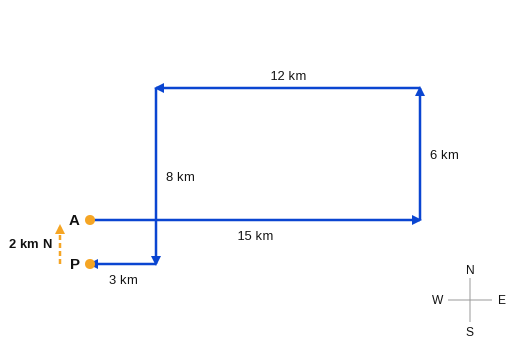
Samad starts from Point A and drives 15 km towards East. He then takes a left turn, drives 6 km, turns left and drives 12 km. He then takes a left turn and drives 8 km. He takes a final right turn, drives 3 km and stops at Point P. How far (shortest distance) and towards which direction should he drive in order to reach Point A again? (All turns are 90° turns only unless specified.)
समद बिंदु A से प्रारंभ करता है और पूर्व की ओर 15 km गाड़ी चलाता है। फिर वह बाएँ मुड़ता है, 6 km गाड़ी चलाता है, बाएँ मुड़ता है और 12 km गाड़ी चलाता है। फिर वह बाएँ मुड़ता है और 8 km गाड़ी चलाता है। वह अंतिम बार दाएँ मुड़ता है, 3 km गाड़ी चलाता है और बिंदु P पर रुक जाता है। बिंदु A पर फिर से पहुँचने के लिए उसे कितनी दूरी (न्यूनतम दूरी) तक और किस दिशा में गाड़ी चलानी चाहिए? (जब तक निर्दिष्ट न हो, सभी मोड़ केवल 90° के मोड़ हैं।)
  1. A2 km towards Northउत्तर की ओर 2 km
  2. B4 km towards Southदक्षिण की ओर 4 km
  3. C2 km towards Westपश्चिम की ओर 2 km
  4. D4 km towards Northउत्तर की ओर 4 km
Show answer

Concept: Track the position with coordinates (East +x, North +y).

  1. A(0,0) → 15 km E → (15,0) → left 6 km N → (15,6).
  2. Left 12 km W → (3,6) → left 8 km S → (3,−2).
  3. Right turn while facing S = West: 3 km → P(0,−2).
  4. P is 2 km South of A, so drive 2 km towards North.

Trick: Net E–W: 15−12−3=0; net N–S: 6−8=−2 → P is 2 km south of A.

Answer: (A) 2 km towards North

अवधारणा: निर्देशांक से स्थिति ट्रैक करें (पूर्व +x, उत्तर +y)।

  1. A(0,0) → 15 km पूर्व → (15,0) → बाएँ 6 km उत्तर → (15,6)।
  2. बाएँ 12 km पश्चिम → (3,6) → बाएँ 8 km दक्षिण → (3,−2)।
  3. दक्षिण की ओर मुख करके दाएँ = पश्चिम: 3 km → P(0,−2)।
  4. P, A से 2 km दक्षिण है, अतः 2 km उत्तर जाना होगा।

ट्रिक: शुद्ध पूर्व–पश्चिम: 15−12−3=0; उत्तर–दक्षिण: 6−8=−2 → P, A से 2 km दक्षिण।

उत्तर: (A) 2 km उत्तर की ओर

RRB NTPC Undergraduate CBT 1General Intelligence and ReasoningDirection and distanceRRB NTPC Undergraduate CBT 1 2024 · 4 Sep Shift 2 →
Q5399.
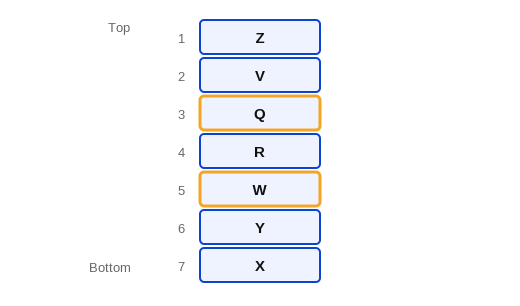
Seven boxes V, W, X, Y, Z, Q and R are kept one over the other but not necessarily in the same order. No box is kept above Z. Only three boxes are kept between Z and W. Only one box is kept between V and R. R is kept immediately above W. Only four boxes are kept between V and X. Q is kept at some place above Y. Which box is kept second below Q?
सात बक्से V, W, X, Y, Z, Q और R एक के ऊपर एक रखे गए हैं, लेकिन आवश्यक नहीं कि इसी क्रम में हों। Z के ऊपर कोई बक्सा नहीं रखा गया है। Z और W के बीच केवल तीन बक्से रखे गए हैं। V और R के बीच केवल एक बक्सा रखा गया है। R, W के ठीक ऊपर रखा गया है। V और X के बीच केवल चार बक्से रखे गए हैं। Q, Y के ऊपर किसी स्थान पर रखा गया है। Q के नीचे दूसरे स्थान पर कौन-सा बक्सा रखा गया है?
  1. AY
  2. BR
  3. CX
  4. DW
Show answer

Concept: Fix definite positions first (positions 1 = top to 7 = bottom).

  1. Z at 1 (nothing above); three between Z and W → W at 5; R immediately above W → R at 4.
  2. One between V and R → V at 2 or 6; four between V and X → V = 2, X = 7.
  3. Remaining 3, 6: Q above Y → Q = 3, Y = 6.
  4. Second below Q (3) is position 5 = W.

Trick: Start with 'no box above Z' – it anchors everything.

Answer: (D) W

अवधारणा: पहले निश्चित स्थान तय करें (1 = ऊपर, 7 = नीचे)।

  1. Z ऊपर (1); Z और W के बीच तीन → W = 5; R, W के ठीक ऊपर → R = 4।
  2. V और R के बीच एक → V = 2 या 6; V और X के बीच चार → V = 2, X = 7।
  3. बचे 3, 6: Q, Y के ऊपर → Q = 3, Y = 6।
  4. Q (3) से दूसरा नीचे स्थान 5 = W।

ट्रिक: 'Z के ऊपर कोई बॉक्स नहीं' से शुरुआत करें।

उत्तर: (D) W

RRB NTPC Undergraduate CBT 1General Intelligence and ReasoningBox arrangementRRB NTPC Undergraduate CBT 1 2024 · 4 Sep Shift 2 →
Q5400.
Refer to the following number and symbol series and answer the question that follows. Counting to be done from left to right only. (Note: All numbers are single digit numbers only).
(Left) 4 7 + $ £ 3 & 8 5 @ 1 Ω # * % 6 2 9 (Right)
How many such numbers are there each of which is immediately preceded by another number and also immediately followed by another number?
निम्नलिखित संख्या और प्रतीक श्रृंखला को देखें और उसके बाद दिए गए प्रश्न का उत्तर दें। गिनती केवल बाएँ से दाएँ की जानी है। (नोट: सभी संख्याएँ केवल एक-अंकीय संख्याएँ हैं।)
(बाएँ) 4 7 + $ £ 3 & 8 5 @ 1 Ω # * % 6 2 9 (दाएँ)
ऐसी कितनी संख्याएँ हैं जिनमें से प्रत्येक के ठीक पहले एक अन्य संख्या है और ठीक बाद भी एक अन्य संख्या है?
  1. A0
  2. B2
  3. C1
  4. D3
Show answer

Concept: Check each number: the element before and after it must both be numbers.

  1. Series: 4 7 + $ £ 3 & 8 5 @ 1 Ω # * % 6 2 9.
  2. Pairs of adjacent numbers: (4,7), (8,5), (6,2,9).
  3. Only 2 has a number on both sides (6 before, 9 after). 7 and 5 are followed by symbols.

Trick: Look for three numbers in a row – the middle one counts.

Answer: (C) 1

अवधारणा: हर संख्या के ठीक पहले और ठीक बाद संख्या होनी चाहिए।

  1. श्रृंखला: 4 7 + $ £ 3 & 8 5 @ 1 Ω # * % 6 2 9।
  2. लगातार संख्याएँ: (4,7), (8,5), (6,2,9)।
  3. केवल 2 के दोनों ओर संख्या है (पहले 6, बाद 9)। 7 और 5 के बाद प्रतीक है।

ट्रिक: लगातार तीन संख्याएँ खोजें – बीच वाली गिनी जाती है।

उत्तर: (C) 1

RRB NTPC Undergraduate CBT 1General Intelligence and ReasoningNumber-symbol seriesRRB NTPC Undergraduate CBT 1 2024 · 4 Sep Shift 2 →