Question bank

Q&A: practice questions with answers

Search questions on any topic. Filter by exam category, exam, subject and topic, try the question, then open the answer and explanation.

Courses – airGurukul

20,719 questions found.

Q5401.
Mayank ranked 39th from the top and 11th from the bottom in his class. How many students are there in his class?
मयंक अपनी कक्षा में ऊपर से 39वें और नीचे से 11वें स्थान पर है। उसकी कक्षा में कितने विद्यार्थी हैं?
  1. A49
  2. B48
  3. C47
  4. D50
Show answer

Concept: Total = rank from top + rank from bottom −1.

  1. Total =39+11−1
  2. =49

Yaad rakhein: Subtract 1 because Mayank is counted twice.

Answer: (A) 49

अवधारणा: कुल = ऊपर से रैंक + नीचे से रैंक −1।

  1. कुल =39+11−1
  2. =49

याद रखें: 1 घटाएँ क्योंकि मयंक दो बार गिना गया है।

उत्तर: (A) 49
RRB NTPC Undergraduate CBT 1General Intelligence and ReasoningRankingRRB NTPC Undergraduate CBT 1 2024 · 4 Sep Shift 2 →
Q5402.
What should come in place of the question mark (?) in the given series?
550 555 565 570 580 585 ? 600
दी गई श्रृंखला में प्रश्न चिह्न (?) के स्थान पर क्या आना चाहिए?
550 555 565 570 580 585 ? 600
  1. A610
  2. B595
  3. C590
  4. D605
Show answer

Concept: Look at the differences.

  1. Differences: +5,+10,+5,+10,+5,…
  2. 585+10=595
  3. Check: 595+5=600 ✓

Trick: Alternating +5, +10 pattern.

Answer: (B) 595

अवधारणा: अंतर देखें।

  1. अंतर: +5,+10,+5,+10,+5,…
  2. 585+10=595
  3. जाँच: 595+5=600 ✓

ट्रिक: +5, +10 बारी-बारी से।

उत्तर: (B) 595

RRB NTPC Undergraduate CBT 1General Intelligence and ReasoningNumber seriesRRB NTPC Undergraduate CBT 1 2024 · 4 Sep Shift 2 →
Q5403.
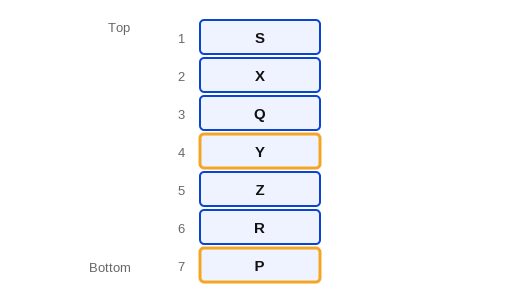
Seven boxes P, Q, R, S, X, Y and Z are kept one over the other, but not necessarily in the same order. Only S is kept above X. Only two boxes are kept between X and Z. Only P is kept below R. Q is not kept immediately above Z. How many boxes are kept between Y and P?
सात बक्से P, Q, R, S, X, Y और Z एक के ऊपर एक रखे गए हैं, लेकिन आवश्यक नहीं कि इसी क्रम में हों। X के ऊपर केवल S रखा गया है। X और Z के बीच केवल दो बक्से रखे गए हैं। R के नीचे केवल P रखा गया है। Q, Z के ठीक ऊपर नहीं रखा गया है। Y और P के बीच कितने बक्से रखे गए हैं?
  1. ATwoदो
  2. BThreeतीन
  3. CFourचार
  4. DOneएक
Show answer

Concept: Use the 'only' clues to fix top and bottom (1 = top).

  1. Only S above X → S = 1, X = 2.
  2. Two boxes between X and Z → Z = 5.
  3. Only P below R → P = 7, R = 6.
  4. Q not immediately above Z → Q ≠ 4, so Q = 3, Y = 4. Between Y (4) and P (7): Z, R = two.

Trick: 'Only S above X' means X is second from top.

Answer: (A) Two

अवधारणा: 'केवल' वाले संकेतों से ऊपर और नीचे तय करें (1 = ऊपर)।

  1. केवल S, X के ऊपर → S = 1, X = 2।
  2. X और Z के बीच दो → Z = 5।
  3. केवल P, R के नीचे → P = 7, R = 6।
  4. Q, Z के ठीक ऊपर नहीं → Q = 3, Y = 4। Y (4) और P (7) के बीच: Z, R = दो।

ट्रिक: 'केवल S, X के ऊपर' = X ऊपर से दूसरा।

उत्तर: (A) दो

RRB NTPC Undergraduate CBT 1General Intelligence and ReasoningBox arrangementRRB NTPC Undergraduate CBT 1 2024 · 4 Sep Shift 2 →
Q5404.
Based on the English alphabetical order, three of the following four letter-clusters are alike in a certain way and thus form a group. Which letter-cluster DOES NOT belong to that group?
(Note: The odd one out is not based on the number of consonants/vowels or their position in the letter-cluster.)
अंग्रेज़ी वर्णमाला क्रम के आधार पर, निम्नलिखित चार अक्षर-समूहों में से तीन किसी निश्चित प्रकार से एकसमान हैं और इस प्रकार एक समूह बनाते हैं। कौन-सा अक्षर-समूह उस समूह से संबंधित नहीं है?
(नोट: असंगत अक्षर-समूह, अक्षर-समूह में व्यंजनों/स्वरों की संख्या या उनके स्थान पर आधारित नहीं है।)
  1. AEHC
  2. BNQK
  3. CYBW
  4. DSVQ
Show answer

Concept: Find the positional gaps between consecutive letters.

  1. EHC: E +3 H, H −5 C.
  2. YBW: Y +3 B, B −5 W; SVQ: S +3 V, V −5 Q.
  3. NQK: N +3 Q, but Q −6 K → odd.

Trick: Write letter positions: N(14) Q(17) K(11) – the second gap is 6, not 5.

Answer: (B) NQK

अवधारणा: लगातार अक्षरों के बीच स्थानीय अंतर देखें।

  1. EHC: E +3 H, H −5 C।
  2. YBW: Y +3 B, B −5 W; SVQ: S +3 V, V −5 Q।
  3. NQK: N +3 Q, पर Q −6 K → विषम।

ट्रिक: स्थान लिखें: N(14) Q(17) K(11) – दूसरा अंतर 6 है, 5 नहीं।

उत्तर: (B) NQK

RRB NTPC Undergraduate CBT 1General Intelligence and ReasoningOdd one out (letters)RRB NTPC Undergraduate CBT 1 2024 · 4 Sep Shift 2 →
Q5405.
Based on the English alphabetical order, three of the following four letter-cluster pairs are alike in a certain way and thus form a group. Which letter-cluster pair DOES NOT belong to that group?
(Note: The odd one out is not based on the number of consonants/vowels or their position in the letter-cluster.)
अंग्रेज़ी वर्णमाला क्रम के आधार पर, निम्नलिखित चार अक्षर-समूह युग्मों में से तीन किसी निश्चित प्रकार से एकसमान हैं और इस प्रकार एक समूह बनाते हैं। कौन-सा अक्षर-समूह युग्म उस समूह से संबंधित नहीं है?
(नोट: असंगत अक्षर-समूह, अक्षर-समूह में व्यंजनों/स्वरों की संख्या या उनके स्थान पर आधारित नहीं है।)
  1. ALQ-NJ
  2. BNS-PK
  3. CJO-LH
  4. DHM-JF
Show answer

Concept: Compare first letters of the two clusters and second letters separately.

  1. LQ-NJ: L +2 N, Q −7 J.
  2. JO-LH: J +2 L, O −7 H; HM-JF: H +2 J, M −7 F.
  3. NS-PK: N +2 P, but S −8 K → odd.

Trick: In the first cluster the gap is 5 in all (L–Q, N–S, J–O, H–M), so the second cluster decides.

Answer: (B) NS-PK

अवधारणा: दोनों समूहों के पहले अक्षर और दूसरे अक्षर अलग-अलग तुलना करें।

  1. LQ-NJ: L +2 N, Q −7 J।
  2. JO-LH: J +2 L, O −7 H; HM-JF: H +2 J, M −7 F।
  3. NS-PK: N +2 P, पर S −8 K → विषम।

ट्रिक: पहले समूह में सबमें अंतर 5 है, अतः फैसला दूसरा समूह करता है।

उत्तर: (B) NS-PK

RRB NTPC Undergraduate CBT 1General Intelligence and ReasoningOdd one out (letter pairs)RRB NTPC Undergraduate CBT 1 2024 · 4 Sep Shift 2 →
Q5406.
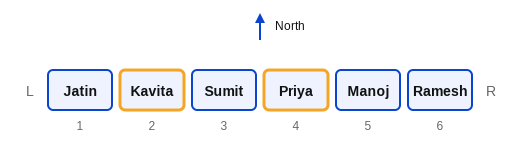
Sumit, Jatin, Ramesh, Priya, Kavita and Manoj are sitting in a straight line, facing north. Sumit sits third from the left end. Manoj sits second to the right of Sumit. Jatin sits to the immediate left of Kavita. Priya does not sit at the end. Who sits second to the left of Priya?
सुमित, जतिन, रमेश, प्रिया, कविता और मनोज एक सीधी पंक्ति में उत्तर की ओर मुख करके बैठे हैं। सुमित बाएँ छोर से तीसरे स्थान पर बैठा है। मनोज, सुमित के दाएँ से दूसरे स्थान पर बैठा है। जतिन, कविता के ठीक बाएँ बैठा है। प्रिया किसी छोर पर नहीं बैठी है। प्रिया के बाएँ से दूसरे स्थान पर कौन बैठा है?
  1. ARameshरमेश
  2. BManojमनोज
  3. CKavitaकविता
  4. DSumitसुमित
Show answer

Concept: Six seats 1–6 from left; all face north so right = towards seat 6.

  1. Sumit = 3; Manoj second to right of Sumit = 5.
  2. Free: 1, 2, 4, 6. Jatin immediately left of Kavita → only adjacent pair is 1, 2: Jatin 1, Kavita 2.
  3. Priya not at end → Priya 4, Ramesh 6.
  4. Second to left of Priya (4) = seat 2 = Kavita.

Trick: Find the only pair of adjacent empty seats for Jatin–Kavita.

Answer: (C) Kavita

अवधारणा: बाएँ से 1–6 सीटें; सभी उत्तरमुखी, इसलिए दायाँ = सीट 6 की ओर।

  1. सुमित = 3; मनोज सुमित के दूसरे दाएँ = 5।
  2. खाली: 1, 2, 4, 6। जतिन, कविता के ठीक बाएँ → केवल 1, 2 सटे हैं: जतिन 1, कविता 2।
  3. प्रिया अंत में नहीं → प्रिया 4, रमेश 6।
  4. प्रिया (4) के दूसरे बाएँ = सीट 2 = कविता।

ट्रिक: जतिन–कविता के लिए सटी हुई खाली सीटें खोजें।

उत्तर: (C) कविता (Kavita)

RRB NTPC Undergraduate CBT 1General Intelligence and ReasoningLinear seatingRRB NTPC Undergraduate CBT 1 2024 · 4 Sep Shift 2 →
Q5407.
What should come in place of the question mark (?) in the given series?
16 28 50 82 124 ?
दी गई श्रृंखला में प्रश्न चिह्न (?) के स्थान पर क्या आना चाहिए?
16 28 50 82 124 ?
  1. A162
  2. B176
  3. C194
  4. D185
Show answer

Concept: Differences increase by a fixed amount.

  1. Differences: 12,22,32,42 (each +10).
  2. Next difference =52.
  3. 124+52=176

Trick: Second difference constant (10) → quadratic pattern.

Answer: (B) 176

अवधारणा: अंतर एक निश्चित मात्रा से बढ़ते हैं।

  1. अंतर: 12,22,32,42 (हर बार +10)।
  2. अगला अंतर =52।
  3. 124+52=176

ट्रिक: दूसरा अंतर स्थिर (10) है।

उत्तर: (B) 176

RRB NTPC Undergraduate CBT 1General Intelligence and ReasoningNumber seriesRRB NTPC Undergraduate CBT 1 2024 · 4 Sep Shift 2 →
Q5408.
Based on the English alphabetical order, three of the following four letter-clusters are alike in a certain way and thus form a group. Which letter-cluster DOES NOT belong to that group?
(Note: The odd one out is not based on the number of consonants/vowels or their position in the letter-cluster.)
अंग्रेज़ी वर्णमाला क्रम के आधार पर, निम्नलिखित चार अक्षर-समूहों में से तीन किसी निश्चित प्रकार से एकसमान हैं और इस प्रकार एक समूह बनाते हैं। कौन-सा अक्षर-समूह उस समूह से संबंधित नहीं है?
(नोट: असंगत अक्षर-समूह, अक्षर-समूह में व्यंजनों/स्वरों की संख्या या उनके स्थान पर आधारित नहीं है।)
  1. ARXT
  2. BMSO
  3. CFLG
  4. DIOK
Show answer

Concept: Check gaps between letter positions.

  1. RXT: R +6 X, X −4 T; MSO: M +6 S, S −4 O.
  2. IOK: I +6 O, O −4 K.
  3. FLG: F +6 L, but L −5 G → odd.

Trick: Pattern +6,−4; FLG breaks the second step.

Answer: (C) FLG

अवधारणा: अक्षरों के स्थानों का अंतर देखें।

  1. RXT: R +6 X, X −4 T; MSO: M +6 S, S −4 O।
  2. IOK: I +6 O, O −4 K।
  3. FLG: F +6 L, पर L −5 G → विषम।

ट्रिक: पैटर्न +6,−4; FLG दूसरे चरण में अलग है।

उत्तर: (C) FLG

RRB NTPC Undergraduate CBT 1General Intelligence and ReasoningOdd one out (letters)RRB NTPC Undergraduate CBT 1 2024 · 4 Sep Shift 2 →
Q5409.
Read the given statements and conclusions carefully. Assuming that the information given in the statements is true, even if it appears to be at variance with commonly known facts, decide which of the given conclusions logically follow(s) from the statements.
Statements:
All mugs are cups.
Some mugs are forks.
Conclusions:
(I): Some cups are forks.
(II): Some forks are mugs.
दिए गए कथनों और निष्कर्षों को ध्यानपूर्वक पढ़िए। यह मानते हुए कि कथनों में दी गई जानकारी सत्य है, भले ही वह सामान्यतः ज्ञात तथ्यों से भिन्न प्रतीत होती हो, निर्णय लीजिए कि दिए गए निष्कर्षों में से कौन-सा/कौन-से निष्कर्ष कथनों का तार्किक रूप से अनुसरण करता है/करते हैं।
कथन:
सभी मग, कप हैं।
कुछ मग, कांटे हैं।
निष्कर्ष:
(I): कुछ कप, कांटे हैं।
(II): कुछ कांटे, मग हैं।
  1. AOnly conclusion I follows.केवल निष्कर्ष I अनुसरण करता है।
  2. BBoth conclusions I and II follow.निष्कर्ष I और II दोनों अनुसरण करते हैं।
  3. CNeither conclusion I nor II follow.न तो निष्कर्ष I और न ही II अनुसरण करता है।
  4. DOnly conclusion II follows.केवल निष्कर्ष II अनुसरण करता है।
Show answer

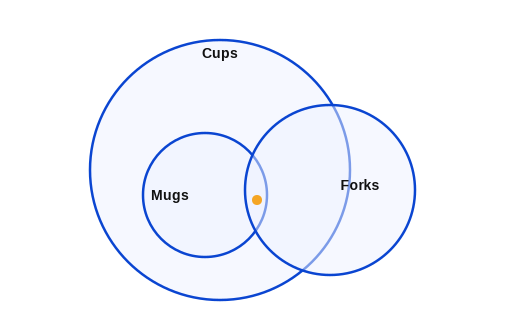
Concept: Draw the minimum Venn diagram for the statements.

  1. All mugs are cups → Mugs inside Cups.
  2. Some mugs are forks → Forks overlap Mugs; that common part is also inside Cups.
  3. So some cups are forks → I follows.
  4. 'Some mugs are forks' converts to 'Some forks are mugs' → II follows.

Trick: 'Some A are B' always gives 'Some B are A'.

Answer: (B) Both conclusions I and II follow.

अवधारणा: कथनों का न्यूनतम वेन आरेख बनाएँ।

  1. सभी mugs cups हैं → Mugs, Cups के अंदर।
  2. कुछ mugs forks हैं → Forks, Mugs को काटता है; यह भाग Cups में भी है।
  3. अतः कुछ cups forks हैं → I अनुसरण करता है।
  4. 'कुछ mugs forks हैं' का रूपांतरण 'कुछ forks mugs हैं' → II भी।

ट्रिक: 'कुछ A, B हैं' से हमेशा 'कुछ B, A हैं' निकलता है।

उत्तर: (B) निष्कर्ष I और II दोनों अनुसरण करते हैं।

RRB NTPC Undergraduate CBT 1General Intelligence and ReasoningSyllogismRRB NTPC Undergraduate CBT 1 2024 · 4 Sep Shift 2 →
Q5410.
In the following triads, each group of letters is related to the subsequent one following a certain logic. Select from the given options, the one which follows the same logic. BOAD - OBAD - BADO
DUCK - UDCK - DCKU
निम्नलिखित त्रिकों में, अक्षरों का प्रत्येक समूह एक निश्चित तर्क का अनुसरण करते हुए अगले समूह से संबंधित है। दिए गए विकल्पों में से उसका चयन कीजिए जो समान तर्क का अनुसरण करता है। BOAD - OBAD - BADO
DUCK - UDCK - DCKU
  1. ACAME - ACME - AMEC
  2. BHEAP - EHAP - PEAH
  3. CFEAN - EFAN - FANE
  4. DRUSK - RSUK - KSUR
Show answer

Concept: Find how the 2nd and 3rd terms come from the 1st.

  1. BOAD → OBAD: first two letters swapped.
  2. BOAD → BADO: the second letter (O) moved to the end. Same for DUCK → UDCK, DCKU.
  3. FEAN → EFAN (swap) and FANE (E moved to end) ✓.
  4. CAME would give CMEA, not AMEC; HEAP gives HAPE, RUSK gives URSK – wrong.

Trick: Third term = first term with its 2nd letter shifted to the end.

Answer: (C) FEAN - EFAN - FANE

अवधारणा: दूसरा और तीसरा पद पहले पद से कैसे बना, देखें।

  1. BOAD → OBAD: पहले दो अक्षर अदला-बदली।
  2. BOAD → BADO: दूसरा अक्षर (O) अंत में। DUCK → UDCK, DCKU भी ऐसे ही।
  3. FEAN → EFAN (अदला-बदली) और FANE (E अंत में) ✓।
  4. CAME से CMEA बनता, AMEC नहीं; HEAP से HAPE, RUSK से URSK – गलत।

ट्रिक: तीसरा पद = पहले पद का दूसरा अक्षर अंत में।

उत्तर: (C) FEAN - EFAN - FANE

RRB NTPC Undergraduate CBT 1General Intelligence and ReasoningLetter triadsRRB NTPC Undergraduate CBT 1 2024 · 4 Sep Shift 2 →
Q5411.
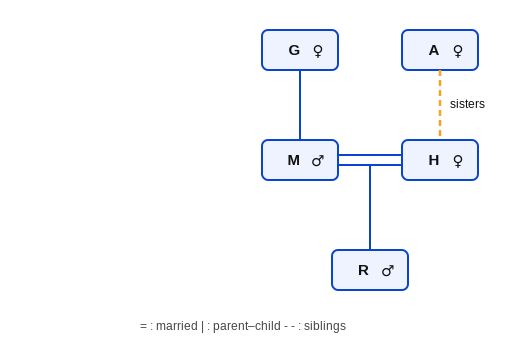
A is the sister of H. H is the mother of R. R is the son of M. G is the mother of M. How is A related to M?
A, H की बहन है। H, R की माता है। R, M का पुत्र है। G, M की माता है। A का M से क्या संबंध है?
  1. ASon's daughterपुत्र की पुत्री
  2. BSon's wife's motherपुत्र की पत्नी की माता
  3. CWife's sisterपत्नी की बहन
  4. DSon's wife's sisterपुत्र की पत्नी की बहन
Show answer

Concept: Draw the family tree.

  1. H is the mother of R, and R is the son of M → M is R's father, i.e. H's husband.
  2. A is the sister of H → A is M's wife's sister.
  3. (G is M's mother – not needed for A.)

Trick: 'Wife's sister' = sister-in-law.

Answer: (C) Wife's sister

अवधारणा: परिवार वृक्ष बनाएँ।

  1. H, R की माँ है और R, M का पुत्र है → M, R का पिता अर्थात H का पति।
  2. A, H की बहन है → A, M की पत्नी की बहन है।
  3. (G, M की माँ है – A के लिए आवश्यक नहीं।)

ट्रिक: 'पत्नी की बहन' = साली (sister-in-law)।

उत्तर: (C) पत्नी की बहन (Wife's sister)

RRB NTPC Undergraduate CBT 1General Intelligence and ReasoningBlood relationsRRB NTPC Undergraduate CBT 1 2024 · 4 Sep Shift 2 →
Q5412.
Each of the digits in the number 4796583 is arranged in the ascending order from left to right. What will be the sum of the digits that are first from the left and first from the right in the new number thus formed?
संख्या 4796583 के प्रत्येक अंक को बाएँ से दाएँ आरोही क्रम में व्यवस्थित किया जाता है। इस प्रकार बनी नई संख्या में बाएँ से पहले और दाएँ से पहले अंकों का योग क्या होगा?
  1. A9
  2. B10
  3. C7
  4. D12
Show answer

Concept: Arrange the digits in ascending order.

  1. 4796583 → 3456789.
  2. First from left =3, first from right =9.
  3. Sum =3+9=12.

Trick: Ascending order: smallest digit + largest digit =3+9.

Answer: (D) 12

अवधारणा: अंकों को आरोही क्रम में लगाएँ।

  1. 4796583 → 3456789।
  2. बाएँ से पहला =3, दाएँ से पहला =9।
  3. योग =3+9=12।

ट्रिक: आरोही क्रम में: सबसे छोटा + सबसे बड़ा अंक =3+9।

उत्तर: (D) 12

RRB NTPC Undergraduate CBT 1General Intelligence and ReasoningDigit arrangementRRB NTPC Undergraduate CBT 1 2024 · 4 Sep Shift 2 →
Q5413.
What should come in place of the question mark (?) in the given series?
24 ? 45 66 94 129
दी गई श्रृंखला में प्रश्न चिह्न (?) के स्थान पर क्या आना चाहिए?
24 ? 45 66 94 129
  1. A44
  2. B41
  3. C31
  4. D38
Show answer

Concept: Use the known differences to find the pattern.

  1. 66−45=21, 94−66=28, 129−94=35 → multiples of 7.
  2. So differences are 7,14,21,28,35.
  3. 24+7=31; check 31+14=45 ✓

Trick: Work backwards from the visible differences.

Answer: (C) 31

अवधारणा: ज्ञात अंतरों से पैटर्न निकालें।

  1. 66−45=21, 94−66=28, 129−94=35 → 7 के गुणज।
  2. अंतर 7,14,21,28,35।
  3. 24+7=31; जाँच 31+14=45 ✓

ट्रिक: दिखाई दे रहे अंतरों से पीछे की ओर चलें।

उत्तर: (C) 31

RRB NTPC Undergraduate CBT 1General Intelligence and ReasoningNumber seriesRRB NTPC Undergraduate CBT 1 2024 · 4 Sep Shift 2 →
Q5414.
Refer to the following number and symbol series and answer the question that follows. All numbers are single-digit. Counting to be done from left to right.
(Left) + # 5 3 $ Ω 4 ? 9 1 & % 7 * @ 2 £ 6 8 (Right)
How many such symbols are there, each of which is immediately preceded by a symbol and also immediately followed by an even number?
निम्नलिखित संख्या और प्रतीक श्रृंखला को देखें और उसके बाद दिए गए प्रश्न का उत्तर दें। सभी संख्याएँ एक-अंकीय हैं। गिनती बाएँ से दाएँ की जानी है।
(बाएँ) + # 5 3 $ Ω 4 ? 9 1 & % 7 * @ 2 £ 6 8 (दाएँ)
ऐसे कितने प्रतीक हैं, जिनमें से प्रत्येक के ठीक पहले एक प्रतीक है और ठीक बाद एक सम संख्या है?
  1. ANoneकोई नहीं
  2. BOneएक
  3. CThreeतीन
  4. DTwoदो
Show answer

Concept: Pattern needed: symbol – SYMBOL – even number.

  1. Series: + # 5 3 $ Ω 4 ? 9 1 & % 7 * @ 2 £ 6 8.
  2. $ Ω 4 → Ω counts.
  3. * @ 2 → @ counts.
  4. & % 7 fails (7 is odd); others are not preceded by a symbol.

Trick: First locate even numbers (4, 2, 6, 8), then check the two elements before each.

Answer: (D) Two

अवधारणा: आवश्यक क्रम: प्रतीक – प्रतीक – सम संख्या।

  1. श्रृंखला: + # 5 3 $ Ω 4 ? 9 1 & % 7 * @ 2 £ 6 8।
  2. $ Ω 4 → Ω गिना जाएगा।
  3. * @ 2 → @ गिना जाएगा।
  4. & % 7 नहीं (7 विषम); बाकी के पहले प्रतीक नहीं है।

ट्रिक: पहले सम संख्याएँ (4, 2, 6, 8) खोजें, फिर उनके पहले के दो तत्व जाँचें।

उत्तर: (D) दो

RRB NTPC Undergraduate CBT 1General Intelligence and ReasoningNumber-symbol seriesRRB NTPC Undergraduate CBT 1 2024 · 4 Sep Shift 2 →
Q5415.
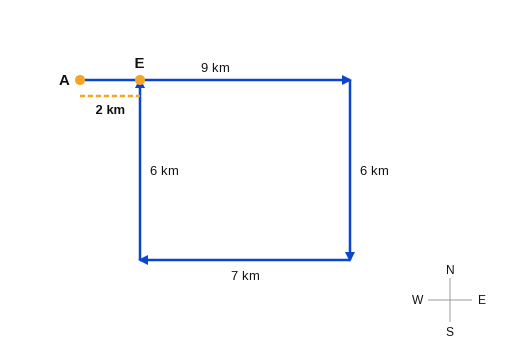
Amit started from Point A and travelled 9 km east. He then turned right and travelled 6 km. He then turned right and travelled 7 km. He finally turned right and travelled 6 km to stop at Point E. What is the shortest distance between Point E and Point A? (All turns are 90-degree turns only.)
अमित ने बिंदु A से प्रारंभ किया और 9 km पूर्व की ओर यात्रा की। फिर वह दाएँ मुड़ा और 6 km यात्रा की। फिर वह दाएँ मुड़ा और 7 km यात्रा की। अंत में वह दाएँ मुड़ा और 6 km यात्रा करके बिंदु E पर रुक गया। बिंदु E और बिंदु A के बीच न्यूनतम दूरी कितनी है? (सभी मोड़ केवल 90 डिग्री के मोड़ हैं।)
  1. A4 km
  2. B3 km
  3. C2 km
  4. D5 km
Show answer

Concept: Plot the path (East +x, North +y).

  1. A(0,0) → 9 km E → (9,0).
  2. Right → South 6 km → (9,−6); right → West 7 km → (2,−6).
  3. Right → North 6 km → E(2,0).
  4. AE =2 km.

Trick: The two 6 km legs cancel; net East =9−7=2 km.

Answer: (C) 2 km

अवधारणा: मार्ग अंकित करें (पूर्व +x, उत्तर +y)।

  1. A(0,0) → 9 km पूर्व → (9,0)।
  2. दाएँ → दक्षिण 6 km → (9,−6); दाएँ → पश्चिम 7 km → (2,−6)।
  3. दाएँ → उत्तर 6 km → E(2,0)।
  4. AE =2 km।

ट्रिक: दोनों 6 km भाग कट जाते हैं; शुद्ध पूर्व =9−7=2 km।

उत्तर: (C) 2 km

RRB NTPC Undergraduate CBT 1General Intelligence and ReasoningDirection and distanceRRB NTPC Undergraduate CBT 1 2024 · 4 Sep Shift 2 →
Q5416.
In a certain code language, ‘EXAM’ is coded as ‘3579’ and ‘HAME’ is coded as ‘5327’. What is the code for ‘H’ in the given code language?
एक निश्चित कूट भाषा में, ‘EXAM’ को ‘3579’ के रूप में और ‘HAME’ को ‘5327’ के रूप में कूटबद्ध किया जाता है। दी गई कूट भाषा में ‘H’ का कूट क्या है?
  1. A2
  2. B7
  3. C5
  4. D3
Show answer

Concept: Common letters share common digits.

  1. EXAM = 3579, HAME = 5327.
  2. Common letters E, A, M ↔ common digits 3, 5, 7.
  3. EXAM's extra X ↔ 9; HAME's extra H ↔ 2.

Trick: Strike out the common digits; the leftover digit belongs to the leftover letter.

Answer: (A) 2

अवधारणा: सामान्य अक्षरों के सामान्य अंक होते हैं।

  1. EXAM = 3579, HAME = 5327।
  2. सामान्य अक्षर E, A, M ↔ सामान्य अंक 3, 5, 7।
  3. EXAM का बचा X ↔ 9; HAME का बचा H ↔ 2।

ट्रिक: सामान्य अंक काटें; बचा अंक बचे अक्षर का है।

उत्तर: (A) 2

RRB NTPC Undergraduate CBT 1General Intelligence and ReasoningCoding-decodingRRB NTPC Undergraduate CBT 1 2024 · 4 Sep Shift 2 →
Q5417.
Select the set in which the numbers are related in the same way as are the numbers of the following sets.
(NOTE: Operations should be performed on the whole numbers, without breaking down the numbers into their constituent digits. E.g. 13 – Operations on 13 such as adding to/subtracting from/multiplying with 13 can be performed. Breaking down 13 into 1 and 3 and then performing mathematical operations on 1 and 3 is not allowed.)
(46, 2208, 24)
(4, 192, 24)
उस समुच्चय का चयन कीजिए जिसमें संख्याएँ उसी प्रकार संबंधित हैं जिस प्रकार निम्नलिखित समुच्चयों की संख्याएँ संबंधित हैं।
(नोट: संक्रियाएँ संख्याओं को उनके घटक अंकों में विभाजित किए बिना, पूर्ण संख्याओं पर की जानी चाहिए। उदाहरण: 13 – 13 पर संक्रियाएँ जैसे 13 में जोड़ना/13 में से घटाना/13 से गुणा करना आदि की जा सकती हैं। 13 को 1 और 3 में विभाजित करके फिर 1 और 3 पर गणितीय संक्रियाएँ करने की अनुमति नहीं है।)
(46, 2208, 24)
(4, 192, 24)
  1. A(37, 451, 6)
  2. B(7, 245, 17)
  3. C(39, 546, 7)
  4. D(24, 967, 20)
Show answer

Concept: Find the rule linking the three numbers.

  1. 46×24×2=2208; 4×24×2=192 → middle = first × third ×2.
  2. (C) 39×7×2=546 ✓
  3. (A) 37×6×2=444≠451; (B) 7×17×2=238≠245; (D) 24×20×2=960≠967.

Trick: Middle number even rules out (A), (B), (D) at once.

Answer: (C) (39, 546, 7)

अवधारणा: तीनों संख्याओं का नियम खोजें।

  1. 46×24×2=2208; 4×24×2=192 → बीच = पहली × तीसरी ×2।
  2. (C) 39×7×2=546 ✓
  3. (A) 37×6×2=444≠451; (B) 7×17×2=238≠245; (D) 24×20×2=960≠967।

ट्रिक: बीच की संख्या सम होनी चाहिए – (A), (B), (D) तुरंत बाहर।

उत्तर: (C) (39, 546, 7)

RRB NTPC Undergraduate CBT 1General Intelligence and ReasoningNumber analogy (sets)RRB NTPC Undergraduate CBT 1 2024 · 4 Sep Shift 2 →
Q5418.
Each of the digits in the number 7231456 is arranged in ascending order from left to right. The position(s) of how many digits will remain unchanged as compared to that in the original number?
संख्या 7231456 के प्रत्येक अंक को बाएँ से दाएँ आरोही क्रम में व्यवस्थित किया जाता है। मूल संख्या की तुलना में कितने अंकों का/के स्थान अपरिवर्तित रहेगा/रहेंगे?
  1. AFourचार
  2. BOneएक
  3. CTwoदो
  4. DThreeतीन
Show answer

Concept: Compare the original and new number digit by digit.

  1. Original: 7 2 3 1 4 5 6.
  2. Ascending: 1 2 3 4 5 6 7.
  3. Same place: 2 (2nd) and 3 (3rd) → two digits.

Trick: A digit stays only if it already equals its position number here.

Answer: (C) Two

अवधारणा: मूल और नई संख्या को अंक-दर-अंक मिलाएँ।

  1. मूल: 7 2 3 1 4 5 6।
  2. आरोही: 1 2 3 4 5 6 7।
  3. स्थान न बदलने वाले: 2 (दूसरा) और 3 (तीसरा) → दो अंक।

ट्रिक: यहाँ जो अंक अपनी स्थिति संख्या के बराबर है, वही नहीं हिलता।

उत्तर: (C) दो

RRB NTPC Undergraduate CBT 1General Intelligence and ReasoningDigit arrangementRRB NTPC Undergraduate CBT 1 2024 · 4 Sep Shift 2 →
Q5419.
What will come in the place of the question mark (?) in the following equation, if ‘÷’ and ‘−’ are interchanged and ‘×’ and ‘+’ are interchanged?
78 × 2 − 2 + 12 ÷ 6 × 5 + 4 ÷ 4 × 24 = ?
यदि ‘÷’ और ‘−’ को आपस में बदल दिया जाए तथा ‘×’ और ‘+’ को आपस में बदल दिया जाए, तो निम्नलिखित समीकरण में प्रश्न चिह्न (?) के स्थान पर क्या आएगा?
78 × 2 − 2 + 12 ÷ 6 × 5 + 4 ÷ 4 × 24 = ?
  1. A124
  2. B148
  3. C154
  4. D136
Show answer

Concept: Interchange the signs, then apply BODMAS.

  1. After swap: 78+2÷2×12−6+5×4−4+24.
  2. 2÷2×12=12; 5×4=20.
  3. 78+12−6+20−4+24=124.

Trick: Rewrite the whole expression first, then solve – avoid swapping mentally.

Answer: (A) 124

अवधारणा: चिह्न बदलें, फिर BODMAS लगाएँ।

  1. बदलने के बाद: 78+2÷2×12−6+5×4−4+24।
  2. 2÷2×12=12; 5×4=20।
  3. 78+12−6+20−4+24=124।

ट्रिक: पहले पूरा व्यंजक दोबारा लिखें, फिर हल करें।

उत्तर: (A) 124

RRB NTPC Undergraduate CBT 1General Intelligence and ReasoningMathematical operationsRRB NTPC Undergraduate CBT 1 2024 · 4 Sep Shift 2 →
Q5420.
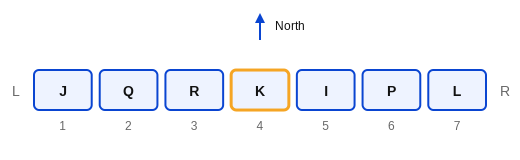
Seven people, I, J, K, L, P, Q and R are sitting in a row, facing north. Only two people sit to the left of R. Only three people sit between R and L. I sits second to the right of R. Only two people sit between I and Q. K sits at some place to the right of J but at some place to the left of P.
How many people sit to the right of K?
सात व्यक्ति I, J, K, L, P, Q और R एक पंक्ति में उत्तर की ओर मुख करके बैठे हैं। R के बाईं ओर केवल दो व्यक्ति बैठे हैं। R और L के बीच केवल तीन व्यक्ति बैठे हैं। I, R के दाएँ से दूसरे स्थान पर बैठा है। I और Q के बीच केवल दो व्यक्ति बैठे हैं। K, J के दाईं ओर किसी स्थान पर, लेकिन P के बाईं ओर किसी स्थान पर बैठा है।
K के दाईं ओर कितने व्यक्ति बैठे हैं?
  1. AThreeतीन
  2. BTwoदो
  3. CFourचार
  4. DOneएक
Show answer

Concept: Seats 1–7 from left, all facing north.

  1. Two to the left of R → R = 3; three between R and L → L = 7.
  2. I second to right of R → I = 5; two between I and Q → Q = 2.
  3. Left: 1, 4, 6 for J, K, P with J < K < P → J 1, K 4, P 6.
  4. Right of K: I, P, L = three.

Trick: Place R first; L can only go right (left side has just 2 seats).

Answer: (A) Three

अवधारणा: बाएँ से सीट 1–7, सभी उत्तरमुखी।

  1. R के बाएँ दो → R = 3; R और L के बीच तीन → L = 7।
  2. I, R के दूसरे दाएँ → I = 5; I और Q के बीच दो → Q = 2।
  3. बचे 1, 4, 6: J, K, P क्रम में → J 1, K 4, P 6।
  4. K के दाएँ: I, P, L = तीन।

ट्रिक: पहले R रखें; L केवल दाईं ओर जा सकता है।

उत्तर: (A) तीन

RRB NTPC Undergraduate CBT 1General Intelligence and ReasoningLinear seatingRRB NTPC Undergraduate CBT 1 2024 · 4 Sep Shift 2 →