Question bank

Q&A: practice questions with answers

Search questions on any topic. Filter by exam category, exam, subject and topic, try the question, then open the answer and explanation.

Courses – airGurukul

20,719 questions found.

Q5461.
Which of the following is a major difference between planted and natural vegetation?
निम्नलिखित में से कौन-सा रोपित और प्राकृतिक वनस्पति के बीच एक प्रमुख अंतर है?
  1. APresence of fruitsफलों की उपस्थिति
  2. BPlace of originउत्पत्ति का स्थान
  3. CHuman supervision involvedमानवीय देखरेख की संलिप्तता
  4. DNumber of leavesपत्तियों की संख्या
Show answer

Concept: Natural vegetation grows on its own without human help; planted vegetation is grown and cared for by people.

  1. Crops, orchards and gardens need human supervision (sowing, watering, protection).
  2. Natural (virgin) vegetation is left undisturbed by humans for a long time.
  3. Fruits, number of leaves or place of origin are not the defining difference.

Yaad rakhein: Human help? Yes → planted; No → natural.

Answer: (C) Human supervision involved

अवधारणा: प्राकृतिक वनस्पति बिना मानव सहायता के अपने आप उगती है; रोपित वनस्पति मनुष्य उगाता और देखभाल करता है।

  1. फसलें, बाग, उद्यान में मानव देखरेख (बुआई, सिंचाई, सुरक्षा) होती है।
  2. प्राकृतिक (अक्षत) वनस्पति लंबे समय तक मनुष्य से अछूती रहती है।
  3. फल, पत्तियों की संख्या या उत्पत्ति स्थान मूल अंतर नहीं हैं।

याद रखें: मानव सहायता? हाँ → रोपित; नहीं → प्राकृतिक।

उत्तर: (C) मानव देखरेख शामिल होना
RRB NTPC Undergraduate CBT 1General AwarenessNatural VegetationRRB NTPC Undergraduate CBT 1 2024 · 4 Sep Shift 1 →
Q5462.
Who is the 52nd Chief Justice of India?
भारत के 52वें मुख्य न्यायाधीश कौन हैं?
  1. AJustice DY Chandrachudन्यायमूर्ति डी.वाई. चंद्रचूड़
  2. BJustice NV Ramanaन्यायमूर्ति एन.वी. रमना
  3. CJustice BR Gavaiन्यायमूर्ति बी.आर. गवई
  4. DJustice Sanjiv Khannaन्यायमूर्ति संजीव खन्ना
Show answer

Concept: Justice B.R. Gavai took oath as the 52nd Chief Justice of India on 14 May 2025.

  1. He succeeded Justice Sanjiv Khanna (51st CJI).
  2. He is the first Buddhist and the second Dalit CJI (after Justice K.G. Balakrishnan). D.Y. Chandrachud was the 50th and N.V. Ramana the 48th CJI.

Yaad rakhein: 48 Ramana → 49 Lalit → 50 Chandrachud → 51 Khanna → 52 Gavai.

Answer: (C) Justice BR Gavai

अवधारणा: न्यायमूर्ति बी.आर. गवई ने 14 मई 2025 को भारत के 52वें मुख्य न्यायाधीश के रूप में शपथ ली।

  1. उन्होंने न्यायमूर्ति संजीव खन्ना (51वें CJI) का स्थान लिया।
  2. वे पहले बौद्ध और दूसरे दलित CJI हैं (के.जी. बालकृष्णन के बाद)। चंद्रचूड़ 50वें और एन.वी. रमना 48वें CJI थे।

याद रखें: 48 रमना → 49 ललित → 50 चंद्रचूड़ → 51 खन्ना → 52 गवई।

उत्तर: (C) न्यायमूर्ति बी.आर. गवई

RRB NTPC Undergraduate CBT 1General AwarenessChief Justice of IndiaRRB NTPC Undergraduate CBT 1 2024 · 4 Sep Shift 1 →
Q5463.
What does the term 'net sown area' refer to?
'निवल बोया गया क्षेत्र' (net sown area) शब्द से क्या तात्पर्य है?
  1. ATotal area cultivated with crops during the yearवर्ष के दौरान फसलों से जोता-बोया गया कुल क्षेत्र
  2. BTotal area under irrigationसिंचाई के अंतर्गत कुल क्षेत्र
  3. CLand covered with forestsवनों से आच्छादित भूमि
  4. DLand left uncultivated for more than five yearsपाँच वर्ष से अधिक समय तक बिना जुताई के छोड़ी गई भूमि
Show answer

Concept: Net sown area is the total area sown with crops in a year, counted only once.

  1. If the same land is sown more than once in a year, the extra sowings are added only in gross cropped area.
  2. Land left uncultivated for over five years = culturable waste land; land under forests and irrigated area are separate categories.

Yaad rakhein: Gross cropped area = NSA + area sown more than once.

Answer: (A) Total area cultivated with crops during the year

अवधारणा: शुद्ध बोया गया क्षेत्र वर्ष में फसलों के अंतर्गत कुल क्षेत्र है, जिसे केवल एक बार गिना जाता है।

  1. एक ही भूमि पर वर्ष में एक से अधिक बार बुआई हो तो अतिरिक्त बुआई केवल सकल फसल क्षेत्र में जुड़ती है।
  2. पाँच वर्ष से अधिक खाली भूमि = कृषि योग्य बंजर भूमि; वन और सिंचित क्षेत्र अलग श्रेणियाँ हैं।

याद रखें: सकल फसल क्षेत्र = शुद्ध बोया क्षेत्र + एक से अधिक बार बोया क्षेत्र।

उत्तर: (A) वर्ष के दौरान फसलों से जोता गया कुल क्षेत्र

RRB NTPC Undergraduate CBT 1General AwarenessLand UseRRB NTPC Undergraduate CBT 1 2024 · 4 Sep Shift 1 →
Q5464.
What is the main aim of globalisation?
वैश्वीकरण का मुख्य उद्देश्य क्या है?
  1. ALimit foreign tradeविदेशी व्यापार को सीमित करना
  2. BReduce employmentरोज़गार कम करना
  3. CIncrease local productionस्थानीय उत्पादन बढ़ाना
  4. DIntegrate the Indian economy with the worldभारतीय अर्थव्यवस्था को विश्व के साथ एकीकृत करना
Show answer

Concept: Globalisation means integrating a country’s economy with the world economy.

  1. It works through free flow of trade, investment (FDI), technology and people across borders.
  2. In India it was part of the 1991 LPG reforms; it aims to increase, not limit, foreign trade.

Yaad rakhein: Globalisation = local → global integration.

Answer: (D) Integrate the Indian economy with the world

अवधारणा: वैश्वीकरण का अर्थ है देश की अर्थव्यवस्था को विश्व अर्थव्यवस्था से जोड़ना।

  1. यह सीमाओं के पार व्यापार, निवेश (FDI), तकनीक और लोगों के मुक्त प्रवाह से होता है।
  2. भारत में यह 1991 के LPG सुधारों का भाग था; इसका उद्देश्य विदेशी व्यापार बढ़ाना है, सीमित करना नहीं।

याद रखें: वैश्वीकरण = स्थानीय → वैश्विक एकीकरण।

उत्तर: (D) भारतीय अर्थव्यवस्था को विश्व से जोड़ना

RRB NTPC Undergraduate CBT 1General AwarenessGlobalisationRRB NTPC Undergraduate CBT 1 2024 · 4 Sep Shift 1 →
Q5465.
The Non-cooperation Movement in 1920 included all the following, EXCEPT:
1920 के असहयोग आंदोलन में निम्नलिखित में से एक को छोड़कर अन्य सभी शामिल थे:
  1. Aviolent attacks on officialsअधिकारियों पर हिंसक हमले
  2. Brefusal to pay taxesकरों का भुगतान करने से इनकार
  3. Cboycott of British courtsब्रिटिश न्यायालयों का बहिष्कार
  4. Dclosure of schools and collegesस्कूलों और कॉलेजों को बंद करना
Show answer

Concept: The Non-Cooperation Movement (1920–22) under Gandhi was based on non-violence.

  1. Programme: surrender of titles, boycott of courts, schools, councils and foreign cloth; refusal to pay taxes was planned as a later stage.
  2. When a mob burnt a police station at Chauri Chaura (Feb 1922), Gandhi withdrew the movement – violence was never part of it.

Yaad rakhein: Gandhian movements → anything “violent” is the EXCEPT option.

Answer: (A) violent attacks on officials

अवधारणा: गांधीजी के नेतृत्व में असहयोग आंदोलन (1920–22) अहिंसा पर आधारित था।

  1. कार्यक्रम: उपाधियाँ लौटाना, अदालतों, स्कूलों, परिषदों और विदेशी वस्त्रों का बहिष्कार; कर न देना बाद के चरण में था।
  2. चौरी चौरा (फरवरी 1922) में हिंसा होते ही गांधीजी ने आंदोलन वापस ले लिया – हिंसा कभी इसका हिस्सा नहीं थी।

याद रखें: गांधीवादी आंदोलन → “हिंसक” विकल्प ही EXCEPT उत्तर।

उत्तर: (A) अधिकारियों पर हिंसक हमले

RRB NTPC Undergraduate CBT 1General AwarenessNon-Cooperation MovementRRB NTPC Undergraduate CBT 1 2024 · 4 Sep Shift 1 →
Q5466.
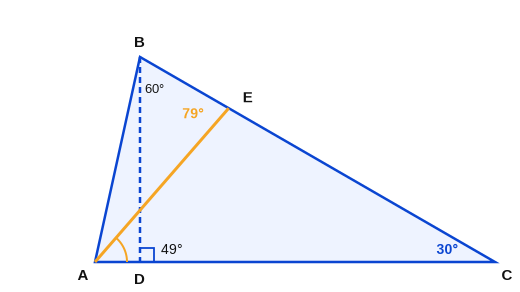
In △ABC, BD ⟂ AC at D and ∠DBC = 60°. E is a point on BC such that ∠CAE = 49°. What is the measure of ∠AEB?
△ABC में, BD ⟂ AC, बिंदु D पर है और ∠DBC = 60° है। BC पर E एक ऐसा बिंदु है कि ∠CAE = 49° है। ∠AEB का माप क्या है?
  1. A80°
  2. B87°
  3. C85°
  4. D79°
Show answer

Concept: Angle sum of a triangle is 180∘; an exterior angle equals the sum of the two interior opposite angles.

  1. In △BDC: ∠BDC=90∘, ∠DBC=60∘ ⇒ ∠C=180∘−90∘−60∘=30∘.
  2. In △AEC: ∠EAC=49∘, ∠ECA=30∘.
  3. ∠AEB is the exterior angle of △AEC at E: ∠AEB=49∘+30∘=79∘.

Trick: Exterior angle = sum of the two far interior angles – no need to find ∠AEC.

Answer: (D) 79∘

अवधारणा: त्रिभुज के कोणों का योग 180∘; बहिष्कोण = दो सम्मुख अंतःकोणों का योग।

  1. △BDC में: ∠BDC=90∘, ∠DBC=60∘ ⇒ ∠C=30∘।
  2. △AEC में: ∠EAC=49∘, ∠ECA=30∘।
  3. E पर बहिष्कोण: ∠AEB=49∘+30∘=79∘।

ट्रिक: बहिष्कोण = दूर के दो अंतःकोणों का योग।

उत्तर: (D) 79∘

RRB NTPC Undergraduate CBT 1MathematicsTriangles – AnglesRRB NTPC Undergraduate CBT 1 2024 · 4 Sep Shift 1 →
Q5467.
The average weight of Rupesh, Mandar and Ketan is 45 kg. If the average weight of Rupesh and Mandar is 43 kg and that of Mandar and Ketan is 49 kg, then the weight of Mandar (in kg) is:
रूपेश, मंदार और केतन का औसत भार 45 kg है। यदि रूपेश और मंदार का औसत भार 43 kg है तथा मंदार और केतन का औसत भार 49 kg है, तो मंदार का भार (kg में) है:
  1. A64
  2. B49
  3. C69
  4. D59
Show answer

Concept: Total = average × number of items.

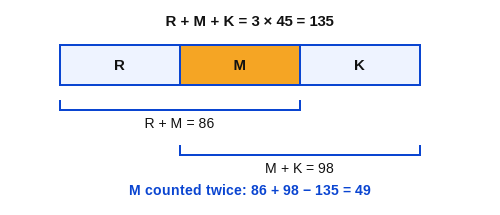
  1. R+M+K=3×45=135
  2. R+M=2×43=86, M+K=2×49=98
  3. Adding the two pair-sums counts M twice: M=86+98−135=49kg.

Trick: (sum of the two pairs) − (total of all three) = the common person.

Answer: (B) 49

अवधारणा: कुल योग = औसत × संख्या।

  1. R+M+K=3×45=135
  2. R+M=2×43=86, M+K=2×49=98
  3. दोनों जोड़ों के योग में M दो बार गिना गया: M=86+98−135=49kg।

ट्रिक: (दोनों जोड़ों का योग) − (तीनों का योग) = साझा व्यक्ति।

उत्तर: (B) 49

RRB NTPC Undergraduate CBT 1MathematicsAverageRRB NTPC Undergraduate CBT 1 2024 · 4 Sep Shift 1 →
Q5468.
Simplify the following.
2((52)x2−28x+17)−5(x2+6x−18)
निम्नलिखित को सरल कीजिए।
2((52)x2−28x+17)−5(x2+6x−18)
  1. A−86x + 124
  2. B−86x − 124
  3. C86x + 124
  4. D86x − 124
Show answer

Concept: Open the brackets carefully (distribute the outside number, watch the minus sign) and combine like terms.

  1. 2(52x2−28x+17)=5x2−56x+34
  2. −5(x2+6x−18)=−5x2−30x+90
  3. Add: (5x2−5x2)+(−56x−30x)+(34+90)=−86x+124

Trick: The x2 terms cancel; only the sign of the constant decides between the options: 34+90=+124.

Answer: (A) −86x+124

अवधारणा: कोष्ठक खोलते समय बाहर की संख्या से गुणा करें (ऋण चिह्न का ध्यान रखें) और समान पद जोड़ें।

  1. 2(52x2−28x+17)=5x2−56x+34
  2. −5(x2+6x−18)=−5x2−30x+90
  3. जोड़ें: −86x+124

ट्रिक: x2 के पद कट जाते हैं; अचर पद 34+90=+124 से उत्तर तय।

उत्तर: (A) −86x+124

RRB NTPC Undergraduate CBT 1MathematicsAlgebraic SimplificationRRB NTPC Undergraduate CBT 1 2024 · 4 Sep Shift 1 →
Q5469.
Pipe A can fill a tank in 17 hours, pipe B can fill the same tank in 24 hours and pipe C can fill the same tank in 18 hours. The time taken by them to fill the same tank if they operate together is::
पाइप A एक टंकी को 17 घंटे में भर सकता है, पाइप B उसी टंकी को 24 घंटे में भर सकता है और पाइप C उसी टंकी को 18 घंटे में भर सकता है। यदि वे एक साथ कार्य करें, तो उसी टंकी को भरने में उनके द्वारा लिया गया समय है:
  1. A1078191 hours1078191 घंटे
  2. B678191 hours678191 घंटे
  3. C1678191 hours1678191 घंटे
  4. D1378191 hours1378191 घंटे
Show answer

Concept: Take tank capacity = LCM of the times; each pipe’s rate = capacity ÷ its time.

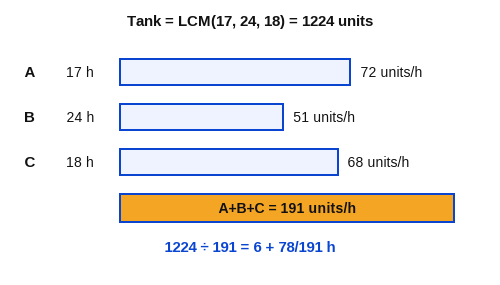
  1. LCM(17,24,18)=1224 units.
  2. Rates: A =122417=72, B =122424=51, C =122418=68 units/h; together 191 units/h.
  3. Time =1224191=678191 hours (since 191×6=1146, remainder 78).

Trick: Together time must be less than the fastest pipe (17 h) and about one-third of it – only 678191 fits.

Answer: (B) 678191 hours

अवधारणा: टंकी की क्षमता = समयों का LCM; प्रत्येक पाइप की दर = क्षमता ÷ उसका समय।

  1. LCM(17,24,18)=1224 इकाई।
  2. दरें: A =72, B =51, C =68 इकाई/घंटा; कुल 191 इकाई/घंटा।
  3. समय =1224191=678191 घंटे (191×6=1146, शेष 78)।

ट्रिक: साथ में समय सबसे तेज पाइप (17 घंटे) से कम, लगभग उसका एक-तिहाई होगा – केवल 678191 सही बैठता है।

उत्तर: (B) 678191 घंटे

RRB NTPC Undergraduate CBT 1MathematicsPipes and CisternsRRB NTPC Undergraduate CBT 1 2024 · 4 Sep Shift 1 →
Q5470.
Neha, Rajat, and Avinash invest ₹1,430, ₹1,680, and ₹1,340, respectively, to start a business. If the profit at the end of the year is ₹1,780, then what is the share of Avinash in the profit?
नेहा, रजत और अविनाश एक व्यवसाय शुरू करने के लिए क्रमशः ₹1,430, ₹1,680 और ₹1,340 का निवेश करते हैं। यदि वर्ष के अंत में लाभ ₹1,780 है, तो लाभ में अविनाश का हिस्सा कितना है?
  1. A₹537
  2. B₹536
  3. C₹533
  4. D₹538
Show answer

Concept: When the time is the same, profit is shared in the ratio of investments.

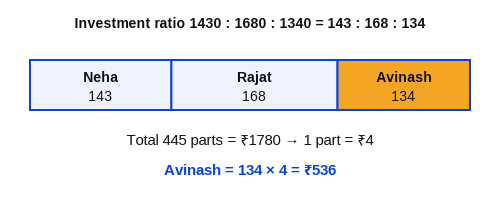
  1. Ratio 1430:1680:1340=143:168:134; total =445 parts.
  2. 445 parts = ₹1780 ⇒ 1 part = ₹4.
  3. Avinash =134×4= ₹536.

Trick: Check: 1780445=4 exactly – a clean number confirms the ratio.

Answer: (B) ₹536

अवधारणा: समय समान हो तो लाभ निवेश के अनुपात में बँटता है।

  1. अनुपात 1430:1680:1340=143:168:134; कुल =445 भाग।
  2. 445 भाग = ₹1780 ⇒ 1 भाग = ₹4।
  3. अविनाश =134×4= ₹536।

ट्रिक: 1780445=4 – पूर्णांक मिलना अनुपात की पुष्टि करता है।

उत्तर: (B) ₹536

RRB NTPC Undergraduate CBT 1MathematicsPartnershipRRB NTPC Undergraduate CBT 1 2024 · 4 Sep Shift 1 →
Q5471.
By how much is 65% of 75 greater than 35 of 25?
65% × 75 का मान, 35 × 25 के मान से कितना अधिक है?
  1. A30.75
  2. B31.75
  3. C27.75
  4. D33.75
Show answer

Concept: Find each quantity separately, then subtract.

  1. 65% of 75=65×75100=48.75
  2. 35 of 25=15
  3. Difference =48.75−15=33.75

Trick: 65% of 75 =75% of 65 =34×65=48.75.

Answer: (D) 33.75

अवधारणा: दोनों मात्राएँ अलग निकालें, फिर घटाएँ।

  1. 65% of 75=65×75100=48.75
  2. 35×25=15
  3. अंतर =48.75−15=33.75

ट्रिक: 75 का 65% =65 का 75% =34×65=48.75।

उत्तर: (D) 33.75

RRB NTPC Undergraduate CBT 1MathematicsPercentage and FractionsRRB NTPC Undergraduate CBT 1 2024 · 4 Sep Shift 1 →
Q5472.
The LCM of the numbers 4.7 and 0.04 is:
संख्याओं 4.7 और 0.04 का LCM (ल.स.प.) है:
  1. A9.4
  2. B0.94
  3. C94
  4. D0.094
Show answer

Concept: Make the decimal places equal, find the LCM of the whole numbers, then put back the decimal places.

  1. 4.7=470100, 0.04=4100
  2. LCM(470,4)=940 (since 470=2×5×47, 4=22).
  3. LCM =940100=9.4

Trick: LCM must be a multiple of the larger number 4.7: 9.4=2×4.7 and 9.4=235×0.04 ✓.

Answer: (A) 9.4

अवधारणा: दशमलव स्थान बराबर करें, पूर्णांकों का LCM निकालें, फिर दशमलव वापस लगाएँ।

  1. 4.7=470100, 0.04=4100
  2. LCM(470,4)=940
  3. LCM =940100=9.4

ट्रिक: LCM बड़ी संख्या 4.7 का गुणज होगा: 9.4=2×4.7=235×0.04 ✓।

उत्तर: (A) 9.4

RRB NTPC Undergraduate CBT 1MathematicsLCM of DecimalsRRB NTPC Undergraduate CBT 1 2024 · 4 Sep Shift 1 →
Q5473.
A woman travels 488 km at 61 km/hr, a second distance of 468 km at 78 km/hr and a third distance of 210 km at 35 km/hr. Find her average speed for the whole journey (in km/hr).
एक महिला 488 km की दूरी 61 km/hr की चाल से, दूसरी 468 km की दूरी 78 km/hr की चाल से और तीसरी 210 km की दूरी 35 km/hr की चाल से तय करती है। पूरी यात्रा के लिए उसकी औसत चाल (km/hr में) ज्ञात कीजिए।
  1. A61.1
  2. B68.8
  3. C59.7
  4. D58.3
Show answer

Concept: Average speed=Total distanceTotal time (not the average of speeds).

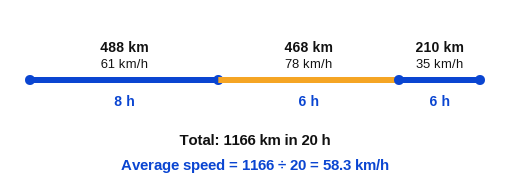
  1. Times: 48861=8 h, 46878=6 h, 21035=6 h ⇒ total 20 h.
  2. Total distance =488+468+210=1166km.
  3. Average speed =116620=58.3km/h

Trick: Each part divides exactly – compute times first, the rest is one division.

Answer: (D) 58.3

अवधारणा: औसत चाल=कुल दूरीकुल समय (चालों का औसत नहीं)।

  1. समय: 48861=8, 46878=6, 21035=6 घंटे ⇒ कुल 20 घंटे।
  2. कुल दूरी =1166km।
  3. औसत चाल =116620=58.3km/h

ट्रिक: हर भाग पूरा-पूरा बँटता है – पहले समय निकालें।

उत्तर: (D) 58.3

RRB NTPC Undergraduate CBT 1MathematicsAverage SpeedRRB NTPC Undergraduate CBT 1 2024 · 4 Sep Shift 1 →
Q5474.
If the third proportional of 50 and 30 is x, then what is the value of x?
यदि 50 और 30 का तृतीयानुपाती x है, तो x का मान क्या है?
  1. A21
  2. B15
  3. C20
  4. D18
Show answer

Concept: If a:b=b:x, then x is the third proportional of a and b: x=b2a.

  1. x=30250=90050=18
  2. Check: 50:30=5:3 and 30:18=5:3 ✓

Yaad rakhein: Third proportional =(second)2first.

Answer: (D) 18

अवधारणा: यदि a:b=b:x हो, तो x, a और b का तृतीयानुपाती है: x=b2a।

  1. x=30250=90050=18
  2. जाँच: 50:30=5:3 और 30:18=5:3 ✓

याद रखें: तृतीयानुपाती =(दूसरा)2पहला।

उत्तर: (D) 18

RRB NTPC Undergraduate CBT 1MathematicsRatio – Third ProportionalRRB NTPC Undergraduate CBT 1 2024 · 4 Sep Shift 1 →
Q5475.
If 3 times Mary's present age is 22 years more than 5 times Dia's present age, and 3 times Dia's present age is 2 years less than Mary's present age, then what is the difference (in years) between the ages of Mary and Dia?
यदि मैरी की वर्तमान आयु का 3 गुना, दीया की वर्तमान आयु के 5 गुने से 22 वर्ष अधिक है, और दीया की वर्तमान आयु का 3 गुना, मैरी की वर्तमान आयु से 2 वर्ष कम है, तो मैरी और दीया की आयु के बीच का अंतर (वर्षों में) क्या है?
  1. A7
  2. B13
  3. C10
  4. D15
Show answer

Concept: Write each statement as an equation and solve them together.

  1. 3M=5D+22 … (i); 3D=M−2 ⇒ M=3D+2 … (ii)
  2. Put (ii) in (i): 3(3D+2)=5D+22 ⇒ 9D+6=5D+22 ⇒ 4D=16 ⇒ D=4.
  3. M=3×4+2=14; difference =14−4=10 years.

Trick: Check: 3×14=42=5×4+22 ✓ and 3×4=12=14−2 ✓.

Answer: (C) 10

अवधारणा: प्रत्येक कथन को समीकरण में लिखकर हल करें।

  1. 3M=5D+22 … (i); 3D=M−2 ⇒ M=3D+2 … (ii)
  2. (ii) को (i) में रखें: 9D+6=5D+22 ⇒ D=4।
  3. M=14; अंतर =14−4=10 वर्ष।

ट्रिक: जाँच: 3×14=42=5×4+22 ✓, 3×4=12=14−2 ✓।

उत्तर: (C) 10

RRB NTPC Undergraduate CBT 1MathematicsProblems on AgesRRB NTPC Undergraduate CBT 1 2024 · 4 Sep Shift 1 →
Q5476.
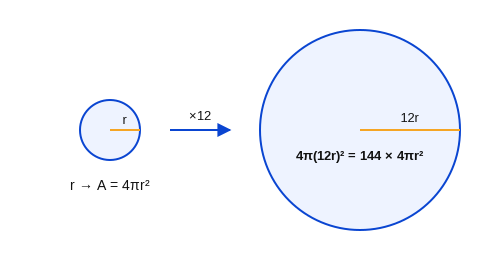
If the radius of a sphere is increased to twelve times its original radius, then by how many times does its surface area increase?
यदि किसी गोले की त्रिज्या को उसकी मूल त्रिज्या का बारह गुना कर दिया जाए, तो उसका पृष्ठीय क्षेत्रफल कितने गुना बढ़ जाएगा?
  1. A128
  2. B144
  3. C64
  4. D164
Show answer

Concept: Surface area of a sphere =4πr2, so it varies as the square of the radius.

  1. New radius =12r.
  2. New area =4π(12r)2=144×4πr2.
  3. So the surface area becomes 144 times.

Trick: Area ratio =(radius ratio)2=122=144; volume would be 123.

Answer: (B) 144

अवधारणा: गोले का पृष्ठीय क्षेत्रफल =4πr2, अर्थात यह त्रिज्या के वर्ग के अनुपात में बदलता है।

  1. नई त्रिज्या =12r।
  2. नया क्षेत्रफल =4π(12r)2=144×4πr2।
  3. अतः पृष्ठीय क्षेत्रफल 144 गुना हो जाता है।

ट्रिक: क्षेत्रफल का अनुपात =(त्रिज्या अनुपात)2=122=144; आयतन के लिए घन लेते हैं।

उत्तर: (B) 144

RRB NTPC Undergraduate CBT 1MathematicsMensuration – SphereRRB NTPC Undergraduate CBT 1 2024 · 4 Sep Shift 1 →
Q5477.
A man walks to a viewpoint and returns to the starting point by his car maintaining constant speed and thus takes a total time of 4 hours 30 minutes. He would have gained 2 hours by driving both ways. How long would it have taken for him to walk both ways with same walking speed?
एक व्यक्ति एक दर्शनीय स्थल तक पैदल जाता है और एक स्थिर चाल बनाए रखते हुए अपनी कार से प्रारंभिक बिंदु पर लौटता है और इस प्रकार कुल 4 घंटे 30 मिनट का समय लेता है। यदि वह दोनों ओर कार से जाता तो उसे 2 घंटे की बचत होती। समान पैदल चाल से दोनों ओर पैदल चलने में उसे कितना समय लगता?
  1. A6 hours 30 minutes6 घंटे 30 मिनट
  2. B7 hours 30 minutes7 घंटे 30 मिनट
  3. C5 hours 15 minutes5 घंटे 15 मिनट
  4. D6 hours 45 minutes6 घंटे 45 मिनट
Show answer

Concept: Let one-way walking time =w and one-way driving time =d.

  1. Walk + drive: w+d=4.5h.
  2. Driving both ways saves 2 h: 2d=4.5−2=2.5, so d=1.25h.
  3. w=4.5−1.25=3.25h.
  4. Walking both ways =2w=6.5h = 6 hours 30 minutes.

Trick: Walk both ways =2(total)−(drive both)=9−2.5=6.5h.

Answer: (A) 6 hours 30 minutes

अवधारणा: मान लीजिए एक ओर पैदल समय =w और कार से समय =d।

  1. पैदल + कार: w+d=4.5h।
  2. दोनों ओर कार से 2 घंटे बचते हैं: 2d=2.5, अतः d=1.25h।
  3. w=4.5−1.25=3.25h।
  4. दोनों ओर पैदल =2w=6.5h = 6 घंटे 30 मिनट।

ट्रिक: दोनों ओर पैदल =2×कुल−दोनों ओर कार=9−2.5=6.5h।

उत्तर: (A) 6 घंटे 30 मिनट

RRB NTPC Undergraduate CBT 1MathematicsTime and DistanceRRB NTPC Undergraduate CBT 1 2024 · 4 Sep Shift 1 →
Q5478.
The value of 67 − 9 × [ 4 + 3 × { 16 − 8 ( 6 − 5 ) × 2} ÷ 32] is:
67 − 9 × [ 4 + 3 × { 16 − 8 ( 6 − 5 ) × 2} ÷ 32] का मान है:
  1. A40
  2. B25
  3. C31
  4. D47
Show answer

Concept: Solve brackets from innermost outward: ( ) → { } → [ ], then ÷, ×, −.

  1. (6−5)=1, so 8×1×2=16.
  2. {16−16}=0; 3×0÷32=0.
  3. [4+0]=4; 9×4=36.
  4. 67−36=31.

Trick: Once a bracket becomes 0, everything multiplied by it vanishes – check that first.

Answer: (C) 31

अवधारणा: कोष्ठक अंदर से बाहर हल करें: ( ) → { } → [ ], फिर ÷, ×, −।

  1. (6−5)=1, अतः 8×1×2=16।
  2. {16−16}=0; 3×0÷32=0।
  3. [4+0]=4; 9×4=36।
  4. 67−36=31।

ट्रिक: कोई कोष्ठक 0 हो जाए तो उससे गुणा होने वाला पूरा भाग 0 हो जाता है।

उत्तर: (C) 31

RRB NTPC Undergraduate CBT 1MathematicsSimplification (BODMAS)RRB NTPC Undergraduate CBT 1 2024 · 4 Sep Shift 1 →
Q5479.
The cost of 10 pens and 3 pencils is ₹129. If the cost of a pen decreases by ₹6 and the cost of a pencil increases by ₹9, then the cost of 8 pens and 2 pencils is ₹72. What is the original cost of 9 pens and 16 pencils?
10 पेन और 3 पेंसिलों का मूल्य ₹129 है। यदि एक पेन का मूल्य ₹6 घट जाए और एक पेंसिल का मूल्य ₹9 बढ़ जाए, तो 8 पेन और 2 पेंसिलों का मूल्य ₹72 हो जाता है। 9 पेन और 16 पेंसिलों का मूल मूल्य क्या है?
  1. A₹156
  2. B₹160
  3. C₹155
  4. D₹161
Show answer

Concept: Form two equations in pen price p and pencil price c.

  1. 10p+3c=129.
  2. 8(p−6)+2(c+9)=72⇒8p+2c=102⇒4p+c=51.
  3. c=51−4p; 10p+3(51−4p)=129⇒p=12,c=3.
  4. 9p+16c=108+48=156.

Trick: Check: 10×12+3×3=129 ✓.

Answer: (A) ₹156

अवधारणा: पेन का मूल्य p और पेंसिल का c लेकर दो समीकरण बनाएँ।

  1. 10p+3c=129।
  2. 8(p−6)+2(c+9)=72⇒8p+2c=102⇒4p+c=51।
  3. c=51−4p; 10p+3(51−4p)=129⇒p=12,c=3।
  4. 9p+16c=108+48=156।

ट्रिक: जाँच: 10×12+3×3=129 ✓।

उत्तर: (A) ₹156

RRB NTPC Undergraduate CBT 1MathematicsLinear EquationsRRB NTPC Undergraduate CBT 1 2024 · 4 Sep Shift 1 →
Q5480.
Find the simple interest (in ₹) on ₹1,200 at an interest rate of 3% per month in 4 months.
₹1,200 पर 3% प्रति माह की ब्याज दर से 4 महीने का साधारण ब्याज (₹ में) ज्ञात कीजिए।
  1. A24
  2. B12
  3. C32
  4. D144
Show answer

Concept: SI=P×R×T100, with R and T in the same time unit (here months).

  1. P=1200, R=3% per month, T=4 months.
  2. SI=1200×3×4100=144.

Trick: 3% per month for 4 months = 12% of ₹1200 = ₹144.

Answer: (D) 144

अवधारणा: SI=P×R×T100; दर और समय एक ही इकाई (यहाँ महीने) में हों।

  1. P=1200, R=3% प्रति माह, T=4 माह।
  2. SI=1200×3×4100=144।

ट्रिक: 3% प्रति माह × 4 माह = 12%; ₹1200 का 12% = ₹144।

उत्तर: (D) 144

RRB NTPC Undergraduate CBT 1MathematicsSimple InterestRRB NTPC Undergraduate CBT 1 2024 · 4 Sep Shift 1 →