Question bank

Q&A: practice questions with answers

Search questions on any topic. Filter by exam category, exam, subject and topic, try the question, then open the answer and explanation.

Courses – airGurukul

20,719 questions found.

Q5481.
A book has a marked price of ₹500. During a festive sale, it is sold at a 10% discount. What is the amount of discount given?
एक पुस्तक का अंकित मूल्य ₹500 है। एक त्योहारी सेल के दौरान, इसे 10% की छूट पर बेचा जाता है। दी गई छूट की राशि कितनी है?
  1. A₹60
  2. B₹50
  3. C₹45
  4. D₹40
Show answer

Concept: Discount = discount% of marked price.

  1. Discount=10% of 500=10100×500=50.

Trick: 10% of any amount = move decimal one place left: 500 → 50.

Answer: (B) ₹50

अवधारणा: छूट = अंकित मूल्य का छूट%।

  1. छूट=500 का 10%=10100×500=50।

ट्रिक: 10% निकालने के लिए दशमलव एक स्थान बाएँ खिसकाएँ: 500 → 50।

उत्तर: (B) ₹50
RRB NTPC Undergraduate CBT 1MathematicsDiscountRRB NTPC Undergraduate CBT 1 2024 · 4 Sep Shift 1 →
Q5482.
The value of 22+52−325−10 is
22+52−325−10 का मान है
  1. A-10
  2. B-16
  3. C-8
  4. D-7
Show answer

Concept: Evaluate each power and root first, then add/subtract left to right.

  1. 22=4, 52=5, 325=3×5=15.
  2. 4+5−15−10=−16.

Trick: a2=a for positive a.

Answer: (B) −16

अवधारणा: पहले प्रत्येक घात और मूल का मान निकालें, फिर बाएँ से दाएँ जोड़/घटाव करें।

  1. 22=4, 52=5, 325=3×5=15।
  2. 4+5−15−10=−16।

ट्रिक: धनात्मक a के लिए a2=a।

उत्तर: (B) −16

RRB NTPC Undergraduate CBT 1MathematicsSimplification (Surds and Powers)RRB NTPC Undergraduate CBT 1 2024 · 4 Sep Shift 1 →
Q5483.
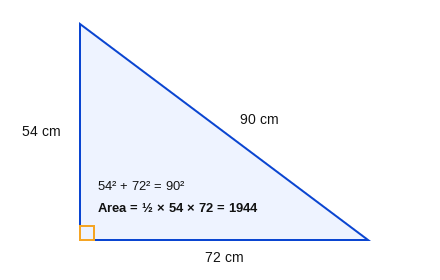
The sides of a triangle are 72 cm, 90 cm, and 54 cm. What is its area? (in cm2 )
एक त्रिभुज की भुजाएँ 72 cm, 90 cm और 54 cm हैं। इसका क्षेत्रफल क्या है? (cm2 में)
  1. A1973
  2. B1944
  3. C1912
  4. D1954
Show answer

Concept: Check for a Pythagorean triplet before using Heron's formula.

  1. 54:72:90=3:4:5 (each ×18), so the triangle is right-angled.
  2. 542+722=2916+5184=8100=902 ✓.
  3. Area =12×54×72=1944cm2.

Trick: Heron check: s=108, 108×54×36×18=1944.

Answer: (B) 1944

अवधारणा: हीरोन सूत्र से पहले देखें कि भुजाएँ पाइथागोरस त्रिक हैं या नहीं।

  1. 54:72:90=3:4:5 (प्रत्येक ×18), अतः त्रिभुज समकोण है।
  2. 542+722=2916+5184=8100=902 ✓।
  3. क्षेत्रफल =12×54×72=1944cm2।

ट्रिक: हीरोन से जाँच: s=108, 108×54×36×18=1944।

उत्तर: (B) 1944

RRB NTPC Undergraduate CBT 1MathematicsMensuration – TriangleRRB NTPC Undergraduate CBT 1 2024 · 4 Sep Shift 1 →
Q5484.
The simple interest on a certain sum for 912 years at the rate of 5.9% per annum is ₹6,726.
What will be the amount payable on the same sum at the rate of 5.6% per annum simple interest in 317 years?
किसी निश्चित राशि पर 912 वर्षों के लिए 5.9% वार्षिक दर से साधारण ब्याज ₹6,726 है।
उसी राशि पर 5.6% वार्षिक साधारण ब्याज की दर से 317 वर्षों में देय मिश्रधन कितना होगा?
  1. A₹14,095
  2. B₹14,100
  3. C₹14,104
  4. D₹14,112
Show answer

Concept: SI=PRT100; find the principal first, then the new amount =P+SI.

  1. 6726=P×5.9×9.5100⇒P=67260056.05=12000.
  2. New SI =12000×5.6×227100=2112.
  3. Amount =12000+2112=14112.

Trick: 5.6×227=17.6%, and 17.6% of 12000 =2112.

Answer: (D) ₹14,112

अवधारणा: SI=PRT100; पहले मूलधन निकालें, फिर मिश्रधन =P+SI।

  1. 6726=P×5.9×9.5100⇒P=67260056.05=12000।
  2. नया SI =12000×5.6×227100=2112।
  3. मिश्रधन =12000+2112=14112।

ट्रिक: 5.6×227=17.6%; 12000 का 17.6%=2112।

उत्तर: (D) ₹14,112

RRB NTPC Undergraduate CBT 1MathematicsSimple InterestRRB NTPC Undergraduate CBT 1 2024 · 4 Sep Shift 1 →
Q5485.
The H.C.F. and the L.C.M. of two numbers are 11 and 440, respectively. If one of the numbers is 55, find the other one.
दो संख्याओं का H.C.F. (म.स.) और L.C.M. (ल.स.) क्रमशः 11 और 440 हैं। यदि उनमें से एक संख्या 55 है, तो दूसरी संख्या ज्ञात कीजिए।
  1. A10
  2. B70
  3. C14
  4. D88
Show answer

Concept: Product of two numbers = HCF × LCM.

  1. 55×x=11×440.
  2. x=484055=88.

Trick: Check: HCF(55, 88) = 11 and LCM = 440 ✓.

Answer: (D) 88

अवधारणा: दो संख्याओं का गुणनफल = म.स. × ल.स.।

  1. 55×x=11×440।
  2. x=484055=88।

ट्रिक: जाँच: म.स.(55, 88) = 11 और ल.स. = 440 ✓।

उत्तर: (D) 88

RRB NTPC Undergraduate CBT 1MathematicsHCF and LCMRRB NTPC Undergraduate CBT 1 2024 · 4 Sep Shift 1 →
Q5486.
Manisha bought a toy for ₹849, decorated it at a cost of ₹6 and sold the toy for ₹441. Find the loss or profit percentage.
मनीषा ने ₹849 में एक खिलौना खरीदा, ₹6 की लागत से उसे सजाया और खिलौने को ₹441 में बेच दिया। हानि या लाभ प्रतिशत ज्ञात कीजिए।
  1. A92019% loss92019% हानि
  2. B920% loss920% हानि
  3. C93019% profit93019% लाभ
  4. D92019% profit92019% लाभ
Show answer

Concept: Overhead (decoration) is added to cost price. Loss%=LossCP×100.

  1. CP =849+6=855; SP =441 → loss.
  2. Loss =855−441=414.
  3. Loss%=414855×100=92019%≈48.42%.

Trick: SP < CP means loss – options with 'profit' are out at once.

Answer: (A) 92019% loss

अवधारणा: सजावट का खर्च क्रय मूल्य में जुड़ता है। हानि%=हानिक्रय मूल्य×100।

  1. क्रय मूल्य =849+6=855; विक्रय मूल्य =441 → हानि।
  2. हानि =855−441=414।
  3. हानि%=414855×100=92019%≈48.42%।

ट्रिक: विक्रय मूल्य < क्रय मूल्य, अतः 'profit' वाले विकल्प तुरंत हट जाते हैं।

उत्तर: (A) 92019% हानि

RRB NTPC Undergraduate CBT 1MathematicsProfit and LossRRB NTPC Undergraduate CBT 1 2024 · 4 Sep Shift 1 →
Q5487.
The value of 169+0.0196−4.41 is ______.
169+0.0196−4.41 का मान ______ है।
  1. A4.52
  2. B5.64
  3. C11.04
  4. D6.17
Show answer

Concept: Square roots of decimals: take the root of the digits and halve the decimal places.

  1. 169=13.
  2. 0.0196=0.14 (since 142=196).
  3. 4.41=2.1.
  4. 13+0.14−2.1=11.04.

Trick: 4 decimal places under the root → 2 decimal places in the answer.

Answer: (C) 11.04

अवधारणा: दशमलव का वर्गमूल: अंकों का वर्गमूल लें और दशमलव स्थान आधे कर दें।

  1. 169=13।
  2. 0.0196=0.14 (क्योंकि 142=196)।
  3. 4.41=2.1।
  4. 13+0.14−2.1=11.04।

ट्रिक: मूल के अंदर 4 दशमलव स्थान → उत्तर में 2 दशमलव स्थान।

उत्तर: (C) 11.04

RRB NTPC Undergraduate CBT 1MathematicsSquare RootsRRB NTPC Undergraduate CBT 1 2024 · 4 Sep Shift 1 →
Q5488.
Abdul and Mohsin together invested ₹79,200 in a business. At the end of the year, out of a total profit of ₹14,400, Mohsin's share was ₹2,600. What was the difference between their investments?
अब्दुल और मोहसिन ने मिलकर एक व्यवसाय में ₹79,200 का निवेश किया। वर्ष के अंत में, ₹14,400 के कुल लाभ में से मोहसिन का हिस्सा ₹2,600 था। उनके निवेशों के बीच का अंतर कितना था?
  1. A₹52,000
  2. B₹50,600
  3. C₹49,800
  4. D₹51,400
Show answer

Concept: For the same time period, profit is shared in the ratio of investments.

  1. Mohsin's share =260014400=1372; Abdul's =5972.
  2. Mohsin's investment =1372×79200=14300; Abdul's =64900.
  3. Difference =64900−14300=50600.

Trick: Difference =59−1372×79200=46×1100=50600.

Answer: (B) ₹50,600

अवधारणा: समान अवधि में लाभ, निवेश के अनुपात में बँटता है।

  1. मोहसिन का हिस्सा =260014400=1372; अब्दुल का =5972।
  2. मोहसिन का निवेश =1372×79200=14300; अब्दुल का =64900।
  3. अंतर =64900−14300=50600।

ट्रिक: अंतर =59−1372×79200=46×1100=50600।

उत्तर: (B) ₹50,600

RRB NTPC Undergraduate CBT 1MathematicsPartnershipRRB NTPC Undergraduate CBT 1 2024 · 4 Sep Shift 1 →
Q5489.
The income of Raman is ₹91,700. He saves 25% of his income. If his income increases by 27% and expenditure increases by 40%, then his savings will:
रमन की आय ₹91,700 है। वह अपनी आय का 25% बचाता है। यदि उसकी आय में 27% और व्यय में 40% की वृद्धि होती है, तो उसकी बचत:
  1. Adecrease by ₹2,751₹2,751 घट जाएगी
  2. Bincrease by ₹2,753₹2,753 बढ़ जाएगी
  3. Cdecrease by ₹2,753₹2,753 घट जाएगी
  4. Dincrease by ₹2,754₹2,754 बढ़ जाएगी
Show answer

Concept: Savings = Income − Expenditure; apply each % change separately.

  1. Savings =25% of 91700 =22925; expenditure =68775.
  2. New income =1.27×91700=116459.
  3. New expenditure =1.40×68775=96285.
  4. New savings =116459−96285=20174; change =20174−22925=−2751 → decrease by ₹2,751.

Trick: Change in savings =0.27×91700−0.40×68775=24759−27510=−2751.

Answer: (A) decrease by ₹2,751

अवधारणा: बचत = आय − व्यय; प्रत्येक प्रतिशत परिवर्तन अलग-अलग लगाएँ।

  1. बचत =91700 का 25%=22925; व्यय =68775।
  2. नई आय =1.27×91700=116459।
  3. नया व्यय =1.40×68775=96285।
  4. नई बचत =116459−96285=20174; परिवर्तन =−2751 → ₹2,751 की कमी।

ट्रिक: बचत में परिवर्तन =0.27×91700−0.40×68775=24759−27510=−2751।

उत्तर: (A) ₹2,751 की कमी

RRB NTPC Undergraduate CBT 1MathematicsIncome, Expenditure and SavingsRRB NTPC Undergraduate CBT 1 2024 · 4 Sep Shift 1 →
Q5490.
Shifa can do a certain piece of work in 30 days. Shifa and Afiya can together do the same work in 18 days, and Shifa, Afiya and Mariyam can do the same work together in 9 days. In how many days can Shifa and Mariyam do the same work?
शिफ़ा किसी कार्य को 30 दिनों में कर सकती है। शिफ़ा और आफ़िया मिलकर उसी कार्य को 18 दिनों में कर सकती हैं, और शिफ़ा, आफ़िया और मरियम मिलकर उसी कार्य को 9 दिनों में कर सकती हैं। शिफ़ा और मरियम उसी कार्य को कितने दिनों में कर सकती हैं?
  1. A405
  2. B374
  3. C536
  4. D454
Show answer

Concept: Take one day's work as a fraction of the whole work and subtract group rates.

  1. Shifa =130, Shifa + Afiya =118, all three =19.
  2. Mariyam =19−118=118.
  3. Shifa + Mariyam =130+118=3+590=445.
  4. Days =454=11.25.

Trick: LCM method: total work 90 units → S = 3, S+A = 5, S+A+M = 10 → M = 5; S+M = 8 → 908=454.

Answer: (D) 454

अवधारणा: एक दिन का कार्य कुल कार्य के भिन्न के रूप में लें और समूह की दरें घटाएँ।

  1. शिफा =130, शिफा + अफ़िया =118, तीनों =19।
  2. मरियम =19−118=118।
  3. शिफा + मरियम =130+118=3+590=445।
  4. दिन =454=11.25।

ट्रिक: LCM विधि: कुल कार्य 90 इकाई → S = 3, S+A = 5, S+A+M = 10 → M = 5; S+M = 8 → 908=454।

उत्तर: (D) 454

RRB NTPC Undergraduate CBT 1MathematicsTime and WorkRRB NTPC Undergraduate CBT 1 2024 · 4 Sep Shift 1 →
Q5491.
If cosecθ+sinθ=2, then find the value of cosec6θ+sin6θ.
यदि cosecθ+sinθ=2 है, तो cosec6θ+sin6θ का मान ज्ञात कीजिए।
  1. A2
  2. B3
  3. C12
  4. D1
Show answer

Concept: If x+1x=2 (with x>0), then x=1.

  1. cosecθ=1sinθ, so sinθ+1sinθ=2⇒sinθ=1.
  2. Then cosecθ=1.
  3. cosec6θ+sin6θ=1+1=2.

Trick: x+1x=2⇒xn+1xn=2 for every n.

Answer: (A) 2

अवधारणा: यदि x+1x=2 (x>0) तो x=1।

  1. cosecθ=1sinθ, अतः sinθ+1sinθ=2⇒sinθ=1।
  2. तब cosecθ=1।
  3. cosec6θ+sin6θ=1+1=2।

ट्रिक: x+1x=2 हो तो हर घात n के लिए xn+1xn=2।

उत्तर: (A) 2

RRB NTPC Undergraduate CBT 1MathematicsTrigonometryRRB NTPC Undergraduate CBT 1 2024 · 4 Sep Shift 1 →
Q5492.
The value of 23−32+(22)2−2+4×7= ______.
23−32+(22)2−2+4×7= का मान ______ है।
  1. A28
  2. B35
  3. C31
  4. D26
Show answer

Concept: Follow BODMAS: powers and brackets first, then multiplication, then addition/subtraction.

  1. 23=8, 32=9, (22)2=1, 4×7=28.
  2. 8−9+1−2+28=26.

Trick: Any number divided by itself is 1, and 12=1.

Answer: (D) 26

अवधारणा: BODMAS लगाएँ: पहले घात और कोष्ठक, फिर गुणा, फिर जोड़/घटाव।

  1. 23=8, 32=9, (22)2=1, 4×7=28।
  2. 8−9+1−2+28=26।

ट्रिक: कोई संख्या स्वयं से भाग देने पर 1, और 12=1।

उत्तर: (D) 26

RRB NTPC Undergraduate CBT 1MathematicsSimplificationRRB NTPC Undergraduate CBT 1 2024 · 4 Sep Shift 1 →
Q5493.
An article listed at ₹500 is sold at successive discounts of 10% and 14%. The buyer wants to sell it at a profit of 15% after offering a 10% discount. What should be his list price (in ₹)?
₹500 अंकित मूल्य वाली एक वस्तु 10% और 14% की क्रमिक छूट पर बेची जाती है। क्रेता इसे 10% की छूट देने के बाद 15% के लाभ पर बेचना चाहता है। उसका अंकित मूल्य (₹ में) क्या होना चाहिए?
  1. A484.50
  2. B485
  3. C494.50
  4. D474
Show answer

Concept: Buyer's cost = list price after successive discounts; required SP = cost × 1.15 = 90% of new list price.

  1. Cost =500×0.90×0.86=387.
  2. Required SP =387×1.15=445.05.
  3. New list price =445.050.90=494.50.

Trick: List price =CP×100+P%100−D%=387×11590.

Answer: (C) 494.50

अवधारणा: खरीदार का क्रय मूल्य = क्रमिक छूट के बाद मूल्य; आवश्यक विक्रय मूल्य = क्रय मूल्य × 1.15 = नए अंकित मूल्य का 90%।

  1. क्रय मूल्य =500×0.90×0.86=387।
  2. आवश्यक विक्रय मूल्य =387×1.15=445.05।
  3. नया अंकित मूल्य =445.050.90=494.50।

ट्रिक: अंकित मूल्य =CP×100+लाभ%100−छूट%=387×11590।

उत्तर: (C) 494.50

RRB NTPC Undergraduate CBT 1MathematicsSuccessive Discount, ProfitRRB NTPC Undergraduate CBT 1 2024 · 4 Sep Shift 1 →
Q5494.
A trader claims to sell pulses at a profit of 48%, but also dishonestly uses a weight which is 12% less than what is mentioned on it. Find the total percentage of profit earned by the trader. (Round off the answer to the nearest whole number.)
एक व्यापारी 48% के लाभ पर दालें बेचने का दावा करता है, परंतु साथ ही बेईमानी से ऐसे बाट का उपयोग करता है जो उस पर अंकित भार से 12% कम है। व्यापारी द्वारा अर्जित कुल लाभ प्रतिशत ज्ञात कीजिए। (उत्तर को निकटतम पूर्ण संख्या तक पूर्णांकित कीजिए।)
  1. A63%
  2. B71%
  3. C68%
  4. D72%
Show answer

Concept: Profit from a false weight: compare the price received with the cost of the quantity actually given.

  1. For 1 kg marked, he gives 0.88 kg (cost 88) and charges 1.48×100=148.
  2. Profit% =148−8888×100=600088≈68.18%.
  3. Rounded: 68%.

Trick: Total gain =(100+claimed)(100−short)−1=14888−1.

Answer: (C) 68%

अवधारणा: कम तौल से लाभ: मिली हुई कीमत की तुलना वास्तव में दी गई मात्रा की लागत से करें।

  1. 1 kg के बदले वह 0.88 kg देता है (लागत 88) और 1.48×100=148 लेता है।
  2. लाभ% =148−8888×100=600088≈68.18%।
  3. निकटतम पूर्णांक: 68%।

ट्रिक: कुल लाभ =100+दावा लाभ100−कम तौल−1=14888−1।

उत्तर: (C) 68%

RRB NTPC Undergraduate CBT 1MathematicsDishonest DealerRRB NTPC Undergraduate CBT 1 2024 · 4 Sep Shift 1 →
Q5495.
The sum of five numbers is 655. The average of the first two numbers is 80 and the third number is 108. Find the average of the remaining two numbers.
पाँच संख्याओं का योग 655 है। पहली दो संख्याओं का औसत 80 है और तीसरी संख्या 108 है। शेष दो संख्याओं का औसत ज्ञात कीजिए।
  1. A189
  2. B193.5
  3. C194.5
  4. D188
Show answer

Concept: Sum = average × count; subtract the known parts.

  1. First two numbers sum =2×80=160.
  2. Remaining two =655−160−108=387.
  3. Average =3872=193.5.

Trick: Total − known parts, then divide by how many are left.

Answer: (B) 193.5

अवधारणा: योग = औसत × संख्या; ज्ञात भाग घटाएँ।

  1. पहली दो संख्याओं का योग =2×80=160।
  2. शेष दो का योग =655−160−108=387।
  3. औसत =3872=193.5।

ट्रिक: कुल − ज्ञात भाग, फिर बची संख्याओं से भाग दें।

उत्तर: (B) 193.5

RRB NTPC Undergraduate CBT 1MathematicsAverageRRB NTPC Undergraduate CBT 1 2024 · 4 Sep Shift 1 →
Q5496.
​If 1 is added to each even digit and 2 is subtracted from each odd digit in the number 4562734, what will be difference between the highest and lowest digits in the number thus formed?
यदि संख्या 4562734 में प्रत्येक सम अंक में 1 जोड़ दिया जाए और प्रत्येक विषम अंक में से 2 घटा दिया जाए, तो इस प्रकार बनी संख्या में सबसे बड़े और सबसे छोटे अंक के बीच कितना अंतर होगा?
  1. A5
  2. B4
  3. C6
  4. D7
Show answer

Concept: Change every digit by the rule: even → +1, odd → −2.

  1. 4 5 6 2 7 3 4 → 5 3 7 3 5 1 5.
  2. New number: 5373515.
  3. Highest digit 7, lowest 1; difference =7−1=6.

Trick: Write the new digits directly under the old ones to avoid mistakes.

Answer: (C) 6

अवधारणा: नियम से हर अंक बदलें: सम → +1, विषम → −2।

  1. 4 5 6 2 7 3 4 → 5 3 7 3 5 1 5।
  2. नई संख्या: 5373515।
  3. सबसे बड़ा अंक 7, सबसे छोटा 1; अंतर =7−1=6।

ट्रिक: नए अंक पुराने अंकों के ठीक नीचे लिखें, गलती नहीं होगी।

उत्तर: (C) 6

RRB NTPC Undergraduate CBT 1General Intelligence and ReasoningNumber OperationsRRB NTPC Undergraduate CBT 1 2024 · 4 Sep Shift 1 →
Q5497.
In the following triads, each group of letters is related to the subsequent one following a certain logic. Select from the given options, the one which follows the same logic. CURD - RCUD - DRUC
KIDS - DKIS - SDIK
निम्नलिखित त्रिकों में, अक्षरों का प्रत्येक समूह एक निश्चित तर्क के आधार पर अपने बाद वाले समूह से संबंधित है। दिए गए विकल्पों में से उसका चयन कीजिए जो समान तर्क का अनुसरण करता है। CURD - RCUD - DRUC
KIDS - DKIS - SDIK
  1. ASLAY - ASLY - LAYS
  2. BPEAT - EPAT - TEAP
  3. CTEAM - TAEM - MAET
  4. DWASH - SWAH - HSAW
Show answer

Concept: Track letter positions: step 1 = 3,1,2,4; step 2 = 4,1,3,2 of the previous word.

  1. CURD → RCUD (3,1,2,4) → DRUC (4,1,3,2).
  2. KIDS → DKIS → SDIK follows the same.
  3. WASH → SWAH (S,W,A,H) → HSAW (H,S,A,W) ✓.
  4. Others fail, e.g. PEAT → EPAT is not (3,1,2,4).

Trick: Test only the first step on all options; usually one survives.

Answer: (D) WASH - SWAH - HSAW

अवधारणा: अक्षरों के स्थान देखें: पहला चरण = 3,1,2,4; दूसरा चरण = पिछले शब्द का 4,1,3,2।

  1. CURD → RCUD (3,1,2,4) → DRUC (4,1,3,2)।
  2. KIDS → DKIS → SDIK भी यही नियम।
  3. WASH → SWAH → HSAW ✓।
  4. अन्य विकल्प नियम तोड़ते हैं, जैसे PEAT → EPAT (3,1,2,4) नहीं है।

ट्रिक: पहले केवल पहला चरण सब विकल्पों पर जाँचें; प्रायः एक ही बचता है।

उत्तर: (D) WASH - SWAH - HSAW

RRB NTPC Undergraduate CBT 1General Intelligence and ReasoningLetter Rearrangement (Triads)RRB NTPC Undergraduate CBT 1 2024 · 4 Sep Shift 1 →
Q5498.
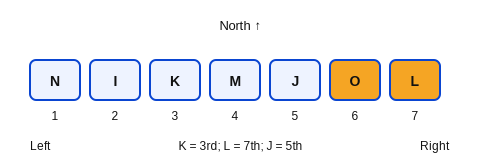
Seven people, I, J, K, L, M, N and O, are sitting in a row, facing north. Only two people sit to the left of K. Only three people sit between K and L. Only one person sits between L and J. N sits to the immediate left of I. M is not an immediate neighbour of L. How many people sit to the right of O?
सात व्यक्ति, I, J, K, L, M, N और O, उत्तर की ओर मुख करके एक पंक्ति में बैठे हैं। K के बाईं ओर केवल दो व्यक्ति बैठे हैं। K और L के बीच केवल तीन व्यक्ति बैठे हैं। L और J के बीच केवल एक व्यक्ति बैठा है। N, I के ठीक बाईं ओर बैठा है। M, L का निकटतम पड़ोसी नहीं है। O के दाईं ओर कितने व्यक्ति बैठे हैं?
  1. AFourचार
  2. BTwoदो
  3. CThreeतीन
  4. DOneएक
Show answer

Concept: Fix definite positions first (all face north, so left = left of the row).

  1. Two to the left of K → K is 3rd. Three between K and L → L is 7th.
  2. One between L and J → J is 5th.
  3. N–I adjacent pair fits only at 1–2; M not next to L → M 4th, O 6th.
  4. Order: N I K M J O L → only L is to the right of O.

Trick: Rules with exact gaps fix seats first; neighbour conditions fill the rest.

Answer: (D) One

अवधारणा: पहले निश्चित स्थान तय करें (सभी उत्तर की ओर मुख, अतः बायाँ = पंक्ति का बायाँ)।

  1. K के बाएँ दो → K तीसरे स्थान पर। K और L के बीच तीन → L 7वें।
  2. L और J के बीच एक → J 5वें।
  3. N–I जोड़ी केवल 1–2 पर; M, L का पड़ोसी नहीं → M 4थे, O 6ठे।
  4. क्रम: N I K M J O L → O के दाएँ केवल L।

ट्रिक: निश्चित दूरी वाले कथनों से पहले सीट तय करें, पड़ोसी वाले कथन बाद में।

उत्तर: (D) एक

RRB NTPC Undergraduate CBT 1General Intelligence and ReasoningLinear Seating ArrangementRRB NTPC Undergraduate CBT 1 2024 · 4 Sep Shift 1 →
Q5499.
HLOY is related to KNRA in a certain way based on the English alphabetical order. In the same way, TTAG is related to WVDI. To which of the given options is CZJM related, following the same logic?
अंग्रेज़ी वर्णमाला क्रम के आधार पर HLOY एक निश्चित प्रकार से KNRA से संबंधित है। उसी प्रकार, TTAG, WVDI से संबंधित है। समान तर्क का अनुसरण करते हुए, CZJM दिए गए विकल्पों में से किससे संबंधित है?
  1. AFBOM
  2. BFOMB
  3. CFBMO
  4. DFMOB
Show answer

Concept: Find the letter shifts: +3, +2, +3, +2.

  1. H→K (+3), L→N (+2), O→R (+3), Y→A (+2).
  2. Check: T→W, T→V, A→D, G→I ✓.
  3. C+3 = F, Z+2 = B, J+3 = M, M+2 = O → FBMO.

Trick: After Z wrap around: Z+2 = B.

Answer: (C) FBMO

अवधारणा: अक्षरों का अंतर: +3, +2, +3, +2।

  1. H→K (+3), L→N (+2), O→R (+3), Y→A (+2)।
  2. जाँच: T→W, T→V, A→D, G→I ✓।
  3. C+3 = F, Z+2 = B, J+3 = M, M+2 = O → FBMO।

ट्रिक: Z के बाद फिर A से गिनें: Z+2 = B।

उत्तर: (C) FBMO

RRB NTPC Undergraduate CBT 1General Intelligence and ReasoningLetter AnalogyRRB NTPC Undergraduate CBT 1 2024 · 4 Sep Shift 1 →
Q5500.
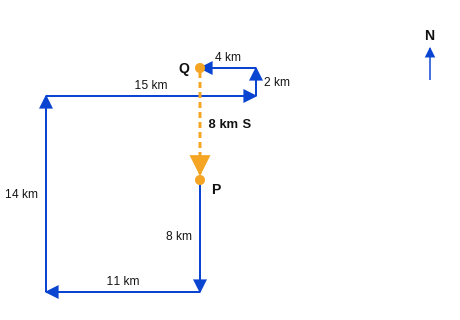
Riya starts from Point P and drives 8 km towards the south. Then she takes a right turn, drives 11 km, she turns right again and drives 14 km. She then takes a right turn and drives 15 km. Then she takes left turn and drives 2 km, she takes a left turn again and drives 4 km and stops at Point Q. How far (shortest distance) and towards which direction should she drive in order to reach Point P again? (All turns are 90-degree turns only unless specified.)
रिया बिंदु P से चलना शुरू करती है और दक्षिण की ओर 8 km गाड़ी चलाती है। फिर वह दाएँ मुड़ती है, 11 km गाड़ी चलाती है, वह फिर से दाएँ मुड़ती है और 14 km गाड़ी चलाती है। फिर वह दाएँ मुड़ती है और 15 km गाड़ी चलाती है। फिर वह बाएँ मुड़ती है और 2 km गाड़ी चलाती है, वह फिर से बाएँ मुड़ती है और 4 km गाड़ी चलाकर बिंदु Q पर रुक जाती है। बिंदु P पर पुनः पहुँचने के लिए उसे कितनी दूरी (न्यूनतम दूरी) और किस दिशा में गाड़ी चलानी चाहिए? (जब तक निर्दिष्ट न हो, सभी मोड़ केवल 90 डिग्री के मोड़ हैं।)
  1. A4 km towards the southदक्षिण की ओर 4 km
  2. B4 km towards the northउत्तर की ओर 4 km
  3. C8 km towards the southदक्षिण की ओर 8 km
  4. D6 km towards the northउत्तर की ओर 6 km
Show answer

Concept: Plot each leg on axes (east = +x, north = +y), taking P as origin.

  1. 8 S → (0, −8); right = west 11 → (−11, −8).
  2. Right = north 14 → (−11, 6); right = east 15 → (4, 6).
  3. Left = north 2 → (4, 8); left = west 4 → Q = (0, 8).
  4. Q is 8 km north of P, so she must drive 8 km south.

Trick: Net E–W: −11 + 15 − 4 = 0; net N–S: −8 + 14 + 2 = 8 north.

Answer: (C) 8 km towards the south

अवधारणा: P को मूल बिंदु मानकर हर चरण अक्ष पर लिखें (पूर्व = +x, उत्तर = +y)।

  1. 8 दक्षिण → (0, −8); दाएँ = पश्चिम 11 → (−11, −8)।
  2. दाएँ = उत्तर 14 → (−11, 6); दाएँ = पूर्व 15 → (4, 6)।
  3. बाएँ = उत्तर 2 → (4, 8); बाएँ = पश्चिम 4 → Q = (0, 8)।
  4. Q, P से 8 km उत्तर में है, अतः 8 km दक्षिण जाना होगा।

ट्रिक: पूर्व–पश्चिम कुल: −11 + 15 − 4 = 0; उत्तर–दक्षिण: −8 + 14 + 2 = 8 उत्तर।

उत्तर: (C) 8 km दक्षिण की ओर

RRB NTPC Undergraduate CBT 1General Intelligence and ReasoningDirection and DistanceRRB NTPC Undergraduate CBT 1 2024 · 4 Sep Shift 1 →