Question bank

Q&A: practice questions with answers

Search questions on any topic. Filter by exam category, exam, subject and topic, try the question, then open the answer and explanation.

Courses – airGurukul

20,719 questions found.

Q5581.
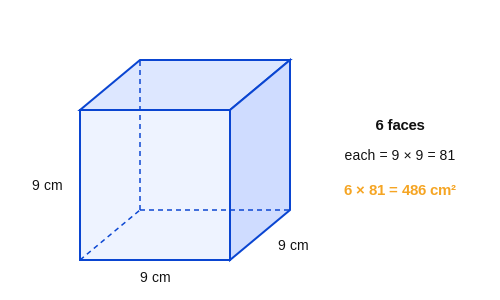
Find the surface area of a cube, whose each side measures 9 cm.
एक घन का पृष्ठीय क्षेत्रफल ज्ञात कीजिए, जिसकी प्रत्येक भुजा की माप 9 cm है।
  1. A364 cm2
  2. B324 cm2
  3. C486 cm2
  4. D729 cm2
Show answer

Concept: A cube has 6 equal square faces, so total surface area =6a2.

  1. a=9 cm, one face =92=81cm2
  2. TSA =6×81=486cm2

Trick: 729 is the volume 93 and 324 is the lateral area 4a2 — do not confuse them.

Answer: (C) 486cm2

अवधारणा: घन के 6 बराबर वर्गाकार फलक होते हैं, अतः कुल पृष्ठीय क्षेत्रफल =6a2।

  1. a=9 cm, एक फलक =92=81cm2
  2. कुल पृष्ठीय क्षेत्रफल =6×81=486cm2

ट्रिक: 729 आयतन (93) है और 324 पार्श्व क्षेत्रफल (4a2) — इनमें भ्रम न करें।

उत्तर: (C) 486cm2

RRB NTPC Undergraduate CBT 1MathematicsMensuration – CubeRRB NTPC Undergraduate CBT 1 2024 · 3 Sep Shift 3 →
Q5582.
In an election between two candidates, 82% of the registered voters cast their vote and 4% of the votes polled were found invalid. The winning candidate got 60% of the valid votes and won the election by a margin of 1968 votes. How many voters were
registered?
दो उम्मीदवारों के बीच हुए एक चुनाव में, 82% पंजीकृत मतदाताओं ने अपना मत डाला और डाले गए मतों में से 4% मत अवैध पाए गए। विजयी उम्मीदवार को वैध मतों का 60% प्राप्त हुआ और उसने 1968 मतों के अंतर से चुनाव जीता। कितने मतदाता
पंजीकृत थे?
  1. A12502
  2. B12501
  3. C12500
  4. D12497
Show answer

Concept: Margin = (winner% − loser%) of valid votes; valid votes are a percentage of polled votes, which are a percentage of registered voters.

  1. Let registered voters =N; polled =0.82N
  2. Valid =0.96×0.82N=0.7872N
  3. Margin =(60%−40%) of valid =0.2×0.7872N=0.15744N
  4. 0.15744N=1968⇒N=12500

Trick: Check options: only 12500×0.82×0.96×0.2 gives a whole number, 1968.

Answer: (C) 12500

अवधारणा: जीत का अंतर = वैध मतों का (विजेता% − पराजित%); वैध मत डाले गए मतों का प्रतिशत हैं और डाले गए मत पंजीकृत मतदाताओं का प्रतिशत।

  1. पंजीकृत मतदाता =N; डाले गए मत =0.82N
  2. वैध मत =0.96×0.82N=0.7872N
  3. अंतर =(60%−40%) वैध का =0.15744N
  4. 0.15744N=1968⇒N=12500

ट्रिक: विकल्प जाँचें: केवल 12500×0.82×0.96×0.2 से पूर्णांक 1968 आता है।

उत्तर: (C) 12500

RRB NTPC Undergraduate CBT 1MathematicsPercentage – ElectionRRB NTPC Undergraduate CBT 1 2024 · 3 Sep Shift 3 →
Q5583.
Find the simple interest (in ₹) on ₹1,200 at an interest rate of 4% per month for 5 months.
₹1,200 पर 4% प्रति माह की ब्याज दर से 5 महीने का साधारण ब्याज (₹ में) ज्ञात कीजिए।
  1. A₹20
  2. B₹40
  3. C₹120
  4. D₹240
Show answer

Concept: SI=P×R×T100, where rate and time must be in the same unit (here, months).

  1. P=1200, R=4% per month, T=5 months
  2. SI =1200×4×5100=240

Trick: 4% per month for 5 months = 20% in total; 20% of 1200 = 240.

Answer: (D) ₹240

अवधारणा: SI=P×R×T100, जहाँ दर और समय एक ही इकाई (यहाँ माह) में हों।

  1. P=1200, R=4% प्रति माह, T=5 माह
  2. SI =1200×4×5100=240

ट्रिक: 4% प्रति माह × 5 माह = कुल 20%; 1200 का 20% = 240।

उत्तर: (D) ₹240

RRB NTPC Undergraduate CBT 1MathematicsSimple InterestRRB NTPC Undergraduate CBT 1 2024 · 3 Sep Shift 3 →
Q5584.
The marked price of a wet grinder is ₹6,500. It was sold at two successive discounts of 5% and 4%. Find its selling price.
एक वेट ग्राइंडर का अंकित मूल्य ₹6,500 है। इसे 5% और 4% की दो क्रमिक छूटों पर बेचा गया। इसका विक्रय मूल्य ज्ञात कीजिए।
  1. A₹5,630
  2. B₹5,500
  3. C₹5,928
  4. D₹5,850
Show answer

Concept: Successive discounts multiply: SP=MP×(1−d1100)(1−d2100).

  1. After 5%: 6500×0.95=6175
  2. After 4%: 6175×0.96=5928

Trick: Net discount =5+4−5×4100=8.8%; 6500×0.912=5928.

Answer: (C) ₹5,928

अवधारणा: क्रमागत छूटें गुणा होती हैं: SP=MP×(1−d1100)(1−d2100)।

  1. 5% के बाद: 6500×0.95=6175
  2. 4% के बाद: 6175×0.96=5928

ट्रिक: कुल छूट =5+4−5×4100=8.8%; 6500×0.912=5928।

उत्तर: (C) ₹5,928

RRB NTPC Undergraduate CBT 1MathematicsSuccessive DiscountRRB NTPC Undergraduate CBT 1 2024 · 3 Sep Shift 3 →
Q5585.
A publisher gives 15% discount on the printed price of a book to booksellers. What does a book seller pay (in ₹) for a book whose printed price is ₹2,400?
एक प्रकाशक पुस्तक विक्रेताओं को किसी पुस्तक के मुद्रित मूल्य पर 15% छूट देता है। एक पुस्तक विक्रेता उस पुस्तक के लिए कितना भुगतान (₹ में) करता है जिसका मुद्रित मूल्य ₹2,400 है?
  1. A2,140
  2. B2,420
  3. C2,004
  4. D2,040
Show answer

Concept: Price paid = printed price − discount = printed price ×100−d100.

  1. Discount =15% of 2400 =360
  2. Price paid =2400−360=2040

Trick: 2400×0.85=2040; note the trap 2,004 (digits swapped).

Answer: (D) ₹2,040

अवधारणा: चुकाया मूल्य = अंकित मूल्य − छूट = अंकित मूल्य ×100−d100।

  1. छूट =2400 का 15%=360
  2. चुकाया मूल्य =2400−360=2040

ट्रिक: 2400×0.85=2040; 2,004 (अंक उलटे) वाले जाल से बचें।

उत्तर: (D) ₹2,040

RRB NTPC Undergraduate CBT 1MathematicsDiscountRRB NTPC Undergraduate CBT 1 2024 · 3 Sep Shift 3 →
Q5586.
The number of prime numbers lying between 332 and 343, both included, is:
332 और 343 के बीच स्थित अभाज्य संख्याओं की संख्या (दोनों को सम्मिलित करते हुए) है:
  1. A2
  2. B1
  3. C3
  4. D4
Show answer

Concept: Test each odd number for divisibility by primes up to 343≈18.5 (2, 3, 5, 7, 11, 13, 17).

  1. 333 =9×37, 335 ends in 5, 339 =3×113, 341 =11×31, 343 =73
  2. 337 is not divisible by 3, 7, 11, 13 or 17 → prime
  3. Even numbers are not prime; so only one prime: 337

Trick: 341 looks prime but 11×31=341 — a classic trap.

Answer: (B) 1

अवधारणा: हर विषम संख्या को 343≈18.5 तक के अभाज्यों (2, 3, 5, 7, 11, 13, 17) से जाँचें।

  1. 333 =9×37, 335 का अंत 5, 339 =3×113, 341 =11×31, 343 =73
  2. 337 किसी से विभाज्य नहीं → अभाज्य
  3. सम संख्याएँ अभाज्य नहीं; अतः केवल एक: 337

ट्रिक: 341 अभाज्य लगता है पर 11×31=341 है।

उत्तर: (B) 1

RRB NTPC Undergraduate CBT 1MathematicsPrime NumbersRRB NTPC Undergraduate CBT 1 2024 · 3 Sep Shift 3 →
Q5587.
The value of 22+102−916−17 is
22+102−916−17 का मान है
  1. A-39
  2. B-48
  3. C-36
  4. D-31
Show answer

Concept: Evaluate powers and roots first (BODMAS), then add/subtract left to right.

  1. 22=4, 102=10, 916=9×4=36
  2. 4+10−36−17=−39

Trick: a2=a for positive a — no need to square 10.

Answer: (A) −39

अवधारणा: पहले घात और मूल (BODMAS), फिर बाएँ से दाएँ जोड़-घटाव।

  1. 22=4, 102=10, 916=9×4=36
  2. 4+10−36−17=−39

ट्रिक: धनात्मक a के लिए a2=a — 10 का वर्ग करने की ज़रूरत नहीं।

उत्तर: (A) −39

RRB NTPC Undergraduate CBT 1MathematicsSimplificationRRB NTPC Undergraduate CBT 1 2024 · 3 Sep Shift 3 →
Q5588.
A number, when increased by 60%, gives 3560. The number is:
एक संख्या में 60% की वृद्धि करने पर 3560 प्राप्त होता है। वह संख्या है:
  1. A2225
  2. B1112.5
  3. C6675
  4. D4450
Show answer

Concept: If a number increased by r% gives y, then the number =y×100100+r.

  1. 1.6x=3560
  2. x=35601.6=2225

Trick: Check: 2225+60% of 2225=2225+1335=3560.

Answer: (A) 2225

अवधारणा: यदि किसी संख्या को r% बढ़ाने पर y मिले, तो संख्या =y×100100+r।

  1. 1.6x=3560
  2. x=35601.6=2225

ट्रिक: जाँच: 2225+1335=3560।

उत्तर: (A) 2225

RRB NTPC Undergraduate CBT 1MathematicsPercentageRRB NTPC Undergraduate CBT 1 2024 · 3 Sep Shift 3 →
Q5589.
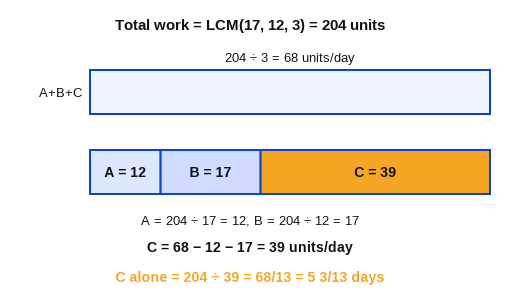
A can lay railway track between two given stations in 17 days and B can do the same job in 12 days. With the help of C, they did the job in 3 days only. Then, C alone can do the job in
A दो दिए गए स्टेशनों के बीच रेलवे ट्रैक 17 दिनों में बिछा सकता है और B वही कार्य 12 दिनों में कर सकता है। C की सहायता से, उन्होंने वह कार्य केवल 3 दिनों में पूरा किया। तो, C अकेले वह कार्य कितने दिनों में कर सकता है?
  1. A6313 days6313 दिन
  2. B7313 days7313 दिन
  3. C5313 days5313 दिन
  4. D12313 days12313 दिन
Show answer

Concept: Take total work = LCM of the days; then work per day (efficiency) of C = combined − A − B.

  1. Total work =LCM(17,12,3)=204 units
  2. A =20417=12, B =20412=17, A+B+C =2043=68 units/day
  3. C =68−12−17=39 units/day
  4. C alone =20439=6813=5313 days

Trick: 1C=13−117−112=1368, answer is just the reciprocal.

Answer: (C) 5313 days

अवधारणा: कुल कार्य = दिनों का LCM लें; फिर C की प्रतिदिन क्षमता = संयुक्त − A − B।

  1. कुल कार्य =LCM(17,12,3)=204 इकाई
  2. A =20417=12, B =20412=17, A+B+C =2043=68 इकाई/दिन
  3. C =68−12−17=39 इकाई/दिन
  4. C अकेला =20439=6813=5313 दिन

ट्रिक: 1C=13−117−112=1368, उत्तर इसका व्युत्क्रम है।

उत्तर: (C) 5313 दिन

RRB NTPC Undergraduate CBT 1MathematicsTime and WorkRRB NTPC Undergraduate CBT 1 2024 · 3 Sep Shift 3 →
Q5590.
Find the mean proportional of 225 and 4.
225 और 4 का मध्यानुपाती ज्ञात कीजिए।
  1. A28
  2. B27
  3. C30
  4. D32
Show answer

Concept: Mean proportional of a and b is ab.

  1. 225×4=900=30

Trick: 225×4=15×2=30.

Answer: (C) 30

अवधारणा: a और b का मध्यानुपाती ab होता है।

  1. 225×4=900=30

ट्रिक: 225×4=15×2=30।

उत्तर: (C) 30

RRB NTPC Undergraduate CBT 1MathematicsMean ProportionalRRB NTPC Undergraduate CBT 1 2024 · 3 Sep Shift 3 →
Q5591.
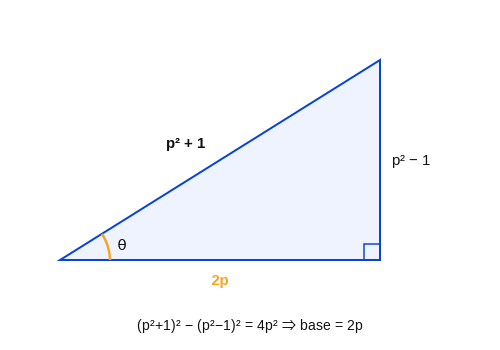
If sinθ=p2−1p2+1, and θ is an acute angle, then find the value of cosθ.
यदि sinθ=p2−1p2+1 है, और θ एक न्यून कोण है, तो cosθ का मान ज्ञात कीजिए।
  1. A2pp2−1
  2. Bp2+12p
  3. C2pp2+1
  4. D1+2pp2−1
Show answer

Concept: sinθ=perpendicularhypotenuse; find the base by Pythagoras, then cosθ=basehypotenuse.

  1. Perpendicular =p2−1, hypotenuse =p2+1
  2. Base2=(p2+1)2−(p2−1)2=4p2, so base =2p
  3. cosθ=2pp2+1

Trick: (p2−1,2p,p2+1) is a standard Pythagorean triplet — learn it.

Answer: (C) 2pp2+1

अवधारणा: sinθ=लंबकर्ण; पाइथागोरस से आधार निकालें, फिर cosθ=आधारकर्ण।

  1. लंब =p2−1, कर्ण =p2+1
  2. आधार2=(p2+1)2−(p2−1)2=4p2, अतः आधार =2p
  3. cosθ=2pp2+1

ट्रिक: (p2−1,2p,p2+1) एक मानक पाइथागोरस त्रिक है।

उत्तर: (C) 2pp2+1

RRB NTPC Undergraduate CBT 1MathematicsTrigonometryRRB NTPC Undergraduate CBT 1 2024 · 3 Sep Shift 3 →
Q5592.
In covering a distance of 52 km, Anmol takes 6 hours more than Nikhil. If Anmol doubles his speed, then he would take 7 hours less than Nikhil. Anmol's speed is:
52 km की दूरी तय करने में, अनमोल, निखिल से 6 घंटे अधिक लेता है। यदि अनमोल अपनी चाल दोगुनी कर दे, तो वह निखिल से 7 घंटे कम समय लेगा। अनमोल की चाल है:
  1. A4 km/hr
  2. B6 km/hr
  3. C2 km/hr
  4. D7 km/hr
Show answer

Concept: Doubling speed halves the time. Compare Anmol’s two times with Nikhil’s time t.

  1. At speed a: 52a=t+6
  2. At speed 2a: 522a=26a=t−7
  3. Subtract: 26a=13
  4. a=2km/h

Trick: Halved time saves 6+7=13 h, so the full time is 26 h; speed =5226=2.

Answer: (C) 2 km/hr

अवधारणा: चाल दोगुनी करने पर समय आधा हो जाता है। अनमोल के दोनों समय की तुलना निखिल के समय t से करें।

  1. चाल a पर: 52a=t+6
  2. चाल 2a पर: 26a=t−7
  3. घटाने पर: 26a=13
  4. a=2km/h

ट्रिक: आधा समय करने पर 6+7=13 घंटे बचे, अतः पूरा समय 26 घंटे; चाल =5226=2।

उत्तर: (C) 2 km/hr

RRB NTPC Undergraduate CBT 1MathematicsSpeed, Time and DistanceRRB NTPC Undergraduate CBT 1 2024 · 3 Sep Shift 3 →
Q5593.
The average weight of Salil, Mukund and Sachin is 45 kg. If the average weight of Salil and Mukund is 44 kg and that of Mukund and Sachin is 48 kg, then the weight of Mukund (in kg) is:
सलिल, मुकुंद और सचिन का औसत भार 45 kg है। यदि सलिल और मुकुंद का औसत भार 44 kg है और मुकुंद और सचिन का औसत भार 48 kg है, तो मुकुंद का भार (kg में) है:
  1. A49
  2. B59
  3. C69
  4. D64
Show answer

Concept: Convert each average into a total, then combine the totals.

  1. Salil + Mukund + Sachin =3×45=135
  2. Salil + Mukund =88 ⇒ Sachin =135−88=47
  3. Mukund + Sachin =96 ⇒ Mukund =96−47=49

Trick: Middle person =(88+96)−135=49 directly.

Answer: (A) 49

अवधारणा: हर औसत को योग में बदलें, फिर योगों को मिलाएँ।

  1. सलिल + मुकुंद + सचिन =3×45=135
  2. सलिल + मुकुंद =88 ⇒ सचिन =135−88=47
  3. मुकुंद + सचिन =96 ⇒ मुकुंद =96−47=49

ट्रिक: बीच वाला (common) व्यक्ति =(88+96)−135=49।

उत्तर: (A) 49

RRB NTPC Undergraduate CBT 1MathematicsAverageRRB NTPC Undergraduate CBT 1 2024 · 3 Sep Shift 3 →
Q5594.
Simplify: x(6x − 9) + 6(x2 − 3) + 19
सरल कीजिए: x(6x − 9) + 6(x2 − 3) + 19
  1. A12x2 − 9x −1
  2. B12x2 − 9x + 1
  3. C−12x2 − 9x + 1
  4. D−12x2 − 9x − 1
Show answer

Concept: Expand each bracket, then collect like terms.

  1. x(6x−9)=6x2−9x
  2. 6(x2−3)=6x2−18
  3. Sum +19: 12x2−9x−18+19=12x2−9x+1

Trick: Put x=1: −3+(−12)+19=4; only 12−9+1=4 matches.

Answer: (B) 12x2−9x+1

अवधारणा: हर कोष्ठक खोलें, फिर समान पद जोड़ें।

  1. x(6x−9)=6x2−9x
  2. 6(x2−3)=6x2−18
  3. +19 जोड़कर: 12x2−9x+1

ट्रिक: x=1 रखें: −3−12+19=4; केवल 12−9+1=4 मेल खाता है।

उत्तर: (B) 12x2−9x+1

RRB NTPC Undergraduate CBT 1MathematicsAlgebraic SimplificationRRB NTPC Undergraduate CBT 1 2024 · 3 Sep Shift 3 →
Q5595.
Pooja, Harsh, and Madhur invest ₹1,120, ₹1,320, and ₹1,160, respectively to start a business. If the profit at the end of the year is ₹1,080, then what is the share of Madhur in the profit?
पूजा, हर्ष और मधुर एक व्यवसाय शुरू करने के लिए क्रमशः ₹1,120, ₹1,320 और ₹1,160 का निवेश करते हैं। यदि वर्ष के अंत में लाभ ₹1,080 है, तो लाभ में मधुर का हिस्सा कितना है?
  1. A₹348
  2. B₹349
  3. C₹351
  4. D₹347
Show answer

Concept: For equal time periods, profit is shared in the ratio of investments.

  1. 1120:1320:1160=28:33:29 (divide by 40)
  2. Total =90 parts
  3. Madhur =2990×1080=29×12=348

Trick: 1080÷90=12 per part makes the multiplication easy.

Answer: (A) ₹348

अवधारणा: समान अवधि हो तो लाभ निवेश के अनुपात में बँटता है।

  1. 1120:1320:1160=28:33:29 (40 से भाग)
  2. कुल =90 भाग
  3. मधुर =2990×1080=29×12=348

ट्रिक: 1080÷90=12 प्रति भाग।

उत्तर: (A) ₹348

RRB NTPC Undergraduate CBT 1MathematicsPartnershipRRB NTPC Undergraduate CBT 1 2024 · 3 Sep Shift 3 →
Q5596.
Based on the English alphabetical order, three of the following four letter-clusters are alike in a certain way and thus form a group. Which letter-cluster DOES NOT belong to that group?
(Note: The odd one out is not based on the number of consonants/vowels or their position in the letter-cluster.)
अंग्रेज़ी वर्णमाला क्रम के आधार पर, निम्नलिखित चार अक्षर-समूहों में से तीन किसी निश्चित प्रकार से एक समान हैं और इस प्रकार एक समूह बनाते हैं। कौन-सा अक्षर-समूह उस समूह से संबंधित नहीं है?
(ध्यान दें: असंगत अक्षर-समूह, उस अक्षर-समूह में व्यंजनों/स्वरों की संख्या या उनके स्थान पर आधारित नहीं है।)
  1. AHPJ
  2. BQYR
  3. CKSM
  4. DNVP
Show answer

Concept: Write the alphabet positions and check the gaps between the letters.

  1. HPJ: H(8) → P(16) is +8, P → J(10) is −6
  2. KSM: 11 → 19 (+8) → 13 (−6); NVP: 14 → 22 (+8) → 16 (−6)
  3. QYR: 17 → 25 (+8) → 18 (−7) — breaks the pattern

Trick: Pattern +8, −6 also means 3rd letter = 1st + 2; Q + 2 = S, not R.

Answer: (B) QYR

अवधारणा: अक्षरों के वर्णमाला क्रमांक लिखकर उनके अंतर जाँचें।

  1. HPJ: H(8) → P(16) +8, P → J(10) −6
  2. KSM: 11 → 19 (+8) → 13 (−6); NVP: 14 → 22 (+8) → 16 (−6)
  3. QYR: 17 → 25 (+8) → 18 (−7) — पैटर्न टूटा

ट्रिक: तीसरा अक्षर = पहला + 2; Q + 2 = S, R नहीं।

उत्तर: (B) QYR

RRB NTPC Undergraduate CBT 1General Intelligence and ReasoningOdd One Out – LettersRRB NTPC Undergraduate CBT 1 2024 · 3 Sep Shift 3 →
Q5597.
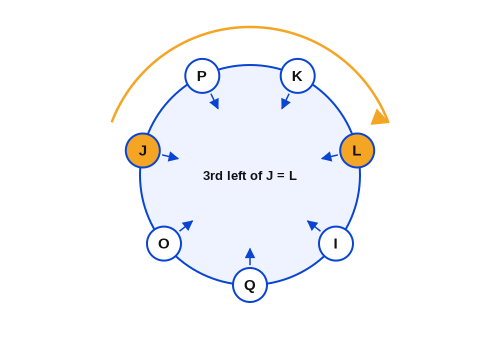
I, J, K, L, O, P and Q are sitting around a circular table facing the centre of the table. Only two people sit between Q and K when counted from the right of Q. Only two people sit between K and O. Only three people sit between Q and P. I sits to the immediate left of L. Who sits third to the left of J?
I, J, K, L, O, P और Q एक वृत्ताकार मेज़ के चारों ओर मेज़ के केंद्र की ओर मुख करके बैठे हैं। Q के दाईं ओर से गिनने पर Q और K के बीच केवल दो व्यक्ति बैठे हैं। K और O के बीच केवल दो व्यक्ति बैठे हैं। Q और P के बीच केवल तीन व्यक्ति बैठे हैं। I, L के ठीक बाईं ओर बैठा है। J के बाईं ओर तीसरे स्थान पर कौन बैठा है?
  1. AK
  2. BL
  3. CQ
  4. DI
Show answer

Concept: Facing the centre, a person’s right is anticlockwise. Fix Q and count seats to Q’s right as positions 1–6.

  1. Two between Q and K from Q’s right ⇒ K at 3. Three between Q and P ⇒ P at 4 (3 is taken).
  2. Two between K and O ⇒ O at 6.
  3. Left seats 1, 2, 5; I immediately left of L ⇒ I = 1, L = 2, J = 5.
  4. Third to the left of J: P, K, L ⇒ L.

Trick: In a 7-seat circle, “n between” on one side = “5 − n between” on the other side.

Answer: (B) L

अवधारणा: केंद्र की ओर मुख होने पर व्यक्ति का दायाँ = वामावर्त (anticlockwise)। Q को स्थिर कर उसके दाएँ स्थान 1–6 गिनें।

  1. Q के दाएँ से Q और K के बीच दो ⇒ K स्थान 3 पर। Q और P के बीच तीन ⇒ P स्थान 4 पर।
  2. K और O के बीच दो ⇒ O स्थान 6 पर।
  3. बचे स्थान 1, 2, 5; I, L के ठीक बाएँ ⇒ I = 1, L = 2, J = 5।
  4. J के बाएँ तीसरा: P, K, L ⇒ L।

ट्रिक: 7 सीटों के वृत्त में एक ओर “n बीच में” = दूसरी ओर “5 − n बीच में”।

उत्तर: (B) L

RRB NTPC Undergraduate CBT 1General Intelligence and ReasoningCircular Seating ArrangementRRB NTPC Undergraduate CBT 1 2024 · 3 Sep Shift 3 →
Q5598.
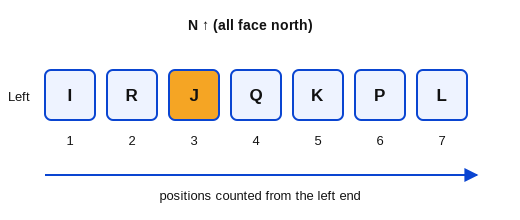
Seven people, I, J, K, L, P, Q and R, are sitting in a row, facing north. Only two people sit to the right of K. Only two people sit between K and R. Only two people sit between I and Q. Q sits to the immediate left of K. L sits to the immediate right of P. Who sits at the third position from the left end of the row?
सात व्यक्ति, I, J, K, L, P, Q और R, एक पंक्ति में उत्तर की ओर मुख करके बैठे हैं। K के दाईं ओर केवल दो व्यक्ति बैठे हैं। K और R के बीच केवल दो व्यक्ति बैठे हैं। I और Q के बीच केवल दो व्यक्ति बैठे हैं। Q, K के ठीक बाईं ओर बैठा है। L, P के ठीक दाईं ओर बैठा है। पंक्ति के बाएँ छोर से तीसरे स्थान पर कौन बैठा है?
  1. AJ
  2. BL
  3. CI
  4. DR
Show answer

Concept: Facing north, the right end is the east end. Number positions 1–7 from the left.

  1. Two people to the right of K ⇒ K = 5; Q immediately left ⇒ Q = 4.
  2. Two between K and R ⇒ R = 2.
  3. Two between I and Q ⇒ I = 1 or 7. P–L must be adjacent: only I = 1 leaves 6, 7 free ⇒ P = 6, L = 7.
  4. Remaining J = 3.

Trick: Test both cases for I quickly — the adjacent-pair condition (P, L) usually rejects one.

Answer: (A) J

अवधारणा: उत्तर की ओर मुख हो तो दायाँ सिरा पूर्व वाला है। बाएँ से स्थान 1–7 लिखें।

  1. K के दाएँ केवल दो ⇒ K = 5; Q ठीक बाएँ ⇒ Q = 4।
  2. K और R के बीच दो ⇒ R = 2।
  3. I और Q के बीच दो ⇒ I = 1 या 7। P–L साथ-साथ: केवल I = 1 से 6, 7 खाली ⇒ P = 6, L = 7।
  4. बचा J = 3।

ट्रिक: I के दोनों विकल्प जाँचें — P, L की सटी जोड़ी एक विकल्प को हटा देती है।

उत्तर: (A) J

RRB NTPC Undergraduate CBT 1General Intelligence and ReasoningLinear Seating ArrangementRRB NTPC Undergraduate CBT 1 2024 · 3 Sep Shift 3 →
Q5599.
What will come in place of the question mark (?) in the following equation, if ‘+’ and ‘−’ are interchanged and ‘×’ and ‘÷’ are interchanged?
100 × 4 + 11 ÷ 2 − 18 = ?
यदि ‘+’ और ‘−’ को आपस में बदल दिया जाए तथा ‘×’ और ‘÷’ को आपस में बदल दिया जाए, तो निम्नलिखित समीकरण में प्रश्न चिह्न (?) के स्थान पर क्या आएगा?
100 × 4 + 11 ÷ 2 − 18 = ?
  1. A27
  2. B15
  3. C21
  4. D36
Show answer

Concept: Swap the signs first, then apply BODMAS.

  1. 100×4+11÷2−18 becomes 100÷4−11×2+18
  2. =25−22+18=21

Trick: Rewrite the whole expression with new signs before calculating — never swap mentally.

Answer: (C) 21

अवधारणा: पहले चिह्न बदलें, फिर BODMAS लगाएँ।

  1. 100×4+11÷2−18 बनता है 100÷4−11×2+18
  2. =25−22+18=21

ट्रिक: गणना से पहले पूरा व्यंजक नए चिह्नों के साथ लिख लें।

उत्तर: (C) 21

RRB NTPC Undergraduate CBT 1General Intelligence and ReasoningMathematical OperationsRRB NTPC Undergraduate CBT 1 2024 · 3 Sep Shift 3 →
Q5600.
What should come in place of the question mark (?) in the given series?
22 25 36 39 50 ?
दी गई श्रृंखला में प्रश्न चिह्न (?) के स्थान पर क्या आना चाहिए?
22 25 36 39 50 ?
  1. A54
  2. B53
  3. C52
  4. D55
Show answer

Concept: Check the differences between consecutive terms.

  1. 22 → 25 (+3) → 36 (+11) → 39 (+3) → 50 (+11)
  2. Next: 50 + 3 = 53

Trick: Alternating differences (+3, +11) repeat — continue the cycle.

Answer: (B) 53

अवधारणा: क्रमागत पदों के अंतर देखें।

  1. 22 → 25 (+3) → 36 (+11) → 39 (+3) → 50 (+11)
  2. अगला: 50 + 3 = 53

ट्रिक: एकांतर अंतर (+3, +11) दोहराए जाते हैं।

उत्तर: (B) 53

RRB NTPC Undergraduate CBT 1General Intelligence and ReasoningNumber SeriesRRB NTPC Undergraduate CBT 1 2024 · 3 Sep Shift 3 →