Question bank

Q&A: practice questions with answers

Search questions on any topic. Filter by exam category, exam, subject and topic, try the question, then open the answer and explanation.

Courses – airGurukul

20,719 questions found.

Q5781.
The simple interest on a certain sum for 812 years at the rate of 3.2% per annum is ₹2,550. What will be the amount payable on the same sum at the rate of 9.6% per annum simple interest in 545 years?
किसी निश्चित राशि पर 812 वर्ष के लिए 3.2% वार्षिक दर से साधारण ब्याज ₹2,550 है। उसी राशि पर 9.6% वार्षिक साधारण ब्याज की दर से 545 वर्ष में देय मिश्रधन कितना होगा?
  1. A₹14,613
  2. B₹14,609
  3. C₹14,583
  4. D₹14,595
Show answer

Concept: SI=P×R×T100, Amount =P+SI.

  1. 2550=P×3.2×8.5100=0.272P⇒P=9375 (₹).
  2. New SI =9375×9.6×5.8100=5220 (₹).
  3. Amount =9375+5220=14595 (₹).

Trick: Rate × time: old =27.2, new =55.68; new SI =2550×55.6827.2=5220.

Answer: (D) ₹14,595

अवधारणा: SI=P×R×T100, मिश्रधन =P+SI।

  1. 2550=P×3.2×8.5100=0.272P⇒P=9375 (₹)।
  2. नया SI =9375×9.6×5.8100=5220 (₹)।
  3. मिश्रधन =9375+5220=14595 (₹)।

ट्रिक: दर × समय: पुराना =27.2, नया =55.68; नया SI =2550×55.6827.2=5220।

उत्तर: (D) ₹14,595

RRB NTPC Undergraduate CBT 1MathematicsSimple interestRRB NTPC Undergraduate CBT 1 2024 · 3 Sep Shift 1 →
Q5782.
Evaluate 242.
242 का मान ज्ञात कीजिए।
  1. A576
  2. B546
  3. C626
  4. D536
Show answer

Concept: Use (a−b)2=a2−2ab+b2 with a round base.

  1. 242=(25−1)2=625−50+1.
  2. =576.

Trick: Squares ending in 4 end in 6; 242=576 (since 252=625, subtract 25+24=49).

Answer: (A) 576

अवधारणा: गोल आधार के साथ (a−b)2=a2−2ab+b2 का प्रयोग करें।

  1. 242=(25−1)2=625−50+1।
  2. =576।

ट्रिक: 4 पर समाप्त संख्या का वर्ग 6 पर समाप्त होता है; 252=625 में से 25+24=49 घटाएँ = 576।

उत्तर: (A) 576

RRB NTPC Undergraduate CBT 1MathematicsSquaresRRB NTPC Undergraduate CBT 1 2024 · 3 Sep Shift 1 →
Q5783.
Ishaan and Meghna have to travel from Delhi to Kanpur in their respective cars. Ishaan is driving at 147 km/hr while Meghna is driving at 42 km/hr. Find the time taken by Meghna to reach Kanpur if Ishaan takes 8 hours.
ईशान और मेघना को अपनी-अपनी कारों से दिल्ली से कानपुर की यात्रा करनी है। ईशान 147 km/hr की चाल से गाड़ी चला रहा है जबकि मेघना 42 km/hr की चाल से गाड़ी चला रही है। यदि ईशान को 8 घंटे लगते हैं, तो मेघना द्वारा कानपुर पहुँचने में लिया गया समय ज्ञात कीजिए।
  1. A32 hours32 घंटे
  2. B19 hours19 घंटे
  3. C33 hours33 घंटे
  4. D28 hours28 घंटे
Show answer

Concept: For the same distance, time is inversely proportional to speed.

  1. Distance =147×8=1176km.
  2. Meghna's time =117642=28 hours.

Trick: T2=T1×S1S2=8×14742=8×3.5=28.

Answer: (D) 28 hours

अवधारणा: समान दूरी के लिए समय चाल के व्युत्क्रमानुपाती होता है।

  1. दूरी =147×8=1176km।
  2. मेघना का समय =117642=28 घंटे।

ट्रिक: T2=T1×S1S2=8×14742=28।

उत्तर: (D) 28 घंटे

RRB NTPC Undergraduate CBT 1MathematicsSpeed and timeRRB NTPC Undergraduate CBT 1 2024 · 3 Sep Shift 1 →
Q5784.
The marked price of a vehicle is ₹6,48,200. It is sold after allowing three successive discounts of 6%, 5% and 4%. Find its selling price. (Rounded off to nearest rupee)
एक वाहन का अंकित मूल्य ₹6,48,200 है। इसे 6%, 5% और 4% की तीन क्रमिक छूट देने के बाद बेचा जाता है। इसका विक्रय मूल्य ज्ञात कीजिए। (निकटतम रुपये तक पूर्णांकित)
  1. A₹5,55,689
  2. B₹5,70,650
  3. C₹5,60,789
  4. D₹5,48,600
Show answer

Concept: Successive discounts multiply: SP =MP×(1−d1)(1−d2)(1−d3).

  1. 648200×0.94=609308.
  2. 609308×0.95=578842.6.
  3. 578842.6×0.96=555688.9≈555689 (₹).

Trick: 0.94×0.95×0.96=0.85728 → net discount 14.272%; SP =648200×0.85728.

Answer: (A) ₹5,55,689

अवधारणा: क्रमिक छूट गुणा होती हैं: SP =MP×(1−d1)(1−d2)(1−d3)।

  1. 648200×0.94=609308।
  2. 609308×0.95=578842.6।
  3. 578842.6×0.96=555688.9≈555689 (₹)।

ट्रिक: 0.94×0.95×0.96=0.85728 → शुद्ध छूट 14.272%।

उत्तर: (A) ₹5,55,689

RRB NTPC Undergraduate CBT 1MathematicsSuccessive discountsRRB NTPC Undergraduate CBT 1 2024 · 3 Sep Shift 1 →
Q5785.
The exterior angle of a regular polygon is one-seventh of its interior angle. How many sides does the polygon have?
एक सम बहुभुज का बाह्य कोण उसके अंतः कोण का सातवाँ भाग है। बहुभुज की कितनी भुजाएँ हैं?
  1. A18
  2. B24
  3. C12
  4. D16
Show answer

Concept: Interior + exterior angle =180∘; number of sides n=360∘exterior.

  1. Exterior =17 interior → ratio 1:7.
  2. Exterior =180∘8=22.5∘.
  3. n=360∘22.5∘=16.

Trick: If exterior =1k interior, then n=2(k+1)=2×8=16.

Answer: (D) 16

अवधारणा: अंतः कोण + बाह्य कोण =180∘; भुजाएँ n=360∘बाह्य।

  1. बाह्य =17 अंतः → अनुपात 1:7।
  2. बाह्य =180∘8=22.5∘।
  3. n=360∘22.5∘=16।

ट्रिक: यदि बाह्य =1k अंतः, तो n=2(k+1)=16।

उत्तर: (D) 16

RRB NTPC Undergraduate CBT 1MathematicsPolygonsRRB NTPC Undergraduate CBT 1 2024 · 3 Sep Shift 1 →
Q5786.
The product of two positive numbers is 2645. If the first number is five times the second number, then the sum of the two numbers is:
दो धनात्मक संख्याओं का गुणनफल 2645 है। यदि पहली संख्या दूसरी संख्या की पाँच गुनी है, तो दोनों संख्याओं का योग है:
  1. A138
  2. B149
  3. C146
  4. D155
Show answer

Concept: Express both numbers in one variable and use the product.

  1. Second =x, first =5x.
  2. 5x2=2645⇒x2=529⇒x=23.
  3. Sum =6x=138.

Trick: 2645÷5=529=232; sum =6×23.

Answer: (A) 138

अवधारणा: दोनों संख्याओं को एक चर में लिखें और गुणनफल का प्रयोग करें।

  1. दूसरी =x, पहली =5x।
  2. 5x2=2645⇒x2=529⇒x=23।
  3. योग =6x=138।

ट्रिक: 2645÷5=529=232; योग =6×23।

उत्तर: (A) 138

RRB NTPC Undergraduate CBT 1MathematicsNumbersRRB NTPC Undergraduate CBT 1 2024 · 3 Sep Shift 1 →
Q5787.
The average runs scored by a batsman in 23 matches is 43. In the next 10 matches, the batsman scored an average of 15 runs. Find his average runs scored (rounded off to two decimal places) in all the 33 matches.
एक बल्लेबाज़ द्वारा 23 मैचों में बनाए गए रनों का औसत 43 है। अगले 10 मैचों में, बल्लेबाज़ ने औसतन 15 रन बनाए। सभी 33 मैचों में उसके द्वारा बनाए गए रनों का औसत (दो दशमलव स्थानों तक पूर्णांकित) ज्ञात कीजिए।
  1. A33.52
  2. B35.52
  3. C34.52
  4. D36.52
Show answer

Concept: Overall average = total runs ÷ total matches.

  1. Runs in 23 matches =23×43=989.
  2. Runs in next 10 =10×15=150.
  3. Average =113933=34.515≈34.52.

Trick: Deviation method: 43−10×(43−15)33=43−8.48=34.52.

Answer: (C) 34.52

अवधारणा: कुल औसत = कुल रन ÷ कुल मैच।

  1. 23 मैचों के रन =23×43=989।
  2. अगले 10 मैच =10×15=150।
  3. औसत =113933=34.515≈34.52।

ट्रिक: विचलन विधि: 43−10×2833=43−8.48=34.52।

उत्तर: (C) 34.52

RRB NTPC Undergraduate CBT 1MathematicsAverageRRB NTPC Undergraduate CBT 1 2024 · 3 Sep Shift 1 →
Q5788.
The number 938315 is divisible by which of the following?
संख्या 938315 निम्नलिखित में से किससे विभाज्य है?
  1. A12
  2. B13
  3. C5
  4. D9
Show answer

Concept: A number is divisible by 5 if its last digit is 0 or 5.

  1. 938315 ends in 5 → divisible by 5.
  2. Not by 12 or 9: it is odd and digit sum =29 (not a multiple of 3 or 9).
  3. 938315=13×72178+1 → not by 13.

Trick: Look at the last digit first – it settles 2, 4, 5, 10 instantly.

Answer: (C) 5

अवधारणा: जिस संख्या का अंतिम अंक 0 या 5 हो वह 5 से विभाज्य होती है।

  1. 938315 का अंतिम अंक 5 → 5 से विभाज्य।
  2. 12 या 9 से नहीं: संख्या विषम है और अंकों का योग =29 (3 या 9 का गुणज नहीं)।
  3. 938315=13×72178+1 → 13 से नहीं।

ट्रिक: पहले अंतिम अंक देखें – 2, 4, 5, 10 तुरंत तय हो जाते हैं।

उत्तर: (C) 5

RRB NTPC Undergraduate CBT 1MathematicsDivisibilityRRB NTPC Undergraduate CBT 1 2024 · 3 Sep Shift 1 →
Q5789.
An amount of ₹785 is divided among three persons in the ratio of 19 : 3 : 18. The difference between the largest and the smallest shares (in ₹) in the distribution is:
₹785 की एक राशि को तीन व्यक्तियों के बीच 19 : 3 : 18 के अनुपात में बाँटा जाता है। इस वितरण में सबसे बड़े और सबसे छोटे हिस्सों के बीच का अंतर (₹ में) है:
  1. A387
  2. B315
  3. C314
  4. D369
Show answer

Concept: Value of 1 part =totalsum of ratio terms.

  1. Sum of ratio =19+3+18=40; 1 part =78540=19.625.
  2. Largest − smallest =19−3=16 parts.
  3. 16×19.625=314 (₹).

Trick: Difference =785×1640=785×0.4=314.

Answer: (C) 314

अवधारणा: 1 भाग =कुलअनुपात पदों का योग।

  1. अनुपात योग =19+3+18=40; 1 भाग =78540=19.625।
  2. सबसे बड़ा − सबसे छोटा =19−3=16 भाग।
  3. 16×19.625=314 (₹)।

ट्रिक: अंतर =785×1640=785×0.4=314।

उत्तर: (C) 314

RRB NTPC Undergraduate CBT 1MathematicsRatio & proportionRRB NTPC Undergraduate CBT 1 2024 · 3 Sep Shift 1 →
Q5790.
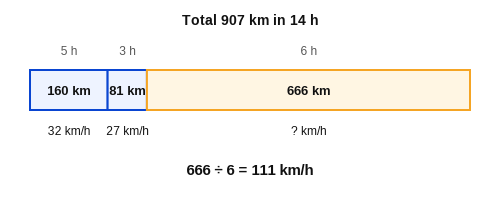
Aarohi has to reach Lucknow which is 907 km away in 14 hours. His starting speed for 5 hours was 32 km/hr. For the next 81 km his speed was 27 km/hr. By what speed he must travel now so as to reach Lucknow in the decided time of 14 hours?
आरोही को 907 km दूर स्थित लखनऊ 14 घंटे में पहुँचना है। पहले 5 घंटे तक उसकी प्रारंभिक चाल 32 km/hr थी। अगले 81 km तक उसकी चाल 27 km/hr थी। निर्धारित 14 घंटे के समय में लखनऊ पहुँचने के लिए उसे अब किस चाल से यात्रा करनी होगी?
  1. A108 km/hr
  2. B117 km/hr
  3. C107 km/hr
  4. D111 km/hr
Show answer

Concept: Required speed = remaining distance ÷ remaining time.

  1. First 5 h: 5×32=160km.
  2. Next 81km at 27km/h takes 3 h.
  3. Remaining distance =907−241=666km; remaining time =14−8=6 h.
  4. Speed =6666=111km/h.

Trick: Keep a running total of distance and time; the last leg gives the answer directly.

Answer: (D) 111 km/hr

अवधारणा: आवश्यक चाल = शेष दूरी ÷ शेष समय।

  1. पहले 5 घंटे: 5×32=160km।
  2. अगले 81km, 27km/h पर 3 घंटे।
  3. शेष दूरी =907−241=666km; शेष समय =14−8=6 घंटे।
  4. चाल =6666=111km/h।

ट्रिक: दूरी और समय का चालू योग रखें; अंतिम हिस्सा सीधे उत्तर देता है।

उत्तर: (D) 111 km/hr

RRB NTPC Undergraduate CBT 1MathematicsSpeed, distance & timeRRB NTPC Undergraduate CBT 1 2024 · 3 Sep Shift 1 →
Q5791.
A can do a work in 11 days and B can do the same work in 24 days. If they work on it together for 2 days, then what fraction of the work is left?
A किसी कार्य को 11 दिनों में कर सकता है और B उसी कार्य को 24 दिनों में कर सकता है। यदि वे 2 दिनों तक एक साथ मिलकर उस पर कार्य करते हैं, तो कार्य का कितना भाग शेष रह जाता है?
  1. A99132
  2. B107132
  3. C97132
  4. D103132
Show answer

Concept: One day's work = 1days; work left = 1− work done.

  1. (A+B) in 1 day =111+124=35264.
  2. In 2 days =70264=35132.
  3. Left =1−35132=97132.

Trick: All options have denominator 132, so work done =35132 and left =132−35=97 parts.

Answer: (C) 97132

अवधारणा: 1 दिन का काम = 1दिन; शेष काम = 1− किया गया काम।

  1. (A+B) का 1 दिन का काम =111+124=35264।
  2. 2 दिन में =70264=35132।
  3. शेष =1−35132=97132।

ट्रिक: सभी विकल्पों का हर 132 है, अतः किया गया =35 भाग, शेष =97 भाग।

उत्तर: (C) 97132

RRB NTPC Undergraduate CBT 1MathematicsTime & workRRB NTPC Undergraduate CBT 1 2024 · 3 Sep Shift 1 →
Q5792.
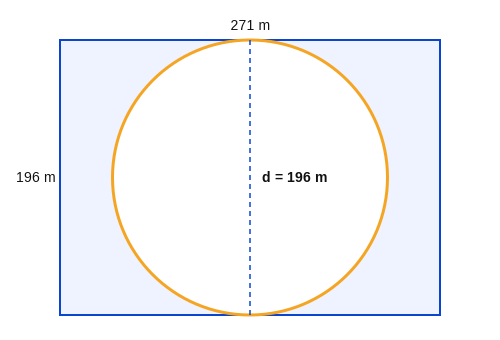
Find the circumference (in m) of the largest circle that can be drawn completely inside a rectangle with sides 196 m and 271 m. (Take π=227.)
196 m और 271 m भुजाओं वाले एक आयत के अंदर पूर्णतः खींचे जा सकने वाले सबसे बड़े वृत्त की परिधि (m में) ज्ञात कीजिए। (π=227 लीजिए।)
  1. A613
  2. B616
  3. C608
  4. D614
Show answer

Concept: The largest circle inside a rectangle has diameter equal to the shorter side.

  1. Diameter =196m (shorter side).
  2. Circumference =πd=227×196.
  3. =22×28=616m.

Trick: 196 is a multiple of 7 → 227×196=616 directly.

Answer: (B) 616

अवधारणा: आयत के अंदर सबसे बड़े वृत्त का व्यास छोटी भुजा के बराबर होता है।

  1. व्यास =196m (छोटी भुजा)।
  2. परिधि =πd=227×196।
  3. =22×28=616m।

ट्रिक: 196, 7 का गुणज है → 227×196=616।

उत्तर: (B) 616

RRB NTPC Undergraduate CBT 1MathematicsMensuration – circleRRB NTPC Undergraduate CBT 1 2024 · 3 Sep Shift 1 →
Q5793.
The value of 400+0.0121−7.84 is ______.
400+0.0121−7.84 का मान ______ है।
  1. A17.31
  2. B4.24
  3. C2.92
  4. D15.32
Show answer

Concept: Find square roots of decimals by pairing decimal places.

  1. 400=20.
  2. 0.0121=0.11 (since 112=121).
  3. 7.84=2.8 (since 282=784).
  4. 20+0.11−2.8=17.31.

Trick: Decimal places in the root = half of those in the number: 0.0121 (4) → 0.11 (2).

Answer: (A) 17.31

अवधारणा: दशमलव संख्याओं का वर्गमूल दशमलव स्थानों को जोड़ी में लेकर निकालें।

  1. 400=20।
  2. 0.0121=0.11 (क्योंकि 112=121)।
  3. 7.84=2.8 (क्योंकि 282=784)।
  4. 20+0.11−2.8=17.31।

ट्रिक: वर्गमूल में दशमलव स्थान = संख्या के आधे: 0.0121 (4) → 0.11 (2)।

उत्तर: (A) 17.31

RRB NTPC Undergraduate CBT 1MathematicsSquare rootsRRB NTPC Undergraduate CBT 1 2024 · 3 Sep Shift 1 →
Q5794.
Anjani can do a certain piece of work in 12 days. Anjani and Khushbu can together do the same work in 9 days, and Anjani, Khushbu and Sushmita can do the same work together in 8 days. In how many days can Anjani and Sushmita do the same work together?
अंजनी किसी कार्य को 12 दिनों में कर सकती है। अंजनी और खुशबू मिलकर उसी कार्य को 9 दिनों में कर सकती हैं, और अंजनी, खुशबू और सुष्मिता मिलकर उसी कार्य को 8 दिनों में कर सकती हैं। अंजनी और सुष्मिता मिलकर उसी कार्य को कितने दिनों में कर सकती हैं?
  1. A727
  2. B707
  3. C808
  4. D829
Show answer

Concept: Use LCM of days as total work and find each person's efficiency.

  1. Total work =LCM(12,9,8)=72 units.
  2. Anjani =6, Anjani+Khushbu =8, all three =9 units/day.
  3. Sushmita =9−8=1 unit/day.
  4. Anjani+Sushmita =7 units/day → 727 days.

Trick: Efficiencies by subtraction: 9−8=1 for Sushmita; then 72÷(6+1).

Answer: (A) 727

अवधारणा: दिनों का LCM कुल काम मानें और हर व्यक्ति की क्षमता निकालें।

  1. कुल काम =LCM(12,9,8)=72 इकाई।
  2. अंजनी =6, अंजनी+खुशबू =8, तीनों =9 इकाई/दिन।
  3. सुष्मिता =9−8=1 इकाई/दिन।
  4. अंजनी+सुष्मिता =7 इकाई/दिन → 727 दिन।

ट्रिक: घटाकर क्षमता: सुष्मिता =9−8=1; फिर 72÷(6+1)।

उत्तर: (A) 727

RRB NTPC Undergraduate CBT 1MathematicsTime & workRRB NTPC Undergraduate CBT 1 2024 · 3 Sep Shift 1 →
Q5795.
If 6x=cscθ and 6x=cotθ, then find the value of 18(x2−1x2).
यदि 6x=cscθ और 6x=cotθ है, तो 18(x2−1x2) का मान ज्ञात कीजिए।
  1. A32
  2. B−12
  3. C12
  4. D13
Show answer

Concept: csc2θ−cot2θ=1.

  1. (6x)2−(6x)2=1.
  2. 36(x2−1x2)=1⇒x2−1x2=136.
  3. 18(x2−1x2)=1836=12.

Trick: Whenever cosec and cot (or sec and tan) are given, square and subtract.

Answer: (C) 12

अवधारणा: csc2θ−cot2θ=1।

  1. (6x)2−(6x)2=1।
  2. 36(x2−1x2)=1⇒x2−1x2=136।
  3. 18(x2−1x2)=1836=12।

ट्रिक: cosec और cot (या sec और tan) दिए हों तो वर्ग करके घटाएँ।

उत्तर: (C) 12

RRB NTPC Undergraduate CBT 1MathematicsTrigonometric identitiesRRB NTPC Undergraduate CBT 1 2024 · 3 Sep Shift 1 →
Q5796.
In a certain code language, ‘RACK’ is coded as ‘3192’ and ‘JACK’ is coded as ‘1326’. What is the code for ‘J’ in the given code language?
एक निश्चित कूट भाषा में, ‘RACK’ को ‘3192’ के रूप में कूटबद्ध किया जाता है और ‘JACK’ को ‘1326’ के रूप में कूटबद्ध किया जाता है। दी गई कूट भाषा में ‘J’ का कूट क्या है?
  1. A6
  2. B1
  3. C3
  4. D2
Show answer

Concept: Common letters share common digits; the uncommon letter takes the uncommon digit.

  1. RACK → 3, 1, 9, 2 and JACK → 1, 3, 2, 6.
  2. A, C, K are common → digits 1, 2, 3 are common.
  3. R → 9 and J → 6.

Trick: Strike out the common digits; what is left in JACK's code is J.

Answer: (A) 6

अवधारणा: समान अक्षरों के समान अंक होते हैं; असमान अक्षर को बचा अंक मिलता है।

  1. RACK → 3, 1, 9, 2 और JACK → 1, 3, 2, 6।
  2. A, C, K समान → अंक 1, 2, 3 समान।
  3. R → 9 और J → 6।

ट्रिक: समान अंक काट दें; JACK के कोड में बचा अंक J है।

उत्तर: (A) 6

RRB NTPC Undergraduate CBT 1General Intelligence and ReasoningCoding-decodingRRB NTPC Undergraduate CBT 1 2024 · 3 Sep Shift 1 →
Q5797.
Read the given statements and conclusions carefully. Assuming that the information given in the statements is true, even if it appears to be at variance with commonly known facts, decide which of the given conclusion(s) logically follow(s) from the statements.
Statements:
No watch is a bow.
No bow is a tie.
Conclusions:
(I) No watch is a tie.
(II) No bow is a watch.
दिए गए कथनों और निष्कर्षों को ध्यानपूर्वक पढ़िए। यह मानते हुए कि कथनों में दी गई जानकारी सत्य है, भले ही वह सामान्य रूप से ज्ञात तथ्यों से भिन्न प्रतीत होती हो, निर्णय लीजिए कि दिए गए निष्कर्षों में से कौन-सा/कौन-से निष्कर्ष तार्किक रूप से कथनों का अनुसरण करता है/करते हैं।
कथन:
कोई भी घड़ी, धनुष नहीं है।
कोई भी धनुष, टाई नहीं है।
निष्कर्ष:
(I) कोई भी घड़ी, टाई नहीं है।
(II) कोई भी धनुष, घड़ी नहीं है।
  1. ABoth conclusions (I) and (II) follow.निष्कर्ष (I) और (II) दोनों अनुसरण करते हैं।
  2. BOnly conclusion (I) follows.केवल निष्कर्ष (I) अनुसरण करता है।
  3. CNeither conclusion (I) nor (II) follows.न तो निष्कर्ष (I) और न ही (II) अनुसरण करता है।
  4. DOnly conclusion (II) follows.केवल निष्कर्ष (II) अनुसरण करता है।
Show answer

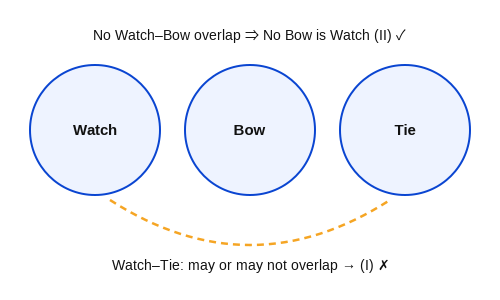
Concept: A 'No' statement can be reversed; two 'No' statements give no definite conclusion between the end terms.

  1. 'No watch is a bow' ⇔ 'No bow is a watch' → (II) follows.
  2. Watch and Tie are both separate from Bow, but they may or may not overlap → (I) does not follow.

Trick: No + No = no conclusion; but a conversion of the given 'No' statement always follows.

Answer: (D) Only conclusion (II) follows.

अवधारणा: 'कोई नहीं' कथन उलटा जा सकता है; दो 'कोई नहीं' कथनों से अंतिम पदों के बीच निश्चित निष्कर्ष नहीं निकलता।

  1. 'कोई घड़ी धनुष नहीं' ⇔ 'कोई धनुष घड़ी नहीं' → (II) अनुसरण करता है।
  2. घड़ी और टाई दोनों धनुष से अलग हैं, पर आपस में मिल भी सकते हैं, नहीं भी → (I) अनुसरण नहीं करता।

ट्रिक: No + No = कोई निष्कर्ष नहीं; पर दिए गए 'No' कथन का उलटा हमेशा सही।

उत्तर: (D) केवल निष्कर्ष (II) अनुसरण करता है।

RRB NTPC Undergraduate CBT 1General Intelligence and ReasoningSyllogismRRB NTPC Undergraduate CBT 1 2024 · 3 Sep Shift 1 →
Q5798.
What will come in the place of the question mark (?) in the following equation, if ‘+’ and ‘−’ are interchanged and ‘×’ and ‘÷’ are interchanged?
17 ÷ 3 + 49 × 7 − 13 = ?
यदि ‘+’ और ‘−’ को आपस में बदल दिया जाए तथा ‘×’ और ‘÷’ को आपस में बदल दिया जाए, तो निम्नलिखित समीकरण में प्रश्न चिह्न (?) के स्थान पर क्या आएगा?
17 ÷ 3 + 49 × 7 − 13 = ?
  1. A41
  2. B57
  3. C45
  4. D43
Show answer

Concept: Interchange the signs first, then apply BODMAS.

  1. After swapping: 17×3−49÷7+13.
  2. =51−7+13.
  3. =57.

Trick: Rewrite the whole expression with new signs before calculating – avoids mixing old and new signs.

Answer: (B) 57

अवधारणा: पहले चिह्न बदलें, फिर BODMAS लगाएँ।

  1. बदलने के बाद: 17×3−49÷7+13।
  2. =51−7+13।
  3. =57।

ट्रिक: गणना से पहले पूरा व्यंजक नए चिह्नों से दोबारा लिखें।

उत्तर: (B) 57

RRB NTPC Undergraduate CBT 1General Intelligence and ReasoningMathematical operationsRRB NTPC Undergraduate CBT 1 2024 · 3 Sep Shift 1 →
Q5799.
What should come in place of the question mark (?) in the given series?
691 692 690 691 689 690 688 ?
दी गई श्रृंखला में प्रश्न चिह्न (?) के स्थान पर क्या आना चाहिए?
691 692 690 691 689 690 688 ?
  1. A688
  2. B689
  3. C687
  4. D690
Show answer

Concept: Alternating pattern of differences.

  1. Differences: +1,−2,+1,−2,+1,−2.
  2. Next: 688+1=689.

Trick: Alternate terms also form a series: 691, 690, 689, 688 and 692, 691, 690, 689.

Answer: (B) 689

अवधारणा: अंतरों का एकांतर पैटर्न।

  1. अंतर: +1,−2,+1,−2,+1,−2।
  2. अगला: 688+1=689।

ट्रिक: एकांतर पद भी श्रृंखला हैं: 691, 690, 689, 688 और 692, 691, 690, 689।

उत्तर: (B) 689

RRB NTPC Undergraduate CBT 1General Intelligence and ReasoningNumber seriesRRB NTPC Undergraduate CBT 1 2024 · 3 Sep Shift 1 →
Q5800.
In the following number-pairs, the second number is obtained by applying certain mathematical operations to the first number. Select the pair in which the numbers are related in the same way as are the numbers of the following pairs.
(Note: Operations should be performed on the whole numbers, without breaking down the numbers into its constituent digits. E.g., 13 – Operations on 13 such as
adding/subtracting/multiplying etc. to 13 can be performed. Breaking down 13 into 1 and 3 and then performing mathematical operations on 1 and 3 is not allowed.) 25, 100
21, 84
निम्नलिखित संख्या-युग्मों में, पहली संख्या पर कुछ गणितीय संक्रियाएँ करके दूसरी संख्या प्राप्त की जाती है। उस युग्म का चयन कीजिए जिसमें संख्याएँ उसी प्रकार संबंधित हैं जिस प्रकार निम्नलिखित युग्मों की संख्याएँ संबंधित हैं।
(ध्यान दें: संक्रियाएँ संख्याओं को उनके घटक अंकों में विभाजित किए बिना, पूर्ण संख्याओं पर की जानी चाहिए। उदाहरण के लिए, 13 – 13 पर संक्रियाएँ जैसे
13 में जोड़ना/घटाना/गुणा करना आदि किया जा सकता है। 13 को 1 और 3 में विभाजित करना और फिर 1 और 3 पर गणितीय संक्रियाएँ करना वर्जित है।) 25, 100
21, 84
  1. A28, 102
  2. B40, 180
  3. C32, 128
  4. D35, 120
Show answer

Concept: Find the single operation that links each given pair.

  1. 25×4=100 and 21×4=84 → rule: second =4× first.
  2. Check: 32×4=128 ✓; 28×4=112≠102; 40×4=160; 35×4=140.

Trick: Divide second by first in each option; only 12832=4.

Answer: (C) 32, 128

अवधारणा: हर दिए गए जोड़े को जोड़ने वाली एक संक्रिया खोजें।

  1. 25×4=100 और 21×4=84 → नियम: दूसरी =4× पहली।
  2. जाँच: 32×4=128 ✓; 28×4=112≠102; 40×4=160; 35×4=140।

ट्रिक: हर विकल्प में दूसरी ÷ पहली करें; केवल 12832=4।

उत्तर: (C) 32, 128

RRB NTPC Undergraduate CBT 1General Intelligence and ReasoningNumber analogyRRB NTPC Undergraduate CBT 1 2024 · 3 Sep Shift 1 →