Question bank

Q&A: practice questions with answers

Search questions on any topic. Filter by exam category, exam, subject and topic, try the question, then open the answer and explanation.

Courses – airGurukul

20,719 questions found.

Q5801.
In a certain code language,
A $ B means ‘A is the daughter of B’
A + B means ‘A is the brother of B’
A @ B means ‘A is the wife of B’
A ÷ B means ‘A is the father of B’
Based on the above, how is E related to N if ‘E $ F @ G ÷ M + N’?
एक निश्चित कूट भाषा में,
A $ B का अर्थ है ‘A, B की पुत्री है’
A + B का अर्थ है ‘A, B का भाई है’
A @ B का अर्थ है ‘A, B की पत्नी है’
A ÷ B का अर्थ है ‘A, B का पिता है’
उपर्युक्त के आधार पर, यदि ‘E $ F @ G ÷ M + N’ है, तो E का N से क्या संबंध है?
  1. AMotherमाता
  2. BDaughterपुत्री
  3. CWifeपत्नी
  4. DSisterबहन
Show answer

Concept: Decode each symbol and build the family tree.
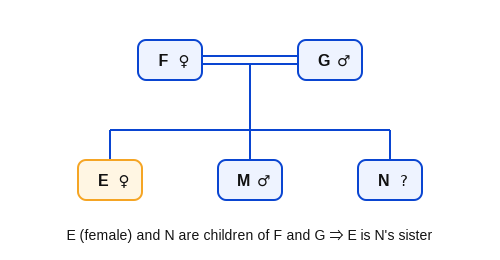
  1. E $ F: E is the daughter of F (E is female).
  2. F @ G: F is the wife of G.
  3. G ÷ M: G is the father of M; M + N: M is the brother of N.
  4. So E, M and N are children of F and G → E is the sister of N.

Trick: Gender of the person asked about comes from the first relation ('daughter') – female sibling = sister.

Answer: (D) Sister

अवधारणा: हर चिह्न को डिकोड करके वंश-वृक्ष बनाएँ।

  1. E $ F: E, F की बेटी है (E स्त्री)।
  2. F @ G: F, G की पत्नी है।
  3. G ÷ M: G, M का पिता है; M + N: M, N का भाई है।
  4. अतः E, M और N, F व G की संतानें हैं → E, N की बहन है।

ट्रिक: पूछे गए व्यक्ति का लिंग पहले संबंध ('बेटी') से मिलता है – स्त्री सहोदर = बहन।

उत्तर: (D) बहन
RRB NTPC Undergraduate CBT 1General Intelligence and ReasoningBlood relations (coded)RRB NTPC Undergraduate CBT 1 2024 · 3 Sep Shift 1 →
Q5802.
Based on the English alphabetical order, three of the following four letter-clusters are alike in a certain way and thus form a group. Which letter-cluster DOES NOT belong to that group?
(Note: The odd one out is not based on the number of consonants/vowels or their position in the letter-cluster.)
अंग्रेज़ी वर्णमाला क्रम के आधार पर, निम्नलिखित चार अक्षर-समूहों में से तीन किसी निश्चित प्रकार से एकसमान हैं और इस प्रकार एक समूह बनाते हैं। कौन-सा अक्षर-समूह उस समूह से संबंधित नहीं है?
(ध्यान दें: असंगत अक्षर-समूह, उस अक्षर-समूह में व्यंजनों/स्वरों की संख्या या उनके स्थान पर आधारित नहीं है।)
  1. ANQL
  2. BEHC
  3. CUXS
  4. DLKO
Show answer

Concept: Check the alphabetical gaps between consecutive letters.

  1. NQL: N(14)→Q(17) +3, Q→L(12) −5.
  2. EHC: +3,−5; UXS: +3,−5.
  3. LKO: L(12)→K(11) −1, K→O(15) +4 → different.

Trick: Write place values once (E=5, J=10, O=15, T=20, Y=25) to read gaps fast.

Answer: (D) LKO

अवधारणा: क्रमागत अक्षरों के बीच अंतर जाँचें।

  1. NQL: N(14)→Q(17) +3, Q→L(12) −5।
  2. EHC: +3,−5; UXS: +3,−5।
  3. LKO: L(12)→K(11) −1, K→O(15) +4 → अलग।

ट्रिक: स्थान मान याद रखें (E=5, J=10, O=15, T=20, Y=25)।

उत्तर: (D) LKO

RRB NTPC Undergraduate CBT 1General Intelligence and ReasoningOdd one out (letters)RRB NTPC Undergraduate CBT 1 2024 · 3 Sep Shift 1 →
Q5803.
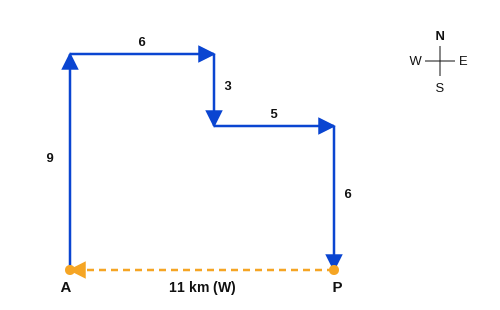
Manoj starts from Point A and drives 9 km towards north. He then takes a right turn, drives 6 km, turns right and drives 3 km. He then takes a left turn and drives 5 km. He takes a final right turn, drives 6 km and stops at Point P. How far (shortest distance) and towards which direction should he drive in order to reach Point A again? (All turns are 90° turns only unless specified.)
मनोज बिंदु A से चलना शुरू करता है और उत्तर की ओर 9 km गाड़ी चलाता है। फिर वह दाएँ मुड़ता है, 6 km गाड़ी चलाता है, दाएँ मुड़ता है और 3 km गाड़ी चलाता है। फिर वह बाएँ मुड़ता है और 5 km गाड़ी चलाता है। वह अंतिम बार दाएँ मुड़ता है, 6 km गाड़ी चलाता है और बिंदु P पर रुक जाता है। बिंदु A पर पुनः पहुँचने के लिए उसे कितनी दूरी (न्यूनतम दूरी) तक और किस दिशा में गाड़ी चलानी चाहिए? (जब तक निर्दिष्ट न किया जाए, सभी मोड़ केवल 90° के मोड़ हैं।)
  1. A9 km towards southदक्षिण की ओर 9 km
  2. B9 km towards westपश्चिम की ओर 9 km
  3. C11 km towards eastपूर्व की ओर 11 km
  4. D11 km towards westपश्चिम की ओर 11 km
Show answer

Concept: Track net north–south and east–west displacement.

  1. North 9, then south 3+6=9 → net north–south =0.
  2. East 6+5=11.
  3. So P is 11 km east of A → he must drive 11 km towards west.

Trick: If the N–S totals cancel, the answer is just the E–W total in the opposite direction.

Answer: (D) 11 km towards west

अवधारणा: कुल उत्तर–दक्षिण और पूर्व–पश्चिम विस्थापन देखें।

  1. उत्तर 9, फिर दक्षिण 3+6=9 → उत्तर–दक्षिण शुद्ध =0।
  2. पूर्व 6+5=11।
  3. P, A से 11 km पूर्व में है → 11 km पश्चिम की ओर जाना होगा।

ट्रिक: उत्तर–दक्षिण बराबर हो जाएँ तो केवल पूर्व–पश्चिम योग विपरीत दिशा में उत्तर है।

उत्तर: (D) 11 km पश्चिम की ओर

RRB NTPC Undergraduate CBT 1General Intelligence and ReasoningDirection & distanceRRB NTPC Undergraduate CBT 1 2024 · 3 Sep Shift 1 →
Q5804.
In a certain code language, 'mud depth urn' is coded as 'qz bd aa' and 'rain dog mud' is coded as 'bd gl kn'. How is 'mud' coded in the given code language?
एक निश्चित कूट भाषा में, 'mud depth urn' को 'qz bd aa' के रूप में कूटबद्ध किया जाता है और 'rain dog mud' को 'bd gl kn' के रूप में कूटबद्ध किया जाता है। दी गई कूट भाषा में 'mud' को किस प्रकार कूटबद्ध किया जाता है?
  1. Aqz
  2. Baa
  3. Cgl
  4. Dbd
Show answer

Concept: A word common to two sentences takes the code common to both.

  1. 'mud' appears in both phrases.
  2. Common code in 'qz bd aa' and 'bd gl kn' is 'bd'.
  3. So mud = bd.

Trick: Common word ↔ common code – no need to decode the others.

Answer: (D) bd

अवधारणा: दोनों वाक्यों में समान शब्द का कोड भी समान होता है।

  1. 'mud' दोनों वाक्यांशों में है।
  2. 'qz bd aa' और 'bd gl kn' में समान कोड 'bd' है।
  3. अतः mud = bd।

ट्रिक: समान शब्द ↔ समान कोड।

उत्तर: (D) bd

RRB NTPC Undergraduate CBT 1General Intelligence and ReasoningCoding-decoding (words)RRB NTPC Undergraduate CBT 1 2024 · 3 Sep Shift 1 →
Q5805.
Read the given statements and conclusions carefully. Assuming that the information given in the statements is true, even if it appears to be at variance with commonly known facts, decide which of the given conclusions logically follow(s) from the statements.
Statements:
All stars are rectangles.
All cones are rectangles.
Conclusions:
(I): Some stars are cones.
(II): Some rectangles are cones.
दिए गए कथनों और निष्कर्षों को ध्यानपूर्वक पढ़िए। यह मानते हुए कि कथनों में दी गई जानकारी सत्य है, भले ही वह सामान्य रूप से ज्ञात तथ्यों से भिन्न प्रतीत होती हो, निर्णय लीजिए कि दिए गए निष्कर्षों में से कौन-सा/कौन-से निष्कर्ष तार्किक रूप से कथनों का अनुसरण करता है/करते हैं।
कथन:
सभी तारे, आयत हैं।
सभी शंकु, आयत हैं।
निष्कर्ष:
(I): कुछ तारे, शंकु हैं।
(II): कुछ आयत, शंकु हैं।
  1. ABoth conclusions (I) and (II) follow.निष्कर्ष (I) और (II) दोनों अनुसरण करते हैं।
  2. BOnly conclusion (II) follows.केवल निष्कर्ष (II) अनुसरण करता है।
  3. CNeither conclusion (I) nor (II) follows.न तो निष्कर्ष (I) और न ही (II) अनुसरण करता है।
  4. DOnly conclusion (I) follows.केवल निष्कर्ष (I) अनुसरण करता है।
Show answer

Concept: Two 'All' statements with a common predicate give no relation between their subjects.

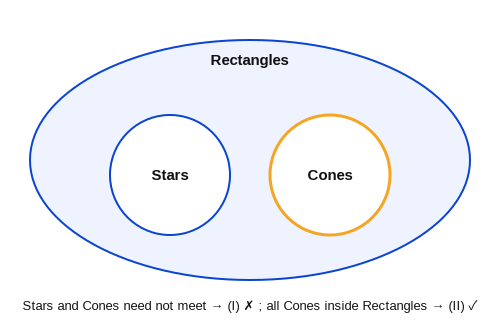
  1. Stars and cones are both inside rectangles but need not meet → (I) does not follow.
  2. All cones are rectangles ⇒ some rectangles are cones (conversion) → (II) follows.

Trick: 'All A are B' always gives 'Some B are A'.

Answer: (B) Only conclusion (II) follows.

अवधारणा: उभयनिष्ठ विधेय वाले दो 'सभी' कथनों से उनके उद्देश्यों में संबंध नहीं निकलता।

  1. स्टार और कोन दोनों आयतों के अंदर हैं पर आवश्यक नहीं कि मिलें → (I) अनुसरण नहीं करता।
  2. सभी कोन आयत हैं ⇒ कुछ आयत कोन हैं → (II) अनुसरण करता है।

ट्रिक: 'सभी A, B हैं' से सदैव 'कुछ B, A हैं' निकलता है।

उत्तर: (B) केवल निष्कर्ष (II) अनुसरण करता है।

RRB NTPC Undergraduate CBT 1General Intelligence and ReasoningSyllogismRRB NTPC Undergraduate CBT 1 2024 · 3 Sep Shift 1 →
Q5806.
Based on the English alphabetical order, three of the following four letter-clusters are alike in a certain way and thus form a group. Which letter-cluster DOES NOT belong to that group? (Note: The odd one out is not based on the number of consonants/vowels or their position in the letter-cluster.)
अंग्रेज़ी वर्णमाला क्रम के आधार पर, निम्नलिखित चार अक्षर-समूहों में से तीन किसी निश्चित प्रकार से एकसमान हैं और इस प्रकार एक समूह बनाते हैं। कौन-सा अक्षर-समूह उस समूह से संबंधित नहीं है? (ध्यान दें: असंगत अक्षर-समूह, उस अक्षर-समूह में व्यंजनों/स्वरों की संख्या या उनके स्थान पर आधारित नहीं है।)
  1. AZUX
  2. BVQU
  3. CXSV
  4. DQLO
Show answer

Concept: Check the alphabetical gaps between consecutive letters.

  1. ZUX: 26→21→24 = −5,+3.
  2. XSV: −5,+3; QLO: −5,+3.
  3. VQU: 22→17→21 = −5,+4 → odd.

Trick: First gap is −5 everywhere, so only the second gap decides.

Answer: (B) VQU

अवधारणा: क्रमागत अक्षरों के बीच अंतर जाँचें।

  1. ZUX: 26→21→24 = −5,+3।
  2. XSV: −5,+3; QLO: −5,+3।
  3. VQU: 22→17→21 = −5,+4 → विषम।

ट्रिक: पहला अंतर सबमें −5 है, अतः केवल दूसरा अंतर देखें।

उत्तर: (B) VQU

RRB NTPC Undergraduate CBT 1General Intelligence and ReasoningOdd one out (letters)RRB NTPC Undergraduate CBT 1 2024 · 3 Sep Shift 1 →
Q5807.
Seven people A, B, C, D, E, F and G are sitting in a row, facing the north. No one sits to the right of G. Only four people sit between E and F. C sits fifth from the right end of the row. B sits to the immediate right of A but left of E. How many people sit to the right of D?
सात व्यक्ति A, B, C, D, E, F और G उत्तर की ओर मुख करके एक पंक्ति में बैठे हैं। G के दाईं ओर कोई नहीं बैठा है। E और F के बीच केवल चार व्यक्ति बैठे हैं। C पंक्ति के दाएँ छोर से पाँचवें स्थान पर बैठा है। B, A के ठीक दाईं ओर लेकिन E के बाईं ओर बैठा है। D के दाईं ओर कितने व्यक्ति बैठे हैं?
  1. AFourचार
  2. BThreeतीन
  3. CTwoदो
  4. DFiveपाँच
Show answer

Concept: Place fixed people first, then fill the rest.

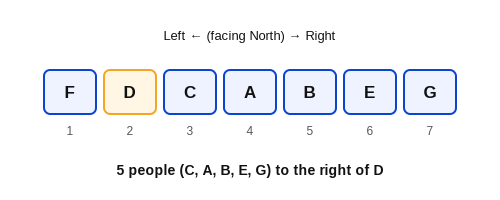
  1. G is at the right end (7th); C is 5th from right = 3rd from left.
  2. 4 people between E and F → positions 1 and 6.
  3. B is left of E, so E = 6, F = 1; A–B adjacent left of E → A = 4, B = 5.
  4. D = 2. Row: F D C A B E G → 5 people to the right of D.

Trick: Start with 'no one to the right of G' and the 'fifth from right' clue – they fix seats instantly.

Answer: (D) Five

अवधारणा: पहले निश्चित स्थान वाले लोगों को रखें, फिर बाकी भरें।

  1. G दाएँ छोर (7वाँ) पर; C दाएँ से 5वाँ = बाएँ से 3रा।
  2. E और F के बीच 4 → स्थान 1 और 6।
  3. B, E के बाएँ है, अतः E = 6, F = 1; A–B साथ-साथ → A = 4, B = 5।
  4. D = 2। पंक्ति: F D C A B E G → D के दाएँ 5 लोग।

ट्रिक: 'G के दाएँ कोई नहीं' और 'दाएँ से पाँचवाँ' से तुरंत स्थान तय होते हैं।

उत्तर: (D) पाँच

RRB NTPC Undergraduate CBT 1General Intelligence and ReasoningLinear seatingRRB NTPC Undergraduate CBT 1 2024 · 3 Sep Shift 1 →
Q5808.
Six friends, B, C, D, E, F and N, are sitting in a straight line, facing north. No one sits to the right of D. Only two people sit between D and B. Only one person sits between E and C. F sits third to the right of E. How many people sit between N and F?
छह मित्र B, C, D, E, F और N उत्तर की ओर मुख करके एक सीधी पंक्ति में बैठे हैं। D के दाईं ओर कोई नहीं बैठा है। D और B के बीच केवल दो व्यक्ति बैठे हैं। E और C के बीच केवल एक व्यक्ति बैठा है। F, E के दाईं ओर तीसरे स्थान पर बैठा है। N और F के बीच कितने व्यक्ति बैठे हैं?
  1. ATwoदो
  2. BOneएक
  3. CZeroशून्य
  4. DThreeतीन
Show answer

Concept: Fix the end person, then use gap clues.

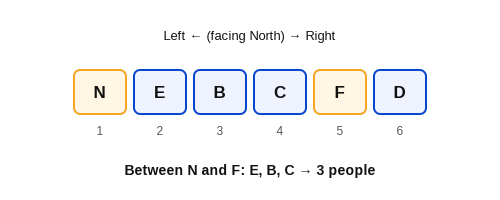
  1. D at right end (6); two between D and B → B = 3.
  2. F third to the right of E: (E, F) = (1, 4) or (2, 5).
  3. If E = 1, C must be 3 (taken by B) → reject. So E = 2, F = 5, C = 4.
  4. N = 1. Row: N E B C F D → between N and F: E, B, C = 3.

Trick: Test both cases of a 'third to the right' clue and reject the one that clashes.

Answer: (D) Three

अवधारणा: अंतिम व्यक्ति तय करें, फिर अंतर वाले संकेत लगाएँ।

  1. D दाएँ छोर (6) पर; D और B के बीच दो → B = 3।
  2. F, E के तीसरे दाएँ: (E, F) = (1, 4) या (2, 5)।
  3. E = 1 हो तो C = 3 (B का स्थान) → अस्वीकार। अतः E = 2, F = 5, C = 4।
  4. N = 1। पंक्ति: N E B C F D → N और F के बीच E, B, C = 3।

ट्रिक: 'तीसरा दाएँ' वाले दोनों मामले जाँचें और टकराने वाला हटा दें।

उत्तर: (D) तीन

RRB NTPC Undergraduate CBT 1General Intelligence and ReasoningLinear seatingRRB NTPC Undergraduate CBT 1 2024 · 3 Sep Shift 1 →
Q5809.
What should come in place of the question mark (?) in the given series based on the English alphabetical order?
WTX SPT OLP KHL ?
अंग्रेज़ी वर्णमाला क्रम के आधार पर दी गई श्रृंखला में प्रश्न चिह्न (?) के स्थान पर क्या आना चाहिए?
WTX SPT OLP KHL ?
  1. AGCH
  2. BGDI
  3. CGCI
  4. DGDH
Show answer

Concept: Each letter position follows its own step.

  1. 1st letters: W, S, O, K → −4 → G.
  2. 2nd letters: T, P, L, H → −4 → D.
  3. 3rd letters: X, T, P, L → −4 → H.

Trick: Every letter moves back 4: KHL −4 each = GDH.

Answer: (D) GDH

अवधारणा: हर स्थान का अक्षर अपने नियम से बदलता है।

  1. पहले अक्षर: W, S, O, K → −4 → G।
  2. दूसरे अक्षर: T, P, L, H → −4 → D।
  3. तीसरे अक्षर: X, T, P, L → −4 → H।

ट्रिक: हर अक्षर 4 पीछे: KHL के हर अक्षर में −4 = GDH।

उत्तर: (D) GDH

RRB NTPC Undergraduate CBT 1General Intelligence and ReasoningLetter seriesRRB NTPC Undergraduate CBT 1 2024 · 3 Sep Shift 1 →
Q5810.
Refer to the following number and symbol series and answer the question that follows. All numbers are single-digit. Counting to be done from left to right.
(Left) 6 @ 8 $ 7 1 * 2 + £ 5 & 3 Ω 9 # % 4 (Right)
How many such symbols are there each of which is immediately preceded by a number and also immediately followed by another symbol?
निम्नलिखित संख्या और प्रतीक श्रृंखला का संदर्भ लीजिए और उसके बाद आने वाले प्रश्न का उत्तर दीजिए। सभी संख्याएँ एक-अंकीय हैं। गिनती बाएँ से दाएँ की जानी है।
(बाएँ) 6 @ 8 $ 7 1 * 2 + £ 5 & 3 Ω 9 # % 4 (दाएँ)
ऐसे कितने प्रतीक हैं जिनमें से प्रत्येक के ठीक पहले एक संख्या है और ठीक बाद में एक अन्य प्रतीक भी है?
  1. A2
  2. B4
  3. C3
  4. D1
Show answer

Concept: Pattern needed: Number – Symbol – Symbol (count the middle symbol).

  1. 2 + £ → '+' preceded by 2, followed by £ ✓.
  2. 9 # % → '#' preceded by 9, followed by % ✓.
  3. No other symbol fits (e.g. '@' is followed by 8, '£' is preceded by '+').

Trick: Scan for two symbols together and check whether a number stands just before the pair.

Answer: (A) 2

अवधारणा: आवश्यक पैटर्न: संख्या – प्रतीक – प्रतीक (बीच वाला प्रतीक गिनें)।

  1. 2 + £ → '+' से पहले 2, बाद में £ ✓।
  2. 9 # % → '#' से पहले 9, बाद में % ✓।
  3. कोई अन्य प्रतीक नहीं (जैसे '@' के बाद 8, '£' से पहले '+')।

ट्रिक: दो साथ-साथ प्रतीक खोजें और देखें कि जोड़े से ठीक पहले संख्या है या नहीं।

उत्तर: (A) 2

RRB NTPC Undergraduate CBT 1General Intelligence and ReasoningNumber–symbol seriesRRB NTPC Undergraduate CBT 1 2024 · 3 Sep Shift 1 →
Q5811.
Pratik starts from Point A and drives 10 km towards the north. He then takes a right turn and drives 8 km, then turns right and drives 17 km. He then takes a right turn and drives 10 km. He takes a final right turn, drives 7 km and stops at Point P. How far (shortest distance) and in which direction should he drive in order to reach Point A again? (All turns are 90-degree turns only unless specified.)
प्रतीक बिंदु A से चलना शुरू करता है और उत्तर की ओर 10 km गाड़ी चलाता है। फिर वह दाएँ मुड़ता है और 8 km गाड़ी चलाता है, फिर दाएँ मुड़ता है और 17 km गाड़ी चलाता है। फिर वह दाएँ मुड़ता है और 10 km गाड़ी चलाता है। वह अंतिम बार दाएँ मुड़ता है, 7 km गाड़ी चलाता है और बिंदु P पर रुक जाता है। बिंदु A पर पुनः पहुँचने के लिए उसे कितनी दूरी (न्यूनतम दूरी) तक और किस दिशा में गाड़ी चलानी चाहिए? (जब तक निर्दिष्ट न किया जाए, सभी मोड़ केवल 90 डिग्री के मोड़ हैं।)
  1. A2 km to the westपश्चिम की ओर 2 km
  2. B2 km to the eastपूर्व की ओर 2 km
  3. C3 km to the eastपूर्व की ओर 3 km
  4. D3 km to the westपश्चिम की ओर 3 km
Show answer

Concept: Track net north–south and east–west displacement.

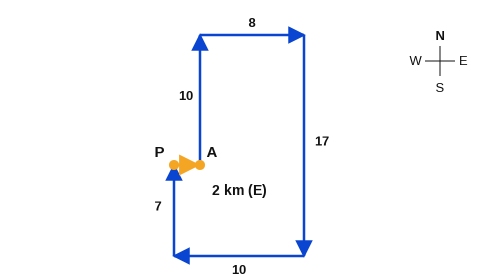
  1. North 10, south 17, north 7 → net north–south =10−17+7=0.
  2. East 8, west 10 → net 2km west.
  3. P is 2 km west of A → he must drive 2 km to the east.

Trick: Four right turns trace a spiral; just add signed distances on each axis.

Answer: (B) 2 km to the east

अवधारणा: कुल उत्तर–दक्षिण और पूर्व–पश्चिम विस्थापन देखें।

  1. उत्तर 10, दक्षिण 17, उत्तर 7 → शुद्ध =10−17+7=0।
  2. पूर्व 8, पश्चिम 10 → शुद्ध 2km पश्चिम।
  3. P, A से 2 km पश्चिम में है → 2 km पूर्व की ओर जाना होगा।

ट्रिक: हर अक्ष पर दूरी को चिह्न सहित जोड़ें।

उत्तर: (B) 2 km पूर्व की ओर

RRB NTPC Undergraduate CBT 1General Intelligence and ReasoningDirection & distanceRRB NTPC Undergraduate CBT 1 2024 · 3 Sep Shift 1 →
Q5812.
What should come in place of the question mark (?) in the given series?
14 26 49 81 124 ?
दी गई श्रृंखला में प्रश्न चिह्न (?) के स्थान पर क्या आना चाहिए?
14 26 49 81 124 ?
  1. A178
  2. B167
  3. C187
  4. D176
Show answer

Concept: Look at the differences and their pattern.

  1. Differences: 12, 23, 32, 43.
  2. Differences of differences: +11,+9,+11 → next +9.
  3. Next difference =52; 124+52=176.

Trick: The differences alternate +11, +9; the next difference is 43+9=52.

Answer: (D) 176

अवधारणा: अंतरों और उनके पैटर्न को देखें।

  1. अंतर: 12, 23, 32, 43।
  2. अंतरों का अंतर: +11,+9,+11 → अगला +9।
  3. अगला अंतर =52; 124+52=176।

ट्रिक: अंतर बारी-बारी से +11, +9 बढ़ते हैं; अगला अंतर 43+9=52।

उत्तर: (D) 176

RRB NTPC Undergraduate CBT 1General Intelligence and ReasoningNumber seriesRRB NTPC Undergraduate CBT 1 2024 · 3 Sep Shift 1 →
Q5813.
Each of the digits in the number 1593486 is arranged in the ascending order from left to right. What will be the sum of the digits that are third from the left and third from the right in the new number thus formed?
संख्या 1593486 के प्रत्येक अंक को बाएँ से दाएँ आरोही क्रम में व्यवस्थित किया जाता है। इस प्रकार बनी नई संख्या में बाएँ से तीसरे और दाएँ से तीसरे अंकों का योग क्या होगा?
  1. A12
  2. B10
  3. C8
  4. D9
Show answer

Concept: Rearrange digits in ascending order and read positions.

  1. 1593486 → 1 3 4 5 6 8 9.
  2. 3rd from left = 4; 3rd from right = 6.
  3. Sum =4+6=10.

Trick: In a 7-digit number, 3rd from right = 5th from left.

Answer: (B) 10

अवधारणा: अंकों को आरोही क्रम में लगाकर स्थान पढ़ें।

  1. 1593486 → 1 3 4 5 6 8 9।
  2. बाएँ से तीसरा = 4; दाएँ से तीसरा = 6।
  3. योग =4+6=10।

ट्रिक: 7 अंकों में दाएँ से तीसरा = बाएँ से पाँचवाँ।

उत्तर: (B) 10

RRB NTPC Undergraduate CBT 1General Intelligence and ReasoningDigit arrangementRRB NTPC Undergraduate CBT 1 2024 · 3 Sep Shift 1 →
Q5814.
WFJU is related to YILX in a certain way based on the English alphabetical order. In the same way, ERRG is related to GUTJ. To which of the given options is KAXP related, following the same logic?
अंग्रेज़ी वर्णमाला क्रम के आधार पर WFJU एक निश्चित प्रकार से YILX से संबंधित है। उसी प्रकार ERRG, GUTJ से संबंधित है। समान तर्क का अनुसरण करते हुए, KAXP दिए गए विकल्पों में से किससे संबंधित है?
  1. AMZSD
  2. BMXZS
  3. CMDZS
  4. DMDSZ
Show answer

Concept: Find the shift applied to each letter position.

  1. WFJU → YILX: +2,+3,+2,+3.
  2. ERRG → GUTJ: +2,+3,+2,+3 ✓.
  3. KAXP: K+2 = M, A+3 = D, X+2 = Z, P+3 = S → MDZS.

Trick: Pattern +2, +3, +2, +3 – apply it letter by letter.

Answer: (C) MDZS

अवधारणा: हर अक्षर पर लगाया गया खिसकाव खोजें।

  1. WFJU → YILX: +2,+3,+2,+3।
  2. ERRG → GUTJ: +2,+3,+2,+3 ✓।
  3. KAXP: K+2 = M, A+3 = D, X+2 = Z, P+3 = S → MDZS।

ट्रिक: पैटर्न +2, +3, +2, +3 – हर अक्षर पर लगाएँ।

उत्तर: (C) MDZS

RRB NTPC Undergraduate CBT 1General Intelligence and ReasoningLetter analogyRRB NTPC Undergraduate CBT 1 2024 · 3 Sep Shift 1 →
Q5815.
What should come in place of the question mark (?) in the given series?
35 44 55 68 83 ?
दी गई श्रृंखला में प्रश्न चिह्न (?) के स्थान पर क्या आना चाहिए?
35 44 55 68 83 ?
  1. A116
  2. B122
  3. C100
  4. D128
Show answer

Concept: Differences increase by 2.

  1. Differences: 9, 11, 13, 15.
  2. Next difference =17.
  3. 83+17=100.

Trick: Consecutive odd-number differences → next is simply the next odd number.

Answer: (C) 100

अवधारणा: अंतर 2-2 बढ़ते हैं।

  1. अंतर: 9, 11, 13, 15।
  2. अगला अंतर =17।
  3. 83+17=100।

ट्रिक: क्रमागत विषम अंतर → अगला विषम संख्या जोड़ें।

उत्तर: (C) 100

RRB NTPC Undergraduate CBT 1General Intelligence and ReasoningNumber seriesRRB NTPC Undergraduate CBT 1 2024 · 3 Sep Shift 1 →
Q5816.
In the following triads, each group of letters is related to the subsequent one following a certain logic. Select from the given options, the one which follows the same logic. SOLD - OSLD - DOSL
BAKE - ABKE - EABK
निम्नलिखित त्रिकों में, अक्षरों का प्रत्येक समूह एक निश्चित तर्क का अनुसरण करते हुए अगले समूह से संबंधित है। दिए गए विकल्पों में से उस विकल्प का चयन कीजिए जो समान तर्क का अनुसरण करता है। SOLD - OSLD - DOSL
BAKE - ABKE - EABK
  1. ACURD - CRUD - DRUC
  2. BCAME - ACME - AMEC
  3. CMILK - IMLK - KILM
  4. DNEAM - ENAM - MENA
Show answer

Concept: Step 1: swap the first two letters. Step 2: move the last letter to the front.

  1. SOLD → OSLD → DOSL; BAKE → ABKE → EABK.
  2. NEAM → ENAM (swap N, E) → MENA (M to front) ✓.
  3. CURD → UCRD expected, not CRUD; CAME → ACME ✓ but then EACM, not AMEC; MILK → IMLK ✓ but then KIML, not KILM.

Trick: Check the second word first – it eliminates most options quickly.

Answer: (D) NEAM - ENAM - MENA

अवधारणा: चरण 1: पहले दो अक्षर बदलें। चरण 2: अंतिम अक्षर आगे लाएँ।

  1. SOLD → OSLD → DOSL; BAKE → ABKE → EABK।
  2. NEAM → ENAM (N, E बदलें) → MENA (M आगे) ✓।
  3. CURD → UCRD होना चाहिए; CAME → ACME ✓ पर फिर EACM; MILK → IMLK ✓ पर फिर KIML।

ट्रिक: पहले दूसरा शब्द जाँचें – अधिकांश विकल्प तुरंत हट जाते हैं।

उत्तर: (D) NEAM - ENAM - MENA

RRB NTPC Undergraduate CBT 1General Intelligence and ReasoningLetter triadsRRB NTPC Undergraduate CBT 1 2024 · 3 Sep Shift 1 →
Q5817.
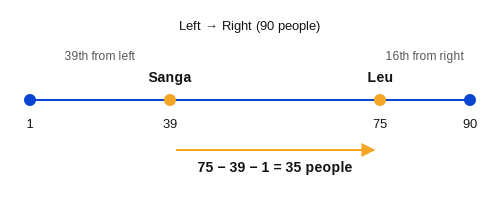
90 people are standing in a row facing north. Mr. Leu is 16th from the right end, while Mr. Sanga is 39th from the left end. How many people are there between Mr. Leu and Mr. Sanga?
90 व्यक्ति उत्तर की ओर मुख करके एक पंक्ति में खड़े हैं। श्री ल्यू दाएँ छोर से 16वें स्थान पर हैं, जबकि श्री सांगा बाएँ छोर से 39वें स्थान पर हैं। श्री ल्यू और श्री सांगा के बीच कितने व्यक्ति हैं?
  1. A37
  2. B34
  3. C32
  4. D35
Show answer

Concept: Convert both positions to the same end.

  1. Leu: 16th from right =90−16+1=75th from left.
  2. Sanga: 39th from left.
  3. Between them =75−39−1=35.

Trick: Between = (bigger position − smaller position − 1) after converting to the same side.

Answer: (D) 35

अवधारणा: दोनों स्थान एक ही छोर से बदलें।

  1. लेउ: दाएँ से 16वाँ =90−16+1=75वाँ बाएँ से।
  2. सांगा: बाएँ से 39वाँ।
  3. बीच में =75−39−1=35।

ट्रिक: एक ही छोर से बदलकर: बीच में = बड़ा − छोटा − 1।

उत्तर: (D) 35

RRB NTPC Undergraduate CBT 1General Intelligence and ReasoningRanking & orderRRB NTPC Undergraduate CBT 1 2024 · 3 Sep Shift 1 →
Q5818.
Each of the digits in the number 7812345 is arranged in ascending order from left to right. The position(s) of how many digits will remain unchanged as compared to that in the original number?
संख्या 7812345 के प्रत्येक अंक को बाएँ से दाएँ आरोही क्रम में व्यवस्थित किया जाता है। मूल संख्या की तुलना में कितने अंकों का/के स्थान अपरिवर्तित रहेगा/रहेंगे?
  1. ANoneएक भी नहीं
  2. BTwoदो
  3. COneएक
  4. DThreeतीन
Show answer

Concept: Compare each position before and after sorting.

  1. Original: 7 8 1 2 3 4 5.
  2. Ascending: 1 2 3 4 5 7 8.
  3. Position by position: 7–1, 8–2, 1–3, 2–4, 3–5, 4–7, 5–8 → no match.

Trick: Write the two numbers one below the other and compare column by column.

Answer: (A) None

अवधारणा: क्रम से पहले और बाद में हर स्थान की तुलना करें।

  1. मूल: 7 8 1 2 3 4 5।
  2. आरोही: 1 2 3 4 5 7 8।
  3. स्थानवार: 7–1, 8–2, 1–3, 2–4, 3–5, 4–7, 5–8 → कोई समान नहीं।

ट्रिक: दोनों संख्याएँ एक के नीचे एक लिखें और कॉलम-दर-कॉलम मिलाएँ।

उत्तर: (A) कोई नहीं

RRB NTPC Undergraduate CBT 1General Intelligence and ReasoningDigit arrangementRRB NTPC Undergraduate CBT 1 2024 · 3 Sep Shift 1 →
Q5819.
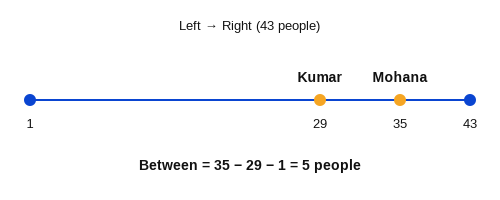
43 people are standing in a row facing north. Kumar is 29th from the left end while Mohana is 9th from the right end. How many people are there between Kumar and Mohana?
43 व्यक्ति उत्तर की ओर मुख करके एक पंक्ति में खड़े हैं। कुमार बाएँ छोर से 29वें स्थान पर है जबकि मोहना दाएँ छोर से 9वें स्थान पर है। कुमार और मोहना के बीच कितने व्यक्ति हैं?
  1. ATwoदो
  2. BFourचार
  3. CThreeतीन
  4. DFiveपाँच
Show answer

Concept: Convert both positions to the same end.

  1. Mohana: 9th from right =43−9+1=35th from left.
  2. Kumar: 29th from left.
  3. Between them =35−29−1=5.

Trick: Position from other end =total−position+1.

Answer: (D) Five

अवधारणा: दोनों स्थान एक ही छोर से बदलें।

  1. मोहना: दाएँ से 9वीं =43−9+1=35वीं बाएँ से।
  2. कुमार: बाएँ से 29वाँ।
  3. बीच में =35−29−1=5।

ट्रिक: दूसरे छोर से स्थान =कुल−स्थान+1।

उत्तर: (D) पाँच

RRB NTPC Undergraduate CBT 1General Intelligence and ReasoningRanking & orderRRB NTPC Undergraduate CBT 1 2024 · 3 Sep Shift 1 →
Q5820.
Refer to the following number and symbol series and answer the question that follows. Counting to be done from left to right only. (Note: All numbers are single digit numbers only.)
(Left) 5 @ 1 £ 3 * 4 7 + $ 9 % 6 2 & 8 Ω # (Right)
If all the number are dropped from the series, which of the following will be sixth from the right?
निम्नलिखित संख्या और प्रतीक श्रृंखला का संदर्भ लीजिए और उसके बाद आने वाले प्रश्न का उत्तर दीजिए। गिनती केवल बाएँ से दाएँ की जानी है। (ध्यान दें: सभी संख्याएँ केवल एक-अंकीय संख्याएँ हैं।)
(बाएँ) 5 @ 1 £ 3 * 4 7 + $ 9 % 6 2 & 8 Ω # (दाएँ)
यदि श्रृंखला से सभी संख्याएँ हटा दी जाएँ, तो निम्नलिखित में से कौन-सा दाएँ से छठे स्थान पर होगा?
  1. A+
  2. B@
  3. C*
  4. D$
Show answer

Concept: Remove all numbers, then count from the right.

  1. Symbols left: @ £ * + $ % & Ω #.
  2. From the right: # (1), Ω (2), & (3), % (4), $ (5), + (6).

Trick: Write only the symbols in a line before counting – avoids miscounting.

Answer: (A) +

अवधारणा: सभी संख्याएँ हटाकर दाएँ से गिनें।

  1. बचे प्रतीक: @ £ * + $ % & Ω #।
  2. दाएँ से: # (1), Ω (2), & (3), % (4), $ (5), + (6)।

ट्रिक: गिनने से पहले केवल प्रतीक एक पंक्ति में लिखें।

उत्तर: (A) +

RRB NTPC Undergraduate CBT 1General Intelligence and ReasoningNumber–symbol seriesRRB NTPC Undergraduate CBT 1 2024 · 3 Sep Shift 1 →