Question bank

Q&A: practice questions with answers

Search questions on any topic. Filter by exam category, exam, subject and topic, try the question, then open the answer and explanation.

Courses – airGurukul

20,719 questions found.

Q5901.
S is the father of Y. Y is the brother of R. R is the wife of U. U is the son of P. How is S related to P?
S, Y का पिता है। Y, R का भाई है। R, U की पत्नी है। U, P का पुत्र है। S का P से क्या संबंध है?
  1. ASon's wife's fatherपुत्र की पत्नी का पिता
  2. BSon's wife's sisterपुत्र की पत्नी की बहन
  3. CSon's wife's brotherपुत्र की पत्नी का भाई
  4. DSon's wife's motherपुत्र की पत्नी की माता
Show answer

Concept: Build a family tree from the statements.
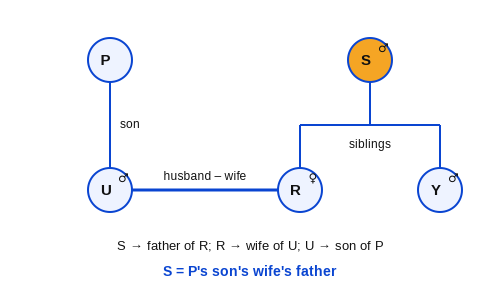
  1. S is father of Y; Y is brother of R ⇒ S is father of R
  2. R is wife of U; U is son of P ⇒ R is P’s son’s wife
  3. So S is father of P’s son’s wife

Trick: Y is only a link – the brother tells us R is S’s child.

Answer: (A) Son’s wife’s father

अवधारणा: कथनों से परिवार वृक्ष बनाएँ।

  1. S, Y का पिता; Y, R का भाई ⇒ S, R का पिता
  2. R, U की पत्नी; U, P का पुत्र ⇒ R, P के पुत्र की पत्नी
  3. अतः S, P के पुत्र की पत्नी के पिता हैं

ट्रिक: Y केवल कड़ी है – भाई होने से पता चलता है कि R, S की संतान है।

उत्तर: (A) पुत्र की पत्नी के पिता
RRB NTPC Undergraduate CBT 1General Intelligence and ReasoningBlood relationRRB NTPC Undergraduate CBT 1 2024 · 2 Sep Shift 3 →
Q5902.
What should come in place of the question mark (?) in the given series?
9 15 47 91 275 ?
दी गई श्रृंखला में प्रश्नवाचक चिह्न (?) के स्थान पर क्या आना चाहिए?
9 15 47 91 275 ?
  1. A547
  2. B574
  3. C505
  4. D550
Show answer

Concept: Alternating operations: ×2−3 and ×3+2.

  1. 9×2−3=15, 15×3+2=47
  2. 47×2−3=91, 91×3+2=275
  3. 275×2−3=547

Trick: Big jumps that alternate small/large suggest alternating multipliers.

Answer: (A) 547

अवधारणा: बारी-बारी से संक्रियाएँ: ×2−3 और ×3+2।

  1. 9×2−3=15, 15×3+2=47
  2. 47×2−3=91, 91×3+2=275
  3. 275×2−3=547

ट्रिक: छोटी-बड़ी बारी-बारी छलाँगें बदलते गुणक का संकेत हैं।

उत्तर: (A) 547

RRB NTPC Undergraduate CBT 1General Intelligence and ReasoningNumber seriesRRB NTPC Undergraduate CBT 1 2024 · 2 Sep Shift 3 →
Q5903.
Based on the English alphabetical order, three of the following four letter cluster pairs are alike in a certain way and thus form a group. Which pair DOES NOT belong to that group? (NOTE: The odd one out is not based on the number of consonants/vowels or their position in the letter cluster.)
अंग्रेज़ी वर्णमाला क्रम के आधार पर, निम्नलिखित चार अक्षर-समूह युग्मों में से तीन किसी निश्चित प्रकार से एकसमान हैं और इस प्रकार एक समूह बनाते हैं। कौन-सा युग्म उस समूह से संबंधित नहीं है? (नोट: असंगत युग्म, व्यंजनों/स्वरों की संख्या या अक्षर-समूह में उनके स्थान पर आधारित नहीं है।)
  1. ARM-VP
  2. BAV-DY
  3. CGB-JE
  4. DOJ-RM
Show answer

Concept: Compare each letter of the first cluster with the second using positions.

  1. AV-DY: +3,+3; GB-JE: +3,+3; OJ-RM: +3,+3
  2. RM-VP: R+4=V, M+3=P ✗

Trick: Check the first letter shift quickly – only RM-VP uses +4.

Answer: (A) RM-VP

अवधारणा: पहले समूह के हर अक्षर की दूसरे से स्थिति द्वारा तुलना करें।

  1. AV-DY: +3,+3; GB-JE: +3,+3; OJ-RM: +3,+3
  2. RM-VP: R+4=V, M+3=P ✗

ट्रिक: पहले अक्षर का अंतर देखें – केवल RM-VP में +4 है।

उत्तर: (A) RM-VP

RRB NTPC Undergraduate CBT 1General Intelligence and ReasoningOdd one out – letter pairsRRB NTPC Undergraduate CBT 1 2024 · 2 Sep Shift 3 →
Q5904.
Based on the English alphabetical order, three of the following four letter-clusters are alike in a certain way and thus form a group. Which letter-cluster DOES NOT belong to that group? (Note: The odd one out is not based on the number of consonants/vowels or their position in the letter-cluster.)
अंग्रेज़ी वर्णमाला क्रम के आधार पर, निम्नलिखित चार अक्षर-समूहों में से तीन किसी निश्चित प्रकार से एकसमान हैं और इस प्रकार एक समूह बनाते हैं। कौन-सा अक्षर-समूह उस समूह से संबंधित नहीं है? (नोट: असंगत अक्षर-समूह, व्यंजनों/स्वरों की संख्या या अक्षर-समूह में उनके स्थान पर आधारित नहीं है।)
  1. ASOJD
  2. BGCXR
  3. CAWRL
  4. DQNHB
Show answer

Concept: Find the gap pattern between consecutive letters (backward, with wrap).

  1. SOJD: 19→15→10→4: −4,−5,−6
  2. GCXR: 7→3→24→18: −4,−5,−6; AWRL: 1→23→18→12: −4,−5,−6
  3. QNHB: 17→14→8→2: −3,−6,−6 ✗

Trick: Backward from A wraps to Z: A−4=W, C−5=X.

Answer: (D) QNHB

अवधारणा: क्रमागत अक्षरों के बीच अंतर का पैटर्न देखें (पीछे की ओर, चक्रीय)।

  1. SOJD: 19→15→10→4: −4,−5,−6
  2. GCXR: 7→3→24→18: −4,−5,−6; AWRL: 1→23→18→12: −4,−5,−6
  3. QNHB: 17→14→8→2: −3,−6,−6 ✗

ट्रिक: A से पीछे जाने पर Z आता है: A−4=W, C−5=X।

उत्तर: (D) QNHB

RRB NTPC Undergraduate CBT 1General Intelligence and ReasoningOdd one out – letter clustersRRB NTPC Undergraduate CBT 1 2024 · 2 Sep Shift 3 →
Q5905.
Refer to the following number, symbol series and answer the question. Counting to be done from left to right only.
(Left) 7 # * © & 8 4 & 6 1 5 9 € 8 $ * 6 6 8 5 7 7 (Right)
How many such numbers are there each of which is immediately preceded by a symbol and also immediately followed by a symbol?
निम्नलिखित संख्या, प्रतीक श्रृंखला का संदर्भ लेकर प्रश्न का उत्तर दीजिए। गणना केवल बाएँ से दाएँ की जानी है।
(बाएँ) 7 # * © & 8 4 & 6 1 5 9 € 8 $ * 6 6 8 5 7 7 (दाएँ)
ऐसी कितनी संख्याएँ हैं जिनमें से प्रत्येक के ठीक पहले एक प्रतीक है और ठीक बाद भी एक प्रतीक है?
  1. AZeroशून्य
  2. BOneएक
  3. CTwoदो
  4. DThreeतीन
Show answer

Concept: Check every number: the element just before it and just after it must both be symbols.

  1. Numbers next to symbols: 8 (after &, before 4) ✗; 6 (after &, before 1) ✗
  2. 8 (after €, before $) ✓; 6 (after *, before 6) ✗; first 7 has nothing before ✗
  3. In the series as printed, exactly one number (8 in “€ 8 $”) qualifies

Trick: Scan only numbers that touch a symbol on the left, then check the right side.

Answer: (B) One

अवधारणा: हर संख्या जाँचें: उसके ठीक पहले और ठीक बाद दोनों प्रतीक होने चाहिए।

  1. प्रतीक से सटी संख्याएँ: 8 (& के बाद, 4 से पहले) ✗; 6 (& के बाद, 1 से पहले) ✗
  2. 8 (€ के बाद, $ से पहले) ✓; 6 (* के बाद, 6 से पहले) ✗; पहले 7 से पहले कुछ नहीं ✗
  3. छपी हुई श्रृंखला में केवल एक संख्या (“€ 8 $” वाली 8) शर्त पूरी करती है

ट्रिक: केवल वे संख्याएँ देखें जिनके बाईं ओर प्रतीक है, फिर दाईं ओर जाँचें।

उत्तर: (B) एक

RRB NTPC Undergraduate CBT 1General Intelligence and ReasoningNumber-symbol seriesRRB NTPC Undergraduate CBT 1 2024 · 2 Sep Shift 3 →
Q5906.
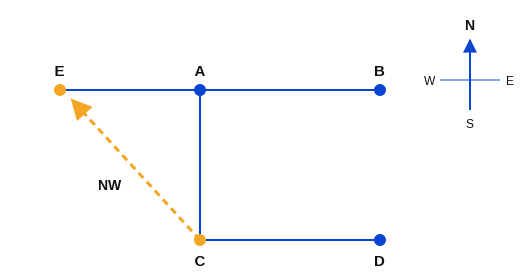
Town A is to the west of Town B. Town C is to the south of Town A. Town D is to the east of Town C. Town E is to the west of Town A. What is the position of Town E with respect to Town C?
नगर A, नगर B के पश्चिम में है। नगर C, नगर A के दक्षिण में है। नगर D, नगर C के पूर्व में है। नगर E, नगर A के पश्चिम में है। नगर C के सापेक्ष नगर E की स्थिति क्या है?
  1. ANortheastउत्तर-पूर्व
  2. BNorthwestउत्तर-पश्चिम
  3. CEastपूर्व
  4. DSouthदक्षिण
Show answer

Concept: Place the towns on a grid using the given directions.

  1. A is west of B; C is south of A; D is east of C
  2. E is west of A, i.e. on A’s row but to the left
  3. From C: go north (to A’s level) then west ⇒ E is north-west of C

Trick: North + West components together ⇒ Northwest.

Answer: (B) Northwest

अवधारणा: दी गई दिशाओं से कस्बों को ग्रिड पर रखें।

  1. A, B के पश्चिम में; C, A के दक्षिण में; D, C के पूर्व में
  2. E, A के पश्चिम में (A की पंक्ति में बाईं ओर)
  3. C से: उत्तर (A के स्तर तक) फिर पश्चिम ⇒ E, C के उत्तर-पश्चिम में

ट्रिक: उत्तर + पश्चिम घटक मिलकर ⇒ उत्तर-पश्चिम।

उत्तर: (B) उत्तर-पश्चिम (Northwest)

RRB NTPC Undergraduate CBT 1General Intelligence and ReasoningDirection senseRRB NTPC Undergraduate CBT 1 2024 · 2 Sep Shift 3 →
Q5907.
Read the given statements and conclusions carefully. Assuming that the information given in the statements is true, even if it appears to be at variance with commonly known facts, decide which of the given conclusion(s) logically follow(s) from the statements.
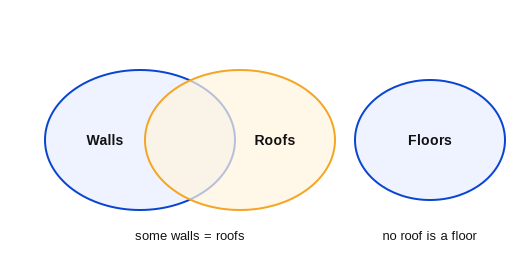
Statements: Some walls are roofs. No roof is a floor.
Conclusions (I): No roof is a wall.
Conclusions (II): Some floors are roofs.
दिए गए कथनों और निष्कर्षों को ध्यानपूर्वक पढ़िए। यह मानते हुए कि कथनों में दी गई जानकारी सत्य है, भले ही वह सामान्यतः ज्ञात तथ्यों से भिन्न प्रतीत होती हो, निर्णय कीजिए कि दिए गए निष्कर्षों में से कौन-सा/से निष्कर्ष कथनों का तार्किक रूप से अनुसरण करता है/करते हैं।
कथन: कुछ दीवारें, छतें हैं। कोई छत, फ़र्श नहीं है।
निष्कर्ष (I): कोई छत, दीवार नहीं है।
निष्कर्ष (II): कुछ फ़र्श, छतें हैं।
  1. AOnly conclusion (I) follows.केवल निष्कर्ष (I) अनुसरण करता है।
  2. BBoth conclusions (I) and (II) follow.निष्कर्ष (I) और (II) दोनों अनुसरण करते हैं।
  3. CNeither conclusion (I) nor (II) follows.न तो निष्कर्ष (I) और न ही (II) अनुसरण करता है।
  4. DOnly conclusion (II) follows.केवल निष्कर्ष (II) अनुसरण करता है।
Show answer

Concept: Draw the least possible Venn diagram and test each conclusion.

  1. Some walls are roofs ⇒ Walls and Roofs overlap
  2. No roof is a floor ⇒ Roofs and Floors are separate
  3. I: “No roof is a wall” contradicts “some walls are roofs” ✗
  4. II: “Some floors are roofs” contradicts “no roof is a floor” ✗

Trick: A conclusion that directly contradicts a statement can never follow.

Answer: (C) Neither conclusion (I) nor (II) follows

अवधारणा: न्यूनतम संभव वेन आरेख बनाकर हर निष्कर्ष जाँचें।

  1. कुछ दीवारें छतें हैं ⇒ Walls और Roofs आंशिक रूप से मिलते हैं
  2. कोई छत फ़र्श नहीं ⇒ Roofs और Floors अलग
  3. I: “कोई छत दीवार नहीं” – कथन के विपरीत ✗
  4. II: “कुछ फ़र्श छतें हैं” – कथन के विपरीत ✗

ट्रिक: जो निष्कर्ष कथन का सीधा विरोध करे, वह कभी अनुसरण नहीं करता।

उत्तर: (C) न तो निष्कर्ष (I) और न ही (II) अनुसरण करता है

RRB NTPC Undergraduate CBT 1General Intelligence and ReasoningSyllogismRRB NTPC Undergraduate CBT 1 2024 · 2 Sep Shift 3 →
Q5908.
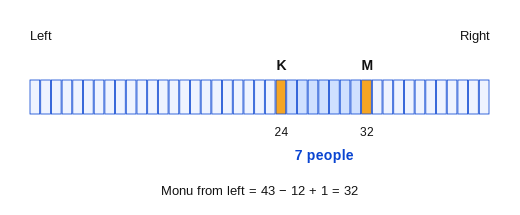
All 43 people are standing in a row, facing North. Kishor is 24th from the left-end while Monu is 12th from the right-end. How many people are there between Kishor and Monu?
कुल 43 व्यक्ति उत्तर की ओर मुख करके एक पंक्ति में खड़े हैं। किशोर बाएँ छोर से 24वें स्थान पर है जबकि मोनू दाएँ छोर से 12वें स्थान पर है। किशोर और मोनू के बीच कितने व्यक्ति हैं?
  1. A8
  2. B6
  3. C7
  4. D5
Show answer

Concept: Convert both positions to the same end: position from left =N−(from right)+1.

  1. Monu from left =43−12+1=32
  2. Kishor =24 from left
  3. Between =32−24−1=7

Trick: Between two positions = difference −1.

Answer: (C) 7

अवधारणा: दोनों स्थितियों को एक ही छोर से बदलें: बाएँ से =N−(दाएँ से)+1।

  1. मोनू बाएँ से =43−12+1=32
  2. किशोर बाएँ से =24
  3. बीच में =32−24−1=7

ट्रिक: दो स्थानों के बीच = अंतर −1।

उत्तर: (C) 7

RRB NTPC Undergraduate CBT 1General Intelligence and ReasoningRanking in a rowRRB NTPC Undergraduate CBT 1 2024 · 2 Sep Shift 3 →
Q5909.
Based on the English alphabetical order, three of the following four letter-cluster pairs are alike in a certain way and thus form a group. Which letter-cluster pair DOES NOT belong to that group?
(Note: The odd one out is not based on the number of consonants/vowels or their position in the letter-cluster.)
अंग्रेज़ी वर्णमाला क्रम के आधार पर, निम्नलिखित चार अक्षर-समूह युग्मों में से तीन किसी निश्चित प्रकार से एकसमान हैं और इस प्रकार एक समूह बनाते हैं। कौन-सा अक्षर-समूह युग्म उस समूह से संबंधित नहीं है?
(नोट: असंगत युग्म, व्यंजनों/स्वरों की संख्या या अक्षर-समूह में उनके स्थान पर आधारित नहीं है।)
  1. ALP-KN
  2. BEI-DG
  3. CHL-GJ
  4. DBF-AC
Show answer

Concept: Compare corresponding letters of the two clusters.

  1. LP-KN: L−1=K, P−2=N; EI-DG: −1,−2; HL-GJ: −1,−2
  2. BF-AC: B−1=A, F−3=C ✗

Trick: Only BF-AC breaks the −1,−2 rule.

Answer: (D) BF-AC

अवधारणा: दोनों समूहों के संगत अक्षरों की तुलना करें।

  1. LP-KN: L−1=K, P−2=N; EI-DG: −1,−2; HL-GJ: −1,−2
  2. BF-AC: B−1=A, F−3=C ✗

ट्रिक: केवल BF-AC में −1,−2 का नियम टूटता है।

उत्तर: (D) BF-AC

RRB NTPC Undergraduate CBT 1General Intelligence and ReasoningOdd one out – letter pairsRRB NTPC Undergraduate CBT 1 2024 · 2 Sep Shift 3 →
Q5910.
In a certain code language, ‘YARN’ is coded as ‘25#@’ and ‘ARTY’ is coded as ‘#$52’. What is the code for ‘T’ in the given code language?
एक निश्चित कूट भाषा में, ‘YARN’ को ‘25#@’ के रूप में कूटबद्ध किया जाता है और ‘ARTY’ को ‘#$52’ के रूप में कूटबद्ध किया जाता है। दी गई कूट भाषा में ‘T’ के लिए कूट क्या है?
  1. A2
  2. B$
  3. C#
  4. D5
Show answer

Concept: Letters common to both words share the codes common to both codes.

  1. YARN → 2, 5, #, @; ARTY → #, $, 5, 2
  2. Common letters Y, A, R ↔ common codes 2, 5, #
  3. Remaining: N = @ and T = $

Trick: Leftover letter ↔ leftover code.

Answer: (B) $

अवधारणा: दोनों शब्दों के सामान्य अक्षरों के कोड भी दोनों कोडों में सामान्य होते हैं।

  1. YARN → 2, 5, #, @; ARTY → #, $, 5, 2
  2. सामान्य अक्षर Y, A, R ↔ सामान्य कोड 2, 5, #
  3. बचे: N = @ तथा T = $

ट्रिक: बचा अक्षर ↔ बचा कोड।

उत्तर: (B) $

RRB NTPC Undergraduate CBT 1General Intelligence and ReasoningCoding–decodingRRB NTPC Undergraduate CBT 1 2024 · 2 Sep Shift 3 →
Q5911.
Select the number from among the given options that can replace the question mark (?) in the following series.
32 40 50 62 76 ?
दिए गए विकल्पों में से उस संख्या का चयन कीजिए जो निम्नलिखित श्रृंखला में प्रश्नवाचक चिह्न (?) का स्थान ले सकती है।
32 40 50 62 76 ?
  1. A86
  2. B98
  3. C95
  4. D92
Show answer

Concept: Look at the differences between consecutive terms.

  1. Differences: 8,10,12,14 (increase by 2)
  2. Next difference =16 ⇒ 76+16=92

Trick: Second differences constant (2) ⇒ add the next even number.

Answer: (D) 92

अवधारणा: क्रमागत पदों का अंतर देखें।

  1. अंतर: 8,10,12,14 (हर बार 2 अधिक)
  2. अगला अंतर =16 ⇒ 76+16=92

ट्रिक: दूसरा अंतर स्थिर (2) ⇒ अगली सम संख्या जोड़ें।

उत्तर: (D) 92

RRB NTPC Undergraduate CBT 1General Intelligence and ReasoningNumber seriesRRB NTPC Undergraduate CBT 1 2024 · 2 Sep Shift 3 →
Q5912.
Each of the digits in the number 2786431 is arranged in the ascending order from left to right. The position(s) of how many digits will remain unchanged as compared to that in the original number?
संख्या 2786431 के प्रत्येक अंक को बाएँ से दाएँ आरोही क्रम में व्यवस्थित किया जाता है। मूल संख्या की तुलना में कितने अंकों का/के स्थान अपरिवर्तित रहेगा/रहेंगे?
  1. ATwoदो
  2. BOneएक
  3. CNoneकोई नहीं
  4. DThreeतीन
Show answer

Concept: Write the new arrangement under the original and compare place by place.

  1. Original: 2 7 8 6 4 3 1
  2. Ascending: 1 2 3 4 6 7 8
  3. No position has the same digit ⇒ none

Trick: Here every digit shifts; compare column-wise, don’t guess.

Answer: (C) None

अवधारणा: नई व्यवस्था को मूल संख्या के नीचे लिखकर स्थानवार तुलना करें।

  1. मूल: 2 7 8 6 4 3 1
  2. आरोही: 1 2 3 4 6 7 8
  3. किसी भी स्थान पर अंक समान नहीं ⇒ कोई नहीं

ट्रिक: स्तंभ-वार तुलना करें, अनुमान न लगाएँ।

उत्तर: (C) कोई नहीं

RRB NTPC Undergraduate CBT 1General Intelligence and ReasoningDigit arrangementRRB NTPC Undergraduate CBT 1 2024 · 2 Sep Shift 3 →
Q5913.
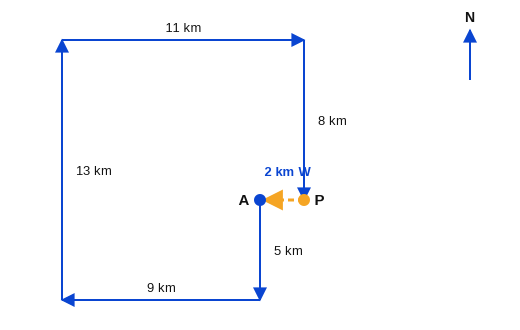
Paula starts from Point A and drives 5 km towards South. He then takes a right turn, drives 9 km, turns right and drives 13 km. He then takes a right turn and drives 11 km. He takes a final right turn, drives 8 km and stops at Point P. How far (shortest distance) and towards which direction should he drive in order to reach Point A again? (All turns are 90° turns only unless specified.)
पाउला बिंदु A से शुरू करके दक्षिण की ओर 5 km गाड़ी चलाता है। फिर वह दाएँ मुड़ता है, 9 km गाड़ी चलाता है, दाएँ मुड़ता है और 13 km गाड़ी चलाता है। फिर वह दाएँ मुड़ता है और 11 km गाड़ी चलाता है। वह अंतिम बार दाएँ मुड़ता है, 8 km गाड़ी चलाता है और बिंदु P पर रुक जाता है। बिंदु A पर फिर से पहुँचने के लिए उसे कितनी दूरी (न्यूनतम दूरी) तक और किस दिशा में गाड़ी चलानी चाहिए? (जब तक निर्दिष्ट न हो, सभी मोड़ केवल 90° के मोड़ हैं।)
  1. A2 km to the Westपश्चिम की ओर 2 km
  2. B5 km to the Westपश्चिम की ओर 5 km
  3. C6 km to the Northउत्तर की ओर 6 km
  4. D4 km to the Eastपूर्व की ओर 4 km
Show answer

Concept: Track coordinates (East +x, North +y); every right turn from South goes West, then North, East, South.

  1. A(0,0) → South 5: (0,−5) → West 9: (−9,−5)
  2. → North 13: (−9,8) → East 11: (2,8) → South 8: (2,0)= P
  3. P is 2 km east of A ⇒ drive 2 km to the West

Trick: Net E–W: 11−9=2 east; net N–S: 13−5−8=0.

Answer: (A) 2 km to the West

अवधारणा: निर्देशांक लें (पूर्व +x, उत्तर +y); दक्षिण से हर दायाँ मोड़: पश्चिम, उत्तर, पूर्व, दक्षिण।

  1. A(0,0) → दक्षिण 5: (0,−5) → पश्चिम 9: (−9,−5)
  2. → उत्तर 13: (−9,8) → पूर्व 11: (2,8) → दक्षिण 8: (2,0)= P
  3. P, A से 2 km पूर्व ⇒ 2 km पश्चिम जाना होगा

ट्रिक: शुद्ध पूर्व–पश्चिम: 11−9=2 पूर्व; उत्तर–दक्षिण: 13−5−8=0।

उत्तर: (A) 2 km पश्चिम

RRB NTPC Undergraduate CBT 1General Intelligence and ReasoningDirection and distanceRRB NTPC Undergraduate CBT 1 2024 · 2 Sep Shift 3 →
Q5914.
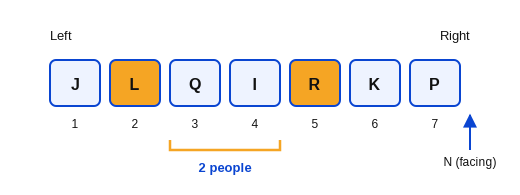
Seven people, I, J, K, L, P, Q and R are sitting in a row, facing north. Only two people sit between J and I. Only P sits to the right of K. Only one person sits between I and K. Q sits at some place to the right of L but at some place to the left of R.
How many people sit between R and L?
सात व्यक्ति, I, J, K, L, P, Q और R उत्तर की ओर मुख करके एक पंक्ति में बैठे हैं। J और I के बीच केवल दो व्यक्ति बैठे हैं। K के दाईं ओर केवल P बैठा है। I और K के बीच केवल एक व्यक्ति बैठा है। Q, L के दाईं ओर कहीं बैठा है लेकिन R के बाईं ओर कहीं बैठा है।
R और L के बीच कितने व्यक्ति बैठे हैं?
  1. AThreeतीन
  2. BOneएक
  3. CFourचार
  4. DTwoदो
Show answer

Concept: Facing north, left–right are as seen; fix the definite clues first.

  1. Only P to the right of K ⇒ K 6th, P 7th
  2. One person between I and K ⇒ I 4th
  3. Two between J and I ⇒ J 1st (7th is taken)
  4. L < Q < R in seats 2,3,5 ⇒ L 2, Q 3, R 5
  5. Between R and L: Q, I ⇒ 2

Trick: Start with the “only” clue – it fixes the end seats.

Answer: (D) Two

अवधारणा: उत्तर की ओर मुख होने पर बायाँ–दायाँ हमारे जैसा; पहले निश्चित सूचनाएँ लगाएँ।

  1. केवल P, K के दाएँ ⇒ K 6वें, P 7वें
  2. I और K के बीच एक ⇒ I 4थे
  3. J और I के बीच दो ⇒ J 1ले (7वाँ भरा है)
  4. L < Q < R, स्थान 2,3,5 ⇒ L 2, Q 3, R 5
  5. R और L के बीच: Q, I ⇒ 2

ट्रिक: “केवल” वाले संकेत से शुरू करें – यह छोर तय कर देता है।

उत्तर: (D) दो

RRB NTPC Undergraduate CBT 1General Intelligence and ReasoningLinear seatingRRB NTPC Undergraduate CBT 1 2024 · 2 Sep Shift 3 →
Q5915.
In the following triads, each group of letters is related to the subsequent one following a certain logic. Select from the given options, the one which follows the same logic. SACK - CSAK - KCAS
LEAP - ALEP - PAEL
निम्नलिखित त्रिकों में, अक्षरों का प्रत्येक समूह एक निश्चित तर्क का अनुसरण करते हुए अगले समूह से संबंधित है। दिए गए विकल्पों में से उसका चयन कीजिए जो समान तर्क का अनुसरण करता है। SACK - CSAK - KCAS
LEAP - ALEP - PAEL
  1. APLAY - APLY - LAYP
  2. BEMIT - MEIT - TMIE
  3. CGOLD - LGOD - DLOG
  4. DTEMP - TMEP - PMET
Show answer

Concept: Number the letters of the first word 1234 and find the position pattern of each step.

  1. SACK → CSAK: 3,1,2,4; CSAK → KCAS: 4,1,3,2 of the new word
  2. LEAP → ALEP → PAEL follows the same ✓
  3. GOLD → LGOD (3,1,2,4) → DLOG (4,1,3,2) ✓

Trick: Test option B: EMIT → MEIT is 2,1,3,4 ✗ – reject at the first step.

Answer: (C) GOLD - LGOD - DLOG

अवधारणा: पहले शब्द के अक्षरों को 1234 मानकर हर चरण का स्थान-पैटर्न खोजें।

  1. SACK → CSAK: 3,1,2,4; CSAK → KCAS: नए शब्द का 4,1,3,2
  2. LEAP → ALEP → PAEL में भी यही ✓
  3. GOLD → LGOD (3,1,2,4) → DLOG (4,1,3,2) ✓

ट्रिक: विकल्प B: EMIT → MEIT 2,1,3,4 है ✗ – पहले ही चरण में बाहर।

उत्तर: (C) GOLD - LGOD - DLOG

RRB NTPC Undergraduate CBT 1General Intelligence and ReasoningLetter triadsRRB NTPC Undergraduate CBT 1 2024 · 2 Sep Shift 3 →
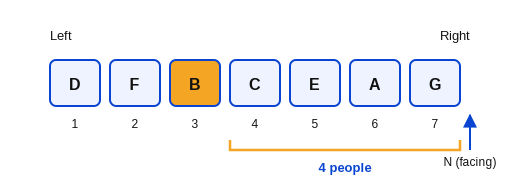
Q5916.
Seven people A, B, C, D, E, F and G are sitting in a row, facing the north. F sits sixth from the right end of the row. Only two people sit between E and F. A sits to the right of E but left of G. D sits third to the left of C. How many people sit to the right of B?
सात व्यक्ति A, B, C, D, E, F और G उत्तर की ओर मुख करके एक पंक्ति में बैठे हैं। F पंक्ति के दाएँ छोर से छठे स्थान पर बैठा है। E और F के बीच केवल दो व्यक्ति बैठे हैं। A, E के दाईं ओर लेकिन G के बाईं ओर बैठा है। D, C के बाईं ओर तीसरे स्थान पर बैठा है। B के दाईं ओर कितने व्यक्ति बैठे हैं?
  1. AThreeतीन
  2. BFourचार
  3. CTwoदो
  4. DFiveपाँच
Show answer

Concept: Seven seats numbered 1–7 from the left (all face north).

  1. F 6th from right ⇒ seat 2; two between E and F ⇒ E seat 5
  2. A right of E, left of G ⇒ A 6, G 7
  3. D third to the left of C, seats 1,3,4 free ⇒ D 1, C 4, B 3
  4. Right of B: C, E, A, G ⇒ 4

Trick: With 7 seats, “6th from right” =2nd from left.

Answer: (B) Four

अवधारणा: सात सीटें, बाएँ से 1–7 (सभी उत्तरमुखी)।

  1. F दाएँ से 6वाँ ⇒ सीट 2; E और F के बीच दो ⇒ E सीट 5
  2. A, E के दाएँ और G के बाएँ ⇒ A 6, G 7
  3. D, C के तीसरे बाएँ; खाली सीट 1,3,4 ⇒ D 1, C 4, B 3
  4. B के दाएँ: C, E, A, G ⇒ 4

ट्रिक: 7 सीटों में “दाएँ से 6वाँ” = बाएँ से 2रा।

उत्तर: (B) चार

RRB NTPC Undergraduate CBT 1General Intelligence and ReasoningLinear seatingRRB NTPC Undergraduate CBT 1 2024 · 2 Sep Shift 3 →
Q5917.
In the following triads, each group of letters is related to the subsequent one following a certain logic. Select from the given options, the one which follows the same logic. SAVE - EASV - AVSE
CROW - WRCO - ROCW
निम्नलिखित त्रिकों में, अक्षरों का प्रत्येक समूह एक निश्चित तर्क का अनुसरण करते हुए अगले समूह से संबंधित है। दिए गए विकल्पों में से उसका चयन कीजिए जो समान तर्क का अनुसरण करता है। SAVE - EASV - AVSE
CROW - WRCO - ROCW
  1. AGROW - GORW - WORG
  2. BTERM - METR - RETM
  3. CDEWS - EDWS - SEWD
  4. DJUST - TUJS - USJT
Show answer

Concept: Number the letters 1234 and find the rearrangement in each step.

  1. SAVE → EASV: 4,2,1,3; EASV → AVSE: 2,4,3,1 of the new word
  2. CROW → WRCO → ROCW fits ✓
  3. JUST → TUJS (4,2,1,3) → USJT (2,4,3,1) ✓

Trick: Check the first step for all options: only JUST → TUJS keeps “U” in 2nd place with last letter first.

Answer: (D) JUST - TUJS - USJT

अवधारणा: अक्षरों को 1234 मानकर हर चरण की पुनर्व्यवस्था खोजें।

  1. SAVE → EASV: 4,2,1,3; EASV → AVSE: नए शब्द का 2,4,3,1
  2. CROW → WRCO → ROCW में भी यही ✓
  3. JUST → TUJS (4,2,1,3) → USJT (2,4,3,1) ✓

ट्रिक: पहले चरण से ही जाँचें: केवल JUST → TUJS में अंतिम अक्षर पहले और दूसरा अक्षर वहीं।

उत्तर: (D) JUST - TUJS - USJT

RRB NTPC Undergraduate CBT 1General Intelligence and ReasoningLetter triadsRRB NTPC Undergraduate CBT 1 2024 · 2 Sep Shift 3 →
Q5918.
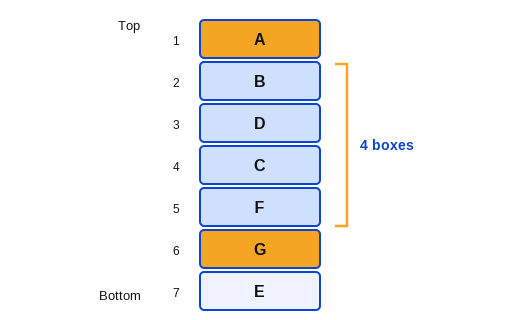
Seven boxes, A, B, C, D, E, F and G, are kept one over the other but not necessarily in the same order.
Only two boxes are kept between C and E. Only A is kept above B. No box is kept below E. F is kept at some place below D but at some place above G.
How many boxes are kept between A and G?
सात बॉक्स, A, B, C, D, E, F और G, एक के ऊपर एक रखे गए हैं, लेकिन आवश्यक नहीं कि इसी क्रम में हों।
C और E के बीच केवल दो बॉक्स रखे गए हैं। B के ऊपर केवल A रखा गया है। E के नीचे कोई बॉक्स नहीं रखा गया है। F, D के नीचे कहीं रखा गया है लेकिन G के ऊपर कहीं रखा गया है।
A और G के बीच कितने बॉक्स रखे गए हैं?
  1. A4
  2. B3
  3. C1
  4. D2
Show answer

Concept: Number positions 1 (top) to 7 (bottom) and place definite boxes first.

  1. No box below E ⇒ E at 7; two between C and E ⇒ C at 4
  2. Only A above B ⇒ A 1, B 2
  3. D above F above G in 3,5,6 ⇒ D 3, F 5, G 6
  4. Between A (1) and G (6): B, D, C, F ⇒ 4

Trick: “Only A above B” fixes the top two at once.

Answer: (A) 4

अवधारणा: स्थान 1 (ऊपर) से 7 (नीचे) मानें, पहले निश्चित बॉक्स रखें।

  1. E के नीचे कोई नहीं ⇒ E 7 पर; C और E के बीच दो ⇒ C 4 पर
  2. केवल A, B के ऊपर ⇒ A 1, B 2
  3. D, F के ऊपर; F, G के ऊपर; खाली 3,5,6 ⇒ D 3, F 5, G 6
  4. A (1) और G (6) के बीच: B, D, C, F ⇒ 4

ट्रिक: “केवल A, B के ऊपर” से ऊपर के दो स्थान तुरंत तय।

उत्तर: (A) 4

RRB NTPC Undergraduate CBT 1General Intelligence and ReasoningBox arrangementRRB NTPC Undergraduate CBT 1 2024 · 2 Sep Shift 3 →
Q5919.
In a certain code language, ‘MEAT’ is coded as ‘4257’ and ‘TURN’ is coded as ‘1365’. What is the code for ‘T’ in the given code language?
एक निश्चित कूट भाषा में, ‘MEAT’ को ‘4257’ के रूप में कूटबद्ध किया जाता है और ‘TURN’ को ‘1365’ के रूप में कूटबद्ध किया जाता है। दी गई कूट भाषा में ‘T’ के लिए कूट क्या है?
  1. A6
  2. B5
  3. C7
  4. D1
Show answer

Concept: The letter common to both words takes the code common to both codes.

  1. MEAT → 4, 2, 5, 7; TURN → 1, 3, 6, 5
  2. Common letter: T; common digit: 5 ⇒ T = 5

Trick: One common letter ↔ one common digit.

Answer: (B) 5

अवधारणा: दोनों शब्दों में सामान्य अक्षर का कोड दोनों कोडों में सामान्य अंक होता है।

  1. MEAT → 4, 2, 5, 7; TURN → 1, 3, 6, 5
  2. सामान्य अक्षर: T; सामान्य अंक: 5 ⇒ T = 5

ट्रिक: एक सामान्य अक्षर ↔ एक सामान्य अंक।

उत्तर: (B) 5

RRB NTPC Undergraduate CBT 1General Intelligence and ReasoningCoding–decodingRRB NTPC Undergraduate CBT 1 2024 · 2 Sep Shift 3 →
Q5920.
This question is based on five, four-digit numbers given below.
(Left) 4138 2345 6367 5353 1276 (Right)
(Example: 6975 – First digit = 6, second digit = 9, third digit = 7 and fourth digit = 5) (NOTE: All operations to be done from left to right.)
What will be the resultant if the first digit of the largest number is multiplied to the second digit of the smallest number?
यह प्रश्न नीचे दी गई पाँच, चार अंकों वाली संख्याओं पर आधारित है।
(बाएँ) 4138 2345 6367 5353 1276 (दाएँ)
(उदाहरण: 6975 – पहला अंक = 6, दूसरा अंक = 9, तीसरा अंक = 7 और चौथा अंक = 5) (नोट: सभी संक्रियाएँ बाएँ से दाएँ की जानी हैं।)
यदि सबसे बड़ी संख्या के पहले अंक को सबसे छोटी संख्या के दूसरे अंक से गुणा किया जाए, तो परिणाम क्या होगा?
  1. A12
  2. B17
  3. C14
  4. D15
Show answer

Concept: Identify the largest and smallest numbers, then pick the required digits.

  1. Largest =6367 ⇒ first digit 6
  2. Smallest =1276 ⇒ second digit 2
  3. 6×2=12

Trick: Compare first digits only: 6 is largest, 1 is smallest.

Answer: (A) 12

अवधारणा: सबसे बड़ी और सबसे छोटी संख्या पहचानें, फिर अंक चुनें।

  1. सबसे बड़ी =6367 ⇒ पहला अंक 6
  2. सबसे छोटी =1276 ⇒ दूसरा अंक 2
  3. 6×2=12

ट्रिक: केवल पहले अंक देखें: 6 सबसे बड़ा, 1 सबसे छोटा।

उत्तर: (A) 12

RRB NTPC Undergraduate CBT 1General Intelligence and ReasoningNumber puzzleRRB NTPC Undergraduate CBT 1 2024 · 2 Sep Shift 3 →