Question bank

Q&A: practice questions with answers

Search questions on any topic. Filter by exam category, exam, subject and topic, try the question, then open the answer and explanation.

Courses – airGurukul

20,719 questions found.

Q6081.
Find the value of: [480 ÷ {12 + 2 × ( 4 − 9 )}].
इसका मान ज्ञात कीजिए: [480 ÷ {12 + 2 × ( 4 − 9 )}]
  1. A241
  2. B240
  3. C242
  4. D243
Show answer

Concept: Solve innermost bracket first: ( ) → { } → [ ].

  1. (4−9)=−5
  2. {12+2×(−5)}=12−10=2
  3. [480÷2]=240

Trick: Bracket order: small → curly → square.

Answer: (B) 240

अवधारणा: सबसे अंदर का कोष्ठक पहले: ( ) → { } → [ ]।

  1. (4−9)=−5
  2. {12+2×(−5)}=12−10=2
  3. [480÷2]=240

ट्रिक: कोष्ठक क्रम: छोटा → मझला → बड़ा।

उत्तर: (B) 240
RRB NTPC Undergraduate CBT 1MathematicsSimplification (BODMAS)RRB NTPC Undergraduate CBT 1 2024 · 2 Sep Shift 1 →
Q6082.
3 years ago, the age of a father was 18 years more than twice his son's age. After how many years, from now, will he be twice his son's age?
3 वर्ष पहले, एक पिता की आयु उसके पुत्र की आयु के दोगुने से 18 वर्ष अधिक थी। अब से कितने वर्ष बाद, वह अपने पुत्र की आयु का दोगुना होगा?
  1. A17
  2. B11
  3. C13
  4. D15
Show answer

Concept: Form equations from present ages F and S.

  1. 3 years ago: F−3=2(S−3)+18⇒F=2S+15
  2. After n years: F+n=2(S+n)⇒F=2S+n
  3. Compare: n=15 years.

Trick: If F−a=2(S−a)+k, then father becomes twice the son after exactly k−a years: 18−3=15.

Answer: (D) 15

अवधारणा: वर्तमान आयु F (पिता) और S (पुत्र) लेकर समीकरण बनाएँ।

  1. 3 वर्ष पहले: F−3=2(S−3)+18⇒F=2S+15
  2. n वर्ष बाद: F+n=2(S+n)⇒F=2S+n
  3. तुलना: n=15 वर्ष।

ट्रिक: यदि F−a=2(S−a)+k हो, तो पिता k−a वर्ष बाद दोगुना होगा: 18−3=15।

उत्तर: (D) 15

RRB NTPC Undergraduate CBT 1MathematicsProblems on AgesRRB NTPC Undergraduate CBT 1 2024 · 2 Sep Shift 1 →
Q6083.
Evaluate: (-9) - (-60) ÷ (-10) + (-4) × 6
मान ज्ञात कीजिए: (-9) - (-60) ÷ (-10) + (-4) × 6
  1. A-39
  2. B-38
  3. C-42
  4. D-41
Show answer

Concept: BODMAS: division and multiplication before addition/subtraction; watch signs.

  1. (−60)÷(−10)=6
  2. (−4)×6=−24
  3. (−9)−6+(−24)=−39

Trick: Negative ÷ negative = positive.

Answer: (A) −39

अवधारणा: BODMAS: पहले भाग व गुणा, फिर जोड़/घटाव; चिह्नों का ध्यान रखें।

  1. (−60)÷(−10)=6
  2. (−4)×6=−24
  3. (−9)−6+(−24)=−39

ट्रिक: ऋणात्मक ÷ ऋणात्मक = धनात्मक।

उत्तर: (A) −39

RRB NTPC Undergraduate CBT 1MathematicsSimplification with IntegersRRB NTPC Undergraduate CBT 1 2024 · 2 Sep Shift 1 →
Q6084.
A can lay railway track between two given stations in 19 days and B can do the same job in 11 days. With the help of C, they did the job in 3 days only. Then, C alone can do the job in
A दो दिए गए स्टेशनों के बीच रेलवे ट्रैक 19 दिनों में बिछा सकता है और B वही कार्य 11 दिनों में कर सकता है। C की सहायता से, उन्होंने यह कार्य केवल 3 दिनों में पूरा किया। तो, C अकेले यह कार्य कितने दिनों में कर सकता है?
  1. A332119 days332119 दिन
  2. B832119 days832119 दिन
  3. C532119 days532119 दिन
  4. D632119 days632119 दिन
Show answer

Concept: One-day work adds up: 1A+1B+1C=1together.

  1. 1C=13−119−111
  2. LCM =627: 209−33−57627=119627
  3. C=627119=532119 days

Trick: 627=3×19×11; integer part must be just over 5 since 119627≈0.19.

Answer: (C) 532119 days

अवधारणा: एक दिन का काम जुड़ता है: 1A+1B+1C=1साथ।

  1. 1C=13−119−111
  2. LCM =627: 209−33−57627=119627
  3. C=627119=532119 दिन

ट्रिक: 627=3×19×11; 119627≈0.19, अतः उत्तर 5 से थोड़ा अधिक।

उत्तर: (C) 532119 दिन

RRB NTPC Undergraduate CBT 1MathematicsTime and WorkRRB NTPC Undergraduate CBT 1 2024 · 2 Sep Shift 1 →
Q6085.
The current population of a town is 12,800. It increases by 25% and 35% in two successive years but decreases by 5% in the third year. What is the population of the town at the end of the third year?
एक कस्बे की वर्तमान जनसंख्या 12,800 है। यह दो क्रमिक वर्षों में 25% और 35% बढ़ती है, लेकिन तीसरे वर्ष में 5% घट जाती है। तीसरे वर्ष के अंत में कस्बे की जनसंख्या कितनी है?
  1. A20,520
  2. B20,525
  3. C20,515
  4. D20,517
Show answer

Concept: Successive % changes multiply: P×(1+r1)(1+r2)(1−r3).

  1. 12800×1.25=16000
  2. 16000×1.35=21600
  3. 21600×0.95=20520

Trick: Use fractions: 12800×54×2720×1920=20520.

Answer: (A) 20,520

अवधारणा: क्रमिक प्रतिशत परिवर्तन गुणा होते हैं: P×(1+r1)(1+r2)(1−r3)।

  1. 12800×1.25=16000
  2. 16000×1.35=21600
  3. 21600×0.95=20520

ट्रिक: भिन्न में: 12800×54×2720×1920=20520।

उत्तर: (A) 20,520

RRB NTPC Undergraduate CBT 1MathematicsPopulation – Successive ChangeRRB NTPC Undergraduate CBT 1 2024 · 2 Sep Shift 1 →
Q6086.
The HCF and the LCM of two numbers are 11 and 330, respectively. If one of the numbers is 66, find the other one.
दो संख्याओं का HCF और LCM क्रमशः 11 और 330 है। यदि उनमें से एक संख्या 66 है, तो दूसरी संख्या ज्ञात कीजिए।
  1. A44
  2. B55
  3. C66
  4. D121
Show answer

Concept: HCF×LCM=product of the two numbers.

  1. 11×330=66×x
  2. x=363066=55

Trick: Other number must be a multiple of HCF 11 dividing 330 → 55.

Answer: (B) 55

अवधारणा: HCF×LCM=दोनों संख्याओं का गुणनफल।

  1. 11×330=66×x
  2. x=363066=55

ट्रिक: दूसरी संख्या 11 का गुणज और 330 का भाजक होगी → 55।

उत्तर: (B) 55

RRB NTPC Undergraduate CBT 1MathematicsHCF and LCMRRB NTPC Undergraduate CBT 1 2024 · 2 Sep Shift 1 →
Q6087.
Pipe P can fill 38 part of a tank in 21 hours and pipe Q can fill 27 part of the same tank in 16 hours. Both P and Q were kept open for 2 hours, then both were closed. Pipe R alone was then opened and it emptied the water in the tank in 3 hours. Pipes P, Q and R together can fill the empty tank in:
पाइप P एक टंकी का 38 भाग 21 घंटे में भर सकता है और पाइप Q उसी टंकी का 27 भाग 16 घंटे में भर सकता है। P और Q दोनों को 2 घंटे के लिए खुला रखा गया, फिर दोनों को बंद कर दिया गया। इसके बाद केवल पाइप R को खोला गया और उसने टंकी का पानी 3 घंटे में खाली कर दिया। पाइप P, Q और R एक साथ खाली टंकी को कितने समय में भर सकते हैं?
  1. A94 hours94 घंटे
  2. B89 hours89 घंटे
  3. C67 hours67 घंटे
  4. D84 hours84 घंटे
Show answer

Concept: Find each pipe's full-tank time, then add rates (emptying pipe negative).

  1. P: 38 in 21 h → full in 21×83=56 h; Q: 27 in 16 h → 56 h.
  2. In 2 h: 2(156+156)=114 tank filled.
  3. R empties 114 in 3 h → empties full tank in 42 h.
  4. Together: 156+156−142=3+3−4168=184 → 84 h.

Trick: Take tank =168 units: P = 3, Q = 3, R = −4 per hour → net 2 → 1682=84 h.

Answer: (D) 84 hours

अवधारणा: हर पाइप का पूरा टैंक भरने का समय निकालें, फिर दरें जोड़ें (खाली करने वाला ऋणात्मक)।

  1. P: 21 घंटे में 38 → पूरा 56 घंटे; Q: 16 घंटे में 27 → 56 घंटे।
  2. 2 घंटे में: 2(156+156)=114 भाग भरा।
  3. R 3 घंटे में 114 खाली करता है → पूरा 42 घंटे में।
  4. साथ में: 156+156−142=184 → 84 घंटे।

ट्रिक: टैंक =168 इकाई: P = 3, Q = 3, R = −4 प्रति घंटा → शुद्ध 2 → 1682=84 घंटे।

उत्तर: (D) 84 घंटे

RRB NTPC Undergraduate CBT 1MathematicsPipes and CisternsRRB NTPC Undergraduate CBT 1 2024 · 2 Sep Shift 1 →
Q6088.
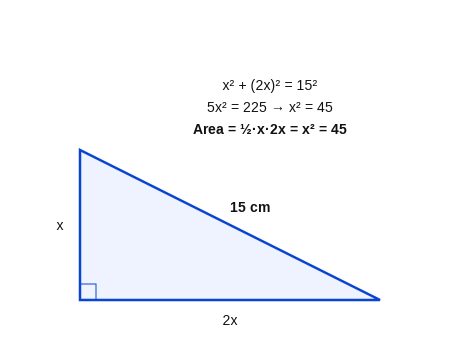
One side of a right-angled triangle is twice the other and the hypotenuse is 15 cm. Find the area (in cm2) of the triangle.
एक समकोण त्रिभुज की एक भुजा दूसरी भुजा की दोगुनी है और कर्ण 15 cm है। त्रिभुज का क्षेत्रफल (cm2 में) ज्ञात कीजिए।
  1. A70
  2. B60
  3. C45
  4. D80
Show answer

Concept: Pythagoras: base2+height2=hypotenuse2; area =12×base×height.

  1. Sides x and 2x: x2+4x2=152
  2. 5x2=225⇒x2=45
  3. Area =12×x×2x=x2=45cm2

Trick: No need to find x – area equals x2 directly.

Answer: (C) 45

अवधारणा: पाइथागोरस: आधार2+लंब2=कर्ण2; क्षेत्रफल =12×आधार×लंब।

  1. भुजाएँ x और 2x: x2+4x2=152
  2. 5x2=225⇒x2=45
  3. क्षेत्रफल =12×x×2x=x2=45cm2

ट्रिक: x निकालने की जरूरत नहीं – क्षेत्रफल सीधे x2 है।

उत्तर: (C) 45

RRB NTPC Undergraduate CBT 1MathematicsMensuration – Right TriangleRRB NTPC Undergraduate CBT 1 2024 · 2 Sep Shift 1 →
Q6089.
The value of 53+(11+56)−53 is
53+(11+56)−53 का मान कितना है?
  1. A713
  2. B611
  3. C518
  4. D1118
Show answer

Concept: Equal terms with opposite signs cancel; then simplify the complex fraction.

  1. 53 and −53 cancel.
  2. 1+56=116
  3. 1116=611

Trick: Spot cancellations before computing.

Answer: (B) 611

अवधारणा: समान पद विपरीत चिह्न के साथ कट जाते हैं; फिर जटिल भिन्न सरल करें।

  1. 53 और −53 कट जाते हैं।
  2. 1+56=116
  3. 1116=611

ट्रिक: गणना से पहले कटने वाले पद देखें।

उत्तर: (B) 611

RRB NTPC Undergraduate CBT 1MathematicsSimplification – FractionsRRB NTPC Undergraduate CBT 1 2024 · 2 Sep Shift 1 →
Q6090.
The average weight (in kg) of a family of five members whose weights are 40 kg, 49 kg, 56 kg, 76 kg and 38 kg is:
पाँच सदस्यों वाले एक परिवार, जिनके भार 40 kg, 49 kg, 56 kg, 76 kg और 38 kg हैं, का औसत भार (kg में) कितना है?
  1. A52.8
  2. B50.8
  3. C53.8
  4. D51.8
Show answer

Concept: Average=sumcount.

  1. Sum =40+49+56+76+38=259
  2. Average =2595=51.8kg

Trick: Assume 50: deviations −10,−1,+6,+26,−12 sum =9 → 50+95=51.8.

Answer: (D) 51.8

अवधारणा: औसत=योगसंख्या।

  1. योग =40+49+56+76+38=259
  2. औसत =2595=51.8kg

ट्रिक: 50 मानें: विचलन −10,−1,+6,+26,−12 का योग =9 → 50+95=51.8।

उत्तर: (D) 51.8

RRB NTPC Undergraduate CBT 1MathematicsAverageRRB NTPC Undergraduate CBT 1 2024 · 2 Sep Shift 1 →
Q6091.
M and N started a business. M invested ₹50,000 more than N for 3 months, while N invested for 7 months. M's share is ₹328 more than that of N, out of a total profit of ₹4,920. Find the capital contributed by M.
M और N ने एक व्यवसाय शुरू किया। M ने N से ₹50,000 अधिक 3 महीने के लिए निवेश किया, जबकि N ने 7 महीने के लिए निवेश किया। ₹4,920 के कुल लाभ में से M का हिस्सा N के हिस्से से ₹328 अधिक है। M द्वारा लगाई गई पूँजी ज्ञात कीजिए।
  1. A₹1,20,000
  2. B₹1,00,000
  3. C₹80,000
  4. D₹60,000
Show answer

Concept: Profit ratio = capital × time ratio.

  1. M+N=4920,M−N=328⇒M=2624,N=2296 → ratio 8:7
  2. 3m7n=87⇒3m=8n (capitals m,n)
  3. m=n+50000⇒3n+150000=8n⇒n=30000
  4. m=80000

Trick: 2624:2296 — divide both by 328 → 8:7.

Answer: (C) ₹80,000

अवधारणा: लाभ का अनुपात = पूँजी × समय का अनुपात।

  1. M+N=4920,M−N=328⇒M=2624,N=2296 → अनुपात 8:7
  2. 3m7n=87⇒3m=8n (पूँजी m,n)
  3. m=n+50000⇒3n+150000=8n⇒n=30000
  4. m=80000

ट्रिक: 2624:2296 — दोनों को 328 से भाग दें → 8:7।

उत्तर: (C) ₹80,000

RRB NTPC Undergraduate CBT 1MathematicsPartnershipRRB NTPC Undergraduate CBT 1 2024 · 2 Sep Shift 1 →
Q6092.
50 glass bottles were purchased for ₹50, and 28 glass bottles broke in transit. The trader sold the remaining glass bottles at ₹5.80 each. Find his profit.
₹50 में 50 काँच की बोतलें खरीदी गईं, और परिवहन के दौरान 28 काँच की बोतलें टूट गईं। व्यापारी ने शेष काँच की बोतलों को ₹5.80 प्रति बोतल की दर से बेचा। उसका लाभ ज्ञात कीजिए।
  1. A₹68.50
  2. B₹76.60
  3. C₹75.30
  4. D₹77.60
Show answer

Concept: Profit = total SP − total CP (broken items give no revenue).

  1. Bottles left =50−28=22
  2. SP =22×5.80=127.60
  3. Profit =127.60−50=77.60

Trick: Cost stays ₹50 even though bottles broke.

Answer: (D) ₹77.60

अवधारणा: लाभ = कुल विक्रय मूल्य − कुल क्रय मूल्य (टूटी बोतलों से कोई आय नहीं)।

  1. बची बोतलें =50−28=22
  2. विक्रय मूल्य =22×5.80=127.60
  3. लाभ =127.60−50=77.60

ट्रिक: बोतलें टूटने पर भी लागत ₹50 ही रहती है।

उत्तर: (D) ₹77.60

RRB NTPC Undergraduate CBT 1MathematicsProfit and LossRRB NTPC Undergraduate CBT 1 2024 · 2 Sep Shift 1 →
Q6093.
The average runs scored by a batsman in 23 matches is 42. In the next 10 matches, the batsman scored an average of 13 runs. Find his average runs scored (rounded off to two decimals) in all the 33 matches.
एक बल्लेबाज़ द्वारा 23 मैचों में बनाए गए औसत रन 42 हैं। अगले 10 मैचों में, बल्लेबाज़ ने 13 रन का औसत बनाया। सभी 33 मैचों में उसके द्वारा बनाए गए औसत रन (दशमलव के दो स्थानों तक पूर्णांकित) ज्ञात कीजिए।
  1. A35.21
  2. B34.21
  3. C33.21
  4. D32.21
Show answer

Concept: Combined average =total runstotal matches.

  1. Runs in 23 matches =23×42=966
  2. Runs in 10 matches =130
  3. Average =109633≈33.21

Trick: Answer must lie between 13 and 42, nearer 42 (more matches) → only 33.21 fits the exact division.

Answer: (C) 33.21

अवधारणा: संयुक्त औसत =कुल रनकुल मैच।

  1. 23 मैचों के रन =23×42=966
  2. 10 मैचों के रन =130
  3. औसत =109633≈33.21

ट्रिक: उत्तर 13 और 42 के बीच, 42 के निकट होगा।

उत्तर: (C) 33.21

RRB NTPC Undergraduate CBT 1MathematicsAverageRRB NTPC Undergraduate CBT 1 2024 · 2 Sep Shift 1 →
Q6094.
The value of 45+(11+56)−25 is
45+(11+56)−25 का मान कितना है?
  1. A5255
  2. B5749
  3. C5161
  4. D4353
Show answer

Concept: Simplify the complex fraction and combine like fractions.

  1. 11+56=611
  2. 45−25=25
  3. 25+611=22+3055=5255

Trick: Group same-denominator fractions first.

Answer: (A) 5255

अवधारणा: जटिल भिन्न सरल करें और समान हर वाली भिन्नें पहले जोड़ें।

  1. 11+56=611
  2. 45−25=25
  3. 25+611=22+3055=5255

ट्रिक: समान हर वाली भिन्नों को पहले मिलाएँ।

उत्तर: (A) 5255

RRB NTPC Undergraduate CBT 1MathematicsSimplification – FractionsRRB NTPC Undergraduate CBT 1 2024 · 2 Sep Shift 1 →
Q6095.
The difference between an interior angle and exterior angle of a regular polygon is 120°. Find the number of sides of the polygon.
एक समबहुभुज के अंतः कोण और बाह्य कोण के बीच का अंतर 120° है। बहुभुज की भुजाओं की संख्या ज्ञात कीजिए।
  1. A15
  2. B12
  3. C14
  4. D10
Show answer

Concept: Interior + exterior =180∘; number of sides n=360∘exterior.

  1. I+E=180∘,I−E=120∘
  2. 2E=60∘⇒E=30∘
  3. n=36030=12

Trick: Exterior =180−difference2.

Answer: (B) 12

अवधारणा: अंतः कोण + बाह्य कोण =180∘; भुजाएँ n=360∘बाह्य कोण।

  1. I+E=180∘,I−E=120∘
  2. 2E=60∘⇒E=30∘
  3. n=36030=12

ट्रिक: बाह्य कोण =180−अंतर2।

उत्तर: (B) 12

RRB NTPC Undergraduate CBT 1MathematicsPolygons – AnglesRRB NTPC Undergraduate CBT 1 2024 · 2 Sep Shift 1 →
Q6096.
FKPX is related to IPSC in a certain way based on the English alphabetical order. In the same way, REBR is related to UJEW. To which of the following options is ATKG related, following the same logic?
अंग्रेज़ी वर्णमाला क्रम के आधार पर FKPX एक निश्चित प्रकार से IPSC से संबंधित है। उसी प्रकार REBR, UJEW से संबंधित है। समान तर्क का अनुसरण करते हुए, ATKG निम्नलिखित में से किस विकल्प से संबंधित है?
  1. ADFRT
  2. BDYLN
  3. CDLNY
  4. DDYNL
Show answer

Concept: Find the position shift of each letter (A=1 … Z=26).

  1. F→I (+3), K→P (+5), P→S (+3), X→C (+5)
  2. REBR→UJEW: +3, +5, +3, +5 ✓
  3. ATKG: A+3=D, T+5=Y, K+3=N, G+5=L → DYNL

Trick: Alternate pattern +3, +5; wrap after Z (X+5 = C).

Answer: (D) DYNL

अवधारणा: हर अक्षर का स्थान-अंतर देखें (A=1 … Z=26)।

  1. F→I (+3), K→P (+5), P→S (+3), X→C (+5)
  2. REBR→UJEW: +3, +5, +3, +5 ✓
  3. ATKG: A+3=D, T+5=Y, K+3=N, G+5=L → DYNL

ट्रिक: एकांतर पैटर्न +3, +5; Z के बाद फिर A से गिनें।

उत्तर: (D) DYNL

RRB NTPC Undergraduate CBT 1General Intelligence and ReasoningLetter AnalogyRRB NTPC Undergraduate CBT 1 2024 · 2 Sep Shift 1 →
Q6097.
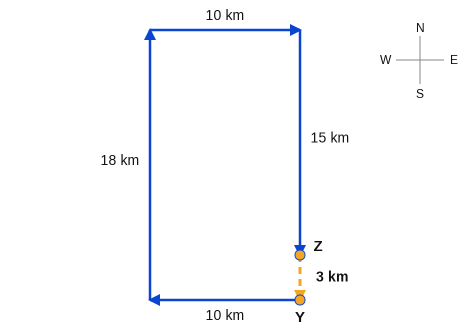
Navneet starts from Point Y and drives 10 km towards west. He then takes a right turn, drives 18 km. He then turns right and drives 10 km. He takes a final right turn, drives 15 km and stops at Point Z. How far (shortest distance) and towards which direction should he drive in order to reach Point Y again? (All turns are 90-degree turns only unless specified)
नवनीत बिंदु Y से चलना शुरू करता है और पश्चिम की ओर 10 km गाड़ी चलाता है। फिर वह दाएँ मुड़ता है और 18 km गाड़ी चलाता है। फिर वह दाएँ मुड़ता है और 10 km गाड़ी चलाता है। वह अंतिम बार दाएँ मुड़ता है, 15 km गाड़ी चलाता है और बिंदु Z पर रुक जाता है। बिंदु Y पर फिर से पहुँचने के लिए उसे कितनी दूर (न्यूनतम दूरी) और किस दिशा में गाड़ी चलानी चाहिए? (जब तक निर्दिष्ट न हो, सभी मोड़ केवल 90 डिग्री के मोड़ हैं)
  1. A3 km towards southदक्षिण की ओर 3 km
  2. B10 km towards northउत्तर की ओर 10 km
  3. C4 km towards eastपूर्व की ओर 4 km
  4. D6 km towards westपश्चिम की ओर 6 km
Show answer

Concept: Trace the path on a grid; a right turn from West is North, from North is East, from East is South.

  1. Y → 10 km West → 18 km North → 10 km East: now 18 km north of Y.
  2. Then 15 km South: Z is 18−15=3km north of Y.
  3. To return: 3 km towards South.

Trick: The two 10 km legs cancel; only 18−15 matters.

Answer: (A) 3 km towards south

अवधारणा: रास्ता ग्रिड पर बनाएँ; पश्चिम से दाएँ मुड़ने पर उत्तर, उत्तर से दाएँ पूर्व, पूर्व से दाएँ दक्षिण।

  1. Y → 10 km पश्चिम → 18 km उत्तर → 10 km पूर्व: अब Y से 18 km उत्तर।
  2. फिर 15 km दक्षिण: Z, Y से 18−15=3km उत्तर में है।
  3. वापस जाने के लिए: 3 km दक्षिण की ओर।

ट्रिक: दोनों 10 km कट जाते हैं; केवल 18−15 देखें।

उत्तर: (A) 3 km दक्षिण की ओर

RRB NTPC Undergraduate CBT 1General Intelligence and ReasoningDirection and DistanceRRB NTPC Undergraduate CBT 1 2024 · 2 Sep Shift 1 →
Q6098.
In a certain code language, ‘CLAM’ is coded as ‘1587’ and ‘LOAM’ is coded as ‘4875’. What is the code for ‘O’ in that language?
एक निश्चित कूट भाषा में, 'CLAM' को '1587' के रूप में कूटबद्ध किया जाता है और 'LOAM' को '4875' के रूप में कूटबद्ध किया जाता है। उस भाषा में 'O' के लिए कूट क्या है?
  1. A4
  2. B5
  3. C7
  4. D8
Show answer

Concept: Common letters of two words share the common digits (order of digits may be jumbled).

  1. CLAM = {1,5,8,7}, LOAM = {4,8,7,5}
  2. Common letters L, A, M ↔ common digits 5, 8, 7
  3. Left over: C = 1 and O = 4

Trick: Remove common letters and digits — the leftovers pair up.

Answer: (A) 4

अवधारणा: दोनों शब्दों के समान अक्षरों के कोड भी समान अंक होते हैं (क्रम बदला हो सकता है)।

  1. CLAM = {1,5,8,7}, LOAM = {4,8,7,5}
  2. समान अक्षर L, A, M ↔ समान अंक 5, 8, 7
  3. बचे: C = 1 और O = 4

ट्रिक: समान अक्षर व अंक हटाएँ — बचे हुए आपस में जुड़ते हैं।

उत्तर: (A) 4

RRB NTPC Undergraduate CBT 1General Intelligence and ReasoningCoding-DecodingRRB NTPC Undergraduate CBT 1 2024 · 2 Sep Shift 1 →
Q6099.
Based on the English alphabetical order, three of the following four letter-clusters are alike in a certain way and thus form a group. Which letter-cluster DOES NOT belong to that group?
(Note: The odd one out is not based on the number of consonants/vowels or their position in the letter-cluster.)
अंग्रेज़ी वर्णमाला क्रम के आधार पर, निम्नलिखित चार अक्षर-समूहों में से तीन किसी निश्चित प्रकार से एकसमान हैं और इस प्रकार एक समूह बनाते हैं। कौन-सा अक्षर-समूह उस समूह से संबंधित नहीं है?
(ध्यान दें: असंगत का निर्धारण व्यंजनों/स्वरों की संख्या या अक्षर-समूह में उनके स्थान के आधार पर नहीं है।)
  1. AHKO
  2. BDGK
  3. CORW
  4. DBEI
Show answer

Concept: Check the gaps between consecutive letters.

  1. HKO: H+3=K, K+4=O
  2. DGK: +3, +4; BEI: +3, +4
  3. ORW: O+3=R, R+5=W → different

Trick: Write positions: O15 R18 W23 → gaps 3, 5.

Answer: (C) ORW

अवधारणा: क्रमागत अक्षरों के बीच का अंतर देखें।

  1. HKO: H+3=K, K+4=O
  2. DGK: +3, +4; BEI: +3, +4
  3. ORW: O+3=R, R+5=W → भिन्न

ट्रिक: स्थान लिखें: O15 R18 W23 → अंतर 3, 5।

उत्तर: (C) ORW

RRB NTPC Undergraduate CBT 1General Intelligence and ReasoningOdd One Out – Letter ClustersRRB NTPC Undergraduate CBT 1 2024 · 2 Sep Shift 1 →
Q6100.
If + means −, − means ×, × means ÷ and ÷ means +, then what will come in place of the question mark (?) in the following equation?
12 − 2 + 49 × 7 ÷ 5 = ?
यदि + का अर्थ −, − का अर्थ ×, × का अर्थ ÷ और ÷ का अर्थ + है, तो निम्नलिखित समीकरण में प्रश्न चिह्न (?) के स्थान पर क्या आएगा?
12 − 2 + 49 × 7 ÷ 5 = ?
  1. A22
  2. B27
  3. C12
  4. D17
Show answer

Concept: Replace symbols first, then apply BODMAS.

  1. 12−2+49×7÷5 becomes 12×2−49÷7+5
  2. =24−7+5=22

Trick: Swap all signs in one go before calculating.

Answer: (A) 22

अवधारणा: पहले चिह्न बदलें, फिर BODMAS लगाएँ।

  1. 12−2+49×7÷5 बनता है 12×2−49÷7+5
  2. =24−7+5=22

ट्रिक: गणना से पहले सारे चिह्न एक साथ बदलें।

उत्तर: (A) 22

RRB NTPC Undergraduate CBT 1General Intelligence and ReasoningMathematical OperationsRRB NTPC Undergraduate CBT 1 2024 · 2 Sep Shift 1 →