Question bank

Q&A: practice questions with answers

Search questions on any topic. Filter by exam category, exam, subject and topic, try the question, then open the answer and explanation.

Courses – airGurukul

20,719 questions found.

Q6201.
Seven boxes A, B, C, D, E, F and G are kept one over the other but not necessarily in the same order. No box is kept above G. Only three boxes are kept between G and B. Only one box is kept between F and D. D is kept immediately above B. Only four boxes are kept between F and E. A is kept at some place above C. How many boxes are kept above B?
सात बक्से A, B, C, D, E, F और G एक के ऊपर एक रखे गए हैं, परंतु आवश्यक नहीं कि इसी क्रम में हों। G के ऊपर कोई बक्सा नहीं रखा गया है। G और B के बीच केवल तीन बक्से रखे गए हैं। F और D के बीच केवल एक बक्सा रखा गया है। D, B के ठीक ऊपर रखा गया है। F और E के बीच केवल चार बक्से रखे गए हैं। A, C के ऊपर किसी स्थान पर रखा गया है। B के ऊपर कितने बक्से रखे गए हैं?
  1. A4
  2. B3
  3. C2
  4. D1
Show answer

Concept: Number positions 1 (bottom) to 7 (top) and place fixed clues first.
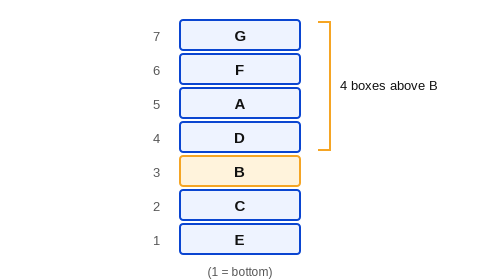
  1. No box above G ⇒ G = 7. Three between G and B ⇒ B = 3; D just above B ⇒ D = 4.
  2. One between F and D ⇒ F = 2 or 6. Four between F and E: F = 2 needs E = 7 (taken) ⇒ F = 6, E = 1.
  3. A above C in slots 5, 2 ⇒ A = 5, C = 2. Top to bottom: G, F, A, D, B, C, E.
  4. Boxes above B: G, F, A, D = 4.

Trick: Start from the extreme box (G at top) — it fixes the rest quickly.

Answer: (A) 4

अवधारणा: स्थान 1 (नीचे) से 7 (ऊपर) मानें, पहले निश्चित सूचनाएँ लगाएँ।

  1. G के ऊपर कोई नहीं ⇒ G = 7. G और B के बीच तीन ⇒ B = 3; D ठीक B के ऊपर ⇒ D = 4.
  2. F और D के बीच एक ⇒ F = 2 या 6. F और E के बीच चार: F = 2 पर E = 7 (भरा) ⇒ F = 6, E = 1.
  3. A, C के लिए 5 और 2; A ऊपर ⇒ A = 5, C = 2. ऊपर से: G, F, A, D, B, C, E.
  4. B के ऊपर: G, F, A, D = 4.

ट्रिक: सबसे ऊपर/नीचे वाले बॉक्स (G) से शुरू करें — बाकी जल्दी तय होते हैं।

उत्तर: (A) 4
RRB NTPC Undergraduate CBT 1General Intelligence and ReasoningBox ArrangementRRB NTPC Undergraduate CBT 1 2024 · 1 Sep Shift 3 →
Q6202.
Based on the English alphabetical order, three of the following four letter-cluster pairs are alike in a certain way and thus form a group. Which letter-cluster pair DOES NOT belong to that group?
(Note: The odd one out is not based on the number of consonants/vowels or their position in the letter-cluster.)
अंग्रेज़ी वर्णमाला क्रम के आधार पर, निम्नलिखित चार अक्षर-समूह युग्मों में से तीन किसी निश्चित प्रकार से एकसमान हैं और इस प्रकार एक समूह बनाते हैं। कौन-सा अक्षर-समूह युग्म उस समूह से संबंधित नहीं है?
(नोट: असंगत अक्षर-समूह युग्म, व्यंजनों/स्वरों की संख्या या अक्षर-समूह में उनके स्थान पर आधारित नहीं है।)
  1. AUX-ZS
  2. BOR-TM
  3. CLO-QI
  4. DRU-WP
Show answer

Concept: Compare each letter of the first cluster with the matching letter of the second.

  1. UX-ZS: U→Z +5, X→S −5. OR-TM: +5, −5. RU-WP: +5, −5.
  2. LO-QI: L→Q +5 but O→I −6.

Trick: Write positions: L=12, O=15, Q=17, I=9 — the second gap breaks the pattern.

Answer: (C) LO-QI

अवधारणा: पहले क्लस्टर के हर अक्षर की तुलना दूसरे क्लस्टर के संगत अक्षर से करें।

  1. UX-ZS: U→Z +5, X→S −5. OR-TM: +5, −5. RU-WP: +5, −5.
  2. LO-QI: L→Q +5 पर O→I −6.

ट्रिक: स्थान लिखें: L=12, O=15, Q=17, I=9 — दूसरा अंतर पैटर्न तोड़ता है।

उत्तर: (C) LO-QI

RRB NTPC Undergraduate CBT 1General Intelligence and ReasoningLetter Analogy – Odd One OutRRB NTPC Undergraduate CBT 1 2024 · 1 Sep Shift 3 →
Q6203.
What should come in place of the question mark (?) in the given series?
121 117.9 114.8 111.7 108.6 ?
दी गई श्रृंखला में प्रश्न चिह्न (?) के स्थान पर क्या आना चाहिए?
121 117.9 114.8 111.7 108.6 ?
  1. A105.5
  2. B107.6
  3. C108.2
  4. D106
Show answer

Concept: Each term decreases by a constant amount.

  1. 121−117.9=3.1, 117.9−114.8=3.1, … common difference −3.1.
  2. Next =108.6−3.1=105.5.

Trick: Constant difference ⇒ arithmetic progression.

Answer: (A) 105.5

अवधारणा: हर पद एक निश्चित मान से घटता है।

  1. 121−117.9=3.1, 117.9−114.8=3.1, … सार्व अंतर −3.1.
  2. अगला =108.6−3.1=105.5.

ट्रिक: अंतर स्थिर ⇒ समांतर श्रेढ़ी (AP)।

उत्तर: (A) 105.5

RRB NTPC Undergraduate CBT 1General Intelligence and ReasoningNumber SeriesRRB NTPC Undergraduate CBT 1 2024 · 1 Sep Shift 3 →
Q6204.
Which of the following letter-number clusters will replace the question mark (?) in the given series to make it logically complete?
PKE 17 RIH 10 TGK 1 ? XCQ -23
निम्नलिखित में से कौन-सा अक्षर-संख्या समूह दी गई श्रृंखला में प्रश्न चिह्न (?) को प्रतिस्थापित करके उसे तार्किक रूप से पूर्ण करेगा?
PKE 17 RIH 10 TGK 1 ? XCQ -23
  1. AVFN -8
  2. BVEN -10
  3. CVEM -10
  4. DEFM -8
Show answer

Concept: Track each letter position and the number separately.

  1. 1st letters P, R, T, V, X (+2); 2nd K, I, G, E, C (−2); 3rd E, H, K, N, Q (+3).
  2. Numbers 17, 10, 1, ?, −23: differences −7, −9, −11, −13 ⇒ 1−11=−10.
  3. Check: −10−13=−23 ✓.

Trick: Differences of the numbers themselves form an AP (−7, −9, −11…).

Answer: (B) VEN −10

अवधारणा: हर अक्षर स्थान और संख्या को अलग-अलग देखें।

  1. पहला अक्षर P, R, T, V, X (+2); दूसरा K, I, G, E, C (−2); तीसरा E, H, K, N, Q (+3)।
  2. संख्याएँ 17, 10, 1, ?, −23: अंतर −7, −9, −11, −13 ⇒ 1−11=−10.
  3. जाँच: −10−13=−23 ✓.

ट्रिक: संख्याओं के अंतर स्वयं एक AP (−7, −9, −11…) बनाते हैं।

उत्तर: (B) VEN −10

RRB NTPC Undergraduate CBT 1General Intelligence and ReasoningLetter-Number SeriesRRB NTPC Undergraduate CBT 1 2024 · 1 Sep Shift 3 →
Q6205.
Each of the digits in the number 4512689 is arranged in ascending order from left to right. The position(s) of how many digits will remain unchanged as compared to that in the original number?
संख्या 4512689 के प्रत्येक अंक को बाएँ से दाएँ आरोही क्रम में व्यवस्थित किया जाता है। मूल संख्या की तुलना में कितने अंकों का/के स्थान अपरिवर्तित रहेगा/रहेंगे?
  1. AThreeतीन
  2. BTwoदो
  3. COneएक
  4. DNoneकोई नहीं
Show answer

Concept: Write the digits in ascending order and compare place by place.

  1. Original: 4 5 1 2 6 8 9; Ascending: 1 2 4 5 6 8 9.
  2. Matching places: 6, 8, 9 (5th, 6th, 7th).
  3. So 3 digits keep their position.

Trick: Write both numbers one under the other and tick matching columns.

Answer: (A) Three

अवधारणा: अंकों को आरोही क्रम में लिखकर स्थान-दर-स्थान तुलना करें।

  1. मूल: 4 5 1 2 6 8 9; आरोही: 1 2 4 5 6 8 9.
  2. समान स्थान: 6, 8, 9 (5वाँ, 6वाँ, 7वाँ)।
  3. अतः 3 अंकों का स्थान नहीं बदलता।

ट्रिक: दोनों संख्याएँ एक के नीचे एक लिखें और मिलते कॉलम गिनें।

उत्तर: (A) तीन

RRB NTPC Undergraduate CBT 1General Intelligence and ReasoningDigit ArrangementRRB NTPC Undergraduate CBT 1 2024 · 1 Sep Shift 3 →
Q6206.
Refer to the following number and symbol series and answer the question that follows. Counting to be done from left to right only.
(Left) % € 9 2 5 * $ € © @ % % 1 7 $ * @ 6 7 3 & * (Right)
How many such symbols are there, each of which is immediately preceded by a number and also immediately followed by a symbol?
निम्नलिखित संख्या और प्रतीक श्रृंखला को देखिए और उसके बाद दिए गए प्रश्न का उत्तर दीजिए। गिनती केवल बाएँ से दाएँ की जानी है।
(बाएँ) % € 9 2 5 * $ € © @ % % 1 7 $ * @ 6 7 3 & * (दाएँ)
ऐसे कितने प्रतीक हैं, जिनमें से प्रत्येक के ठीक पहले एक संख्या है और ठीक बाद एक प्रतीक भी है?
  1. A5
  2. B4
  3. C3
  4. D2
Show answer

Concept: Find every pattern: number – symbol – symbol, and count the middle symbols.

  1. 5 * $ → * qualifies (preceded by 5, followed by $).
  2. 7 $ * → $ qualifies (preceded by 7, followed by *).
  3. 3 & * → & qualifies. Others (e.g. 6 after @, 1 after %) fail.
  4. Total = 3.

Trick: Scan only the places where a number is followed by a symbol, then check the next item.

Answer: (C) 3

अवधारणा: पैटर्न खोजें: संख्या – प्रतीक – प्रतीक, और बीच वाले प्रतीक गिनें।

  1. 5 * $ → * मान्य (पहले 5, बाद में $)।
  2. 7 $ * → $ मान्य (पहले 7, बाद में *)।
  3. 3 & * → & मान्य। अन्य (जैसे @ के बाद 6) मान्य नहीं।
  4. कुल = 3.

ट्रिक: केवल वे स्थान देखें जहाँ संख्या के बाद प्रतीक है, फिर उसके अगले पद को जाँचें।

उत्तर: (C) 3

RRB NTPC Undergraduate CBT 1General Intelligence and ReasoningSymbol-Number SeriesRRB NTPC Undergraduate CBT 1 2024 · 1 Sep Shift 3 →
Q6207.
Seven boxes U, V, W, X, E, F and G are kept one over the other but not necessarily in the same order.
Only three boxes are kept above V. Only one box is kept between F and V. Only three boxes are kept between F and U. U is kept at some place above V. E is kept immediately below U. G is kept at one of the places above X. W is not kept immediately above or below F. Which box is kept at the lowermost position?
सात बक्से U, V, W, X, E, F और G एक के ऊपर एक रखे गए हैं, परंतु आवश्यक नहीं कि इसी क्रम में हों।
V के ऊपर केवल तीन बक्से रखे गए हैं। F और V के बीच केवल एक बक्सा रखा गया है। F और U के बीच केवल तीन बक्से रखे गए हैं। U, V के ऊपर किसी स्थान पर रखा गया है। E, U के ठीक नीचे रखा गया है। G, X के ऊपर के किसी एक स्थान पर रखा गया है। W, F के ठीक ऊपर या ठीक नीचे नहीं रखा गया है। सबसे नीचे के स्थान पर कौन-सा बक्सा रखा गया है?
  1. AW
  2. BU
  3. CX
  4. DF
Show answer

Concept: Number positions 1 (top) to 7 (bottom).

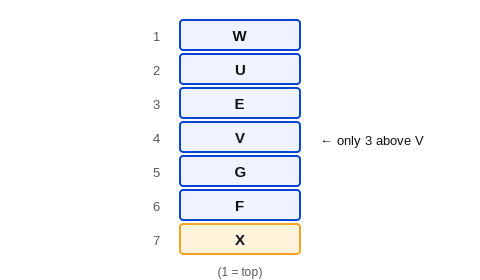
  1. Three above V ⇒ V = 4. One between F and V ⇒ F = 2 or 6.
  2. Three between F and U with U above V: F = 2 gives U = 6 (below V ✗) ⇒ F = 6, U = 2; E just below U ⇒ E = 3.
  3. W, G, X go to 1, 5, 7. W not next to F ⇒ W = 1; G above X ⇒ G = 5, X = 7.
  4. Lowermost box = X.

Trick: Use the "U above V" condition to reject one case immediately.

Answer: (C) X

अवधारणा: स्थान 1 (ऊपर) से 7 (नीचे) मानें।

  1. V के ऊपर तीन ⇒ V = 4. F और V के बीच एक ⇒ F = 2 या 6.
  2. F और U के बीच तीन, U, V के ऊपर: F = 2 पर U = 6 (V के नीचे ✗) ⇒ F = 6, U = 2; E ठीक U के नीचे ⇒ E = 3.
  3. W, G, X के लिए 1, 5, 7. W, F के पास नहीं ⇒ W = 1; G, X के ऊपर ⇒ G = 5, X = 7.
  4. सबसे नीचे = X.

ट्रिक: "U, V के ऊपर" शर्त से एक केस तुरंत हट जाता है।

उत्तर: (C) X

RRB NTPC Undergraduate CBT 1General Intelligence and ReasoningBox ArrangementRRB NTPC Undergraduate CBT 1 2024 · 1 Sep Shift 3 →
Q6208.
Read the given statements and conclusions carefully. Assuming that the information given in the statements is true, even if it appears to be at variance with commonly known facts, decide which of the given conclusion(s) logically follow(s) from the statements.
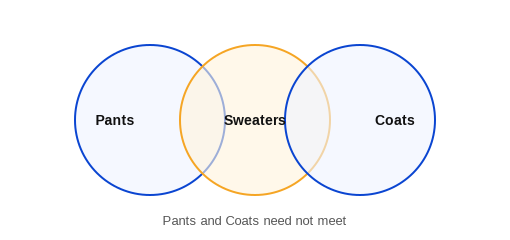
Statements:
Some pants are sweaters.
Some sweaters are coats.
Conclusions:
(I) Some pants are coats.
(II) Some sweaters are pants.
दिए गए कथनों और निष्कर्षों को ध्यानपूर्वक पढ़िए। यह मानते हुए कि कथनों में दी गई जानकारी सत्य है, भले ही वह सामान्य रूप से ज्ञात तथ्यों से भिन्न प्रतीत होती हो, निर्णय कीजिए कि दिए गए निष्कर्षों में से कौन-सा/से निष्कर्ष कथनों का तार्किक रूप से अनुसरण करता है/करते हैं।
कथन:
कुछ पैंट, स्वेटर हैं।
कुछ स्वेटर, कोट हैं।
निष्कर्ष:
(I) कुछ पैंट, कोट हैं।
(II) कुछ स्वेटर, पैंट हैं।
  1. AOnly conclusion (I) follows.केवल निष्कर्ष (I) अनुसरण करता है।
  2. BNeither conclusion (I) nor (II) follows.न तो निष्कर्ष (I) और न ही (II) अनुसरण करता है।
  3. COnly conclusion (II) follows.केवल निष्कर्ष (II) अनुसरण करता है।
  4. DBoth conclusions (I) and (II) follow.निष्कर्ष (I) और (II) दोनों अनुसरण करते हैं।
Show answer

Concept: "Some A are B" can be converted to "Some B are A"; two "some" statements give no link between the outer terms.

  1. II: "Some pants are sweaters" ⇒ "Some sweaters are pants" (conversion) ✓.
  2. I: Pants and coats are linked only through some sweaters, which may be different ones ⇒ not definite ✗.

Yaad rakhein: Some + Some ⇒ no conclusion between the end terms.

Answer: (C) Only conclusion (II) follows.

अवधारणा: "कुछ A, B हैं" को "कुछ B, A हैं" में बदला जा सकता है; दो "कुछ" कथनों से बाहरी पदों में संबंध नहीं बनता।

  1. II: "कुछ पैंट स्वेटर हैं" ⇒ "कुछ स्वेटर पैंट हैं" (रूपांतरण) ✓.
  2. I: पैंट और कोट केवल स्वेटर से जुड़े हैं, जो अलग-अलग हो सकते हैं ⇒ निश्चित नहीं ✗.

याद रखें: कुछ + कुछ ⇒ अंतिम पदों में कोई निष्कर्ष नहीं।

उत्तर: (C) केवल निष्कर्ष (II) अनुसरण करता है।

RRB NTPC Undergraduate CBT 1General Intelligence and ReasoningSyllogismRRB NTPC Undergraduate CBT 1 2024 · 1 Sep Shift 3 →
Q6209.
Based on the English alphabetical order, three of the following four letter-cluster pairs are alike in a certain way and thus form a group. Which letter-cluster pair DOES NOT belong to that group?
(Note: The odd one out is not based on the number of consonants/vowels or their position in the letter-cluster.)
अंग्रेज़ी वर्णमाला क्रम के आधार पर, निम्नलिखित चार अक्षर-समूह युग्मों में से तीन किसी निश्चित प्रकार से एकसमान हैं और इस प्रकार एक समूह बनाते हैं। कौन-सा अक्षर-समूह युग्म उस समूह से संबंधित नहीं है?
(नोट: असंगत अक्षर-समूह युग्म, व्यंजनों/स्वरों की संख्या या अक्षर-समूह में उनके स्थान पर आधारित नहीं है।)
  1. ALO-HJ
  2. BFI-BC
  3. CPS-LN
  4. DIL-EG
Show answer

Concept: Compare each letter of the first cluster with the matching letter of the second.

  1. LO-HJ: L→H −4, O→J −5. PS-LN: −4, −5. IL-EG: −4, −5.
  2. FI-BC: F→B −4 but I→C −6.

Trick: Positions: I=9, C=3 — a gap of 6, not 5.

Answer: (B) FI-BC

अवधारणा: पहले क्लस्टर के हर अक्षर की तुलना दूसरे क्लस्टर के संगत अक्षर से करें।

  1. LO-HJ: L→H −4, O→J −5. PS-LN: −4, −5. IL-EG: −4, −5.
  2. FI-BC: F→B −4 पर I→C −6.

ट्रिक: स्थान: I=9, C=3 — अंतर 6 है, 5 नहीं।

उत्तर: (B) FI-BC

RRB NTPC Undergraduate CBT 1General Intelligence and ReasoningLetter Analogy – Odd One OutRRB NTPC Undergraduate CBT 1 2024 · 1 Sep Shift 3 →
Q6210.
Based on the English alphabetical order, three of the following four letter-cluster pairs are alike in a certain way and thus form a group. Which letter-cluster pair DOES NOT belong to that group?
(Note: The odd one out is not based on the number of consonants/vowels or their position in the letter-cluster.)
अंग्रेज़ी वर्णमाला क्रम के आधार पर, निम्नलिखित चार अक्षर-समूह युग्मों में से तीन किसी निश्चित प्रकार से एकसमान हैं और इस प्रकार एक समूह बनाते हैं। कौन-सा अक्षर-समूह युग्म उस समूह से संबंधित नहीं है?
(नोट: असंगत अक्षर-समूह युग्म, व्यंजनों/स्वरों की संख्या या अक्षर-समूह में उनके स्थान पर आधारित नहीं है।)
  1. ATW-VY
  2. BRU-TW
  3. CAD-CF
  4. DEH-GK
Show answer

Concept: Compare each letter of the first cluster with the matching letter of the second.

  1. TW-VY: +2, +2. RU-TW: +2, +2. AD-CF: +2, +2.
  2. EH-GK: E→G +2 but H→K +3.

Trick: In the three alike pairs, the second cluster is also a "+3" pair like the first (V→Y); G→K is +4.

Answer: (D) EH-GK

अवधारणा: पहले क्लस्टर के हर अक्षर की तुलना दूसरे क्लस्टर के संगत अक्षर से करें।

  1. TW-VY: +2, +2. RU-TW: +2, +2. AD-CF: +2, +2.
  2. EH-GK: E→G +2 पर H→K +3.

ट्रिक: तीन समान जोड़ियों में दूसरा क्लस्टर भी "+3" वाला है (V→Y); G→K में +4 है।

उत्तर: (D) EH-GK

RRB NTPC Undergraduate CBT 1General Intelligence and ReasoningLetter Analogy – Odd One OutRRB NTPC Undergraduate CBT 1 2024 · 1 Sep Shift 3 →
Q6211.
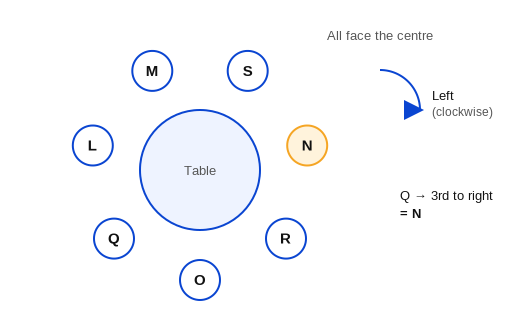
L, M, N, O, Q, R, and S are sitting around a circular table facing the centre of the table. S sits fourth to the left of O. R sits fourth to the right of M. Only two people sit between O and M when counted from the left of O. L is not an immediate neighbour of R or O. N is not an immediate neighbour of L.
Who sits third to the right of Q?
L, M, N, O, Q, R और S एक वृत्ताकार मेज़ के चारों ओर केंद्र की ओर मुख करके बैठे हैं। S, O के बाएँ से चौथे स्थान पर बैठा है। R, M के दाएँ से चौथे स्थान पर बैठा है। O के बाएँ से गिनने पर O और M के बीच केवल दो व्यक्ति बैठे हैं। L, R या O का निकटतम पड़ोसी नहीं है। N, L का निकटतम पड़ोसी नहीं है।
Q के दाएँ से तीसरे स्थान पर कौन बैठा है?
  1. AO
  2. BS
  3. CN
  4. DL
Show answer

Concept: Facing the centre, "left" = clockwise and "right" = anticlockwise (seen from above).

  1. Fix O. S is 4th to the left of O; M is 3rd to the left of O (two people between, counted from O's left).
  2. R is 4th to the right of M ⇒ R is O's immediate right.
  3. Left empty: Q, L, N. L not next to R or O ⇒ L sits between Q-seat and M; N not next to L ⇒ N between S and R; Q next to O.
  4. Clockwise from O: O, Q, L, M, S, N, R. Third to the right of Q: Q → O → R → N.

Trick: Draw the circle and mark one direction arrow for "left" before placing anyone.

Answer: (C) N

अवधारणा: केंद्र की ओर मुख होने पर (ऊपर से देखने पर) "बाएँ" = दक्षिणावर्त (clockwise), "दाएँ" = वामावर्त।

  1. O को स्थिर करें। S, O के बाएँ चौथा; M, O के बाएँ तीसरा (बीच में दो)।
  2. R, M के दाएँ चौथा ⇒ R, O के ठीक दाएँ।
  3. बचे Q, L, N. L, R या O का पड़ोसी नहीं ⇒ L, M के पास; N, L का पड़ोसी नहीं ⇒ N, S और R के बीच; Q, O के पास।
  4. O से दक्षिणावर्त: O, Q, L, M, S, N, R. Q के दाएँ तीसरा: Q → O → R → N.

ट्रिक: व्यक्ति बैठाने से पहले वृत्त बनाकर "बाएँ" की दिशा का तीर लगा लें।

उत्तर: (C) N

RRB NTPC Undergraduate CBT 1General Intelligence and ReasoningCircular Seating ArrangementRRB NTPC Undergraduate CBT 1 2024 · 1 Sep Shift 3 →
Q6212.
In the following triads, each group of letters is related to the subsequent one following a certain logic. Select from the given options, the one which follows the same logic. HAIR - AHIR - RIAH
MEAN - EMAN - NAEM
निम्नलिखित त्रिकों में, अक्षरों का प्रत्येक समूह एक निश्चित तर्क का अनुसरण करते हुए अगले समूह से संबंधित है। दिए गए विकल्पों में से उस विकल्प का चयन कीजिए, जो समान तर्क का अनुसरण करता है। HAIR - AHIR - RIAH
MEAN - EMAN - NAEM
  1. AWANT - AWNT - TANW
  2. BLOCK - OLCK - OCKL
  3. CBOND - BNOD - DNOB
  4. DDUST - UDST - TSUD
Show answer

Concept: Find how the 2nd and 3rd groups are formed from the 1st.

  1. HAIR → AHIR: first two letters swapped. HAIR → RIAH: whole word reversed.
  2. MEAN → EMAN (swap) → NAEM (reverse) ✓.
  3. DUST → UDST (swap) → TSUD (reverse) ✓. WANT reversed is TNAW, not TANW; LOCK reversed is KCOL.

Trick: Test the "reverse" part first — it eliminates options fastest.

Answer: (D) DUST - UDST - TSUD

अवधारणा: देखें कि दूसरा और तीसरा समूह पहले से कैसे बनते हैं।

  1. HAIR → AHIR: पहले दो अक्षर अदला-बदली। HAIR → RIAH: पूरा शब्द उल्टा।
  2. MEAN → EMAN (अदला-बदली) → NAEM (उल्टा) ✓.
  3. DUST → UDST → TSUD ✓. WANT उल्टा TNAW है, TANW नहीं; LOCK उल्टा KCOL है।

ट्रिक: पहले "उल्टा" वाला नियम जाँचें — विकल्प सबसे जल्दी कटते हैं।

उत्तर: (D) DUST - UDST - TSUD

RRB NTPC Undergraduate CBT 1General Intelligence and ReasoningLetter Triads – AnalogyRRB NTPC Undergraduate CBT 1 2024 · 1 Sep Shift 3 →
Q6213.
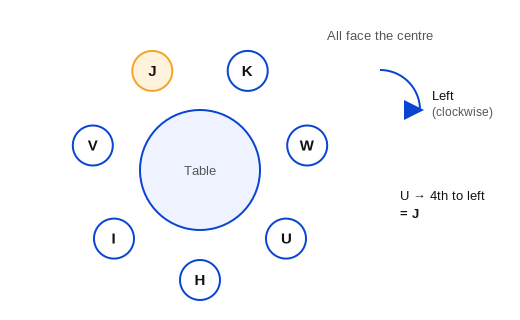
H, I, J, K, U, V and W are sitting around a circular table facing the centre of the table. Only I sits between V and H. H sits third to the left of K. W sits to the immediate left of K. J is not an immediate neighbour of H.
Who sits fourth to the left of U?
H, I, J, K, U, V और W एक वृत्ताकार मेज़ के चारों ओर केंद्र की ओर मुख करके बैठे हैं। V और H के बीच केवल I बैठा है। H, K के बाएँ से तीसरे स्थान पर बैठा है। W, K के ठीक बाएँ बैठा है। J, H का निकटतम पड़ोसी नहीं है।
U के बाएँ से चौथे स्थान पर कौन बैठा है?
  1. AH
  2. BJ
  3. CW
  4. DV
Show answer

Concept: Facing the centre, "left" = clockwise and "right" = anticlockwise (seen from above).

  1. Fix H. H is 3rd to the left of K ⇒ K is 3rd to the right of H; W is immediately left of K.
  2. Only I between V and H: I next to H, V next to I — the W side is full, so I, V go on the other side.
  3. J not next to H ⇒ J sits between V and K; U takes the seat next to H. Clockwise: H, I, V, J, K, W, U.
  4. Fourth to the left of U: H, I, V, J ⇒ J.

Trick: Place the chain W–K first; it shows which side has room for V–I.

Answer: (B) J

अवधारणा: केंद्र की ओर मुख होने पर "बाएँ" = दक्षिणावर्त, "दाएँ" = वामावर्त (ऊपर से देखने पर)।

  1. H स्थिर करें। H, K के बाएँ तीसरा ⇒ K, H के दाएँ तीसरा; W, K के ठीक बाएँ।
  2. V और H के बीच केवल I: W वाली तरफ़ जगह भरी है, इसलिए I, V दूसरी तरफ़।
  3. J, H का पड़ोसी नहीं ⇒ J, V और K के बीच; U, H के पास। दक्षिणावर्त: H, I, V, J, K, W, U.
  4. U के बाएँ चौथा: H, I, V, J ⇒ J.

ट्रिक: पहले W–K की जोड़ी रखें; इससे पता चलता है V–I कहाँ आएँगे।

उत्तर: (B) J

RRB NTPC Undergraduate CBT 1General Intelligence and ReasoningCircular Seating ArrangementRRB NTPC Undergraduate CBT 1 2024 · 1 Sep Shift 3 →
Q6214.
In a certain code language,
A $ B means ‘A is the mother of B’,
A + B means ‘A is the brother of B’,
A @ B means ‘A is the wife of B’,
and A ÷ B means ‘A is the father of B’.
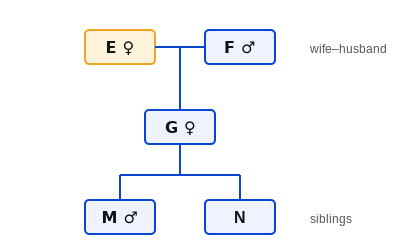
How is E related to N if ‘E @ F ÷ G $ M + N’?
एक निश्चित कूट भाषा में,
A $ B का अर्थ है 'A, B की माता है',
A + B का अर्थ है 'A, B का भाई है',
A @ B का अर्थ है 'A, B की पत्नी है',
और A ÷ B का अर्थ है 'A, B का पिता है'।
यदि 'E @ F ÷ G $ M + N' है, तो E, N से किस प्रकार संबंधित है?
  1. AMother's motherमाता की माता
  2. BMother's sisterमाता की बहन
  3. CMother's fatherमाता के पिता
  4. DMother's brotherमाता का भाई
Show answer

Concept: Decode each symbol from left to right and draw the family tree.

  1. E @ F: E is wife of F. F ÷ G: F is father of G.
  2. G $ M: G is mother of M. M + N: M is brother of N ⇒ G is mother of N too.
  3. E is mother of G, and G is mother of N ⇒ E is N's mother's mother.

Trick: Gender clue: "$" (mother) tells G is female — so the link through G is "mother's".

Answer: (A) Mother's mother

अवधारणा: हर चिह्न को बाएँ से दाएँ खोलें और परिवार-वृक्ष बनाएँ।

  1. E @ F: E, F की पत्नी। F ÷ G: F, G का पिता।
  2. G $ M: G, M की माँ। M + N: M, N का भाई ⇒ G, N की भी माँ।
  3. E, G की माँ और G, N की माँ ⇒ E, N की माँ की माँ (नानी)।

ट्रिक: लिंग संकेत: "$" (माँ) से G स्त्री है — इसलिए संबंध "माँ की" ओर से है।

उत्तर: (A) Mother's mother (नानी)

RRB NTPC Undergraduate CBT 1General Intelligence and ReasoningCoded Blood RelationsRRB NTPC Undergraduate CBT 1 2024 · 1 Sep Shift 3 →
Q6215.
What will come in the place of the question mark (?) in the following equation, if ‘+’ and ‘−’ are interchanged and ‘×’ and ‘÷’ are interchanged?
56 × 8 − 13 ÷ 3 + 11 = ?
यदि '+' और '−' को आपस में बदल दिया जाए तथा '×' और '÷' को आपस में बदल दिया जाए, तो निम्नलिखित समीकरण में प्रश्न चिह्न (?) के स्थान पर क्या आएगा?
56 × 8 − 13 ÷ 3 + 11 = ?
  1. A33
  2. B34
  3. C32
  4. D35
Show answer

Concept: Interchange the signs first, then apply BODMAS.

  1. 56×8−13÷3+11 becomes 56÷8+13×3−11.
  2. 56÷8=7; 13×3=39.
  3. 7+39−11=35.

Trick: Do ÷ and × before + and − after swapping.

Answer: (D) 35

अवधारणा: पहले चिह्न बदलें, फिर BODMAS लगाएँ।

  1. 56×8−13÷3+11 बन जाता है 56÷8+13×3−11.
  2. 56÷8=7; 13×3=39.
  3. 7+39−11=35.

ट्रिक: चिह्न बदलने के बाद ÷ और × पहले, फिर + और −।

उत्तर: (D) 35

RRB NTPC Undergraduate CBT 1General Intelligence and ReasoningMathematical OperationsRRB NTPC Undergraduate CBT 1 2024 · 1 Sep Shift 3 →
Q6216.
Which of the given numbers will replace the question mark (?) in the following series to make it logically complete?
235 246 268 301 345 ?
दी गई संख्याओं में से कौन-सी संख्या निम्नलिखित श्रृंखला में प्रश्न चिह्न (?) को प्रतिस्थापित करके उसे तार्किक रूप से पूर्ण करेगी?
235 246 268 301 345 ?
  1. A401
  2. B400
  3. C410
  4. D445
Show answer

Concept: Look at the differences between consecutive terms.

  1. Differences: 11, 22, 33, 44 (multiples of 11).
  2. Next difference =55 ⇒ 345+55=400.

Trick: Differences 11×1,11×2,11×3,…

Answer: (B) 400

अवधारणा: क्रमागत पदों के अंतर देखें।

  1. अंतर: 11, 22, 33, 44 (11 के गुणज)।
  2. अगला अंतर =55 ⇒ 345+55=400.

ट्रिक: अंतर 11×1,11×2,11×3,…

उत्तर: (B) 400

RRB NTPC Undergraduate CBT 1General Intelligence and ReasoningNumber SeriesRRB NTPC Undergraduate CBT 1 2024 · 1 Sep Shift 3 →
Q6217.
Raj ranked 44th from the top and 15th from the bottom in his class. How many students are there in his class?
राज की अपनी कक्षा में ऊपर से 44वीं और नीचे से 15वीं रैंक थी। उसकी कक्षा में कितने विद्यार्थी हैं?
  1. A57
  2. B59
  3. C56
  4. D58
Show answer

Concept: Total = rank from top + rank from bottom −1.

  1. Total =44+15−1=58.

Yaad rakhein: Raj is counted in both ranks, so subtract 1.

Answer: (D) 58

अवधारणा: कुल = ऊपर से रैंक + नीचे से रैंक −1.

  1. कुल =44+15−1=58.

याद रखें: राज दोनों रैंकों में गिना गया है, इसलिए 1 घटाएँ।

उत्तर: (D) 58

RRB NTPC Undergraduate CBT 1General Intelligence and ReasoningRankingRRB NTPC Undergraduate CBT 1 2024 · 1 Sep Shift 3 →
Q6218.
Read the given statement(s) and conclusions carefully. Assuming that the information given in the statements is true, even if it appears to be at variance with commonly known facts, decide which of the given conclusion(s) logically follow(s) from the statement(s).
Statements:
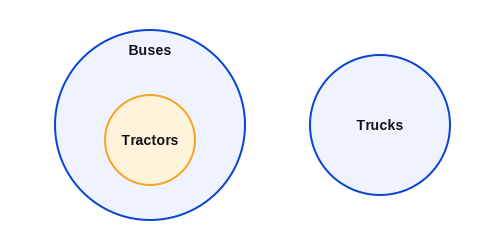
All Tractors are Buses.
No Buses are Trucks.
Conclusions:
I. No Trucks are Tractors.
II. Some Trucks are Tractors.
दिए गए कथन/कथनों और निष्कर्षों को ध्यानपूर्वक पढ़िए। यह मानते हुए कि कथनों में दी गई जानकारी सत्य है, भले ही वह सामान्य रूप से ज्ञात तथ्यों से भिन्न प्रतीत होती हो, निर्णय कीजिए कि दिए गए निष्कर्षों में से कौन-सा/से निष्कर्ष कथन/कथनों का तार्किक रूप से अनुसरण करता है/करते हैं।
कथन:
सभी ट्रैक्टर, बसें हैं।
कोई बस, ट्रक नहीं है।
निष्कर्ष:
I. कोई ट्रक, ट्रैक्टर नहीं है।
II. कुछ ट्रक, ट्रैक्टर हैं।
  1. AOnly conclusion (I) follows.केवल निष्कर्ष (I) अनुसरण करता है।
  2. BBoth conclusions (I) and (II) follow.निष्कर्ष (I) और (II) दोनों अनुसरण करते हैं।
  3. COnly conclusion (II) follows.केवल निष्कर्ष (II) अनुसरण करता है।
  4. DNeither conclusion (I) nor (II) follows.न तो निष्कर्ष (I) और न ही (II) अनुसरण करता है।
Show answer

Concept: All A are B + No B are C ⇒ No A are C (and No C are A).

  1. Tractors lie fully inside Buses; Buses and Trucks do not meet.
  2. So no Truck can be a Tractor ⇒ I follows.
  3. II contradicts I ⇒ II does not follow.

Yaad rakhein: All + No ⇒ No.

Answer: (A) Only conclusion (I) follows.

अवधारणा: सभी A, B हैं + कोई B, C नहीं ⇒ कोई A, C नहीं (और कोई C, A नहीं)।

  1. ट्रैक्टर पूरी तरह बसों के अंदर; बसें और ट्रक कहीं नहीं मिलते।
  2. अतः कोई ट्रक ट्रैक्टर नहीं ⇒ I अनुसरण करता है।
  3. II, I के विपरीत है ⇒ II अनुसरण नहीं करता।

याद रखें: सभी + कोई नहीं ⇒ कोई नहीं।

उत्तर: (A) केवल निष्कर्ष (I) अनुसरण करता है।

RRB NTPC Undergraduate CBT 1General Intelligence and ReasoningSyllogismRRB NTPC Undergraduate CBT 1 2024 · 1 Sep Shift 3 →
Q6219.
What should come in place of the question mark (?) in the given series?
1 2 4 8 10 20 22 ?
दी गई श्रृंखला में प्रश्न चिह्न (?) के स्थान पर क्या आना चाहिए?
1 2 4 8 10 20 22 ?
  1. A44
  2. B42
  3. C26
  4. D24
Show answer

Concept: Two operations alternate: ×2 then +2.

  1. 1×2=2, 2+2=4, 4×2=8, 8+2=10, 10×2=20, 20+2=22.
  2. Next: 22×2=44.

Trick: Alternating patterns: check odd and even steps separately.

Answer: (A) 44

अवधारणा: दो संक्रियाएँ बारी-बारी: ×2 फिर +2.

  1. 1×2=2, 2+2=4, 4×2=8, 8+2=10, 10×2=20, 20+2=22.
  2. अगला: 22×2=44.

ट्रिक: बारी-बारी वाले पैटर्न में विषम और सम चरण अलग-अलग जाँचें।

उत्तर: (A) 44

RRB NTPC Undergraduate CBT 1General Intelligence and ReasoningNumber SeriesRRB NTPC Undergraduate CBT 1 2024 · 1 Sep Shift 3 →
Q6220.
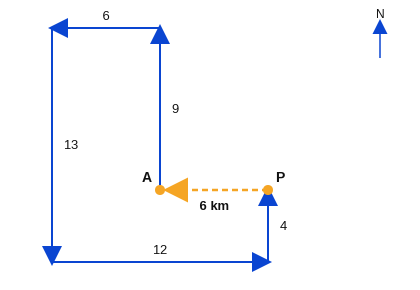
Shreyas starts from Point A and drives 9 km towards the north. He then takes a left turn and drives 6 km, then turns left and drives 13 km. He then takes a left turn and drives 12 km. He takes a final left turn, drives 4 km and stops at Point P. How far (shortest distance) and in which direction should he drive in order to reach Point A again? (All turns are 90-degree turns only unless specified.)
श्रेयस बिंदु A से चलना शुरू करता है और उत्तर की ओर 9 km गाड़ी चलाता है। फिर वह बाएँ मुड़ता है और 6 km गाड़ी चलाता है, फिर बाएँ मुड़ता है और 13 km गाड़ी चलाता है। फिर वह बाएँ मुड़ता है और 12 km गाड़ी चलाता है। वह अंतिम बार बाएँ मुड़ता है, 4 km गाड़ी चलाता है और बिंदु P पर रुक जाता है। बिंदु A पर पुनः पहुँचने के लिए उसे कितनी दूरी (न्यूनतम दूरी) तक और किस दिशा में गाड़ी चलानी चाहिए? (जब तक निर्दिष्ट न हो, सभी मोड़ केवल 90 डिग्री के मोड़ हैं।)
  1. A6 km to the westपश्चिम की ओर 6 km
  2. B5 km to the eastपूर्व की ओर 5 km
  3. C5 km to the westपश्चिम की ओर 5 km
  4. D6 km to the eastपूर्व की ओर 6 km
Show answer

Concept: Track each move on axes, taking A as origin (East +x, North +y).

  1. North 9 → (0, 9); left (west) 6 → (−6, 9).
  2. Left (south) 13 → (−6, −4); left (east) 12 → (6, −4).
  3. Left (north) 4 → P (6, 0).
  4. A (0, 0) is 6 km to the west of P.

Trick: Net E–W: −6+12=6 east; net N–S: 9−13+4=0. So go back 6 km west.

Answer: (A) 6 km to the west

अवधारणा: A को मूल बिंदु मानकर हर चाल लिखें (पूर्व +x, उत्तर +y)।

  1. उत्तर 9 → (0, 9); बाएँ (पश्चिम) 6 → (−6, 9).
  2. बाएँ (दक्षिण) 13 → (−6, −4); बाएँ (पूर्व) 12 → (6, −4).
  3. बाएँ (उत्तर) 4 → P (6, 0).
  4. A (0, 0), P से 6 km पश्चिम में है।

ट्रिक: कुल पूर्व–पश्चिम: −6+12=6 पूर्व; उत्तर–दक्षिण: 9−13+4=0. अतः 6 km पश्चिम लौटें।

उत्तर: (A) 6 km पश्चिम की ओर

RRB NTPC Undergraduate CBT 1General Intelligence and ReasoningDirection and DistanceRRB NTPC Undergraduate CBT 1 2024 · 1 Sep Shift 3 →