Question bank

Q&A: practice questions with answers

Search questions on any topic. Filter by exam category, exam, subject and topic, try the question, then open the answer and explanation.

Courses – airGurukul

20,719 questions found.

Q6301.
What will come in the place of the question mark (?) in the following equation, ‘÷’ and ‘×’ are interchanged and ‘−‘ and ‘+’ are interchanged?
13 − 5 ÷ 5 × 5 + 13 × 13 − 9 × 3 ÷ 3 − 108 = ?
यदि ‘÷’ और ‘×’ को आपस में बदल दिया जाए तथा ‘−‘ और ‘+’ को आपस में बदल दिया जाए, तो निम्नलिखित समीकरण में प्रश्न चिह्न (?) के स्थान पर क्या आएगा?
13 − 5 ÷ 5 × 5 + 13 × 13 − 9 × 3 ÷ 3 − 108 = ?
  1. A90
  2. B129
  3. C110
  4. D134
Show answer

Concept: Swap the signs first, then apply BODMAS.

  1. After swapping: 13+5×5÷5−13÷13+9÷3×3+108.
  2. 5×5÷5=5, 13÷13=1, 9÷3×3=9.
  3. 13+5−1+9+108=134.

Trick: Rewrite the whole expression once with new signs before calculating — avoids mixing old and new signs.

Answer: (D) 134

अवधारणा: पहले चिह्न बदलें, फिर BODMAS लगाएँ।

  1. बदलने के बाद: 13+5×5÷5−13÷13+9÷3×3+108.
  2. 5×5÷5=5, 13÷13=1, 9÷3×3=9.
  3. 13+5−1+9+108=134.

ट्रिक: पूरा व्यंजक नए चिह्नों के साथ एक बार दोबारा लिखें।

उत्तर: (D) 134
RRB NTPC Undergraduate CBT 1General Intelligence and ReasoningSymbol InterchangeRRB NTPC Undergraduate CBT 1 2024 · 1 Sep Shift 2 →
Q6302.
In a certain code language, ‘VAST’ is coded as ‘7892’ and ‘SAVE’ is coded as ‘8629’. What is the code for ‘E’ in the given code language?
एक निश्चित कूट भाषा में, ‘VAST’ को ‘7892’ के रूप में कूटबद्ध किया जाता है और ‘SAVE’ को ‘8629’ के रूप में कूटबद्ध किया जाता है। दी गई कूट भाषा में ‘E’ का कूट क्या है?
  1. A2
  2. B9
  3. C6
  4. D8
Show answer

Concept: Letters common to both words take the digits common to both codes.

  1. VAST = 7892, SAVE = 8629.
  2. Common letters V, A, S ↔ common digits 8, 9, 2.
  3. Leftover: T = 7 in VAST, E = 6 in SAVE.

Trick: Uncommon letter ↔ uncommon digit.

Answer: (C) 6

अवधारणा: दोनों शब्दों के समान अक्षरों को दोनों कूटों के समान अंक मिलते हैं।

  1. VAST = 7892, SAVE = 8629.
  2. समान अक्षर V, A, S ↔ समान अंक 8, 9, 2.
  3. बचे: VAST में T = 7, SAVE में E = 6.

ट्रिक: असमान अक्षर ↔ असमान अंक।

उत्तर: (C) 6

RRB NTPC Undergraduate CBT 1General Intelligence and ReasoningCoding–Decoding (Common Letters)RRB NTPC Undergraduate CBT 1 2024 · 1 Sep Shift 2 →
Q6303.
Based on the English alphabetical order, three of the following four letter-clusters are alike in a certain way and thus form a group. Which letter-cluster DOES NOT belong to that group?
(Note: The odd one out is not based on the number of consonants/vowels or their position in the letter-cluster.)
अंग्रेज़ी वर्णमाला क्रम के आधार पर, निम्नलिखित चार अक्षर-समूहों में से तीन किसी निश्चित प्रकार से एकसमान हैं और इस प्रकार एक समूह बनाते हैं। कौन-सा अक्षर-समूह उस समूह से संबंधित नहीं है?
(ध्यान दें: असंगत अक्षर-समूह, उस अक्षर-समूह में व्यंजनों/स्वरों की संख्या या उनके स्थान पर आधारित नहीं है।)
  1. ALNH
  2. BKNZ
  3. COQK
  4. DTVP
Show answer

Concept: Find the gaps between letter positions (A = 1 … Z = 26).

  1. LNH: 12, 14, 8 → +2, −6.
  2. OQK: 15, 17, 11 → +2, −6; TVP: 20, 22, 16 → +2, −6.
  3. KNZ: 11, 14, 26 → +3, +12 → odd one.

Trick: Skip one letter forward, then six back — KNZ breaks it at the first step.

Answer: (B) KNZ

अवधारणा: अक्षरों की स्थिति (A = 1 … Z = 26) के अंतर देखें।

  1. LNH: +2, −6.
  2. OQK और TVP: +2, −6.
  3. KNZ: +3, +12 → भिन्न।

ट्रिक: पहला कदम ही +2 नहीं है — KNZ अलग।

उत्तर: (B) KNZ

RRB NTPC Undergraduate CBT 1General Intelligence and ReasoningOdd One Out – Letter ClustersRRB NTPC Undergraduate CBT 1 2024 · 1 Sep Shift 2 →
Q6304.
In a certain code language, ‘WAVE’ is coded as ‘3257’ and ‘VOLT’ is coded as ‘1346’. What is the code for ‘V’ in the given code language?
एक निश्चित कूट भाषा में, ‘WAVE’ को ‘3257’ के रूप में कूटबद्ध किया जाता है और ‘VOLT’ को ‘1346’ के रूप में कूटबद्ध किया जाता है। दी गई कूट भाषा में ‘V’ का कूट क्या है?
  1. A1
  2. B7
  3. C3
  4. D5
Show answer

Concept: The only letter common to both words gets the only digit common to both codes.

  1. WAVE = 3257, VOLT = 1346.
  2. Common letter: V; common digit: 3.
  3. So V = 3.

Trick: One common letter ↔ one common digit.

Answer: (C) 3

अवधारणा: दोनों शब्दों का एकमात्र समान अक्षर, दोनों कूटों का एकमात्र समान अंक पाता है।

  1. WAVE = 3257, VOLT = 1346.
  2. समान अक्षर V; समान अंक 3.
  3. अतः V = 3.

ट्रिक: एक समान अक्षर ↔ एक समान अंक।

उत्तर: (C) 3

RRB NTPC Undergraduate CBT 1General Intelligence and ReasoningCoding–Decoding (Common Letters)RRB NTPC Undergraduate CBT 1 2024 · 1 Sep Shift 2 →
Q6305.
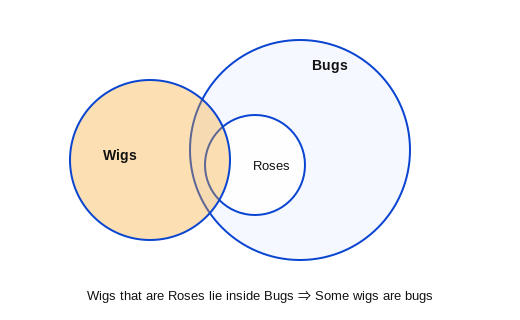
Read the given statements and conclusions carefully. You have to take the given statements to be true even if they seem to be at variance from commonly known facts. You have to decide which conclusion(s) logically follow/s from the given statements. Statements:
Some wigs are roses.
All roses are bugs.
Conclusions (I): Some wigs are bugs.
Conclusions (II): All bugs are roses.
दिए गए कथनों और निष्कर्षों को ध्यानपूर्वक पढ़िए। आपको दिए गए कथनों को सत्य मानना है, भले ही वे सामान्यतः ज्ञात तथ्यों से भिन्न प्रतीत होते हों। आपको निर्णय करना है कि कौन-सा/से निष्कर्ष दिए गए कथनों का तार्किक रूप से अनुसरण करता है/करते हैं। कथन:
कुछ विग, गुलाब हैं।
सभी गुलाब, कीड़े हैं।
निष्कर्ष (I): कुछ विग, कीड़े हैं।
निष्कर्ष (II): सभी कीड़े, गुलाब हैं।
  1. ABoth conclusions (I) and (II) follow.निष्कर्ष (I) और (II) दोनों अनुसरण करते हैं।
  2. BNeither conclusion (I) nor (II) follows.न तो निष्कर्ष (I) और न ही (II) अनुसरण करता है।
  3. COnly conclusion (I) follows.केवल निष्कर्ष (I) अनुसरण करता है।
  4. DOnly conclusion (II) follows.केवल निष्कर्ष (II) अनुसरण करता है।
Show answer

Concept: Some A are B + All B are C ⇒ Some A are C (definite).

  1. Some wigs are roses, and every rose is a bug → those wigs are bugs → (I) follows.
  2. All roses are bugs does not mean all bugs are roses → (II) does not follow.

Yaad rakhein: Some + All = Some (with the first term of 'Some').

Answer: (C) Only conclusion (I) follows.

अवधारणा: कुछ A, B हैं + सभी B, C हैं ⇒ कुछ A, C हैं (निश्चित)।

  1. कुछ wigs, roses हैं और सभी roses, bugs हैं → वे wigs, bugs हैं → (I) सही।
  2. 'सभी roses, bugs' का उल्टा निश्चित नहीं → (II) नहीं।

याद रखें: कुछ + सभी = कुछ।

उत्तर: (C) केवल निष्कर्ष (I) अनुसरण करता है।

RRB NTPC Undergraduate CBT 1General Intelligence and ReasoningSyllogismRRB NTPC Undergraduate CBT 1 2024 · 1 Sep Shift 2 →
Q6306.
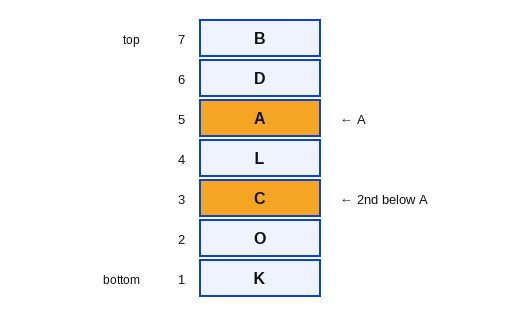
Seven boxes A, B, C, D, K, L and O are kept one over the other but not necessarily in the same order. No box is kept above B. Only three boxes are kept between B and C. Only one box is kept between D and L. L is kept immediately above C. Only four boxes are kept between D and K. A is kept at some place above O.
Which box is kept second below A?
सात बक्से A, B, C, D, K, L और O एक के ऊपर एक रखे गए हैं, लेकिन आवश्यक नहीं कि इसी क्रम में हों। B के ऊपर कोई बक्सा नहीं रखा गया है। B और C के बीच केवल तीन बक्से रखे गए हैं। D और L के बीच केवल एक बक्सा रखा गया है। L, C के ठीक ऊपर रखा गया है। D और K के बीच केवल चार बक्से रखे गए हैं। A, O के ऊपर किसी स्थान पर रखा गया है।
A के नीचे दूसरे स्थान पर कौन-सा बक्सा रखा गया है?
  1. AC
  2. BD
  3. CO
  4. DB
Show answer

Concept: Number positions 1 (bottom) to 7 (top) and fix definite clues first.

  1. Nothing above B → B = 7; three between B and C → C = 3; L immediately above C → L = 4.
  2. One between D and L → D = 2 or 6; four between D and K: D = 2 would need K = 7 (taken), so D = 6, K = 1.
  3. A above O among 2 and 5 → A = 5, O = 2.
  4. Second below A (5) is position 3 = C.

Trick: 'k boxes between' means positions differ by k+1.

Answer: (A) C

अवधारणा: स्थान 1 (नीचे) से 7 (ऊपर) मानें; पहले निश्चित सूचनाएँ लगाएँ।

  1. B के ऊपर कोई नहीं → B = 7; B और C के बीच तीन → C = 3; L, C के ठीक ऊपर → L = 4.
  2. D और L के बीच एक → D = 2 या 6; D और K के बीच चार: D = 6, K = 1.
  3. A, O से ऊपर → A = 5, O = 2.
  4. A (5) से दूसरा नीचे = स्थान 3 = C.

ट्रिक: 'बीच में k डिब्बे' = स्थानों का अंतर k+1.

उत्तर: (A) C

RRB NTPC Undergraduate CBT 1General Intelligence and ReasoningBox Stacking PuzzleRRB NTPC Undergraduate CBT 1 2024 · 1 Sep Shift 2 →
Q6307.
If + means −, − means ×, × means ÷ and ÷ means +, then what will come in place of the question mark (?) in the following equation?
20 ÷ 55 × 5 + 7 − 4 = ?
यदि + का अर्थ −, − का अर्थ ×, × का अर्थ ÷ और ÷ का अर्थ + है, तो निम्नलिखित समीकरण में प्रश्न चिह्न (?) के स्थान पर क्या आएगा?
20 ÷ 55 × 5 + 7 − 4 = ?
  1. A3
  2. B13
  3. C8
  4. D17
Show answer

Concept: Replace each sign as per the given meaning, then use BODMAS.

  1. 20÷55×5+7−4 becomes 20+55÷5−7×4.
  2. =20+11−28=3.

Trick: Do division and multiplication first: 11 and 28.

Answer: (A) 3

अवधारणा: दिए अर्थ के अनुसार चिह्न बदलें, फिर BODMAS लगाएँ।

  1. व्यंजक बनता है 20+55÷5−7×4.
  2. =20+11−28=3.

ट्रिक: पहले भाग और गुणा: 11 और 28.

उत्तर: (A) 3

RRB NTPC Undergraduate CBT 1General Intelligence and ReasoningSymbol SubstitutionRRB NTPC Undergraduate CBT 1 2024 · 1 Sep Shift 2 →
Q6308.
UP 16 is related to TK 4 in a certain way. In the same way, YT 23 is related to XO 11. To which of the following is KG 13 related, following the same logic?
UP 16 एक निश्चित प्रकार से TK 4 से संबंधित है। उसी प्रकार, YT 23, XO 11 से संबंधित है। उसी तर्क का अनुसरण करते हुए, KG 13 निम्नलिखित में से किससे संबंधित है?
  1. AIB 3
  2. BJA 3
  3. CIA 1
  4. DJB 1
Show answer

Concept: Check the change in each part separately.

  1. U → T (−1), P → K (−5), 16→4 (−12).
  2. Y → X (−1), T → O (−5), 23→11 (−12).
  3. K → J, G → B, 13−12=1 → JB 1.

Trick: Same three steps for every pair: −1, −5, −12.

Answer: (D) JB 1

अवधारणा: हर भाग का परिवर्तन अलग-अलग देखें।

  1. U → T (−1), P → K (−5), 16 → 4 (−12).
  2. Y → X (−1), T → O (−5), 23 → 11 (−12).
  3. K → J, G → B, 13−12=1 → JB 1.

ट्रिक: हर युग्म में −1, −5, −12.

उत्तर: (D) JB 1

RRB NTPC Undergraduate CBT 1General Intelligence and ReasoningLetter–Number AnalogyRRB NTPC Undergraduate CBT 1 2024 · 1 Sep Shift 2 →
Q6309.
In the following triad, each group of letters is related to the subsequent one following a certain logic. Select from the given options, the one which follows the same logic. WISE - EWSI - WEIS
PLUS - SPUL - PSLU
निम्नलिखित त्रिक में, अक्षरों का प्रत्येक समूह एक निश्चित तर्क का अनुसरण करते हुए अगले समूह से संबंधित है। दिए गए विकल्पों में से उस विकल्प का चयन कीजिए जो समान तर्क का अनुसरण करता है। WISE - EWSI - WEIS
PLUS - SPUL - PSLU
  1. APAWN - NPWA - PANW
  2. BPAGE - EPAG - AGEP
  3. CDOSE - ODSE - EOSD
  4. DBORN - NBRO - BNOR
Show answer

Concept: Track letter positions 1-2-3-4 through each step.

  1. WISE → EWSI: order 4-1-3-2. PLUS → SPUL ✓.
  2. EWSI → WEIS: swap 1st–2nd and 3rd–4th. SPUL → PSLU ✓.
  3. BORN → NBRO (4-1-3-2) → BNOR (swap pairs) ✓.

Trick: Step 2 just swaps letters in pairs — check that first, it is quick.

Answer: (D) BORN - NBRO - BNOR

अवधारणा: हर चरण में अक्षरों की स्थिति 1-2-3-4 देखें।

  1. WISE → EWSI: क्रम 4-1-3-2; PLUS → SPUL ✓.
  2. EWSI → WEIS: जोड़ों की अदला-बदली; SPUL → PSLU ✓.
  3. BORN → NBRO → BNOR ✓.

ट्रिक: दूसरा चरण सिर्फ़ जोड़ों की अदला-बदली है — पहले वही जाँचें।

उत्तर: (D) BORN - NBRO - BNOR

RRB NTPC Undergraduate CBT 1General Intelligence and ReasoningLetter Rearrangement TriadsRRB NTPC Undergraduate CBT 1 2024 · 1 Sep Shift 2 →
Q6310.
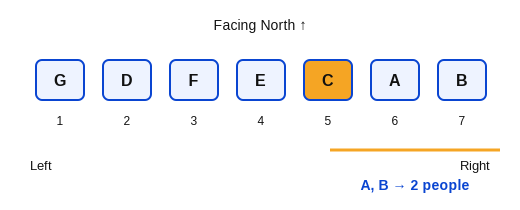
Seven people A, B, C, D, E, F and G are sitting in a row, facing north.
No one sits to the left of G. Only four people sit between G and A. Only three people sit to the right of E. D sits to the immediate left of F. B is not an immediate neighbour of E. How many people sit to the right of C?
सात व्यक्ति A, B, C, D, E, F और G उत्तर की ओर मुख करके एक पंक्ति में बैठे हैं।
G के बाईं ओर कोई नहीं बैठा है। G और A के बीच केवल चार व्यक्ति बैठे हैं। E के दाईं ओर केवल तीन व्यक्ति बैठे हैं। D, F के ठीक बाईं ओर बैठा है। B, E का निकटतम पड़ोसी नहीं है। C के दाईं ओर कितने व्यक्ति बैठे हैं?
  1. A2
  2. B1
  3. C3
  4. D4
Show answer

Concept: Facing north, left end is position 1; place fixed people first.

  1. No one left of G → G = 1; four between G and A → A = 6.
  2. Three to the right of E → E = 4.
  3. D immediately left of F: only free pair is 2-3 → D = 2, F = 3.
  4. B not next to E → B = 7, C = 5; right of C: A and B = 2.

Trick: 'Only k to the right' in a row of 7 → position 7−k.

Answer: (A) 2

अवधारणा: उत्तर की ओर मुख: बायाँ सिरा स्थान 1; पहले निश्चित व्यक्ति रखें।

  1. G के बाएँ कोई नहीं → G = 1; G और A के बीच चार → A = 6.
  2. E के दाएँ तीन → E = 4.
  3. D, F के ठीक बाएँ: खाली जोड़ी 2-3 → D = 2, F = 3.
  4. B, E का पड़ोसी नहीं → B = 7, C = 5; C के दाएँ A, B = 2.

ट्रिक: 7 की पंक्ति में 'दाएँ केवल k' → स्थान 7−k.

उत्तर: (A) 2

RRB NTPC Undergraduate CBT 1General Intelligence and ReasoningLinear Seating ArrangementRRB NTPC Undergraduate CBT 1 2024 · 1 Sep Shift 2 →
Q6311.
Farooq ranked 28th from the top and 35th from the bottom in his class. How many students are there in his class?
फ़ारूक़ अपनी कक्षा में ऊपर से 28वें और नीचे से 35वें स्थान पर है। उसकी कक्षा में कितने विद्यार्थी हैं?
  1. A62
  2. B60
  3. C63
  4. D61
Show answer

Concept: Total = rank from top + rank from bottom − 1.

  1. 28+35−1=62.

Trick: Subtract 1 because the person is counted twice.

Answer: (A) 62

अवधारणा: कुल = ऊपर से स्थान + नीचे से स्थान − 1.

  1. 28+35−1=62.

ट्रिक: व्यक्ति दो बार गिना गया, इसलिए 1 घटाएँ।

उत्तर: (A) 62

RRB NTPC Undergraduate CBT 1General Intelligence and ReasoningRankingRRB NTPC Undergraduate CBT 1 2024 · 1 Sep Shift 2 →
Q6312.
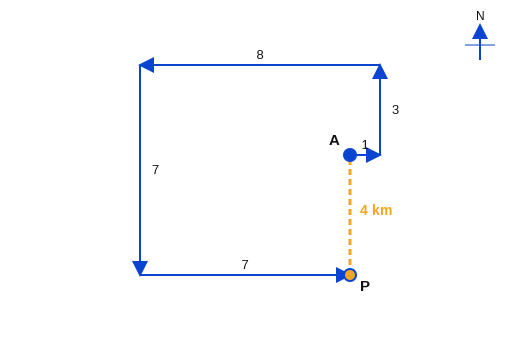
Qadir starts from Point A and drives 1 km towards East. He then takes a left turn, drives 3 km, turns left and drives 8 km. He then takes a left turn and drives 7 km. He takes a final left turn, drives 7 km and stops at Point P. How far (shortest distance) and towards which direction should he drive in order to reach Point A again? (All turns are 90° turns only unless specified.)
क़ादिर बिंदु A से शुरू करता है और पूर्व की ओर 1 km ड्राइव करता है। फिर वह बाएँ मुड़ता है, 3 km ड्राइव करता है, बाएँ मुड़ता है और 8 km ड्राइव करता है। फिर वह बाएँ मुड़ता है और 7 km ड्राइव करता है। वह अंतिम बार बाएँ मुड़ता है, 7 km ड्राइव करता है और बिंदु P पर रुक जाता है। पुनः बिंदु A पर पहुँचने के लिए उसे कितनी दूरी (न्यूनतम दूरी) तक और किस दिशा में ड्राइव करना चाहिए? (जब तक निर्दिष्ट न हो, सभी मोड़ केवल 90° के मोड़ हैं।)
  1. A5 km to the Northउत्तर की ओर 5 km
  2. B4 km to the Northउत्तर की ओर 4 km
  3. C7 km to the Westपश्चिम की ओर 7 km
  4. D6 km to the Westपश्चिम की ओर 6 km
Show answer

Concept: Plot the moves on axes (East +x, North +y).

  1. A(0, 0) → East 1 → (1, 0) → left = North 3 → (1, 3).
  2. Left = West 8 → (−7, 3) → left = South 7 → (−7, −4).
  3. Left = East 7 → P(0, −4).
  4. P is 4 km south of A → drive 4 km to the North.

Trick: Net E–W: 1−8+7=0; net N–S: 3−7=−4.

Answer: (B) 4 km to the North

अवधारणा: चालों को अक्षों पर लिखें (पूर्व +x, उत्तर +y)।

  1. A(0, 0) → पूर्व 1 → (1, 0) → बाएँ = उत्तर 3 → (1, 3).
  2. बाएँ = पश्चिम 8 → (−7, 3) → बाएँ = दक्षिण 7 → (−7, −4).
  3. बाएँ = पूर्व 7 → P(0, −4).
  4. P, A से 4 km दक्षिण → 4 km उत्तर जाना होगा।

ट्रिक: पूर्व-पश्चिम: 1−8+7=0; उत्तर-दक्षिण: 3−7=−4.

उत्तर: (B) 4 km उत्तर की ओर

RRB NTPC Undergraduate CBT 1General Intelligence and ReasoningDirection and DistanceRRB NTPC Undergraduate CBT 1 2024 · 1 Sep Shift 2 →
Q6313.
If 1 is subtracted from each odd digit of the number 95423671, then what will be the sum of the digits that are repeated more than once in the new number formed?
यदि संख्या 95423671 के प्रत्येक विषम अंक में से 1 घटाया जाए, तो इस प्रकार बनी नई संख्या में एक से अधिक बार आने वाले अंकों का योग क्या होगा?
  1. A10
  2. B8
  3. C6
  4. D12
Show answer

Concept: Change only the odd digits, then find digits that occur more than once.

  1. 95423671 → odd digits 9, 5, 3, 7, 1 become 8, 4, 2, 6, 0.
  2. New number: 84422660.
  3. Repeated digits: 4, 2, 6 → sum =4+2+6=12.

Trick: Each odd digit becomes the even digit just below it — pairs form with the existing evens.

Answer: (D) 12

अवधारणा: केवल विषम अंक बदलें, फिर एक से अधिक बार आने वाले अंक खोजें।

  1. विषम अंक 9, 5, 3, 7, 1 → 8, 4, 2, 6, 0.
  2. नई संख्या: 84422660.
  3. दोहराए अंक: 4, 2, 6 → योग 12.

ट्रिक: हर विषम अंक अपने से ठीक छोटे सम अंक में बदलता है।

उत्तर: (D) 12

RRB NTPC Undergraduate CBT 1General Intelligence and ReasoningNumber OperationsRRB NTPC Undergraduate CBT 1 2024 · 1 Sep Shift 2 →
Q6314.
Which of the following letter-number clusters will replace the question mark (?) in the given series to make it logically complete?
LXU -2 OTT 4 RPS -8 ? XHQ -32
निम्नलिखित में से कौन-सा अक्षर-संख्या समूह दी गई श्रृंखला में प्रश्न चिह्न (?) के स्थान पर आकर उसे तार्किक रूप से पूर्ण करेगा?
LXU -2 OTT 4 RPS -8 ? XHQ -32
  1. AFHT 15
  2. BVXL 19
  3. CULR 16
  4. DPHR 13
Show answer

Concept: Track each letter position and the number separately.

  1. 1st letters: L, O, R, U, X (+3).
  2. 2nd letters: X, T, P, L, H (−4); 3rd letters: U, T, S, R, Q (−1).
  3. Numbers: −2, 4, −8, 16, −32 (×(−2)).
  4. Missing term: ULR 16.

Trick: The number alone decides: after −8 comes 16, and only ULR 16 carries 16.

Answer: (C) ULR 16

अवधारणा: हर अक्षर की स्थिति और संख्या अलग-अलग देखें।

  1. पहले अक्षर: L, O, R, U, X (+3).
  2. दूसरे: X, T, P, L, H (−4); तीसरे: U, T, S, R, Q (−1).
  3. संख्याएँ: −2, 4, −8, 16, −32 (×(−2)).
  4. लुप्त पद: ULR 16.

ट्रिक: संख्या 16 ही बनती है — ULR 16.

उत्तर: (C) ULR 16

RRB NTPC Undergraduate CBT 1General Intelligence and ReasoningLetter–Number SeriesRRB NTPC Undergraduate CBT 1 2024 · 1 Sep Shift 2 →
Q6315.
What should come in place of the question mark (?) in the given series?
1 2 4 7 11 ?
दी गई श्रृंखला में प्रश्न चिह्न (?) के स्थान पर क्या आना चाहिए?
1 2 4 7 11 ?
  1. A15
  2. B17
  3. C18
  4. D16
Show answer

Concept: Check differences between consecutive terms.

  1. Differences: +1, +2, +3, +4.
  2. Next difference +5 → 11+5=16.

Trick: Increasing natural-number differences.

Answer: (D) 16

अवधारणा: क्रमागत पदों का अंतर देखें।

  1. अंतर: +1, +2, +3, +4.
  2. अगला +5 → 16.

ट्रिक: अंतर क्रमशः 1, 2, 3, 4, 5.

उत्तर: (D) 16

RRB NTPC Undergraduate CBT 1General Intelligence and ReasoningNumber SeriesRRB NTPC Undergraduate CBT 1 2024 · 1 Sep Shift 2 →
Q6316.
Each of the digits in the number 3875269 is arranged in the ascending order from left to right. The position(s) of how many digits will remain unchanged as compared to that in the original number?
संख्या 3875269 के प्रत्येक अंक को बाएँ से दाएँ आरोही क्रम में व्यवस्थित किया जाता है। मूल संख्या की तुलना में कितने अंकों का/के स्थान अपरिवर्तित रहेगा/रहेंगे?
  1. AThreeतीन
  2. BNoneएक भी नहीं
  3. CTwoदो
  4. DOneएक
Show answer

Concept: Write both numbers one below the other and compare position by position.

  1. Original: 3 8 7 5 2 6 9.
  2. Ascending: 2 3 5 6 7 8 9.
  3. Only the 7th digit (9) is the same → one digit.

Trick: The largest digit already at the right end stays put.

Answer: (D) One

अवधारणा: दोनों संख्याएँ एक के नीचे एक लिखकर स्थानवार मिलाएँ।

  1. मूल: 3 8 7 5 2 6 9.
  2. आरोही: 2 3 5 6 7 8 9.
  3. केवल 7वाँ अंक (9) समान → एक।

ट्रिक: सबसे बड़ा अंक पहले से अंत में है, वही नहीं हिलता।

उत्तर: (D) One (एक)

RRB NTPC Undergraduate CBT 1General Intelligence and ReasoningDigit ArrangementRRB NTPC Undergraduate CBT 1 2024 · 1 Sep Shift 2 →
Q6317.
Based on the English alphabetical order, three of the following four letter-clusters are alike in a certain way and thus form a group. Which letter-cluster DOES NOT belong to that group?
(Note: The odd one out is not based on the number of consonants/vowels or their position in the letter-cluster.)
अंग्रेज़ी वर्णमाला क्रम के आधार पर, निम्नलिखित चार अक्षर-समूहों में से तीन किसी निश्चित प्रकार से एकसमान हैं और इस प्रकार एक समूह बनाते हैं। कौन-सा अक्षर-समूह उस समूह से संबंधित नहीं है?
(ध्यान दें: असंगत अक्षर-समूह, उस अक्षर-समूह में व्यंजनों/स्वरों की संख्या या उनके स्थान पर आधारित नहीं है।)
  1. AIEA
  2. BXTQ
  3. CRNK
  4. DFBY
Show answer

Concept: Find gaps between letter positions (wrap Z → A where needed).

  1. XTQ: 24, 20, 17 → −4, −3; RNK: 18, 14, 11 → −4, −3.
  2. FBY: F → B (−4), B → Y (−3, wrapping back) ✓.
  3. IEA: 9, 5, 1 → −4, −4 → odd one.

Trick: Remember the circular alphabet: 3 steps back from B is Y.

Answer: (A) IEA

अवधारणा: अक्षर-स्थितियों का अंतर देखें (ज़रूरत हो तो Z → A घुमाव)।

  1. XTQ और RNK: −4, −3.
  2. FBY: F → B (−4), B → Y (−3, चक्रीय) ✓.
  3. IEA: −4, −4 → भिन्न।

ट्रिक: वर्णमाला चक्रीय है: B से 3 पीछे Y.

उत्तर: (A) IEA

RRB NTPC Undergraduate CBT 1General Intelligence and ReasoningOdd One Out – Letter ClustersRRB NTPC Undergraduate CBT 1 2024 · 1 Sep Shift 2 →
Q6318.
What should come in place of the question mark (?) in the given series based on the English alphabetical order?
QVO SRN ? WJL YFK
अंग्रेज़ी वर्णमाला क्रम के आधार पर दी गई श्रृंखला में प्रश्न चिह्न (?) के स्थान पर क्या आना चाहिए?
QVO SRN ? WJL YFK
  1. ANHG
  2. BVML
  3. CMKL
  4. DUNM
Show answer

Concept: Track each letter of the clusters separately.

  1. 1st letters: Q, S, ?, W, Y (+2) → U.
  2. 2nd letters: V, R, ?, J, F (−4) → N.
  3. 3rd letters: O, N, ?, L, K (−1) → M.

Trick: One column is enough: first letter must be U → only UNM.

Answer: (D) UNM

अवधारणा: हर स्थान के अक्षर अलग-अलग देखें।

  1. पहले अक्षर: Q, S, ?, W, Y (+2) → U.
  2. दूसरे: V, R, ?, J, F (−4) → N.
  3. तीसरे: O, N, ?, L, K (−1) → M.

ट्रिक: पहला अक्षर U होना चाहिए — केवल UNM.

उत्तर: (D) UNM

RRB NTPC Undergraduate CBT 1General Intelligence and ReasoningLetter SeriesRRB NTPC Undergraduate CBT 1 2024 · 1 Sep Shift 2 →
Q6319.
This question is based on the five, three-digit numbers given below.
(Left) 284 517 639 741 425 (Right)
(Example- 697 – First digit = 6, second digit = 9 and third digit = 7)
(NOTE: All operations to be done from left to right.)
If all the numbers are arranged in descending order, the position(s) of how many numbers will remain unchanged as compared to that in the original number?
यह प्रश्न नीचे दी गई तीन अंकों वाली पाँच संख्याओं पर आधारित है।
(बाएँ) 284 517 639 741 425 (दाएँ)
(उदाहरण- 697 – पहला अंक = 6, दूसरा अंक = 9 और तीसरा अंक = 7)
(ध्यान दें: सभी संक्रियाएँ बाएँ से दाएँ की जानी हैं।)
यदि सभी संख्याओं को अवरोही क्रम में व्यवस्थित किया जाए, तो मूल क्रम की तुलना में कितनी संख्याओं का/के स्थान अपरिवर्तित रहेगा/रहेंगे?
  1. ANoneएक भी नहीं
  2. BTwoदो
  3. CFourचार
  4. DThreeतीन
Show answer

Concept: Arrange in descending order and compare positions.

  1. Original: 284, 517, 639, 741, 425.
  2. Descending: 741, 639, 517, 425, 284.
  3. No number stays in its place → none.

Trick: Check the middle one first: 639 moves to 2nd place, so even the middle changes.

Answer: (A) None

अवधारणा: अवरोही क्रम में लगाकर स्थान मिलाएँ।

  1. मूल: 284, 517, 639, 741, 425.
  2. अवरोही: 741, 639, 517, 425, 284.
  3. कोई भी संख्या अपने स्थान पर नहीं → कोई नहीं।

ट्रिक: बीच वाली 639 भी दूसरे स्थान पर चली गई।

उत्तर: (A) None (कोई नहीं)

RRB NTPC Undergraduate CBT 1General Intelligence and ReasoningNumber ArrangementRRB NTPC Undergraduate CBT 1 2024 · 1 Sep Shift 2 →
Q6320.
In the following triads, each group of letters is related to the subsequent one following a certain logic. Select from the given options, the one which follows the same logic. LOCK – OLCK – LCKO
ACNE – CANE – ANEC
निम्नलिखित त्रिकों में, अक्षरों का प्रत्येक समूह एक निश्चित तर्क का अनुसरण करते हुए अगले समूह से संबंधित है। दिए गए विकल्पों में से उस विकल्प का चयन कीजिए जो समान तर्क का अनुसरण करता है। LOCK – OLCK – LCKO
ACNE – CANE – ANEC
  1. AFROG – RFOG – ROGF
  2. BOILS – IOLS – SILO
  3. CHUNT – HNUT – TNUH
  4. DBEAM – EBAM – BAME
Show answer

Concept: Find the two steps from the example and apply them to each option.

  1. Step 1: swap the first two letters (LOCK → OLCK, ACNE → CANE).
  2. Step 2: move the first letter to the end (OLCK → LCKO, CANE → ANEC).
  3. BEAM → EBAM → BAME ✓.

Trick: Step 2 result always ends with the original 2nd letter.

Answer: (D) BEAM – EBAM – BAME

अवधारणा: उदाहरण से दोनों चरण पहचानें और विकल्पों पर लगाएँ।

  1. चरण 1: पहले दो अक्षर अदल-बदल (LOCK → OLCK)।
  2. चरण 2: पहला अक्षर अंत में (OLCK → LCKO)।
  3. BEAM → EBAM → BAME ✓.

ट्रिक: तीसरा शब्द हमेशा मूल शब्द के दूसरे अक्षर पर खत्म होता है।

उत्तर: (D) BEAM – EBAM – BAME

RRB NTPC Undergraduate CBT 1General Intelligence and ReasoningLetter Rearrangement TriadsRRB NTPC Undergraduate CBT 1 2024 · 1 Sep Shift 2 →