Question bank

Q&A: practice questions with answers

Search questions on any topic. Filter by exam category, exam, subject and topic, try the question, then open the answer and explanation.

Courses – airGurukul

20,719 questions found.

Q6381.
The average weight (in kg) of a family of five members, whose weights are 40 kg, 49 kg, 56 kg, 74 kg, and 39 kg, is:
पाँच सदस्यों वाले एक परिवार, जिनका भार 40 kg, 49 kg, 56 kg, 74 kg और 39 kg है, का औसत भार (kg में) है:
  1. A52.6
  2. B50.6
  3. C53.6
  4. D51.6
Show answer

Concept: Average = sum of observations ÷ number of observations.

  1. Sum =40+49+56+74+39=258
  2. Average =2585=51.6kg

Trick: Assume mean 50: deviations −10,−1,+6,+24,−11 sum to +8; 50+85=51.6.

Answer: (D) 51.6

अवधारणा: औसत = प्रेक्षणों का योग ÷ प्रेक्षणों की संख्या।

  1. योग =40+49+56+74+39=258
  2. औसत =2585=51.6kg

ट्रिक: माना औसत 50: विचलन −10,−1,+6,+24,−11 का योग +8; 50+85=51.6।

उत्तर: (D) 51.6

RRB NTPC Undergraduate CBT 1MathematicsAverageRRB NTPC Undergraduate CBT 1 2024 · 1 Sep Shift 1 →
Q6382.
A, B and C started a business investing ₹1,340, ₹1,100 and ₹2,440, respectively. If B's share in the profit earned by them is ₹814, what is the difference in the profit (in ₹) earned by A and C?
A, B और C ने क्रमशः ₹1,340, ₹1,100 और ₹2,440 का निवेश करके एक व्यवसाय शुरू किया। यदि उनके द्वारा अर्जित लाभ में B का हिस्सा ₹814 है, तो A और C द्वारा अर्जित लाभ (₹ में) का अंतर क्या है?
  1. A₹811
  2. B₹815
  3. C₹816
  4. D₹814
Show answer

Concept: For equal time, profit is shared in the ratio of investments.

  1. Ratio =1340:1100:2440=67:55:122
  2. B's 55 parts =814⇒1 part =14.8
  3. C − A =(122−67)=55 parts =814

Trick: C − A investment =2440−1340=1100= B's investment, so the profit difference equals B's share directly.

Answer: (D) ₹814

अवधारणा: समान समय के लिए लाभ निवेश के अनुपात में बँटता है।

  1. अनुपात =1340:1100:2440=67:55:122
  2. B के 55 भाग =814⇒1 भाग =14.8
  3. C − A =(122−67)=55 भाग =814

ट्रिक: C और A के निवेश का अंतर =2440−1340=1100= B का निवेश, इसलिए लाभ का अंतर सीधे B के हिस्से के बराबर है।

उत्तर: (D) ₹814

RRB NTPC Undergraduate CBT 1MathematicsPartnershipRRB NTPC Undergraduate CBT 1 2024 · 1 Sep Shift 1 →
Q6383.
The sum of two numbers is 84 and their L.C.M. is 120. What are the two numbers?
दो संख्याओं का योग 84 है और उनका ल.स.प. (L.C.M.) 120 है। वे दो संख्याएँ कौन-सी हैं?
  1. A65, 19
  2. B60, 24
  3. C53, 31
  4. D58, 26
Show answer

Concept: Check options: sum must be 84 and LCM must be 120.

  1. All options sum to 84, so test LCM.
  2. 60=22×3×5,24=23×3
  3. LCM =23×3×5=120 ✓

Trick: Both numbers must divide 120 – only 60 and 24 are factors of 120.

Answer: (B) 60, 24

अवधारणा: विकल्प जाँचें: योग 84 और LCM 120 होना चाहिए।

  1. सभी विकल्पों का योग 84 है, इसलिए LCM जाँचें।
  2. 60=22×3×5,24=23×3
  3. LCM =23×3×5=120 ✓

ट्रिक: दोनों संख्याएँ 120 की गुणनखंड होनी चाहिए – केवल 60 और 24 ही 120 को विभाजित करती हैं।

उत्तर: (B) 60, 24

RRB NTPC Undergraduate CBT 1MathematicsLCM – Two NumbersRRB NTPC Undergraduate CBT 1 2024 · 1 Sep Shift 1 →
Q6384.
The LCM of the numbers 5.1 and 0.102 is:
संख्याओं 5.1 और 0.102 का ल.स.प. (LCM) है:
  1. A51
  2. B5.1
  3. C0.51
  4. D0.051
Show answer

Concept: Make decimal places equal, find LCM of the numbers without decimals, then put the decimal back.

  1. 5.1=5.100 and 0.102 → 5100 and 102 (thousandths)
  2. 5100=102×50, so LCM =5100
  3. Restore 3 decimal places: 5.100=5.1

Trick: If one number is a multiple of the other, the larger is the LCM: 5.1=0.102×50.

Answer: (B) 5.1

अवधारणा: दशमलव स्थान बराबर करें, बिना दशमलव की संख्याओं का LCM लें, फिर दशमलव वापस लगाएँ।

  1. 5.1=5.100 और 0.102 → 5100 और 102 (हज़ारवें भाग)
  2. 5100=102×50, अतः LCM =5100
  3. 3 दशमलव स्थान वापस: 5.100=5.1

ट्रिक: यदि एक संख्या दूसरी का गुणज है, तो बड़ी संख्या ही LCM है: 5.1=0.102×50।

उत्तर: (B) 5.1

RRB NTPC Undergraduate CBT 1MathematicsLCM of DecimalsRRB NTPC Undergraduate CBT 1 2024 · 1 Sep Shift 1 →
Q6385.
The simple interest on a certain sum for 415 years at the rate of 2.5% per annum is ₹8,400.
What will be the amount payable on the same sum at the rate of 8.1% per annum simple interest in 1014 years?
किसी निश्चित राशि पर 2.5% वार्षिक दर से 415 वर्षों का साधारण ब्याज ₹8,400 है।
उसी राशि पर 8.1% वार्षिक साधारण ब्याज की दर से 1014 वर्षों में देय मिश्रधन कितना होगा?
  1. A₹1,46,429
  2. B₹1,46,416
  3. C₹1,46,420
  4. D₹1,46,404
Show answer

Concept: SI=P×R×T100; Amount = P + SI.

  1. 8400=P×2.5×4.2100⇒P=84000010.5=80000
  2. New SI =80000×8.1×10.25100=66420
  3. Amount =80000+66420=146420

Trick: 415=4.2 and 1014=10.25 – convert mixed fractions to decimals first.

Answer: (C) ₹1,46,420

अवधारणा: SI=P×R×T100; मिश्रधन = मूलधन + ब्याज।

  1. 8400=P×2.5×4.2100⇒P=84000010.5=80000
  2. नया ब्याज =80000×8.1×10.25100=66420
  3. मिश्रधन =80000+66420=146420

ट्रिक: 415=4.2 और 1014=10.25 – पहले मिश्र भिन्न को दशमलव में बदलें।

उत्तर: (C) ₹1,46,420

RRB NTPC Undergraduate CBT 1MathematicsSimple InterestRRB NTPC Undergraduate CBT 1 2024 · 1 Sep Shift 1 →
Q6386.
The average price of three items of furniture is ₹ 16860. If their prices are in the ratio 3:5:7, the price of the costliest item (in ₹) is
फ़र्नीचर की तीन वस्तुओं का औसत मूल्य ₹ 16860 है। यदि उनके मूल्य 3:5:7 के अनुपात में हैं, तो सबसे महँगी वस्तु का मूल्य (₹ में) है
  1. A23604
  2. B7868
  3. C10116
  4. D5620
Show answer

Concept: Total = average × count; split total in the given ratio.

  1. Total =16860×3=50580
  2. Ratio sum =3+5+7=15
  3. Costliest =715×50580=23604

Trick: Average of 15 parts over 3 items ⇒ 1 part =168605=3372; 7×3372=23604.

Answer: (A) 23604

अवधारणा: कुल = औसत × संख्या; कुल को दिए अनुपात में बाँटें।

  1. कुल =16860×3=50580
  2. अनुपात योग =3+5+7=15
  3. सबसे महँगी =715×50580=23604

ट्रिक: 3 वस्तुओं में 15 भाग ⇒ 1 भाग =168605=3372; 7×3372=23604।

उत्तर: (A) 23604

RRB NTPC Undergraduate CBT 1MathematicsAverage and RatioRRB NTPC Undergraduate CBT 1 2024 · 1 Sep Shift 1 →
Q6387.
Amit bought some erasers at the rate of ₹150 a dozen. He sold them for ₹42 each. His profit percentage is ______%.
अमित ने ₹150 प्रति दर्जन की दर से कुछ रबड़ (erasers) खरीदे। उसने उन्हें ₹42 प्रति रबड़ की दर से बेचा। उसका लाभ प्रतिशत ______% है।
  1. A236
  2. B240
  3. C234
  4. D238
Show answer

Concept: Profit%=SP−CPCP×100 per eraser.

  1. CP of one eraser =15012=12.5
  2. SP =42, profit =29.5
  3. 29.512.5×100=236%

Trick: Per dozen: CP =150, SP =42×12=504; profit =354; 354150×100=236%.

Answer: (A) 236

अवधारणा: प्रति रबड़ लाभ%=SP−CPCP×100।

  1. एक रबड़ का क्रय मूल्य =15012=12.5
  2. विक्रय मूल्य =42, लाभ =29.5
  3. 29.512.5×100=236%

ट्रिक: प्रति दर्जन: CP =150, SP =42×12=504; लाभ =354; 354150×100=236%।

उत्तर: (A) 236

RRB NTPC Undergraduate CBT 1MathematicsProfit and LossRRB NTPC Undergraduate CBT 1 2024 · 1 Sep Shift 1 →
Q6388.
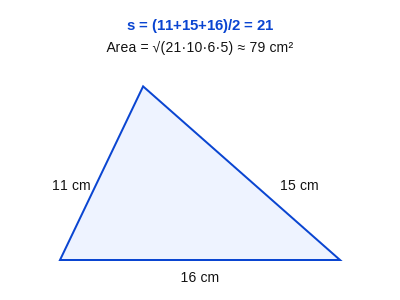
What is the area (rounded off to the nearest integer) of a triangle whose three sides measure 11 cm, 15 cm and 16 cm?
उस त्रिभुज का क्षेत्रफल (निकटतम पूर्णांक तक पूर्णांकित) क्या है, जिसकी तीनों भुजाओं की माप 11 cm, 15 cm और 16 cm है?
  1. A79 cm2
  2. B82 cm2
  3. C84 cm2
  4. D87 cm2
Show answer

Concept: Area =s(s−a)(s−b)(s−c), where s=a+b+c2.

  1. s=11+15+162=21
  2. s−a=10,s−b=6,s−c=5
  3. Area =21×10×6×5=6300≈79.4cm2

Trick: 792=6241 and 802=6400; 6300 is nearer 6241, so the area rounds to 79.

Answer: (A) 79cm2

अवधारणा: क्षेत्रफल =s(s−a)(s−b)(s−c), जहाँ s=a+b+c2।

  1. s=11+15+162=21
  2. s−a=10,s−b=6,s−c=5
  3. क्षेत्रफल =21×10×6×5=6300≈79.4cm2

ट्रिक: 792=6241 और 802=6400; 6300, 6241 के अधिक पास है, अतः उत्तर 79।

उत्तर: (A) 79cm2

RRB NTPC Undergraduate CBT 1MathematicsHeron's FormulaRRB NTPC Undergraduate CBT 1 2024 · 1 Sep Shift 1 →
Q6389.
In covering a distance of 60 km, Pranay takes 6 hours more than Aman. If Pranay doubles his speed, then he would take 9 hours less than Aman. Pranay's speed is:
60 km की दूरी तय करने में प्रणय, अमन से 6 घंटे अधिक लेता है। यदि प्रणय अपनी चाल दोगुनी कर दे, तो वह अमन से 9 घंटे कम लेगा। प्रणय की चाल है:
  1. A12 km/hr
  2. B2 km/hr
  3. C11 km/hr
  4. D9 km/hr
Show answer

Concept: Time =DistanceSpeed. Let Pranay's speed =p, Aman's =a.

  1. 60p−60a=6 … (1)
  2. 60a−602p=9 … (2)
  3. Add: 60p−30p=15⇒30p=15⇒p=2km/h

Trick: Option check: p=2 ⇒ Pranay takes 30 h, Aman 24 h, doubled speed 15 h =24−9 ✓.

Answer: (B) 2km/hr

अवधारणा: समय =दूरीचाल. प्रणय की चाल =p, अमन की =a।

  1. 60p−60a=6 … (1)
  2. 60a−602p=9 … (2)
  3. जोड़ने पर: 30p=15⇒p=2km/h

ट्रिक: विकल्प जाँच: p=2 ⇒ प्रणय 30 घंटे, अमन 24 घंटे, दोगुनी चाल पर 15 घंटे =24−9 ✓।

उत्तर: (B) 2km/hr

RRB NTPC Undergraduate CBT 1MathematicsSpeed, Time and DistanceRRB NTPC Undergraduate CBT 1 2024 · 1 Sep Shift 1 →
Q6390.
By how much is 65% of 55 greater than 25 of 15?
55 का 65%, 15 के 25 से कितना अधिक है?
  1. A26.75
  2. B23.75
  3. C29.75
  4. D27.75
Show answer

Concept: Find both values separately, then subtract.

  1. 65% of 55=65×55100=35.75
  2. 25 of 15=6
  3. Difference =35.75−6=29.75

Trick: Quick: 0.65×55=33+2.75=35.75 (60% plus 5%).

Answer: (C) 29.75

अवधारणा: दोनों मान अलग-अलग निकालें, फिर घटाएँ।

  1. 55 का 65%=65×55100=35.75
  2. 15 का 25=6
  3. अंतर =35.75−6=29.75

ट्रिक: 0.65×55=33+2.75=35.75 – जल्दी गणना के लिए।

उत्तर: (C) 29.75

RRB NTPC Undergraduate CBT 1MathematicsPercentage and FractionsRRB NTPC Undergraduate CBT 1 2024 · 1 Sep Shift 1 →
Q6391.
5 years ago, the age of a father was 11 years more than twice his son's age. After how many years, from now, will he be twice his son's age?
5 वर्ष पहले, एक पिता की आयु उसके पुत्र की आयु के दोगुने से 11 वर्ष अधिक थी। अब से कितने वर्ष बाद उसकी आयु उसके पुत्र की आयु की दोगुनी होगी?
  1. A10
  2. B4
  3. C5
  4. D6
Show answer

Concept: Let present ages be father F, son S.

  1. F−5=2(S−5)+11⇒F=2S+6
  2. After x years: F+x=2(S+x)
  3. 2S+6+x=2S+2x⇒x=6

Trick: Father is always '2S + 6'; the extra 6 is exactly the years needed to make it double.

Answer: (D) 6

अवधारणा: माना वर्तमान आयु पिता F, पुत्र S।

  1. F−5=2(S−5)+11⇒F=2S+6
  2. x वर्ष बाद: F+x=2(S+x)
  3. 2S+6+x=2S+2x⇒x=6

ट्रिक: पिता की आयु 2S+6 है; यही अतिरिक्त 6 वर्ष दोगुना होने के लिए चाहिए।

उत्तर: (D) 6

RRB NTPC Undergraduate CBT 1MathematicsProblems on AgesRRB NTPC Undergraduate CBT 1 2024 · 1 Sep Shift 1 →
Q6392.
Find the simple interest (in ₹) on ₹1,200 at an interest rate of 4% per month for 4 months.
₹1,200 पर 4% प्रति माह की ब्याज दर से 4 महीनों का साधारण ब्याज (₹ में) ज्ञात कीजिए।
  1. A₹16
  2. B₹32
  3. C₹36
  4. D₹192
Show answer

Concept: SI=P×R×T100 with R and T in the same unit (here months).

  1. P=1200,R=4% per month, T=4 months
  2. SI=1200×4×4100=192

Trick: Rate is per month, so do not convert months into years.

Answer: (D) ₹192

अवधारणा: SI=P×R×T100, जहाँ R और T एक ही इकाई में (यहाँ माह)।

  1. P=1200,R=4% प्रति माह, T=4 माह
  2. SI=1200×4×4100=192

ट्रिक: दर प्रति माह है, इसलिए माह को वर्ष में न बदलें।

उत्तर: (D) ₹192

RRB NTPC Undergraduate CBT 1MathematicsSimple InterestRRB NTPC Undergraduate CBT 1 2024 · 1 Sep Shift 1 →
Q6393.
The product of two consecutive natural numbers is 600. The greater of the two numbers is:
दो क्रमागत प्राकृत संख्याओं का गुणनफल 600 है। दोनों संख्याओं में से बड़ी संख्या है:
  1. A31
  2. B25
  3. C40
  4. D16
Show answer

Concept: Product of consecutive numbers n(n+1) is just above n2.

  1. 600≈24.5
  2. Try 24×25=600 ✓
  3. Greater number =25

Trick: Take the square root and check the two integers around it.

Answer: (B) 25

अवधारणा: क्रमागत संख्याओं का गुणनफल n(n+1), n2 से थोड़ा अधिक होता है।

  1. 600≈24.5
  2. 24×25=600 ✓
  3. बड़ी संख्या =25

ट्रिक: वर्गमूल लेकर उसके आस-पास के दो पूर्णांक जाँचें।

उत्तर: (B) 25

RRB NTPC Undergraduate CBT 1MathematicsNumber SystemRRB NTPC Undergraduate CBT 1 2024 · 1 Sep Shift 1 →
Q6394.
A man riding on a bicycle at a speed of 24 km/hr crosses a bridge in 3.1 minutes. Find the length of the bridge.
24 km/hr की चाल से साइकिल चला रहा एक व्यक्ति एक पुल को 3.1 मिनट में पार करता है। पुल की लंबाई ज्ञात कीजिए।
  1. A0.34 km
  2. B1.24 km
  3. C0.62 km
  4. D1.64 km
Show answer

Concept: Distance = speed × time; the bicycle's length is negligible, so distance = bridge length.

  1. 3.1min=3.160h
  2. Length =24×3.160=0.4×3.1=1.24km

Trick: 24km/h=0.4km per minute — multiply by minutes.

Answer: (B) 1.24km

अवधारणा: दूरी = चाल × समय; साइकिल की लंबाई नगण्य है, अतः दूरी = पुल की लंबाई।

  1. 3.1min=3.160h
  2. लंबाई =24×3.160=0.4×3.1=1.24km

ट्रिक: 24km/h=0.4km प्रति मिनट — मिनटों से गुणा करें।

उत्तर: (B) 1.24km

RRB NTPC Undergraduate CBT 1MathematicsSpeed and DistanceRRB NTPC Undergraduate CBT 1 2024 · 1 Sep Shift 1 →
Q6395.
Pipe A can fill a tank in 20 hours, pipe B can fill the same tank in 25 hours and pipe C can fill the same tank in 10 hours. The time taken by them to fill the same tank if they operate together is::
पाइप A एक टंकी को 20 घंटे में भर सकता है, पाइप B उसी टंकी को 25 घंटे में भर सकता है और पाइप C उसी टंकी को 10 घंटे में भर सकता है। यदि वे एक साथ कार्य करें, तो उसी टंकी को भरने में उनके द्वारा लिया गया समय है::
  1. A2519 hours2519 घंटे
  2. B5519 hours5519 घंटे
  3. C11519 hours11519 घंटे
  4. D3519 hours3519 घंटे
Show answer

Concept: Rates add when pipes work together.

  1. 120+125+110=5+4+10100=19100
  2. Time =10019=5519 hours

Trick: Capacity =100 units (LCM); rates 5+4+10=19 units/h ⇒ 10019 h.

Answer: (B) 5519 hours

अवधारणा: साथ में काम करने पर दरें जुड़ती हैं।

  1. 120+125+110=5+4+10100=19100
  2. समय =10019=5519 घंटे

ट्रिक: क्षमता =100 इकाई (LCM); दरें 5+4+10=19 इकाई/घंटा ⇒ 10019 घंटे।

उत्तर: (B) 5519 घंटे

RRB NTPC Undergraduate CBT 1MathematicsPipes and CisternRRB NTPC Undergraduate CBT 1 2024 · 1 Sep Shift 1 →
Q6396.
What will come in the place of the question mark (?) in the following equation, if ‘+’ and ‘−’ are interchanged and ‘×’ and ‘÷’ are interchanged?
72 × 3 − 8 ÷ 5 + 31 = ?
यदि ‘+’ और ‘−’ को आपस में बदल दिया जाए तथा ‘×’ और ‘÷’ को आपस में बदल दिया जाए, तो निम्नलिखित समीकरण में प्रश्न चिह्न (?) के स्थान पर क्या आएगा?
72 × 3 − 8 ÷ 5 + 31 = ?
  1. A33
  2. B35
  3. C37
  4. D31
Show answer

Concept: Swap the signs as told, then apply BODMAS.

  1. After interchange: 72÷3+8×5−31
  2. =24+40−31
  3. =33

Trick: Rewrite the whole expression first, then calculate — avoids sign mix-ups.

Answer: (A) 33

अवधारणा: निर्देशानुसार चिह्न बदलें, फिर BODMAS लगाएँ।

  1. बदलने के बाद: 72÷3+8×5−31
  2. =24+40−31
  3. =33

ट्रिक: पहले पूरा व्यंजक दोबारा लिखें, फिर गणना करें।

उत्तर: (A) 33

RRB NTPC Undergraduate CBT 1General Intelligence and ReasoningMathematical OperationsRRB NTPC Undergraduate CBT 1 2024 · 1 Sep Shift 1 →
Q6397.
Based on the English alphabetical order, three of the following four letter-clusters are alike in a certain way and thus form a group. Which letter-cluster DOES NOT belong to that group?
(Note: The odd one out is not based on the number of consonants/vowels or their position in the letter-cluster.)
अंग्रेज़ी वर्णमाला क्रम के आधार पर, निम्नलिखित चार अक्षर-समूहों में से तीन किसी निश्चित प्रकार से एकसमान हैं और इस प्रकार एक समूह बनाते हैं। कौन-सा अक्षर-समूह उस समूह से संबंधित नहीं है?
(नोट: असंगत अक्षर-समूह, उस अक्षर-समूह में व्यंजनों/स्वरों की संख्या या उनके स्थान पर आधारित नहीं है।)
  1. AICWS
  2. BDXRN
  3. CKFYU
  4. DNHBX
Show answer

Concept: Check gaps between consecutive letters (with wrap-around).

  1. ICWS: I −6 C −6 W −4 S
  2. DXRN: D −6 X −6 R −4 N
  3. NHBX: N −6 H −6 B −4 X
  4. KFYU: K −5 F −7 Y −4 U ✗

Trick: With wrap-around, C − 6 = W (3 − 6 + 26 = 23).

Answer: (C) KFYU

अवधारणा: क्रमागत अक्षरों के बीच अंतर देखें (Z के बाद A से फिर गिनें)।

  1. ICWS: I −6 C −6 W −4 S
  2. DXRN: D −6 X −6 R −4 N
  3. NHBX: N −6 H −6 B −4 X
  4. KFYU: K −5 F −7 Y −4 U ✗

ट्रिक: चक्रीय गिनती: C − 6 = W (3 − 6 + 26 = 23)।

उत्तर: (C) KFYU

RRB NTPC Undergraduate CBT 1General Intelligence and ReasoningOdd One Out – LettersRRB NTPC Undergraduate CBT 1 2024 · 1 Sep Shift 1 →
Q6398.
If 1 is added to each odd digit and 2 is subtracted from each even digit in the number 8147563, what will be the sum of the digits that are second from the left and second from the right?
यदि संख्या 8147563 में प्रत्येक विषम अंक में 1 जोड़ा जाए और प्रत्येक सम अंक में से 2 घटाया जाए, तो बाएँ से दूसरे और दाएँ से दूसरे अंकों का योग क्या होगा?
  1. A14
  2. B4
  3. C10
  4. D6
Show answer

Concept: Odd digit +1, even digit −2.

  1. 8147563 → 8→6, 1→2, 4→2, 7→8, 5→6, 6→4, 3→4
  2. New number: 6228644
  3. 2nd from left =2, 2nd from right =4; sum =6

Trick: Only the needed positions matter: change just the 2nd (1→2) and 6th (6→4) digits.

Answer: (D) 6

अवधारणा: विषम अंक +1, सम अंक −2।

  1. 8147563 → 8→6, 1→2, 4→2, 7→8, 5→6, 6→4, 3→4
  2. नई संख्या: 6228644
  3. बाएँ से दूसरा =2, दाएँ से दूसरा =4; योग =6

ट्रिक: केवल ज़रूरी स्थान बदलें: दूसरा (1→2) और छठा (6→4)।

उत्तर: (D) 6

RRB NTPC Undergraduate CBT 1General Intelligence and ReasoningDigit OperationsRRB NTPC Undergraduate CBT 1 2024 · 1 Sep Shift 1 →
Q6399.
MJRN is related to KHPL in a certain way based on the English alphabetical order. In the same way, PMUQ is related to NKSO. To which of the given options is SPXT related, following the same logic?
अंग्रेज़ी वर्णमाला क्रम के आधार पर MJRN एक निश्चित प्रकार से KHPL से संबंधित है। उसी प्रकार PMUQ, NKSO से संबंधित है। समान तर्क का अनुसरण करते हुए SPXT दिए गए विकल्पों में से किससे संबंधित है?
  1. ANQRV
  2. BQNRV
  3. CNQVR
  4. DQNVR
Show answer

Concept: Find the shift applied to each letter.

  1. MJRN → KHPL: each letter −2
  2. PMUQ → NKSO: each letter −2
  3. SPXT → S−2=Q, P−2=N, X−2=V, T−2=R → QNVR

Trick: Uniform −2 shift: S − 2 = Q and P − 2 = N leave only QNRV/QNVR; X − 2 = V decides.

Answer: (D) QNVR

अवधारणा: प्रत्येक अक्षर में कितना खिसकाव है, ज्ञात करें।

  1. MJRN → KHPL: हर अक्षर −2
  2. PMUQ → NKSO: हर अक्षर −2
  3. SPXT → Q, N, V, R → QNVR

ट्रिक: सभी अक्षर −2: पहले अक्षर से ही विकल्प छाँटें।

उत्तर: (D) QNVR

RRB NTPC Undergraduate CBT 1General Intelligence and ReasoningLetter AnalogyRRB NTPC Undergraduate CBT 1 2024 · 1 Sep Shift 1 →
Q6400.
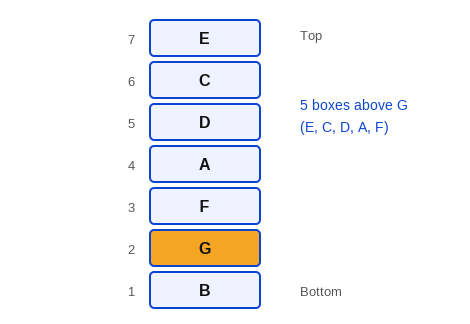
Seven boxes A, B, C, D, E, F and G are kept one over the other but not necessarily in the same order. D is kept immediately above A. G is kept immediately above B. Only E is kept above C. Only two boxes are kept above D. G is not kept at the third position from the bottom. How many boxes are kept above G?
सात बक्से A, B, C, D, E, F और G एक के ऊपर एक रखे गए हैं, लेकिन ज़रूरी नहीं कि इसी क्रम में हों। D को A के ठीक ऊपर रखा गया है। G को B के ठीक ऊपर रखा गया है। C के ऊपर केवल E रखा गया है। D के ऊपर केवल दो बक्से रखे गए हैं। G को नीचे से तीसरे स्थान पर नहीं रखा गया है। G के ऊपर कितने बक्से रखे गए हैं?
  1. A3
  2. B5
  3. C4
  4. D2
Show answer

Concept: Fix definite positions first (positions counted from the top).

  1. Only E above C ⇒ E = 1st, C = 2nd from top
  2. Only two above D ⇒ D = 3rd, A (just below D) = 4th
  3. G–B pair fits in 5–6 or 6–7; G not 3rd from bottom (5th from top) ⇒ G = 6th, B = 7th, F = 5th
  4. Boxes above G = 5

Trick: 'Only X above Y' instantly fixes both X and Y at the top.

Answer: (B) 5

अवधारणा: निश्चित स्थान पहले तय करें (ऊपर से गिनती)।

  1. केवल E, C के ऊपर ⇒ E = 1, C = 2
  2. D के ऊपर केवल दो ⇒ D = 3, A = 4
  3. G–B जोड़ी 5–6 या 6–7; G नीचे से तीसरा (ऊपर से 5वाँ) नहीं ⇒ G = 6, B = 7, F = 5
  4. G के ऊपर 5 बॉक्स

ट्रिक: 'केवल X, Y के ऊपर' से दोनों का स्थान तुरंत तय होता है।

उत्तर: (B) 5

RRB NTPC Undergraduate CBT 1General Intelligence and ReasoningBox ArrangementRRB NTPC Undergraduate CBT 1 2024 · 1 Sep Shift 1 →