Question bank

Q&A: practice questions with answers

Search questions on any topic. Filter by exam category, exam, subject and topic, try the question, then open the answer and explanation.

Courses – airGurukul

20,719 questions found.

Q6401.
I is the daughter of X. K is the son of R. X is married to Z. Z is the mother of N. F is married to R. F is the brother of X. How is X related to K?
I, X की पुत्री है। K, R का पुत्र है। X का विवाह Z से हुआ है। Z, N की माता है। F का विवाह R से हुआ है। F, X का भाई है। X, K से किस प्रकार संबंधित है?
  1. AFather's fatherपिता के पिता
  2. BMother's brotherमाता का भाई
  3. CFather's brotherपिता का भाई
  4. DFatherपिता
Show answer

Concept: Build the family tree and fix genders.
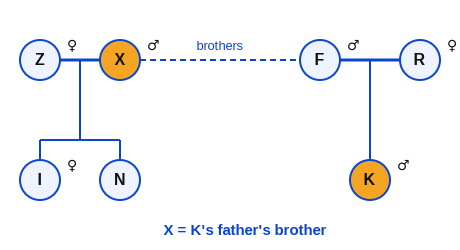
  1. Z is mother of N and wife of X ⇒ X is male.
  2. F (brother of X) is married to R; K is R's son ⇒ F is K's father.
  3. X is the brother of K's father.

Trick: Spouse statements decide gender: wife = mother ⇒ husband is male.

Answer: (C) Father's brother

अवधारणा: परिवार वृक्ष बनाएँ और लिंग तय करें।

  1. Z, N की माँ और X की पत्नी ⇒ X पुरुष।
  2. F (X का भाई) का विवाह R से; K, R का पुत्र ⇒ F, K का पिता।
  3. X, K के पिता का भाई (चाचा) है।

ट्रिक: पति-पत्नी कथन से लिंग तय होता है: पत्नी माँ है ⇒ पति पुरुष।

उत्तर: (C) पिता का भाई (Father's brother)
RRB NTPC Undergraduate CBT 1General Intelligence and ReasoningBlood RelationRRB NTPC Undergraduate CBT 1 2024 · 1 Sep Shift 1 →
Q6402.
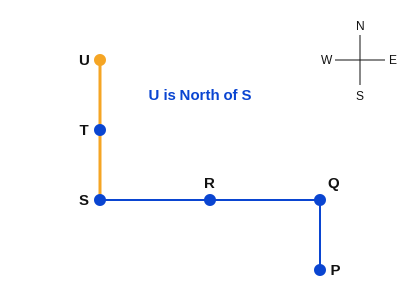
Town P is to the south of Town Q. Town R is to the west of Town Q. Town S is to the west of Town R. Town T is to the north of Town S and also to the south of Town U. What is the position of Town U with respect to Town S?
शहर P, शहर Q के दक्षिण में है। शहर R, शहर Q के पश्चिम में है। शहर S, शहर R के पश्चिम में है। शहर T, शहर S के उत्तर में है और शहर U के दक्षिण में भी है। शहर S के सापेक्ष शहर U की स्थिति क्या है?
  1. AWestपश्चिम
  2. BEastपूर्व
  3. CSouthदक्षिण
  4. DNorthउत्तर
Show answer

Concept: Place towns step by step on a compass grid.

  1. R is west of Q; S is west of R.
  2. T is north of S, and U is north of T.
  3. So U lies directly north of S.

Trick: Only the S–T–U chain is needed; P, Q, R are distractors.

Answer: (D) North

अवधारणा: कस्बों को क्रम से दिशा-ग्रिड पर रखें।

  1. R, Q के पश्चिम में; S, R के पश्चिम में।
  2. T, S के उत्तर में और U, T के उत्तर में।
  3. अतः U, S के ठीक उत्तर में है।

ट्रिक: केवल S–T–U श्रृंखला चाहिए; P, Q, R भ्रम पैदा करते हैं।

उत्तर: (D) उत्तर (North)

RRB NTPC Undergraduate CBT 1General Intelligence and ReasoningDirection SenseRRB NTPC Undergraduate CBT 1 2024 · 1 Sep Shift 1 →
Q6403.
Based on the English alphabetical order, three of the following four letter-cluster pairs are alike in a certain way and thus form a group. Which letter-cluster pair DOES NOT belong to that group?
(Note: The odd one out is not based on the number of consonants/vowels or their position in the letter-cluster.)
अंग्रेज़ी वर्णमाला क्रम के आधार पर, निम्नलिखित चार अक्षर-समूह युग्मों में से तीन किसी निश्चित प्रकार से एकसमान हैं और इस प्रकार एक समूह बनाते हैं। कौन-सा अक्षर-समूह युग्म उस समूह से संबंधित नहीं है?
(नोट: असंगत अक्षर-समूह, उस अक्षर-समूह में व्यंजनों/स्वरों की संख्या या उनके स्थान पर आधारित नहीं है।)
  1. APS−RU
  2. BYB−ZF
  3. CEH−GJ
  4. DIL−KN
Show answer

Concept: Check: 1st→2nd letter, 1st→3rd letter, 3rd→4th letter.

  1. PS−RU: P+3=S, P+2=R, R+3=U
  2. EH−GJ: +3, +2, +3; IL−KN: +3, +2, +3
  3. YB−ZF: Y+3=B, Y+1=Z, Z+6=F ✗

Trick: In the pattern the second cluster is the first shifted by +2 letters each.

Answer: (B) YB−ZF

अवधारणा: जाँचें: पहला→दूसरा अक्षर, पहला→तीसरा, तीसरा→चौथा।

  1. PS−RU: P+3=S, P+2=R, R+3=U
  2. EH−GJ: +3, +2, +3; IL−KN: +3, +2, +3
  3. YB−ZF: Y+3=B, Y+1=Z, Z+6=F ✗

ट्रिक: पैटर्न में दूसरा समूह पहले समूह के हर अक्षर को +2 करके बनता है।

उत्तर: (B) YB−ZF

RRB NTPC Undergraduate CBT 1General Intelligence and ReasoningOdd Pair – LettersRRB NTPC Undergraduate CBT 1 2024 · 1 Sep Shift 1 →
Q6404.
In the following number-pairs, the second number is obtained by applying certain mathematical operations to the first number. Select the set in which the numbers are related in the same way as are the numbers of the following sets.
(NOTE: Operations should be performed on the whole numbers, without breaking down the numbers into their constituent digits. E.g. 13 – Operations on 13 such as
adding/subtracting/multiplying to 13 can be performed. Breaking down 13 into 1 and 3 and then performing mathematical operations on 1 and 3 is not allowed.)
300, 194
315, 209
निम्नलिखित संख्या-युग्मों में, पहली संख्या पर कुछ गणितीय संक्रियाएँ करके दूसरी संख्या प्राप्त की जाती है। उस समुच्चय का चयन कीजिए जिसमें संख्याएँ उसी प्रकार संबंधित हैं जिस प्रकार निम्नलिखित समुच्चयों की संख्याएँ संबंधित हैं।
(नोट: संख्याओं को उनके घटक अंकों में विभाजित किए बिना, पूर्ण संख्याओं पर संक्रियाएँ की जानी चाहिए। उदाहरण: 13 – 13 पर की जाने वाली संक्रियाएँ, जैसे
13 में जोड़ना/घटाना/गुणा करना आदि की जा सकती हैं। 13 को 1 और 3 में विभाजित करके फिर 1 और 3 पर गणितीय संक्रियाएँ करने की अनुमति नहीं है।)
300, 194
315, 209
  1. A272, 166
  2. B255, 159
  3. C288, 180
  4. D240, 124
Show answer

Concept: Find the operation linking each pair.

  1. 300−106=194, 315−106=209
  2. Check: 272−106=166 ✓
  3. Others: 255−159=96, 288−180=108, 240−124=116

Trick: Constant difference pairs: just subtract each option pair.

Answer: (A) 272, 166

अवधारणा: प्रत्येक युग्म को जोड़ने वाली संक्रिया ज्ञात करें।

  1. 300−106=194, 315−106=209
  2. जाँच: 272−106=166 ✓
  3. अन्य: 255−159=96, 288−180=108, 240−124=116

ट्रिक: अंतर स्थिर है: हर विकल्प में घटाकर देखें।

उत्तर: (A) 272, 166

RRB NTPC Undergraduate CBT 1General Intelligence and ReasoningNumber Pair AnalogyRRB NTPC Undergraduate CBT 1 2024 · 1 Sep Shift 1 →
Q6405.
In a certain code language, ‘LOAN’ is coded as ‘4257’ and ‘NIKE’ is coded as ‘1346’. What is the code for ‘N’ in the given code language?
एक निश्चित कूट भाषा में, ‘LOAN’ को ‘4257’ लिखा जाता है और ‘NIKE’ को ‘1346’ लिखा जाता है। दी गई कूट भाषा में ‘N’ के लिए कूट क्या है?
  1. A1
  2. B6
  3. C7
  4. D4
Show answer

Concept: A letter common to two words gets the digit common to both codes.

  1. LOAN → 4257, NIKE → 1346
  2. Common letter: N
  3. Common digit: 4 ⇒ N = 4

Trick: Common letter ↔ common digit (order of digits doesn't matter).

Answer: (D) 4

अवधारणा: दो शब्दों में उभयनिष्ठ अक्षर का कोड, दोनों कोड का उभयनिष्ठ अंक होता है।

  1. LOAN → 4257, NIKE → 1346
  2. उभयनिष्ठ अक्षर: N
  3. उभयनिष्ठ अंक: 4 ⇒ N = 4

ट्रिक: उभयनिष्ठ अक्षर ↔ उभयनिष्ठ अंक।

उत्तर: (D) 4

RRB NTPC Undergraduate CBT 1General Intelligence and ReasoningCoding–DecodingRRB NTPC Undergraduate CBT 1 2024 · 1 Sep Shift 1 →
Q6406.
This question is based on the five, three-digit numbers given below.
(Left) 512 648 729 378 462 (Right)
(Example- 697 – First digit = 6, second digit = 9 and third digit = 7)
(NOTE: All operations to be done from left to right.)
What will be the resultant if the first digit of the lowest number is added to the third digit of the highest number?
यह प्रश्न नीचे दी गई पाँच, तीन-अंकीय संख्याओं पर आधारित है।
(बाएँ) 512 648 729 378 462 (दाएँ)
(उदाहरण- 697 – पहला अंक = 6, दूसरा अंक = 9 और तीसरा अंक = 7)
(नोट: सभी संक्रियाएँ बाएँ से दाएँ की जानी हैं।)
यदि सबसे छोटी संख्या के पहले अंक को सबसे बड़ी संख्या के तीसरे अंक में जोड़ा जाए, तो परिणाम क्या होगा?
  1. A12
  2. B10
  3. C13
  4. D11
Show answer

Concept: Identify lowest and highest numbers first.

  1. Lowest = 378 → first digit 3
  2. Highest = 729 → third digit 9
  3. 3+9=12

Trick: Compare hundreds digits first: 3 is lowest, 7 is highest.

Answer: (A) 12

अवधारणा: पहले सबसे छोटी और सबसे बड़ी संख्या पहचानें।

  1. सबसे छोटी = 378 → पहला अंक 3
  2. सबसे बड़ी = 729 → तीसरा अंक 9
  3. 3+9=12

ट्रिक: सैकड़े के अंक से तुलना करें: 3 सबसे छोटा, 7 सबसे बड़ा।

उत्तर: (A) 12

RRB NTPC Undergraduate CBT 1General Intelligence and ReasoningNumber AnalysisRRB NTPC Undergraduate CBT 1 2024 · 1 Sep Shift 1 →
Q6407.
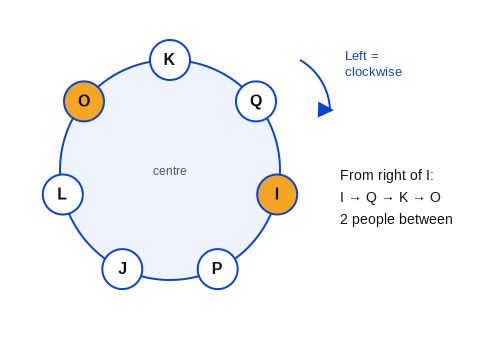
I, J, K, L, O, P and Q are sitting around a circular table, facing the centre of the table. P sits third to the left of K. O sits second to the left of J. Only K sits between Q and O. L is not an immediate neighbour of P.
How many people sit between I and O when counted from the right of I?
I, J, K, L, O, P और Q एक वृत्ताकार मेज़ के चारों ओर मेज़ के केंद्र की ओर मुख करके बैठे हैं। P, K के बाएँ से तीसरे स्थान पर बैठा है। O, J के बाएँ से दूसरे स्थान पर बैठा है। Q और O के बीच केवल K बैठा है। L, P का निकटतम पड़ोसी नहीं है।
I के दाएँ से गिनने पर I और O के बीच कितने व्यक्ति बैठे हैं?
  1. AOneएक
  2. BFourचार
  3. CThreeतीन
  4. DTwoदो
Show answer

Concept: Facing the centre: left = clockwise, right = anticlockwise.

  1. Fix K; P is 3rd to the left of K.
  2. Q and O are K's two neighbours; O is 2nd left of J ⇒ O on K's right, Q on K's left, J next to P.
  3. Remaining seats: L not next to P ⇒ L sits between J and O; I sits between Q and P.
  4. From I going right: Q, K, then O ⇒ 2 people between.

Trick: Place the person with most clues (K) first, then use the 'only between' clue.

Answer: (D) Two

अवधारणा: केंद्र की ओर मुख: बाएँ = दक्षिणावर्त, दाएँ = वामावर्त।

  1. K को रखें; P, K के बाएँ तीसरे स्थान पर।
  2. Q और O, K के दोनों पड़ोसी; O, J के बाएँ दूसरे ⇒ O, K के दाएँ, Q बाएँ, J, P के बगल में।
  3. L, P का पड़ोसी नहीं ⇒ L, J और O के बीच; I, Q और P के बीच।
  4. I से दाईं ओर: Q, K, फिर O ⇒ 2 व्यक्ति।

ट्रिक: सबसे अधिक सूचना वाले व्यक्ति (K) को पहले रखें।

उत्तर: (D) दो

RRB NTPC Undergraduate CBT 1General Intelligence and ReasoningCircular SeatingRRB NTPC Undergraduate CBT 1 2024 · 1 Sep Shift 1 →
Q6408.
What should come in place of the question mark (?) in the given series?
890 891 893 896 900 ?
दी गई श्रृंखला में प्रश्न चिह्न (?) के स्थान पर क्या आना चाहिए?
890 891 893 896 900 ?
  1. A903
  2. B906
  3. C905
  4. D904
Show answer

Concept: Look at successive differences.

  1. Differences: +1, +2, +3, +4
  2. Next: +5
  3. 900+5=905

Trick: Increasing natural-number differences are the most common pattern.

Answer: (C) 905

अवधारणा: क्रमागत अंतर देखें।

  1. अंतर: +1, +2, +3, +4
  2. अगला: +5
  3. 900+5=905

ट्रिक: बढ़ते प्राकृत संख्या अंतर सबसे आम पैटर्न है।

उत्तर: (C) 905

RRB NTPC Undergraduate CBT 1General Intelligence and ReasoningNumber SeriesRRB NTPC Undergraduate CBT 1 2024 · 1 Sep Shift 1 →
Q6409.
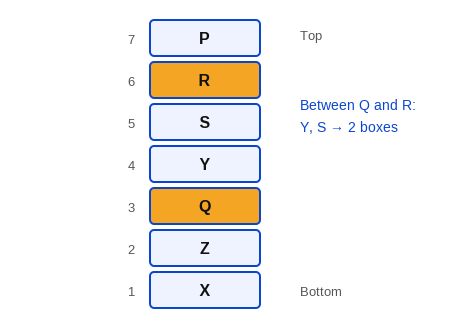
Seven boxes P, Q, R, S, X, Y and Z are kept one over the other, but not necessarily in the same order. Z is kept second from the bottom. Only three boxes are kept between Z and R. X is kept at one of the positions below Z. Only S is kept between R and Y. P is kept at one of the positions above R. How many boxes are kept between Q and R?
सात बक्से P, Q, R, S, X, Y और Z एक के ऊपर एक रखे गए हैं, लेकिन ज़रूरी नहीं कि इसी क्रम में हों। Z को नीचे से दूसरे स्थान पर रखा गया है। Z और R के बीच केवल तीन बक्से रखे गए हैं। X को Z के नीचे के किसी एक स्थान पर रखा गया है। R और Y के बीच केवल S रखा गया है। P को R के ऊपर के किसी एक स्थान पर रखा गया है। Q और R के बीच कितने बक्से रखे गए हैं?
  1. AOneएक
  2. BFourचार
  3. CTwoदो
  4. DThreeतीन
Show answer

Concept: Number positions from the bottom (1) to the top (7).

  1. Z = 2; three boxes between Z and R ⇒ R = 6.
  2. X below Z ⇒ X = 1. P above R ⇒ P = 7.
  3. Only S between R and Y ⇒ S = 5, Y = 4 (S cannot be 7 as P is there). Q = 3.
  4. Between Q (3) and R (6): Y, S ⇒ 2 boxes.

Trick: Use 'X below Z' with Z = 2 to lock X at the bottom immediately.

Answer: (C) Two

अवधारणा: स्थान नीचे (1) से ऊपर (7) गिनें।

  1. Z = 2; Z और R के बीच तीन ⇒ R = 6।
  2. X, Z के नीचे ⇒ X = 1। P, R के ऊपर ⇒ P = 7।
  3. R और Y के बीच केवल S ⇒ S = 5, Y = 4। Q = 3।
  4. Q (3) और R (6) के बीच: Y, S ⇒ 2 बॉक्स।

ट्रिक: Z = 2 होने पर 'X, Z के नीचे' से X = 1 तुरंत तय।

उत्तर: (C) दो

RRB NTPC Undergraduate CBT 1General Intelligence and ReasoningBox ArrangementRRB NTPC Undergraduate CBT 1 2024 · 1 Sep Shift 1 →
Q6410.
What should come in place of the question mark (?) in the given series?
56 58 63 73 90 ?
दी गई श्रृंखला में प्रश्न चिह्न (?) के स्थान पर क्या आना चाहिए?
56 58 63 73 90 ?
  1. A115
  2. B112
  3. C114
  4. D116
Show answer

Concept: Differences follow n2+1.

  1. Differences: 2, 5, 10, 17 =12+1,22+1,32+1,42+1
  2. Next difference =52+1=26
  3. 90+26=116

Trick: Differences 2, 5, 10, 17 themselves differ by 3, 5, 7 → next 9.

Answer: (D) 116

अवधारणा: अंतर n2+1 के रूप में हैं।

  1. अंतर: 2, 5, 10, 17 =12+1,22+1,32+1,42+1
  2. अगला अंतर =52+1=26
  3. 90+26=116

ट्रिक: अंतरों का अंतर 3, 5, 7 → अगला 9।

उत्तर: (D) 116

RRB NTPC Undergraduate CBT 1General Intelligence and ReasoningNumber SeriesRRB NTPC Undergraduate CBT 1 2024 · 1 Sep Shift 1 →
Q6411.
Based on the English alphabetical order, three of the following four letter-clusters are alike in a certain way and thus form a group. Which letter-cluster DOES NOT belong to that group?
(Note: The odd one out is not based on the number of consonants/vowels or their position in the letter-cluster.)
अंग्रेज़ी वर्णमाला क्रम के आधार पर, निम्नलिखित चार अक्षर-समूहों में से तीन किसी निश्चित प्रकार से एकसमान हैं और इस प्रकार एक समूह बनाते हैं। कौन-सा अक्षर-समूह उस समूह से संबंधित नहीं है?
(नोट: असंगत अक्षर-समूह, उस अक्षर-समूह में व्यंजनों/स्वरों की संख्या या उनके स्थान पर आधारित नहीं है।)
  1. ACXZ
  2. BOJL
  3. CZTW
  4. DIDF
Show answer

Concept: Check the gap pattern in each cluster.

  1. CXZ: C −5 X +2 Z
  2. OJL: O −5 J +2 L
  3. IDF: I −5 D +2 F
  4. ZTW: Z −6 T +3 W ✗

Trick: Write position numbers: Z = 26, T = 20, W = 23 shows −6, +3.

Answer: (C) ZTW

अवधारणा: प्रत्येक समूह में अंतर का पैटर्न देखें।

  1. CXZ: C −5 X +2 Z
  2. OJL: O −5 J +2 L
  3. IDF: I −5 D +2 F
  4. ZTW: Z −6 T +3 W ✗

ट्रिक: स्थान संख्या लिखें: Z = 26, T = 20, W = 23 → −6, +3।

उत्तर: (C) ZTW

RRB NTPC Undergraduate CBT 1General Intelligence and ReasoningOdd One Out – LettersRRB NTPC Undergraduate CBT 1 2024 · 1 Sep Shift 1 →
Q6412.
In a certain code language, ‘learning is lifelong’ is written as ‘fk mb tb’ and ‘is school over’ is coded as ‘jt mt fk’. How is ‘is’ coded in the given language?
एक निश्चित कूट भाषा में, ‘learning is lifelong’ को ‘fk mb tb’ लिखा जाता है और ‘is school over’ को ‘jt mt fk’ के रूप में कूटबद्ध किया जाता है। दी गई भाषा में ‘is’ को किस प्रकार कूटबद्ध किया जाता है?
  1. Ajt
  2. Btb
  3. Cfk
  4. Dmb
Show answer

Concept: A word common to two sentences takes the code common to both.

  1. 'is' appears in both sentences.
  2. Common code in 'fk mb tb' and 'jt mt fk' is 'fk'.
  3. So 'is' = fk.

Trick: Common word ↔ common code.

Answer: (C) fk

अवधारणा: दो वाक्यों में उभयनिष्ठ शब्द का कोड, दोनों कोड में उभयनिष्ठ होता है।

  1. 'is' दोनों वाक्यों में है।
  2. 'fk mb tb' और 'jt mt fk' में उभयनिष्ठ कोड 'fk' है।
  3. अतः 'is' = fk।

ट्रिक: उभयनिष्ठ शब्द ↔ उभयनिष्ठ कोड।

उत्तर: (C) fk

RRB NTPC Undergraduate CBT 1General Intelligence and ReasoningCoding–DecodingRRB NTPC Undergraduate CBT 1 2024 · 1 Sep Shift 1 →
Q6413.
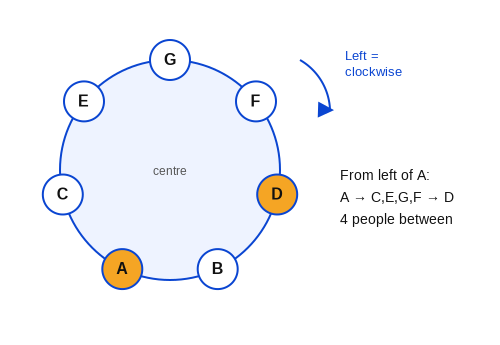
A, B, C, D, E, F and G are sitting around a circular table facing the centre. B sits third to the left of G. C sits second to the left of B. F sits to the immediate right of D. E sits to the immediate right of G. How many people sit between A and D when counted from the left of A?
A, B, C, D, E, F और G एक वृत्ताकार मेज़ के चारों ओर केंद्र की ओर मुख करके बैठे हैं। B, G के बाएँ से तीसरे स्थान पर बैठा है। C, B के बाएँ से दूसरे स्थान पर बैठा है। F, D के ठीक दाएँ बैठा है। E, G के ठीक दाएँ बैठा है। A के बाएँ से गिनने पर A और D के बीच कितने व्यक्ति बैठे हैं?
  1. AThreeतीन
  2. BOneएक
  3. CFourचार
  4. DTwoदो
Show answer

Concept: Facing the centre: left = clockwise, right = anticlockwise.

  1. Fix G. B is 3rd to the left of G; C is 2nd to the left of B.
  2. E is immediately right of G.
  3. Remaining seats for D, F, A: F immediately right of D ⇒ F next to G, then D, and A between D and B.
  4. From A going left: C, E, G, F, then D ⇒ 4 people between.

Trick: With 7 seats, going 4 one way = 3 the other way — useful to cross-check.

Answer: (C) Four

अवधारणा: केंद्र की ओर मुख: बाएँ = दक्षिणावर्त, दाएँ = वामावर्त।

  1. G को रखें। B, G के बाएँ तीसरा; C, B के बाएँ दूसरा।
  2. E, G के ठीक दाएँ।
  3. D, F, A के लिए शेष स्थान: F, D के ठीक दाएँ ⇒ G के बाद F, फिर D, और A, D व B के बीच।
  4. A से बाईं ओर: C, E, G, F, फिर D ⇒ 4 व्यक्ति।

ट्रिक: 7 सीटों में एक ओर 4 = दूसरी ओर 3 — जाँच के लिए उपयोगी।

उत्तर: (C) चार

RRB NTPC Undergraduate CBT 1General Intelligence and ReasoningCircular SeatingRRB NTPC Undergraduate CBT 1 2024 · 1 Sep Shift 1 →
Q6414.
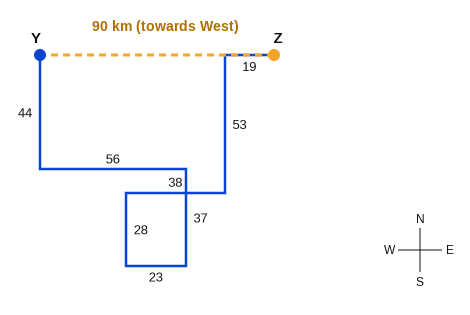
Bimal starts from Point Y and drives 44 km towards south. He then takes a left turn, drives 56 km, turns right and drives 37 km. He then takes a right turn and drives 23 km. He takes a right turn, drives 28 km. He then turns right, drives 38 km, turns left and drives 53 km, turns right and drives 19 km to stop at Point Z. How far (shortest distance) and towards which direction should he drive in order to reach Point Y again? (All turns are 90° turns only unless specified.)
बिमल बिंदु Y से चलना शुरू करता है और दक्षिण की ओर 44 km गाड़ी चलाता है। फिर वह बाएँ मुड़ता है, 56 km गाड़ी चलाता है, दाएँ मुड़ता है और 37 km गाड़ी चलाता है। फिर वह दाएँ मुड़ता है और 23 km गाड़ी चलाता है। वह दाएँ मुड़ता है, 28 km गाड़ी चलाता है। फिर वह दाएँ मुड़ता है, 38 km गाड़ी चलाता है, बाएँ मुड़ता है और 53 km गाड़ी चलाता है, दाएँ मुड़ता है और 19 km गाड़ी चलाकर बिंदु Z पर रुक जाता है। पुनः बिंदु Y तक पहुँचने के लिए उसे कितनी दूरी (न्यूनतम दूरी) तक और किस दिशा में गाड़ी चलानी चाहिए? (जब तक निर्दिष्ट न हो, सभी मोड़ केवल 90° के मोड़ हैं।)
  1. A90 km towards westपश्चिम की ओर 90 km
  2. B87 km towards eastपूर्व की ओर 87 km
  3. C92 km towards eastपूर्व की ओर 92 km
  4. D84 km towards southदक्षिण की ओर 84 km
Show answer

Concept: Track net East–West and North–South displacement.

  1. Moves: S 44, E 56, S 37, W 23, N 28, E 38, N 53, E 19.
  2. North–South: −44−37+28+53=0
  3. East–West: 56−23+38+19=90 km East
  4. Z is 90 km east of Y ⇒ drive 90 km towards West.

Trick: Net vertical is zero, so the answer is just the net horizontal distance.

Answer: (A) 90 km towards west

अवधारणा: कुल पूर्व–पश्चिम और उत्तर–दक्षिण विस्थापन निकालें।

  1. चालें: दक्षिण 44, पूर्व 56, दक्षिण 37, पश्चिम 23, उत्तर 28, पूर्व 38, उत्तर 53, पूर्व 19।
  2. उत्तर–दक्षिण: −44−37+28+53=0
  3. पूर्व–पश्चिम: 56−23+38+19=90 km पूर्व
  4. Z, Y से 90 km पूर्व ⇒ पश्चिम की ओर 90 km चलना होगा।

ट्रिक: ऊर्ध्वाधर विस्थापन शून्य है, अतः उत्तर केवल क्षैतिज दूरी है।

उत्तर: (A) पश्चिम की ओर 90 km

RRB NTPC Undergraduate CBT 1General Intelligence and ReasoningDirection and DistanceRRB NTPC Undergraduate CBT 1 2024 · 1 Sep Shift 1 →
Q6415.
What should come in place of the question mark (?) in the given series based on the English alphabetical order?
UNA OHU IBO CVI ?
अंग्रेज़ी वर्णमाला क्रम के आधार पर दी गई श्रृंखला में प्रश्न चिह्न (?) के स्थान पर क्या आना चाहिए?
UNA OHU IBO CVI ?
  1. AWSP
  2. BWPC
  3. CWPS
  4. DWCP
Show answer

Concept: Each position moves −6 (with wrap-around).

  1. 1st letters: U, O, I, C → W (C − 6 → W)
  2. 2nd letters: N, H, B, V → P
  3. 3rd letters: A, U, O, I → C
  4. Answer: WPC

Trick: Note the 3rd letter of each term = 1st letter of the previous term.

Answer: (B) WPC

अवधारणा: हर स्थान −6 खिसकता है (चक्रीय)।

  1. पहले अक्षर: U, O, I, C → W
  2. दूसरे अक्षर: N, H, B, V → P
  3. तीसरे अक्षर: A, U, O, I → C
  4. उत्तर: WPC

ट्रिक: हर पद का तीसरा अक्षर = पिछले पद का पहला अक्षर।

उत्तर: (B) WPC

RRB NTPC Undergraduate CBT 1General Intelligence and ReasoningLetter SeriesRRB NTPC Undergraduate CBT 1 2024 · 1 Sep Shift 1 →
Q6416.
Which of the following letter-number clusters will replace the question mark (?) in the given series to make it logically complete?
DLY 15, BJW 22, ZHU 29, XFS 36, ?
निम्नलिखित में से कौन-सा अक्षर-संख्या समूह दी गई श्रृंखला को तार्किक रूप से पूर्ण करने के लिए प्रश्न चिह्न (?) का स्थान लेगा?
DLY 15, BJW 22, ZHU 29, XFS 36, ?
  1. AVDP 41
  2. BWER 43
  3. CVDQ 43
  4. DVER 42
Show answer

Concept: Letters move −2; number moves +7.

  1. D, B, Z, X → V; L, J, H, F → D; Y, W, U, S → Q
  2. Numbers: 15, 22, 29, 36 → 43
  3. Answer: VDQ 43

Trick: The number part alone (+7 → 43) leaves only two options; the last letter Q decides.

Answer: (C) VDQ 43

अवधारणा: अक्षर −2; संख्या +7।

  1. D, B, Z, X → V; L, J, H, F → D; Y, W, U, S → Q
  2. संख्याएँ: 15, 22, 29, 36 → 43
  3. उत्तर: VDQ 43

ट्रिक: केवल संख्या (+7 → 43) से दो विकल्प बचते हैं; अंतिम अक्षर Q निर्णय करता है।

उत्तर: (C) VDQ 43

RRB NTPC Undergraduate CBT 1General Intelligence and ReasoningLetter–Number SeriesRRB NTPC Undergraduate CBT 1 2024 · 1 Sep Shift 1 →
Q6417.
Read the given statement(s) and conclusions carefully. Assuming that the information given in the statements is true, even if it appears to be at variance with commonly known facts, decide which of the given conclusions logically follow(s) from the statement(s).
Statements:
Some crafts are handlooms.
All shawls are handlooms.
Conclusions:
(I) Some crafts are shawls.
(II) All handlooms are shawls.
दिए गए कथन(नों) और निष्कर्षों को ध्यानपूर्वक पढ़िए। यह मानते हुए कि कथनों में दी गई जानकारी सत्य है, भले ही वह सामान्य रूप से ज्ञात तथ्यों से भिन्न प्रतीत होती हो, निर्णय लीजिए कि दिए गए निष्कर्षों में से कौन-सा/से निष्कर्ष तार्किक रूप से कथन(नों) का अनुसरण करता है/करते हैं।
कथन:
कुछ शिल्प, हथकरघा हैं।
सभी शॉल, हथकरघा हैं।
निष्कर्ष:
(I) कुछ शिल्प, शॉल हैं।
(II) सभी हथकरघा, शॉल हैं।
  1. AOnly conclusion (II) follows.केवल निष्कर्ष (II) अनुसरण करता है।
  2. BOnly conclusion (I) follows.केवल निष्कर्ष (I) अनुसरण करता है।
  3. CNeither conclusion (I) nor (II) follows.न तो निष्कर्ष (I) और न ही (II) अनुसरण करता है।
  4. DBoth conclusions (I) and (II) follow.निष्कर्ष (I) और (II) दोनों अनुसरण करते हैं।
Show answer

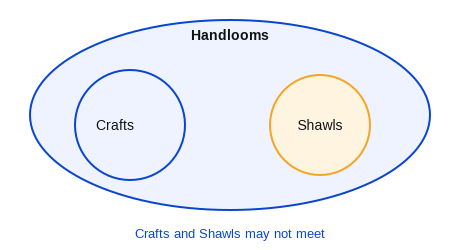
Concept: Draw the least-overlap Venn diagram consistent with the statements.

  1. Crafts and shawls both lie partly/fully inside handlooms but need not touch each other ⇒ (I) not certain.
  2. Shawls are inside handlooms, not vice versa ⇒ 'All handlooms are shawls' (II) does not follow.

Trick: Two circles linked only through a common third circle give no definite relation.

Answer: (C) Neither conclusion (I) nor (II) follows.

अवधारणा: कथनों के अनुरूप न्यूनतम ओवरलैप वाला वेन आरेख बनाएँ।

  1. Crafts और shawls दोनों handlooms से जुड़े हैं पर आपस में मिलना आवश्यक नहीं ⇒ (I) निश्चित नहीं।
  2. Shawls, handlooms के अंदर हैं, उल्टा नहीं ⇒ (II) अनुसरण नहीं करता।

ट्रिक: तीसरे वृत्त के माध्यम से जुड़े दो वृत्तों में कोई निश्चित संबंध नहीं होता।

उत्तर: (C) न तो (I) और न ही (II) अनुसरण करता है।

RRB NTPC Undergraduate CBT 1General Intelligence and ReasoningSyllogismRRB NTPC Undergraduate CBT 1 2024 · 1 Sep Shift 1 →
Q6418.
Refer to the following number and symbol series and answer the question that follows. Counting to be done from left to right only.
(Left) 5 8 £ 1 7 & $ $ 7 # 4 1 8 9 @ 7 5 7 £ @ 2 & (Right)
How many such numbers are there each of which is immediately preceded by a number and also immediately followed by a number?
निम्नलिखित संख्या और प्रतीक श्रृंखला को देखिए और उसके बाद दिए गए प्रश्न का उत्तर दीजिए। गिनती केवल बाएँ से दाएँ की जानी है।
(बाएँ) 5 8 £ 1 7 & $ $ 7 # 4 1 8 9 @ 7 5 7 £ @ 2 & (दाएँ)
ऐसी कितनी संख्याएँ हैं, जिनमें से प्रत्येक के ठीक पहले एक संख्या है और ठीक बाद में भी एक संख्या है?
  1. A3
  2. B5
  3. C4
  4. D2
Show answer

Concept: Check each number's immediate left and right neighbours.

  1. Series: 5 8 £ 1 7 & $ $ 7 # 4 1 8 9 @ 7 5 7 £ @ 2 &
  2. Qualifying: 1 (between 4 and 8), 8 (between 1 and 9), 5 (between 7 and 7)
  3. Count =3

Trick: Look only at runs of 3 or more consecutive numbers: '4 1 8 9' gives 2 and '7 5 7' gives 1.

Answer: (A) 3

अवधारणा: प्रत्येक संख्या के ठीक बाएँ और दाएँ पड़ोसी देखें।

  1. श्रृंखला: 5 8 £ 1 7 & $ $ 7 # 4 1 8 9 @ 7 5 7 £ @ 2 &
  2. योग्य: 1 (4 और 8 के बीच), 8 (1 और 9 के बीच), 5 (7 और 7 के बीच)
  3. कुल =3

ट्रिक: केवल 3 या अधिक लगातार संख्याओं के समूह देखें: '4 1 8 9' से 2, '7 5 7' से 1।

उत्तर: (A) 3

RRB NTPC Undergraduate CBT 1General Intelligence and ReasoningNumber–Symbol SeriesRRB NTPC Undergraduate CBT 1 2024 · 1 Sep Shift 1 →
Q6419.
DJMS is related to FORU in a certain way based on the English alphabetical order. In the same way, LDGA is related to NILC. To which of the given options is RSVG related, following the same logic?
अंग्रेज़ी वर्णमाला क्रम के आधार पर DJMS एक निश्चित प्रकार से FORU से संबंधित है। उसी प्रकार LDGA, NILC से संबंधित है। समान तर्क का अनुसरण करते हुए RSVG दिए गए विकल्पों में से किससे संबंधित है?
  1. ATAXI
  2. BTIXA
  3. CTXAI
  4. DTXSW
Show answer

Concept: Find shifts position by position.

  1. DJMS → FORU: +2, +5, +5, +2
  2. LDGA → NILC: +2, +5, +5, +2 ✓
  3. RSVG: R+2 = T, S+5 = X, V+5 = A (wrap), G+2 = I ⇒ TXAI

Trick: Pattern +2, +5, +5, +2 is symmetric; remember V + 5 crosses Z to A.

Answer: (C) TXAI

अवधारणा: हर स्थान पर खिसकाव ज्ञात करें।

  1. DJMS → FORU: +2, +5, +5, +2
  2. LDGA → NILC: +2, +5, +5, +2 ✓
  3. RSVG: R+2 = T, S+5 = X, V+5 = A (चक्रीय), G+2 = I ⇒ TXAI

ट्रिक: पैटर्न +2, +5, +5, +2 सममित है; V + 5, Z पार करके A बनता है।

उत्तर: (C) TXAI

RRB NTPC Undergraduate CBT 1General Intelligence and ReasoningLetter AnalogyRRB NTPC Undergraduate CBT 1 2024 · 1 Sep Shift 1 →
Q6420.
Each of the digits in the number 2516984 is arranged in the ascending order from left to right. What will be the sum of the digits that are third from the left and third from the right in the new number thus formed?
संख्या 2516984 के प्रत्येक अंक को बाएँ से दाएँ आरोही क्रम में व्यवस्थित किया जाता है। इस प्रकार बनी नई संख्या में बाएँ से तीसरे और दाएँ से तीसरे अंकों का योग क्या होगा?
  1. A12
  2. B10
  3. C9
  4. D7
Show answer

Concept: Arrange digits in ascending order.

  1. 2516984 → 1245689
  2. 3rd from left =4, 3rd from right =6
  3. Sum =10

Trick: In a 7-digit number, 3rd from right = 5th from left.

Answer: (B) 10

अवधारणा: अंकों को आरोही क्रम में लगाएँ।

  1. 2516984 → 1245689
  2. बाएँ से तीसरा =4, दाएँ से तीसरा =6
  3. योग =10

ट्रिक: 7 अंकों की संख्या में दाएँ से तीसरा = बाएँ से पाँचवाँ।

उत्तर: (B) 10

RRB NTPC Undergraduate CBT 1General Intelligence and ReasoningDigit ArrangementRRB NTPC Undergraduate CBT 1 2024 · 1 Sep Shift 1 →