Question bank

Q&A: practice questions with answers

Search questions on any topic. Filter by exam category, exam, subject and topic, try the question, then open the answer and explanation.

Courses – airGurukul

20,719 questions found.

Q6501.
In a certain code language, ‘LIKE’ is coded as ‘5738’ and ‘TASK’ is coded as ‘2819’. What is the code for ‘K’ in the given code language?
एक निश्चित कूट भाषा में, ‘LIKE’ को ‘5738’ के रूप में कूटबद्ध किया जाता है और ‘TASK’ को ‘2819’ के रूप में कूटबद्ध किया जाता है। दी गई कूट भाषा में ‘K’ के लिए कूट क्या है?
  1. A8
  2. B9
  3. C2
  4. D3
Show answer

Concept: A letter common to two words gets the digit common to both codes.

  1. LIKE → 5738 and TASK → 2819.
  2. Common letter: K; common digit: 8.
  3. So K = 8.

Trick: Common letter ↔ common digit (order may be jumbled).

Answer: (A) 8

अवधारणा: दो शब्दों में समान अक्षर का कोड दोनों कोडों में समान अंक होता है।

  1. LIKE → 5738 और TASK → 2819।
  2. समान अक्षर: K; समान अंक: 8।
  3. अतः K = 8।

ट्रिक: समान अक्षर ↔ समान अंक (क्रम बदला हो सकता है)।

उत्तर: (A) 8
RRB NTPC Graduate CBT 1General Intelligence and ReasoningCoding–decodingRRB NTPC Graduate CBT 1 2024 · 24 Jun Shift 3 →
Q6502.
What should come in place of the question mark (?) in the given series?
4 8 15 27 46 ? 113
दी गई श्रृंखला में प्रश्नचिह्न (?) के स्थान पर क्या आना चाहिए?
4 8 15 27 46 ? 113
  1. A72
  2. B68
  3. C76
  4. D74
Show answer

Concept: Take first and second differences.

  1. Differences: 4, 7, 12, 19, ?, ?
  2. Second differences: 3, 5, 7, 9, 11 ⇒ next differences 28 and 39.
  3. 46+28=74; check 74+39=113 ✔

Trick: If first differences are irregular, look for odd-number second differences.

Answer: (D) 74

अवधारणा: पहला और दूसरा अंतर लें।

  1. अंतर: 4, 7, 12, 19, ?, ?
  2. दूसरा अंतर: 3, 5, 7, 9, 11 ⇒ अगले अंतर 28 और 39।
  3. 46+28=74; जाँच 74+39=113 ✔

ट्रिक: पहला अंतर अनियमित हो तो दूसरे अंतर में विषम संख्याएँ देखें।

उत्तर: (D) 74

RRB NTPC Graduate CBT 1General Intelligence and ReasoningNumber seriesRRB NTPC Graduate CBT 1 2024 · 24 Jun Shift 3 →
Q6503.
Each of the digits in the number 7416385 is arranged in ascending order from left to right. The position(s) of how many digits will remain unchanged as compared to that/those in the original number?
संख्या 7416385 के प्रत्येक अंक को बाएँ से दाएँ आरोही क्रम में व्यवस्थित किया जाता है। मूल संख्या की तुलना में कितने अंकों का/के स्थान अपरिवर्तित रहेगा/रहेंगे?
  1. ANoneकोई नहीं
  2. BThreeतीन
  3. CTwoदो
  4. DOneएक
Show answer

Concept: Write the number and its ascending form one below the other.

  1. Original: 7 4 1 6 3 8 5
  2. Ascending: 1 3 4 5 6 7 8
  3. Compare place by place: no position matches.

Trick: Just compare digit by digit — no calculation needed.

Answer: (A) None

अवधारणा: मूल संख्या और आरोही क्रम को एक के नीचे एक लिखें।

  1. मूल: 7 4 1 6 3 8 5
  2. आरोही: 1 3 4 5 6 7 8
  3. स्थान-दर-स्थान तुलना: कोई भी अंक अपनी जगह पर नहीं।

ट्रिक: केवल अंक-दर-अंक तुलना करें।

उत्तर: (A) None

RRB NTPC Graduate CBT 1General Intelligence and ReasoningDigit arrangementRRB NTPC Graduate CBT 1 2024 · 24 Jun Shift 3 →
Q6504.
Read the given statements and conclusions carefully. Assuming that the information given in the statements is true, even if it appears to be at variance with commonly known facts, decide which of the given conclusion(s) logically follow(s) from the statements.
Statements:
All tanks are figs.
No eagles are tanks.
Some mugs are eagles.
Conclusions:
(I) Some figs are not eagles.
(II) Some mugs are not tanks.
दिए गए कथनों और निष्कर्षों को ध्यानपूर्वक पढ़िए। यह मानते हुए कि कथनों में दी गई जानकारी सत्य है, भले ही वह सामान्यतः ज्ञात तथ्यों से भिन्न प्रतीत होती हो, निर्णय कीजिए कि दिए गए निष्कर्षों में से कौन-सा/से निष्कर्ष तार्किक रूप से कथनों का अनुसरण करता है/करते हैं।
कथन:
सभी टैंक, अंजीर हैं।
कोई भी चील, टैंक नहीं है।
कुछ मग, चील हैं।
निष्कर्ष:
(I) कुछ अंजीर, चील नहीं हैं।
(II) कुछ मग, टैंक नहीं हैं।
  1. AOnly conclusion (I) follows.केवल निष्कर्ष (I) अनुसरण करता है।
  2. BBoth conclusions (I) and (II) follow.निष्कर्ष (I) और (II) दोनों अनुसरण करते हैं।
  3. CNeither conclusion (I) nor (II) follows.न तो निष्कर्ष (I) और न ही (II) अनुसरण करता है।
  4. DOnly conclusion (II) follows.केवल निष्कर्ष (II) अनुसरण करता है।
Show answer

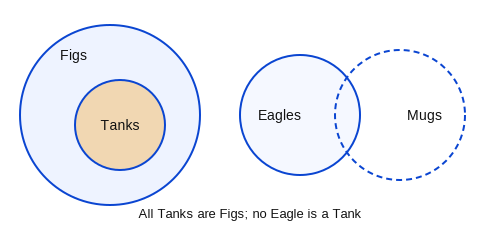
Concept: Draw the least-overlap diagram and test each conclusion.

  1. All tanks are figs and no eagle is a tank ⇒ the figs that are tanks are not eagles ⇒ Some figs are not eagles — (I) follows.
  2. Some mugs are eagles, and no eagle is a tank ⇒ those mugs are not tanks ⇒ Some mugs are not tanks — (II) follows.
  3. So both conclusions follow.

Trick: “Some A are B” + “No B is C” ⇒ “Some A are not C” always follows.

Answer: (B) Both conclusions (I) and (II) follow.

अवधारणा: न्यूनतम ओवरलैप वाला चित्र बनाकर हर निष्कर्ष जाँचें।

  1. सभी tanks figs हैं और कोई eagle tank नहीं ⇒ जो figs tanks हैं वे eagles नहीं ⇒ कुछ figs eagles नहीं हैं — (I) सही।
  2. कुछ mugs eagles हैं और कोई eagle tank नहीं ⇒ वे mugs tanks नहीं ⇒ कुछ mugs tanks नहीं हैं — (II) सही।
  3. अतः दोनों निष्कर्ष अनुसरण करते हैं।

ट्रिक: “कुछ A, B हैं” + “कोई B, C नहीं” ⇒ “कुछ A, C नहीं हैं” हमेशा सही।

उत्तर: (B) Both conclusions (I) and (II) follow.

RRB NTPC Graduate CBT 1General Intelligence and ReasoningSyllogismRRB NTPC Graduate CBT 1 2024 · 24 Jun Shift 3 →
Q6505.
If ‘P’ stands for ‘×’, ‘Q’ stands for ‘÷’, ‘R’ stands for ‘−’ and ‘S’ stands for ‘+’, then what will come in place of the question mark (?) in the following equation?
(110 R 32) Q 2 S 9 P 4 R 21 = ?
यदि ‘P’ का अर्थ ‘×’, ‘Q’ का अर्थ ‘÷’, ‘R’ का अर्थ ‘−’ और ‘S’ का अर्थ ‘+’ है, तो निम्नलिखित समीकरण में प्रश्नचिह्न (?) के स्थान पर क्या आएगा?
(110 R 32) Q 2 S 9 P 4 R 21 = ?
  1. A36
  2. B22
  3. C54
  4. D48
Show answer

Concept: Replace letters and follow BODMAS.

  1. (110−32)÷2+9×4−21
  2. =78÷2+36−21
  3. =39+36−21=54

Trick: Bracket first, then ÷ and ×, then + and −.

Answer: (C) 54

अवधारणा: अक्षरों को चिह्नों से बदलें और BODMAS लगाएँ।

  1. (110−32)÷2+9×4−21
  2. =78÷2+36−21
  3. =39+36−21=54

ट्रिक: पहले कोष्ठक, फिर ÷ व ×, फिर + व −।

उत्तर: (C) 54

RRB NTPC Graduate CBT 1General Intelligence and ReasoningMathematical operationsRRB NTPC Graduate CBT 1 2024 · 24 Jun Shift 3 →
Q6506.
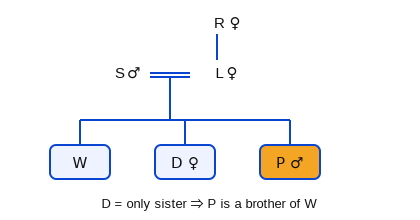
S is the father of W. D is the only sister of W. R is the mother's mother of D. L, the mother of P, is married to S.
How is P related to W?
S, W का पिता है। D, W की एकमात्र बहन है। R, D की माँ की माँ है। P की माँ L का विवाह S से हुआ है।
P का W से क्या संबंध है?
  1. ASister's husbandबहन का पति
  2. BFather's brotherपिता का भाई
  3. CBrotherभाई
  4. DSisterबहन
Show answer

Concept: Build the family tree from the statements.

  1. S is the father of W; L (S’s wife) is the mother of P ⇒ P and W are siblings.
  2. D is the only sister of W, so P cannot be another sister ⇒ P is male.
  3. Hence P is W’s brother. (R is L’s mother.)

Trick: “Only sister” clue fixes the gender of the other sibling.

Answer: (C) Brother

अवधारणा: कथनों से वंश-वृक्ष बनाएँ।

  1. S, W का पिता है; L (S की पत्नी) P की माँ है ⇒ P और W भाई-बहन हैं।
  2. D, W की इकलौती बहन है, अतः P दूसरी बहन नहीं हो सकती ⇒ P पुरुष है।
  3. अतः P, W का भाई है। (R, L की माँ है।)

ट्रिक: “इकलौती बहन” संकेत दूसरे भाई-बहन का लिंग तय कर देता है।

उत्तर: (C) Brother

RRB NTPC Graduate CBT 1General Intelligence and ReasoningBlood relationsRRB NTPC Graduate CBT 1 2024 · 24 Jun Shift 3 →
Q6507.
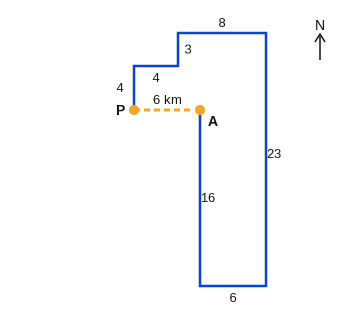
Mr. RST starts from Point A and drives 16 km towards the south. He then takes a left turn, drives 6 km, turns left and drives 23 km. He then takes a left turn and drives 8 km, turns left and drives 3 km. He then takes a right turn and drives 4 km. He takes a final left turn, drives 4 km and stops at Point P. How far (shortest distance) and in which direction should he drive in order to reach Point A again? (All turns are 90-degree turns only unless specified)
श्री RST बिंदु A से शुरू करते हैं और दक्षिण की ओर 16 km गाड़ी चलाते हैं। फिर वे बाएँ मुड़ते हैं, 6 km गाड़ी चलाते हैं, बाएँ मुड़ते हैं और 23 km गाड़ी चलाते हैं। फिर वे बाएँ मुड़ते हैं और 8 km गाड़ी चलाते हैं, बाएँ मुड़ते हैं और 3 km गाड़ी चलाते हैं। फिर वे दाएँ मुड़ते हैं और 4 km गाड़ी चलाते हैं। अंत में वे बाएँ मुड़ते हैं, 4 km गाड़ी चलाते हैं और बिंदु P पर रुक जाते हैं। बिंदु A पर फिर से पहुँचने के लिए उन्हें कितनी दूर (न्यूनतम दूरी) और किस दिशा में गाड़ी चलानी चाहिए? (जब तक निर्दिष्ट न हो, सभी मोड़ केवल 90-डिग्री के मोड़ हैं)
  1. A3 km to the westपश्चिम की ओर 3 km
  2. B5 km to the northउत्तर की ओर 5 km
  3. C6 km to the eastपूर्व की ओर 6 km
  4. D2 km to the southदक्षिण की ओर 2 km
Show answer

Concept: Track coordinates with A at (0,0); east = +x, north = +y.

  1. South 16 → (0,−16); left (east) 6 → (6,−16); left (north) 23 → (6,7).
  2. Left (west) 8 → (−2,7); left (south) 3 → (−2,4); right (west) 4 → (−6,4).
  3. Left (south) 4 → P =(−6,0).
  4. A is 6 km east of P.

Trick: Net x: 6−8−4=−6, net y: −16+23−3−4=0.

Answer: (C) 6 km to the east

अवधारणा: A को (0,0) मानकर निर्देशांक लें; पूर्व = +x, उत्तर = +y।

  1. दक्षिण 16 → (0,−16); बाएँ (पूर्व) 6 → (6,−16); बाएँ (उत्तर) 23 → (6,7)।
  2. बाएँ (पश्चिम) 8 → (−2,7); बाएँ (दक्षिण) 3 → (−2,4); दाएँ (पश्चिम) 4 → (−6,4)।
  3. बाएँ (दक्षिण) 4 → P =(−6,0)।
  4. A, P से 6 km पूर्व में है।

ट्रिक: कुल x: 6−8−4=−6, कुल y: −16+23−3−4=0।

उत्तर: (C) 6 km to the east

RRB NTPC Graduate CBT 1General Intelligence and ReasoningDirection and distanceRRB NTPC Graduate CBT 1 2024 · 24 Jun Shift 3 →
Q6508.
This question is based on the five, three-digit numbers given below.
(Left) 514 414 422 875 167 (Right)
(Example: 697 – First digit = 6, second digit = 9 and third digit = 7)
(Note: All operations to be done from left to right.)
What will be the resultant if the second digit of the highest number is subtracted from the second digit of the lowest number?
यह प्रश्न नीचे दी गई तीन-अंकीय पाँच संख्याओं पर आधारित है।
(बाएँ) 514 414 422 875 167 (दाएँ)
(उदाहरण: 697 – पहला अंक = 6, दूसरा अंक = 9 और तीसरा अंक = 7)
(नोट: सभी संक्रियाएँ बाएँ से दाएँ की जानी हैं।)
यदि सबसे बड़ी संख्या के दूसरे अंक को सबसे छोटी संख्या के दूसरे अंक में से घटाया जाए, तो परिणाम क्या होगा?
  1. A2
  2. B1
  3. C−1
  4. D−2
Show answer

Concept: Identify the highest and lowest numbers first.

  1. Highest = 875 (second digit 7); lowest = 167 (second digit 6).
  2. Second digit of highest subtracted from that of lowest: 6−7=−1

Trick: “X subtracted from Y” means Y−X.

Answer: (C) −1

अवधारणा: पहले सबसे बड़ी और सबसे छोटी संख्या पहचानें।

  1. सबसे बड़ी = 875 (दूसरा अंक 7); सबसे छोटी = 167 (दूसरा अंक 6)।
  2. बड़ी के दूसरे अंक को छोटी के दूसरे अंक से घटाएँ: 6−7=−1

ट्रिक: “X को Y से घटाया” का अर्थ Y−X।

उत्तर: (C) −1

RRB NTPC Graduate CBT 1General Intelligence and ReasoningNumber puzzle – digitsRRB NTPC Graduate CBT 1 2024 · 24 Jun Shift 3 →
Q6509.
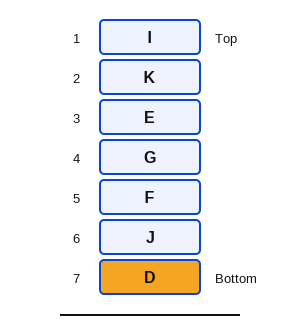
Seven boxes D, E, F, G, I, J and K are kept one over the other but not necessarily in the same order. Only three boxes are kept above G. Only one box is kept between J and G. Only three boxes are kept between J and K. K is kept at some place above G. E is kept immediately below K. F is kept at one of the places above D. I is not kept immediately above or below J. Which box is kept at the lowermost position?
सात बक्से D, E, F, G, I, J और K एक के ऊपर एक रखे हुए हैं, लेकिन जरूरी नहीं कि इसी क्रम में हों। G के ऊपर केवल तीन बक्से रखे हैं। J और G के बीच केवल एक बक्सा रखा है। J और K के बीच केवल तीन बक्से रखे हैं। K, G के ऊपर किसी स्थान पर रखा है। E, K के ठीक नीचे रखा है। F, D के ऊपर के स्थानों में से किसी एक पर रखा है। I, J के ठीक ऊपर या ठीक नीचे नहीं रखा है। सबसे नीचे के स्थान पर कौन-सा बक्सा रखा है?
  1. AK
  2. BD
  3. CG
  4. DF
Show answer

Concept: Number positions 1 (top) to 7 (bottom).

  1. Three above G ⇒ G = 4. One between J and G ⇒ J = 2 or 6.
  2. Three between J and K with K above G ⇒ J = 6, K = 2; E just below K ⇒ E = 3.
  3. Left: 1, 5, 7. I not next to J (5, 7) ⇒ I = 1; F above D ⇒ F = 5, D = 7.
  4. Order (top→bottom): I, K, E, G, F, J, D.

Trick: Fix the box with an exact position (G) first.

Answer: (B) D

अवधारणा: स्थान 1 (ऊपर) से 7 (नीचे) तक मानें।

  1. G के ऊपर तीन ⇒ G = 4। J और G के बीच एक ⇒ J = 2 या 6।
  2. J और K के बीच तीन और K, G से ऊपर ⇒ J = 6, K = 2; E, K के ठीक नीचे ⇒ E = 3।
  3. बचे: 1, 5, 7। I, J के सटे नहीं (5, 7) ⇒ I = 1; F, D से ऊपर ⇒ F = 5, D = 7।
  4. क्रम (ऊपर→नीचे): I, K, E, G, F, J, D।

ट्रिक: जिस बॉक्स का स्थान निश्चित है (G) उसे पहले रखें।

उत्तर: (B) D

RRB NTPC Graduate CBT 1General Intelligence and ReasoningBox arrangementRRB NTPC Graduate CBT 1 2024 · 24 Jun Shift 3 →
Q6510.
In the following triads, each group of letters is related to the subsequent one following a certain logic. Select from the given options, the one that follows the same logic. SAND - DSNA - SDAN
GUNT - TGNU - GTUN
निम्नलिखित त्रिकों में, अक्षरों का प्रत्येक समूह एक निश्चित तर्क के अनुसार अपने बाद वाले समूह से संबंधित है। दिए गए विकल्पों में से उस विकल्प का चयन कीजिए जो समान तर्क का अनुसरण करता है। SAND - DSNA - SDAN
GUNT - TGNU - GTUN
  1. AJUNK - KJNU - JKUN
  2. BSEAL - ESAL - LEAS
  3. CFEAR - RFEA - EARF
  4. DPOLE - EPLO - POEL
Show answer

Concept: Find the position-shuffle rule.

  1. SAND (1 2 3 4) → DSNA = positions 4, 1, 3, 2.
  2. DSNA → SDAN = swap 1st–2nd and 3rd–4th.
  3. GUNT → TGNU → GTUN fits. JUNK → KJNU → JKUN fits ✔

Trick: Write positions as numbers (4132) and apply them to options.

Answer: (A) JUNK - KJNU - JKUN

अवधारणा: स्थान-बदल नियम खोजें।

  1. SAND (1 2 3 4) → DSNA = स्थान 4, 1, 3, 2।
  2. DSNA → SDAN = 1-2 और 3-4 की अदला-बदली।
  3. GUNT → TGNU → GTUN सही। JUNK → KJNU → JKUN सही ✔

ट्रिक: स्थानों को संख्या (4132) में लिखकर विकल्पों पर लगाएँ।

उत्तर: (A) JUNK - KJNU - JKUN

RRB NTPC Graduate CBT 1General Intelligence and ReasoningLetter triadsRRB NTPC Graduate CBT 1 2024 · 24 Jun Shift 3 →
Q6511.
Which of the following letter-clusters should replace # and % so that the pattern and relationship followed between the letter-cluster pair on the left side of :: is the same as that on the right side of :: ?
# : RMN :: TOP : %
निम्नलिखित में से कौन-से अक्षर-समूह # और % को प्रतिस्थापित करने चाहिए ताकि :: के बाईं ओर के अक्षर-समूह युग्म के बीच अनुसरित पैटर्न और संबंध वही हो जो :: के दाईं ओर है?
# : RMN :: TOP : %
  1. A# = MHI, % = YTU
  2. B# = MOU, % = YLU
  3. C# = KJI, % = YMU
  4. D# = NHI, % = YOK
Show answer

Concept: Find the letter shift from # to RMN and apply the same to TOP.

  1. Option A: M → R, H → M, I → N — each +5.
  2. TOP +5: T → Y, O → T, P → U ⇒ YTU ✔

Trick: Check one pair fully, then apply the same shift to the other.

Answer: (A) # = MHI, % = YTU

अवधारणा: # से RMN तक का अक्षर-अंतर ज्ञात कर TOP पर लगाएँ।

  1. विकल्प A: M → R, H → M, I → N — हर अक्षर +5।
  2. TOP +5: T → Y, O → T, P → U ⇒ YTU ✔

ट्रिक: एक जोड़ी पूरी जाँचें, फिर वही अंतर दूसरी पर लगाएँ।

उत्तर: (A) # = MHI, % = YTU

RRB NTPC Graduate CBT 1General Intelligence and ReasoningLetter analogyRRB NTPC Graduate CBT 1 2024 · 24 Jun Shift 3 →
Q6512.
David ranked 19th from the top and 25th from the bottom in his class. How many students are there in his class?
डेविड अपनी कक्षा में ऊपर से 19वें और नीचे से 25वें स्थान पर था। उसकी कक्षा में कितने विद्यार्थी हैं?
  1. A42
  2. B43
  3. C44
  4. D45
Show answer

Concept: Total = rank from top + rank from bottom − 1.

  1. 19+25−1=43

Trick: Subtract 1 because David is counted twice.

Answer: (B) 43

अवधारणा: कुल = ऊपर से रैंक + नीचे से रैंक − 1।

  1. 19+25−1=43

ट्रिक: 1 घटाएँ क्योंकि डेविड दो बार गिना गया।

उत्तर: (B) 43

RRB NTPC Graduate CBT 1General Intelligence and ReasoningRankingRRB NTPC Graduate CBT 1 2024 · 24 Jun Shift 3 →
Q6513.
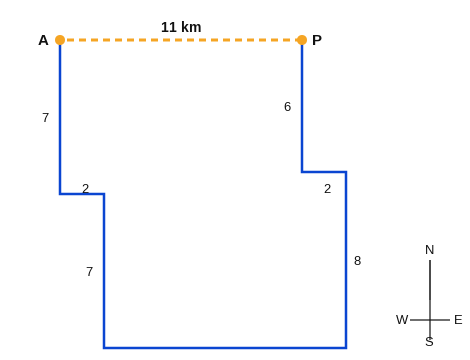
Zakir starts from Point A and drives 7 km towards the South. He then takes a left turn, drives 2 km, turns right and drives 7 km. He then takes a left turn and drives 11 km. He then takes a left turn and drives 8 km. He then takes a left turn and drives 2 turns. He takes a final right turn, drives 6 km and stops at Point P. How far (shortest distance) and towards which direction should he drive in order to reach Point A again? (All turns are 90 degrees turns only unless specified.)
ज़ाकिर बिंदु A से शुरू करता है और दक्षिण की ओर 7 km गाड़ी चलाता है। फिर वह बाएँ मुड़ता है, 2 km गाड़ी चलाता है, दाएँ मुड़ता है और 7 km गाड़ी चलाता है। फिर वह बाएँ मुड़ता है और 11 km गाड़ी चलाता है। फिर वह बाएँ मुड़ता है और 8 km गाड़ी चलाता है। फिर वह बाएँ मुड़ता है और 2 टर्न गाड़ी चलाता है। अंत में वह दाएँ मुड़ता है, 6 km गाड़ी चलाता है और बिंदु P पर रुक जाता है। बिंदु A पर फिर से पहुँचने के लिए उसे कितनी दूर (न्यूनतम दूरी) और किस दिशा में गाड़ी चलानी चाहिए? (जब तक निर्दिष्ट न हो, सभी मोड़ केवल 90 डिग्री के मोड़ हैं।)
  1. A10 km to the Westपश्चिम की ओर 10 km
  2. B9 km to the Westपश्चिम की ओर 9 km
  3. C11 km to the Westपश्चिम की ओर 11 km
  4. D13 km to the Westपश्चिम की ओर 13 km
Show answer

Concept: Track the position with coordinates: East (+x), North (+y), starting at A = (0, 0).

  1. South 7 → (0, −7); left (East) 2 → (2, −7); right (South) 7 → (2, −14).
  2. Left (East) 11 → (13, −14); left (North) 8 → (13, −6); left (West) 2 → (11, −6).
  3. Right (North) 6 → P = (11, 0).
  4. P is on the same level as A and 11 km to its East, so he must drive 11 km West.

Trick: Net North-South: −7−7+8+6=0; net East-West: 2+11−2=11 East. Return = 11 km West.

Answer: (C) 11 km to the West

अवधारणा: निर्देशांक (coordinates) से स्थिति ज्ञात करें: पूर्व (+x), उत्तर (+y), A = (0, 0)।

  1. दक्षिण 7 → (0, −7); बाएँ (पूर्व) 2 → (2, −7); दाएँ (दक्षिण) 7 → (2, −14)।
  2. बाएँ (पूर्व) 11 → (13, −14); बाएँ (उत्तर) 8 → (13, −6); बाएँ (पश्चिम) 2 → (11, −6)।
  3. दाएँ (उत्तर) 6 → P = (11, 0)।
  4. P, A के ठीक 11 km पूर्व में है, अतः उसे 11 km पश्चिम जाना होगा।

ट्रिक: कुल उत्तर-दक्षिण: −7−7+8+6=0; कुल पूर्व-पश्चिम: 2+11−2=11 पूर्व। वापसी = 11 km पश्चिम।

उत्तर: (C) 11 km पश्चिम की ओर

RRB NTPC Graduate CBT 1General Intelligence and ReasoningDirection and distanceRRB NTPC Graduate CBT 1 2024 · 24 Jun Shift 3 →
Q6514.
This question is based on the five, three-digit numbers given below.
(Left) 103 678 217 111 537 (Right)
(Example: 697 – First digit = 6, second digit = 9 and third digit = 7)
(Note: All operations to be done from left to right.)
What will be the resultant if the second digit of the highest number is added to the first digit of the lowest number?
यह प्रश्न नीचे दी गई तीन-अंकीय पाँच संख्याओं पर आधारित है।
(बाएँ) 103 678 217 111 537 (दाएँ)
(उदाहरण: 697 – पहला अंक = 6, दूसरा अंक = 9 और तीसरा अंक = 7)
(नोट: सभी संक्रियाएँ बाएँ से दाएँ की जानी हैं।)
यदि सबसे बड़ी संख्या के दूसरे अंक को सबसे छोटी संख्या के पहले अंक में जोड़ा जाए, तो परिणाम क्या होगा?
  1. A12
  2. B10
  3. C8
  4. D6
Show answer

Concept: Identify the highest and lowest numbers, then pick the asked digits.

  1. Numbers: 103, 678, 217, 111, 537.
  2. Highest = 678 → second digit = 7.
  3. Lowest = 103 → first digit = 1.
  4. 7+1=8

Trick: Compare first digits to find the extremes quickly: 6 is the biggest, 1 the smallest (103 < 111).

Answer: (C) 8

अवधारणा: सबसे बड़ी और सबसे छोटी संख्या पहचानें, फिर माँगे गए अंक लें।

  1. संख्याएँ: 103, 678, 217, 111, 537।
  2. सबसे बड़ी = 678 → दूसरा अंक = 7।
  3. सबसे छोटी = 103 → पहला अंक = 1।
  4. 7+1=8

ट्रिक: पहले अंक से तुलना करें: 6 सबसे बड़ा; 1 वाले में 103 < 111।

उत्तर: (C) 8

RRB NTPC Graduate CBT 1General Intelligence and ReasoningNumber-digit operationsRRB NTPC Graduate CBT 1 2024 · 24 Jun Shift 3 →
Q6515.
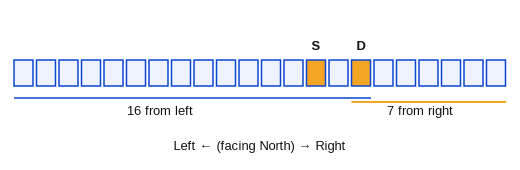
In a row of 22 students facing north, Suman is 14th from the left end. If Dipa is 2nd to the right of Suman, what is Dipa's position from the right end of the line?
उत्तर की ओर मुख किए 22 विद्यार्थियों की एक पंक्ति में, सुमन बाएँ छोर से 14वें स्थान पर है। यदि दीपा, सुमन के दाईं ओर दूसरे स्थान पर है, तो पंक्ति के दाएँ छोर से दीपा का स्थान क्या है?
  1. A5th5वाँ
  2. B7th7वाँ
  3. C8th8वाँ
  4. D6th6वाँ
Show answer

Concept: Position from right =Total−Position from left+1.

  1. Facing north, right = east side; Dipa is 2nd to the right of Suman.
  2. Dipa from left =14+2=16
  3. Dipa from right =22−16+1=7

Trick: Left + Right − 1 = Total → 16+7−1=22 ✔

Answer: (B) 7th

अवधारणा: दाएँ से स्थान =कुल−बाएँ से स्थान+1।

  1. उत्तर की ओर मुख होने पर दायाँ = पूर्व; दीपा, सुमन के दाएँ दूसरे स्थान पर है।
  2. दीपा बाएँ से =14+2=16
  3. दीपा दाएँ से =22−16+1=7

ट्रिक: बाएँ + दाएँ − 1 = कुल → 16+7−1=22 ✔

उत्तर: (B) 7वाँ

RRB NTPC Graduate CBT 1General Intelligence and ReasoningRanking and positionRRB NTPC Graduate CBT 1 2024 · 24 Jun Shift 3 →
Q6516.
Which of the following letter-number clusters will replace the question mark (?) in the given series to make it logically complete?
AAA 5, BCD 10, CEG 15, DGJ 20, ?
निम्नलिखित में से कौन-सा अक्षर-संख्या समूह दी गई श्रृंखला में प्रश्नचिह्न (?) के स्थान पर आकर इसे तार्किक रूप से पूर्ण करेगा?
AAA 5, BCD 10, CEG 15, DGJ 20, ?
  1. AEIM 25
  2. BEKM 25
  3. CETM 25
  4. DEGM 25
Show answer

Concept: First letter moves +1; within each cluster the gap between letters grows by 1 each term; the number increases by 5.

  1. AAA: gap 0; BCD: gap +1; CEG: gap +2; DGJ: gap +3.
  2. Next: start E, gap +4 → E(5), I(9), M(13) = EIM.
  3. Numbers: 5, 10, 15, 20, 25.

Trick: Use positions: E=5, I=9, M=13 (EJOTY: E5 J10 O15 T20 Y25).

Answer: (A) EIM 25

अवधारणा: पहला अक्षर +1 बढ़ता है; हर समूह में अक्षरों का अंतर हर पद में 1 बढ़ता है; संख्या 5 बढ़ती है।

  1. AAA: अंतर 0; BCD: +1; CEG: +2; DGJ: +3।
  2. अगला: E से शुरू, अंतर +4 → E(5), I(9), M(13) = EIM।
  3. संख्याएँ: 5, 10, 15, 20, 25।

ट्रिक: स्थान याद रखें: E=5, I=9, M=13 (EJOTY: E5 J10 O15 T20 Y25)।

उत्तर: (A) EIM 25

RRB NTPC Graduate CBT 1General Intelligence and ReasoningLetter-number seriesRRB NTPC Graduate CBT 1 2024 · 24 Jun Shift 3 →
Q6517.
If 1 is added to each even digit and 1 is subtracted from each odd digit in the number 7521432, what will be the sum of digits which are second from left and third from right in the new number thus formed?
यदि संख्या 7521432 के प्रत्येक सम अंक में 1 जोड़ा जाता है और प्रत्येक विषम अंक में से 1 घटाया जाता है, तो इस प्रकार बनी नई संख्या में बाएँ से दूसरे और दाएँ से तीसरे अंकों का योग क्या होगा?
  1. A9
  2. B6
  3. C10
  4. D8
Show answer

Concept: Change each digit (even +1, odd −1) and then read the required positions.

  1. 7521432 → 7−1, 5−1, 2+1, 1−1, 4+1, 3−1, 2+1 = 6430523.
  2. Second from left = 4.
  3. Third from right (3, 2, 5) = 5.
  4. 4+5=9

Trick: Only transform the two digits you need: 2nd digit 5 → 4; 3rd from right is 4 → 5.

Answer: (A) 9

अवधारणा: हर अंक बदलें (सम +1, विषम −1), फिर माँगे गए स्थान पढ़ें।

  1. 7521432 → 7−1, 5−1, 2+1, 1−1, 4+1, 3−1, 2+1 = 6430523।
  2. बाएँ से दूसरा = 4।
  3. दाएँ से तीसरा (3, 2, 5) = 5।
  4. 4+5=9

ट्रिक: केवल ज़रूरी दो अंक बदलें: दूसरा अंक 5 → 4; दाएँ से तीसरा 4 → 5।

उत्तर: (A) 9

RRB NTPC Graduate CBT 1General Intelligence and ReasoningDigit operationsRRB NTPC Graduate CBT 1 2024 · 24 Jun Shift 3 →
Q6518.
VBCD is related to MTTV in a certain way based on the English alphabetical order. In the same way, LVSX is related to CNJP. To which of the following options is KXRZ related, following the same logic?
अंग्रेज़ी वर्णमाला क्रम के आधार पर VBCD एक निश्चित प्रकार से MTTV से संबंधित है। उसी प्रकार, LVSX, CNJP से संबंधित है। समान तर्क का अनुसरण करते हुए, KXRZ निम्नलिखित में से किस विकल्प से संबंधित है?
  1. ABROP
  2. BBPIR
  3. CBPRI
  4. DBRIP
Show answer

Concept: Compare alphabet positions letter by letter (wrap around after Z).

  1. LVSX → CNJP: L(12)−9=C, V(22)−8=N, S(19)−9=J, X(24)−8=P → pattern −9, −8, −9, −8.
  2. Check VBCD: V−9=M, B−8=T, C−9=T, D−8=V ✔ (MTTV).
  3. KXRZ: K(11)−9=B, X(24)−8=P, R(18)−9=I, Z(26)−8=R → BPIR.

Trick: For wrap-around, −8 is the same as +18 and −9 is +17.

Answer: (B) BPIR

अवधारणा: अक्षरों की वर्णमाला स्थिति एक-एक कर तुलना करें (Z के बाद फिर A से)।

  1. LVSX → CNJP: L(12)−9=C, V(22)−8=N, S(19)−9=J, X(24)−8=P → पैटर्न −9, −8, −9, −8।
  2. VBCD जाँच: V−9=M, B−8=T, C−9=T, D−8=V ✔ (MTTV)।
  3. KXRZ: K(11)−9=B, X(24)−8=P, R(18)−9=I, Z(26)−8=R → BPIR।

ट्रिक: चक्र में −8 = +18 और −9 = +17।

उत्तर: (B) BPIR

RRB NTPC Graduate CBT 1General Intelligence and ReasoningLetter analogyRRB NTPC Graduate CBT 1 2024 · 24 Jun Shift 3 →
Q6519.
Each of the digits in the number 5123487 is arranged in ascending order from left to right. The position(s) of how many digits will remain unchanged as compared to that in the original number?
संख्या 5123487 के प्रत्येक अंक को बाएँ से दाएँ आरोही क्रम में व्यवस्थित किया जाता है। मूल संख्या की तुलना में कितने अंकों का/के स्थान अपरिवर्तित रहेगा/रहेंगे?
  1. ATwoदो
  2. BOneएक
  3. CNoneकोई नहीं
  4. DThreeतीन
Show answer

Concept: Write the number in ascending order and compare digit by digit.

  1. Original: 5 1 2 3 4 8 7
  2. Ascending: 1 2 3 4 5 7 8
  3. Position-wise: 5→1, 1→2, 2→3, 3→4, 4→5, 8→7, 7→8 — no digit stays in place.

Trick: Since 5 shifts every small digit one step left, positions 1–5 all change; 8 and 7 swap.

Answer: (C) None

अवधारणा: संख्या को आरोही क्रम में लिखें और अंक-दर-अंक तुलना करें।

  1. मूल: 5 1 2 3 4 8 7
  2. आरोही: 1 2 3 4 5 7 8
  3. स्थान-वार: 5→1, 1→2, 2→3, 3→4, 4→5, 8→7, 7→8 — कोई अंक अपनी जगह नहीं।

ट्रिक: 5 हटने से छोटे अंक एक स्थान खिसक जाते हैं; 8 और 7 आपस में बदलते हैं।

उत्तर: (C) कोई नहीं

RRB NTPC Graduate CBT 1General Intelligence and ReasoningDigit arrangementRRB NTPC Graduate CBT 1 2024 · 24 Jun Shift 3 →
Q6520.
In a certain code language, ‘CURE’ is coded as ‘5783’ and ‘RIGS’ is coded as ‘2179’. What is the code for ‘R’ in the given code language?
एक निश्चित कूट भाषा में, ‘CURE’ को ‘5783’ के रूप में कूटबद्ध किया जाता है और ‘RIGS’ को ‘2179’ के रूप में कूटबद्ध किया जाता है। दी गई कूट भाषा में ‘R’ के लिए कूट क्या है?
  1. A2
  2. B1
  3. C8
  4. D7
Show answer

Concept: Letters common to two words share the digit common to their codes (codes are jumbled).

  1. CURE = 5783 and RIGS = 2179.
  2. Common letter: R; common digit: 7.
  3. So R = 7.

Trick: Common letter ↔ common digit.

Answer: (D) 7

अवधारणा: दो शब्दों में उभयनिष्ठ अक्षर का कोड उनके कोडों में उभयनिष्ठ अंक होता है (कोड क्रम में नहीं)।

  1. CURE = 5783 और RIGS = 2179।
  2. उभयनिष्ठ अक्षर: R; उभयनिष्ठ अंक: 7।
  3. अतः R = 7।

ट्रिक: उभयनिष्ठ अक्षर ↔ उभयनिष्ठ अंक।

उत्तर: (D) 7

RRB NTPC Graduate CBT 1General Intelligence and ReasoningCoding-decodingRRB NTPC Graduate CBT 1 2024 · 24 Jun Shift 3 →