Question bank

Q&A: practice questions with answers

Search questions on any topic. Filter by exam category, exam, subject and topic, try the question, then open the answer and explanation.

Courses – airGurukul

20,719 questions found.

Q6581.
If Ojaswita received the following marks in five assignments: 82, 86, 92, 75, and 95, what is her average score?
यदि ओजस्विता को पाँच असाइनमेंट में निम्नलिखित अंक प्राप्त हुए: 82, 86, 92, 75 और 95, तो उसका औसत अंक क्या है?
  1. A84
  2. B86
  3. C87
  4. D89
Show answer

Concept: Average=Sum of observationsNumber of observations

  1. Sum =82+86+92+75+95=430.
  2. Average =4305=86.

Trick: Take 86 as base: deviations −4,0,+6,−11,+9 sum to 0, so average is 86.

Answer: (B) 86

अवधारणा: औसत=प्रेक्षणों का योगप्रेक्षणों की संख्या

  1. योग =82+86+92+75+95=430।
  2. औसत =4305=86।

ट्रिक: 86 को आधार मानें: विचलन −4,0,+6,−11,+9 का योग 0 है, अतः औसत 86।

उत्तर: (B) 86

RRB NTPC Graduate CBT 1MathematicsAverageRRB NTPC Graduate CBT 1 2024 · 24 Jun Shift 2 →
Q6582.
The population of a village was 1,20,000. It increased by 15% in the first year and increased by 20% in the second year. Its population after two years is _______.
एक गाँव की जनसंख्या 1,20,000 थी। पहले वर्ष में इसमें 15% की वृद्धि हुई और दूसरे वर्ष में 20% की वृद्धि हुई। दो वर्ष बाद इसकी जनसंख्या _______ है।
  1. A1,65,600
  2. B1,38,000
  3. C1,62,000
  4. D1,44,000
Show answer

Concept: Successive increases multiply: P×(1+r1100)(1+r2100).

  1. After 1st year: 120000×1.15=138000.
  2. After 2nd year: 138000×1.20=165600.

Trick: Net % =15+20+15×20100=38%; 38% of 120000=45600 → 165600.

Answer: (A) 1,65,600

अवधारणा: क्रमागत वृद्धि गुणा होती है: P×(1+r1100)(1+r2100)।

  1. पहले वर्ष के बाद: 120000×1.15=138000।
  2. दूसरे वर्ष के बाद: 138000×1.20=165600।

ट्रिक: शुद्ध % =15+20+15×20100=38%; 120000 का 38%=45600 → 165600।

उत्तर: (A) 1,65,600

RRB NTPC Graduate CBT 1MathematicsPopulation Growth – Successive %RRB NTPC Graduate CBT 1 2024 · 24 Jun Shift 2 →
Q6583.
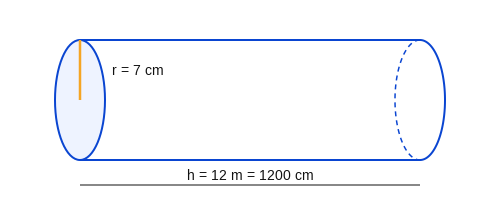
The volume (in cm3) of a wire of diameter 14 cm and length 12 m is:
(Take π=227)
14 cm व्यास और 12 m लंबाई वाले एक तार का आयतन (cm3 में) है:
(π=227 लीजिए)
  1. A1,84,400
  2. B1,84,300
  3. C1,84,700
  4. D1,84,800
Show answer

Concept: A wire is a cylinder: V=πr2h (same units for r and h).

  1. Diameter 14cm ⇒ r=7cm; length 12m=1200cm.
  2. V=227×7×7×1200=154×1200.
  3. V=184800cm3.

Trick: πr2 for r=7 is always 154 – remember it.

Answer: (D) 1,84,800

अवधारणा: तार एक बेलन है: V=πr2h (r और h एक ही इकाई में)।

  1. व्यास 14cm ⇒ r=7cm; लंबाई 12m=1200cm।
  2. V=227×7×7×1200=154×1200।
  3. V=184800cm3।

ट्रिक: r=7 के लिए πr2=154 हमेशा याद रखें।

उत्तर: (D) 1,84,800

RRB NTPC Graduate CBT 1MathematicsMensuration – CylinderRRB NTPC Graduate CBT 1 2024 · 24 Jun Shift 2 →
Q6584.
What sum (in ₹) will earn an interest of ₹420 in 2 years at 5% simple interest per year?
प्रति वर्ष 5% साधारण ब्याज की दर से कितनी राशि (₹ में) पर 2 वर्षों में ₹420 का ब्याज प्राप्त होगा?
  1. A₹4,350
  2. B₹4,400
  3. C₹4,000
  4. D₹4,200
Show answer

Concept: SI=P×R×T100 ⇒ P=SI×100R×T.

  1. P=420×1005×2.
  2. P=4200010=4200.

Trick: 5% for 2 years =10%; 10% of P =420 ⇒ P =4200.

Answer: (D) ₹4,200

अवधारणा: SI=P×R×T100 ⇒ P=SI×100R×T।

  1. P=420×1005×2।
  2. P=4200010=4200।

ट्रिक: 2 वर्ष का 5% =10%; P का 10%=420 ⇒ P =4200।

उत्तर: (D) ₹4,200

RRB NTPC Graduate CBT 1MathematicsSimple InterestRRB NTPC Graduate CBT 1 2024 · 24 Jun Shift 2 →
Q6585.
Simplify: (1518)(153)÷(36×129+26)+38÷1815 of 158
सरल कीजिए: (1518)(153)÷(36×129+26)+38÷1815 of 158
  1. A713
  2. B29
  3. C13
  4. D57
Show answer

Concept: Use BODMAS: brackets, then 'of', then division/multiplication (left to right), then addition.

  1. 1518÷153=56×15=16.
  2. Bracket: 36×129+26=23+13=1 ⇒ 16÷1=16.
  3. 'of' first: 1815×158=188; 38÷188=318=16.
  4. Total =16+16=13.

Trick: 'of' is solved before ÷ – that is the key step here.

Answer: (C) 13

अवधारणा: BODMAS लगाएँ: कोष्ठक, फिर 'of', फिर भाग/गुणा (बाएँ से दाएँ), फिर जोड़।

  1. 1518÷153=56×15=16।
  2. कोष्ठक: 36×129+26=23+13=1 ⇒ 16÷1=16।
  3. पहले 'of': 1815×158=188; 38÷188=318=16।
  4. कुल =16+16=13।

ट्रिक: 'of' को ÷ से पहले हल करें – यही मुख्य कदम है।

उत्तर: (C) 13

RRB NTPC Graduate CBT 1MathematicsSimplification – Fractions (BODMAS)RRB NTPC Graduate CBT 1 2024 · 24 Jun Shift 2 →
Q6586.
Find the greatest number by which when the numbers 176 and 273 are divided, it leaves remainders 5 and 3, respectively.
वह बड़ी से बड़ी संख्या ज्ञात कीजिए, जिससे 176 और 273 को विभाजित करने पर क्रमशः 5 और 3 शेषफल प्राप्त होते हैं।
  1. A12
  2. B14
  3. C10
  4. D9
Show answer

Concept: Required number = HCF of (number − remainder) values.

  1. 176−5=171 and 273−3=270.
  2. 171=32×19, 270=2×33×5.
  3. HCF =32=9 (and 9>5, so the remainders are valid).

Trick: Check options: 171÷9=19, 270÷9=30 – both exact.

Answer: (D) 9

अवधारणा: अभीष्ट संख्या = (संख्या − शेषफल) का HCF।

  1. 176−5=171 और 273−3=270।
  2. 171=32×19, 270=2×33×5।
  3. HCF =32=9 (और 9>5, अतः शेषफल मान्य हैं)।

ट्रिक: विकल्प जाँचें: 171÷9=19, 270÷9=30 – दोनों पूर्ण।

उत्तर: (D) 9

RRB NTPC Graduate CBT 1MathematicsHCF with RemaindersRRB NTPC Graduate CBT 1 2024 · 24 Jun Shift 2 →
Q6587.
David’s salary was first reduced by 17% and subsequently raised by 10%. How much percentage was his final salary lower compared to his initial salary?
डेविड के वेतन में पहले 17% की कमी की गई और उसके बाद 10% की वृद्धि की गई। उसका अंतिम वेतन उसके प्रारंभिक वेतन की तुलना में कितने प्रतिशत कम था?
  1. A1.7%
  2. B17%
  3. C8.7%
  4. D10%
Show answer

Concept: Net change =a+b+ab100 (decrease taken negative).

  1. a=−17, b=+10.
  2. Net =−17+10+(−17)(10)100=−7−1.7=−8.7%.
  3. So the final salary is 8.7% lower.

Trick: Take salary 100: 100→83→91.3 ⇒ 8.7% less.

Answer: (C) 8.7%

अवधारणा: शुद्ध परिवर्तन =a+b+ab100 (कमी ऋणात्मक)।

  1. a=−17, b=+10।
  2. शुद्ध =−17+10+(−17)(10)100=−7−1.7=−8.7%।
  3. अतः अंतिम वेतन 8.7% कम है।

ट्रिक: वेतन 100 मानें: 100→83→91.3 ⇒ 8.7% कम।

उत्तर: (C) 8.7%

RRB NTPC Graduate CBT 1MathematicsSuccessive Percentage ChangeRRB NTPC Graduate CBT 1 2024 · 24 Jun Shift 2 →
Q6588.
Which smallest number should be added to 25553 so that the sum is completely divisible by 38?
25553 में कौन-सी सबसे छोटी संख्या जोड़ी जानी चाहिए, ताकि योगफल 38 से पूर्णतः विभाज्य हो?
  1. A21
  2. B22
  3. C23
  4. D18
Show answer

Concept: Least number to add = divisor − remainder.

  1. 25553÷38: 38×672=25536, remainder =17.
  2. Number to add =38−17=21.
  3. Check: 25553+21=25574=38×673.

Trick: Subtract-to-divide needs the remainder; add-to-divide needs (divisor − remainder).

Answer: (A) 21

अवधारणा: जोड़ी जाने वाली न्यूनतम संख्या = भाजक − शेषफल।

  1. 25553÷38: 38×672=25536, शेषफल =17।
  2. जोड़ें =38−17=21।
  3. जाँच: 25553+21=25574=38×673।

ट्रिक: घटाने के लिए शेषफल; जोड़ने के लिए (भाजक − शेषफल)।

उत्तर: (A) 21

RRB NTPC Graduate CBT 1MathematicsDivisibility – Least Number to AddRRB NTPC Graduate CBT 1 2024 · 24 Jun Shift 2 →
Q6589.
The ratio of an exterior angle to the interior angle of a regular polygon A is 1 : 4. Find the number of sides of A.
एक सम बहुभुज A के बाह्य कोण और अंतः कोण का अनुपात 1 : 4 है। A की भुजाओं की संख्या ज्ञात कीजिए।
  1. A8
  2. B9
  3. C10
  4. D12
Show answer

Concept: Exterior + interior angle =180∘; number of sides n=360∘exterior angle.

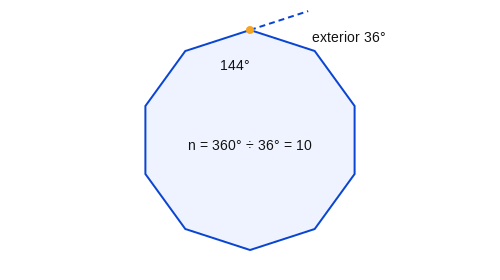
  1. Ratio 1:4 ⇒ exterior =15×180∘=36∘, interior =144∘.
  2. n=360∘36∘=10.

Trick: Ratio 1:k ⇒ n=2(k+1); here 2×5=10.

Answer: (C) 10

अवधारणा: बाह्य + आंतरिक कोण =180∘; भुजाओं की संख्या n=360∘बाह्य कोण।

  1. अनुपात 1:4 ⇒ बाह्य =15×180∘=36∘, आंतरिक =144∘।
  2. n=360∘36∘=10।

ट्रिक: अनुपात 1:k ⇒ n=2(k+1); यहाँ 2×5=10।

उत्तर: (C) 10

RRB NTPC Graduate CBT 1MathematicsPolygons – Exterior AngleRRB NTPC Graduate CBT 1 2024 · 24 Jun Shift 2 →
Q6590.
If x=2+3, what is the value of x2+1x2?
यदि x=2+3 है, तो x2+1x2 का मान क्या है?
  1. A14
  2. B16
  3. C30
  4. D26
Show answer

Concept: If x+1x=k, then x2+1x2=k2−2.

  1. 1x=12+3=2−34−3=2−3.
  2. x+1x=(2+3)+(2−3)=4.
  3. x2+1x2=42−2=14.

Trick: For x=a+b with a2−b=1: x+1x=2a.

Answer: (A) 14

अवधारणा: यदि x+1x=k, तो x2+1x2=k2−2।

  1. 1x=12+3=2−34−3=2−3।
  2. x+1x=(2+3)+(2−3)=4।
  3. x2+1x2=42−2=14।

ट्रिक: x=a+b और a2−b=1 हो तो x+1x=2a।

उत्तर: (A) 14

RRB NTPC Graduate CBT 1MathematicsAlgebra – SurdsRRB NTPC Graduate CBT 1 2024 · 24 Jun Shift 2 →
Q6591.
The profit made on a product is 66%. What is the loss percentage (rounded off to two decimal place) incurred on the sale if the figures of both the cost price and the selling price are interchanged?
किसी उत्पाद पर 66% का लाभ होता है। यदि क्रय मूल्य और विक्रय मूल्य दोनों के आँकड़े आपस में बदल दिए जाएँ, तो बिक्री पर होने वाली हानि का प्रतिशत (दो दशमलव स्थानों तक पूर्णांकित) क्या होगा?
  1. A39.76%
  2. B38.40%
  3. C41.12%
  4. D38.57%
Show answer

Concept: Loss%=LossCP×100.

  1. Let CP =100 ⇒ SP =166 (profit 66%).
  2. Interchange: CP =166, SP =100 ⇒ loss =66.
  3. Loss %=66166×100≈39.76%.

Trick: Shortcut: P100+P×100=66166×100.

Answer: (A) 39.76%

अवधारणा: हानि%=हानिCP×100।

  1. CP =100 मानें ⇒ SP =166 (लाभ 66%)।
  2. अदला-बदली: CP =166, SP =100 ⇒ हानि =66।
  3. हानि %=66166×100≈39.76%।

ट्रिक: शॉर्टकट: P100+P×100=66166×100।

उत्तर: (A) 39.76%

RRB NTPC Graduate CBT 1MathematicsProfit and Loss – Interchange of CP and SPRRB NTPC Graduate CBT 1 2024 · 24 Jun Shift 2 →
Q6592.
Anuj gets double the amount in 10 years when invested at compound interest, compounded annually. In how many years will the amount become four times itself?
चक्रवृद्धि ब्याज, जो वार्षिक रूप से संयोजित होता है, पर निवेश करने पर अनुज को 10 वर्षों में दोगुनी राशि मिलती है। कितने वर्षों में राशि स्वयं की चार गुना हो जाएगी?
  1. A39
  2. B19
  3. C20
  4. D40
Show answer

Concept: At compound interest, the multiplying factor for equal periods repeats: A=P(1+r)n.

  1. P→2P in 10 years ⇒ (1+r)10=2.
  2. 4P needs (1+r)n=4=22=(1+r)20.
  3. So n=20 years.

Trick: CI: 2 times in t yrs ⇒ 2k times in k×t yrs (4=22 ⇒ 20).

Answer: (C) 20

अवधारणा: चक्रवृद्धि ब्याज में समान अवधि का गुणांक दोहराता है: A=P(1+r)n।

  1. P→2P, 10 वर्ष में ⇒ (1+r)10=2।
  2. 4P के लिए (1+r)n=4=22=(1+r)20।
  3. अतः n=20 वर्ष।

ट्रिक: CI: t वर्ष में 2 गुना ⇒ k×t वर्ष में 2k गुना (4=22 ⇒ 20)।

उत्तर: (C) 20

RRB NTPC Graduate CBT 1MathematicsCompound Interest – Doubling TimeRRB NTPC Graduate CBT 1 2024 · 24 Jun Shift 2 →
Q6593.
Simplify: 1+sinA1−sinA+1−sinA1+sinA
सरल कीजिए: 1+sinA1−sinA+1−sinA1+sinA
  1. A2cosA
  2. B2secA
  3. C2cosecA
  4. D2sinA
Show answer

Concept: Rationalise each root using 1−sin2A=cos2A.

  1. 1+sinA1−sinA=(1+sinA)2cos2A=1+sinAcosA.
  2. Similarly 1−sinA1+sinA=1−sinAcosA.
  3. Sum =2cosA=2secA.

Trick: Put A=0∘: expression =1+1=2; only 2sec0∘=2 and 2cos0∘=2 – try A=60∘ to confirm 2secA.

Answer: (B) 2secA

अवधारणा: 1−sin2A=cos2A से हर मूल का परिमेयकरण करें।

  1. 1+sinA1−sinA=(1+sinA)2cos2A=1+sinAcosA।
  2. इसी प्रकार 1−sinA1+sinA=1−sinAcosA।
  3. योग =2cosA=2secA।

ट्रिक: A=0∘ रखें: मान =2; 2secA और 2cosA दोनों 2 देते हैं – A=60∘ से 2secA पक्का करें।

उत्तर: (B) 2secA

RRB NTPC Graduate CBT 1MathematicsTrigonometric IdentitiesRRB NTPC Graduate CBT 1 2024 · 24 Jun Shift 2 →
Q6594.
If x2 + y2 − 12x + 18y + 117 = 0, then the value of x2 + y2 is:
यदि x2 + y2 − 12x + 18y + 117 = 0 है, तो x2 + y2 का मान है:
  1. A109
  2. B121
  3. C116
  4. D117
Show answer

Concept: Complete the squares; a sum of squares equals 0 only when each square is 0.

  1. x2−12x+36+y2+18y+81=36+81−117.
  2. (x−6)2+(y+9)2=0 ⇒ x=6, y=−9.
  3. x2+y2=36+81=117.

Trick: Constant 117=36+81 exactly ⇒ the answer is that same 117.

Answer: (D) 117

अवधारणा: वर्ग पूरा करें; वर्गों का योग 0 तभी होता है जब हर वर्ग 0 हो।

  1. x2−12x+36+y2+18y+81=36+81−117।
  2. (x−6)2+(y+9)2=0 ⇒ x=6, y=−9।
  3. x2+y2=36+81=117।

ट्रिक: अचर 117=36+81 ठीक बराबर ⇒ उत्तर भी 117।

उत्तर: (D) 117

RRB NTPC Graduate CBT 1MathematicsAlgebra – Sum of SquaresRRB NTPC Graduate CBT 1 2024 · 24 Jun Shift 2 →
Q6595.
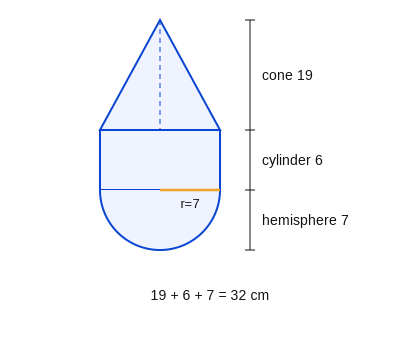
A cylinder is surmounted by a cone at one end and a hemisphere at the other end. The common radius is 7 cm, the height of the cylinder is 6 cm and the total height of the structure is 32 cm. Find the volume (in cm3) of the structure.
(Use π=227)
एक बेलन के एक सिरे पर शंकु और दूसरे सिरे पर अर्धगोला अध्यारोपित है। उभयनिष्ठ त्रिज्या 7 cm है, बेलन की ऊँचाई 6 cm है और संरचना की कुल ऊँचाई 32 cm है। संरचना का आयतन (cm3 में) ज्ञात कीजिए।
(π=227 का प्रयोग कीजिए)
  1. A2621
  2. B2616
  3. C2620
  4. D2618
Show answer

Concept: Volume = cone + cylinder + hemisphere =πr2(h13+h2+2r3).

  1. Cone height =32−6−7=19cm (hemisphere height = r=7).
  2. πr2=227×49=154.
  3. V=154(193+6+143)=154×17=2618cm3.

Trick: Take πr2=154 common – then just add the 'effective heights'.

Answer: (D) 2618

अवधारणा: आयतन = शंकु + बेलन + अर्धगोला =πr2(h13+h2+2r3)।

  1. शंकु की ऊँचाई =32−6−7=19cm (अर्धगोले की ऊँचाई = r=7)।
  2. πr2=227×49=154।
  3. V=154(193+6+143)=154×17=2618cm3।

ट्रिक: πr2=154 उभयनिष्ठ लें – फिर केवल 'प्रभावी ऊँचाइयाँ' जोड़ें।

उत्तर: (D) 2618

RRB NTPC Graduate CBT 1MathematicsMensuration – Combination of SolidsRRB NTPC Graduate CBT 1 2024 · 24 Jun Shift 2 →
Q6596.
In this question, a group of number/symbol is coded using letter codes as per the codes given below and the conditions which follow. The correct combination of codes following the conditions is your answer.
Note: If none of the conditions apply, then codes for the respective number/symbol are to be followed directly as given in the table.
Number/ symbol86*%9&3+@5$74
CodeWCEJFADQGPRBU
Conditions:
(I) If the first element is a number and the last a symbol, the codes for these two (the first and the last elements) are to be interchanged.
(II) If the first element is an odd number and the last an even number, the first and last elements are to be coded as ©.
(III) If the third element is a perfect cube, the second element is to be coded as the code for the third element.
What will %987 be coded as?
इस प्रश्न में, नीचे दिए गए कूटों और उसके बाद दी गई शर्तों के अनुसार संख्या/प्रतीक के एक समूह को अक्षर कूटों का उपयोग करके कूटबद्ध किया गया है। शर्तों का पालन करने वाले कूटों का सही संयोजन आपका उत्तर है।
नोट: यदि कोई भी शर्त लागू नहीं होती है, तो संबंधित संख्या/प्रतीक के लिए तालिका में दिए गए कूटों का सीधे पालन किया जाना है।
संख्या/प्रतीक86*%9&3+@5$74
कूटWCEJFADQGPRBU
शर्तें:
(I) यदि पहला अवयव एक संख्या है और अंतिम अवयव एक प्रतीक है, तो इन दोनों (पहले और अंतिम अवयव) के कूट आपस में बदल दिए जाने हैं।
(II) यदि पहला अवयव एक विषम संख्या है और अंतिम अवयव एक सम संख्या है, तो पहले और अंतिम दोनों अवयवों को © के रूप में कूटबद्ध किया जाना है।
(III) यदि तीसरा अवयव एक पूर्ण घन है, तो दूसरे अवयव को तीसरे अवयव के कूट के रूप में कूटबद्ध किया जाना है।
%987 को किस प्रकार कूटबद्ध किया जाएगा?
  1. AJFWB
  2. BJWFB
  3. CJWWB
  4. DBFWJ
Show answer

Concept: Check each condition in order; apply only those that fit, otherwise use the table codes.

  1. Elements: % 9 8 7 → table codes J F W B.
  2. (I) first is a symbol, not a number – no. (II) first is not an odd number – no.
  3. (III) third element 8 =23 is a perfect cube → second element (9) takes the code of 8, i.e. W.
  4. Code: J W W B.

Trick: First see what type the first and last elements are – it eliminates (I) and (II) at once.

Answer: (C) JWWB

अवधारणा: शर्तों को क्रम से जाँचें; जो लागू हो वही लगाएँ, नहीं तो तालिका के कूट लें।

  1. अवयव: % 9 8 7 → तालिका कूट J F W B।
  2. (I) पहला अवयव प्रतीक है, संख्या नहीं – लागू नहीं। (II) पहला विषम संख्या नहीं – लागू नहीं।
  3. (III) तीसरा अवयव 8 =23 पूर्ण घन है → दूसरे अवयव (9) को 8 का कूट W मिलेगा।
  4. कूट: J W W B।

ट्रिक: पहले पहला और अंतिम अवयव संख्या है या प्रतीक – यही देखें, (I) और (II) तुरंत हट जाती हैं।

उत्तर: (C) JWWB

RRB NTPC Graduate CBT 1General Intelligence and ReasoningCoding with ConditionsRRB NTPC Graduate CBT 1 2024 · 24 Jun Shift 2 →
Q6597.
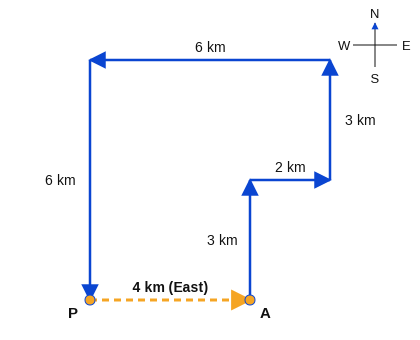
Vinay starts from Point A and drives 3 km towards the North. He then takes a right turn, drives 2 km, turns left and drives 3 km. He then takes a left turn and drives 6 km. He takes a final left turn, drives 6 km and stops at Point P. How far (shortest distance) and towards which direction should he drive in order to reach Point A again? (All turns are 90 degrees turns only unless specified)
विनय बिंदु A से चलना शुरू करता है और उत्तर की ओर 3 km गाड़ी चलाता है। फिर वह दाएँ मुड़ता है, 2 km गाड़ी चलाता है, बाएँ मुड़ता है और 3 km गाड़ी चलाता है। फिर वह बाएँ मुड़ता है और 6 km गाड़ी चलाता है। वह अंतिम बार बाएँ मुड़ता है, 6 km गाड़ी चलाता है और बिंदु P पर रुक जाता है। फिर से बिंदु A पर पहुँचने के लिए उसे कितनी दूर (न्यूनतम दूरी) और किस दिशा में गाड़ी चलानी चाहिए? (जब तक निर्दिष्ट न किया जाए, सभी मोड़ केवल 90 डिग्री के मोड़ हैं)
  1. A6 km to the Eastपूर्व की ओर 6 km
  2. B4 km to the Westपश्चिम की ओर 4 km
  3. C4 km to the Eastपूर्व की ओर 4 km
  4. D5 km to the Eastपूर्व की ओर 5 km
Show answer

Concept: Plot each move on a grid taking A as origin, East = +x, North = +y.

  1. 3 km North → (0, 3); right (East) 2 km → (2, 3).
  2. Left (North) 3 km → (2, 6); left (West) 6 km → (−4, 6).
  3. Left (South) 6 km → P(−4, 0).
  4. P is 4 km West of A, so he must drive 4 km towards East.

Trick: Net East–West: 2−6=−4; net North–South: 3+3−6=0.

Answer: (C) 4 km to the East

अवधारणा: A को मूल बिंदु मानकर हर चाल को ग्रिड पर लिखें (पूर्व = +x, उत्तर = +y)।

  1. उत्तर 3 km → (0, 3); दाएँ (पूर्व) 2 km → (2, 3)।
  2. बाएँ (उत्तर) 3 km → (2, 6); बाएँ (पश्चिम) 6 km → (−4, 6)।
  3. बाएँ (दक्षिण) 6 km → P(−4, 0)।
  4. P, A से 4 km पश्चिम में है, अतः 4 km पूर्व की ओर जाना होगा।

ट्रिक: पूर्व–पश्चिम: 2−6=−4; उत्तर–दक्षिण: 3+3−6=0।

उत्तर: (C) 4 km पूर्व की ओर

RRB NTPC Graduate CBT 1General Intelligence and ReasoningDirection and DistanceRRB NTPC Graduate CBT 1 2024 · 24 Jun Shift 2 →
Q6598.
What should come in place of the question mark (?) in the given series?
4 10 19 34 58 ?
दी गई श्रृंखला में प्रश्न चिह्न (?) के स्थान पर क्या आना चाहिए?
4 10 19 34 58 ?
  1. A94
  2. B72
  3. C74
  4. D89
Show answer

Concept: Check the differences and then the second differences.

  1. Differences: 10−4=6, 9, 15, 24.
  2. Second differences: 3,6,9 → next is 12.
  3. Next difference =24+12=36; next term =58+36=94.

Trick: When first differences grow unevenly, look at the second-level difference.

Answer: (A) 94

अवधारणा: पहले अंतर, फिर अंतरों का अंतर देखें।

  1. अंतर: 10−4=6, 9, 15, 24।
  2. दूसरे स्तर के अंतर: 3,6,9 → अगला 12।
  3. अगला अंतर =24+12=36; अगला पद =58+36=94।

ट्रिक: पहले अंतर अनियमित बढ़ें तो दूसरे स्तर के अंतर देखें।

उत्तर: (A) 94

RRB NTPC Graduate CBT 1General Intelligence and ReasoningNumber SeriesRRB NTPC Graduate CBT 1 2024 · 24 Jun Shift 2 →
Q6599.
Refer to the following number and symbol series and answer the question that follows. Counting to be done from left to right only.
(Note: All numbers are single digit numbers only.)
(Left) 3 3 & 7 * € 2 6 8 £ % 5 6 £ © 1 6 & % 8 # # (Right)
How many such numbers are there, each of which is immediately preceded by a number and also immediately followed by a symbol?
निम्नलिखित संख्या और प्रतीक श्रृंखला को देखें और उसके बाद दिए गए प्रश्न का उत्तर दें। गिनती केवल बाएँ से दाएँ की जानी है।
(नोट: सभी संख्याएँ केवल एक अंक वाली संख्याएँ हैं।)
(बाएँ) 3 3 & 7 * € 2 6 8 £ % 5 6 £ © 1 6 & % 8 # # (दाएँ)
ऐसी कितनी संख्याएँ हैं, जिनमें से प्रत्येक के ठीक पहले एक संख्या है और ठीक बाद एक प्रतीक भी है?
  1. A3
  2. B4
  3. C6
  4. D5
Show answer

Concept: Check every number: the element just before it must be a number and the element just after it must be a symbol.

  1. 3 3 & → 3 (preceded by 3, followed by &) ✓
  2. 6 8 £ → 8 ✓; 5 6 £ → 6 ✓
  3. 1 6 & → 6 ✓; other numbers fail (e.g. 7 is preceded by &).
  4. Total = 4.

Trick: Look for the pattern “number–number–symbol” and count the middle number.

Answer: (B) 4

अवधारणा: हर संख्या जाँचें: उससे ठीक पहले संख्या और ठीक बाद प्रतीक होना चाहिए।

  1. 3 3 & → 3 (पहले 3, बाद में &) ✓
  2. 6 8 £ → 8 ✓; 5 6 £ → 6 ✓
  3. 1 6 & → 6 ✓; बाकी संख्याएँ शर्त पूरी नहीं करतीं।
  4. कुल = 4।

ट्रिक: “संख्या–संख्या–प्रतीक” पैटर्न ढूँढें और बीच वाली संख्या गिनें।

उत्तर: (B) 4

RRB NTPC Graduate CBT 1General Intelligence and ReasoningNumber–Symbol SeriesRRB NTPC Graduate CBT 1 2024 · 24 Jun Shift 2 →
Q6600.
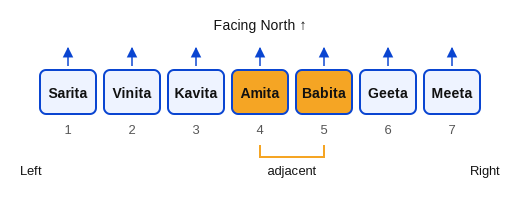
Amita, Babita, Geeta, Kavita, Meeta, Sarita, Vinita are sitting in a straight line, facing north. Geeta sits third to the right of Kavita. Sarita sits third to the left of Amita, who is third to the left of Meeta. Neither Sarita nor Babita sit immediately next to Kavita. Three of the following four are alike in a certain way based on the given arrangement and thus form a group. Which of the following does NOT belong to that group?
अमिता, बबीता, गीता, कविता, मीता, सरिता, विनीता एक सीधी पंक्ति में उत्तर की ओर मुख करके बैठी हैं। गीता, कविता के दाएँ से तीसरे स्थान पर बैठी है। सरिता, अमिता के बाएँ से तीसरे स्थान पर बैठी है, जो मीता के बाएँ से तीसरे स्थान पर बैठी है। न तो सरिता और न ही बबीता, कविता के ठीक बगल में बैठी है। दी गई व्यवस्था के आधार पर निम्नलिखित चार में से तीन किसी निश्चित प्रकार से एकसमान हैं और इस प्रकार एक समूह बनाते हैं। निम्नलिखित में से कौन-सा उस समूह से संबंधित नहीं है?
  1. AAmita and Babitaअमिता और बबीता
  2. BVinita and Amitaविनीता और अमिता
  3. CBabita and Meetaबबीता और मीता
  4. DSarita and Kavitaसरिता और कविता
Show answer

Concept: Fix the definite chain first, then use the “not next to” conditions.

  1. Sarita _ _ Amita _ _ Meeta → positions 1, 4, 7.
  2. Kavita–Geeta (3 apart) can be 2–5 or 3–6; at 2 Kavita would be next to Sarita, so Kavita = 3, Geeta = 6.
  3. Babita cannot be at 2 (next to Kavita) → Babita = 5, Vinita = 2.
  4. Order: Sarita, Vinita, Kavita, Amita, Babita, Geeta, Meeta. Three pairs have one person between them; Amita–Babita sit together.

Trick: In odd-one-out pairs, compare the gap between the two people.

Answer: (A) Amita and Babita

अवधारणा: पहले निश्चित श्रृंखला बनाएँ, फिर “पास नहीं” वाली शर्तें लगाएँ।

  1. सरिता _ _ अमिता _ _ मीता → स्थान 1, 4, 7।
  2. कविता–गीता (3 का अंतर) 2–5 या 3–6; 2 पर कविता सरिता के पास होगी, अतः कविता = 3, गीता = 6।
  3. बबीता 2 पर नहीं (कविता के पास) → बबीता = 5, विनीता = 2।
  4. क्रम: सरिता, विनीता, कविता, अमिता, बबीता, गीता, मीता। तीन जोड़ों के बीच एक व्यक्ति है; अमिता–बबीता साथ बैठी हैं।

ट्रिक: विषम जोड़ी में दोनों के बीच का अंतर देखें।

उत्तर: (A) Amita and Babita

RRB NTPC Graduate CBT 1General Intelligence and ReasoningLinear Seating ArrangementRRB NTPC Graduate CBT 1 2024 · 24 Jun Shift 2 →