Question bank

Q&A: practice questions with answers

Search questions on any topic. Filter by exam category, exam, subject and topic, try the question, then open the answer and explanation.

Courses – airGurukul

20,719 questions found.

Q6681.
Find roots of x2 + (2a + 3)x + (a2+ 3a) = 0.
x2 + (2a + 3)x + (a2+ 3a) = 0 के मूल ज्ञात कीजिए।
  1. Ax = −a, −a −3
  2. Bx = a, a + 3
  3. Cx = 2a, a + 3
  4. Dx = −a, a + 3
Show answer

Concept: Split the middle term: find two numbers with sum 2a+3 and product a2+3a=a(a+3).

  1. The numbers are a and a+3 (sum 2a+3, product a(a+3)).
  2. x2+(2a+3)x+a(a+3)=(x+a)(x+a+3).
  3. Roots: x=−a and x=−a−3.

Trick: Put a=0: x2+3x=0 gives 0,−3; only option (A) gives 0,−3.

Answer: (A) x=−a, −a−3

अवधारणा: मध्य पद तोड़ें: ऐसी दो संख्याएँ जिनका योग 2a+3 और गुणनफल a(a+3) हो।

  1. संख्याएँ a और a+3 हैं।
  2. x2+(2a+3)x+a(a+3)=(x+a)(x+a+3)।
  3. मूल: x=−a तथा x=−a−3।

ट्रिक: a=0 रखें: x2+3x=0 से 0,−3; केवल विकल्प (A) यह देता है।

उत्तर: (A) x=−a, −a−3
RRB NTPC Graduate CBT 1MathematicsQuadratic EquationsRRB NTPC Graduate CBT 1 2024 · 24 Jun Shift 1 →
Q6682.
There are two pumps to fill a tank with water. The first pump can fill the empty tank in 6 hours, while the second in 8 hours. If both the pumps are opened at the same time and kept open for 2 hours, the part of tank that will be filled up is:
एक टंकी को पानी से भरने के लिए दो पंप हैं। पहला पंप खाली टंकी को 6 घंटे में भर सकता है, जबकि दूसरा 8 घंटे में। यदि दोनों पंपों को एक ही समय पर खोला जाए और 2 घंटे तक खुला रखा जाए, तो टंकी का कितना भाग भर जाएगा?
  1. A910
  2. B912
  3. C712
  4. D710
Show answer

Concept: Work done in t hours by both =t(1a+1b).

  1. One hour together =16+18=4+324=724.
  2. In 2 hours =2×724=712.

Trick: LCM 24 units: pumps fill 4 + 3 = 7 units/h; 2 h → 14 units =1424=712.

Answer: (C) 712

अवधारणा: दोनों द्वारा t घंटे में किया कार्य =t(1a+1b)।

  1. एक घंटे में =16+18=724।
  2. 2 घंटे में =2×724=712।

ट्रिक: LCM 24 इकाई: 4 + 3 = 7 इकाई/घंटा; 2 घंटे → 14 इकाई =712।

उत्तर: (C) 712

RRB NTPC Graduate CBT 1MathematicsPipes and CisternsRRB NTPC Graduate CBT 1 2024 · 24 Jun Shift 1 →
Q6683.
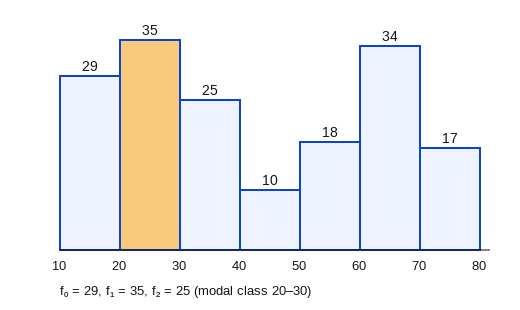
What is the mode of the data given below? [Give your answer correct to 2 decimal places.]
Age in years10-2020-3030-4040-5050-6060-7070-80
No. of patients29352510183417
नीचे दिए गए आँकड़ों का बहुलक (mode) क्या है? [अपना उत्तर 2 दशमलव स्थानों तक सही दीजिए।]
आयु (वर्षों में)10-2020-3030-4040-5050-6060-7070-80
रोगियों की संख्या29352510183417
  1. A39.44
  2. B6.56
  3. C23.75
  4. D22.58
Show answer

Concept: Mode=l+f1−f02f1−f0−f2×h, where f1 is the highest frequency.

  1. Highest frequency 35 → modal class 20–30: l=20, h=10.
  2. f0=29, f1=35, f2=25.
  3. Mode=20+35−2970−29−25×10=20+6016.
  4. =20+3.75=23.75.

Trick: The mode must lie inside the modal class (20 to 30) — only 23.75 and 22.58 qualify; compute to choose.

Answer: (C) 23.75

अवधारणा: बहुलक=l+f1−f02f1−f0−f2×h, जहाँ f1 अधिकतम बारंबारता है।

  1. अधिकतम बारंबारता 35 → बहुलक वर्ग 20–30: l=20, h=10।
  2. f0=29, f1=35, f2=25।
  3. बहुलक=20+616×10=20+3.75।
  4. =23.75।

ट्रिक: बहुलक, बहुलक वर्ग (20 से 30) के अंदर ही होगा — केवल 23.75 व 22.58 बचते हैं।

उत्तर: (C) 23.75

RRB NTPC Graduate CBT 1MathematicsStatistics – Mode of Grouped DataRRB NTPC Graduate CBT 1 2024 · 24 Jun Shift 1 →
Q6684.
A person drove at 77 km/hr for 3.5 hours, then increased his speed by 9 km/hr, and reached the destination in another hour. Find the average speed (in km/hr) of the person during the entire journey.
एक व्यक्ति ने 3.5 घंटे तक 77 km/hr की चाल से गाड़ी चलाई, फिर अपनी चाल 9 km/hr बढ़ा दी, और अगले एक घंटे में गंतव्य पर पहुँच गया। पूरी यात्रा के दौरान व्यक्ति की औसत चाल (km/hr में) ज्ञात कीजिए।
  1. A82
  2. B75
  3. C77
  4. D79
Show answer

Concept: Average speed=Total distanceTotal time.

  1. Distance 1 =77×3.5=269.5km.
  2. Distance 2 =(77+9)×1=86km.
  3. Total =355.5km in 4.5h.
  4. Average =355.54.5=79km/h.

Trick: Weighted average: 77+9×14.5=77+2=79.

Answer: (D) 79

अवधारणा: औसत चाल=कुल दूरीकुल समय।

  1. दूरी 1 =77×3.5=269.5km।
  2. दूरी 2 =86×1=86km।
  3. कुल =355.5km, समय 4.5h।
  4. औसत =355.54.5=79km/h।

ट्रिक: भारित औसत: 77+9×14.5=79।

उत्तर: (D) 79

RRB NTPC Graduate CBT 1MathematicsAverage SpeedRRB NTPC Graduate CBT 1 2024 · 24 Jun Shift 1 →
Q6685.
The mean proportional between 12+34 and 16−44 is:
12+34 और 16−44 का मध्यानुपाती कितना है?
  1. A7
  2. B22
  3. C19
  4. D12
Show answer

Concept: Mean proportional of a and b is ab.

  1. a=12+34=12+6=18
  2. b=16−44=16−8=8
  3. 18×8=144=12

Trick: Simplify 4=2 first; the mean proportional always lies between the two numbers (8<12<18).

Answer: (D) 12

अवधारणा: a और b का मध्यानुपाती ab होता है।

  1. a=12+34=12+6=18
  2. b=16−44=16−8=8
  3. 18×8=144=12

ट्रिक: पहले 4=2 रखें; मध्यानुपाती हमेशा दोनों संख्याओं के बीच होता है (8<12<18)।

उत्तर: (D) 12

RRB NTPC Graduate CBT 1MathematicsMean proportionalRRB NTPC Graduate CBT 1 2024 · 24 Jun Shift 1 →
Q6686.
X varies inversely as Y and Y varies inversely as Z. In a particular case, X=12 and Z=174. What will be the value of X when Z=7?
X, Y के व्युत्क्रमानुपाती है और Y, Z के व्युत्क्रमानुपाती है। एक विशेष स्थिति में, X=12 और Z=174 है। जब Z=7 हो, तो X का मान कितना होगा?
  1. A259
  2. B262
  3. C260
  4. D257
Show answer

Concept: If X∝1Y and Y∝1Z, then X∝Z, i.e. X=kZ.

  1. X=k1Y and Y=k2Z give X=k1k2Z=kZ.
  2. 12=k×174⇒k=37
  3. When Z=7: X=37×7=259

Trick: Two inverse variations make a direct variation: X2X1=Z2Z1, so X=12×7×74=259.

Answer: (A) 259

अवधारणा: यदि X∝1Y और Y∝1Z, तो X∝Z, अर्थात X=kZ।

  1. X=k1Y, Y=k2Z से X=k1k2Z=kZ
  2. 12=k×174⇒k=37
  3. Z=7 पर: X=37×7=259

ट्रिक: दो व्युत्क्रम विचरण मिलकर प्रत्यक्ष विचरण बनाते हैं: X=12×7×74=259।

उत्तर: (A) 259

RRB NTPC Graduate CBT 1MathematicsVariationRRB NTPC Graduate CBT 1 2024 · 24 Jun Shift 1 →
Q6687.
What price should Kunal mark on a pair of pants which costs him ₹3,300, so as to gain 33% after allowing a successive discount of 25% and 30%?
कुणाल को एक पैंट का मूल्य ₹3,300 पड़ता है। 25% और 30% की क्रमिक छूट देने के बाद 33% लाभ प्राप्त करने के लिए उसे पैंट पर कितना मूल्य अंकित करना चाहिए?
  1. A₹8,310
  2. B₹8,360
  3. C₹8,256
  4. D₹8,290
Show answer

Concept: SP=MP×(1−d1)(1−d2) and SP=CP×(1+gain).

  1. Required SP =3300×1.33=4389
  2. Net factor after discounts =0.75×0.70=0.525
  3. MP=43890.525=8360

Trick: Successive 25% and 30% = single discount of 25+30−25×30100=47.5%.

Answer: (B) ₹8,360

अवधारणा: विक्रय मूल्य=अंकित मूल्य×(1−d1)(1−d2) तथा विक्रय मूल्य=क्रय मूल्य×(1+लाभ)।

  1. आवश्यक विक्रय मूल्य =3300×1.33=4389
  2. छूटों के बाद गुणक =0.75×0.70=0.525
  3. अंकित मूल्य=43890.525=8360

ट्रिक: क्रमिक 25% और 30% = एकल छूट 25+30−25×30100=47.5%।

उत्तर: (B) ₹8,360

RRB NTPC Graduate CBT 1MathematicsProfit, loss and discountRRB NTPC Graduate CBT 1 2024 · 24 Jun Shift 1 →
Q6688.
The LCM of 44, 86 and another number, x, is 7568. Which of the following can be the value of x?
44, 86 और एक अन्य संख्या x का LCM 7568 है। निम्नलिखित में से कौन-सा x का मान हो सकता है?
  1. A145
  2. B101
  3. C165
  4. D176
Show answer

Concept: Every factor of x must divide the LCM, and the LCM must still be reached.

  1. 44=22×11, 86=2×43, 7568=24×11×43
  2. LCM(44,86)=22×11×43=1892; so x must supply 24 and have no other primes.
  3. 176=24×11 ✔; 145, 165 contain 5, and 101 is prime – they do not divide 7568.

Trick: Quick test: the option must divide 7568 – only 7568÷176=43 works.

Answer: (D) 176

अवधारणा: x के सभी गुणनखंड LCM को विभाजित करें और LCM पूरा बने।

  1. 44=22×11, 86=2×43, 7568=24×11×43
  2. LCM(44,86)=1892; अतः x में 24 होना चाहिए और कोई अन्य अभाज्य नहीं।
  3. 176=24×11 ✔; 145, 165 में 5 है, 101 अभाज्य है – ये 7568 को विभाजित नहीं करते।

ट्रिक: विकल्प 7568 को विभाजित करे – केवल 7568÷176=43।

उत्तर: (D) 176

RRB NTPC Graduate CBT 1MathematicsLCMRRB NTPC Graduate CBT 1 2024 · 24 Jun Shift 1 →
Q6689.
By selling cloth at ₹344/m, a shopkeeper loses 57%. Find the rate (in ₹/m) at which it should be sold so as to earn a profit of 71%.
₹344/m की दर से कपड़ा बेचने पर एक दुकानदार को 57% की हानि होती है। 71% का लाभ अर्जित करने के लिए उसे किस दर (₹/m में) पर बेचा जाना चाहिए?
  1. A1,368
  2. B1,365
  3. C1,366
  4. D1,367
Show answer

Concept: At a loss of l%, SP=CP×100−l100.

  1. 344=CP×43100⇒CP=800
  2. For 71% profit: SP=800×171100=1368

Trick: Direct ratio: new SP=344×17143=8×171=1368.

Answer: (A) 1,368

अवधारणा: हानि l% पर विक्रय मूल्य=क्रय मूल्य×100−l100।

  1. 344=क्रय मूल्य×43100⇒क्रय मूल्य=800
  2. 71% लाभ के लिए: 800×171100=1368

ट्रिक: सीधा अनुपात: 344×17143=8×171=1368।

उत्तर: (A) 1,368

RRB NTPC Graduate CBT 1MathematicsProfit and lossRRB NTPC Graduate CBT 1 2024 · 24 Jun Shift 1 →
Q6690.
Evaluate cos42∘·cos18∘−sin42∘·sin18∘.
cos42∘·cos18∘−sin42∘·sin18∘ का मान ज्ञात कीजिए।
  1. A1
  2. B12
  3. C14
  4. D13
Show answer

Concept: cosAcosB−sinAsinB=cos(A+B)

  1. cos42∘cos18∘−sin42∘sin18∘=cos(42∘+18∘)
  2. =cos60∘=12

Trick: 'cos cos minus sin sin' → cos of the sum; angles here add to 60∘.

Answer: (B) 12

अवधारणा: cosAcosB−sinAsinB=cos(A+B)

  1. cos42∘cos18∘−sin42∘sin18∘=cos(42∘+18∘)
  2. =cos60∘=12

ट्रिक: 'cos cos घटा sin sin' → योग का cos; यहाँ कोणों का योग 60∘ है।

उत्तर: (B) 12

RRB NTPC Graduate CBT 1MathematicsTrigonometric identitiesRRB NTPC Graduate CBT 1 2024 · 24 Jun Shift 1 →
Q6691.
The simple interest (in ₹) on ₹2,200 at the rate of 7% per annum in 2 years is:
₹2,200 पर 7% वार्षिक दर से 2 वर्षों का साधारण ब्याज (₹ में) कितना है?
  1. A₹358
  2. B₹258
  3. C₹408
  4. D₹308
Show answer

Concept: SI=P×R×T100

  1. SI=2200×7×2100
  2. =22×14=308

Trick: 1 year interest = 154; two years = 308.

Answer: (D) ₹308

अवधारणा: साधारण ब्याज=P×R×T100

  1. 2200×7×2100
  2. =22×14=308

ट्रिक: 1 वर्ष का ब्याज = 154; दो वर्ष = 308।

उत्तर: (D) ₹308

RRB NTPC Graduate CBT 1MathematicsSimple interestRRB NTPC Graduate CBT 1 2024 · 24 Jun Shift 1 →
Q6692.
If 91÷13×32−18×14÷2+11=z, then find value of z.
यदि 91÷13×32−18×14÷2+11=z है, तो z का मान ज्ञात कीजिए।
  1. A-49
  2. B-48
  3. C-51
  4. D-52
Show answer

Concept: Powers first, then ÷ and × from left to right, then + and −.

  1. 32=9; 91÷13×9=7×9=63
  2. 18×14÷2=252÷2=126
  3. z=63−126+11=−52

Trick: Do × and ÷ strictly left to right – never multiply before an earlier division.

Answer: (D) −52

अवधारणा: पहले घात, फिर ÷ और × बाएँ से दाएँ, फिर + और −।

  1. 32=9; 91÷13×9=7×9=63
  2. 18×14÷2=252÷2=126
  3. z=63−126+11=−52

ट्रिक: × और ÷ सख़्ती से बाएँ से दाएँ करें।

उत्तर: (D) −52

RRB NTPC Graduate CBT 1MathematicsSimplification (BODMAS)RRB NTPC Graduate CBT 1 2024 · 24 Jun Shift 1 →
Q6693.
The average weight of 5 students is 60 kg. After a new student joins the group, the average becomes 62 kg. What is the weight of the new student?
5 विद्यार्थियों का औसत भार 60 kg है। एक नए विद्यार्थी के समूह में शामिल होने के बाद, औसत 62 kg हो जाता है। नए विद्यार्थी का भार कितना है?
  1. A70 kg
  2. B62 kg
  3. C68 kg
  4. D72 kg
Show answer

Concept: Total = average × number of items.

  1. Total of 5 students =5×60=300
  2. Total of 6 students =6×62=372
  3. New student =372−300=72kg

Trick: New member = new average + (old count × rise) =62+5×2=72.

Answer: (D) 72kg

अवधारणा: योग = औसत × संख्या।

  1. 5 छात्रों का योग =5×60=300
  2. 6 छात्रों का योग =6×62=372
  3. नया छात्र =372−300=72kg

ट्रिक: नया सदस्य = नया औसत + (पुरानी संख्या × वृद्धि) =62+5×2=72।

उत्तर: (D) 72kg

RRB NTPC Graduate CBT 1MathematicsAverageRRB NTPC Graduate CBT 1 2024 · 24 Jun Shift 1 →
Q6694.
What is the median of the following data?
46, 19, 87, 72, 80, 91, 82, 15, 53, 86, 26
निम्नलिखित आँकड़ों की माध्यिका (median) क्या है?
46, 19, 87, 72, 80, 91, 82, 15, 53, 86, 26
  1. A71.5
  2. B72
  3. C72.5
  4. D73
Show answer

Concept: For an odd number n of observations, median = (n+12)th value after arranging in order.

  1. Ascending: 15, 19, 26, 46, 53, 72, 80, 82, 86, 87, 91
  2. n=11⇒11+12=6th value
  3. 6th value = 72

Trick: Always sort first; the unsorted middle value (91) is a trap.

Answer: (B) 72

अवधारणा: विषम n प्रेक्षणों के लिए माध्यिका = क्रम में लगाने के बाद (n+12)वाँ मान।

  1. आरोही क्रम: 15, 19, 26, 46, 53, 72, 80, 82, 86, 87, 91
  2. n=11⇒11+12=6वाँ मान
  3. 6वाँ मान = 72

ट्रिक: पहले क्रम में लगाएँ; बिना क्रम का बीच का मान (91) जाल है।

उत्तर: (B) 72

RRB NTPC Graduate CBT 1MathematicsStatistics – medianRRB NTPC Graduate CBT 1 2024 · 24 Jun Shift 1 →
Q6695.
For a regular polygon, the sum of the interior angles is 200% more than the sum of its exterior angles. Each interior angle of the polygon measures x°. What is the value of x?
एक सम बहुभुज के लिए, अंतः कोणों का योग उसके बाह्य कोणों के योग से 200% अधिक है। बहुभुज का प्रत्येक अंतः कोण x° है। x का मान कितना है?
  1. A155
  2. B125
  3. C145
  4. D135
Show answer

Concept: Sum of exterior angles of any polygon =360∘; sum of interior angles =(n−2)×180∘.

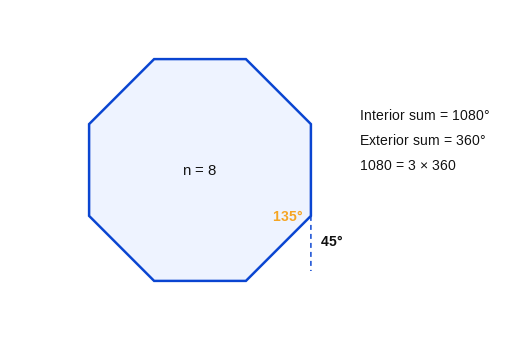
  1. 200% more than 360° means 3×360∘=1080∘.
  2. (n−2)×180=1080⇒n=8
  3. Each interior angle =1080∘8=135∘

Trick: Each exterior angle =360∘8=45∘, so interior =180∘−45∘=135∘.

Answer: (D) 135

अवधारणा: किसी भी बहुभुज के बाह्य कोणों का योग =360∘; अंतः कोणों का योग =(n−2)×180∘।

  1. 360° से 200% अधिक = 3×360∘=1080∘
  2. (n−2)×180=1080⇒n=8
  3. प्रत्येक अंतः कोण =1080∘8=135∘

ट्रिक: प्रत्येक बाह्य कोण =360∘8=45∘, अतः अंतः कोण =180∘−45∘=135∘।

उत्तर: (D) 135

RRB NTPC Graduate CBT 1MathematicsGeometry – polygonsRRB NTPC Graduate CBT 1 2024 · 24 Jun Shift 1 →
Q6696.
If 1 is added to each odd digit and 2 is subtracted from each even digit in the number 8315476, which of the following digits will be third from the right?
यदि संख्या 8315476 में प्रत्येक विषम अंक में 1 जोड़ा जाए और प्रत्येक सम अंक में से 2 घटाया जाए, तो निम्नलिखित में से कौन-सा अंक दाएँ से तीसरा होगा?
  1. A4
  2. B6
  3. C8
  4. D2
Show answer

Concept: Change every digit by the given rule, then read the required position.

  1. Number: 8 3 1 5 4 7 6.
  2. Odd digits +1: 3→4, 1→2, 5→6, 7→8. Even digits −2: 8→6, 4→2, 6→4.
  3. New number: 6 4 2 6 2 8 4.
  4. From the right: 4 (1st), 8 (2nd), 2 (3rd).

Trick: For 'third from right' you only need the last three digits: 5476 → …2 8 4.

Answer: (D) 2

अवधारणा: दिए गए नियम से प्रत्येक अंक बदलें, फिर अभीष्ट स्थान पढ़ें।

  1. संख्या: 8 3 1 5 4 7 6।
  2. विषम अंक +1: 3→4, 1→2, 5→6, 7→8। सम अंक −2: 8→6, 4→2, 6→4।
  3. नई संख्या: 6 4 2 6 2 8 4।
  4. दाएँ से: 4 (पहला), 8 (दूसरा), 2 (तीसरा)।

ट्रिक: 'दाएँ से तीसरा' के लिए केवल अंतिम तीन अंक बदलें: 4 7 6 → 2 8 4।

उत्तर: (D) 2

RRB NTPC Graduate CBT 1General Intelligence and ReasoningNumber OperationsRRB NTPC Graduate CBT 1 2024 · 24 Jun Shift 1 →
Q6697.
Which of the following letter-clusters should replace # and % so that the pattern and relationship followed between the letter-cluster pair on the left side of :: is the same as that on the right side of :: ?
# : XTR :: LHF : %
निम्नलिखित में से कौन-से अक्षर-समूह # और % को प्रतिस्थापित करने चाहिए ताकि :: के बाईं ओर के अक्षर-समूह युग्म के बीच अनुसरण किया गया पैटर्न और संबंध वही हो जो :: के दाईं ओर के अक्षर-समूह युग्म के बीच है?
# : XTR :: LHF : %
  1. A# = DTX, % = FBZ
  2. B# = DZX, % = FBZ
  3. C# = UZX, % = FBZ
  4. D# = DZX, % = FBO
Show answer

Concept: Find the rule from the complete pair LHF : FBZ, then apply it backwards to get #.

  1. L(12)−6=F(6), H(8)−6=B(2), F(6)−6=Z (wrap-around). So the rule is: each letter −6.
  2. # → XTR means #−6 = XTR, so # = XTR + 6 each: X+6=D, T+6=Z, R+6=X → DZX.
  3. Check: D−6=X, Z−6=T, X−6=R ✓.

Trick: Backward 6 in the alphabet = forward 20; going past A, continue from Z.

Answer: (B) # = DZX, % = FBZ

अवधारणा: पूर्ण युग्म LHF : FBZ से नियम निकालें, फिर उल्टा लगाकर # ज्ञात करें।

  1. L(12)−6=F(6), H(8)−6=B(2), F(6)−6=Z (चक्रीय)। नियम: प्रत्येक अक्षर −6।
  2. # → XTR, अर्थात # = XTR के प्रत्येक अक्षर +6: X+6=D, T+6=Z, R+6=X → DZX।
  3. जाँच: D−6=X, Z−6=T, X−6=R ✓।

ट्रिक: A से पीछे जाने पर Z से गिनती जारी रखें।

उत्तर: (B) # = DZX, % = FBZ

RRB NTPC Graduate CBT 1General Intelligence and ReasoningLetter AnalogyRRB NTPC Graduate CBT 1 2024 · 24 Jun Shift 1 →
Q6698.
What should come in place of the question mark (?) in the given series?
4 7 13 24 42 ? 107
दी गई श्रृंखला में प्रश्न चिह्न (?) के स्थान पर क्या आना चाहिए?
4 7 13 24 42 ? 107
  1. A68
  2. B66
  3. C69
  4. D67
Show answer

Concept: Check differences, and then the differences of the differences.

  1. Differences: 7−4=3, 13−7=6, 24−13=11, 42−24=18.
  2. Second differences: 3, 5, 7 → next 9, 11.
  3. Next differences: 18+9=27, 27+11=38.
  4. ? = 42+27 = 69; check 69+38 = 107 ✓.

Trick: Second differences forming odd numbers 3, 5, 7, 9… is a very common RRB pattern.

Answer: (C) 69

अवधारणा: अंतर तथा अंतरों का अंतर देखें।

  1. अंतर: 3, 6, 11, 18।
  2. दूसरे अंतर: 3, 5, 7 → आगे 9, 11।
  3. अगले अंतर: 18+9=27, 27+11=38।
  4. ? = 42+27 = 69; जाँच 69+38 = 107 ✓।

ट्रिक: दूसरे अंतर विषम संख्याएँ 3, 5, 7, 9… — RRB का आम पैटर्न।

उत्तर: (C) 69

RRB NTPC Graduate CBT 1General Intelligence and ReasoningNumber SeriesRRB NTPC Graduate CBT 1 2024 · 24 Jun Shift 1 →
Q6699.
If 2 is added to each odd digit and 1 is subtracted from each even digit in the number 7156423, then how many digits will appear more than once in the new number thus formed?
यदि संख्या 7156423 में प्रत्येक विषम अंक में 2 जोड़ा जाए और प्रत्येक सम अंक में से 1 घटाया जाए, तो इस प्रकार बनी नई संख्या में कितने अंक एक से अधिक बार आएँगे?
  1. ATwoदो
  2. BThreeतीन
  3. COneएक
  4. DNoneकोई नहीं
Show answer

Concept: Apply the rule to each digit and count the digits that repeat.

  1. Number: 7 1 5 6 4 2 3.
  2. Odd +2: 7→9, 1→3, 5→7, 3→5. Even −1: 6→5, 4→3, 2→1.
  3. New number: 9 3 7 5 3 1 5.
  4. 3 appears twice and 5 appears twice; 9, 7, 1 appear once → two digits repeat.

Trick: Count distinct digits that repeat, not total repetitions.

Answer: (A) Two

अवधारणा: प्रत्येक अंक पर नियम लगाएँ और दोहराए गए अंक गिनें।

  1. संख्या: 7 1 5 6 4 2 3।
  2. विषम +2: 7→9, 1→3, 5→7, 3→5। सम −1: 6→5, 4→3, 2→1।
  3. नई संख्या: 9 3 7 5 3 1 5।
  4. 3 दो बार, 5 दो बार; 9, 7, 1 एक-एक बार → दो अंक।

ट्रिक: अलग-अलग दोहराए अंक गिनें, कुल दोहराव नहीं।

उत्तर: (A) दो (Two)

RRB NTPC Graduate CBT 1General Intelligence and ReasoningNumber OperationsRRB NTPC Graduate CBT 1 2024 · 24 Jun Shift 1 →
Q6700.
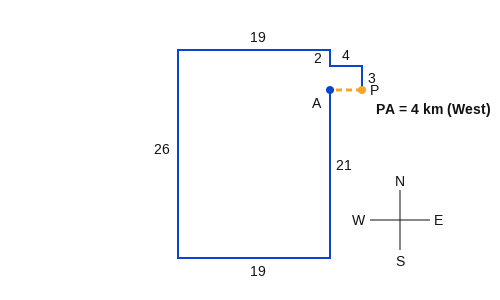
Mr. HIJ starts from Point A and drives 21 km towards the south. He then takes a right turn, drives 19 km, turns right and drives 26 km. He then takes a right turn and drives 19 km, turns right and drives 2 km. He then takes a left turn and drives 4 km. He takes a final right turn, drives 3 km and stops at Point P. How far (shortest distance) and in which direction should he drive in order to reach Point A again? (All turns are 90-degree turns only unless specified)
श्री HIJ बिंदु A से शुरू करते हैं और दक्षिण की ओर 21 km गाड़ी चलाते हैं। फिर वे दाएँ मुड़ते हैं, 19 km गाड़ी चलाते हैं, दाएँ मुड़ते हैं और 26 km गाड़ी चलाते हैं। फिर वे दाएँ मुड़ते हैं और 19 km गाड़ी चलाते हैं, दाएँ मुड़ते हैं और 2 km गाड़ी चलाते हैं। फिर वे बाएँ मुड़ते हैं और 4 km गाड़ी चलाते हैं। वे अंतिम बार दाएँ मुड़ते हैं, 3 km गाड़ी चलाते हैं और बिंदु P पर रुक जाते हैं। फिर से बिंदु A पर पहुँचने के लिए उन्हें कितनी दूरी (न्यूनतम दूरी) तक और किस दिशा में गाड़ी चलानी चाहिए? (जब तक निर्दिष्ट न किया जाए, सभी मोड़ केवल 90-डिग्री के मोड़ हैं)
  1. A7 km to the eastपूर्व की ओर 7 km
  2. B5 km to the southदक्षिण की ओर 5 km
  3. C6 km to the northउत्तर की ओर 6 km
  4. D4 km to the westपश्चिम की ओर 4 km
Show answer

Concept: Track the facing direction after each turn and add/subtract along each axis.

  1. South 21 (facing S); right → West 19; right → North 26; right → East 19.
  2. Net so far: 26−21 = 5 km north of A, 19−19 = 0 east-west.
  3. Right → South 2 (now 3 km N); left → East 4; right → South 3 (now 0 km N).
  4. P is exactly 4 km east of A, so he must drive 4 km to the west.

Trick: Right turn from S = W, from W = N, from N = E, from E = S — the clockwise order N→E→S→W.

Answer: (D) 4 km to the west

अवधारणा: हर मोड़ के बाद मुख की दिशा देखें और प्रत्येक अक्ष पर दूरी जोड़ें/घटाएँ।

  1. दक्षिण 21; दाएँ → पश्चिम 19; दाएँ → उत्तर 26; दाएँ → पूर्व 19।
  2. अब तक: A से 26−21 = 5 km उत्तर, पूर्व-पश्चिम में 0।
  3. दाएँ → दक्षिण 2 (3 km उत्तर); बाएँ → पूर्व 4; दाएँ → दक्षिण 3 (0 km उत्तर)।
  4. P, A से ठीक 4 km पूर्व में है, अतः 4 km पश्चिम जाना होगा।

ट्रिक: दायाँ मोड़ = घड़ी की दिशा: N→E→S→W।

उत्तर: (D) 4 km पश्चिम की ओर

RRB NTPC Graduate CBT 1General Intelligence and ReasoningDirection and DistanceRRB NTPC Graduate CBT 1 2024 · 24 Jun Shift 1 →