Question bank

Q&A: practice questions with answers

Search questions on any topic. Filter by exam category, exam, subject and topic, try the question, then open the answer and explanation.

Courses – airGurukul

20,719 questions found.

Q6781.
What is the mode of the following data?
53, 47, 43, 42, 52, 54, 54, 51, 42, 53, 53, 48, 46, 43, 43, 40, 43, 41
निम्नलिखित आँकड़ों का बहुलक क्या है?
53, 47, 43, 42, 52, 54, 54, 51, 42, 53, 53, 48, 46, 43, 43, 40, 43, 41
  1. A47
  2. B53
  3. C42
  4. D43
Show answer

Concept: Mode is the value that occurs most often in the data.

  1. Count repeats: 43 appears 4 times.
  2. 53 appears 3 times; 42 and 54 appear 2 times each; others once.
  3. Highest frequency is 4, for 43.

Trick: Sort mentally or tally only the repeated numbers – no need to count singles.

Answer: (D) 43

अवधारणा: जो मान आँकड़ों में सबसे अधिक बार आता है, वही बहुलक (Mode) है।

  1. गिनती: 43 चार बार आता है।
  2. 53 तीन बार; 42 और 54 दो-दो बार; बाकी एक बार।
  3. सबसे अधिक बारंबारता 4 है, 43 की।

ट्रिक: केवल दोहराने वाली संख्याओं को गिनें।

उत्तर: (D) 43
RRB NTPC Graduate CBT 1MathematicsModeRRB NTPC Graduate CBT 1 2024 · 23 Jun Shift 3 →
Q6782.
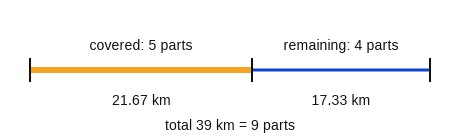
While covering a distance of 39 km, a man noticed that after cycling for 5 hour 5 minutes, the distance covered by him was 54 of the remaining distance. What was his speed (in km/hr, rounded off to one decimal place)?
39 km की दूरी तय करते समय, एक व्यक्ति ने देखा कि 5 घंटे 5 मिनट तक साइकिल चलाने के बाद उसके द्वारा तय की गई दूरी, शेष दूरी का 54 थी। उसकी चाल (km/hr में, दशमलव के एक स्थान तक पूर्णांकित) क्या थी?
  1. A1.9
  2. B4.3
  3. C3.2
  4. D6.5
Show answer

Concept: Covered : remaining =5:4, so the covered part is 59 of the total.

  1. Distance covered =59×39=653≈21.67km
  2. Time =5h5min=5560=6112h
  3. Speed =653÷6112=65×123×61=26061≈4.26
  4. Rounded: 4.3km/h

Trick: 'a/b of remaining' ⇒ covered =aa+b of total.

Answer: (B) 4.3

अवधारणा: तय दूरी : शेष दूरी =5:4, अतः तय दूरी कुल का 59 है।

  1. तय दूरी =59×39=653≈21.67km
  2. समय =5h5min=6112h
  3. चाल =653÷6112=26061≈4.26
  4. पूर्णांकित: 4.3km/h

ट्रिक: 'शेष का a/b' ⇒ तय दूरी =aa+b × कुल।

उत्तर: (B) 4.3

RRB NTPC Graduate CBT 1MathematicsSpeed, distance and timeRRB NTPC Graduate CBT 1 2024 · 23 Jun Shift 3 →
Q6783.
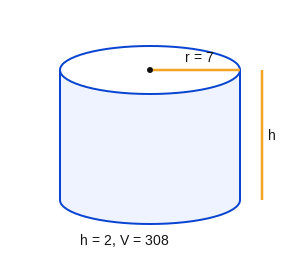
The total surface area of a cylinder is 396 cm2, and its radius is 7 cm. Find the volume (in cm3) of the cylinder.
Use π=227
एक बेलन का संपूर्ण पृष्ठीय क्षेत्रफल 396 cm2 है, और इसकी त्रिज्या 7 cm है। बेलन का आयतन (cm3 में) ज्ञात कीजिए।
π=227 का प्रयोग कीजिए
  1. A307
  2. B308
  3. C314
  4. D300
Show answer

Concept: TSA=2πr(r+h), V=πr2h

  1. 2×227×7×(7+h)=396
  2. 44(7+h)=396⇒7+h=9⇒h=2cm
  3. V=227×72×2=22×7×2=308cm3

Trick: With r=7, 2πr=44 – divide TSA by 44 to get r+h instantly.

Answer: (B) 308

अवधारणा: कुल पृष्ठीय क्षेत्रफल=2πr(r+h), V=πr2h

  1. 2×227×7×(7+h)=396
  2. 44(7+h)=396⇒h=2cm
  3. V=227×49×2=308cm3

ट्रिक: r=7 हो तो 2πr=44; TSA ÷ 44 = r+h।

उत्तर: (B) 308

RRB NTPC Graduate CBT 1MathematicsCylinder – surface area and volumeRRB NTPC Graduate CBT 1 2024 · 23 Jun Shift 3 →
Q6784.
By how much is 60% of 40 greater than 35 of 15?
40 का 60%, 15 के 35 से कितना अधिक है?
  1. A12
  2. B15
  3. C9
  4. D13
Show answer

Concept: Find both values separately and subtract.

  1. 60% of 40=60100×40=24
  2. 35 of 15=9
  3. Difference =24−9=15

Trick: 60%=35, so the answer is 35×(40−15)=15.

Answer: (B) 15

अवधारणा: दोनों मान अलग निकालकर घटाएँ।

  1. 40 का 60%=24
  2. 15 का 35=9
  3. अंतर =24−9=15

ट्रिक: 60%=35, अतः 35×(40−15)=15।

उत्तर: (B) 15

RRB NTPC Graduate CBT 1MathematicsPercentage and fractionsRRB NTPC Graduate CBT 1 2024 · 23 Jun Shift 3 →
Q6785.
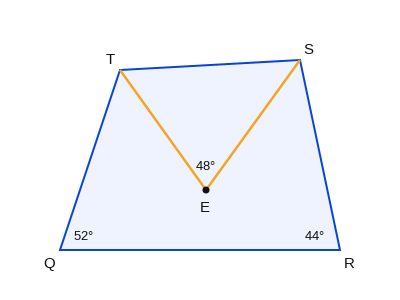
In a quadrilateral QRST, ∠Q = 52° and ∠R = 44°. The bisectors of ∠S and ∠T meet at E. What is the measure of ∠TES?
एक चतुर्भुज QRST में, ∠Q = 52° और ∠R = 44° है। ∠S और ∠T के समद्विभाजक E पर मिलते हैं। ∠TES की माप क्या है?
  1. A48°
  2. B37°
  3. C44°
  4. D59°
Show answer

Concept: Angle sum of a quadrilateral =360∘; the angle between bisectors of two adjacent angles =12(sum of the other two angles).

  1. ∠S+∠T=360∘−(52∘+44∘)=264∘
  2. In △TES: ∠S2+∠T2=132∘
  3. ∠TES=180∘−132∘=48∘

Trick: ∠TES=∠Q+∠R2=96∘2=48∘.

Answer: (A) 48∘

अवधारणा: चतुर्भुज के कोणों का योग =360∘; दो आसन्न कोणों के समद्विभाजकों के बीच का कोण =12(शेष दो कोणों का योग)।

  1. ∠S+∠T=360∘−96∘=264∘
  2. △TES में: ∠S2+∠T2=132∘
  3. ∠TES=180∘−132∘=48∘

ट्रिक: ∠TES=∠Q+∠R2=48∘।

उत्तर: (A) 48∘

RRB NTPC Graduate CBT 1MathematicsQuadrilateral – angle bisectorsRRB NTPC Graduate CBT 1 2024 · 23 Jun Shift 3 →
Q6786.
Mukesh sold a car for ₹2,03,700 at 10% loss. For what price (in ₹) should he sell the car to gain 68% profit?
मुकेश ने 10% हानि पर ₹2,03,700 में एक कार बेची। 68% लाभ प्राप्त करने के लिए उसे कार किस मूल्य (₹ में) पर बेचनी चाहिए?
  1. A3,80,238
  2. B3,80,240
  3. C3,80,237
  4. D3,80,243
Show answer

Concept: SP=CP×100±gain/loss%100

  1. At 10% loss: CP=2037000.9
  2. Required SP =2037000.9×1.68=203700×16890
  3. =203700×2815=13580×28=380240

Trick: Directly scale SP: new SP=old SP×16890.

Answer: (B) ₹3,80,240

अवधारणा: विक्रय मूल्य=क्रय मूल्य×100±लाभ/हानि%100

  1. 10% हानि पर: CP=2037000.9
  2. अभीष्ट SP =203700×16890
  3. =203700×2815=13580×28=380240

ट्रिक: सीधे नया SP=पुराना SP×16890।

उत्तर: (B) ₹3,80,240

RRB NTPC Graduate CBT 1MathematicsProfit and lossRRB NTPC Graduate CBT 1 2024 · 23 Jun Shift 3 →
Q6787.
If a2+b2=132 and a×b=36, then find (a−b)(a+b), where a>b.
यदि a2+b2=132 और a×b=36 है, तो (a−b)(a+b) ज्ञात कीजिए, जहाँ a>b है।
  1. A517
  2. B1117
  3. C511
  4. D1737
Show answer

Concept: (a±b)2=a2+b2±2ab

  1. (a−b)2=132−72=60
  2. (a+b)2=132+72=204
  3. a−ba+b=60204=517 (positive since a>b)

Trick: Squared ratio =a2+b2−2aba2+b2+2ab – no need to find a and b.

Answer: (A) 517

अवधारणा: (a±b)2=a2+b2±2ab

  1. (a−b)2=132−72=60
  2. (a+b)2=132+72=204
  3. a−ba+b=60204=517 (a>b होने से धनात्मक)

ट्रिक: अनुपात का वर्ग =a2+b2−2aba2+b2+2ab – a, b निकालने की ज़रूरत नहीं।

उत्तर: (A) 517

RRB NTPC Graduate CBT 1MathematicsAlgebraic identitiesRRB NTPC Graduate CBT 1 2024 · 23 Jun Shift 3 →
Q6788.
A sells a camera to B at a loss of 60% and B sells the camera to C at a profit of 25%. If C purchased the camera for ₹62,616, then what was the cost (in ₹) of the camera for A?
A एक कैमरा B को 60% की हानि पर बेचता है और B वह कैमरा C को 25% के लाभ पर बेचता है। यदि C ने कैमरा ₹62,616 में खरीदा, तो A के लिए कैमरे का क्रय मूल्य (₹ में) क्या था?
  1. A1,25,229
  2. B1,25,230
  3. C1,25,226
  4. D1,25,232
Show answer

Concept: Successive changes multiply: Final price=CPA×100−60100×100+25100

  1. 62616=CPA×0.4×1.25=CPA×0.5
  2. CPA=62616×2=125232

Trick: 25×54=12 – C's price is exactly half of A's cost.

Answer: (D) ₹1,25,232

अवधारणा: क्रमागत परिवर्तन गुणा होते हैं: अंतिम मूल्य=CPA×40100×125100

  1. 62616=CPA×0.5
  2. CPA=62616×2=125232

ट्रिक: 25×54=12 – C का मूल्य A की लागत का आधा है।

उत्तर: (D) ₹1,25,232

RRB NTPC Graduate CBT 1MathematicsSuccessive profit and lossRRB NTPC Graduate CBT 1 2024 · 23 Jun Shift 3 →
Q6789.
A man spends 50% of his monthly salary on the rent of his house. If every month he also spends ₹780 on his conveyance and ₹9,800 on his groceries and saves the remaining ₹110, his monthly salary is:
एक व्यक्ति अपने मासिक वेतन का 50% अपने घर के किराए पर खर्च करता है। यदि वह प्रत्येक माह ₹780 अपने वाहन-व्यय पर और ₹9,800 किराने के सामान पर भी खर्च करता है और शेष ₹110 की बचत करता है, तो उसका मासिक वेतन है:
  1. A₹21,430
  2. B₹21,307
  3. C₹21,282
  4. D₹21,380
Show answer

Concept: After 50% rent, the remaining 50% covers all other spending and savings.

  1. Remaining amount =780+9800+110=10690
  2. 50% of salary =10690
  3. Salary =10690×2=21380

Trick: Remaining % × salary = sum of the leftover items.

Answer: (D) ₹21,380

अवधारणा: 50% किराए के बाद बचा 50% बाकी सभी खर्च और बचत के बराबर है।

  1. शेष राशि =780+9800+110=10690
  2. वेतन का 50%=10690
  3. वेतन =10690×2=21380

ट्रिक: शेष % × वेतन = बाकी मदों का योग।

उत्तर: (D) ₹21,380

RRB NTPC Graduate CBT 1MathematicsPercentage – income and expenditureRRB NTPC Graduate CBT 1 2024 · 23 Jun Shift 3 →
Q6790.
Seven times the present age of Anjali is 14 years more than six times the present age of Kamal, and seven times the present age of Kamal is 7 years less than seven times the present age of Anjali. What is the sum of the present ages (in years) of Anjali and Kamal?
अंजलि की वर्तमान आयु का सात गुना, कमल की वर्तमान आयु के छह गुने से 14 वर्ष अधिक है, और कमल की वर्तमान आयु का सात गुना, अंजलि की वर्तमान आयु के सात गुने से 7 वर्ष कम है। अंजलि और कमल की वर्तमान आयु का योग (वर्षों में) क्या है?
  1. A20
  2. B15
  3. C12
  4. D13
Show answer

Concept: Form two equations with Anjali's age A and Kamal's age K.

  1. 7A=6K+14 … (1)
  2. 7K=7A−7⇒K=A−1 … (2)
  3. Put (2) in (1): 7A=6A−6+14⇒A=8, K=7
  4. Sum =8+7=15

Trick: Check: 7×8=56=6×7+14 ✔.

Answer: (B) 15

अवधारणा: अंजलि की आयु A और कमल की आयु K लेकर दो समीकरण बनाएँ।

  1. 7A=6K+14 … (1)
  2. 7K=7A−7⇒K=A−1 … (2)
  3. (2) को (1) में रखें: 7A=6A−6+14⇒A=8, K=7
  4. योग =15

ट्रिक: जाँच: 7×8=56=6×7+14 ✔।

उत्तर: (B) 15

RRB NTPC Graduate CBT 1MathematicsProblems on agesRRB NTPC Graduate CBT 1 2024 · 23 Jun Shift 3 →
Q6791.
If x+1x=33, then x2+1x2 is:
यदि x+1x=33 है, तो x2+1x2 का मान है:
  1. A1091
  2. B1083
  3. C1087
  4. D1089
Show answer

Concept: x+1x=1+1x, so the given condition fixes 1x directly; also x2+1x2=1+1x2.

  1. x+1x=33⇒1+1x=33⇒1x=32.
  2. x2+1x2=1+(1x)2=1+322=1+1024=1025.
  3. 1025 is not among the options (1091, 1083, 1087, 1089), so no option is correct.
  4. If the condition had been x+1x=33, then x2+1x2=332−2=1087, option (C).

Note: Read the fraction carefully: x+1x is not the same as x+1x. In the exam, every candidate gets full marks (bonus) for such a question.

Answer: Bonus – no option is correct as printed; full marks to all.

अवधारणा: x+1x=1+1x, अतः दी गई शर्त से सीधे 1x मिल जाता है; साथ ही x2+1x2=1+1x2।

  1. x+1x=33⇒1+1x=33⇒1x=32।
  2. x2+1x2=1+(1x)2=1+322=1+1024=1025।
  3. 1025 विकल्पों (1091, 1083, 1087, 1089) में नहीं है, इसलिए कोई विकल्प सही नहीं।
  4. यदि शर्त x+1x=33 होती, तो x2+1x2=332−2=1087, विकल्प (C) होता।

नोट: भिन्न को ध्यान से पढ़ें: x+1x और x+1x एक समान नहीं हैं। परीक्षा में ऐसे प्रश्न पर सभी अभ्यर्थियों को पूरे अंक (बोनस) दिए जाते हैं।

उत्तर: बोनस – छपे प्रश्न के अनुसार कोई विकल्प सही नहीं; सभी को पूरे अंक।

RRB NTPC Graduate CBT 1MathematicsAlgebraic IdentitiesRRB NTPC Graduate CBT 1 2024 · 23 Jun Shift 3 →
Q6792.
Rahul had some marbles. When he distributed the marbles equally among 27 children, he found that 17 marbles were left. Had he distributed the marbles equally among 19 children and 15 children, he still would have had 9 and 5 marbles, respectively, left with him. But when he distributed them equally among 80 children, no marble was left. The number of marbles that Rahul initially had may lie between ________.
राहुल के पास कुछ कंचे थे। जब उसने कंचों को 27 बच्चों में बराबर-बराबर बाँटा, तो उसने पाया कि 17 कंचे शेष बचे। यदि वह कंचों को 19 बच्चों और 15 बच्चों में बराबर-बराबर बाँटता, तो भी उसके पास क्रमशः 9 और 5 कंचे शेष बचते। परंतु जब उसने उन्हें 80 बच्चों में बराबर-बराबर बाँटा, तो कोई कंचा शेष नहीं बचा। राहुल के पास आरंभ में कंचों की संख्या ________ के बीच हो सकती है।
  1. A5140 and 51505140 और 5150
  2. B5110 and 51305110 और 5130
  3. C5070 and 50805070 और 5080
  4. D5090 and 51005090 और 5100
Show answer

Concept: If N leaves remainders that are each 10 less than the divisors, then N+10 is divisible by all divisors.

  1. 27−17=10, 19−9=10, 15−5=10 ⇒ N+10 is a multiple of LCM(27,19,15)=2565
  2. N=2565k−10: k=1⇒2555 (not divisible by 80), k=2⇒5120
  3. 5120÷80=64 ✔ ⇒ N=5120, which lies between 5110 and 5130.

Trick: Constant (divisor − remainder) ⇒ N=LCM×k−that constant.

Answer: (B) 5110 and 5130

अवधारणा: यदि हर भाजक और शेषफल का अंतर समान (10) हो, तो N+10 सभी भाजकों से विभाज्य होगा।

  1. 27−17=10, 19−9=10, 15−5=10 ⇒ N+10, LCM(27,19,15)=2565 का गुणज
  2. N=2565k−10: k=1⇒2555 (80 से विभाज्य नहीं), k=2⇒5120
  3. 5120÷80=64 ✔ ⇒ N=5120, जो 5110 और 5130 के बीच है।

ट्रिक: स्थिर (भाजक − शेष) ⇒ N=LCM×k−अंतर।

उत्तर: (B) 5110 and 5130

RRB NTPC Graduate CBT 1MathematicsRemainders and LCMRRB NTPC Graduate CBT 1 2024 · 23 Jun Shift 3 →
Q6793.
A pipe can fill a tank in 15 hours. Another pipe can empty the filled tank in 40 hours. If both the pipes are opened simultaneously, then the time (in hours) in which the tank will be one-third filled, is:
एक पाइप किसी टंकी को 15 घंटे में भर सकता है। एक अन्य पाइप भरी हुई टंकी को 40 घंटे में खाली कर सकता है। यदि दोनों पाइप एक साथ खोल दिए जाएँ, तो टंकी कितने समय (घंटों में) में एक-तिहाई भर जाएगी?
  1. A8
  2. B32
  3. C24
  4. D16
Show answer

Concept: Net rate = filling rate − emptying rate.

  1. Net rate =115−140=8−3120=124 tank per hour
  2. Full tank takes 24 h, so 13 tank takes 243=8 h

Trick: LCM method: tank =120 units; filler +8, emptier −3 ⇒ net 5/h; 13 tank =40 units ⇒ 8 h.

Answer: (A) 8

अवधारणा: शुद्ध दर = भरने की दर − खाली करने की दर।

  1. शुद्ध दर =115−140=124 टंकी प्रति घंटा
  2. पूरी टंकी 24 घंटे में, अतः 13 टंकी 8 घंटे में

ट्रिक: LCM विधि: टंकी =120 इकाई; शुद्ध 5 इकाई/घंटा; 13 टंकी =40 इकाई ⇒ 8 घंटे।

उत्तर: (A) 8

RRB NTPC Graduate CBT 1MathematicsPipes and cisternsRRB NTPC Graduate CBT 1 2024 · 23 Jun Shift 3 →
Q6794.
Solve for θ: cosθ1−sinθ+cosθ1+sinθ=4
θ के लिए हल कीजिए: cosθ1−sinθ+cosθ1+sinθ=4
  1. A90∘
  2. B30∘
  3. C60∘
  4. D45∘
Show answer

Concept: Take LCM and use 1−sin2θ=cos2θ.

  1. cosθ(1+sinθ)+cosθ(1−sinθ)1−sin2θ=2cosθcos2θ=2cosθ
  2. 2cosθ=4⇒cosθ=12
  3. θ=60∘

Trick: The expression always simplifies to 2secθ; so secθ=2⇒θ=60∘.

Answer: (C) 60∘

अवधारणा: LCM लेकर 1−sin2θ=cos2θ का प्रयोग करें।

  1. cosθ(1+sinθ)+cosθ(1−sinθ)1−sin2θ=2cosθ
  2. 2cosθ=4⇒cosθ=12
  3. θ=60∘

ट्रिक: यह व्यंजक सदैव 2secθ होता है; secθ=2⇒θ=60∘।

उत्तर: (C) 60∘

RRB NTPC Graduate CBT 1MathematicsTrigonometric equationsRRB NTPC Graduate CBT 1 2024 · 23 Jun Shift 3 →
Q6795.
A tank can be filled by two pipes C and D in 60 minutes and 40 minutes, respectively. How much time will it take to fill the tank from the empty state if D is used for half the time and C and D fill it together for the other half?
एक टंकी को दो पाइप C और D क्रमशः 60 मिनट और 40 मिनट में भर सकते हैं। यदि आधे समय तक D का उपयोग किया जाए और शेष आधे समय में C और D मिलकर इसे भरें, तो खाली टंकी को भरने में कितना समय लगेगा?
  1. A50 minutes50 मिनट
  2. B30 minutes30 मिनट
  3. C15 minutes15 मिनट
  4. D1 hour1 घंटा
Show answer

Concept: Let total time be t minutes; D works alone for t2, C and D together for t2.

  1. Rates: C =160, D =140, together =124 per minute
  2. t2(140+124)=1⇒t2×8120=1
  3. t30=1⇒t=30 minutes

Trick: Units: tank =120; D =3/min, C+D =5/min ⇒ 3x+5x=120, x=15 ⇒ total 30 min.

Answer: (B) 30 minutes

अवधारणा: कुल समय t मिनट मानें; D अकेला t2 और C, D साथ t2 मिनट।

  1. दरें: C =160, D =140, साथ =124 प्रति मिनट
  2. t2(140+124)=1⇒t30=1
  3. t=30 मिनट

ट्रिक: इकाई विधि: टंकी =120; D =3/मिनट, C+D =5/मिनट ⇒ 8x=120, x=15 ⇒ कुल 30 मिनट।

उत्तर: (B) 30 minutes

RRB NTPC Graduate CBT 1MathematicsPipes and cisternsRRB NTPC Graduate CBT 1 2024 · 23 Jun Shift 3 →
Q6796.
What will come in place of the question mark (?) in the following equation, if ‘+’ and ‘−’ are interchanged and ‘×’ and ‘÷’ are interchanged?
35 − 112 × 84 ÷ 48 + 75 = ?
यदि '+' और '−' को आपस में बदल दिया जाए तथा '×' और '÷' को आपस में बदल दिया जाए, तो निम्नलिखित समीकरण में प्रश्न चिह्न (?) के स्थान पर क्या आएगा?
35 − 112 × 84 ÷ 48 + 75 = ?
  1. A24
  2. B174
  3. C86
  4. D46
Show answer

Concept: First swap the signs as told, then solve using BODMAS (÷, × before +, −).

  1. Swap: 35+112÷84×48−75
  2. 112÷84=43, and 43×48=64
  3. 35+64−75=24

Trick: Rewrite the whole expression with the new signs first – mistakes happen when swapping in your head.

Answer: (A) 24

अवधारणा: पहले चिह्न आपस में बदलें, फिर BODMAS (÷, × पहले, फिर +, −) से हल करें।

  1. बदलने पर: 35+112÷84×48−75
  2. 112÷84=43, और 43×48=64
  3. 35+64−75=24

ट्रिक: नए चिह्नों के साथ पूरा व्यंजक पहले लिख लें – मन में बदलने पर गलती होती है।

उत्तर: (A) 24

RRB NTPC Graduate CBT 1General Intelligence and ReasoningMathematical OperationsRRB NTPC Graduate CBT 1 2024 · 23 Jun Shift 3 →
Q6797.
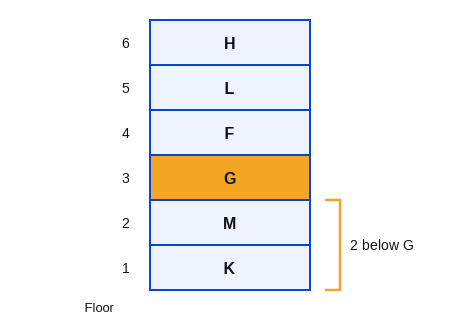
F, G, H, K, L, and M live on six different floors of the same building. The lowermost floor in the building is numbered 1, the floor above it is numbered 2, and so on till the topmost floor, which is numbered 6. L lives on floor number 5. H lives on a floor above L. Only K lives below M. F lives on an even numbered floor. How many people live below G?
F, G, H, K, L और M एक ही इमारत की छह अलग-अलग मंज़िलों पर रहते हैं। इमारत की सबसे निचली मंज़िल की संख्या 1 है, उसके ऊपर वाली मंज़िल की संख्या 2 है, और इसी प्रकार सबसे ऊपरी मंज़िल तक, जिसकी संख्या 6 है। L मंज़िल संख्या 5 पर रहता है। H, L से ऊपर वाली मंज़िल पर रहता है। केवल K, M से नीचे रहता है। F एक सम संख्या वाली मंज़िल पर रहता है। G से नीचे कितने व्यक्ति रहते हैं?
  1. ATwoदो
  2. BThreeतीन
  3. CFourचार
  4. DOneएक
Show answer

Concept: Place the fixed clues first (L, H), then the "only K below M" clue.

  1. L = floor 5; H is above L, so H = 6.
  2. Only K lives below M → K = 1, M = 2.
  3. F is on an even floor; 2 and 6 are taken → F = 4. Remaining: G = 3.
  4. Below G: K and M = two persons.

Trick: "Only X below Y" always means X is on floor 1 and Y on floor 2.

Answer: (A) Two

अवधारणा: पहले निश्चित सूचनाएँ (L, H) रखें, फिर "केवल K, M से नीचे" वाली शर्त।

  1. L = मंज़िल 5; H, L से ऊपर → H = 6।
  2. केवल K, M के नीचे रहता है → K = 1, M = 2।
  3. F सम (even) मंज़िल पर; 2 और 6 भरी हैं → F = 4। बचा G = 3।
  4. G से नीचे: K और M = दो व्यक्ति।

ट्रिक: "केवल X, Y के नीचे" का अर्थ हमेशा X = मंज़िल 1 और Y = मंज़िल 2।

उत्तर: (A) दो

RRB NTPC Graduate CBT 1General Intelligence and ReasoningFloor PuzzleRRB NTPC Graduate CBT 1 2024 · 23 Jun Shift 3 →
Q6798.
If 2 is added to each odd digit and 1 is subtracted from each even digit in the number 75246183, how many digits will appear more than once in the new number thus formed?
यदि संख्या 75246183 में प्रत्येक विषम अंक में 2 जोड़ दिया जाए और प्रत्येक सम अंक में से 1 घटा दिया जाए, तो इस प्रकार बनी नई संख्या में कितने अंक एक से अधिक बार आएँगे?
  1. AThreeतीन
  2. BTwoदो
  3. CNoneकोई नहीं
  4. DOneएक
Show answer

Concept: Change every digit by the rule (odd +2, even −1), then count digits that repeat.

  1. Number: 7 5 2 4 6 1 8 3
  2. New: 9 7 1 3 5 3 7 5
  3. Repeated digits: 7 (twice), 3 (twice), 5 (twice) → three digits.

Trick: Write the new digit directly under each old digit – no digit gets skipped.

Answer: (A) Three

अवधारणा: हर अंक को नियम (विषम +2, सम −1) से बदलें, फिर दोहराए अंक गिनें।

  1. संख्या: 7 5 2 4 6 1 8 3
  2. नई: 9 7 1 3 5 3 7 5
  3. दोहराए अंक: 7, 3, 5 (प्रत्येक दो बार) → तीन अंक।

ट्रिक: हर पुराने अंक के नीचे नया अंक लिखें – कोई अंक छूटेगा नहीं।

उत्तर: (A) तीन

RRB NTPC Graduate CBT 1General Intelligence and ReasoningNumber OperationsRRB NTPC Graduate CBT 1 2024 · 23 Jun Shift 3 →
Q6799.
What should come in place of the question mark (?) in the given series?
1412 1420 1430 1442 1456 ?
दी गई श्रृंखला में प्रश्न चिह्न (?) के स्थान पर क्या आना चाहिए?
1412 1420 1430 1442 1456 ?
  1. A1474
  2. B1470
  3. C1468
  4. D1472
Show answer

Concept: Check the differences between consecutive terms.

  1. Differences: 8, 10, 12, 14 – they rise by 2.
  2. Next difference =16
  3. 1456+16=1472

Trick: When differences are consecutive even numbers, the next difference is just +2 more.

Answer: (D) 1472

अवधारणा: क्रमागत पदों का अंतर देखें।

  1. अंतर: 8, 10, 12, 14 – हर बार 2 बढ़ रहा है।
  2. अगला अंतर =16
  3. 1456+16=1472

ट्रिक: अंतर क्रमागत सम संख्याएँ हों तो अगला अंतर 2 अधिक होगा।

उत्तर: (D) 1472

RRB NTPC Graduate CBT 1General Intelligence and ReasoningNumber SeriesRRB NTPC Graduate CBT 1 2024 · 23 Jun Shift 3 →
Q6800.
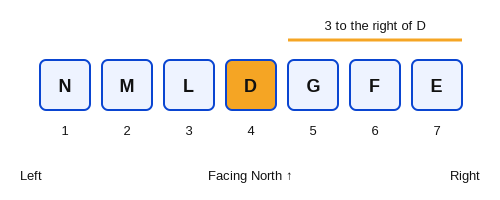
Seven people D, E, F, G, L, M and N are sitting in a row, facing north. Only two people sit to the left of L. Only three people sit between L and E. G sits second to the right of L. Only two people sit between G and M. D sits at some place to the right of N but at some place to the left of F. How many people sit to the right of D?
सात व्यक्ति D, E, F, G, L, M और N एक पंक्ति में उत्तर की ओर मुख करके बैठे हैं। L के बाईं ओर केवल दो व्यक्ति बैठे हैं। L और E के बीच केवल तीन व्यक्ति बैठे हैं। G, L के दाईं ओर दूसरे स्थान पर बैठा है। G और M के बीच केवल दो व्यक्ति बैठे हैं। D, N के दाईं ओर किसी स्थान पर, परंतु F के बाईं ओर किसी स्थान पर बैठा है। D के दाईं ओर कितने व्यक्ति बैठे हैं?
  1. AFourचार
  2. BTwoदो
  3. CThreeतीन
  4. DOneएक
Show answer

Concept: Facing north, left and right are the solver's own left and right. Number seats 1–7 from the left.

  1. Only two people left of L → L = 3. Three between L and E → E = 7.
  2. G second to the right of L → G = 5. Two between G and M → M = 2.
  3. Seats 1, 4, 6 remain for N, D, F with N < D < F → N = 1, D = 4, F = 6.
  4. Right of D: G, F, E = three.

Trick: People to the right of seat k in a row of 7 =7−k=7−4=3.

Answer: (C) Three

अवधारणा: उत्तर की ओर मुख होने पर बाएँ-दाएँ हमारे अपने बाएँ-दाएँ होते हैं। बाएँ से सीट 1–7 मानें।

  1. L के बाएँ केवल दो → L = 3; L और E के बीच तीन → E = 7।
  2. G, L के दाएँ दूसरे स्थान पर → G = 5; G और M के बीच दो → M = 2।
  3. बची सीट 1, 4, 6 पर N < D < F → N = 1, D = 4, F = 6।
  4. D के दाएँ: G, F, E = तीन।

ट्रिक: 7 की पंक्ति में सीट k के दाएँ =7−k=7−4=3 व्यक्ति।

उत्तर: (C) तीन

RRB NTPC Graduate CBT 1General Intelligence and ReasoningLinear Seating ArrangementRRB NTPC Graduate CBT 1 2024 · 23 Jun Shift 3 →