Question bank

Q&A: practice questions with answers

Search questions on any topic. Filter by exam category, exam, subject and topic, try the question, then open the answer and explanation.

Courses – airGurukul

20,719 questions found.

Q7001.
Which of the given letter-clusters should replace # and % so that the pattern and relationship followed between the letter-cluster pair on the left side of :: is the same as that on the right side of ::?
# : GLO :: INQ : %
दिए गए अक्षर-समूहों में से कौन-से # और % को प्रतिस्थापित करेंगे ताकि :: के बाईं ओर के अक्षर-समूह युग्म के बीच का पैटर्न और संबंध वही हो जो :: के दाईं ओर है?
# : GLO :: INQ : %
  1. A# = DFR, % = NPY
  2. B# = BGJ, % = NSV
  3. C# = BPU, % = MTG
  4. D# = EDG, % = MGV
Show answer

Concept: Find the shift from # to GLO and apply the same to INQ.

  1. Try (B): B → G, G → L, J → O: each letter +5.
  2. Apply +5 to INQ: I → N, N → S, Q → V = NSV, which matches % in (B).

Trick: B(2)+5 = G(7): check first letters of options against G.

Answer: (B) # = BGJ, % = NSV

अवधारणा: # से GLO तक का खिसकाव ज्ञात करें और INQ पर वही लगाएँ।

  1. (B) जाँचें: B → G, G → L, J → O: हर अक्षर +5।
  2. INQ पर +5: I → N, N → S, Q → V = NSV, जो (B) के % से मेल खाता है।

ट्रिक: B(2)+5 = G(7): विकल्पों के पहले अक्षर G से मिलाएँ।

उत्तर: (B) # = BGJ, % = NSV
RRB NTPC Graduate CBT 1General Intelligence and ReasoningLetter AnalogyRRB NTPC Graduate CBT 1 2024 · 23 Jun Shift 1 →
Q7002.
In the following triads, each group of letters is related to the subsequent one following a certain logic. Select from the given options, the one that follows the same logic. BACK - ABCK - BCKA
MINO - IMNO - MNOI
निम्नलिखित त्रिकों में, अक्षरों का प्रत्येक समूह एक निश्चित तर्क के अनुसार अगले समूह से संबंधित है। दिए गए विकल्पों में से उसका चयन कीजिए जो समान तर्क का अनुसरण करता है। BACK - ABCK - BCKA
MINO - IMNO - MNOI
  1. ARANK - ARNK - ANKR
  2. BCLIP - LCIP - PLIC
  3. CCAGE - CGAE - EGAC
  4. DTEAR - ETAR - TARE
Show answer

Concept: Step 1: swap the first two letters. Step 2: move the first letter of the result to the end.

  1. BACK → ABCK → BCKA; MINO → IMNO → MNOI.
  2. TEAR → ETAR (swap T, E) → TARE (E moved to end). ✔
  3. RANK → ARNK → RNKA (not ANKR); CLIP → LCIP → CIPL (not PLIC).

Trick: Apply both steps to each option; only one survives.

Answer: (D) TEAR - ETAR - TARE

अवधारणा: चरण 1: पहले दो अक्षर आपस में बदलें। चरण 2: नए शब्द का पहला अक्षर अंत में ले जाएँ।

  1. BACK → ABCK → BCKA; MINO → IMNO → MNOI।
  2. TEAR → ETAR (T, E बदले) → TARE (E अंत में)। ✔
  3. RANK → ARNK → RNKA (ANKR नहीं); CLIP → LCIP → CIPL (PLIC नहीं)।

ट्रिक: हर विकल्प पर दोनों चरण लगाएँ; केवल एक सही बैठता है।

उत्तर: (D) TEAR - ETAR - TARE

RRB NTPC Graduate CBT 1General Intelligence and ReasoningLetter TriadsRRB NTPC Graduate CBT 1 2024 · 23 Jun Shift 1 →
Q7003.
A group of numbers and symbols is coded using letter codes as per the codes given below and the conditions that follow. Study the given codes and conditions and answer the question that follows.
Note: If none of the conditions apply, then codes for the respective number/symbol are to be followed directly as given in the table.
Number/symbol@42+8-÷67%5$#&
CodePVARZIEHLOJCBQ
Conditions:
(i) If the first and the last elements are symbols, then the codes for these two (the first and the last element) are to be interchanged.
(ii) If the third element is a prime number, then the third element is to be coded as γ.
(iii) If the fifth element is a multiple of 4, then the fifth element is to be coded as β.
What will be the code for the following group?
4 6 ÷ % 8
नीचे दिए गए कूटों और उसके बाद दी गई शर्तों के अनुसार संख्याओं और प्रतीकों के एक समूह को अक्षर कूटों का उपयोग करके कूटबद्ध किया गया है। दिए गए कूटों और शर्तों का अध्ययन कीजिए और नीचे दिए गए प्रश्न का उत्तर दीजिए।
नोट: यदि कोई भी शर्त लागू नहीं होती है, तो संबंधित संख्या/प्रतीक के लिए तालिका में दिए गए कूटों का सीधे अनुसरण किया जाना है।
संख्या/प्रतीक@42+8-÷67%5$#&
कूटPVARZIEHLOJCBQ
शर्तें:
(i) यदि पहला और अंतिम अवयव प्रतीक हैं, तो इन दोनों (पहले और अंतिम अवयव) के कूट आपस में बदल दिए जाने हैं।
(ii) यदि तीसरा अवयव एक अभाज्य संख्या है, तो तीसरे अवयव को γ के रूप में कूटबद्ध किया जाना है।
(iii) यदि पाँचवाँ अवयव 4 का गुणज है, तो पाँचवें अवयव को β के रूप में कूटबद्ध किया जाना है।
निम्नलिखित समूह के लिए कूट क्या होगा?
4 6 ÷ % 8
  1. ABHEOZ
  2. BVHEOZ
  3. CVHEOβ
  4. DγHYOβ
Show answer

Concept: Read codes from the table, then test each condition on the group 4 6 ÷ % 8.

  1. Direct codes: 4 = V, 6 = H, ÷ = E, % = O, 8 = Z.
  2. (i) First element 4 is a number – not applied. (ii) Third element ÷ is not a prime – not applied.
  3. (iii) Fifth element 8 is a multiple of 4 ⇒ 8 coded as β. Code = V H E O β.

Trick: Check conditions only on the positions they name (1st, 3rd, 5th).

Answer: (C) VHEOβ

अवधारणा: तालिका से कूट पढ़ें, फिर समूह 4 6 ÷ % 8 पर हर शर्त जाँचें।

  1. सीधे कूट: 4 = V, 6 = H, ÷ = E, % = O, 8 = Z।
  2. (i) पहला तत्व 4 संख्या है – लागू नहीं। (ii) तीसरा तत्व ÷ अभाज्य संख्या नहीं – लागू नहीं।
  3. (iii) पाँचवाँ तत्व 8, 4 का गुणज है ⇒ 8 का कूट β। कूट = V H E O β।

ट्रिक: शर्तें केवल बताए गए स्थानों (1, 3, 5) पर ही जाँचें।

उत्तर: (C) VHEOβ

RRB NTPC Graduate CBT 1General Intelligence and ReasoningCoding–Decoding with ConditionsRRB NTPC Graduate CBT 1 2024 · 23 Jun Shift 1 →
Q7004.
Based on the English alphabetical order, three of the following four letter-clusters are alike in a certain way and thus form a group. Which letter-cluster DOES NOT belong to that group?
(Note: The odd one out is not based on the number of consonants/vowels or their position in the letter-cluster.)
अंग्रेज़ी वर्णमाला क्रम के आधार पर, निम्नलिखित चार अक्षर-समूहों में से तीन किसी निश्चित प्रकार से एक समान हैं और इस प्रकार एक समूह बनाते हैं। कौन-सा अक्षर-समूह उस समूह से संबंधित नहीं है?
(नोट: असंगत अक्षर-समूह, उस अक्षर-समूह में व्यंजनों/स्वरों की संख्या या उनके स्थान पर आधारित नहीं है।)
  1. AOSM
  2. BRVQ
  3. CUYT
  4. DJNI
Show answer

Concept: Find the gaps between consecutive letters.

  1. RVQ: R → V +4, V → Q −5. UYT: +4,−5. JNI: +4,−5.
  2. OSM: O → S +4, S → M −6 – different.

Trick: In the group, the third letter is just before the first (Q–R, T–U, I–J); in OSM it is not (M vs O).

Answer: (A) OSM

अवधारणा: क्रमागत अक्षरों का अंतर देखें।

  1. RVQ: R → V +4, V → Q −5। UYT: +4,−5। JNI: +4,−5।
  2. OSM: O → S +4, S → M −6 – अलग।

ट्रिक: समूह में तीसरा अक्षर पहले से ठीक पहले वाला है (Q–R, T–U, I–J); OSM में नहीं (M और O)।

उत्तर: (A) OSM

RRB NTPC Graduate CBT 1General Intelligence and ReasoningOdd One Out – LettersRRB NTPC Graduate CBT 1 2024 · 23 Jun Shift 1 →
Q7005.
Read the given statement(s) and conclusions carefully. Assuming that the information given in the statement(s) is true, even if it appears to be at variance with commonly known facts, decide which of the given conclusions logically follow(s) from the statement(s).
Statement:
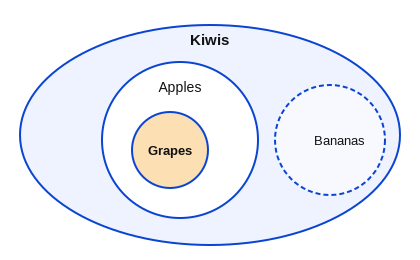
All grapes are apples.
All apples are kiwis.
Some kiwis are bananas.
Conclusion:
(I) All apples are bananas.
(II) Some kiwis are grapes.
दिए गए कथन/कथनों और निष्कर्षों को ध्यानपूर्वक पढ़िए। यह मानते हुए कि कथन/कथनों में दी गई जानकारी सत्य है, भले ही वह सामान्यतः ज्ञात तथ्यों से भिन्न प्रतीत होती हो, निर्णय कीजिए कि दिए गए निष्कर्षों में से कौन-सा/से निष्कर्ष तार्किक रूप से कथन/कथनों का अनुसरण करता है/करते हैं।
कथन:
सभी अंगूर, सेब हैं।
सभी सेब, कीवी हैं।
कुछ कीवी, केले हैं।
निष्कर्ष:
(I) सभी सेब, केले हैं।
(II) कुछ कीवी, अंगूर हैं।
  1. ANeither conclusion (I) nor (II) follows.न तो निष्कर्ष (I) और न ही (II) अनुसरण करता है।
  2. BOnly conclusion (II) follows.केवल निष्कर्ष (II) अनुसरण करता है।
  3. COnly conclusion (I) follows.केवल निष्कर्ष (I) अनुसरण करता है।
  4. DBoth conclusions I and II follow.निष्कर्ष I और II दोनों अनुसरण करते हैं।
Show answer

Concept: Draw the minimal Venn diagram that satisfies all statements and test each conclusion.

  1. Grapes ⊂ Apples ⊂ Kiwis; Bananas only overlap some Kiwis (may stay outside Apples).
  2. (I) All apples are bananas – not certain, as the diagram shows Bananas need not cover Apples. ✘
  3. (II) All grapes are kiwis, so some kiwis are grapes. ✔

Trick: 'All A are B' always gives 'Some B are A'.

Answer: (B) Only conclusion (II) follows.

अवधारणा: सभी कथनों को पूरा करने वाला न्यूनतम वेन आरेख बनाएँ और निष्कर्ष जाँचें।

  1. अंगूर ⊂ सेब ⊂ कीवी; केले केवल कुछ कीवी से मिलते हैं (सेब से बाहर रह सकते हैं)।
  2. (I) सभी सेब केले हैं – निश्चित नहीं, आरेख में केले सेब को ढकते नहीं। ✘
  3. (II) सभी अंगूर कीवी हैं, अतः कुछ कीवी अंगूर हैं। ✔

ट्रिक: 'सभी A, B हैं' से हमेशा 'कुछ B, A हैं' निकलता है।

उत्तर: (B) Only conclusion (II) follows.

RRB NTPC Graduate CBT 1General Intelligence and ReasoningSyllogismRRB NTPC Graduate CBT 1 2024 · 23 Jun Shift 1 →
Q7006.
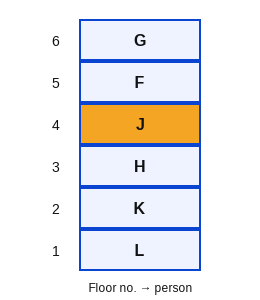
F, G, H, J, K and L live on six different floors of the same building. The lowermost floor in the building is numbered 1, the floor above it, number 2 and so on till the topmost floor is numbered 6. Only three people live between K and G, where K lives below G. H lives on an odd numbered floor and immediately above K. J lives on one of the floors below F and on one of the floors above L. Who lives on floor numbered 4?
F, G, H, J, K और L एक ही इमारत की छह अलग-अलग मंज़िलों पर रहते हैं। इमारत की सबसे निचली मंज़िल की संख्या 1 है, उसके ऊपर वाली मंज़िल की संख्या 2 है और इसी प्रकार सबसे ऊपरी मंज़िल की संख्या 6 है। K और G के बीच केवल तीन व्यक्ति रहते हैं, जहाँ K, G से नीचे रहता है। H एक विषम संख्या वाली मंज़िल पर और K के ठीक ऊपर रहता है। J, F से नीचे की किसी एक मंज़िल पर और L से ऊपर की किसी एक मंज़िल पर रहता है। मंज़िल संख्या 4 पर कौन रहता है?
  1. AF
  2. BH
  3. CL
  4. DJ
Show answer

Concept: Fix K and G first (three floors between them), then use H's condition.

  1. Possible: K = 1, G = 5 or K = 2, G = 6.
  2. H is odd and just above K: K = 1 gives H = 2 (even) ✘; so K = 2, H = 3, G = 6.
  3. Remaining floors 1, 4, 5 for L < J < F ⇒ L = 1, J = 4, F = 5.

Trick: Start with the clue that has the fewest possibilities.

Answer: (D) J

अवधारणा: पहले K और G (बीच में तीन मंज़िल) तय करें, फिर H की शर्त लगाएँ।

  1. संभव: K = 1, G = 5 या K = 2, G = 6।
  2. H विषम और K के ठीक ऊपर: K = 1 से H = 2 (सम) ✘; अतः K = 2, H = 3, G = 6।
  3. बची मंज़िलें 1, 4, 5 पर L < J < F ⇒ L = 1, J = 4, F = 5।

ट्रिक: सबसे कम संभावनाओं वाली शर्त से शुरू करें।

उत्तर: (D) J

RRB NTPC Graduate CBT 1General Intelligence and ReasoningFloor PuzzleRRB NTPC Graduate CBT 1 2024 · 23 Jun Shift 1 →
Q7007.
This question is based on the five, three-digit numbers given below.
(Left) 941 915 741 807 776 (Right)
(Example- 697 – First digit = 6, second digit = 9 and third digit = 7)
(NOTE: All operations to be done from left to right.)
What will be the resultant if the third digit of the highest number is added to the first digit of the lowest number?
यह प्रश्न नीचे दी गई तीन अंकों वाली पाँच संख्याओं पर आधारित है।
(बाएँ) 941 915 741 807 776 (दाएँ)
(उदाहरण- 697 – पहला अंक = 6, दूसरा अंक = 9 और तीसरा अंक = 7)
(नोट: सभी संक्रियाएँ बाएँ से दाएँ की जानी हैं।)
यदि सबसे बड़ी संख्या के तीसरे अंक को सबसे छोटी संख्या के पहले अंक में जोड़ा जाए, तो परिणाम क्या होगा?
  1. A8
  2. B9
  3. C11
  4. D7
Show answer

Concept: Identify the highest and lowest numbers, then pick the required digits.

  1. Highest =941 → third digit =1.
  2. Lowest =741 → first digit =7.
  3. 1+7=8.

Trick: Compare first digits first: 9 vs 7 decides quickly.

Answer: (A) 8

अवधारणा: सबसे बड़ी और सबसे छोटी संख्या पहचानें, फिर अंक चुनें।

  1. सबसे बड़ी =941 → तीसरा अंक =1।
  2. सबसे छोटी =741 → पहला अंक =7।
  3. 1+7=8।

ट्रिक: पहले अंकों की तुलना करें: 9 और 7 से तुरंत निर्णय।

उत्तर: (A) 8

RRB NTPC Graduate CBT 1General Intelligence and ReasoningNumber OperationsRRB NTPC Graduate CBT 1 2024 · 23 Jun Shift 1 →
Q7008.
Each of the digits in the number 73412968 is arranged in the descending order from left to right. Which of the following digits will be fifth from the right in the new number thus formed?
संख्या 73412968 के प्रत्येक अंक को बाएँ से दाएँ अवरोही क्रम में व्यवस्थित किया जाता है। इस प्रकार बनी नई संख्या में दाएँ से पाँचवाँ अंक निम्नलिखित में से कौन-सा होगा?
  1. A6
  2. B4
  3. C7
  4. D3
Show answer

Concept: Arrange the digits of 73412968 from largest to smallest.

  1. Descending: 98764321.
  2. From the right: 1 (1st), 2 (2nd), 3 (3rd), 4 (4th), 6 (5th).

Trick: In 8 digits, 5th from right = 4th from left: 9, 8, 7, 6.

Answer: (A) 6

अवधारणा: 73412968 के अंकों को बड़े से छोटे क्रम में लगाएँ।

  1. घटते क्रम में: 98764321।
  2. दाएँ से: 1 (पहला), 2, 3, 4, 6 (पाँचवाँ)।

ट्रिक: 8 अंकों में दाएँ से 5वाँ = बाएँ से 4था: 9, 8, 7, 6।

उत्तर: (A) 6

RRB NTPC Graduate CBT 1General Intelligence and ReasoningDigit ArrangementRRB NTPC Graduate CBT 1 2024 · 23 Jun Shift 1 →
Q7009.
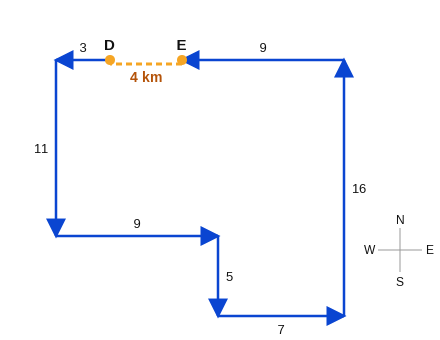
Mr. C starts from Point D and drives 3 km towards the west. He then takes a left turn, drives 11 km, turns left and drives 9 km. He then takes a right turn and drives 5 km, turns left drives 7 km. He then takes left turn, drives 16 km. He takes a final left turn drives 9 km and stops at Point E. How far (shortest distance) and towards which direction should he drive in order to reach Point D again? (All turns are 90 degrees turns only unless specified.)
श्री C बिंदु D से प्रारंभ करते हैं और पश्चिम की ओर 3 km गाड़ी चलाते हैं। फिर वे बाएँ मुड़ते हैं, 11 km गाड़ी चलाते हैं, बाएँ मुड़ते हैं और 9 km गाड़ी चलाते हैं। फिर वे दाएँ मुड़ते हैं और 5 km गाड़ी चलाते हैं, बाएँ मुड़ते हैं और 7 km गाड़ी चलाते हैं। फिर वे बाएँ मुड़ते हैं, 16 km गाड़ी चलाते हैं। वे अंतिम बार बाएँ मुड़ते हैं, 9 km गाड़ी चलाते हैं और बिंदु E पर रुक जाते हैं। पुनः बिंदु D पर पहुँचने के लिए उन्हें कितनी दूर (न्यूनतम दूरी) और किस दिशा की ओर गाड़ी चलानी चाहिए? (जब तक निर्दिष्ट न हो, सभी मोड़ केवल 90 डिग्री के हैं।)
  1. A2 km towards the Eastपूर्व की ओर 2 km
  2. B4 km towards the Westपश्चिम की ओर 4 km
  3. C2 km towards the Westपश्चिम की ओर 2 km
  4. D4 km towards the Southदक्षिण की ओर 4 km
Show answer

Concept: Take D as origin, east +x, north +y; track the facing direction after each turn.

  1. West 3: (−3,0). Left → south 11: (−3,−11). Left → east 9: (6,−11).
  2. Right → south 5: (6,−16). Left → east 7: (13,−16).
  3. Left → north 16: (13,0). Left → west 9: E =(4,0). D is 4km to the west of E.

Trick: Net N–S: −11−5+16=0; net E–W: −3+9+7−9=4 east ⇒ go 4 west.

Answer: (B) 4km towards the West

अवधारणा: D को मूल बिंदु लें, पूर्व +x, उत्तर +y; हर मोड़ पर दिशा देखें।

  1. पश्चिम 3: (−3,0)। बाएँ → दक्षिण 11: (−3,−11)। बाएँ → पूर्व 9: (6,−11)।
  2. दाएँ → दक्षिण 5: (6,−16)। बाएँ → पूर्व 7: (13,−16)।
  3. बाएँ → उत्तर 16: (13,0)। बाएँ → पश्चिम 9: E =(4,0)। D, E से 4km पश्चिम में है।

ट्रिक: उत्तर–दक्षिण: −11−5+16=0; पूर्व–पश्चिम: −3+9+7−9=4 पूर्व ⇒ 4 पश्चिम जाएँ।

उत्तर: (B) 4km towards the West

RRB NTPC Graduate CBT 1General Intelligence and ReasoningDirection and DistanceRRB NTPC Graduate CBT 1 2024 · 23 Jun Shift 1 →
Q7010.
This question is based on the five, three-digit numbers given below.
(Left) 441 317 999 155 444 (Right)
(Example- 697 – First digit = 6, second digit = 9 and third digit = 7)
(NOTE: All operations to be done from left to right.)
What will be the resultant if the third digit of the highest number is subtracted from the first digit of the lowest number?
यह प्रश्न नीचे दी गई तीन अंकों वाली पाँच संख्याओं पर आधारित है।
(बाएँ) 441 317 999 155 444 (दाएँ)
(उदाहरण- 697 – पहला अंक = 6, दूसरा अंक = 9 और तीसरा अंक = 7)
(नोट: सभी संक्रियाएँ बाएँ से दाएँ की जानी हैं।)
यदि सबसे बड़ी संख्या के तीसरे अंक को सबसे छोटी संख्या के पहले अंक में से घटाया जाए, तो परिणाम क्या होगा?
  1. A−6
  2. B−7
  3. C−5
  4. D−8
Show answer

Concept: Identify the highest and lowest numbers, then subtract as asked.

  1. Highest =999 → third digit =9.
  2. Lowest =155 → first digit =1.
  3. 1−9=−8.

Trick: 'A subtracted from B' means B−A.

Answer: (D) −8

अवधारणा: सबसे बड़ी और सबसे छोटी संख्या पहचानें, फिर घटाएँ।

  1. सबसे बड़ी =999 → तीसरा अंक =9।
  2. सबसे छोटी =155 → पहला अंक =1।
  3. 1−9=−8।

ट्रिक: 'A को B से घटाएँ' = B−A।

उत्तर: (D) −8

RRB NTPC Graduate CBT 1General Intelligence and ReasoningNumber OperationsRRB NTPC Graduate CBT 1 2024 · 23 Jun Shift 1 →
Q7011.
This question is based on the five, three-digit numbers given below.
(Left) 107 788 634 346 488 (Right)
(Example- 697 – First digit = 6, second digit = 9 and third digit = 7)
(NOTE: All operations to be done from left to right.)
What will be the resultant if the first digit of the highest number is added to the third digit of the lowest number?
यह प्रश्न नीचे दी गई तीन अंकों वाली पाँच संख्याओं पर आधारित है।
(बाएँ) 107 788 634 346 488 (दाएँ)
(उदाहरण- 697 – पहला अंक = 6, दूसरा अंक = 9 और तीसरा अंक = 7)
(नोट: सभी संक्रियाएँ बाएँ से दाएँ की जानी हैं।)
यदि सबसे बड़ी संख्या के पहले अंक को सबसे छोटी संख्या के तीसरे अंक में जोड़ा जाए, तो परिणाम क्या होगा?
  1. A7
  2. B9
  3. C12
  4. D14
Show answer

Concept: Find the highest and lowest of the five numbers, then pick the asked digits.

  1. Numbers: 107, 788, 634, 346, 488.
  2. Highest = 788 → first digit = 7.
  3. Lowest = 107 → third digit = 7.
  4. Sum: 7+7=14.

Trick: Compare only the hundreds digit first: 7 (in 788) is the largest, 1 (in 107) the smallest.

Answer: (D) 14

अवधारणा: पाँचों संख्याओं में सबसे बड़ी और सबसे छोटी संख्या ढूँढकर पूछे गए अंक लें।

  1. संख्याएँ: 107, 788, 634, 346, 488।
  2. सबसे बड़ी = 788 → पहला अंक = 7।
  3. सबसे छोटी = 107 → तीसरा अंक = 7।
  4. योग: 7+7=14।

ट्रिक: पहले सैकड़े का अंक देखें: 788 का 7 सबसे बड़ा, 107 का 1 सबसे छोटा।

उत्तर: (D) 14

RRB NTPC Graduate CBT 1General Intelligence and ReasoningNumber arrangement (digits)RRB NTPC Graduate CBT 1 2024 · 23 Jun Shift 1 →
Q7012.
Which of the following letter-number clusters will replace the question mark (?) in the given series to make it logically complete?
LOK 4, JMI 9, HKG 25, FIE 49, ?
दी गई श्रृंखला को तार्किक रूप से पूर्ण करने के लिए निम्नलिखित में से कौन-सा अक्षर-संख्या समूह प्रश्न चिह्न (?) को प्रतिस्थापित करेगा?
LOK 4, JMI 9, HKG 25, FIE 49, ?
  1. ADGC 169
  2. BDGC 121
  3. CDFC 121
  4. DDGC 81
Show answer

Concept: Letters and numbers follow separate patterns.

  1. Each letter moves back by 2: L→J→H→F→D, O→M→K→I→G, K→I→G→E→C → DGC.
  2. Numbers are squares of primes: 22=4, 32=9, 52=25, 72=49, next 112=121.
  3. Required term: DGC 121.

Trick: 4, 9, 25, 49 skip 16 and 36 – a hint that the bases are primes 2, 3, 5, 7, 11.

Answer: (B) DGC 121

अवधारणा: अक्षर और संख्याएँ अलग-अलग पैटर्न पर चलते हैं।

  1. हर अक्षर 2 पीछे जाता है: L→J→H→F→D, O→M→K→I→G, K→I→G→E→C → DGC।
  2. संख्याएँ अभाज्य संख्याओं के वर्ग हैं: 22=4, 32=9, 52=25, 72=49, अगला 112=121।
  3. अभीष्ट पद: DGC 121।

ट्रिक: 4, 9, 25, 49 में 16 और 36 नहीं हैं – यानी आधार अभाज्य 2, 3, 5, 7, 11 हैं।

उत्तर: (B) DGC 121

RRB NTPC Graduate CBT 1General Intelligence and ReasoningLetter-number seriesRRB NTPC Graduate CBT 1 2024 · 23 Jun Shift 1 →
Q7013.
PSKO is related to ILDH in a certain way based on the English alphabetical order. In the same way, RUMQ is related to KNFJ. To which of the given options is TWOS related, following the same logic?
अंग्रेज़ी वर्णमाला क्रम के आधार पर PSKO एक निश्चित प्रकार से ILDH से संबंधित है। उसी प्रकार, RUMQ, KNFJ से संबंधित है। समान तर्क का अनुसरण करते हुए, TWOS दिए गए विकल्पों में से किससे संबंधित है?
  1. APMLH
  2. BMPLH
  3. CMPHL
  4. DPMHL
Show answer

Concept: Find the shift from each letter of the first word to the second.

  1. PSKO → ILDH: P(16)→I(9), S(19)→L(12), K(11)→D(4), O(15)→H(8); each −7.
  2. Check RUMQ → KNFJ: each −7 ✓.
  3. TWOS: T(20)→M(13), W(23)→P(16), O(15)→H(8), S(19)→L(12) → MPHL.

Trick: −7 is the same as +19; use EJOTY (5, 10, 15, 20, 25) to locate letters fast.

Answer: (C) MPHL

अवधारणा: पहले शब्द के हर अक्षर से दूसरे शब्द के अक्षर तक का अंतर ज्ञात करें।

  1. PSKO → ILDH: P(16)→I(9), S(19)→L(12), K(11)→D(4), O(15)→H(8); हर अक्षर −7।
  2. जाँच RUMQ → KNFJ: हर अक्षर −7 ✓।
  3. TWOS: T(20)→M(13), W(23)→P(16), O(15)→H(8), S(19)→L(12) → MPHL।

ट्रिक: EJOTY (5, 10, 15, 20, 25) से अक्षरों की स्थिति जल्दी निकालें।

उत्तर: (C) MPHL

RRB NTPC Graduate CBT 1General Intelligence and ReasoningLetter analogyRRB NTPC Graduate CBT 1 2024 · 23 Jun Shift 1 →
Q7014.
Which of the following letter-number clusters will replace the question mark (?) in the given series to make it logically complete?
HL27 GK38 FJ49 EI60 ?
दी गई श्रृंखला को तार्किक रूप से पूर्ण करने के लिए निम्नलिखित में से कौन-सा अक्षर-संख्या समूह प्रश्न चिह्न (?) को प्रतिस्थापित करेगा?
HL27 GK38 FJ49 EI60 ?
  1. ADG71
  2. BDH71
  3. CDH72
  4. DDG72
Show answer

Concept: Each part of the cluster changes by a fixed step.

  1. First letter: H, G, F, E → D (back 1).
  2. Second letter: L, K, J, I → H (back 1).
  3. Number: 27, 38, 49, 60 → 60+11=71.
  4. Next term: DH71.

Trick: Only the options with H and 71 survive – DH71 is the only one.

Answer: (B) DH71

अवधारणा: समूह का हर भाग एक निश्चित अंतर से बदलता है।

  1. पहला अक्षर: H, G, F, E → D (1 पीछे)।
  2. दूसरा अक्षर: L, K, J, I → H (1 पीछे)।
  3. संख्या: 27, 38, 49, 60 → 60+11=71।
  4. अगला पद: DH71।

ट्रिक: H और 71 दोनों वाला विकल्प केवल DH71 है।

उत्तर: (B) DH71

RRB NTPC Graduate CBT 1General Intelligence and ReasoningLetter-number seriesRRB NTPC Graduate CBT 1 2024 · 23 Jun Shift 1 →
Q7015.
In this question, a group of numbers/symbols are coded using letter codes as per the codes given below, and the conditions that follow. The correct combination of codes (following only the condition/s that apply) is your answer.
Note: If none of the conditions apply, then codes for the respective number/symbol are to be followed directly as given in the table.
Number/symbol7@62#%&89=$34+
CodeEJAHFRBYLHQTKZ

Conditions:
(i) If the first element is an odd number and the last element is also an odd number then the codes for these two (the first and the last elements) are to be interchanged.
(ii) If the first and last elements are perfect squares then the code of the 1st and last element is to be that of the preceding number or symbol.
(iii) If the first and last element is a symbol then the first and last element is to be coded as >.
What is the code for the following?
9%+27
इस प्रश्न में, नीचे दिए गए कूटों और उसके बाद दी गई शर्तों के अनुसार संख्याओं/प्रतीकों के एक समूह को अक्षर कूटों का उपयोग करके कूटबद्ध किया गया है। कूटों का सही संयोजन (केवल लागू होने वाली शर्त/शर्तों का अनुसरण करते हुए) आपका उत्तर है।
नोट: यदि कोई भी शर्त लागू नहीं होती है, तो संबंधित संख्या/प्रतीक के लिए तालिका में दिए गए कूटों का सीधे अनुसरण किया जाना है।
संख्या/प्रतीक7@62#%&89=$34+
कूटEJAHFRBYLHQTKZ

शर्तें:
(i) यदि पहला अवयव एक विषम संख्या है और अंतिम अवयव भी एक विषम संख्या है, तो इन दोनों (पहले और अंतिम अवयवों) के कूट आपस में बदल दिए जाने हैं।
(ii) यदि पहला और अंतिम अवयव पूर्ण वर्ग हैं, तो पहले और अंतिम अवयव का कूट उसके पूर्ववर्ती संख्या या प्रतीक का कूट होगा।
(iii) यदि पहला और अंतिम अवयव प्रतीक है, तो पहले और अंतिम अवयव को > के रूप में कूटबद्ध किया जाना है।
निम्नलिखित के लिए कूट क्या है?
9%+27
  1. ALRZHE
  2. BERZHE
  3. CLRZHL
  4. DERZHL
Show answer

Concept: Write the plain codes first, then test each condition on the first and last elements.

  1. 9 % + 2 7 → L R Z H E.
  2. First 9 is odd and last 7 is odd → condition (i): interchange their codes.
  3. Condition (ii) fails (7 is not a perfect square); (iii) fails (both are numbers).
  4. Code: E R Z H L.

Trick: Check the first and last elements only – odd/odd here, so just swap the end letters: LRZHE → ERZHL.

Answer: (D) ERZHL

अवधारणा: पहले सीधे कोड लिखें, फिर पहले और अंतिम तत्व पर शर्तें जाँचें।

  1. 9 % + 2 7 → L R Z H E।
  2. पहला 9 विषम और अंतिम 7 विषम → शर्त (i): दोनों के कोड आपस में बदलें।
  3. शर्त (ii) लागू नहीं (7 पूर्ण वर्ग नहीं); (iii) लागू नहीं (दोनों संख्याएँ हैं)।
  4. कोड: E R Z H L।

ट्रिक: केवल पहला और अंतिम तत्व देखें – विषम/विषम, अतः छोर के अक्षर बदलें: LRZHE → ERZHL।

उत्तर: (D) ERZHL

RRB NTPC Graduate CBT 1General Intelligence and ReasoningCoding with conditionsRRB NTPC Graduate CBT 1 2024 · 23 Jun Shift 1 →
Q7016.
If ‘P’ stands for ‘×’, ‘Q’ stands for ‘÷’, ‘R’ stands for ‘−’ and ‘S’ stands for ‘+’, then what will come in place of the question mark (?) in the following equation?
29 S 9 P 3 R 13 P 4 S 55 = ?
यदि 'P' का अर्थ '×', 'Q' का अर्थ '÷', 'R' का अर्थ '−' और 'S' का अर्थ '+' है, तो निम्नलिखित समीकरण में प्रश्न चिह्न (?) के स्थान पर क्या आएगा?
29 S 9 P 3 R 13 P 4 S 55 = ?
  1. A59
  2. B27
  3. C83
  4. D41
Show answer

Concept: Replace letters by signs, then apply BODMAS.

  1. 29+9×3−13×4+55.
  2. =29+27−52+55.
  3. =111−52=59.

Trick: Do both multiplications first (27 and 52), then add/subtract left to right.

Answer: (A) 59

अवधारणा: अक्षरों के स्थान पर चिह्न रखकर BODMAS लगाएँ।

  1. 29+9×3−13×4+55।
  2. =29+27−52+55।
  3. =111−52=59।

ट्रिक: पहले दोनों गुणा (27 और 52), फिर जोड़-घटाव।

उत्तर: (A) 59

RRB NTPC Graduate CBT 1General Intelligence and ReasoningMathematical operationsRRB NTPC Graduate CBT 1 2024 · 23 Jun Shift 1 →
Q7017.
In a certain code language,
‘A + B’ means ‘A is the son of B’,
‘A – B’ means ‘A is the brother of B’,
‘A × B’ means ‘A is the wife of B’ and
‘A ÷ B’ means ‘A is the father of B’.
How is S related to H if ‘S + D – F × G ÷ H’?
एक निश्चित कूट भाषा में,
'A + B' का अर्थ है 'A, B का पुत्र है',
'A – B' का अर्थ है 'A, B का भाई है',
'A × B' का अर्थ है 'A, B की पत्नी है' और
'A ÷ B' का अर्थ है 'A, B का पिता है'।
यदि 'S + D – F × G ÷ H' है, तो S, H से किस प्रकार संबंधित है?
  1. AFather's sister's sonपिता की बहन का पुत्र
  2. BFather's brother's sonपिता के भाई का पुत्र
  3. CMother's sister's sonमाता की बहन का पुत्र
  4. DMother's brother's sonमाता के भाई का पुत्र
Show answer

Concept: Decode each symbol and draw the family tree.

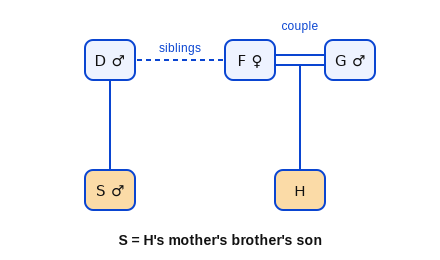
  1. S + D: S is the son of D.
  2. D – F: D is the brother of F.
  3. F × G: F is the wife of G; G ÷ H: G is the father of H.
  4. So F is H's mother, D is H's mother's brother, and S is his son.

Trick: Read the chain from H backwards: father G → his wife F (mother) → her brother D → his son S.

Answer: (D) Mother's brother's son

अवधारणा: हर चिह्न को डिकोड करके वंश-वृक्ष बनाएँ।

  1. S + D: S, D का पुत्र है।
  2. D – F: D, F का भाई है।
  3. F × G: F, G की पत्नी है; G ÷ H: G, H का पिता है।
  4. अतः F, H की माँ है, D मामा है और S मामा का पुत्र है।

ट्रिक: H से पीछे पढ़ें: पिता G → पत्नी F (माँ) → उसका भाई D (मामा) → पुत्र S।

उत्तर: (D) माँ के भाई का पुत्र (Mother's brother's son)

RRB NTPC Graduate CBT 1General Intelligence and ReasoningCoded blood relationsRRB NTPC Graduate CBT 1 2024 · 23 Jun Shift 1 →
Q7018.
What should come in place of the question mark (?) in the given series?
216, 182, 152, 126, 104, ?
दी गई श्रृंखला में प्रश्न चिह्न (?) के स्थान पर क्या आना चाहिए?
216, 182, 152, 126, 104, ?
  1. A78
  2. B72
  3. C81
  4. D86
Show answer

Concept: Check the differences between consecutive terms.

  1. Differences: 216−182=34, 182−152=30, 152−126=26, 126−104=22.
  2. Differences decrease by 4 → next difference =18.
  3. 104−18=86.

Trick: Differences 34, 30, 26, 22, 18 – an arithmetic pattern.

Answer: (D) 86

अवधारणा: लगातार पदों का अंतर देखें।

  1. अंतर: 216−182=34, 182−152=30, 152−126=26, 126−104=22।
  2. अंतर हर बार 4 कम → अगला अंतर =18।
  3. 104−18=86।

ट्रिक: अंतर 34, 30, 26, 22, 18 – समांतर पैटर्न।

उत्तर: (D) 86

RRB NTPC Graduate CBT 1General Intelligence and ReasoningNumber seriesRRB NTPC Graduate CBT 1 2024 · 23 Jun Shift 1 →
Q7019.
In a certain code language, ‘SOUP’ is coded as ‘5173’ and ‘PINT’ is coded as ‘4216’. What is the code for ‘P’ in the given code language?
एक निश्चित कूट भाषा में, 'SOUP' को '5173' के रूप में कूटबद्ध किया जाता है और 'PINT' को '4216' के रूप में कूटबद्ध किया जाता है। दी गई कूट भाषा में 'P' के लिए कूट क्या है?
  1. A1
  2. B4
  3. C6
  4. D3
Show answer

Concept: A letter common to two words gets the digit common to both codes.

  1. SOUP → 5173 and PINT → 4216.
  2. Common letter: P only.
  3. Common digit: 1 only.
  4. So P = 1.

Trick: Match the common letter with the common digit – no need to fix the order.

Answer: (A) 1

अवधारणा: दो शब्दों में उभयनिष्ठ अक्षर का कोड दोनों कोडों में उभयनिष्ठ अंक होता है।

  1. SOUP → 5173 और PINT → 4216।
  2. उभयनिष्ठ अक्षर: केवल P।
  3. उभयनिष्ठ अंक: केवल 1।
  4. अतः P = 1।

ट्रिक: उभयनिष्ठ अक्षर = उभयनिष्ठ अंक – क्रम देखने की ज़रूरत नहीं।

उत्तर: (A) 1

RRB NTPC Graduate CBT 1General Intelligence and ReasoningCoding-decodingRRB NTPC Graduate CBT 1 2024 · 23 Jun Shift 1 →
Q7020.
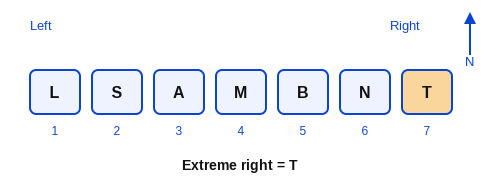
Seven people, A, B, L, M, N, S, and T are sitting in a row, facing north. Only L sits to the left of S. Only four people sit between L and N. Only M sits between A and B, and A is not an immediate neighbour of N.
Who sits at the extreme right of the line?
सात व्यक्ति, A, B, L, M, N, S और T एक पंक्ति में उत्तर की ओर मुख करके बैठे हैं। केवल L, S के बाईं ओर बैठा है। L और N के बीच केवल चार व्यक्ति बैठे हैं। A और B के बीच केवल M बैठा है, और A, N का निकटतम पड़ोसी नहीं है।
पंक्ति के दाएँ छोर पर कौन बैठा है?
  1. AA
  2. BN
  3. CD
  4. DT
Show answer

Concept: All face north, so left = left end. Fix the sure positions first.

  1. Only L is left of S → L at 1, S at 2.
  2. Four people between L and N → N at 6.
  3. A, M, B must sit together (A_M_B) in 3, 4, 5 (no other three consecutive seats are free).
  4. A is not next to N → A at 3, M at 4, B at 5; T at 7.

Trick: Order: L S A M B N T – the last seat left over goes to T.

Answer: (D) T

अवधारणा: सभी उत्तर की ओर मुख किए हैं, अतः बायाँ = बायाँ सिरा। पहले निश्चित स्थान तय करें।

  1. केवल L, S के बाएँ → L स्थान 1, S स्थान 2।
  2. L और N के बीच चार लोग → N स्थान 6।
  3. A, M, B साथ-साथ (A_M_B) केवल 3, 4, 5 पर बैठ सकते हैं।
  4. A, N का पड़ोसी नहीं → A 3, M 4, B 5; T स्थान 7।

ट्रिक: क्रम: L S A M B N T – बचा हुआ अंतिम स्थान T का।

उत्तर: (D) T

RRB NTPC Graduate CBT 1General Intelligence and ReasoningLinear seating arrangementRRB NTPC Graduate CBT 1 2024 · 23 Jun Shift 1 →