Question bank

Q&A: practice questions with answers

Search questions on any topic. Filter by exam category, exam, subject and topic, try the question, then open the answer and explanation.

Courses – airGurukul

20,719 questions found.

Q7101.
72 is related to 9 following a certain logic. Following the same logic, 24 is related to 3. To which of the following is 64 related, following the same logic?
(NOTE: Operations should be performed on the whole numbers, without breaking down the numbers into their constituent digits. E.g. 13 – Operations on 13 such as
adding/subtracting/multiplying to 13 can be performed. Breaking down 13 into 1 and 3 and then performing mathematical operations on 1 and 3 is not allowed.)
72 एक निश्चित तर्क का अनुसरण करते हुए 9 से संबंधित है। उसी तर्क का अनुसरण करते हुए, 24, 3 से संबंधित है। उसी तर्क का अनुसरण करते हुए, 64 निम्नलिखित में से किससे संबंधित है?
(नोट: संख्याओं को उनके घटक अंकों में विभाजित किए बिना, पूर्ण संख्याओं पर संक्रियाएँ की जानी चाहिए। उदाहरण 13 – 13 पर संक्रियाएँ जैसे
13 में जोड़ना/घटाना/गुणा करना आदि किया जा सकता है। 13 को 1 और 3 में विभाजित करना और फिर 1 और 3 पर गणितीय संक्रियाएँ करने की अनुमति नहीं है।)
  1. A6
  2. B8
  3. C7
  4. D9
Show answer

Concept: Find one operation that turns the first number into the second in both given pairs.

  1. 72÷8=9 and 24÷8=3 → rule: divide by 8
  2. 64÷8=8

Trick: Both pairs share the same ratio 8 : 1 – check division first when the second number is much smaller.

Answer: (B) 8

अवधारणा: एक ऐसी संक्रिया खोजें जो दोनों युग्मों में पहली संख्या को दूसरी में बदल दे।

  1. 72÷8=9 तथा 24÷8=3 → नियम: 8 से भाग
  2. 64÷8=8

ट्रिक: जब दूसरी संख्या बहुत छोटी हो, पहले भाग का नियम जाँचें।

उत्तर: (B) 8
RRB NTPC Graduate CBT 1General Intelligence and ReasoningNumber AnalogyRRB NTPC Graduate CBT 1 2024 · 21 Jun Shift 3 →
Q7102.
If 2 is added to each even digit and 2 is subtracted from each odd digit in the number 6597423, what will be the sum of all the even digits in the new number thus formed?
यदि संख्या 6597423 में प्रत्येक सम अंक में 2 जोड़ा जाए और प्रत्येक विषम अंक में से 2 घटाया जाए, तो इस प्रकार बनी नई संख्या में सभी सम अंकों का योग क्या होगा?
  1. A20
  2. B14
  3. C16
  4. D18
Show answer

Concept: Change each digit as instructed, then add the even digits of the new number.

  1. 6597423 → 6+2 = 8, 5−2 = 3, 9−2 = 7, 7−2 = 5, 4+2 = 6, 2+2 = 4, 3−2 = 1
  2. New number: 8375641
  3. Even digits 8, 6, 4 → sum = 18

Trick: Adding/subtracting 2 keeps parity: only the old even digits (6, 4, 2) stay even → 8 + 6 + 4.

Answer: (D) 18

अवधारणा: निर्देश अनुसार हर अंक बदलें, फिर नई संख्या के सम अंकों को जोड़ें।

  1. 6597423 → 6+2 = 8, 5−2 = 3, 9−2 = 7, 7−2 = 5, 4+2 = 6, 2+2 = 4, 3−2 = 1
  2. नई संख्या: 8375641
  3. सम अंक 8, 6, 4 → योग = 18

ट्रिक: 2 जोड़ने/घटाने से सम-विषम नहीं बदलता: पुराने सम अंक (6, 4, 2) ही सम रहते हैं → 8 + 6 + 4।

उत्तर: (D) 18

RRB NTPC Graduate CBT 1General Intelligence and ReasoningDigit OperationsRRB NTPC Graduate CBT 1 2024 · 21 Jun Shift 3 →
Q7103.
What should come in place of the question mark (?) in the given series?
135 123 109 93 75 ?
दी गई श्रृंखला में प्रश्न चिह्न (?) के स्थान पर क्या आना चाहिए?
135 123 109 93 75 ?
  1. A65
  2. B55
  3. C45
  4. D75
Show answer

Concept: Look at the differences between consecutive terms.

  1. 135 → 123 → 109 → 93 → 75: differences −12, −14, −16, −18
  2. Next difference −20 → 75 − 20 = 55

Trick: Differences grow by 2 each time.

Answer: (B) 55

अवधारणा: क्रमागत पदों का अंतर देखें।

  1. 135 → 123 → 109 → 93 → 75: अंतर −12, −14, −16, −18
  2. अगला अंतर −20 → 75 − 20 = 55

ट्रिक: अंतर हर बार 2 बढ़ता है।

उत्तर: (B) 55

RRB NTPC Graduate CBT 1General Intelligence and ReasoningNumber SeriesRRB NTPC Graduate CBT 1 2024 · 21 Jun Shift 3 →
Q7104.
Which of the given letter-clusters should replace # and % so that the pattern and relationship followed between the letter-cluster pair on the left side of :: is the same as that on the right side of ::?
# : PKN :: TOR : %
दिए गए अक्षर-समूहों में से कौन-सा # और % को प्रतिस्थापित करे ताकि :: के बाईं ओर के अक्षर-समूह युग्म के बीच का पैटर्न और संबंध वही हो जो :: के दाईं ओर है?
# : PKN :: TOR : %
  1. A# = KFI, % = YTW
  2. B# = KFL, % = YPG
  3. C# = KPJ, % = YOJ
  4. D# = LJY, % = YVX
Show answer

Concept: Find the letter-wise shift in the right pair and apply the same shift on the left.

  1. Option (A): KFI → PKN: K+5 = P, F+5 = K, I+5 = N.
  2. TOR → YTW: T+5 = Y, O+5 = T, R+5 = W.
  3. Both pairs follow +5 on every letter.

Trick: Use place values: K(11)→P(16), T(20)→Y(25) – same +5 shift.

Answer: (A) # = KFI, % = YTW

अवधारणा: दाएँ युग्म में अक्षरवार अंतर देखें और वही अंतर बाएँ युग्म पर लगाएँ।

  1. विकल्प (A): KFI → PKN: K+5 = P, F+5 = K, I+5 = N।
  2. TOR → YTW: T+5 = Y, O+5 = T, R+5 = W।
  3. दोनों में हर अक्षर +5।

ट्रिक: स्थानीय मान: K(11)→P(16), T(20)→Y(25) – समान +5।

उत्तर: (A) # = KFI, % = YTW

RRB NTPC Graduate CBT 1General Intelligence and ReasoningLetter AnalogyRRB NTPC Graduate CBT 1 2024 · 21 Jun Shift 3 →
Q7105.
Based on the English alphabetical order, three of the following four letter-clusters are alike in a certain way and thus form a group. Which letter-cluster DOES NOT belong to that group?
(Note: The odd one out is not based on the number of consonants/vowels or their position in the letter-cluster.)
अंग्रेज़ी वर्णमाला क्रम के आधार पर, निम्नलिखित चार अक्षर-समूहों में से तीन किसी निश्चित प्रकार से एकसमान हैं और इस प्रकार एक समूह बनाते हैं। कौन-सा अक्षर-समूह उस समूह से संबंधित नहीं है?
(नोट: असंगत अक्षर-समूह, उस अक्षर-समूह में व्यंजनों/स्वरों की संख्या या उनके स्थान पर आधारित नहीं है।)
  1. AGLOS
  2. BEJNQ
  3. CZEHL
  4. DYDGK
Show answer

Concept: Write the alphabet positions and check the gaps between letters (wrap around after Z).

  1. GLOS: 7, 12, 15, 19 → +5, +3, +4
  2. ZEHL: 26, 5, 8, 12 → +5, +3, +4 ; YDGK: 25, 4, 7, 11 → +5, +3, +4
  3. EJNQ: 5, 10, 14, 17 → +5, +4, +3 – different order

Trick: After Z continue A = 27, so Z→E is +5.

Answer: (B) EJNQ

अवधारणा: अक्षरों के स्थान लिखें और अंतर जाँचें (Z के बाद फिर A)।

  1. GLOS: 7, 12, 15, 19 → +5, +3, +4
  2. ZEHL: 26, 5, 8, 12 → +5, +3, +4 ; YDGK: 25, 4, 7, 11 → +5, +3, +4
  3. EJNQ: 5, 10, 14, 17 → +5, +4, +3 – क्रम अलग

ट्रिक: Z के बाद A = 27 मानें, तो Z→E = +5।

उत्तर: (B) EJNQ

RRB NTPC Graduate CBT 1General Intelligence and ReasoningOdd One Out – LettersRRB NTPC Graduate CBT 1 2024 · 21 Jun Shift 3 →
Q7106.
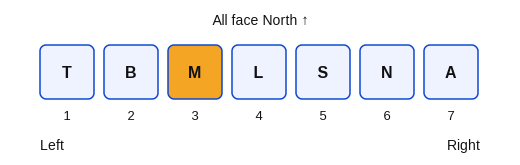
Seven people, A, B, L, M, N, S, and T are sitting in a row, facing north. Only five people sit between T and A. N sits to the immediate left of A. Only one person sits between N and L. M sits at some place to the left of S but at some place to the right of B. Who sits third from the left end of the line?
सात व्यक्ति, A, B, L, M, N, S और T, उत्तर की ओर मुख करके एक पंक्ति में बैठे हैं। T और A के बीच केवल पाँच व्यक्ति बैठे हैं। N, A के ठीक बाईं ओर बैठा है। N और L के बीच केवल एक व्यक्ति बैठा है। M, S के बाईं ओर किसी स्थान पर, लेकिन B के दाईं ओर किसी स्थान पर बैठा है। पंक्ति के बाएँ छोर से तीसरे स्थान पर कौन बैठा है?
  1. AA
  2. BT
  3. CM
  4. DB
Show answer

Concept: Seven seats; five people between T and A puts them at the two ends.

  1. N is immediately left of A, so A cannot be at the left end → A = 7, N = 6, T = 1.
  2. One person between N and L → L = 4.
  3. Seats 2, 3, 5 remain for B, M, S with B left of M left of S → B = 2, M = 3, S = 5.
  4. Third from the left = M.

Trick: In a row of 7, '5 between' always means both are at the ends.

Answer: (C) M

अवधारणा: सात सीटें; T और A के बीच पाँच लोग → दोनों सिरों पर।

  1. N, A के ठीक बाएँ है, अतः A बाएँ सिरे पर नहीं → A = 7, N = 6, T = 1।
  2. N और L के बीच एक व्यक्ति → L = 4।
  3. सीट 2, 3, 5 पर B, M, S; B, M के बाएँ और M, S के बाएँ → B = 2, M = 3, S = 5।
  4. बाएँ से तीसरा = M।

ट्रिक: 7 की पंक्ति में 'बीच में 5' = दोनों सिरों पर।

उत्तर: (C) M

RRB NTPC Graduate CBT 1General Intelligence and ReasoningLinear SeatingRRB NTPC Graduate CBT 1 2024 · 21 Jun Shift 3 →
Q7107.
In a certain code language, ‘please go down’ is coded as ‘ta wk vb’ and ‘down the drain’ is coded as ‘cm dg wk’. How is ‘down’ coded in the given language?
एक निश्चित कूट भाषा में, ‘please go down’ को ‘ta wk vb’ के रूप में कूटबद्ध किया जाता है और ‘down the drain’ को ‘cm dg wk’ के रूप में कूटबद्ध किया जाता है। दी गई भाषा में ‘down’ को किस प्रकार कूटबद्ध किया जाता है?
  1. Avb
  2. Bcm
  3. Cdg
  4. Dwk
Show answer

Concept: A word common to two sentences takes the code common to both.

  1. 'please go down' → ta wk vb
  2. 'down the drain' → cm dg wk
  3. Common word 'down', common code 'wk'.

Trick: Common word ↔ common code.

Answer: (D) wk

अवधारणा: दो वाक्यों में समान शब्द का कोड भी समान होता है।

  1. 'please go down' → ta wk vb
  2. 'down the drain' → cm dg wk
  3. समान शब्द 'down', समान कोड 'wk'।

ट्रिक: समान शब्द ↔ समान कोड।

उत्तर: (D) wk

RRB NTPC Graduate CBT 1General Intelligence and ReasoningCoding–DecodingRRB NTPC Graduate CBT 1 2024 · 21 Jun Shift 3 →
Q7108.
KORJ is related to DHKC in a certain way based on the English alphabetical order. In the same way, IMPH is related to BFIA. To which of the given options is NRUM related, following the same logic?
अंग्रेज़ी वर्णमाला क्रम के आधार पर KORJ एक निश्चित प्रकार से DHKC से संबंधित है। उसी प्रकार, IMPH, BFIA से संबंधित है। उसी तर्क का अनुसरण करते हुए, NRUM दिए गए विकल्पों में से किससे संबंधित है?
  1. AKGFN
  2. BGKNF
  3. CKGNF
  4. DGKFN
Show answer

Concept: Each letter is moved by a fixed number of places in the alphabet.

  1. KORJ → DHKC: K(11)→D(4), O(15)→H(8), R(18)→K(11), J(10)→C(3); each letter −7.
  2. Check IMPH → BFIA: I(9)→B(2), M→F, P→I, H→A; again −7.
  3. NRUM: N(14)→G(7), R(18)→K(11), U(21)→N(14), M(13)→F(6).

Trick: Find the shift with the first letter only, verify with one more pair, then apply.

Answer: (B) GKNF

अवधारणा: हर अक्षर को वर्णमाला में एक निश्चित संख्या से खिसकाया गया है।

  1. KORJ → DHKC: K(11)→D(4), O(15)→H(8), R(18)→K(11), J(10)→C(3); हर अक्षर −7।
  2. जाँच IMPH → BFIA: I(9)→B(2), M→F, P→I, H→A; फिर से −7।
  3. NRUM: N(14)→G(7), R(18)→K(11), U(21)→N(14), M(13)→F(6)।

ट्रिक: पहले अक्षर से shift निकालें, एक और जोड़ी से जाँचें, फिर लागू करें।

उत्तर: (B) GKNF

RRB NTPC Graduate CBT 1General Intelligence and ReasoningLetter AnalogyRRB NTPC Graduate CBT 1 2024 · 21 Jun Shift 3 →
Q7109.
If 1 is added to each even digit and each odd digit in the number 76341528, what will be the sum of all the odd digits in the new number thus formed?
यदि संख्या 76341528 में प्रत्येक सम अंक और प्रत्येक विषम अंक में 1 जोड़ा जाए, तो इस प्रकार बनी नई संख्या में सभी विषम अंकों का योग क्या होगा?
  1. A28
  2. B22
  3. C24
  4. D26
Show answer

Concept: Add 1 to every digit, then pick the odd digits of the new number.

  1. Number: 7 6 3 4 1 5 2 8.
  2. After adding 1: 8 7 4 5 2 6 3 9.
  3. Odd digits: 7, 5, 3, 9; sum =7+5+3+9=24.

Trick: Adding 1 flips parity: the odd digits of the new number come from the even digits 6, 4, 2, 8 → 7, 5, 3, 9.

Answer: (C) 24

अवधारणा: हर अंक में 1 जोड़ें, फिर नई संख्या के विषम अंक चुनें।

  1. संख्या: 7 6 3 4 1 5 2 8।
  2. 1 जोड़ने पर: 8 7 4 5 2 6 3 9।
  3. विषम अंक: 7, 5, 3, 9; योग =7+5+3+9=24।

ट्रिक: 1 जोड़ने से सम-विषम बदल जाता है: नए विषम अंक पुराने सम अंकों 6, 4, 2, 8 से बनते हैं → 7, 5, 3, 9।

उत्तर: (C) 24

RRB NTPC Graduate CBT 1General Intelligence and ReasoningNumber OperationsRRB NTPC Graduate CBT 1 2024 · 21 Jun Shift 3 →
Q7110.
What should come in place of the question mark (?) in the given series?
1212 1220 1230 1242 1256 ?
दी गई श्रृंखला में प्रश्न चिह्न (?) के स्थान पर क्या आना चाहिए?
1212 1220 1230 1242 1256 ?
  1. A1272
  2. B1274
  3. C1268
  4. D1270
Show answer

Concept: The differences between consecutive terms increase by 2.

  1. Differences: 1220−1212=8, 1230−1220=10, 1242−1230=12, 1256−1242=14.
  2. Next difference =16.
  3. Missing term =1256+16=1272.

Trick: When differences are 8, 10, 12, 14 … the next is simply +16.

Answer: (A) 1272

अवधारणा: क्रमिक पदों का अंतर 2-2 से बढ़ रहा है।

  1. अंतर: 1220−1212=8, 1230−1220=10, 1242−1230=12, 1256−1242=14।
  2. अगला अंतर =16।
  3. लुप्त पद =1256+16=1272।

ट्रिक: अंतर 8, 10, 12, 14 … हों तो अगला +16।

उत्तर: (A) 1272

RRB NTPC Graduate CBT 1General Intelligence and ReasoningNumber SeriesRRB NTPC Graduate CBT 1 2024 · 21 Jun Shift 3 →
Q7111.
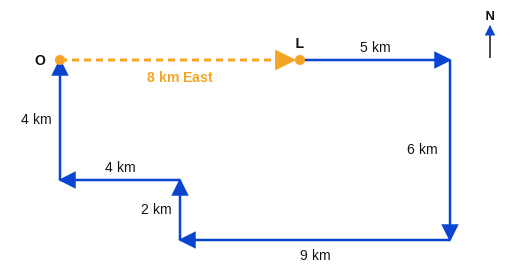
Mr. X starts from Point L and drives 5 km towards the east. He then takes a right turn, drives 6 km, turns right and drives 9 km. He then takes a right turn and drives 2 km, turns left, drives 4 km. He takes a final right turn, drives 4 km and stops at Point O. How far (shortest distance) and towards which direction should he drive in order to reach Point L again? (All turns are 90-degree turns only unless specified.)
श्री X, बिंदु L से चलना शुरू करते हैं और पूर्व की ओर 5 km गाड़ी चलाते हैं। फिर वे दाएँ मुड़ते हैं, 6 km गाड़ी चलाते हैं, दाएँ मुड़ते हैं और 9 km गाड़ी चलाते हैं। फिर वे दाएँ मुड़ते हैं और 2 km गाड़ी चलाते हैं, बाएँ मुड़ते हैं, 4 km गाड़ी चलाते हैं। वे अंतिम बार दाएँ मुड़ते हैं, 4 km गाड़ी चलाते हैं और बिंदु O पर रुक जाते हैं। फिर से बिंदु L पर पहुँचने के लिए उन्हें कितनी दूर (न्यूनतम दूरी) और किस दिशा में गाड़ी चलानी चाहिए? (जब तक निर्दिष्ट न किया जाए, सभी मोड़ केवल 90 डिग्री के मोड़ हैं।)
  1. A8 km towards the eastपूर्व की ओर 8 km
  2. B2 km towards the northउत्तर की ओर 2 km
  3. C7 km towards the westपश्चिम की ओर 7 km
  4. D2 km towards the southदक्षिण की ओर 2 km
Show answer

Concept: Take L as origin; East = +x, North = +y, and track each move.

  1. 5 km East → (5, 0); right turn = South 6 km → (5, −6).
  2. Right = West 9 km → (−4, −6); right = North 2 km → (−4, −4).
  3. Left = West 4 km → (−8, −4); right = North 4 km → O(−8, 0).
  4. O is 8 km due West of L, so he must drive 8 km towards the East.

Trick: Net E–W: 5−9−4=−8; net N–S: −6+2+4=0 → O is 8 km West of L.

Answer: (A) 8 km towards the east

अवधारणा: L को मूल बिंदु मानें; पूर्व = +x, उत्तर = +y।

  1. 5 km पूर्व → (5, 0); दाएँ मुड़कर दक्षिण 6 km → (5, −6)।
  2. दाएँ = पश्चिम 9 km → (−4, −6); दाएँ = उत्तर 2 km → (−4, −4)।
  3. बाएँ = पश्चिम 4 km → (−8, −4); दाएँ = उत्तर 4 km → O(−8, 0)।
  4. O, L से 8 km पश्चिम में है, अतः उसे 8 km पूर्व की ओर जाना होगा।

ट्रिक: पूर्व–पश्चिम: 5−9−4=−8; उत्तर–दक्षिण: −6+2+4=0 → O, L से 8 km पश्चिम।

उत्तर: (A) 8 km पूर्व की ओर

RRB NTPC Graduate CBT 1General Intelligence and ReasoningDirection and DistanceRRB NTPC Graduate CBT 1 2024 · 21 Jun Shift 3 →
Q7112.
In a certain code language, ‘GATE’ is coded as ‘3647’ and ‘WING’ is coded as ‘1265’. What is the code for ‘G’ in the given code language?
एक निश्चित कूट भाषा में, ‘GATE’ को ‘3647’ के रूप में कूटबद्ध किया जाता है और ‘WING’ को ‘1265’ के रूप में कूटबद्ध किया जाता है। दी गई कूट भाषा में ‘G’ के लिए कूट क्या है?
  1. A3
  2. B5
  3. C6
  4. D7
Show answer

Concept: A letter common to two words takes the digit common to their codes.

  1. GATE → 3647 and WING → 1265.
  2. Common letter: G only. Common digit: 6 only.
  3. So G = 6.

Trick: Match the only common letter with the only common digit.

Answer: (C) 6

अवधारणा: दो शब्दों में उभयनिष्ठ अक्षर का कोड, उनके कोडों का उभयनिष्ठ अंक होता है।

  1. GATE → 3647 और WING → 1265।
  2. उभयनिष्ठ अक्षर: केवल G। उभयनिष्ठ अंक: केवल 6।
  3. अतः G = 6।

ट्रिक: एकमात्र उभयनिष्ठ अक्षर = एकमात्र उभयनिष्ठ अंक।

उत्तर: (C) 6

RRB NTPC Graduate CBT 1General Intelligence and ReasoningCoding–DecodingRRB NTPC Graduate CBT 1 2024 · 21 Jun Shift 3 →
Q7113.
In the following triads, each group of letters is related to the subsequent one following a certain logic. Select from the given options, the one that follows the same logic. ARCE - CARE - ECRA
POLE - LPOE - ELOP
निम्नलिखित त्रिकों में, अक्षरों का प्रत्येक समूह एक निश्चित तर्क का अनुसरण करते हुए अगले समूह से संबंधित है। दिए गए विकल्पों में से उस विकल्प का चयन कीजिए जो उसी तर्क का अनुसरण करता है। ARCE - CARE - ECRA
POLE - LPOE - ELOP
  1. AWORM - RWOM - MROW
  2. BBING - IBNG - GINB
  3. CZEAP - AZEP - EAPZ
  4. DSAFE - SFAE - EFAS
Show answer

Concept: Find how the letters of the first cluster are rearranged.

  1. ARCE → CARE: letters in order 3-1-2-4; ARCE → ECRA: full reverse.
  2. POLE → LPOE (3-1-2-4) and ELOP (reverse) ✓.
  3. WORM → RWOM (3-1-2-4) and MROW (reverse) ✓.
  4. BING → IBNG (2-1-3-4) ✗; ZEAP → AZEP ✓ but EAPZ is not reverse ✗; SAFE → SFAE ✗.

Trick: Check the last cluster first – it must be the exact reverse of the first.

Answer: (A) WORM - RWOM - MROW

अवधारणा: पहले समूह के अक्षरों की पुनर्व्यवस्था पहचानें।

  1. ARCE → CARE: अक्षर क्रम 3-1-2-4; ARCE → ECRA: पूरा उल्टा।
  2. POLE → LPOE (3-1-2-4) और ELOP (उल्टा) ✓।
  3. WORM → RWOM (3-1-2-4) और MROW (उल्टा) ✓।
  4. BING → IBNG (2-1-3-4) ✗; ZEAP → AZEP ✓ पर EAPZ उल्टा नहीं ✗; SAFE → SFAE ✗।

ट्रिक: पहले अंतिम समूह जाँचें – वह पहले समूह का बिल्कुल उल्टा होना चाहिए।

उत्तर: (A) WORM - RWOM - MROW

RRB NTPC Graduate CBT 1General Intelligence and ReasoningLetter TriadsRRB NTPC Graduate CBT 1 2024 · 21 Jun Shift 3 →
Q7114.
Based on the English alphabetical order, three of the following four letter-cluster pairs are alike in a certain way and thus form a group. Which letter-cluster pair DOES NOT belong to that group?
(Note: The odd one out is not based on the number of consonants/vowels or their position in the letter-cluster.)
अंग्रेज़ी वर्णमाला क्रम के आधार पर, निम्नलिखित चार अक्षर-समूह युग्मों में से तीन किसी निश्चित प्रकार से एकसमान हैं और इस प्रकार एक समूह बनाते हैं। कौन-सा अक्षर-समूह युग्म उस समूह से संबंधित नहीं है?
(नोट: असंगत अक्षर-समूह, उस अक्षर-समूह में व्यंजनों/स्वरों की संख्या या उनके स्थान पर आधारित नहीं है।)
  1. ANU – PX
  2. BKR – NU
  3. CEL – GO
  4. DAH – CK
Show answer

Concept: Compare the shift from the first cluster to the second, letter by letter.

  1. NU – PX: N→P +2, U→X +3.
  2. EL – GO: E→G +2, L→O +3; AH – CK: A→C +2, H→K +3.
  3. KR – NU: K→N +3, R→U +3 – a different pattern.

Trick: Write position numbers (A=1 … Z=26) and subtract; the odd shift stands out.

Answer: (B) KR – NU

अवधारणा: पहले समूह से दूसरे तक हर अक्षर का खिसकाव देखें।

  1. NU – PX: N→P +2, U→X +3।
  2. EL – GO: E→G +2, L→O +3; AH – CK: A→C +2, H→K +3।
  3. KR – NU: K→N +3, R→U +3 – अलग पैटर्न।

ट्रिक: स्थानीय मान (A=1 … Z=26) लिखकर घटाएँ; अलग खिसकाव तुरंत दिखेगा।

उत्तर: (B) KR – NU

RRB NTPC Graduate CBT 1General Intelligence and ReasoningOdd One Out – Letter PairsRRB NTPC Graduate CBT 1 2024 · 21 Jun Shift 3 →
Q7115.
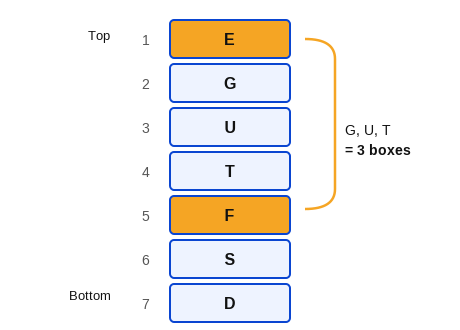
Seven boxes, D, E, F, G, S, T and U, are kept one over the other but not necessarily in the same order. U is kept immediately above T. S is kept immediately above D. Only E is kept above G. Only two boxes are kept above U. S is not kept at third position from the bottom. How many boxes are kept between F and E?
सात बक्से, D, E, F, G, S, T और U, एक के ऊपर एक रखे गए हैं, लेकिन ज़रूरी नहीं कि इसी क्रम में हों। U को T के ठीक ऊपर रखा गया है। S को D के ठीक ऊपर रखा गया है। G के ऊपर केवल E रखा गया है। U के ऊपर केवल दो बक्से रखे गए हैं। S को नीचे से तीसरे स्थान पर नहीं रखा गया है। F और E के बीच कितने बक्से रखे गए हैं?
  1. AThreeतीन
  2. BTwoदो
  3. COneएक
  4. DFourचार
Show answer

Concept: Number positions 1 (top) to 7 (bottom) and place fixed clues first.

  1. Only E above G → E = 1, G = 2.
  2. Only two above U → U = 3; U immediately above T → T = 4.
  3. S immediately above D: S–D at 5–6 or 6–7. S is not 3rd from bottom (position 5) → S = 6, D = 7, F = 5.
  4. Between F (5) and E (1): G, U, T = three boxes.

Trick: 'Only X above Y' instantly fixes X at the top and Y second.

Answer: (A) Three

अवधारणा: स्थान 1 (ऊपर) से 7 (नीचे) तक मानें और निश्चित सूचनाएँ पहले लगाएँ।

  1. केवल E, G के ऊपर → E = 1, G = 2।
  2. U के ऊपर केवल दो → U = 3; U ठीक T के ऊपर → T = 4।
  3. S ठीक D के ऊपर: S–D 5–6 या 6–7 पर। S नीचे से तीसरा (स्थान 5) नहीं → S = 6, D = 7, F = 5।
  4. F (5) और E (1) के बीच: G, U, T = तीन बॉक्स।

ट्रिक: 'केवल X, Y के ऊपर' से X सबसे ऊपर और Y दूसरे स्थान पर तय।

उत्तर: (A) तीन

RRB NTPC Graduate CBT 1General Intelligence and ReasoningBox ArrangementRRB NTPC Graduate CBT 1 2024 · 21 Jun Shift 3 →
Q7116.
Refer to the following number and symbol series and answer the question that follows. Counting to be done from left to right only.
(Left) 6 @ $ 1 8 # 9 % ≺ 2 4 ⋟ 3 ^ 5 & 7 (Right)
How many such symbols are there, each of which is immediately preceded by a number and also immediately followed by another number?
निम्नलिखित संख्या और प्रतीक श्रृंखला को देखिए और नीचे दिए गए प्रश्न का उत्तर दीजिए। गिनती केवल बाएँ से दाएँ की जानी है।
(बाएँ) 6 @ $ 1 8 # 9 % ≺ 2 4 ⋟ 3 ^ 5 & 7 (दाएँ)
ऐसे कितने प्रतीक हैं, जिनमें से प्रत्येक के ठीक पहले एक संख्या है और ठीक बाद भी एक अन्य संख्या है?
  1. AThreeतीन
  2. BOneएक
  3. CMore than threeतीन से अधिक
  4. DTwoदो
Show answer

Concept: Look for the pattern Number – Symbol – Number.

  1. Series: 6 @ $ 1 8 # 9 % ≺ 2 4 ⋟ 3 ^ 5 & 7.
  2. Valid: 8 # 9, 4 ⋟ 3, 3 ^ 5, 5 & 7 → 4 symbols.
  3. @, $, % and ≺ each touch another symbol, so they do not count.
  4. 4 is more than three.

Trick: Scan only the symbols and check both neighbours of each.

Answer: (C) More than three

अवधारणा: पैटर्न संख्या – प्रतीक – संख्या खोजें।

  1. श्रृंखला: 6 @ $ 1 8 # 9 % ≺ 2 4 ⋟ 3 ^ 5 & 7।
  2. मान्य: 8 # 9, 4 ⋟ 3, 3 ^ 5, 5 & 7 → 4 प्रतीक।
  3. @, $, % और ≺ किसी प्रतीक से सटे हैं, अतः नहीं गिने जाते।
  4. 4, तीन से अधिक है।

ट्रिक: केवल प्रतीकों को देखें और हर प्रतीक के दोनों पड़ोसी जाँचें।

उत्तर: (C) तीन से अधिक

RRB NTPC Graduate CBT 1General Intelligence and ReasoningSymbol–Number SeriesRRB NTPC Graduate CBT 1 2024 · 21 Jun Shift 3 →
Q7117.
What should come in place of the question mark (?) in the given series based on the English alphabetical order?
FRO RDA DPM PBY ?
अंग्रेज़ी वर्णमाला क्रम के आधार पर दी गई श्रृंखला में प्रश्न चिह्न (?) के स्थान पर क्या आना चाहिए?
FRO RDA DPM PBY ?
  1. ABKN
  2. BBNK
  3. CBHY
  4. DHBU
Show answer

Concept: Each letter moves +12 positions (cycling after Z).

  1. First letters: F(6) → R(18) → D(4) → P(16) → B(2) → N(14).
  2. Second letters: R → D → P → B → N.
  3. Third letters: O(15) → A(1) → M(13) → Y(25) → K(11).
  4. Next term = BNK.

Trick: +12 and −14 give the same letter; also each term's 2nd letter becomes the next term's 1st.

Answer: (B) BNK

अवधारणा: हर अक्षर +12 स्थान आगे (Z के बाद फिर A से)।

  1. पहले अक्षर: F(6) → R(18) → D(4) → P(16) → B(2) → N(14)।
  2. दूसरे अक्षर: R → D → P → B → N।
  3. तीसरे अक्षर: O(15) → A(1) → M(13) → Y(25) → K(11)।
  4. अगला पद = BNK।

ट्रिक: +12 और −14 समान अक्षर देते हैं; हर पद का दूसरा अक्षर अगले पद का पहला बनता है।

उत्तर: (B) BNK

RRB NTPC Graduate CBT 1General Intelligence and ReasoningLetter SeriesRRB NTPC Graduate CBT 1 2024 · 21 Jun Shift 3 →
Q7118.
In a certain code language,
A + B means ‘A is the son of B’,
A – B means ‘A is the sister of B’,
A x B means ‘A is the wife of B’ and
A ÷ B means ‘A is the father of B’.
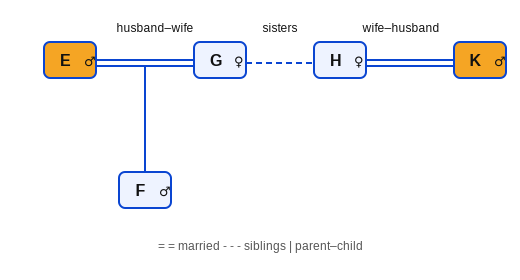
Based on the above, how is E related to K if ‘E ÷ F + G – H x K’?
एक निश्चित कूट भाषा में,
A + B का अर्थ है ‘A, B का पुत्र है’,
A – B का अर्थ है ‘A, B की बहन है’,
A x B का अर्थ है ‘A, B की पत्नी है’ और
A ÷ B का अर्थ है ‘A, B का पिता है’।
उपरोक्त के आधार पर, यदि ‘E ÷ F + G – H x K’ है, तो E का K से क्या संबंध है?
  1. AWife's brother's sonपत्नी के भाई का पुत्र
  2. BWife's sister's husbandपत्नी की बहन का पति
  3. CWife's sister's sonपत्नी की बहन का पुत्र
  4. D​Wife's brother's wifeपत्नी के भाई की पत्नी
Show answer

Concept: Decode each symbol from left to right.

  1. E ÷ F: E is the father of F. F + G: F is the son of G, so G is F's mother, i.e. E's wife.
  2. G – H: G is the sister of H. H × K: H is the wife of K.
  3. So K's wife is H, H's sister is G, and G's husband is E.
  4. E is K's wife's sister's husband.

Trick: Draw the couples with double lines – the relation reads straight off the chart.

Answer: (B) Wife's sister's husband

अवधारणा: हर प्रतीक को बाएँ से दाएँ डिकोड करें।

  1. E ÷ F: E, F का पिता। F + G: F, G का पुत्र; अतः G, F की माँ यानी E की पत्नी।
  2. G – H: G, H की बहन। H × K: H, K की पत्नी।
  3. अतः K की पत्नी H, H की बहन G, और G का पति E।
  4. E, K की पत्नी की बहन का पति है।

ट्रिक: पति-पत्नी को दोहरी रेखा से जोड़ें – संबंध चार्ट से सीधे पढ़ें।

उत्तर: (B) पत्नी की बहन का पति

RRB NTPC Graduate CBT 1General Intelligence and ReasoningBlood Relations – CodedRRB NTPC Graduate CBT 1 2024 · 21 Jun Shift 3 →
Q7119.
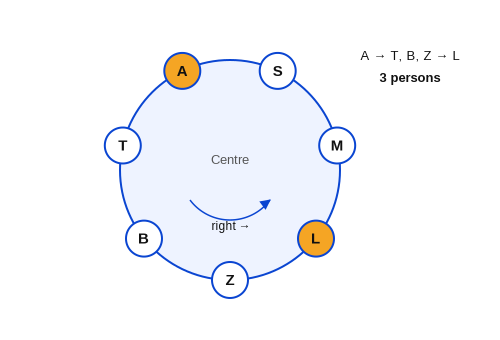
A, B, L, M, S, T and Z are sitting around a circular table facing the centre. Only one person sits between B and L when counted from the left of L. S sits third to the right of Z. M sits third to the left of T. S sits to the immediate right of M. A is not an immediate neighbour of M. How many people sit between A and L when counted from the right of A?
A, B, L, M, S, T और Z एक वृत्ताकार मेज़ के चारों ओर केंद्र की ओर मुख करके बैठे हैं। L के बाएँ से गिनने पर B और L के बीच केवल एक व्यक्ति बैठा है। S, Z के दाएँ से तीसरे स्थान पर बैठा है। M, T के बाएँ से तीसरे स्थान पर बैठा है। S, M के ठीक दाएँ बैठा है। A, M का निकटतम पड़ोसी नहीं है। A के दाएँ से गिनने पर A और L के बीच कितने व्यक्ति बैठे हैं?
  1. A2
  2. B4
  3. C3
  4. D1
Show answer

Concept: For people facing the centre, 'right' is anticlockwise and 'left' is clockwise.

  1. Fix Z. S is third to the right of Z; M is immediately left of S; T is third to the right of M.
  2. Remaining seats for A, B, L: two seats beside Z and the seat between S and T.
  3. B is second to the left of L. If A sat next to Z on M's side, A would neighbour M – not allowed. So A sits between S and T, L between Z and M, B between T and Z.
  4. From A going right: T, B, Z, then L → 3 people.

Trick: Place the chain Z → M → S → T first; only three seats remain to test.

Answer: (C) 3

अवधारणा: केंद्र की ओर मुख वालों के लिए 'दाएँ' = घड़ी की विपरीत दिशा, 'बाएँ' = घड़ी की दिशा।

  1. Z को स्थिर करें। S, Z के दाएँ तीसरा; M, S के ठीक बाएँ; T, M के दाएँ तीसरा।
  2. A, B, L के लिए बचे स्थान: Z के दोनों ओर और S व T के बीच।
  3. B, L के बाएँ दूसरा है। यदि A, M की ओर Z के पास बैठे तो वह M का पड़ोसी बनेगा – मना है। अतः A, S और T के बीच; L, Z और M के बीच; B, T और Z के बीच।
  4. A से दाएँ गिनें: T, B, Z, फिर L → 3 व्यक्ति।

ट्रिक: पहले Z → M → S → T की श्रृंखला बैठाएँ; केवल तीन स्थान जाँचने बचते हैं।

उत्तर: (C) 3

RRB NTPC Graduate CBT 1General Intelligence and ReasoningCircular Seating ArrangementRRB NTPC Graduate CBT 1 2024 · 21 Jun Shift 3 →
Q7120.
Which of the given letter-clusters should replace # and % so that the pattern and relationship followed between the letter-cluster pair on the left side of :: is the same as that on the right side of ::?
# : ZTW :: NHK : %
दिए गए अक्षर-समूहों में से कौन-सा # और % को प्रतिस्थापित करे ताकि :: के बाईं ओर के अक्षर-समूह युग्म के बीच का पैटर्न और संबंध वही हो जो :: के दाईं ओर है?
# : ZTW :: NHK : %
  1. A# = UGF, % = SPR
  2. B# = UKH, % = OHY
  3. C# = UOR, % = SMP
  4. D# = UPL, % = TYF
Show answer

Concept: Find the rule from the complete pair and apply it to both sides of ::.

  1. Option C: UOR → ZTW: U+5=Z, O+5=T, R+5=W.
  2. NHK → SMP: N+5=S, H+5=M, K+5=P – same rule +5.
  3. Other options do not give a single consistent rule on both sides.

Trick: Test each option on the left pair first; the moment it fails, drop it.

Answer: (C) # = UOR, % = SMP

अवधारणा: पूरी जोड़ी से नियम खोजें और :: के दोनों ओर लागू करें।

  1. विकल्प C: UOR → ZTW: U+5=Z, O+5=T, R+5=W।
  2. NHK → SMP: N+5=S, H+5=M, K+5=P – वही नियम +5।
  3. अन्य विकल्प दोनों ओर एक समान नियम नहीं देते।

ट्रिक: हर विकल्प पहले बाईं जोड़ी पर जाँचें; विफल होते ही छोड़ दें।

उत्तर: (C) # = UOR, % = SMP

RRB NTPC Graduate CBT 1General Intelligence and ReasoningLetter AnalogyRRB NTPC Graduate CBT 1 2024 · 21 Jun Shift 3 →