Question bank

Q&A: practice questions with answers

Search questions on any topic. Filter by exam category, exam, subject and topic, try the question, then open the answer and explanation.

Courses – airGurukul

20,719 questions found.

Q7181.
Nandan had some marbles. When he distributed the marbles equally among 32 children, he found that 4 marbles were left. Had he distributed the marbles equally among 41 children and 48 children, he still would have had 13 and 20 marbles, respectively, left with him. But when he distributed them equally among 53 children, no marble was left. The number of marbles that Nandan initially had may lie between __________.
नंदन के पास कुछ कंचे थे। जब उसने कंचों को 32 बच्चों में बराबर-बराबर बाँटा, तो उसने पाया कि 4 कंचे बच गए। यदि वह कंचों को 41 बच्चों और 48 बच्चों में बराबर-बराबर बाँटता, तो भी उसके पास क्रमशः 13 और 20 कंचे बच जाते। लेकिन जब उसने उन्हें 53 बच्चों में बराबर-बराबर बाँटा, तो कोई कंचा नहीं बचा। नंदन के पास आरंभ में कंचों की संख्या __________ के बीच हो सकती है।
  1. A7814 and 78247814 और 7824
  2. B7794 and 78047794 और 7804
  3. C7864 and 78747864 और 7874
  4. D7834 and 78547834 और 7854
Show answer

Concept: If divisor − remainder is the same for all divisors, the number = k × LCM − (that common difference).

  1. 32−4=28, 41−13=28, 48−20=28, so N+28 is divisible by 32, 41 and 48.
  2. LCM(32,41,48)=96×41=3936, so N=3936k−28.
  3. k=1: 3908 (not divisible by 53). k=2: 7872−28=7844=53×148 ✓.
  4. N=7844, which lies between 7834 and 7854.

Trick: Common 'shortfall' 28 → subtract it from multiples of the LCM, then test the extra condition.

Answer: (D) 7834 and 7854

अवधारणा: यदि हर भाजक के लिए (भाजक − शेषफल) समान हो, तो संख्या = k × LCM − वह अंतर।

  1. 32−4=28, 41−13=28, 48−20=28, अतः N+28 संख्या 32, 41 और 48 से विभाज्य है।
  2. LCM(32,41,48)=96×41=3936, अतः N=3936k−28।
  3. k=1: 3908 (53 से विभाज्य नहीं)। k=2: 7872−28=7844=53×148 ✓।
  4. N=7844, जो 7834 और 7854 के बीच है।

ट्रिक: समान 'कमी' 28 → LCM के गुणजों में से 28 घटाएँ, फिर अतिरिक्त शर्त जाँचें।

उत्तर: (D) 7834 और 7854
RRB NTPC Graduate CBT 1MathematicsLCM – RemaindersRRB NTPC Graduate CBT 1 2024 · 21 Jun Shift 2 →
Q7182.
Find the value of 7secA(1+sinA)(secA−tanA)−4.
7secA(1+sinA)(secA−tanA)−4 का मान ज्ञात कीजिए।
  1. A7
  2. B3
  3. C10
  4. D4
Show answer

Concept: Use secA−tanA=1−sinAcosA and 1−sin2A=cos2A.

  1. secA(1+sinA)(secA−tanA)=1cosA×(1+sinA)×1−sinAcosA.
  2. =1−sin2Acos2A=cos2Acos2A=1.
  3. Expression =7×1−4=3.

Trick: Put A=0∘: 7×1×1×1−4=3.

Answer: (B) 3

अवधारणा: secA−tanA=1−sinAcosA तथा 1−sin2A=cos2A का प्रयोग करें।

  1. secA(1+sinA)(secA−tanA)=1cosA×(1+sinA)×1−sinAcosA।
  2. =1−sin2Acos2A=cos2Acos2A=1।
  3. व्यंजक =7×1−4=3।

ट्रिक: A=0∘ रखें: 7×1×1×1−4=3।

उत्तर: (B) 3

RRB NTPC Graduate CBT 1MathematicsTrigonometric IdentitiesRRB NTPC Graduate CBT 1 2024 · 21 Jun Shift 2 →
Q7183.
If the length of a cuboid is 33 cm, breadth is 4 cm and volume is 7524 cm3, then find the height (in cm) of the cuboid.
यदि एक घनाभ की लंबाई 33 cm, चौड़ाई 4 cm और आयतन 7524 cm3 है, तो घनाभ की ऊँचाई (cm में) ज्ञात कीजिए।
  1. A60
  2. B57
  3. C54
  4. D67
Show answer

Concept: Volume of cuboid =l×b×h.

  1. 7524=33×4×h=132h.
  2. h=7524132=57cm.

Trick: Unit digit check: 132×57 ends in 4 (2×7=14) ✓.

Answer: (B) 57

अवधारणा: घनाभ का आयतन =l×b×h।

  1. 7524=33×4×h=132h।
  2. h=7524132=57cm।

ट्रिक: इकाई अंक जाँच: 132×57 का अंतिम अंक 4 (2×7=14) ✓।

उत्तर: (B) 57

RRB NTPC Graduate CBT 1MathematicsMensuration – CuboidRRB NTPC Graduate CBT 1 2024 · 21 Jun Shift 2 →
Q7184.
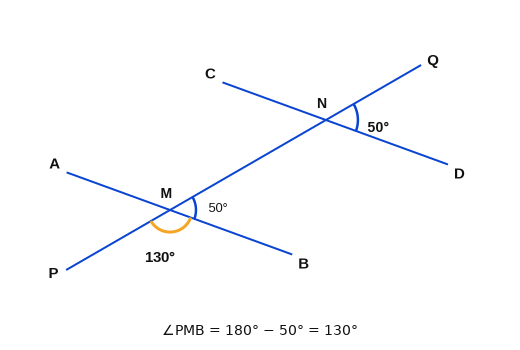
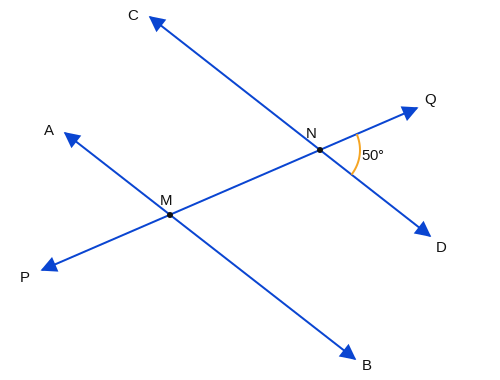
In the given figure, AB and CD are two parallel lines and PQ is a transversal line. Find the measure of ∠PMB.
दी गई आकृति में, AB और CD दो समांतर रेखाएँ हैं और PQ एक तिर्यक रेखा है। ∠PMB का माप ज्ञात कीजिए।
  1. A50°
  2. B100°
  3. C130°
  4. D120°
Show answer

Concept: When a transversal cuts two parallel lines, corresponding angles are equal and angles on a straight line add up to 180∘.

  1. ∠QND=50∘ (given).
  2. ∠QMB and ∠QND are corresponding angles (AB∥CD), so ∠QMB=50∘.
  3. ∠PMB and ∠QMB form a linear pair: ∠PMB=180∘−50∘=130∘.

Trick: The angle at N is acute (50∘); ∠PMB opens on the other side of the transversal, so it is obtuse =180∘−50∘.

Answer: (C) 130∘

अवधारणा: जब एक तिर्यक रेखा दो समांतर रेखाओं को काटती है तो संगत कोण बराबर होते हैं और सरल रेखा पर बने कोणों का योग 180∘ होता है।

  1. ∠QND=50∘ (दिया है)।
  2. ∠QMB और ∠QND संगत कोण हैं (AB∥CD), अतः ∠QMB=50∘।
  3. ∠PMB और ∠QMB रैखिक युग्म हैं: ∠PMB=180∘−50∘=130∘।

ट्रिक: N पर कोण न्यून (50∘) है; ∠PMB तिर्यक रेखा की दूसरी ओर है, अतः अधिक कोण =180∘−50∘।

उत्तर: (C) 130∘

RRB NTPC Graduate CBT 1MathematicsLines and Angles – Parallel LinesRRB NTPC Graduate CBT 1 2024 · 21 Jun Shift 2 →
Q7185.
A sells a smartphone to B at a loss of 60% and B sells the smartphone to C at a profit of 25%. If C purchased the smartphone for ₹42,206, then what was the cost (in ₹) of the smartphone for A?
A एक स्मार्टफ़ोन B को 60% की हानि पर बेचता है और B वह स्मार्टफ़ोन C को 25% के लाभ पर बेचता है। यदि C ने स्मार्टफ़ोन ₹42,206 में खरीदा, तो A के लिए स्मार्टफ़ोन का क्रय मूल्य (₹ में) कितना था?
  1. A84,412
  2. B84,415
  3. C84,407
  4. D84,406
Show answer

Concept: Successive selling: final price = original cost × product of the multipliers.

  1. Loss 60% → multiplier 0.4; profit 25% → multiplier 1.25.
  2. C's price =x×0.4×1.25=0.5x.
  3. 0.5x=42206⇒x=84412.

Trick: 0.4×1.25=12, so A's cost is just double C's price.

Answer: (A) ₹84,412

अवधारणा: क्रमिक बिक्री: अंतिम मूल्य = मूल लागत × सभी गुणकों का गुणनफल।

  1. हानि 60% → गुणक 0.4; लाभ 25% → गुणक 1.25।
  2. C का मूल्य =x×0.4×1.25=0.5x।
  3. 0.5x=42206⇒x=84412।

ट्रिक: 0.4×1.25=12, अतः A की लागत = C के मूल्य का दोगुना।

उत्तर: (A) ₹84,412

RRB NTPC Graduate CBT 1MathematicsProfit and Loss – SuccessiveRRB NTPC Graduate CBT 1 2024 · 21 Jun Shift 2 →
Q7186.
A pipe can fill a tank in 27 hours. Another pipe can empty the filled tank in 28 hours. If both the pipes are opened simultaneously, then the time (in hours) in which the tank will be one-fourth filled, is:
एक पाइप किसी टंकी को 27 घंटे में भर सकता है। दूसरा पाइप भरी हुई टंकी को 28 घंटे में खाली कर सकता है। यदि दोनों पाइप एक साथ खोल दिए जाएँ, तो टंकी कितने समय (घंटों में) में एक-चौथाई भर जाएगी?
  1. A567
  2. B378
  3. C756
  4. D189
Show answer

Concept: Net filling rate = filling rate − emptying rate.

  1. Net rate =127−128=28−27756=1756 tank per hour.
  2. Full tank takes 756 hours.
  3. One-fourth tank =7564=189 hours.

Trick: For consecutive numbers n,n+1: net time =n(n+1); here 27×28=756.

Answer: (D) 189

अवधारणा: शुद्ध भरने की दर = भरने की दर − खाली करने की दर।

  1. शुद्ध दर =127−128=28−27756=1756 टंकी प्रति घंटा।
  2. पूरी टंकी 756 घंटे में भरेगी।
  3. एक-चौथाई टंकी =7564=189 घंटे।

ट्रिक: क्रमागत संख्याओं n,n+1 के लिए शुद्ध समय =n(n+1); यहाँ 27×28=756।

उत्तर: (D) 189

RRB NTPC Graduate CBT 1MathematicsPipes and CisternRRB NTPC Graduate CBT 1 2024 · 21 Jun Shift 2 →
Q7187.
The population of a village was 1,20,000. It increased by 10% in the first year and increased by 30% in the second year. Its population after two years is _______.
एक गाँव की जनसंख्या 1,20,000 थी। पहले वर्ष में इसमें 10% की वृद्धि हुई और दूसरे वर्ष में 30% की वृद्धि हुई। दो वर्ष बाद इसकी जनसंख्या _______ है।
  1. A1,68,000
  2. B1,32,000
  3. C1,71,600
  4. D1,56,000
Show answer

Concept: Successive percentage increases are applied one after another as multipliers.

  1. After year 1: 120000×1.10=132000.
  2. After year 2: 132000×1.30=171600.

Trick: Net change =10+30+10×30100=43%; 120000×1.43=171600.

Answer: (C) 1,71,600

अवधारणा: क्रमिक प्रतिशत वृद्धि को गुणकों के रूप में एक के बाद एक लगाएँ।

  1. पहले वर्ष के बाद: 120000×1.10=132000।
  2. दूसरे वर्ष के बाद: 132000×1.30=171600।

ट्रिक: कुल वृद्धि =10+30+10×30100=43%; 120000×1.43=171600।

उत्तर: (C) 1,71,600

RRB NTPC Graduate CBT 1MathematicsPopulation GrowthRRB NTPC Graduate CBT 1 2024 · 21 Jun Shift 2 →
Q7188.
The percentage profit earned by selling a table lamp for ₹863 is equal to the percentage loss incurred by selling the same table lamp for ₹433. At what price (in ₹) should the table lamp be sold to make 25% profit?
एक टेबल लैंप को ₹863 में बेचने पर अर्जित प्रतिशत लाभ, उसी टेबल लैंप को ₹433 में बेचने पर हुई प्रतिशत हानि के बराबर है। 25% लाभ प्राप्त करने के लिए टेबल लैंप को किस मूल्य (₹ में) पर बेचा जाना चाहिए?
  1. A812
  2. B810
  3. C811
  4. D813
Show answer

Concept: If profit % at one SP equals loss % at another SP, the cost price is the average of the two SPs.

  1. 863−CPCP=CP−433CP⇒CP=863+4332=648.
  2. SP for 25% profit =648×125100=810.

Trick: Equal profit% and loss% → CP=SP1+SP22.

Answer: (B) ₹810

अवधारणा: यदि एक विक्रय मूल्य पर लाभ% दूसरे पर हानि% के बराबर हो, तो क्रय मूल्य दोनों SP का औसत होता है।

  1. 863−CPCP=CP−433CP⇒CP=863+4332=648।
  2. 25% लाभ हेतु SP =648×125100=810।

ट्रिक: लाभ% = हानि% → CP=SP1+SP22।

उत्तर: (B) ₹810

RRB NTPC Graduate CBT 1MathematicsProfit and LossRRB NTPC Graduate CBT 1 2024 · 21 Jun Shift 2 →
Q7189.
The mean of a data is 76 and its median is 100. The mode (using empirical relation) of the data is:
किसी आँकड़े का माध्य 76 है और इसका माध्यिका 100 है। आँकड़े का बहुलक (आनुभविक संबंध का उपयोग करके) कितना है?
  1. A148
  2. B60
  3. C174
  4. D77
Show answer

Concept: Empirical relation: Mode=3Median−2Mean.

  1. Mode=3×100−2×76.
  2. =300−152=148.

Trick: Remember '3 Median minus 2 Mean'.

Answer: (A) 148

अवधारणा: आनुभविक संबंध: बहुलक=3माध्यिका−2माध्य।

  1. बहुलक=3×100−2×76।
  2. =300−152=148।

ट्रिक: याद रखें: '3 माध्यिका − 2 माध्य'।

उत्तर: (A) 148

RRB NTPC Graduate CBT 1MathematicsStatistics – Mean, Median, ModeRRB NTPC Graduate CBT 1 2024 · 21 Jun Shift 2 →
Q7190.
If x+1x=11, then x2+1x2 is:
यदि x+1x=11, तो x2+1x2 का मान कितना है?
  1. A119
  2. B129
  3. C114
  4. D112
Show answer

Concept: x+1x=1+1x, so the given condition fixes 1x directly; also x2+1x2=1+1x2.

  1. x+1x=11⇒1+1x=11⇒1x=10.
  2. x2+1x2=1+(1x)2=1+102=1+100=101.
  3. 101 is not among the options (119, 129, 114, 112), so no option is correct.
  4. If the condition had been x+1x=11, then x2+1x2=112−2=119, option (A).

Note: Read the fraction carefully: x+1x is not the same as x+1x. In the exam, every candidate gets full marks (bonus) for such a question.

Answer: Bonus – no option is correct as printed; full marks to all.

अवधारणा: x+1x=1+1x, अतः दी गई शर्त से सीधे 1x मिल जाता है; साथ ही x2+1x2=1+1x2।

  1. x+1x=11⇒1+1x=11⇒1x=10।
  2. x2+1x2=1+(1x)2=1+102=1+100=101।
  3. 101 विकल्पों (119, 129, 114, 112) में नहीं है, इसलिए कोई विकल्प सही नहीं।
  4. यदि शर्त x+1x=11 होती, तो x2+1x2=112−2=119, विकल्प (A) होता।

नोट: भिन्न को ध्यान से पढ़ें: x+1x और x+1x एक समान नहीं हैं। परीक्षा में ऐसे प्रश्न पर सभी अभ्यर्थियों को पूरे अंक (बोनस) दिए जाते हैं।

उत्तर: बोनस – छपे प्रश्न के अनुसार कोई विकल्प सही नहीं; सभी को पूरे अंक।

RRB NTPC Graduate CBT 1MathematicsAlgebraic IdentitiesRRB NTPC Graduate CBT 1 2024 · 21 Jun Shift 2 →
Q7191.
The sum of nine times the present age of A and eight times the present age of B is 29 years. Two times the present age of B exceeds two times the present age of A by 20 years. What will be the sum of the ages (in years) of A and B, 6 years from now?
A की वर्तमान आयु के नौ गुने और B की वर्तमान आयु के आठ गुने का योग 29 वर्ष है। B की वर्तमान आयु का दोगुना, A की वर्तमान आयु के दोगुने से 20 वर्ष अधिक है। अब से 6 वर्ष बाद A और B की आयु का योग (वर्षों में) कितना होगा?
  1. A14
  2. B10
  3. C16
  4. D12
Show answer

Concept: Form two linear equations from the statements and solve.

  1. 9A+8B=29 and 2B−2A=20⇒B=A+10.
  2. 9A+8(A+10)=29⇒17A=−51⇒A=−3, B=7.
  3. Present sum A+B=4.
  4. Sum after 6 years =4+6+6=16 years.

Trick: Sum of two ages after n years = present sum + 2n.

Answer: (C) 16

अवधारणा: कथनों से दो रैखिक समीकरण बनाकर हल करें।

  1. 9A+8B=29 तथा 2B−2A=20⇒B=A+10।
  2. 9A+8(A+10)=29⇒17A=−51⇒A=−3, B=7।
  3. वर्तमान योग A+B=4।
  4. 6 वर्ष बाद योग =4+6+6=16 वर्ष।

ट्रिक: n वर्ष बाद दो व्यक्तियों की आयु का योग = वर्तमान योग + 2n।

उत्तर: (C) 16

RRB NTPC Graduate CBT 1MathematicsProblems on AgesRRB NTPC Graduate CBT 1 2024 · 21 Jun Shift 2 →
Q7192.
At what rate (in percentage) per annum will ₹1,250 give ₹500 as simple interest in 10 years?
₹1,250 पर 10 वर्षों में ₹500 साधारण ब्याज कितनी वार्षिक दर (प्रतिशत में) पर प्राप्त होगा?
  1. A6%
  2. B4%
  3. C3%
  4. D7%
Show answer

Concept: SI=P×R×T100⇒R=SI×100P×T.

  1. R=500×1001250×10.
  2. =5000012500=4%.

Trick: Interest is 5001250=40% in 10 years → 4% per year.

Answer: (B) 4%

अवधारणा: SI=P×R×T100⇒R=SI×100P×T।

  1. R=500×1001250×10।
  2. =5000012500=4%।

ट्रिक: 10 वर्षों में ब्याज 5001250=40% → प्रति वर्ष 4%।

उत्तर: (B) 4%

RRB NTPC Graduate CBT 1MathematicsSimple InterestRRB NTPC Graduate CBT 1 2024 · 21 Jun Shift 2 →
Q7193.
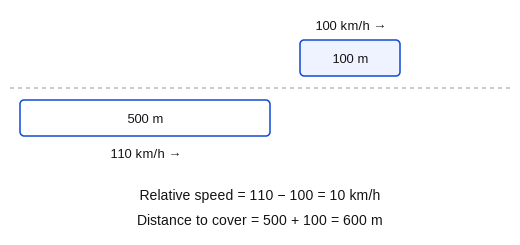
Two trains having lengths of 100 m and 500 m are running at speeds of 100 km/hr and 110 km/hr, respectively, in the same direction. The time taken (in minutes) by the faster train, coming from behind, to completely cross the other train is:
100 m और 500 m लंबाई वाली दो रेलगाड़ियाँ एक ही दिशा में क्रमशः 100 km/hr और 110 km/hr की चाल से चल रही हैं। पीछे से आ रही तेज़ रेलगाड़ी द्वारा दूसरी रेलगाड़ी को पूरी तरह पार करने में लिया गया समय (मिनट में) कितना है?
  1. A9.3
  2. B1.4
  3. C3.6
  4. D6
Show answer

Concept: Overtaking in the same direction: time = (sum of lengths) ÷ (difference of speeds).

  1. Relative speed =110−100=10km/h=10×518=259m/s.
  2. Distance =100+500=600m.
  3. Time =600×925=216s=21660=3.6 minutes.

Trick: In km and hours: 0.610h=0.06×60=3.6 min.

Answer: (C) 3.6

अवधारणा: समान दिशा में आगे निकलना: समय = (लंबाइयों का योग) ÷ (चालों का अंतर)।

  1. सापेक्ष चाल =110−100=10km/h=10×518=259m/s।
  2. दूरी =100+500=600m।
  3. समय =600×925=216s=21660=3.6 मिनट।

ट्रिक: km और घंटे में: 0.610h=0.06×60=3.6 मिनट।

उत्तर: (C) 3.6

RRB NTPC Graduate CBT 1MathematicsTrains – Same DirectionRRB NTPC Graduate CBT 1 2024 · 21 Jun Shift 2 →
Q7194.
In covering a distance of 90 km, Anirudh takes 3 hours more than Burhan. If Anirudh doubles his speed, then he would take 2 hours less than Burhan. Anirudh's initial speed is:
90 km की दूरी तय करने में अनिरुद्ध, बुरहान से 3 घंटे अधिक लेता है। यदि अनिरुद्ध अपनी चाल दोगुनी कर ले, तो वह बुरहान से 2 घंटे कम लेगा। अनिरुद्ध की प्रारंभिक चाल कितनी है?
  1. A18 km/hr
  2. B6 km/hr
  3. C9 km/hr
  4. D2 km/hr
Show answer

Concept: Express both conditions in terms of Burhan's time and subtract.

  1. Let Anirudh's speed =a, Burhan's time =t. Then 90a=t+3 and 902a=t−2.
  2. Subtract: 90a−902a=5⇒45a=5.
  3. a=9km/h (check: 10 h normally, 5 h at double speed; Burhan 7 h ✓).

Trick: Doubling speed halves the time: half of Anirudh's time = 3 + 2 = 5 h, so time = 10 h, speed = 9 km/h.

Answer: (C) 9 km/hr

अवधारणा: दोनों शर्तों को बुरहान के समय के रूप में लिखकर घटाएँ।

  1. अनिरुद्ध की चाल =a, बुरहान का समय =t। तब 90a=t+3 और 902a=t−2।
  2. घटाने पर: 90a−902a=5⇒45a=5।
  3. a=9km/h (जाँच: सामान्यतः 10 घंटे, दोगुनी चाल पर 5 घंटे; बुरहान 7 घंटे ✓)।

ट्रिक: चाल दोगुनी → समय आधा: अनिरुद्ध के समय का आधा = 3 + 2 = 5 घंटे, अतः समय 10 घंटे, चाल 9 km/h।

उत्तर: (C) 9 km/hr

RRB NTPC Graduate CBT 1MathematicsSpeed, Time and DistanceRRB NTPC Graduate CBT 1 2024 · 21 Jun Shift 2 →
Q7195.
If x2+1x2=83, x>0, then find the value of x3−1x3.
यदि x2+1x2=83, x>0, तो x3−1x3 का मान ज्ञात कीजिए।
  1. A656
  2. B820
  3. C720
  4. D756
Show answer

Concept: (x−1x)2=x2+1x2−2 and x3−1x3=(x−1x)3+3(x−1x).

  1. (x−1x)2=83−2=81⇒x−1x=9.
  2. x3−1x3=93+3×9=729+27=756.

Trick: If x−1x=k, then x3−1x3=k3+3k.

Answer: (D) 756

अवधारणा: (x−1x)2=x2+1x2−2 तथा x3−1x3=(x−1x)3+3(x−1x)।

  1. (x−1x)2=83−2=81⇒x−1x=9।
  2. x3−1x3=93+3×9=729+27=756।

ट्रिक: यदि x−1x=k, तो x3−1x3=k3+3k।

उत्तर: (D) 756

RRB NTPC Graduate CBT 1MathematicsAlgebraic IdentitiesRRB NTPC Graduate CBT 1 2024 · 21 Jun Shift 2 →
Q7196.
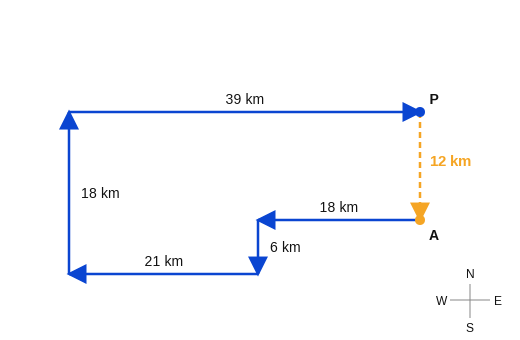
Mr. Helux starts from Point A and drives 18 km towards the West. He then takes a left turn, drives 6 km, turns right and drives 21 km. He then takes a right turn and drives 18 km. He takes a final right turn, drives 39 km and stops at Point P. How far (shortest distance) and towards which direction should he drive in order to reach Point A again? (All turns are 90 degrees turns only unless specified.)
श्री हेलक्स बिंदु A से चलना शुरू करते हैं और पश्चिम की ओर 18 km गाड़ी चलाते हैं। फिर वे बाएँ मुड़ते हैं, 6 km गाड़ी चलाते हैं, दाएँ मुड़ते हैं और 21 km गाड़ी चलाते हैं। फिर वे दाएँ मुड़ते हैं और 18 km गाड़ी चलाते हैं। वे अंतिम बार दाएँ मुड़ते हैं, 39 km गाड़ी चलाते हैं और बिंदु P पर रुक जाते हैं। पुनः बिंदु A तक पहुँचने के लिए उन्हें कितनी दूरी (न्यूनतम दूरी) तक और किस दिशा में गाड़ी चलानी चाहिए? (जब तक निर्दिष्ट न किया जाए, सभी मोड़ केवल 90 डिग्री के मोड़ हैं।)
  1. A12 km to the Southदक्षिण की ओर 12 km
  2. B16 km to the Eastपूर्व की ओर 16 km
  3. C19 km to the Northउत्तर की ओर 19 km
  4. D10 km to the Westपश्चिम की ओर 10 km
Show answer

Concept: Track the position with East–West and North–South totals; a left turn while facing West means facing South, a right turn means facing North.

  1. West 18, left (South) 6, right (West) 21 → he is 39 km West and 6 km South of A.
  2. Right (North) 18 → 6 km South becomes 12 km North; right (East) 39 → East–West offset becomes 0.
  3. So P is exactly 12 km North of A; to return he must drive 12 km towards the South.

Trick: Net E–W: −18−21+39=0; net N–S: −6+18=12 North → go back South.

Answer: (A) 12 km to the South

अवधारणा: पूर्व–पश्चिम और उत्तर–दक्षिण की कुल दूरी अलग-अलग जोड़ें; पश्चिम की ओर मुँह हो तो बायाँ मोड़ = दक्षिण, दायाँ मोड़ = उत्तर।

  1. पश्चिम 18, बाएँ (दक्षिण) 6, दाएँ (पश्चिम) 21 → वह A से 39 km पश्चिम और 6 km दक्षिण में है।
  2. दाएँ (उत्तर) 18 → अब 12 km उत्तर; दाएँ (पूर्व) 39 → पूर्व–पश्चिम दूरी 0।
  3. अतः P, A से ठीक 12 km उत्तर में है; वापस जाने के लिए 12 km दक्षिण की ओर जाना होगा।

ट्रिक: शुद्ध E–W: −18−21+39=0; शुद्ध N–S: −6+18=12 उत्तर → वापसी दक्षिण की ओर।

उत्तर: (A) 12 km दक्षिण की ओर

RRB NTPC Graduate CBT 1General Intelligence and ReasoningDirection and DistanceRRB NTPC Graduate CBT 1 2024 · 21 Jun Shift 2 →
Q7197.
Read the given statements and conclusions carefully. Assuming that the information given in the statements is true, even if it appears to be at variance with commonly known facts, decide which of the given conclusion(s) logically follow(s) from the statements.
Statements:
All induction are stove.
Some stove are oven.
Some oven are tandoor.
Conclusions:
(I) Some tandoor are induction.
(II) Some oven are induction.
दिए गए कथनों और निष्कर्षों को ध्यानपूर्वक पढ़िए। यह मानते हुए कि कथनों में दी गई जानकारी सत्य है, भले ही वह सामान्यतः ज्ञात तथ्यों से भिन्न प्रतीत होती हो, निर्णय कीजिए कि दिए गए निष्कर्षों में से कौन-सा/से निष्कर्ष कथनों का तार्किक रूप से अनुसरण करता है/करते हैं।
कथन:
सभी इंडक्शन, स्टोव हैं।
कुछ स्टोव, ओवन हैं।
कुछ ओवन, तंदूर हैं।
निष्कर्ष:
(I) कुछ तंदूर, इंडक्शन हैं।
(II) कुछ ओवन, इंडक्शन हैं।
  1. ANeither conclusion (I) nor (II) followsन तो निष्कर्ष (I) और न ही (II) अनुसरण करता है
  2. BBoth conclusions (I) and (II) followनिष्कर्ष (I) और (II) दोनों अनुसरण करते हैं
  3. COnly conclusion (I) followsकेवल निष्कर्ष (I) अनुसरण करता है
  4. DOnly conclusion (II) followsकेवल निष्कर्ष (II) अनुसरण करता है
Show answer

Concept: A conclusion follows only if it is true in every possible Venn diagram of the statements.

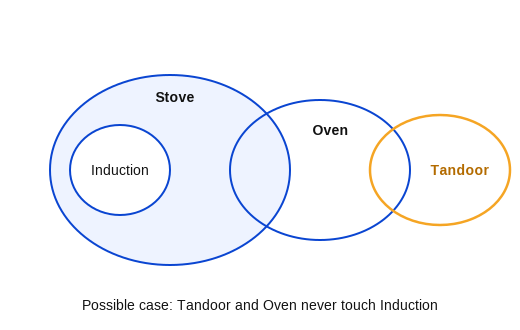
  1. Induction lies inside Stove; Oven meets Stove only in “some” part – that part may lie outside Induction.
  2. Tandoor meets Oven only in “some” part, so it need not touch Induction → (I) Some tandoor are induction: not certain.
  3. Oven may overlap only the non-induction part of Stove → (II) Some oven are induction: not certain.

Trick: “Some + Some” or “All + Some” never gives a definite “some” link to the first term.

Answer: (A) Neither conclusion (I) nor (II) follows

अवधारणा: निष्कर्ष तभी अनुसरण करता है जब वह कथनों के हर संभव वेन आरेख में सत्य हो।

  1. Induction पूरा Stove के अंदर है; Oven केवल Stove के “कुछ” भाग से मिलता है – वह भाग Induction के बाहर भी हो सकता है।
  2. Tandoor केवल Oven के “कुछ” भाग से मिलता है, Induction को छूना ज़रूरी नहीं → (I) निश्चित नहीं।
  3. Oven केवल Stove के non-induction भाग से मिल सकता है → (II) भी निश्चित नहीं।

ट्रिक: “कुछ + कुछ” या “सभी + कुछ” से पहले पद के साथ कोई निश्चित “कुछ” संबंध नहीं बनता।

उत्तर: (A) न तो (I) और न ही (II) अनुसरण करता है

RRB NTPC Graduate CBT 1General Intelligence and ReasoningSyllogismRRB NTPC Graduate CBT 1 2024 · 21 Jun Shift 2 →
Q7198.
What should come in place of the question mark (?) in the given series?
6 13 25 42 64 ?
दी गई श्रृंखला में प्रश्न चिह्न (?) के स्थान पर क्या आना चाहिए?
6 13 25 42 64 ?
  1. A86
  2. B96
  3. C91
  4. D81
Show answer

Concept: Check the differences between consecutive terms.

  1. Differences: 13−6=7, 25−13=12, 42−25=17, 64−42=22
  2. The differences rise by 5: next difference =27
  3. 64+27=91

Trick: Second differences constant (5) → keep adding 5 to the last gap.

Answer: (C) 91

अवधारणा: क्रमागत पदों का अंतर देखें।

  1. अंतर: 13−6=7, 25−13=12, 42−25=17, 64−42=22
  2. अंतर 5-5 बढ़ रहा है: अगला अंतर =27
  3. 64+27=91

ट्रिक: दूसरा अंतर स्थिर (5) → अंतिम अंतर में 5 जोड़ते जाएँ।

उत्तर: (C) 91

RRB NTPC Graduate CBT 1General Intelligence and ReasoningNumber SeriesRRB NTPC Graduate CBT 1 2024 · 21 Jun Shift 2 →
Q7199.
In a certain code language,
'A + B' means ‘A is the father of B’
'A – B' means ‘A is the daughter of B’
'A x B' means ‘A is the son of B’
'A ÷ B' means ‘A is the wife of B’
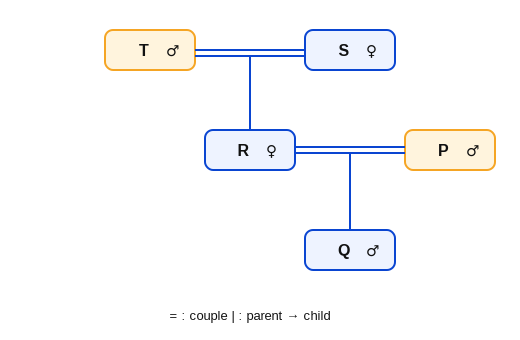
Based on the above, how is P related to T if ‘P + Q x R – S ÷ T’?
एक निश्चित कूट भाषा में,
'A + B' का अर्थ है ‘A, B का पिता है’
'A – B' का अर्थ है ‘A, B की पुत्री है’
'A x B' का अर्थ है ‘A, B का पुत्र है’
'A ÷ B' का अर्थ है ‘A, B की पत्नी है’
उपर्युक्त के आधार पर, यदि ‘P + Q x R – S ÷ T’ है, तो P का T से क्या संबंध है?
  1. ADaughter's husbandपुत्री का पति
  2. BSon's wife's brotherपुत्र की पत्नी का भाई
  3. CWife's brother's sonपत्नी के भाई का पुत्र
  4. DDaughter's sonपुत्री का पुत्र
Show answer

Concept: Decode each symbol step by step and draw the family tree.

  1. P + Q: P is the father of Q. Q × R: Q is the son of R, so R is Q’s mother (wife of P).
  2. R – S: R is the daughter of S. S ÷ T: S is the wife of T, so T is R’s father.
  3. R is T’s daughter and P is R’s husband → P is T’s daughter’s husband (son-in-law).

Trick: Go from T downwards: T → daughter R → her husband P.

Answer: (A) Daughter's husband

अवधारणा: प्रत्येक चिह्न का अर्थ क्रम से लगाएँ और परिवार वृक्ष बनाएँ।

  1. P + Q: P, Q का पिता है। Q × R: Q, R का पुत्र है, अतः R, Q की माँ (P की पत्नी) है।
  2. R – S: R, S की पुत्री है। S ÷ T: S, T की पत्नी है, अतः T, R का पिता है।
  3. R, T की पुत्री है और P उसका पति → P, T की पुत्री का पति (दामाद) है।

ट्रिक: T से नीचे चलें: T → पुत्री R → उसका पति P।

उत्तर: (A) पुत्री का पति (Daughter's husband)

RRB NTPC Graduate CBT 1General Intelligence and ReasoningBlood Relation – CodedRRB NTPC Graduate CBT 1 2024 · 21 Jun Shift 2 →
Q7200.
In a certain code language, ‘talk to him’ is coded as ‘yd hp mu’ and ‘when you talk’ is coded as ‘nc mu bt’. How is ‘talk’ coded in the given language?
एक निश्चित कूट भाषा में, ‘talk to him’ को ‘yd hp mu’ के रूप में कूटबद्ध किया जाता है और ‘when you talk’ को ‘nc mu bt’ के रूप में कूटबद्ध किया जाता है। उसी भाषा में ‘talk’ को किस प्रकार कूटबद्ध किया जाता है?
  1. Ayd
  2. Bnc
  3. Cbt
  4. Dmu
Show answer

Concept: A word common to two sentences has the code common to both coded sentences.

  1. ‘talk to him’ → ‘yd hp mu’; ‘when you talk’ → ‘nc mu bt’
  2. Common word: talk; common code: mu
  3. So talk = mu.

Trick: Match the common word with the common code – order of codes does not matter.

Answer: (D) mu

अवधारणा: दो वाक्यों में उभयनिष्ठ शब्द का कोड दोनों कोडित वाक्यों में उभयनिष्ठ होता है।

  1. ‘talk to him’ → ‘yd hp mu’; ‘when you talk’ → ‘nc mu bt’
  2. उभयनिष्ठ शब्द: talk; उभयनिष्ठ कोड: mu
  3. अतः talk = mu।

ट्रिक: उभयनिष्ठ शब्द ↔ उभयनिष्ठ कोड – कोड का क्रम मायने नहीं रखता।

उत्तर: (D) mu

RRB NTPC Graduate CBT 1General Intelligence and ReasoningCoding–Decoding (Words)RRB NTPC Graduate CBT 1 2024 · 21 Jun Shift 2 →