Question bank

Q&A: practice questions with answers

Search questions on any topic. Filter by exam category, exam, subject and topic, try the question, then open the answer and explanation.

Courses – airGurukul

20,719 questions found.

Q7281.
A and B complete a work in 20 days. If A alone can do it in 45 days, then B alone can do one-third of the same work in ______________ days.
A और B मिलकर एक कार्य 20 दिनों में पूरा करते हैं। यदि A अकेला इसे 45 दिनों में कर सकता है, तो B अकेला उसी कार्य का एक-तिहाई भाग ______________ दिनों में कर सकता है।
  1. A36
  2. B12
  3. C24
  4. D48
Show answer

Concept: Take total work = LCM of the days and find each person's units per day.
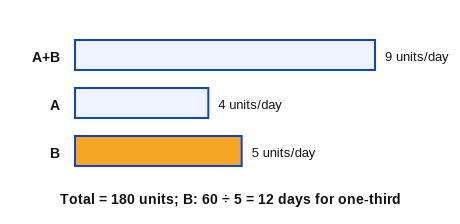
  1. Total work =LCM(20,45)=180 units
  2. A + B =18020=9 units/day; A =18045=4 units/day
  3. B =9−4=5 units/day
  4. One-third work =60 units → 605=12 days

Trick: B alone takes 20×4545−20=36 days; one-third of it =12 days.

Answer: (B) 12 days

अवधारणा: कुल कार्य = दिनों का LCM मानकर प्रतिदिन की इकाइयाँ निकालें।

  1. कुल कार्य =LCM(20,45)=180 इकाई
  2. A + B =18020=9 इकाई/दिन; A =18045=4 इकाई/दिन
  3. B =9−4=5 इकाई/दिन
  4. एक-तिहाई कार्य =60 इकाई → 605=12 दिन

ट्रिक: B अकेले 20×4545−20=36 दिन; उसका एक-तिहाई =12 दिन।

उत्तर: (B) 12 दिन

RRB NTPC Graduate CBT 1MathematicsTime and WorkRRB NTPC Graduate CBT 1 2024 · 21 Jun Shift 1 →
Q7282.
At what rate (in percentage) per annum will ₹1,300 give ₹650 as simple interest in 10 years?
किस वार्षिक दर (प्रतिशत में) पर ₹1,300, 10 वर्षों में ₹650 साधारण ब्याज देगा?
  1. A8%
  2. B4%
  3. C7%
  4. D5%
Show answer

Concept: SI=P×R×T100

  1. 650=1300×R×10100=130R
  2. R=650130=5%

Trick: Interest is half the principal in 10 years → 50%10=5% per year.

Answer: (D) 5%

अवधारणा: साधारण ब्याज=P×R×T100

  1. 650=1300×R×10100=130R
  2. R=650130=5%

ट्रिक: 10 वर्ष में ब्याज मूलधन का आधा → 50%10=5% प्रति वर्ष।

उत्तर: (D) 5%

RRB NTPC Graduate CBT 1MathematicsSimple InterestRRB NTPC Graduate CBT 1 2024 · 21 Jun Shift 1 →
Q7283.
What is the median of the following data?
75, 69, 45, 17, 22, 57, 79, 28, 18, 91, 32
निम्नलिखित आँकड़ों की माध्यिका (median) क्या है?
75, 69, 45, 17, 22, 57, 79, 28, 18, 91, 32
  1. A46
  2. B45.5
  3. C44.5
  4. D45
Show answer

Concept: For n (odd) observations in ascending order, median =(n+12)th value.

  1. Ascending: 17,18,22,28,32,45,57,69,75,79,91
  2. n=11 → 11+12=6th value
  3. 6th value =45

Trick: Always sort first – the middle of the unsorted list (57) is a trap.

Answer: (D) 45

अवधारणा: विषम n प्रेक्षणों को आरोही क्रम में रखने पर माध्यिका =(n+12) वाँ मान।

  1. आरोही क्रम: 17,18,22,28,32,45,57,69,75,79,91
  2. n=11 → 11+12=6 वाँ मान
  3. छठा मान =45

ट्रिक: पहले क्रम में लगाएँ – बिना क्रम के बीच का मान (57) जाल है।

उत्तर: (D) 45

RRB NTPC Graduate CBT 1MathematicsStatistics – MedianRRB NTPC Graduate CBT 1 2024 · 21 Jun Shift 1 →
Q7284.
A sells a printer to B at a loss of 60% and B sells the printer to C at a profit of 25%. If C purchased the printer for ₹89,569 then what was the cost (in ₹) of the printer for A?
A एक प्रिंटर को 60% की हानि पर B को बेचता है और B उस प्रिंटर को 25% के लाभ पर C को बेचता है। यदि C ने प्रिंटर ₹89,569 में खरीदा, तो A के लिए प्रिंटर का क्रय मूल्य (₹ में) क्या था?
  1. A1,79,141
  2. B1,79,140
  3. C1,79,138
  4. D1,79,134
Show answer

Concept: Successive sales multiply: C's price = A's cost ×(1−0.60)×(1+0.25).

  1. C's price =x×0.4×1.25=0.5x
  2. 0.5x=89569
  3. x=179138

Trick: −60% then +25%: 25×54=12 – A's cost is double C's price.

Answer: (C) ₹1,79,138

अवधारणा: क्रमिक बिक्री में गुणक गुणा होते हैं: C का मूल्य = A का क्रय मूल्य ×(1−0.60)×(1+0.25)।

  1. C का मूल्य =x×0.4×1.25=0.5x
  2. 0.5x=89569
  3. x=179138

ट्रिक: −60% फिर +25%: 25×54=12 – A का मूल्य, C के मूल्य का दोगुना।

उत्तर: (C) ₹1,79,138

RRB NTPC Graduate CBT 1MathematicsProfit and Loss – SuccessiveRRB NTPC Graduate CBT 1 2024 · 21 Jun Shift 1 →
Q7285.
If a + b = 41, and a − b = 38, find the value of (a + b)2.
यदि a + b = 41 और a − b = 38 है, तो (a + b)2 का मान ज्ञात कीजिए।
  1. A1763
  2. B1733
  3. C1759
  4. D1681
Show answer

Concept: (a+b)2 needs only the value of a+b.

  1. a+b=41
  2. (a+b)2=412=1681

Trick: Extra data (a−b=38) is a distractor; 412=1600+80+1=1681.

Answer: (D) 1681

अवधारणा: (a+b)2 के लिए केवल a+b का मान चाहिए।

  1. a+b=41
  2. (a+b)2=412=1681

ट्रिक: अतिरिक्त जानकारी (a−b=38) भ्रम के लिए है; 412=1600+80+1=1681।

उत्तर: (D) 1681

RRB NTPC Graduate CBT 1MathematicsAlgebraRRB NTPC Graduate CBT 1 2024 · 21 Jun Shift 1 →
Q7286.
Two quadratic equations, x2 - 5x + 6 = 0 and 2x2 - kx + 6 = 0, have one common root. What is the possible value of k?
दो द्विघात समीकरणों, x2 - 5x + 6 = 0 और 2x2 - kx + 6 = 0 का एक मूल उभयनिष्ठ है। k का संभावित मान क्या है?
  1. A5
  2. B11
  3. C7
  4. D9
Show answer

Concept: A common root of both equations must satisfy the second equation.

  1. x2−5x+6=0⇒(x−2)(x−3)=0, roots 2,3
  2. If x=2: 8−2k+6=0⇒k=7
  3. If x=3: 18−3k+6=0⇒k=8 (not an option)
  4. So k=7

Trick: Factorise the easy equation first, then substitute its roots.

Answer: (C) 7

अवधारणा: दोनों समीकरणों का उभयनिष्ठ मूल दूसरे समीकरण को भी संतुष्ट करेगा।

  1. x2−5x+6=0⇒(x−2)(x−3)=0, मूल 2,3
  2. x=2: 8−2k+6=0⇒k=7
  3. x=3: 18−3k+6=0⇒k=8 (विकल्प में नहीं)
  4. अतः k=7

ट्रिक: पहले आसान समीकरण का गुणनखंड करें, फिर मूल रखें।

उत्तर: (C) 7

RRB NTPC Graduate CBT 1MathematicsQuadratic Equations – Common RootRRB NTPC Graduate CBT 1 2024 · 21 Jun Shift 1 →
Q7287.
Evaluate: 86 × 104
मान ज्ञात कीजिए: 86 × 104
  1. A8944
  2. B9044
  3. C8954
  4. D8934
Show answer

Concept: Use (a−b)(a+b)=a2−b2 with numbers around 95.

  1. 86×104=(95−9)(95+9)
  2. =952−92=9025−81=8944

Trick: Or 86×104=8600+344=8944; last digit 6×4=24 → ends in 4.

Answer: (A) 8944

अवधारणा: (a−b)(a+b)=a2−b2 का प्रयोग, 95 के आसपास।

  1. 86×104=(95−9)(95+9)
  2. =952−92=9025−81=8944

ट्रिक: या 86×104=8600+344=8944; इकाई अंक 6×4=24 → 4।

उत्तर: (A) 8944

RRB NTPC Graduate CBT 1MathematicsSimplificationRRB NTPC Graduate CBT 1 2024 · 21 Jun Shift 1 →
Q7288.
In covering a distance of 162 km, Abhay takes 6 hours more than Sameer. If Abhay doubles his speed, then he would take 3 hours less than Sameer. Abhay's initial speed is:
162 km की दूरी तय करने में, अभय, समीर से 6 घंटे अधिक लेता है। यदि अभय अपनी चाल दोगुनी कर दे, तो वह समीर से 3 घंटे कम लेगा। अभय की प्रारंभिक चाल है:
  1. A8 km/hr
  2. B4 km/hr
  3. C18 km/hr
  4. D9 km/hr
Show answer

Concept: Write the two time conditions and add them to eliminate Sameer's time.

  1. Let Abhay's speed =a, Sameer's =s. 162a−162s=6
  2. Doubled speed: 162s−1622a=3
  3. Adding: 162a−81a=9⇒81a=9
  4. a=9km/h (Sameer: 12 h; Abhay: 18 h ✓)

Trick: Option check: a=9 → 18 h; doubled → 9 h; Sameer 18−6=12 h and 12−9=3 ✓.

Answer: (D) 9km/h

अवधारणा: दोनों समय-शर्तें लिखकर जोड़ें, समीर का समय हट जाएगा।

  1. अभय की चाल =a, समीर की =s। 162a−162s=6
  2. दोगुनी चाल: 162s−1622a=3
  3. जोड़ने पर: 162a−81a=9⇒81a=9
  4. a=9km/h (समीर: 12 घंटे; अभय: 18 घंटे ✓)

ट्रिक: विकल्प जाँच: a=9 → 18 घंटे; दोगुनी चाल → 9 घंटे; समीर 18−6=12 घंटे, 12−9=3 ✓।

उत्तर: (D) 9km/h

RRB NTPC Graduate CBT 1MathematicsTime and DistanceRRB NTPC Graduate CBT 1 2024 · 21 Jun Shift 1 →
Q7289.
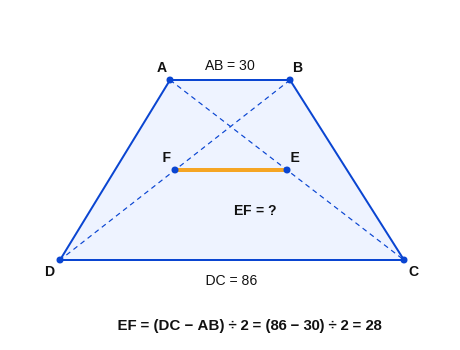
ABCD is a quadrilateral in which AB ∥ DC, and E and F are the mid points of the diagonals AC and BD, respectively. If AB = 30 cm, BC = 20 cm, DC = 86 cm and AD = 84 cm, then what is the length (in cm) of EF?
ABCD एक चतुर्भुज है जिसमें AB ∥ DC है, और E और F क्रमशः विकर्णों AC और BD के मध्य बिंदु हैं। यदि AB = 30 cm, BC = 20 cm, DC = 86 cm और AD = 84 cm है, तो EF की लंबाई (cm में) कितनी है?
  1. A28
  2. B31
  3. C23
  4. D24
Show answer

Concept: In a trapezium, the segment joining the midpoints of the diagonals is parallel to the bases and equals half their difference.

  1. AB∥DC, AB=30, DC=86
  2. EF=DC−AB2=86−302
  3. EF=28cm (BC and AD are not needed)

Trick: Midpoints of sides → half the sum; midpoints of diagonals → half the difference.

Answer: (A) 28

अवधारणा: समलंब में विकर्णों के मध्य-बिंदुओं को मिलाने वाली रेखा समांतर भुजाओं के समांतर होती है और उनके अंतर की आधी होती है।

  1. AB∥DC, AB=30, DC=86
  2. EF=DC−AB2=86−302
  3. EF=28cm (BC और AD की ज़रूरत नहीं)

ट्रिक: भुजाओं के मध्य-बिंदु → योग का आधा; विकर्णों के मध्य-बिंदु → अंतर का आधा।

उत्तर: (A) 28

RRB NTPC Graduate CBT 1MathematicsGeometry – TrapeziumRRB NTPC Graduate CBT 1 2024 · 21 Jun Shift 1 →
Q7290.
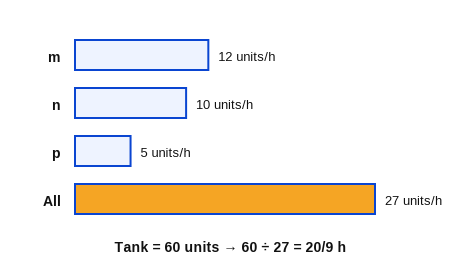
Three water pipes m, n and p, take 5, 6 and 12 hours, respectively, to fill a water tank. If all three pipes are opened at the same time, then the required time to fill the water tank will be:
तीन पानी के पाइप m, n और p, एक पानी की टंकी को भरने में क्रमशः 5, 6 और 12 घंटे लेते हैं। यदि तीनों पाइप एक साथ खोल दिए जाएँ, तो पानी की टंकी को भरने में लगने वाला आवश्यक समय होगा:
  1. A227 hours227 घंटे
  2. B119 hours119 घंटे
  3. C219 hours219 घंटे
  4. D229 hours229 घंटे
Show answer

Concept: Take tank capacity = LCM of the times and add the hourly units.

  1. Capacity =LCM(5,6,12)=60 units
  2. m =12, n =10, p =5 units/hour
  3. Together =27 units/hour
  4. Time =6027=209=229 hours

Trick: 15+16+112=12+10+560=2760, invert it.

Answer: (D) 229 hours

अवधारणा: टंकी की क्षमता = समयों का LCM मानें और प्रति घंटा इकाइयाँ जोड़ें।

  1. क्षमता =LCM(5,6,12)=60 इकाई
  2. m =12, n =10, p =5 इकाई/घंटा
  3. एक साथ =27 इकाई/घंटा
  4. समय =6027=209=229 घंटे

ट्रिक: 15+16+112=2760, फिर उल्टा करें।

उत्तर: (D) 229 घंटे

RRB NTPC Graduate CBT 1MathematicsPipes and CisternsRRB NTPC Graduate CBT 1 2024 · 21 Jun Shift 1 →
Q7291.
A pouch contains 50 Paisa, 25 Paisa and 10 Paisa coins in the ratio 18 : 12 : 10, amounting to ₹130. Find the number of 10 Paisa coins.
एक थैली में 50 पैसे, 25 पैसे और 10 पैसे के सिक्के 18 : 12 : 10 के अनुपात में हैं, जिनकी कुल राशि ₹130 है। 10 पैसे के सिक्कों की संख्या ज्ञात कीजिए।
  1. A149
  2. B184
  3. C100
  4. D180
Show answer

Concept: Value of each coin group = number of coins × coin value.

  1. Let coins be 18k,12k,10k
  2. Value: 0.50×18k+0.25×12k+0.10×10k=9k+3k+k=13k
  3. 13k=130⇒k=10
  4. 10 paise coins =10×10=100

Trick: Value ratio 9:3:1 → ₹130 splits as ₹90 : ₹30 : ₹10; ₹10 in 10-paise coins =100 coins.

Answer: (C) 100

अवधारणा: हर समूह का मूल्य = सिक्कों की संख्या × सिक्के का मान।

  1. सिक्के 18k,12k,10k
  2. मूल्य: 0.50×18k+0.25×12k+0.10×10k=9k+3k+k=13k
  3. 13k=130⇒k=10
  4. 10 पैसे के सिक्के =10×10=100

ट्रिक: मूल्य अनुपात 9:3:1 → ₹130 = ₹90 : ₹30 : ₹10; ₹10 में 10 पैसे के 100 सिक्के।

उत्तर: (C) 100

RRB NTPC Graduate CBT 1MathematicsRatio – CoinsRRB NTPC Graduate CBT 1 2024 · 21 Jun Shift 1 →
Q7292.
The average of fifty numbers is 34. If two numbers, namely 34 and 22 are discarded, the average of the remaining numbers is:
पचास संख्याओं का औसत 34 है। यदि दो संख्याएँ, अर्थात् 34 और 22 हटा दी जाएँ, तो शेष संख्याओं का औसत है:
  1. A32.25
  2. B35.25
  3. C34.25
  4. D31.25
Show answer

Concept: Sum = average × count; remove the discarded numbers and divide by the new count.

  1. Sum of 50 numbers =50×34=1700
  2. After removing 34 and 22: 1700−56=1644
  3. New average =164448=34.25

Trick: Removing 34 (= average) changes nothing; removing 22 (12 below) raises average by 1248=0.25.

Answer: (C) 34.25

अवधारणा: योग = औसत × संख्या; हटाई गई संख्याएँ घटाकर नई संख्या से भाग दें।

  1. 50 संख्याओं का योग =50×34=1700
  2. 34 और 22 हटाने पर: 1700−56=1644
  3. नया औसत =164448=34.25

ट्रिक: 34 (= औसत) हटाने से कोई असर नहीं; 22 (12 कम) हटाने से औसत 1248=0.25 बढ़ता है।

उत्तर: (C) 34.25

RRB NTPC Graduate CBT 1MathematicsAverageRRB NTPC Graduate CBT 1 2024 · 21 Jun Shift 1 →
Q7293.
Find the value of (3+3tan2A)cotA(1+cot2A)secA.
(3+3tan2A)cotA(1+cot2A)secA का मान ज्ञात कीजिए।
  1. AtanA
  2. BsinA
  3. C3sinA
  4. D3tanA
Show answer

Concept: Use 1+tan2A=sec2A and 1+cot2A=csc2A.

  1. Numerator =3(1+tan2A)cotA=3sec2AcotA
  2. Denominator =csc2AsecA
  3. Ratio =3secAcotAcsc2A=3·1cosA·cosAsinA·sin2A
  4. =3sinA

Trick: Check with A=45∘: 6·122=32=3sin45∘ ✓.

Answer: (C) 3sinA

अवधारणा: 1+tan2A=sec2A और 1+cot2A=csc2A का प्रयोग करें।

  1. अंश =3(1+tan2A)cotA=3sec2AcotA
  2. हर =csc2AsecA
  3. अनुपात =3secAcotAcsc2A=3·1cosA·cosAsinA·sin2A
  4. =3sinA

ट्रिक: A=45∘ रखें: 6·122=32=3sin45∘ ✓।

उत्तर: (C) 3sinA

RRB NTPC Graduate CBT 1MathematicsTrigonometric IdentitiesRRB NTPC Graduate CBT 1 2024 · 21 Jun Shift 1 →
Q7294.
The average of 10 observations is 40. It was realised later that an observation was misread as 31 in place of 50. Find the correct average.
10 प्रेक्षणों का औसत 40 है। बाद में ज्ञात हुआ कि एक प्रेक्षण को 50 के स्थान पर गलती से 31 पढ़ लिया गया था। सही औसत ज्ञात कीजिए।
  1. A41.9
  2. B44.9
  3. C40.9
  4. D42.9
Show answer

Concept: Correct sum = wrong sum − wrong value + correct value.

  1. Wrong sum =10×40=400
  2. Correct sum =400−31+50=419
  3. Correct average =41910=41.9

Trick: Average changes by 50−3110=1.9 → 40+1.9=41.9.

Answer: (A) 41.9

अवधारणा: सही योग = गलत योग − गलत मान + सही मान।

  1. गलत योग =10×40=400
  2. सही योग =400−31+50=419
  3. सही औसत =41910=41.9

ट्रिक: औसत में बदलाव 50−3110=1.9 → 40+1.9=41.9।

उत्तर: (A) 41.9

RRB NTPC Graduate CBT 1MathematicsAverage – CorrectionRRB NTPC Graduate CBT 1 2024 · 21 Jun Shift 1 →
Q7295.
Which positive number should replace both question marks in the following equation?
?11=275?
निम्नलिखित समीकरण में दोनों प्रश्नचिह्नों के स्थान पर कौन-सी धनात्मक संख्या आनी चाहिए?
?11=275?
  1. A55
  2. B54
  3. C49
  4. D46
Show answer

Concept: If x11=275x, cross-multiply to get x2.

  1. x2=11×275=3025
  2. x=3025=55 (positive)

Trick: 3025 ends in 25 → square of a number ending in 5: 552=3025.

Answer: (A) 55

अवधारणा: x11=275x में वज्र-गुणन करके x2 निकालें।

  1. x2=11×275=3025
  2. x=3025=55 (धनात्मक)

ट्रिक: 3025 के अंत में 25 → 5 पर समाप्त संख्या का वर्ग: 552=3025।

उत्तर: (A) 55

RRB NTPC Graduate CBT 1MathematicsSquare RootsRRB NTPC Graduate CBT 1 2024 · 21 Jun Shift 1 →
Q7296.
MJGT is related to QNKX in a certain way based on the English alphabetical order. In the same way, CZWJ is related to GDAN. To which of the following options is OLIV related, following the same logic?
अंग्रेज़ी वर्णमाला क्रम के आधार पर MJGT एक निश्चित तरीके से QNKX से संबंधित है। उसी प्रकार, CZWJ, GDAN से संबंधित है। समान तर्क का अनुसरण करते हुए, OLIV निम्नलिखित में से किस विकल्प से संबंधित है?
  1. ASMPZ
  2. BSPMZ
  3. CSPZM
  4. DSMZP
Show answer

Concept: Compare each letter of the first cluster with the matching letter of the second.

  1. M→Q, J→N, G→K, T→X: every letter moves +4.
  2. Check: C→G, Z→D, W→A, J→N, again +4 each.
  3. OLIV: O→S, L→P, I→M, V→Z gives SPMZ.

Trick: Check just the first two letters (O+4 = S, L+4 = P) to reject options A and D quickly.

Answer: (B) SPMZ

अवधारणा: पहले समूह के प्रत्येक अक्षर की तुलना दूसरे समूह के संगत अक्षर से करें।

  1. M→Q, J→N, G→K, T→X: हर अक्षर +4 आगे।
  2. जाँच: C→G, Z→D, W→A, J→N, फिर से +4।
  3. OLIV: O→S, L→P, I→M, V→Z = SPMZ।

ट्रिक: केवल पहले दो अक्षर (O+4 = S, L+4 = P) देखकर विकल्प A और D तुरंत हट जाते हैं।

उत्तर: (B) SPMZ

RRB NTPC Graduate CBT 1General Intelligence and ReasoningAnalogy (letter shift)RRB NTPC Graduate CBT 1 2024 · 21 Jun Shift 1 →
Q7297.
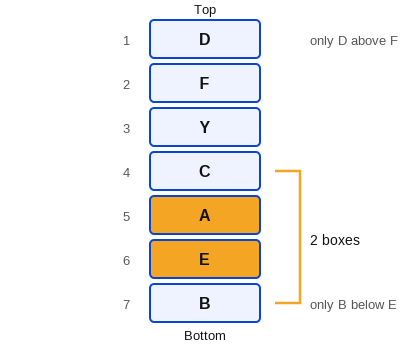
Seven boxes, A, B, C, D, E, F and Y, are kept one over the other but not necessarily in the same order. Only D is kept above F. Only three boxes are kept between D and A. Only B is kept below E. Y is not kept immediately above A. How many boxes are kept between C and B?
सात बक्से, A, B, C, D, E, F और Y, एक के ऊपर एक रखे गए हैं, लेकिन जरूरी नहीं कि इसी क्रम में हों। F के ऊपर केवल D रखा है। D और A के बीच केवल तीन बक्से रखे हैं। E के नीचे केवल B रखा है। Y, A के ठीक ऊपर नहीं रखा है। C और B के बीच कितने बक्से रखे हैं?
  1. AFourचार
  2. BThreeतीन
  3. CTwoदो
  4. DOneएक
Show answer

Concept: Fix the definite clues first (top and bottom), then place the rest.

  1. Only D above F → D at 1 (top), F at 2.
  2. Only B below E → B at 7 (bottom), E at 6.
  3. Three boxes between D and A → A at 5.
  4. Y not immediately above A → Y not at 4, so Y at 3 and C at 4.
  5. Between C (4) and B (7): A and E, i.e. two boxes.

Trick: "Only X above Y" means X is at the very top and Y is just below it.

Answer: (C) Two

अवधारणा: पहले निश्चित संकेत (सबसे ऊपर और सबसे नीचे) लगाएँ, फिर बाकी।

  1. केवल D, F के ऊपर → D स्थान 1 (सबसे ऊपर), F स्थान 2।
  2. केवल B, E के नीचे → B स्थान 7, E स्थान 6।
  3. D और A के बीच तीन बॉक्स → A स्थान 5।
  4. Y, A के ठीक ऊपर नहीं → Y स्थान 3, C स्थान 4।
  5. C (4) और B (7) के बीच A और E, यानी दो बॉक्स।

ट्रिक: "केवल X, Y के ऊपर" का अर्थ है X सबसे ऊपर और Y उसके ठीक नीचे।

उत्तर: (C) दो

RRB NTPC Graduate CBT 1General Intelligence and ReasoningBox arrangementRRB NTPC Graduate CBT 1 2024 · 21 Jun Shift 1 →
Q7298.
If 2 is added to each even digit and 1 is subtracted from each odd digit in the number 4123957, what will be the difference between the greatest and smallest digits in the new number thus formed?
यदि संख्या 4123957 में प्रत्येक सम अंक में 2 जोड़ दिया जाए और प्रत्येक विषम अंक में से 1 घटा दिया जाए, तो इस प्रकार बनी नई संख्या में सबसे बड़े और सबसे छोटे अंक के बीच का अंतर क्या होगा?
  1. A6
  2. B4
  3. C2
  4. D8
Show answer

Concept: Change every digit by the given rule, then compare the largest and smallest digits.

  1. Digits 4 1 2 3 9 5 7.
  2. Even digits +2: 4→6, 2→4. Odd digits −1: 1→0, 3→2, 9→8, 5→4, 7→6.
  3. New number 6042846; greatest digit 8, smallest 0.
  4. Difference =8−0=8.

Trick: Only the extremes matter: largest odd 9 becomes 8, smallest odd 1 becomes 0.

Answer: (D) 8

अवधारणा: नियम से हर अंक बदलें, फिर सबसे बड़े और सबसे छोटे अंक की तुलना करें।

  1. अंक 4 1 2 3 9 5 7।
  2. सम अंक +2: 4→6, 2→4। विषम अंक −1: 1→0, 3→2, 9→8, 5→4, 7→6।
  3. नई संख्या 6042846; सबसे बड़ा अंक 8, सबसे छोटा 0।
  4. अंतर =8−0=8।

ट्रिक: केवल चरम अंक देखें: 9 → 8 और 1 → 0।

उत्तर: (D) 8

RRB NTPC Graduate CBT 1General Intelligence and ReasoningNumber operationsRRB NTPC Graduate CBT 1 2024 · 21 Jun Shift 1 →
Q7299.
What should come in place of the question mark (?) in the given series?
356, 333, 300, ?, 204, 141
दी गई श्रृंखला में प्रश्नचिह्न (?) के स्थान पर क्या आना चाहिए?
356, 333, 300, ?, 204, 141
  1. A237
  2. B247
  3. C257
  4. D227
Show answer

Concept: Look at the differences between consecutive terms.

  1. 356−333=23, 333−300=33: differences rise by 10.
  2. Next difference 43: 300−43=257.
  3. Check: 257−53=204 and 204−63=141 ✓.

Trick: Differences 23, 33, 43, 53, 63 form an AP with common difference 10.

Answer: (C) 257

अवधारणा: क्रमागत पदों का अंतर देखें।

  1. 356−333=23, 333−300=33: अंतर 10-10 बढ़ रहा है।
  2. अगला अंतर 43: 300−43=257।
  3. जाँच: 257−53=204, 204−63=141 ✓।

ट्रिक: अंतर 23, 33, 43, 53, 63 समांतर श्रेणी में (सार्व अंतर 10)।

उत्तर: (C) 257

RRB NTPC Graduate CBT 1General Intelligence and ReasoningNumber seriesRRB NTPC Graduate CBT 1 2024 · 21 Jun Shift 1 →
Q7300.
Which of the following letter-clusters should replace # and % so that the pattern and relationship followed between the letter-cluster pair on the left side of :: is the same as that on the right side of :: ?
# : XFL :: KSY : %
निम्नलिखित में से कौन-से अक्षर-समूह # और % को प्रतिस्थापित करेंगे, ताकि :: के बाईं ओर के अक्षर-समूह युग्म के बीच अनुसरित पैटर्न और संबंध वही हो, जो :: के दाईं ओर है?
# : XFL :: KSY : %
  1. A# = SAG, % = PID
  2. B# = TAG, % = PXD
  3. C# = SAG, % = PXD
  4. D# = SAG, % = PXO
Show answer

Concept: Find the shift between the two clusters of a pair and apply the same on the right side.

  1. Try # = SAG: S+5 = X, A+5 = F, G+5 = L gives XFL, so the rule is +5.
  2. Right side: K+5 = P, S+5 = X, Y+5 = D (after Z we restart at A), so % = PXD.

Trick: Y+5: Z, A, B, C, D. Option D (PXO) fails on the last letter, option B (TAG) on the first.

Answer: (C) # = SAG, % = PXD

अवधारणा: जोड़ी के दोनों समूहों के बीच का अंतर ज्ञात कर दाईं ओर लागू करें।

  1. # = SAG लें: S+5 = X, A+5 = F, G+5 = L → XFL, यानी नियम +5।
  2. दाईं ओर: K+5 = P, S+5 = X, Y+5 = D (Z के बाद फिर A से), अतः % = PXD।

ट्रिक: Y+5: Z, A, B, C, D। विकल्प D (PXO) अंतिम अक्षर पर और B (TAG) पहले अक्षर पर गलत।

उत्तर: (C) # = SAG, % = PXD

RRB NTPC Graduate CBT 1General Intelligence and ReasoningLetter analogyRRB NTPC Graduate CBT 1 2024 · 21 Jun Shift 1 →