Question bank

Q&A: practice questions with answers

Search questions on any topic. Filter by exam category, exam, subject and topic, try the question, then open the answer and explanation.

Courses – airGurukul

20,719 questions found.

Q7401.
Based on the English alphabetical order, three of the following four letter-clusters are alike in a certain way and thus form a group. Which letter-cluster DOES NOT belong to that group?
(Note: The odd one out is not based on the number of consonants/vowels or their position in the letter-cluster.)
अंग्रेज़ी वर्णमाला क्रम के आधार पर, निम्नलिखित चार अक्षर-समूहों में से तीन किसी निश्चित प्रकार से एकसमान हैं और इस प्रकार एक समूह बनाते हैं। कौन-सा अक्षर-समूह उस समूह से संबंधित नहीं है?
(नोट: असंगत अक्षर-समूह, उस अक्षर-समूह में व्यंजनों/स्वरों की संख्या या उनके स्थान पर आधारित नहीं है।)
  1. ASXBE
  2. BBGKN
  3. CFYUB
  4. DFKOR
Show answer

Concept: Find the gaps between consecutive letters (alphabet positions, wrap-around after Z).

  1. SXBE: S +5 X +4 B +3 E.
  2. BGKN: B +5 G +4 K +3 N; FKOR: F +5 K +4 O +3 R.
  3. FYUB: F → Y is not +5 (it is +19), Y −4 U, U +7 B – pattern broken.

Trick: Check only the first gap (+5): F → Y fails immediately.

Answer: (C) FYUB

अवधारणा: क्रमागत अक्षरों के बीच अंतर (वर्णमाला स्थान, Z के बाद फिर A) ज्ञात करें।

  1. SXBE: S +5 X +4 B +3 E।
  2. BGKN: B +5 G +4 K +3 N; FKOR: F +5 K +4 O +3 R।
  3. FYUB: F → Y, +5 नहीं है (+19), Y −4 U, U +7 B – पैटर्न टूटा।

ट्रिक: केवल पहला अंतर (+5) जाँचें: F → Y तुरंत असफल।

उत्तर: (C) FYUB
RRB NTPC Graduate CBT 1General Intelligence and ReasoningOdd One Out – LettersRRB NTPC Graduate CBT 1 2024 · 20 Jun Shift 3 →
Q7402.
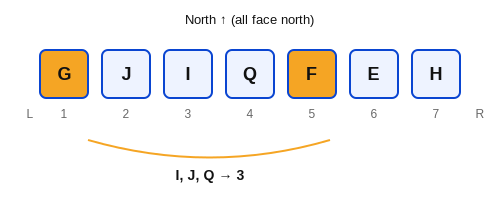
Seven friends, E, F, G, H, I, J and Q, are sitting in a row facing north. Only three people sit to the left of Q. Only H sits to the right of E. Only three people sit between E and J. I sits at some place to the left of F but at some place to the right of G. How many people sit between G and F?
सात मित्र, E, F, G, H, I, J और Q, उत्तर की ओर मुख करके एक पंक्ति में बैठे हैं। Q के बाईं ओर केवल तीन व्यक्ति बैठे हैं। E के दाईं ओर केवल H बैठा है। E और J के बीच केवल तीन व्यक्ति बैठे हैं। I, F के बाईं ओर कहीं बैठा है, लेकिन G के दाईं ओर कहीं बैठा है। G और F के बीच कितने व्यक्ति बैठे हैं?
  1. ATwoदो
  2. BThreeतीन
  3. CFourचार
  4. DOneएक
Show answer

Concept: Seven seats 1–7 from left (all face north, so left = our left).

  1. Three people left of Q → Q at 4.
  2. Only H right of E → E at 6, H at 7.
  3. Three between E and J → J at 2.
  4. Seats 1, 3, 5 remain for G, I, F with G < I < F → G 1, I 3, F 5. Between G and F: J, I, Q = 3.

Trick: Fix the "only" clues first – they pin exact seats.

Answer: (B) Three

अवधारणा: सात सीटें बाएँ से 1–7 (सभी उत्तर की ओर मुख, अतः बायाँ = हमारा बायाँ)।

  1. Q के बाएँ तीन लोग → Q स्थान 4।
  2. E के दाएँ केवल H → E 6, H 7।
  3. E और J के बीच तीन → J स्थान 2।
  4. बचे 1, 3, 5 पर G, I, F जहाँ G के दाएँ I और I के दाएँ F → G 1, I 3, F 5। G और F के बीच: J, I, Q = 3।

ट्रिक: "केवल" वाले संकेत पहले लगाएँ – वे सटीक स्थान तय करते हैं।

उत्तर: (B) तीन

RRB NTPC Graduate CBT 1General Intelligence and ReasoningLinear Seating ArrangementRRB NTPC Graduate CBT 1 2024 · 20 Jun Shift 3 →
Q7403.
In the following number-pairs, the second number is obtained by applying certain mathematical operation(s) to the first number. Select the number pair in which the numbers are related in the same way as are the numbers of the following pairs. (NOTE: Operations should be performed on the whole numbers, without breaking down the numbers into their constituent digits. E.g. 13 – Operations on 13 such as adding to/subtracting from/multiplying with 13 can be performed. Breaking down 13 into 1 and 3 and then performing mathematical operations on 1 and 3 is not allowed.)
78, 91
94, 107
निम्नलिखित संख्या-युग्मों में, पहली संख्या पर कुछ गणितीय संक्रिया/संक्रियाएँ करके दूसरी संख्या प्राप्त की जाती है। उस संख्या-युग्म का चयन कीजिए जिसमें संख्याएँ उसी प्रकार संबंधित हैं जिस प्रकार निम्नलिखित युग्मों की संख्याएँ संबंधित हैं। (नोट: संख्याओं को उनके घटक अंकों में तोड़े बिना, संक्रियाएँ पूर्ण संख्याओं पर की जानी चाहिए। उदाहरण के लिए 13 – 13 पर संक्रियाएँ जैसे 13 में जोड़ना/13 में से घटाना/13 से गुणा करना आदि की जा सकती हैं। 13 को 1 और 3 में तोड़कर फिर 1 और 3 पर गणितीय संक्रियाएँ करने की अनुमति नहीं है।)
78, 91
94, 107
  1. A82, 105
  2. B86, 99
  3. C71, 74
  4. D99, 114
Show answer

Concept: Find the single operation linking each pair.

  1. 78+13=91; 94+13=107 → rule: add 13.
  2. 86+13=99 ✔.
  3. 82+23=105, 71+3=74, 99+15=114 – do not fit.

Trick: Just subtract: second − first must be 13.

Answer: (B) 86, 99

अवधारणा: प्रत्येक युग्म को जोड़ने वाली संक्रिया ज्ञात करें।

  1. 78+13=91; 94+13=107 → नियम: 13 जोड़ें।
  2. 86+13=99 ✔।
  3. 82+23=105, 71+3=74, 99+15=114 – मेल नहीं।

ट्रिक: बस घटाएँ: दूसरी − पहली = 13 होना चाहिए।

उत्तर: (B) 86, 99

RRB NTPC Graduate CBT 1General Intelligence and ReasoningNumber Pair AnalogyRRB NTPC Graduate CBT 1 2024 · 20 Jun Shift 3 →
Q7404.
Which of the following letter-clusters should replace # and % so that the pattern and relationship followed between the letter-cluster pair on the left side of :: is the same as that on the right side of :: ?
# : OWF :: VDM : %
निम्नलिखित में से कौन-से अक्षर-समूह # और % के स्थान पर आने चाहिए ताकि :: के बाईं ओर के अक्षर-समूह युग्म के बीच का पैटर्न और संबंध वही हो जो :: के दाईं ओर के अक्षर-समूह युग्म के बीच है?
# : OWF :: VDM : %
  1. A# = TBK, % = QYU
  2. B# = TBM, % = QYH
  3. C# = TBK, % = QYH
  4. D# = TYK, % = QYH
Show answer

Concept: The same shift must take # to OWF and VDM to %.

  1. Try # = TBK: T −5 = O, B −5 = W, K −5 = F → rule "−5 each letter".
  2. Apply to VDM: V −5 = Q, D −5 = Y, M −5 = H → % = QYH.
  3. Only option (C) has both TBK and QYH.

Trick: Moving 5 back: A–V, B–W, C–X, D–Y, E–Z (wrap-around pairs).

Answer: (C) # = TBK, % = QYH

अवधारणा: एक ही बदलाव # को OWF में और VDM को % में बदलेगा।

  1. # = TBK लें: T −5 = O, B −5 = W, K −5 = F → नियम "हर अक्षर −5"।
  2. VDM पर: V −5 = Q, D −5 = Y, M −5 = H → % = QYH।
  3. केवल विकल्प (C) में TBK और QYH दोनों हैं।

ट्रिक: 5 पीछे: B → W, D → Y (Z के बाद घूमकर)।

उत्तर: (C) # = TBK, % = QYH

RRB NTPC Graduate CBT 1General Intelligence and ReasoningLetter AnalogyRRB NTPC Graduate CBT 1 2024 · 20 Jun Shift 3 →
Q7405.
If 1 is added to each odd digit and 2 is subtracted from each even digit in the number 1385724, then how many digits will appear more than once in the new number thus formed?
यदि संख्या 1385724 में प्रत्येक विषम अंक में 1 जोड़ा जाए और प्रत्येक सम अंक में से 2 घटाया जाए, तो इस प्रकार बनी नई संख्या में कितने अंक एक से अधिक बार आएँगे?
  1. A0
  2. B2
  3. C3
  4. D1
Show answer

Concept: Odd digit +1, even digit −2, then count repeated digits.

  1. 1 3 8 5 7 2 4 → 2 4 6 6 8 0 2.
  2. 2 appears twice, 6 appears twice; 4, 8, 0 appear once.
  3. Digits appearing more than once: 2 and 6 → 2 digits.

Trick: Count distinct digits that repeat, not the number of repetitions.

Answer: (B) 2

अवधारणा: विषम अंक +1, सम अंक −2, फिर दोहराए गए अंक गिनें।

  1. 1 3 8 5 7 2 4 → 2 4 6 6 8 0 2।
  2. 2 दो बार, 6 दो बार; 4, 8, 0 एक-एक बार।
  3. एक से अधिक बार आने वाले अंक: 2 और 6 → 2 अंक।

ट्रिक: दोहराने वाले भिन्न अंकों की संख्या गिनें, दोहराव की नहीं।

उत्तर: (B) 2

RRB NTPC Graduate CBT 1General Intelligence and ReasoningNumber OperationsRRB NTPC Graduate CBT 1 2024 · 20 Jun Shift 3 →
Q7406.
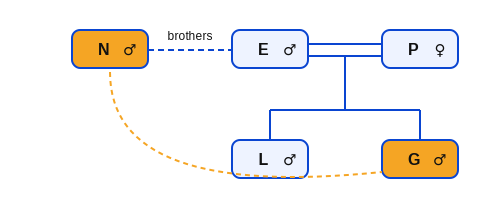
N is the brother of E. E is the husband of P. L and G are sons of P. How is N related to G?
N, E का भाई है। E, P का पति है। L और G, P के पुत्र हैं। N का G से क्या संबंध है?
  1. AHusband's brotherपति का भाई
  2. BFatherपिता
  3. CFather's brotherपिता का भाई
  4. DFather's fatherपिता के पिता
Show answer

Concept: Draw the family tree step by step.

  1. E is the husband of P; L and G are sons of P → E is the father of G.
  2. N is the brother of E → N is the brother of G's father.
  3. So N is G's father's brother (uncle).

Trick: Brother of father = paternal uncle (chacha).

Answer: (C) Father's brother

अवधारणा: चरणबद्ध पारिवारिक वृक्ष बनाएँ।

  1. E, P का पति है; L और G, P के पुत्र हैं → E, G का पिता है।
  2. N, E का भाई है → N, G के पिता का भाई है।
  3. अतः N, G का चाचा (पिता का भाई) है।

ट्रिक: पिता का भाई = चाचा।

उत्तर: (C) पिता का भाई

RRB NTPC Graduate CBT 1General Intelligence and ReasoningBlood RelationRRB NTPC Graduate CBT 1 2024 · 20 Jun Shift 3 →
Q7407.
What should come in place of the question mark (?) in the given series?
413, 390, 357, ?, 261, 198
दी गई श्रृंखला में प्रश्न चिह्न (?) के स्थान पर क्या आना चाहिए?
413, 390, 357, ?, 261, 198
  1. A344
  2. B324
  3. C334
  4. D314
Show answer

Concept: Check the differences between consecutive terms.

  1. 413−23=390, 390−33=357: differences grow by 10.
  2. Next: 357−43=314.
  3. Check: 314−53=261, 261−63=198 ✔.

Trick: Differences 23,33,43,53,63 – an arithmetic pattern.

Answer: (D) 314

अवधारणा: क्रमागत पदों के अंतर देखें।

  1. 413−23=390, 390−33=357: अंतर 10-10 बढ़ता है।
  2. अगला: 357−43=314।
  3. जाँच: 314−53=261, 261−63=198 ✔।

ट्रिक: अंतर 23,33,43,53,63 – समांतर पैटर्न।

उत्तर: (D) 314

RRB NTPC Graduate CBT 1General Intelligence and ReasoningNumber SeriesRRB NTPC Graduate CBT 1 2024 · 20 Jun Shift 3 →
Q7408.
Which of the following letter-number clusters will replace the question mark (?) in the given series to make it logically complete?
KO29 JN41 IM53 HL65 ?
निम्नलिखित में से कौन-सा अक्षर-संख्या समूह दी गई श्रृंखला में प्रश्न चिह्न (?) को प्रतिस्थापित करके उसे तार्किक रूप से पूर्ण करेगा?
KO29 JN41 IM53 HL65 ?
  1. AGK77
  2. BGL78
  3. CGK78
  4. DGL77
Show answer

Concept: Track the first letter, second letter and number separately.

  1. First letters: K, J, I, H → G (each −1).
  2. Second letters: O, N, M, L → K (each −1).
  3. Numbers: 29, 41, 53, 65 → 77 (each +12). Next term: GK77.

Trick: Split each term into three columns – each moves by a fixed step.

Answer: (A) GK77

अवधारणा: पहला अक्षर, दूसरा अक्षर और संख्या अलग-अलग देखें।

  1. पहले अक्षर: K, J, I, H → G (हर बार −1)।
  2. दूसरे अक्षर: O, N, M, L → K (हर बार −1)।
  3. संख्याएँ: 29, 41, 53, 65 → 77 (हर बार +12)। अगला पद: GK77।

ट्रिक: हर पद को तीन भागों में तोड़ें – हर भाग निश्चित कदम से बढ़ता है।

उत्तर: (A) GK77

RRB NTPC Graduate CBT 1General Intelligence and ReasoningAlphanumeric SeriesRRB NTPC Graduate CBT 1 2024 · 20 Jun Shift 3 →
Q7409.
Based on the English alphabetical order, three of the following four letter-cluster pairs are alike in a certain way and thus form a group. Which letter-cluster pair DOES NOT belong to that group?
(Note: The odd one out is not based on the number of consonants/vowels or their position in the letter-cluster.)
अंग्रेज़ी वर्णमाला क्रम के आधार पर, निम्नलिखित चार अक्षर-समूह युग्मों में से तीन किसी निश्चित प्रकार से एकसमान हैं और इस प्रकार एक समूह बनाते हैं। कौन-सा अक्षर-समूह युग्म उस समूह से संबंधित नहीं है?
(नोट: असंगत अक्षर-समूह, उस अक्षर-समूह में व्यंजनों/स्वरों की संख्या या उनके स्थान पर आधारित नहीं है।)
  1. AWE – CJ
  2. BFN – LS
  3. CCK – JP
  4. DJR – PW
Show answer

Concept: Compare first letters with each other and second letters with each other across the pair.

  1. WE – CJ: W +6 = C, E +5 = J.
  2. FN – LS: F +6 = L, N +5 = S; JR – PW: J +6 = P, R +5 = W.
  3. CK – JP: C +7 = J, K +5 = P → breaks the (+6,+5) pattern.

Trick: Also inside each cluster gaps are +8 then +7; CK–JP gives +8 then +6 – same odd one.

Answer: (C) CK – JP

अवधारणा: युग्म में पहले अक्षरों की आपस में और दूसरे अक्षरों की आपस में तुलना करें।

  1. WE – CJ: W +6 = C, E +5 = J।
  2. FN – LS: F +6 = L, N +5 = S; JR – PW: J +6 = P, R +5 = W।
  3. CK – JP: C +7 = J, K +5 = P → (+6,+5) पैटर्न टूटा।

ट्रिक: हर समूह के अंदर अंतर +8 फिर +7; CK–JP में +8 फिर +6 – वही विषम।

उत्तर: (C) CK – JP

RRB NTPC Graduate CBT 1General Intelligence and ReasoningOdd One Out – Letter PairsRRB NTPC Graduate CBT 1 2024 · 20 Jun Shift 3 →
Q7410.
Refer to the following number and symbol series and answer the question that follows. Counting to be done from left to right only.
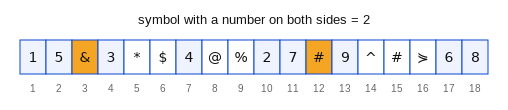
(Left) 1 5 & 3 * $ 4 @ % 2 7 # 9 ^ # ⋟ 6 8 (Right)
How many such symbols are there, each of which is immediately preceded by a number and also immediately followed by another number?
निम्नलिखित संख्या और प्रतीक श्रृंखला को देखिए और उसके बाद दिए गए प्रश्न का उत्तर दीजिए। गिनती केवल बाएँ से दाएँ की जानी है।
(बाएँ) 1 5 & 3 * $ 4 @ % 2 7 # 9 ^ # ⋟ 6 8 (दाएँ)
ऐसे कितने प्रतीक हैं, जिनमें से प्रत्येक के ठीक पहले एक संख्या है और ठीक बाद भी एक अन्य संख्या है?
  1. AOneएक
  2. BTwoदो
  3. CNoneकोई नहीं
  4. DThreeतीन
Show answer

Concept: Look for the pattern number–symbol–number.

  1. 5 & 3 → counted.
  2. 7 # 9 → counted.
  3. Others fail: 3 * $, 4 @ %, 9 ^ #, # ⋟ 6 (a symbol on one side). Total =2.

Trick: Scan only symbols that have digits on both sides – underline them in one pass.

Answer: (B) Two

अवधारणा: संख्या–प्रतीक–संख्या का पैटर्न देखें।

  1. 5 & 3 → गिना गया।
  2. 7 # 9 → गिना गया।
  3. बाकी असफल: 3 * $, 4 @ %, 9 ^ #, # ⋟ 6 (एक ओर प्रतीक)। कुल =2।

ट्रिक: केवल वे प्रतीक देखें जिनके दोनों ओर अंक हों – एक बार में चिह्नित करें।

उत्तर: (B) दो

RRB NTPC Graduate CBT 1General Intelligence and ReasoningNumber-Symbol SeriesRRB NTPC Graduate CBT 1 2024 · 20 Jun Shift 3 →
Q7411.
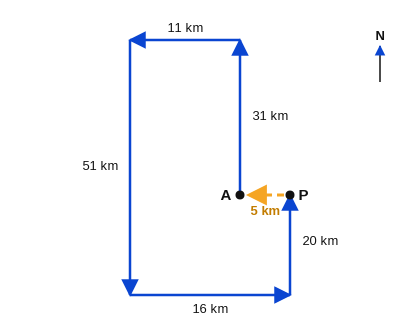
Mr. OPQ starts from Point A and drives 31 km towards the north. He then takes a left turn, drives 11 km, turns left and drives 51 km. He then takes a left turn and drives 16 km. He takes a final left turn, drives 20 km and stops at Point P. How far (shortest distance) and in which direction should he drive in order to reach Point A again? (All turns are 90-degree turns only unless specified)
श्री OPQ बिंदु A से चलना शुरू करते हैं और उत्तर की ओर 31 km गाड़ी चलाते हैं। फिर वे बाएँ मुड़ते हैं, 11 km गाड़ी चलाते हैं, बाएँ मुड़ते हैं और 51 km गाड़ी चलाते हैं। फिर वे बाएँ मुड़ते हैं और 16 km गाड़ी चलाते हैं। वे अंतिम बार बाएँ मुड़ते हैं, 20 km गाड़ी चलाते हैं और बिंदु P पर रुक जाते हैं। बिंदु A पर फिर से पहुँचने के लिए उन्हें कितनी दूरी (न्यूनतम दूरी) तक और किस दिशा में गाड़ी चलानी चाहिए? (जब तक निर्दिष्ट न हो, सभी मोड़ केवल 90-डिग्री के मोड़ हैं)
  1. A5 km to the westपश्चिम की ओर 5 km
  2. B3 km to the southदक्षिण की ओर 3 km
  3. C9 km to the eastपूर्व की ओर 9 km
  4. D4 km to the northउत्तर की ओर 4 km
Show answer

Concept: Track north–south and east–west movement separately.

  1. North 31, left → west 11, left → south 51, left → east 16, left → north 20.
  2. N–S: 31−51+20=0 (back on A’s level).
  3. E–W: 16−11=5 km east of A.
  4. So P is 5 km east of A → drive 5 km west.

Trick: Four left turns after going north bring you facing north again; only net shifts matter.

Answer: (A) 5 km to the west

अवधारणा: उत्तर–दक्षिण और पूर्व–पश्चिम गति अलग-अलग जोड़ें।

  1. उत्तर 31, बाएँ → पश्चिम 11, बाएँ → दक्षिण 51, बाएँ → पूर्व 16, बाएँ → उत्तर 20
  2. उ–द: 31−51+20=0 (A की सीध में)
  3. पू–प: 16−11=5 km, A के पूर्व में
  4. अतः P, A से 5 km पूर्व → 5 km पश्चिम जाना होगा।

ट्रिक: केवल कुल (net) विस्थापन देखें।

उत्तर: (A) 5 km पश्चिम की ओर

RRB NTPC Graduate CBT 1General Intelligence and ReasoningDirection and DistanceRRB NTPC Graduate CBT 1 2024 · 20 Jun Shift 3 →
Q7412.
SGUL is related to XLZQ in a certain way based on the English alphabetical order. In the same way, MAOF is related to RFTK. To which of the following options is BPDU related, following the same logic?
अंग्रेज़ी वर्णमाला क्रम के आधार पर SGUL एक निश्चित प्रकार से XLZQ से संबंधित है। उसी प्रकार, MAOF, RFTK से संबंधित है। समान तर्क का अनुसरण करते हुए, BPDU निम्नलिखित में से किस विकल्प से संबंधित है?
  1. AGZIU
  2. BGZUI
  3. CGUIZ
  4. DGUZI
Show answer

Concept: Compare letter positions of the pair.

  1. S→X, G→L, U→Z, L→Q: each +5. Check MAOF → RFTK: each +5 ✓.
  2. BPDU: B+5 = G, P+5 = U, D+5 = I, U+5 = Z.

Trick: Shift only the first letter and the option list narrows quickly; here all start with G, so check the 2nd letter (P→U).

Answer: (C) GUIZ

अवधारणा: युग्म के अक्षरों की स्थितियाँ मिलाएँ।

  1. S→X, G→L, U→Z, L→Q: प्रत्येक +5; MAOF → RFTK भी +5 ✓
  2. BPDU: B+5 = G, P+5 = U, D+5 = I, U+5 = Z

ट्रिक: सभी विकल्प G से शुरू हैं, दूसरा अक्षर (P→U) जाँचें।

उत्तर: (C) GUIZ

RRB NTPC Graduate CBT 1General Intelligence and ReasoningLetter AnalogyRRB NTPC Graduate CBT 1 2024 · 20 Jun Shift 3 →
Q7413.
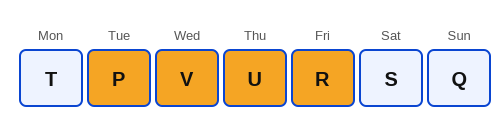
Each of P, Q, R, S, T, U and V has an exam on a different day of a week starting from Monday and ending on Sunday of the same week.
P has the exam on Tuesday. Only two people have exams after R. S has the exam immediately before Q but after R. U has the exam immediately after V.
How many people have exams between T and S?
P, Q, R, S, T, U और V में से प्रत्येक की परीक्षा एक ही सप्ताह के सोमवार से शुरू होकर रविवार को समाप्त होने वाले सप्ताह के भिन्न-भिन्न दिन है।
P की परीक्षा मंगलवार को है। R के बाद केवल दो व्यक्तियों की परीक्षाएँ हैं। S की परीक्षा Q से ठीक पहले लेकिन R के बाद है। U की परीक्षा V के ठीक बाद है।
T और S के बीच कितने व्यक्तियों की परीक्षाएँ हैं?
  1. AOneएक
  2. BThreeतीन
  3. CFourचार
  4. DTwoदो
Show answer

Concept: Fix the definite clues first, then the pairs.

  1. Only two after R → R = Friday; S immediately before Q but after R → S = Sat, Q = Sun.
  2. P = Tue. Left: Mon, Wed, Thu. V–U consecutive → V = Wed, U = Thu; T = Mon.
  3. Order: T, P, V, U, R, S, Q. Between T and S: P, V, U, R = 4.

Trick: “Only n after X” fixes X’s day straight away.

Answer: (C) Four

अवधारणा: पहले निश्चित सूचनाएँ, फिर जोड़ियाँ रखें।

  1. R के बाद केवल दो → R = शुक्रवार; S, Q से ठीक पहले और R के बाद → S = शनि, Q = रवि
  2. P = मंगल। बचे: सोम, बुध, गुरु। V–U लगातार → V = बुध, U = गुरु; T = सोम
  3. क्रम: T, P, V, U, R, S, Q; T और S के बीच: P, V, U, R = 4

ट्रिक: “X के बाद केवल n” से X का दिन तुरंत तय हो जाता है।

उत्तर: (C) चार

RRB NTPC Graduate CBT 1General Intelligence and ReasoningScheduling – Days of WeekRRB NTPC Graduate CBT 1 2024 · 20 Jun Shift 3 →
Q7414.
What should come in place of the question mark (?) in the given series?
911 910 920 919 929 ? 938
दी गई श्रृंखला में प्रश्न चिह्न (?) के स्थान पर क्या आना चाहिए?
911 910 920 919 929 ? 938
  1. A926
  2. B924
  3. C928
  4. D929
Show answer

Concept: Look at differences between consecutive terms.

  1. 911 −1​ 910 +10​ 920 −1​ 919 +10​ 929
  2. Next: 929−1=928, then 928+10=938 ✓

Trick: Alternating pattern −1,+10; the last given term 938 confirms it.

Answer: (C) 928

अवधारणा: क्रमागत पदों का अंतर देखें।

  1. 911 −1​ 910 +10​ 920 −1​ 919 +10​ 929
  2. अगला: 929−1=928, फिर 928+10=938 ✓

ट्रिक: एकांतर पैटर्न −1,+10; अंतिम पद 938 पुष्टि करता है।

उत्तर: (C) 928

RRB NTPC Graduate CBT 1General Intelligence and ReasoningNumber SeriesRRB NTPC Graduate CBT 1 2024 · 20 Jun Shift 3 →
Q7415.
A group of numbers and symbols is coded using letter codes as per the codes given below and the conditions that follow. Study the given codes and conditions and answer the question that follows.
Note: If none of the conditions apply, then codes for the respective number/symbol are to be followed directly as given in the table.
Number/symbol9%25*$3^#4+678
CodeSGLFBMCHNDJPEK

Conditions:
i) If the first element is a symbol and the last a number, the codes for these two (the first and the last elements) are to be interchanged.
ii) If the first element is an odd number and the last element is an even number, then the first and last elements are to be coded as @.
iii) If both the second and third elements are divisible by 2, the third element is to be coded as the code for the second element.
What will be the code for 768*%?
संख्याओं और प्रतीकों के एक समूह को नीचे दिए गए कोड और उसके बाद दी गई शर्तों के अनुसार अक्षर कोड का उपयोग करके कूटबद्ध किया गया है। दिए गए कोड और शर्तों का अध्ययन कीजिए और उसके बाद दिए गए प्रश्न का उत्तर दीजिए।
नोट: यदि कोई भी शर्त लागू नहीं होती है, तो संबंधित संख्या/प्रतीक के लिए तालिका में दिए गए कोड का सीधे अनुसरण करना है।
संख्या/प्रतीक9%25*$3^#4+678
कोडSGLFBMCHNDJPEK

शर्तें:
i) यदि पहला अवयव एक प्रतीक है और अंतिम अवयव एक संख्या है, तो इन दोनों (पहले और अंतिम अवयवों) के कोड आपस में बदल दिए जाने हैं।
ii) यदि पहला अवयव एक विषम संख्या है और अंतिम अवयव एक सम संख्या है, तो पहले और अंतिम अवयवों को @ के रूप में कूटबद्ध किया जाना है।
iii) यदि दूसरा और तीसरा दोनों अवयव 2 से विभाज्य हैं, तो तीसरे अवयव को दूसरे अवयव के कोड के रूप में कूटबद्ध किया जाना है।
768*% के लिए कोड क्या होगा?
  1. AEPPBG
  2. BGPKBE
  3. CEPKBG
  4. DEKKBG
Show answer

Concept: Test each condition on 7 6 8 * %, then code.

  1. (i) First is a number, not a symbol ✗. (ii) Last (%) is not an even number ✗.
  2. (iii) 2nd = 6 and 3rd = 8 are both even ✓ → 3rd gets the code of 6 = P.
  3. Codes: 7 = E, 6 = P, 8 → P, * = B, % = G → EPPBG.

Trick: Check conditions in order before using the table; only one applies here.

Answer: (A) EPPBG

अवधारणा: 7 6 8 * % पर प्रत्येक शर्त जाँचें, फिर कोड करें।

  1. (i) पहला अवयव संख्या है, प्रतीक नहीं ✗; (ii) अंतिम (%) सम संख्या नहीं ✗
  2. (iii) दूसरा 6 और तीसरा 8 दोनों 2 से विभाज्य ✓ → तीसरे को 6 का कोड P
  3. कोड: 7 = E, 6 = P, 8 → P, * = B, % = G → EPPBG

ट्रिक: तालिका से पहले शर्तें क्रम से जाँचें।

उत्तर: (A) EPPBG

RRB NTPC Graduate CBT 1General Intelligence and ReasoningCoding–Decoding with ConditionsRRB NTPC Graduate CBT 1 2024 · 20 Jun Shift 3 →
Q7416.
RUYQ is related to KNRJ in a certain way based on the English alphabetical order. In the same way, ORVN is related to HKOG. To which of the given options is LOSK related, following the same logic?
अंग्रेज़ी वर्णमाला क्रम के आधार पर RUYQ एक निश्चित प्रकार से KNRJ से संबंधित है। उसी प्रकार, ORVN, HKOG से संबंधित है। समान तर्क का अनुसरण करते हुए, LOSK दिए गए विकल्पों में से किससे संबंधित है?
  1. AHELD
  2. BHEDL
  3. CEHLD
  4. DEHDL
Show answer

Concept: Find the shift between corresponding letters.

  1. R→K, U→N, Y→R, Q→J: each −7. ORVN → HKOG: each −7 ✓.
  2. LOSK: L−7 = E, O−7 = H, S−7 = L, K−7 = D.

Trick: −7 is the same as +19; use EJOTY positions (L = 12, 12−7=5 = E).

Answer: (C) EHLD

अवधारणा: संगत अक्षरों का अंतर खोजें।

  1. R→K, U→N, Y→R, Q→J: प्रत्येक −7; ORVN → HKOG भी −7 ✓
  2. LOSK: L−7 = E, O−7 = H, S−7 = L, K−7 = D

ट्रिक: EJOTY से स्थिति: L = 12, 12−7=5 = E

उत्तर: (C) EHLD

RRB NTPC Graduate CBT 1General Intelligence and ReasoningLetter AnalogyRRB NTPC Graduate CBT 1 2024 · 20 Jun Shift 3 →
Q7417.
If 1 is added to each odd digit and 2 is subtracted from each even digit in the number 4568712, what will be the difference between the highest and lowest digits in the number thus formed?
यदि संख्या 4568712 में प्रत्येक विषम अंक में 1 जोड़ा जाए और प्रत्येक सम अंक में से 2 घटाया जाए, तो इस प्रकार बनी संख्या में सबसे बड़े और सबसे छोटे अंकों के बीच का अंतर क्या होगा?
  1. A7
  2. B6
  3. C9
  4. D8
Show answer

Concept: Apply the rule digit by digit to 4 5 6 8 7 1 2.

  1. Even digits −2: 4→2, 6→4, 8→6, 2→0.
  2. Odd digits +1: 5→6, 7→8, 1→2.
  3. New number: 2 6 4 6 8 2 0. Highest = 8, lowest = 0; 8−0=8.

Trick: Only the largest and smallest new digits matter: 8 (from 7) and 0 (from 2).

Answer: (D) 8

अवधारणा: 4 5 6 8 7 1 2 के प्रत्येक अंक पर नियम लगाएँ।

  1. सम अंक −2: 4→2, 6→4, 8→6, 2→0
  2. विषम अंक +1: 5→6, 7→8, 1→2
  3. नई संख्या: 2 6 4 6 8 2 0; सबसे बड़ा 8, सबसे छोटा 0; 8−0=8

ट्रिक: केवल नया सबसे बड़ा (7→8) और सबसे छोटा (2→0) अंक देखें।

उत्तर: (D) 8

RRB NTPC Graduate CBT 1General Intelligence and ReasoningNumber OperationsRRB NTPC Graduate CBT 1 2024 · 20 Jun Shift 3 →
Q7418.
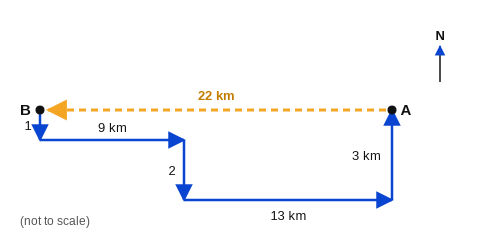
Mr. Y starts from Point B and drives 1 km towards the south. He then takes a left turn, drives 9 km, turns right and drives 2 km. He then takes a left turn and drives 13 km. He takes a final left turn, drives 3 km and stops at Point A. How far (shortest distance) and towards which direction should he drive in order to reach Point B again? (All turns are 90-degree turns only unless specified.)
श्री Y बिंदु B से चलना शुरू करते हैं और दक्षिण की ओर 1 km गाड़ी चलाते हैं। फिर वे बाएँ मुड़ते हैं, 9 km गाड़ी चलाते हैं, दाएँ मुड़ते हैं और 2 km गाड़ी चलाते हैं। फिर वे बाएँ मुड़ते हैं और 13 km गाड़ी चलाते हैं। वे अंतिम बार बाएँ मुड़ते हैं, 3 km गाड़ी चलाते हैं और बिंदु A पर रुक जाते हैं। बिंदु B पर फिर से पहुँचने के लिए उन्हें कितनी दूरी (न्यूनतम दूरी) तक और किस दिशा की ओर गाड़ी चलानी चाहिए? (जब तक निर्दिष्ट न हो, सभी मोड़ केवल 90-डिग्री के मोड़ हैं।)
  1. A18 km towards the eastपूर्व की ओर 18 km
  2. B9 km towards the southदक्षिण की ओर 9 km
  3. C1 km towards the northउत्तर की ओर 1 km
  4. D22 km towards the westपश्चिम की ओर 22 km
Show answer

Concept: Add east–west and north–south moves separately.

  1. South 1; left (east) 9; right (south) 2; left (east) 13; left (north) 3.
  2. N–S: −1−2+3=0 → A is level with B.
  3. E–W: 9+13=22 km east of B.
  4. To return to B: 22 km towards the west.

Trick: Facing south, a left turn means east.

Answer: (D) 22 km towards the west

अवधारणा: पूर्व–पश्चिम और उत्तर–दक्षिण गति अलग जोड़ें।

  1. दक्षिण 1; बाएँ (पूर्व) 9; दाएँ (दक्षिण) 2; बाएँ (पूर्व) 13; बाएँ (उत्तर) 3
  2. उ–द: −1−2+3=0 → A, B की सीध में
  3. पू–प: 9+13=22 km, B के पूर्व में
  4. B तक लौटने हेतु 22 km पश्चिम की ओर।

ट्रिक: दक्षिण की ओर मुख हो तो बाएँ = पूर्व।

उत्तर: (D) 22 km पश्चिम की ओर

RRB NTPC Graduate CBT 1General Intelligence and ReasoningDirection and DistanceRRB NTPC Graduate CBT 1 2024 · 20 Jun Shift 3 →
Q7419.
In a certain code language, ‘can you knock’ is coded as ‘mo nv sb’ and ‘knock the door’ is coded as ‘kx rg nv’. How is ‘knock’ coded in the given language?
एक निश्चित कूट भाषा में, ‘can you knock’ को ‘mo nv sb’ के रूप में और ‘knock the door’ को ‘kx rg nv’ के रूप में कूटबद्ध किया जाता है। दी गई भाषा में ‘knock’ को किस प्रकार कूटबद्ध किया जाता है?
  1. Arg
  2. Bnv
  3. Csb
  4. Dkx
Show answer

Concept: A word common to two sentences takes the code common to both.

  1. ‘can you knock’ → mo nv sb; ‘knock the door’ → kx rg nv.
  2. Common word: knock; common code: nv.

Trick: Match common word ↔ common code.

Answer: (B) nv

अवधारणा: दोनों वाक्यों में उभयनिष्ठ शब्द का कोड भी उभयनिष्ठ होता है।

  1. ‘can you knock’ → mo nv sb; ‘knock the door’ → kx rg nv
  2. उभयनिष्ठ शब्द: knock; उभयनिष्ठ कोड: nv

ट्रिक: उभयनिष्ठ शब्द ↔ उभयनिष्ठ कोड।

उत्तर: (B) nv

RRB NTPC Graduate CBT 1General Intelligence and ReasoningCoding–Decoding (Word Codes)RRB NTPC Graduate CBT 1 2024 · 20 Jun Shift 3 →
Q7420.
Select the letter-cluster from among the given options that can replace the question mark (?) in the following series.
PTM NSJ LRG ? HPA
दिए गए विकल्पों में से उस अक्षर-समूह का चयन कीजिए जो निम्नलिखित श्रृंखला में प्रश्न चिह्न (?) को प्रतिस्थापित कर सकता है।
PTM NSJ LRG ? HPA
  1. AJQD
  2. BJQE
  3. CJPD
  4. DHPD
Show answer

Concept: Track each letter position across the clusters.

  1. 1st: P, N, L, ?, H → −2 each → J
  2. 2nd: T, S, R, ?, P → −1 each → Q
  3. 3rd: M, J, G, ?, A → −3 each → D

Trick: Use the last cluster HPA to check: J−2 = H, Q−1 = P, D−3 = A ✓.

Answer: (A) JQD

अवधारणा: प्रत्येक स्थान के अक्षर अलग-अलग देखें।

  1. पहला: P, N, L, ?, H → प्रत्येक −2 → J
  2. दूसरा: T, S, R, ?, P → प्रत्येक −1 → Q
  3. तीसरा: M, J, G, ?, A → प्रत्येक −3 → D

ट्रिक: अंतिम पद HPA से जाँचें: J−2 = H, Q−1 = P, D−3 = A ✓

उत्तर: (A) JQD

RRB NTPC Graduate CBT 1General Intelligence and ReasoningLetter SeriesRRB NTPC Graduate CBT 1 2024 · 20 Jun Shift 3 →