Question bank

Q&A: practice questions with answers

Search questions on any topic. Filter by exam category, exam, subject and topic, try the question, then open the answer and explanation.

Courses – airGurukul

20,719 questions found.

Q7461.
Which is the largest saline wetland in India?
भारत की सबसे बड़ी लवणीय आर्द्रभूमि कौन-सी है?
  1. AChilika Lakeचिल्का झील
  2. BPulicat Lakeपुलिकट झील
  3. CSambhar Lakeसांभर झील
  4. DWular Lakeवुलर झील
Show answer

Concept: Sambhar Lake in Rajasthan (near Jaipur–Ajmer) is India's largest inland saline (salt-water) lake/wetland.

  1. It is a Ramsar site (1990) and a major source of salt; it attracts flamingos in winter.
  2. Chilika (Odisha) is the largest brackish-water coastal lagoon, Pulicat is a brackish lagoon on the AP–TN coast, and Wular (J&K) is a large freshwater lake.

Yaad rakhein: Largest saline inland = Sambhar; largest brackish lagoon = Chilika; largest freshwater = Wular.

Answer: (C) Sambhar Lake

अवधारणा: राजस्थान की सांभर झील भारत की सबसे बड़ी अंतर्देशीय खारी (saline) झील/आर्द्रभूमि है।

  1. यह रामसर स्थल (1990) है और नमक का प्रमुख स्रोत है; सर्दियों में यहाँ फ्लेमिंगो आते हैं।
  2. चिल्का (ओडिशा) सबसे बड़ा खारे-मीठे (brackish) पानी का लैगून है, पुलिकट भी brackish लैगून है, और वुलर (J&K) मीठे पानी की झील है।

याद रखें: सबसे बड़ी खारी अंतर्देशीय = सांभर; brackish लैगून = चिल्का; मीठे पानी = वुलर।

उत्तर: (C) सांभर झील
RRB NTPC Graduate CBT 1General AwarenessIndian LakesRRB NTPC Graduate CBT 1 2024 · 20 Jun Shift 2 →
Q7462.
What is the IMF's projected US GDP growth rate for 2025, as per the April 2025 forecast?
अप्रैल 2025 के पूर्वानुमान के अनुसार, IMF द्वारा 2025 के लिए अमेरिका की अनुमानित GDP वृद्धि दर क्या है?
  1. A3.7%
  2. B2.5%
  3. C3.4%
  4. D1.8%
Show answer

Concept: The IMF releases its World Economic Outlook (WEO) in April and October, with updates in January and July.

  1. In the April 2025 WEO, the IMF projected US GDP growth for 2025 at 1.8%, down from 2.7% projected in January 2025.
  2. The cut was mainly due to higher tariffs and policy uncertainty.

Yaad rakhein: IMF April 2025: US 1.8% (2025); global growth 2.8%.

Answer: (D) 1.8%

अवधारणा: IMF अपना World Economic Outlook (WEO) अप्रैल और अक्टूबर में जारी करता है, जनवरी और जुलाई में अद्यतन।

  1. अप्रैल 2025 WEO में IMF ने 2025 के लिए अमेरिकी GDP वृद्धि 1.8% अनुमानित की, जो जनवरी 2025 के 2.7% अनुमान से कम थी।
  2. कटौती का मुख्य कारण ऊँचे टैरिफ और नीतिगत अनिश्चितता थी।

याद रखें: IMF अप्रैल 2025: अमेरिका 1.8% (2025); वैश्विक वृद्धि 2.8%.

उत्तर: (D) 1.8%

RRB NTPC Graduate CBT 1General AwarenessIMF – World Economic OutlookRRB NTPC Graduate CBT 1 2024 · 20 Jun Shift 2 →
Q7463.
According to the Economic survey 2024-25, what is the value of India’s foreign exchange reserves, as of the end of December 2024?
आर्थिक सर्वेक्षण 2024-25 के अनुसार, दिसंबर 2024 के अंत तक भारत के विदेशी मुद्रा भंडार का मूल्य कितना है?
  1. A$330.3 billion$330.3 बिलियन
  2. B$520.5 billion$520.5 बिलियन
  3. C$440.8 billion$440.8 बिलियन
  4. D$640.3 billion$640.3 बिलियन
Show answer

Concept: The Economic Survey 2024-25 was tabled in Parliament on 31 January 2025.

  1. It reported India's foreign exchange reserves at about US$640.3 billion at the end of December 2024.
  2. These reserves covered roughly 90% of India's external debt and about 10–11 months of imports.

Yaad rakhein: Forex reserves (end-Dec 2024, Economic Survey) ≈ US$640 billion.

Answer: (D) $640.3 billion

अवधारणा: आर्थिक सर्वेक्षण 2024-25 संसद में 31 जनवरी 2025 को प्रस्तुत किया गया।

  1. इसके अनुसार दिसंबर 2024 के अंत में भारत का विदेशी मुद्रा भंडार लगभग US$640.3 अरब (billion) था।
  2. यह भंडार भारत के बाहरी ऋण का लगभग 90% और लगभग 10–11 महीनों के आयात के बराबर था।

याद रखें: विदेशी मुद्रा भंडार (दिसंबर 2024 अंत) ≈ US$640 अरब।

उत्तर: (D) $640.3 billion

RRB NTPC Graduate CBT 1General AwarenessEconomic Survey 2024-25RRB NTPC Graduate CBT 1 2024 · 20 Jun Shift 2 →
Q7464.
Which of the following statements is NOT correct with reference to the modern periodic table?
आधुनिक आवर्त सारणी के संदर्भ में निम्नलिखित में से कौन-सा कथन सही नहीं है?
  1. AThe first period contains 8 elements.पहले आवर्त में 8 तत्व होते हैं।
  2. BGroups are the vertical columns, and periods are horizontal rows.समूह ऊर्ध्वाधर स्तंभ होते हैं, और आवर्त क्षैतिज पंक्तियाँ होती हैं।
  3. CLanthanoids and actinoids are placed in separate panels at the bottom.लैंथेनॉइड और ऐक्टिनॉइड को नीचे अलग पैनलों में रखा गया है।
  4. DThe second and third periods each contain 8 elements.दूसरे और तीसरे आवर्त में प्रत्येक में 8 तत्व होते हैं।
Show answer

Concept: The modern periodic table has 7 periods (rows) and 18 groups (columns).

  1. The first period has only 2 elements (H and He) – so "first period contains 8 elements" is NOT correct.
  2. Periods 2 and 3 have 8 elements each; lanthanoids and actinoids are shown in two separate rows at the bottom.

Yaad rakhein: Elements per period: 2, 8, 8, 18, 18, 32, 32.

Answer: (A) The first period contains 8 elements.

अवधारणा: आधुनिक आवर्त सारणी में 7 आवर्त (पंक्तियाँ) और 18 वर्ग (स्तंभ) हैं।

  1. पहले आवर्त में केवल 2 तत्व (H और He) हैं – अतः "पहले आवर्त में 8 तत्व" कथन गलत है।
  2. दूसरे और तीसरे आवर्त में 8-8 तत्व; लैंथेनॉइड और ऐक्टिनॉइड नीचे अलग पंक्तियों में रखे गए हैं।

याद रखें: प्रति आवर्त तत्व: 2, 8, 8, 18, 18, 32, 32.

उत्तर: (A) पहले आवर्त में 8 तत्व होते हैं।

RRB NTPC Graduate CBT 1General AwarenessModern Periodic TableRRB NTPC Graduate CBT 1 2024 · 20 Jun Shift 2 →
Q7465.
Who discovered the antibacterial properties of a Penicillium fungus in 1929?
1929 में पेनिसिलियम कवक के जीवाणुरोधी गुणों की खोज किसने की?
  1. AAntonie van Leeuwenhoekएंटोनी वैन ल्यूवेनहॉक
  2. BPaul Ehrlichपॉल एर्लिक
  3. CMarie Curieमैरी क्यूरी
  4. DAlexander Flemingअलेक्ज़ेंडर फ़्लेमिंग
Show answer

Concept: Penicillin was the first true antibiotic.

  1. Alexander Fleming noticed in 1928 that Penicillium notatum mould killed Staphylococcus bacteria; he published the finding in 1929.
  2. He shared the 1945 Nobel Prize with Florey and Chain. Leeuwenhoek first saw microbes, Paul Ehrlich made Salvarsan, Marie Curie worked on radioactivity.

Yaad rakhein: Fleming – Penicillin (1928–29); Ehrlich – "magic bullet" Salvarsan.

Answer: (D) Alexander Fleming

अवधारणा: पेनिसिलिन पहला वास्तविक एंटीबायोटिक था।

  1. अलेक्ज़ेंडर फ्लेमिंग ने 1928 में देखा कि Penicillium notatum फफूँद Staphylococcus बैक्टीरिया को नष्ट करती है; 1929 में यह खोज प्रकाशित हुई।
  2. उन्हें फ्लोरी और चेन के साथ 1945 का नोबेल मिला। ल्यूवेनहॉक ने सूक्ष्मजीव देखे, पॉल एर्लिक ने साल्वर्सन बनाया, मैरी क्यूरी ने रेडियोधर्मिता पर काम किया।

याद रखें: फ्लेमिंग – पेनिसिलिन (1928–29).

उत्तर: (D) अलेक्ज़ेंडर फ्लेमिंग

RRB NTPC Graduate CBT 1General AwarenessDiscoveries in MedicineRRB NTPC Graduate CBT 1 2024 · 20 Jun Shift 2 →
Q7466.
Which positive number should replace both question marks in the following equation?
?56=504?
निम्नलिखित समीकरण में दोनों प्रश्नचिह्नों के स्थान पर कौन-सी धनात्मक संख्या आनी चाहिए?
?56=504?
  1. A183
  2. B174
  3. C168
  4. D184
Show answer

Concept: If xa=bx, then x2=ab.

  1. x2=56×504.
  2. 56×504=28224.
  3. x=28224=168 (positive).

Trick: 56×504=56×56×9, so x=56×3=168.

Answer: (C) 168

अवधारणा: यदि xa=bx हो, तो x2=ab।

  1. x2=56×504।
  2. 56×504=28224।
  3. x=28224=168 (धनात्मक)।

ट्रिक: 56×504=56×56×9, अतः x=56×3=168।

उत्तर: (C) 168

RRB NTPC Graduate CBT 1MathematicsSquare rootsRRB NTPC Graduate CBT 1 2024 · 20 Jun Shift 2 →
Q7467.
The shorter side of a rectangle is 21 cm less than the longer side. The numerical value of its area is equal to 5 times the numerical value of its perimeter. What is the length (in cm) of its longer side?
एक आयत की छोटी भुजा, लंबी भुजा से 21 cm कम है। इसके क्षेत्रफल का संख्यात्मक मान इसके परिमाप के संख्यात्मक मान के 5 गुना के बराबर है। इसकी लंबी भुजा की लंबाई (cm में) कितनी है?
  1. A32
  2. B47
  3. C35
  4. D38
Show answer

Concept: Area =L×B, Perimeter =2(L+B).

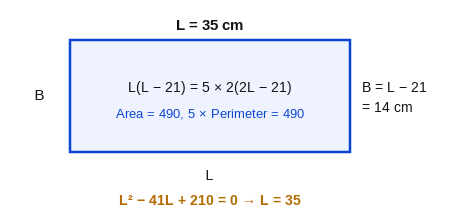
  1. Let longer side =L, shorter =L−21.
  2. L(L−21)=5×2(2L−21)=20L−210.
  3. L2−41L+210=0⇒(L−35)(L−6)=0.
  4. L=6 gives a negative breadth, so L=35cm (check: 35×14=490=5×98).

Trick: Test options: 35×14=490 and 5×2(35+14)=490 ✔.

Answer: (C) 35

अवधारणा: क्षेत्रफल =L×B, परिमाप =2(L+B)।

  1. लंबी भुजा =L, छोटी भुजा =L−21।
  2. L(L−21)=5×2(2L−21)=20L−210।
  3. L2−41L+210=0⇒(L−35)(L−6)=0।
  4. L=6 पर चौड़ाई ऋणात्मक होगी, अतः L=35cm (जाँच: 35×14=490=5×98)।

ट्रिक: विकल्प से जाँचें: 35×14=490 और 5×2(35+14)=490 ✔।

उत्तर: (C) 35

RRB NTPC Graduate CBT 1MathematicsMensuration – rectangleRRB NTPC Graduate CBT 1 2024 · 20 Jun Shift 2 →
Q7468.
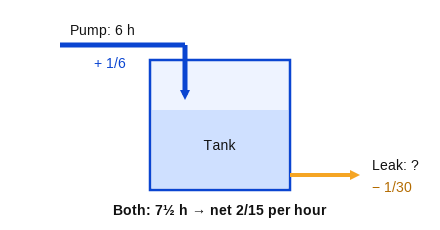
An electric pump can fill a tank in 6 hours. Due to a leakage in the tank, it takes 712 hours to fill the tank. How much time will this leak take to empty the full tank if water does not get in or out of the tank through any other point during this period?
एक विद्युत पंप एक टंकी को 6 घंटे में भर सकता है। टंकी में रिसाव के कारण, टंकी को भरने में 712 घंटे लगते हैं। यदि इस अवधि के दौरान टंकी में किसी अन्य स्थान से पानी अंदर या बाहर नहीं जाता है, तो यह रिसाव भरी हुई टंकी को खाली करने में कितना समय लेगा?
  1. A39 hours39 घंटे
  2. B33 hours33 घंटे
  3. C30 hours30 घंटे
  4. D44 hours44 घंटे
Show answer

Concept: Net rate = filling rate − leak rate.

  1. Pump rate =16 per hour; with leak the net rate =17.5=215 per hour.
  2. Leak rate =16−215=5−430=130.
  3. Leak empties the full tank in 30 hours.

Trick: Leak time =abb−a=6×7.51.5=30 hours.

Answer: (C) 30 hours

अवधारणा: शुद्ध दर = भरने की दर − रिसाव (leak) की दर।

  1. पंप की दर =16 प्रति घंटा; रिसाव के साथ शुद्ध दर =17.5=215 प्रति घंटा।
  2. रिसाव की दर =16−215=5−430=130।
  3. रिसाव भरी टंकी को 30 घंटे में खाली करेगा।

ट्रिक: रिसाव का समय =abb−a=6×7.51.5=30 घंटे।

उत्तर: (C) 30 घंटे

RRB NTPC Graduate CBT 1MathematicsPipes and cisternsRRB NTPC Graduate CBT 1 2024 · 20 Jun Shift 2 →
Q7469.
A and B complete a work in 15 days. If A alone can do it in 17 days, then B alone can do two-third of the same work in ______________ days.
A और B एक कार्य को 15 दिनों में पूरा करते हैं। यदि A अकेले इसे 17 दिनों में कर सकता है, तो B अकेले उसी कार्य का दो-तिहाई भाग ______________ दिनों में कर सकता है।
  1. A85
  2. B340
  3. C255
  4. D170
Show answer

Concept: Take total work = LCM of days, then find one-day work.

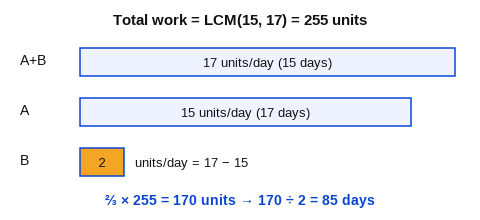
  1. Total work =LCM(15,17)=255 units.
  2. A+B =17 units/day, A =15 units/day, so B =2 units/day.
  3. 23 of work =170 units; time =1702=85 days.

Trick: B alone =15×1717−15=127.5 days; 23×127.5=85.

Answer: (A) 85

अवधारणा: कुल कार्य = दिनों का LCM लें, फिर एक दिन का कार्य निकालें।

  1. कुल कार्य =LCM(15,17)=255 इकाई।
  2. A+B =17 इकाई/दिन, A =15 इकाई/दिन, अतः B =2 इकाई/दिन।
  3. 23 कार्य =170 इकाई; समय =1702=85 दिन।

ट्रिक: B अकेला =15×1717−15=127.5 दिन; 23×127.5=85।

उत्तर: (A) 85

RRB NTPC Graduate CBT 1MathematicsTime and workRRB NTPC Graduate CBT 1 2024 · 20 Jun Shift 2 →
Q7470.
Kalpana and Sudha got 621 and 522 marks, respectively, in the same examination. If Kalpana scored 69% marks, then what is the percentage of marks scored by Sudha?
एक ही परीक्षा में कल्पना और सुधा ने क्रमशः 621 और 522 अंक प्राप्त किए। यदि कल्पना ने 69% अंक प्राप्त किए, तो सुधा द्वारा प्राप्त अंकों का प्रतिशत कितना है?
  1. A58%
  2. B59%
  3. C60%
  4. D55%
Show answer

Concept: Maximum marks =markspercent×100.

  1. Maximum marks =62169×100=900.
  2. Sudha's percentage =522900×100=58%.

Trick: Ratio method: 522621×69%=58%.

Answer: (A) 58%

अवधारणा: पूर्णांक =अंकप्रतिशत×100।

  1. पूर्णांक =62169×100=900।
  2. सुधा का प्रतिशत =522900×100=58%।

ट्रिक: अनुपात से: 522621×69%=58%।

उत्तर: (A) 58%

RRB NTPC Graduate CBT 1MathematicsPercentageRRB NTPC Graduate CBT 1 2024 · 20 Jun Shift 2 →
Q7471.
Which of the following numbers is divisible by 81?
निम्नलिखित में से कौन-सी संख्या 81 से विभाज्य है?
  1. A5265
  2. B5854
  3. C4678
  4. D5232
Show answer

Concept: 81=34; divide directly (digit-sum test of 9 is necessary but not sufficient).

  1. Digit sums: 5265 → 18, 5854 → 22, 4678 → 25, 5232 → 12; only 5265 is divisible by 9.
  2. 5265÷81=65 exactly (81×65=5265).

Trick: First drop options failing the 9-test, then divide.

Answer: (A) 5265

अवधारणा: 81=34; सीधे भाग दें (9 का अंक-योग परीक्षण आवश्यक है, पर्याप्त नहीं)।

  1. अंक-योग: 5265 → 18, 5854 → 22, 4678 → 25, 5232 → 12; केवल 5265 ही 9 से विभाज्य है।
  2. 5265÷81=65 पूर्णतः (81×65=5265)।

ट्रिक: पहले 9 के नियम से विकल्प हटाएँ, फिर भाग दें।

उत्तर: (A) 5265

RRB NTPC Graduate CBT 1MathematicsDivisibilityRRB NTPC Graduate CBT 1 2024 · 20 Jun Shift 2 →
Q7472.
The selling price of 20 books is equal to the cost price of 6 books. Find the loss or gain percentage.
20 पुस्तकों का विक्रय मूल्य 6 पुस्तकों के क्रय मूल्य के बराबर है। हानि या लाभ प्रतिशत ज्ञात कीजिए।
  1. A70% gain70% लाभ
  2. B507% gain507% लाभ
  3. C507% loss507% हानि
  4. D70% loss70% हानि
Show answer

Concept: Compare SP and CP of the same number of articles.

  1. SP20=CP6⇒SPCP=620.
  2. SP < CP, so it is a loss.
  3. Loss%=20−620×100=70%.

Trick: Loss%=differencegoods sold×100=1420×100.

Answer: (D) 70% loss

अवधारणा: समान संख्या की वस्तुओं के विक्रय मूल्य और क्रय मूल्य की तुलना करें।

  1. SP20=CP6⇒SPCP=620।
  2. SP < CP, अतः हानि है।
  3. हानि%=20−620×100=70%।

ट्रिक: हानि%=अंतरबेची गई वस्तुएँ×100=1420×100।

उत्तर: (D) 70% हानि

RRB NTPC Graduate CBT 1MathematicsProfit and lossRRB NTPC Graduate CBT 1 2024 · 20 Jun Shift 2 →
Q7473.
Five solid cubes, each of volume 1,09,41,048 cm3, are joined end to end to form a cuboid. What is the lateral surface area (in cm2) of the cuboid?
पाँच ठोस घनों, जिनमें से प्रत्येक का आयतन 1,09,41,048 cm3 है, को सिरे से सिरा मिलाकर एक घनाभ बनाया जाता है। घनाभ का पार्श्व पृष्ठीय क्षेत्रफल (cm2 में) कितना है?
  1. A5,91,408
  2. B5,91,310
  3. C5,91,663
  4. D5,91,312
Show answer

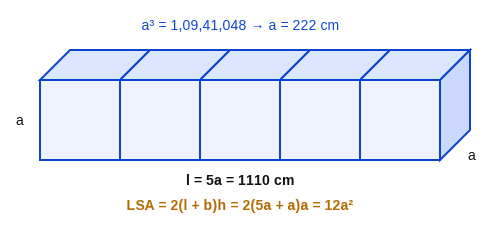
Concept: Joining 5 cubes of edge a gives a cuboid 5a×a×a.

  1. a3=10941048⇒a=222cm.
  2. Lateral surface area =2(l+b)h=2(5a+a)a=12a2.
  3. 12×2222=12×49284=591408cm2.

Trick: Cube root: ends in 8 → unit digit 2; 10941≈223 → 222.

Answer: (A) 5,91,408

अवधारणा: भुजा a वाले 5 घन जोड़ने पर 5a×a×a का घनाभ बनता है।

  1. a3=10941048⇒a=222cm।
  2. पार्श्व पृष्ठीय क्षेत्रफल (LSA) =2(l+b)h=2(5a+a)a=12a2।
  3. 12×2222=12×49284=591408cm2।

ट्रिक: घनमूल: अंत में 8 → इकाई अंक 2; 10941≈223 → 222।

उत्तर: (A) 5,91,408

RRB NTPC Graduate CBT 1MathematicsMensuration – cube and cuboidRRB NTPC Graduate CBT 1 2024 · 20 Jun Shift 2 →
Q7474.
Find the roots of x−4−10x−2+9=0.
x−4−10x−2+9=0 के मूल ज्ञात कीजिए।
  1. A±1, ±14
  2. B±1, ±23
  3. C±1, ±15
  4. D±1, ±13
Show answer

Concept: Substitute u=x−2 to get a quadratic.

  1. u2−10u+9=0⇒(u−1)(u−9)=0.
  2. u=1⇒x2=1⇒x=±1.
  3. u=9⇒x2=19⇒x=±13.

Trick: Put x=13: 81−90+9=0 ✔.

Answer: (D) ±1, ±13

अवधारणा: u=x−2 रखकर द्विघात समीकरण बनाएँ।

  1. u2−10u+9=0⇒(u−1)(u−9)=0।
  2. u=1⇒x2=1⇒x=±1।
  3. u=9⇒x2=19⇒x=±13।

ट्रिक: x=13 रखें: 81−90+9=0 ✔।

उत्तर: (D) ±1, ±13

RRB NTPC Graduate CBT 1MathematicsQuadratic equationsRRB NTPC Graduate CBT 1 2024 · 20 Jun Shift 2 →
Q7475.
If 3tanA=3sinA, find the value of (23cosecA×tanA).
यदि 3tanA=3sinA है, तो (23cosecA×tanA) का मान ज्ञात कीजिए।
  1. A6
  2. B3
  3. C23
  4. D2
Show answer

Concept: tanA=sinAcosA and cosecA=1sinA.

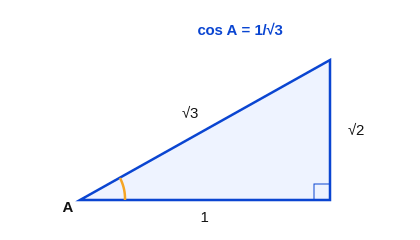
  1. 3sinAcosA=3sinA⇒cosA=33=13.
  2. cosecA×tanA=1sinA×sinAcosA=secA=3.
  3. 23×3=6.

Trick: cosecA×tanA=secA always.

Answer: (A) 6

अवधारणा: tanA=sinAcosA तथा cosecA=1sinA।

  1. 3sinAcosA=3sinA⇒cosA=33=13।
  2. cosecA×tanA=1sinA×sinAcosA=secA=3।
  3. 23×3=6।

ट्रिक: cosecA×tanA=secA हमेशा।

उत्तर: (A) 6

RRB NTPC Graduate CBT 1MathematicsTrigonometryRRB NTPC Graduate CBT 1 2024 · 20 Jun Shift 2 →
Q7476.
A man sold an article at a gain of 57%. If he had sold it for ₹238 more, he would have gained 82%. The cost price (in ₹) of the article is:
एक व्यक्ति ने एक वस्तु को 57% लाभ पर बेचा। यदि वह इसे ₹238 अधिक में बेचता, तो उसे 82% लाभ होता। वस्तु का क्रय मूल्य (₹ में) है:
  1. A955
  2. B952
  3. C949
  4. D950
Show answer

Concept: A change in gain% equals the change in SP as a percent of CP.

  1. Extra gain =82%−57%=25% of CP.
  2. 25% of CP = ₹238.
  3. CP =238×10025= ₹952.

Trick: Difference of percents ↔ difference of amounts.

Answer: (B) 952

अवधारणा: लाभ% में परिवर्तन = विक्रय मूल्य में परिवर्तन (क्रय मूल्य के प्रतिशत के रूप में)।

  1. अतिरिक्त लाभ =82%−57%=25% क्रय मूल्य का।
  2. क्रय मूल्य का 25%= ₹238।
  3. क्रय मूल्य =238×10025= ₹952।

ट्रिक: प्रतिशत का अंतर ↔ राशि का अंतर।

उत्तर: (B) 952

RRB NTPC Graduate CBT 1MathematicsProfit and lossRRB NTPC Graduate CBT 1 2024 · 20 Jun Shift 2 →
Q7477.
Evaluate: 81 × 112
मान ज्ञात कीजिए: 81 × 112
  1. A9072
  2. B9062
  3. C9082
  4. D9172
Show answer

Concept: Split 112 as 100+12.

  1. 81×100=8100.
  2. 81×12=972.
  3. 8100+972=9072.

Trick: Unit digit 1×2=2 and 81×112≈9000 → only 9072 fits.

Answer: (A) 9072

अवधारणा: 112 को 100+12 में तोड़ें।

  1. 81×100=8100।
  2. 81×12=972।
  3. 8100+972=9072।

ट्रिक: इकाई अंक 1×2=2 और 81×112≈9000 → केवल 9072।

उत्तर: (A) 9072

RRB NTPC Graduate CBT 1MathematicsMultiplicationRRB NTPC Graduate CBT 1 2024 · 20 Jun Shift 2 →
Q7478.
Mahesh withdrew ₹3,100 from a bank. He received a total of 34 notes of ₹50 and ₹100 denominations. The number of ₹50 notes received by him was:
महेश ने एक बैंक से ₹3,100 निकाले। उसे ₹50 और ₹100 मूल्यवर्ग के कुल 34 नोट प्राप्त हुए। उसे प्राप्त ₹50 के नोटों की संख्या थी:
  1. A6
  2. B16
  3. C13
  4. D4
Show answer

Concept: Form two equations: number of notes and total value.

  1. x+y=34 (x = ₹50 notes, y = ₹100 notes).
  2. 50x+100y=3100⇒x+2y=62.
  3. Subtract: y=28, so x=6.

Trick: If all 34 were ₹100 notes: ₹3400; shortfall ₹300 ÷ ₹50 =6 notes of ₹50.

Answer: (A) 6

अवधारणा: दो समीकरण बनाएँ: नोटों की संख्या और कुल राशि।

  1. x+y=34 (x = ₹50 के नोट, y = ₹100 के नोट)।
  2. 50x+100y=3100⇒x+2y=62।
  3. घटाएँ: y=28, अतः x=6।

ट्रिक: यदि सभी 34 नोट ₹100 के होते: ₹3400; कमी ₹300 ÷ ₹50 =6 नोट ₹50 के।

उत्तर: (A) 6

RRB NTPC Graduate CBT 1MathematicsLinear equationsRRB NTPC Graduate CBT 1 2024 · 20 Jun Shift 2 →
Q7479.
The mean of a data is 42 and its median is 53. The mode (using empirical relation) of the data is:
एक आँकड़े का माध्य 42 और माध्यिका 53 है। आँकड़े का बहुलक (आनुभविक संबंध का उपयोग करके) है:
  1. A169
  2. B75
  3. C24
  4. D100
Show answer

Concept: Empirical relation: Mode=3Median−2Mean.

  1. Mode =3×53−2×42.
  2. =159−84=75.

Trick: Mo=3Md−2M.

Answer: (B) 75

अवधारणा: आनुभविक संबंध: बहुलक=3माध्यिका−2माध्य।

  1. बहुलक =3×53−2×42।
  2. =159−84=75।

ट्रिक: Mo=3Md−2M।

उत्तर: (B) 75

RRB NTPC Graduate CBT 1MathematicsStatistics – empirical relationRRB NTPC Graduate CBT 1 2024 · 20 Jun Shift 2 →
Q7480.
What is the median of the following data?
19, 98, 77, 24, 99, 71, 70, 56, 80, 12, 88
निम्नलिखित आँकड़ों की माध्यिका क्या है?
19, 98, 77, 24, 99, 71, 70, 56, 80, 12, 88
  1. A71
  2. B70.5
  3. C72
  4. D71.5
Show answer

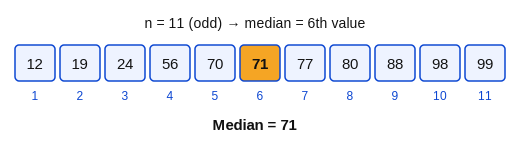
Concept: Arrange in order; for odd n the median is the (n+12)th value.

  1. Ascending: 12, 19, 24, 56, 70, 71, 77, 80, 88, 98, 99.
  2. n=11, so median = 6th value.
  3. 6th value =71.

Trick: Odd count → no averaging needed; options 70.5 and 71.5 are traps.

Answer: (A) 71

अवधारणा: आँकड़ों को क्रम में लगाएँ; विषम n पर माध्यिका (n+12)th पद है।

  1. आरोही क्रम: 12, 19, 24, 56, 70, 71, 77, 80, 88, 98, 99।
  2. n=11, अतः माध्यिका = छठा पद।
  3. छठा पद =71।

ट्रिक: विषम संख्या → औसत लेने की ज़रूरत नहीं; 70.5 और 71.5 जाल हैं।

उत्तर: (A) 71

RRB NTPC Graduate CBT 1MathematicsStatistics – medianRRB NTPC Graduate CBT 1 2024 · 20 Jun Shift 2 →