Question bank

Q&A: practice questions with answers

Search questions on any topic. Filter by exam category, exam, subject and topic, try the question, then open the answer and explanation.

Courses – airGurukul

20,719 questions found.

Q7481.
The product of two numbers x and y is 45 and their sum is 14. Find the sum of their cubes.
दो संख्याओं x और y का गुणनफल 45 है और उनका योग 14 है। उनके घनों का योग ज्ञात कीजिए।
  1. A675
  2. B586
  3. C854
  4. D759
Show answer

Concept: x3+y3=(x+y)3−3xy(x+y).

  1. (x+y)3=143=2744.
  2. 3xy(x+y)=3×45×14=1890.
  3. x3+y3=2744−1890=854.

Trick: Here x=9, y=5: 729+125=854.

Answer: (C) 854

अवधारणा: x3+y3=(x+y)3−3xy(x+y)।

  1. (x+y)3=143=2744।
  2. 3xy(x+y)=3×45×14=1890।
  3. x3+y3=2744−1890=854।

ट्रिक: यहाँ x=9, y=5: 729+125=854।

उत्तर: (C) 854

RRB NTPC Graduate CBT 1MathematicsAlgebraic identitiesRRB NTPC Graduate CBT 1 2024 · 20 Jun Shift 2 →
Q7482.
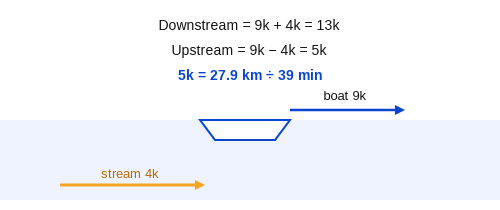
A boat takes 39 minutes to go 27.9 km upstream. The ratio of the speed of the boat in still water to that of the stream is 9 : 4. How much total time (in hours) will the boat take to go 18.9 km upstream and 51.3 km downstream?
एक नाव को धारा के प्रतिकूल 27.9 km जाने में 39 मिनट लगते हैं। शांत जल में नाव की चाल और धारा की चाल का अनुपात 9 : 4 है। नाव को धारा के प्रतिकूल 18.9 km और धारा के अनुकूल 51.3 km जाने में कुल कितना समय (घंटों में) लगेगा?
  1. A4.3
  2. B0.9
  3. C2.6
  4. D1.9
Show answer

Concept: Upstream =B−S, Downstream =B+S.

  1. B=9k, S=4k → upstream 5k, downstream 13k.
  2. 5k=27.939×60=167439km/h, so 13k=167415=111.6km/h.
  3. Upstream time =18.9×391674≈0.44 h; downstream =51.3111.6≈0.46 h.
  4. Total =0.9 hours.

Trick: In minutes: upstream 18.927.9×39=26.4 min; downstream =26.4×51.318.9×513=27.6 min; total 54 min =0.9 h.

Answer: (B) 0.9

अवधारणा: ऊर्ध्वप्रवाह (upstream) =B−S, अनुप्रवाह (downstream) =B+S।

  1. B=9k, S=4k → ऊर्ध्वप्रवाह 5k, अनुप्रवाह 13k।
  2. 5k=27.939×60=167439km/h, अतः 13k=167415=111.6km/h।
  3. ऊर्ध्वप्रवाह समय =18.9×391674≈0.44 घंटा; अनुप्रवाह =51.3111.6≈0.46 घंटा।
  4. कुल =0.9 घंटा।

ट्रिक: मिनट में: ऊर्ध्वप्रवाह 18.927.9×39=26.4 मिनट; अनुप्रवाह =26.4×51.318.9×513=27.6 मिनट; कुल 54 मिनट =0.9 घंटा।

उत्तर: (B) 0.9

RRB NTPC Graduate CBT 1MathematicsBoats and streamsRRB NTPC Graduate CBT 1 2024 · 20 Jun Shift 2 →
Q7483.
If the average of 6 consecutive odd numbers is 30, the difference between the largest and the smallest numbers is:
यदि 6 क्रमागत विषम संख्याओं का औसत 30 है, तो सबसे बड़ी और सबसे छोटी संख्या के बीच का अंतर है:
  1. A15
  2. B16
  3. C10
  4. D18
Show answer

Concept: Consecutive odd numbers differ by 2; for n such numbers, largest − smallest =2(n−1).

  1. Average =30, so the six numbers are 25,27,29,31,33,35 (centred on 30).
  2. Largest − smallest =35−25=10.
  3. Check with formula: 2(6−1)=10.

Trick: The average is not even needed: difference =2(n−1) for consecutive odd/even numbers.

Answer: (C) 10

अवधारणा: क्रमागत विषम संख्याओं में अंतर 2 होता है; n संख्याओं के लिए सबसे बड़ी − सबसे छोटी =2(n−1).

  1. औसत =30, अतः छह संख्याएँ 25,27,29,31,33,35 हैं।
  2. सबसे बड़ी − सबसे छोटी =35−25=10.
  3. सूत्र से जाँच: 2(6−1)=10.

ट्रिक: औसत की ज़रूरत ही नहीं: क्रमागत विषम/सम संख्याओं में अंतर =2(n−1).

उत्तर: (C) 10

RRB NTPC Graduate CBT 1MathematicsAverage of Consecutive NumbersRRB NTPC Graduate CBT 1 2024 · 20 Jun Shift 2 →
Q7484.
A bag contains 50 Paisa, 25 Paisa and 10 Paisa coins in the ratio 16 : 8 : 20, amounting to ₹384. Find the number of 10 Paisa coins.
एक थैले में 50 पैसे, 25 पैसे और 10 पैसे के सिक्के 16 : 8 : 20 के अनुपात में हैं, जिनकी कुल राशि ₹384 है। 10 पैसे के सिक्कों की संख्या ज्ञात कीजिए।
  1. A660
  2. B668
  3. C640
  4. D696
Show answer

Concept: Convert the ratio of number of coins into a ratio of values, then find one unit.

  1. Let coins be 16k,8k,20k.
  2. Value in ₹: 16k×0.5+8k×0.25+20k×0.1=8k+2k+2k=12k.
  3. 12k=384⇒k=32.
  4. Number of 10 paisa coins =20×32=640.

Trick: Value ratio =8:2:2 (12 parts = ₹384, 1 part = ₹32); 10 paisa share = ₹64, so coins =640.1=640.

Answer: (C) 640

अवधारणा: सिक्कों की संख्या के अनुपात को मूल्य के अनुपात में बदलें, फिर एक इकाई निकालें।

  1. सिक्के 16k,8k,20k मानें।
  2. मूल्य (₹): 16k×0.5+8k×0.25+20k×0.1=12k.
  3. 12k=384⇒k=32.
  4. 10 पैसे के सिक्के =20×32=640.

ट्रिक: प्रत्येक प्रकार का मूल्य-अंश निकालकर जोड़ें; कुल से k तुरंत मिल जाता है।

उत्तर: (C) 640

RRB NTPC Graduate CBT 1MathematicsCoins and RatioRRB NTPC Graduate CBT 1 2024 · 20 Jun Shift 2 →
Q7485.
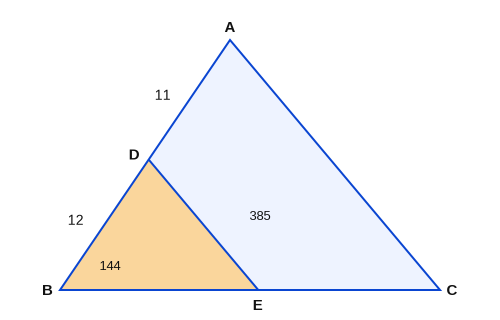
In △ABC, DE∥AC, where D and E are the points on sides AB and BC, respectively.
If BD = 12 cm and AD = 11 cm, then what is the ratio of the area of △BDE to that of the trapezium ADEC?
△ABC में, DE∥AC है, जहाँ D और E क्रमशः भुजाओं AB और BC पर स्थित बिंदु हैं।
यदि BD = 12 cm और AD = 11 cm है, तो △BDE के क्षेत्रफल और समलंब ADEC के क्षेत्रफल का अनुपात क्या है?
  1. A623 : 199
  2. B385 : 144
  3. C390 : 413
  4. D144 : 385
Show answer

Concept: If DE∥AC, then △BDE~△BAC and the ratio of areas = (ratio of sides)2.

  1. BA=BD+DA=12+11=23cm.
  2. ar(BDE)ar(BAC)=(1223)2=144529.
  3. Trapezium ADEC=529−144=385 parts.
  4. Required ratio =144:385.

Trick: Small triangle : trapezium =a2:(b2−a2) where a=BD, b=BA.

Answer: (D) 144:385

अवधारणा: यदि DE∥AC हो, तो △BDE~△BAC और क्षेत्रफलों का अनुपात = (भुजाओं का अनुपात)2.

  1. BA=BD+DA=12+11=23cm.
  2. ar(BDE)ar(BAC)=(1223)2=144529.
  3. समलंब ADEC=529−144=385 भाग।
  4. अभीष्ट अनुपात =144:385.

ट्रिक: छोटा त्रिभुज : समलंब =a2:(b2−a2), जहाँ a=BD, b=BA.

उत्तर: (D) 144:385

RRB NTPC Graduate CBT 1MathematicsSimilar Triangles – Area RatioRRB NTPC Graduate CBT 1 2024 · 20 Jun Shift 2 →
Q7486.
If a sum of ₹6,70,000 is invested for a year at 2% per annum compounded half yearly, then find the compound interest.
यदि ₹6,70,000 की राशि को 2% वार्षिक दर पर अर्धवार्षिक रूप से संयोजित चक्रवृद्धि ब्याज पर एक वर्ष के लिए निवेश किया जाता है, तो चक्रवृद्धि ब्याज ज्ञात कीजिए।
  1. A₹12,805
  2. B₹13,467
  3. C₹11,545
  4. D₹13,630
Show answer

Concept: For half-yearly compounding, rate is halved and time (in periods) is doubled: CI=P[(1+r100)n−1].

  1. Rate per half-year =22=1%, periods =2.
  2. (1.01)2−1=0.0201.
  3. CI=670000×0.0201=13467.

Trick: For 2 periods at r%, effective rate =2r+r2100=2.01%.

Answer: (B) ₹13,467

अवधारणा: अर्धवार्षिक चक्रवृद्धि में दर आधी और समय (अवधियाँ) दुगुना होता है: CI=P[(1+r100)n−1].

  1. प्रति छमाही दर =22=1%, अवधियाँ =2.
  2. (1.01)2−1=0.0201.
  3. CI=670000×0.0201=13467.

ट्रिक: 2 अवधियों के लिए प्रभावी दर =2r+r2100=2.01%.

उत्तर: (B) ₹13,467

RRB NTPC Graduate CBT 1MathematicsCompound Interest (Half-yearly)RRB NTPC Graduate CBT 1 2024 · 20 Jun Shift 2 →
Q7487.
The average of 10 observations is 40. It was realised later that an observation was misread as 32 in place of 43. Find the correct average.
10 प्रेक्षणों का औसत 40 है। बाद में ज्ञात हुआ कि एक प्रेक्षण को 43 के स्थान पर गलती से 32 पढ़ लिया गया था। सही औसत ज्ञात कीजिए।
  1. A44.1
  2. B41.1
  3. C42.1
  4. D40.1
Show answer

Concept: Correct sum = wrong sum − wrong value + correct value.

  1. Wrong sum =10×40=400.
  2. Correct sum =400−32+43=411.
  3. Correct average =41110=41.1.

Trick: Change in average =43−3210=1.1, so 40+1.1=41.1.

Answer: (B) 41.1

अवधारणा: सही योग = गलत योग − गलत मान + सही मान।

  1. गलत योग =10×40=400.
  2. सही योग =400−32+43=411.
  3. सही औसत =41110=41.1.

ट्रिक: औसत में परिवर्तन =43−3210=1.1, अतः 40+1.1=41.1.

उत्तर: (B) 41.1

RRB NTPC Graduate CBT 1MathematicsAverage – CorrectionRRB NTPC Graduate CBT 1 2024 · 20 Jun Shift 2 →
Q7488.
If a + b = 24 and (a − b)2 = 268, find the value of product of a and b.
यदि a + b = 24 और (a − b)2 = 268 है, तो a और b के गुणनफल का मान ज्ञात कीजिए।
  1. A77
  2. B110
  3. C68
  4. D140
Show answer

Concept: (a+b)2−(a−b)2=4ab.

  1. (a+b)2=242=576.
  2. 4ab=576−268=308.
  3. ab=3084=77.

Trick: Product =(sum)2−(difference)24.

Answer: (A) 77

अवधारणा: (a+b)2−(a−b)2=4ab.

  1. (a+b)2=242=576.
  2. 4ab=576−268=308.
  3. ab=3084=77.

ट्रिक: गुणनफल =(योग)2−(अंतर)24.

उत्तर: (A) 77

RRB NTPC Graduate CBT 1MathematicsAlgebraic IdentitiesRRB NTPC Graduate CBT 1 2024 · 20 Jun Shift 2 →
Q7489.
If a : b :: b : c; c = 4a and b = 18, find the positive value of c.
यदि a : b :: b : c; c = 4a और b = 18 है, तो c का धनात्मक मान ज्ञात कीजिए।
  1. A36
  2. B34
  3. C38
  4. D31
Show answer

Concept: If a:b::b:c, then b2=ac.

  1. b2=a×4a=4a2⇒b=2a.
  2. 18=2a⇒a=9.
  3. c=4a=36.

Trick: c=4a means b=2a and c=2b – directly c=2×18=36.

Answer: (A) 36

अवधारणा: यदि a:b::b:c हो, तो b2=ac.

  1. b2=a×4a=4a2⇒b=2a.
  2. 18=2a⇒a=9.
  3. c=4a=36.

ट्रिक: c=4a हो तो सामान्य अनुपात 2 है, अतः c=2b=2×18=36.

उत्तर: (A) 36

RRB NTPC Graduate CBT 1MathematicsMean ProportionalRRB NTPC Graduate CBT 1 2024 · 20 Jun Shift 2 →
Q7490.
Find the simple interest (in closest integral ₹) on ₹3,000 at 6% per annum rate of interest for the period from 9 February 2024 to 10 April 2024.
₹3,000 पर 6% वार्षिक ब्याज दर से 9 फ़रवरी 2024 से 10 अप्रैल 2024 तक की अवधि के लिए साधारण ब्याज (निकटतम पूर्णांक ₹ में) ज्ञात कीजिए।
  1. A29
  2. B28
  3. C30
  4. D31
Show answer

Concept: Count days (exclude the first day, include the last) and use SI=P×R×T100 with T in years.

  1. 2024 is a leap year: February days after 9th =29−9=20, March =31, April =10; total =61 days.
  2. T=61366 year.
  3. SI=3000×6×61100×366=10980366=30.

Trick: Note 366=6×61, so 61366=16 year → SI=3000×6100×6=30.

Answer: (C) ₹30

अवधारणा: दिन गिनें (पहला दिन छोड़ें, अंतिम दिन जोड़ें) और SI=P×R×T100 लगाएँ, T वर्षों में।

  1. 2024 लीप वर्ष है: फ़रवरी में 9 के बाद =29−9=20, मार्च =31, अप्रैल =10; कुल =61 दिन।
  2. T=61366 वर्ष।
  3. SI=3000×6×61100×366=30.

ट्रिक: 366=6×61, अतः 61366=16 वर्ष → SI=30.

उत्तर: (C) ₹30

RRB NTPC Graduate CBT 1MathematicsSimple Interest – DaysRRB NTPC Graduate CBT 1 2024 · 20 Jun Shift 2 →
Q7491.
The present cost of a house is ₹1,23,016. After a year, its cost will increase to ₹1,40,203. The percentage increase (rounded off to the nearest integer) in the cost of the house is:
एक मकान का वर्तमान मूल्य ₹1,23,016 है। एक वर्ष बाद, इसका मूल्य बढ़कर ₹1,40,203 हो जाएगा। मकान के मूल्य में प्रतिशत वृद्धि (निकटतम पूर्णांक तक पूर्णांकित) है:
  1. A10%
  2. B14%
  3. C8%
  4. D17%
Show answer

Concept: Increase%=New−OldOld×100.

  1. Increase =140203−123016=17187.
  2. 17187123016×100≈13.97%.
  3. Rounded to the nearest integer =14%.

Trick: 10% of 123016 ≈ 12302, 4% ≈ 4921; together ≈ 17223 – very close to 17187, so ≈ 14%.

Answer: (B) 14%

अवधारणा: वृद्धि%=नया−पुरानापुराना×100.

  1. वृद्धि =140203−123016=17187.
  2. 17187123016×100≈13.97%.
  3. निकटतम पूर्णांक =14%.

ट्रिक: 123016 का 10% ≈ 12302, 4% ≈ 4921; योग ≈ 17223 – 17187 के बहुत पास, अतः ≈ 14%.

उत्तर: (B) 14%

RRB NTPC Graduate CBT 1MathematicsPercentage IncreaseRRB NTPC Graduate CBT 1 2024 · 20 Jun Shift 2 →
Q7492.
The successive discounts of 28%, 20% and 10% are equivalent to a single discount of:
28%, 20% और 10% की क्रमिक छूटें किस एकल छूट के समतुल्य हैं?
  1. A50.59%
  2. B48.16%
  3. C46.1%
  4. D46.69%
Show answer

Concept: Single equivalent discount =100− final price when the marked price is 100.

  1. After 28%: 100×0.72=72.
  2. After 20%: 72×0.8=57.6.
  3. After 10%: 57.6×0.9=51.84.
  4. Single discount =100−51.84=48.16%.

Trick: For two discounts use a+b−ab100: 28,20→42.4; then 42.4,10→42.4+10−4.24=48.16.

Answer: (B) 48.16%

अवधारणा: अंकित मूल्य 100 मानें; एकल समतुल्य छूट =100− अंतिम मूल्य।

  1. 28% के बाद: 100×0.72=72.
  2. 20% के बाद: 72×0.8=57.6.
  3. 10% के बाद: 57.6×0.9=51.84.
  4. एकल छूट =100−51.84=48.16%.

ट्रिक: दो छूटों के लिए a+b−ab100: 28,20→42.4; फिर 42.4,10→48.16.

उत्तर: (B) 48.16%

RRB NTPC Graduate CBT 1MathematicsSuccessive DiscountsRRB NTPC Graduate CBT 1 2024 · 20 Jun Shift 2 →
Q7493.
A woman travelled at a speed of 20 m/min for 80 min, and at a speed of 65 m/min for 64 min. Her average speed (in m/min) is:
एक महिला ने 80 मिनट तक 20 m/min की चाल से और 64 मिनट तक 65 m/min की चाल से यात्रा की। उसकी औसत चाल (m/min में) है:
  1. A40
  2. B44
  3. C46
  4. D33
Show answer

Concept: Average speed=Total distanceTotal time.

  1. Distance 1 =20×80=1600m; distance 2 =65×64=4160m.
  2. Total distance =5760m; total time =144min.
  3. Average speed =5760144=40m/min.

Trick: Never average the two speeds directly unless the times are equal.

Answer: (A) 40

अवधारणा: औसत चाल=कुल दूरीकुल समय.

  1. दूरी 1 =20×80=1600m; दूरी 2 =65×64=4160m.
  2. कुल दूरी =5760m; कुल समय =144min.
  3. औसत चाल =5760144=40m/min.

ट्रिक: समय बराबर न हो तो दोनों चालों का सीधा औसत कभी न लें।

उत्तर: (A) 40

RRB NTPC Graduate CBT 1MathematicsAverage SpeedRRB NTPC Graduate CBT 1 2024 · 20 Jun Shift 2 →
Q7494.
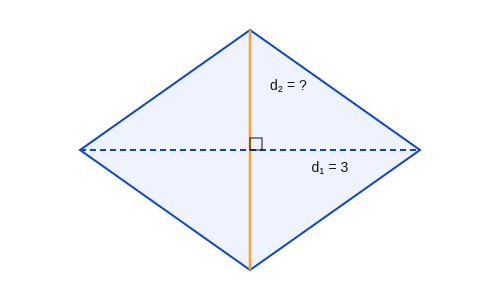
The diagonals of a quadrilateral are perpendicular bisectors of each other. If the length of one diagonal is 3 cm and the area of the quadrilateral is 180 cm2, find the length (in cm) of the other diagonal.
एक चतुर्भुज के विकर्ण एक-दूसरे के लंब समद्विभाजक हैं। यदि एक विकर्ण की लंबाई 3 cm है और चतुर्भुज का क्षेत्रफल 180 cm2 है, तो दूसरे विकर्ण की लंबाई (cm में) ज्ञात कीजिए।
  1. A128
  2. B120
  3. C115
  4. D112
Show answer

Concept: A quadrilateral whose diagonals are perpendicular bisectors of each other is a rhombus; Area=12d1d2.

  1. 180=12×3×d2.
  2. d2=3603=120cm.

Trick: Product of diagonals =2× area =360, so other diagonal =3603.

Answer: (B) 120

अवधारणा: जिस चतुर्भुज के विकर्ण एक-दूसरे के लंब समद्विभाजक हों वह समचतुर्भुज है; क्षेत्रफल=12d1d2.

  1. 180=12×3×d2.
  2. d2=3603=120cm.

ट्रिक: विकर्णों का गुणनफल =2× क्षेत्रफल =360.

उत्तर: (B) 120

RRB NTPC Graduate CBT 1MathematicsRhombus – AreaRRB NTPC Graduate CBT 1 2024 · 20 Jun Shift 2 →
Q7495.
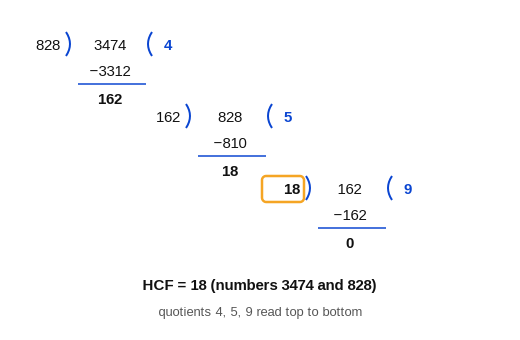
In finding the HCF of two numbers by division method, the quotients are 4, 5, and 9, respectively, and the last divisor is 18. What is the LCM of the two numbers?
भाग विधि द्वारा दो संख्याओं का HCF ज्ञात करने में, भागफल क्रमशः 4, 5 और 9 हैं, और अंतिम भाजक 18 है। दोनों संख्याओं का LCM क्या है?
  1. A159806
  2. B159807
  3. C159804
  4. D159803
Show answer

Concept: In the division method the last divisor is the HCF; rebuild the numbers backwards using dividend = divisor × quotient + remainder. Then LCM=a×bHCF.

  1. Last step: divisor 18, quotient 9, remainder 0 → dividend =18×9=162.
  2. Middle step: divisor 162, quotient 5, remainder 18 → dividend =162×5+18=828.
  3. First step: divisor 828, quotient 4, remainder 162 → dividend =828×4+162=3474.
  4. Numbers 3474 and 828; LCM=3474×82818=3474×46=159804.

Trick: The LCM must be divisible by the HCF 18: only 159804 is even with digit sum 27.

Answer: (C) 159804

अवधारणा: विभाजन विधि में अंतिम भाजक ही HCF होता है; भाज्य = भाजक × भागफल + शेषफल से पीछे की ओर संख्याएँ बनाएँ। फिर LCM=a×bHCF.

  1. अंतिम चरण: भाजक 18, भागफल 9, शेष 0 → भाज्य =18×9=162.
  2. बीच का चरण: भाजक 162, भागफल 5, शेष 18 → भाज्य =162×5+18=828.
  3. पहला चरण: भाजक 828, भागफल 4, शेष 162 → भाज्य =828×4+162=3474.
  4. संख्याएँ 3474 और 828; LCM=3474×82818=159804.

ट्रिक: LCM, HCF 18 से विभाज्य होना चाहिए: केवल 159804 (सम, अंकों का योग 27) ऐसा है।

उत्तर: (C) 159804

RRB NTPC Graduate CBT 1MathematicsHCF by Division MethodRRB NTPC Graduate CBT 1 2024 · 20 Jun Shift 2 →
Q7496.
If 2 is added to each even digit and 2 is added to each odd digit in the number 4713562, what will be the sum of the last two and first two digits in the new number thus formed?
यदि संख्या 4713562 में प्रत्येक सम अंक में 2 जोड़ा जाए और प्रत्येक विषम अंक में 2 जोड़ा जाए, तो इस प्रकार बनी नई संख्या के अंतिम दो और पहले दो अंकों का योग क्या होगा?
  1. A23
  2. B27
  3. C29
  4. D25
Show answer

Concept: Every digit (even or odd) gets +2.

  1. 4713562→6935784 (each digit +2).
  2. First two digits: 6+9=15; last two digits: 8+4=12.
  3. Sum =15+12=27.

Trick: Since both even and odd digits get +2, simply add 2 to every digit.

Answer: (B) 27

अवधारणा: हर अंक (सम या विषम) में +2 जोड़ना है।

  1. 4713562→6935784 (हर अंक +2)।
  2. पहले दो अंक: 6+9=15; अंतिम दो अंक: 8+4=12।
  3. योग =15+12=27।

ट्रिक: सम और विषम दोनों में +2 है, तो सीधे हर अंक में 2 जोड़ दें।

उत्तर: (B) 27

RRB NTPC Graduate CBT 1General Intelligence and ReasoningNumber operationsRRB NTPC Graduate CBT 1 2024 · 20 Jun Shift 2 →
Q7497.
Select the pair which follows the same pattern as that followed by the two set of pairs given below. Both pairs follow the same pattern.
PNQ : QQO
UQR : VTP
उस युग्म का चयन कीजिए जो उसी पैटर्न का अनुसरण करता है, जिसका अनुसरण नीचे दिए गए दो युग्म करते हैं। दोनों युग्म समान पैटर्न का अनुसरण करते हैं।
PNQ : QQO
UQR : VTP
  1. AOHM : PKK
  2. BVHQ : WKN
  3. CQSX : RUV
  4. DUCT : VFS
Show answer

Concept: Compare letter positions: 1st, 2nd and 3rd letters change by fixed amounts.

  1. PNQ → QQO: P+1=Q, N+3=Q, Q−2=O.
  2. UQR → VTP: U+1=V, Q+3=T, R−2=P.
  3. OHM: O+1=P, H+3=K, M−2=K → PKK ✔.

Trick: Pattern (+1,+3,−2) — check only the option whose third letter fits first.

Answer: (A) OHM : PKK

अवधारणा: अक्षरों के स्थानों की तुलना करें: तीनों अक्षर निश्चित अंतर से बदलते हैं।

  1. PNQ → QQO: P+1=Q, N+3=Q, Q−2=O।
  2. UQR → VTP: U+1=V, Q+3=T, R−2=P।
  3. OHM: O+1=P, H+3=K, M−2=K → PKK ✔।

ट्रिक: पैटर्न (+1,+3,−2) — विकल्पों में यही जाँचें।

उत्तर: (A) OHM : PKK

RRB NTPC Graduate CBT 1General Intelligence and ReasoningLetter analogyRRB NTPC Graduate CBT 1 2024 · 20 Jun Shift 2 →
Q7498.
Select the pair that follows the same pattern as that followed by the two pairs given below. Both pairs follow the same pattern.
MWC : JYA
KUR : HWP
उस युग्म का चयन कीजिए जो उसी पैटर्न का अनुसरण करता है, जिसका अनुसरण नीचे दिए गए दो युग्म करते हैं। दोनों युग्म समान पैटर्न का अनुसरण करते हैं।
MWC : JYA
KUR : HWP
  1. APAY : MGT
  2. BWTH : PUR
  3. CJVP : GXN
  4. DSLV : QPS
Show answer

Concept: Find the change in each letter position.

  1. MWC → JYA: M−3=J, W+2=Y, C−2=A.
  2. KUR → HWP: K−3=H, U+2=W, R−2=P.
  3. JVP: J−3=G, V+2=X, P−2=N → GXN ✔.

Trick: Pattern (−3,+2,−2).

Answer: (C) JVP : GXN

अवधारणा: हर अक्षर के स्थान में परिवर्तन देखें।

  1. MWC → JYA: M−3=J, W+2=Y, C−2=A।
  2. KUR → HWP: K−3=H, U+2=W, R−2=P।
  3. JVP: J−3=G, V+2=X, P−2=N → GXN ✔।

ट्रिक: पैटर्न (−3,+2,−2)।

उत्तर: (C) JVP : GXN

RRB NTPC Graduate CBT 1General Intelligence and ReasoningLetter analogyRRB NTPC Graduate CBT 1 2024 · 20 Jun Shift 2 →
Q7499.
What should come in place of the question mark (?) in the given series?
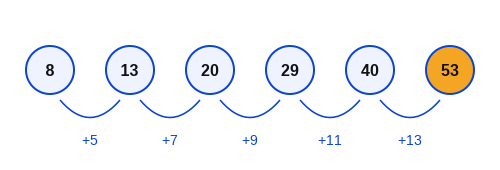
8 13 20 29 40 ?
दी गई श्रृंखला में प्रश्नचिह्न (?) के स्थान पर क्या आना चाहिए?
8 13 20 29 40 ?
  1. A65
  2. B61
  3. C53
  4. D57
Show answer

Concept: Check the differences between consecutive terms.

  1. Differences: 5,7,9,11 — consecutive odd numbers.
  2. Next difference =13.
  3. 40+13=53.

Trick: Terms are n2+4: 4+4,9+4,16+4,25+4,36+4,49+4=53.

Answer: (C) 53

अवधारणा: क्रमागत पदों का अंतर देखें।

  1. अंतर: 5,7,9,11 — क्रमागत विषम संख्याएँ।
  2. अगला अंतर =13।
  3. 40+13=53।

ट्रिक: पद n2+4 हैं: 4+4,9+4,16+4,25+4,36+4,49+4=53।

उत्तर: (C) 53

RRB NTPC Graduate CBT 1General Intelligence and ReasoningNumber seriesRRB NTPC Graduate CBT 1 2024 · 20 Jun Shift 2 →
Q7500.
Refer to the following number and symbol series and answer the question that follows. Counting to be done from left to right only.
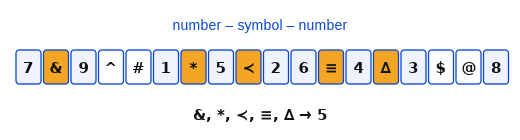
(Left) 7 & 9 ^ # 1 * 5 ≺ 2 6 ≡ 4 ∆ 3 $ @ 8 (Right)
How many such symbols are there, each of which is immediately preceded by a number and also immediately followed by another number?
निम्नलिखित संख्या और प्रतीक श्रृंखला को देखिए और उसके बाद दिए गए प्रश्न का उत्तर दीजिए। गिनती केवल बाएँ से दाएँ की जानी है।
(बाएँ) 7 & 9 ^ # 1 * 5 ≺ 2 6 ≡ 4 ∆ 3 $ @ 8 (दाएँ)
ऐसे कितने प्रतीक हैं, जिनमें से प्रत्येक के ठीक पहले एक संख्या है और ठीक बाद में भी एक अन्य संख्या है?
  1. AThreeतीन
  2. BOneएक
  3. CMore than threeतीन से अधिक
  4. DTwoदो
Show answer

Concept: Look for the pattern number – symbol – number.

  1. 7 & 9 ✔, 1 * 5 ✔, 5 ≺ 2 ✔, 6 ≡ 4 ✔, 4 ∆ 3 ✔.
  2. ^ (9 ^ #), # , $ (3 $ @) and @ fail.
  3. Count =5, i.e. more than three.

Trick: Scan the series once, marking each symbol that sits between two numbers.

Answer: (C) More than three

अवधारणा: संख्या – प्रतीक – संख्या का पैटर्न खोजें।

  1. 7 & 9 ✔, 1 * 5 ✔, 5 ≺ 2 ✔, 6 ≡ 4 ✔, 4 ∆ 3 ✔।
  2. ^ (9 ^ #), #, $ (3 $ @) और @ शर्त पूरी नहीं करते।
  3. कुल =5, अर्थात तीन से अधिक।

ट्रिक: श्रृंखला को एक बार देखें और दो संख्याओं के बीच वाले प्रतीक गिनें।

उत्तर: (C) तीन से अधिक

RRB NTPC Graduate CBT 1General Intelligence and ReasoningSymbol-number seriesRRB NTPC Graduate CBT 1 2024 · 20 Jun Shift 2 →