Question bank

Q&A: practice questions with answers

Search questions on any topic. Filter by exam category, exam, subject and topic, try the question, then open the answer and explanation.

Courses – airGurukul

20,719 questions found.

Q7881.
Four numbers are in the ratio of 11 : 19 : 5 : 7 respectively. If the sum of these four numbers is 2289, then what is the sum of the first and the third number?
चार संख्याएँ क्रमशः 11 : 19 : 5 : 7 के अनुपात में हैं। यदि इन चारों संख्याओं का योग 2289 है, तो पहली और तीसरी संख्या का योग क्या है?
  1. A872
  2. B848
  3. C816
  4. D887
Show answer

Concept: Share of a total in a ratio = (its parts ÷ total parts) × total.

  1. Total parts =11+19+5+7=42.
  2. One part =228942=54.5.
  3. First + third =(11+5)×54.5=16×54.5=872.

Trick: 1642×2289=821×2289=8×109=872.

Answer: (A) 872

अवधारणा: अनुपात में भाग = (उसके भाग ÷ कुल भाग) × कुल योग।

  1. कुल भाग =11+19+5+7=42।
  2. एक भाग =228942=54.5।
  3. पहली + तीसरी संख्या =(11+5)×54.5=16×54.5=872।

ट्रिक: 1642×2289=821×2289=8×109=872।

उत्तर: (A) 872

RRB NTPC Graduate CBT 1MathematicsRatio and proportionRRB NTPC Graduate CBT 1 2024 · 19 Jun Shift 1 →
Q7882.
Simplify: [(28÷39)×{6÷2×18−26}]÷{8×6÷3}
सरल कीजिए: [(28÷39)×{6÷2×18−26}]÷{8×6÷3}
  1. A63
  2. B84
  3. C42
  4. D104
Show answer

Concept: BODMAS – solve the innermost brackets first, then ÷ and × from left to right.

  1. 28÷39=28×3=84.
  2. 6÷2×18−26=3×166=8.
  3. 84×8=672.
  4. 8×6÷3=16, so 672÷16=42.

Trick: 39=13, so dividing by it means multiplying by 3.

Answer: (C) 42

अवधारणा: BODMAS – पहले अंदर के कोष्ठक, फिर ÷ और × बाएँ से दाएँ।

  1. 28÷39=28×3=84।
  2. 6÷2×18−26=3×166=8।
  3. 84×8=672।
  4. 8×6÷3=16, अतः 672÷16=42।

ट्रिक: 39=13, इससे भाग देना यानी 3 से गुणा करना।

उत्तर: (C) 42

RRB NTPC Graduate CBT 1MathematicsSimplification (BODMAS)RRB NTPC Graduate CBT 1 2024 · 19 Jun Shift 1 →
Q7883.
A shop sells candles in two packs: Pack A: 5 candles at ₹4 each and Pack B: 5 candles at ₹6 each. What is the average price per candle?
एक दुकान मोमबत्तियों को दो पैकों में बेचती है: पैक A: ₹4 प्रति मोमबत्ती की दर से 5 मोमबत्तियाँ और पैक B: ₹6 प्रति मोमबत्ती की दर से 5 मोमबत्तियाँ। प्रति मोमबत्ती औसत मूल्य क्या है?
  1. A₹6
  2. B₹5
  3. C₹5.5
  4. D₹4
Show answer

Concept: Average price = total cost ÷ total number of candles.

  1. Pack A: 5×4= ₹20; Pack B: 5×6= ₹30.
  2. Total = ₹50 for 10 candles.
  3. Average =5010= ₹5.

Trick: Equal quantities ⇒ simple average of prices: 4+62=5.

Answer: (B) ₹5

अवधारणा: औसत मूल्य = कुल लागत ÷ कुल मोमबत्तियाँ।

  1. पैक A: 5×4= ₹20; पैक B: 5×6= ₹30।
  2. कुल = ₹50, 10 मोमबत्तियों के लिए।
  3. औसत =5010= ₹5।

ट्रिक: मात्राएँ बराबर हों तो मूल्यों का सीधा औसत: 4+62=5।

उत्तर: (B) ₹5

RRB NTPC Graduate CBT 1MathematicsAverageRRB NTPC Graduate CBT 1 2024 · 19 Jun Shift 1 →
Q7884.
The average age of Amit, Arjun and Anya is 30 years. If the average age of Amit and Anya is 35 years, what will be Arjun's age after 2 years?
अमित, अर्जुन और अन्या की औसत आयु 30 वर्ष है। यदि अमित और अन्या की औसत आयु 35 वर्ष है, तो 2 वर्ष बाद अर्जुन की आयु क्या होगी?
  1. A30 years30 वर्ष
  2. B24 years24 वर्ष
  3. C22 years22 वर्ष
  4. D28 years28 वर्ष
Show answer

Concept: Sum = average × number of persons.

  1. Amit + Arjun + Anya =3×30=90 years.
  2. Amit + Anya =2×35=70 years.
  3. Arjun =90−70=20 years.
  4. After 2 years: 20+2=22 years.

Trick: Don't stop at 20 – the question asks for age after 2 years.

Answer: (C) 22 years

अवधारणा: योग = औसत × व्यक्तियों की संख्या।

  1. अमित + अर्जुन + अन्या =3×30=90 वर्ष।
  2. अमित + अन्या =2×35=70 वर्ष।
  3. अर्जुन =90−70=20 वर्ष।
  4. 2 वर्ष बाद: 20+2=22 वर्ष।

ट्रिक: 20 पर न रुकें – प्रश्न 2 वर्ष बाद की आयु पूछ रहा है।

उत्तर: (C) 22 वर्ष

RRB NTPC Graduate CBT 1MathematicsAverage – agesRRB NTPC Graduate CBT 1 2024 · 19 Jun Shift 1 →
Q7885.
7362 × 726.8 × 0.709 is equal in value to:
7362 × 726.8 × 0.709 का मान किसके बराबर है?
  1. A736.2 × 726.8 × 709
  2. B7.362 × 7.268 × 709
  3. C7.362 × 72.68 × 70.9
  4. D73.62 × 7268 × 7.09
Show answer

Concept: A product stays the same if the decimal shifts multiply to 1 overall.

  1. Option D: 73.62=7362100 (factor ÷100).
  2. 7268=726.8×10 (factor ×10).
  3. 7.09=0.709×10 (factor ×10).
  4. Net factor =10×10100=1 ⇒ equal value.

Trick: Count total decimal places: original 0+1+3=4; option D 2+0+2=4 with the same digits.

Answer: (D) 73.62×7268×7.09

अवधारणा: दशमलव खिसकाने के कुल गुणक का गुणनफल 1 हो तो मान नहीं बदलता।

  1. विकल्प D: 73.62=7362100 (गुणक ÷100)।
  2. 7268=726.8×10 (गुणक ×10)।
  3. 7.09=0.709×10 (गुणक ×10)।
  4. कुल गुणक =10×10100=1 ⇒ मान बराबर।

ट्रिक: कुल दशमलव स्थान गिनें: मूल 0+1+3=4; विकल्प D 2+0+2=4 (अंक समान)।

उत्तर: (D) 73.62×7268×7.09

RRB NTPC Graduate CBT 1MathematicsDecimalsRRB NTPC Graduate CBT 1 2024 · 19 Jun Shift 1 →
Q7886.
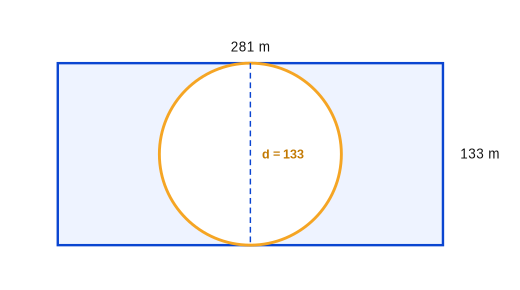
Find the circumference (in m) of the largest circle that can be inscribed in a rectangle whose dimensions are given as 281 m and 133 m.
Take π=227
उस सबसे बड़े वृत्त की परिधि (m में) ज्ञात कीजिए जो एक आयत के अंदर अंकित (inscribed) किया जा सकता है, जिसकी विमाएँ 281 m और 133 m दी गई हैं।
π=227 लीजिए
  1. A411
  2. B416
  3. C418
  4. D428
Show answer

Concept: The largest circle inside a rectangle has diameter equal to the shorter side.

  1. Shorter side =133 m, so diameter d=133 m.
  2. Circumference =πd=227×133.
  3. =22×19=418 m.

Trick: 133=7×19 – the 7 cancels at once.

Answer: (C) 418

अवधारणा: आयत के अंदर सबसे बड़े वृत्त का व्यास छोटी भुजा के बराबर होता है।

  1. छोटी भुजा =133 m, अतः व्यास d=133 m।
  2. परिधि =πd=227×133।
  3. =22×19=418 m।

ट्रिक: 133=7×19 – 7 तुरंत कट जाता है।

उत्तर: (C) 418

RRB NTPC Graduate CBT 1MathematicsMensuration – circleRRB NTPC Graduate CBT 1 2024 · 19 Jun Shift 1 →
Q7887.
A dealer purchased a ceiling fan for ₹66,000. He allows a discount of 56% on its marked price and still gains 69%. Find the marked price of the ceiling fan.
एक व्यापारी ने एक छत का पंखा ₹66,000 में खरीदा। वह इसके अंकित मूल्य पर 56% की छूट देता है और फिर भी 69% लाभ प्राप्त करता है। छत के पंखे का अंकित मूल्य ज्ञात कीजिए।
  1. A₹2,53,597
  2. B₹2,53,394
  3. C₹2,53,426
  4. D₹2,53,500
Show answer

Concept: SP=CP×100+gain%100 and SP=MP×100−discount%100.

  1. SP =66000×169100= ₹1,11,540.
  2. MP×44100=111540.
  3. MP =111540×10044= ₹2,53,500.

Trick: MP=CP×16944=66000×16944=1500×169=253500.

Answer: (D) ₹2,53,500

अवधारणा: SP=CP×100+लाभ%100 तथा SP=MP×100−बट्टा%100।

  1. विक्रय मूल्य =66000×169100= ₹1,11,540।
  2. MP×44100=111540।
  3. अंकित मूल्य =111540×10044= ₹2,53,500।

ट्रिक: MP=CP×16944=66000×16944=1500×169=253500।

उत्तर: (D) ₹2,53,500

RRB NTPC Graduate CBT 1MathematicsProfit, loss and discountRRB NTPC Graduate CBT 1 2024 · 19 Jun Shift 1 →
Q7888.
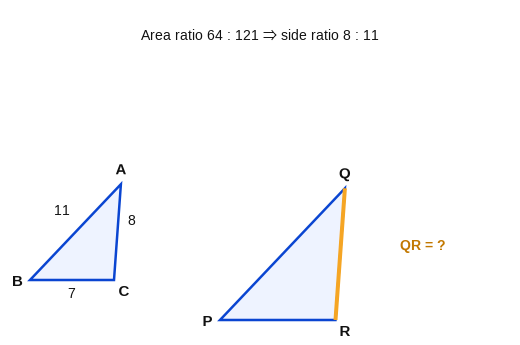
Let △ABC~△QPR and ar(△ABC)ar(△PQR)=64121. If AB = 11 cm, BC = 7 cm and AC = 8 cm, then QR (in cm) is equal to:
माना △ABC~△QPR और ar(△ABC)ar(△PQR)=64121 है। यदि AB = 11 cm, BC = 7 cm और AC = 8 cm है, तो QR (cm में) किसके बराबर है?
  1. A11
  2. B9
  3. C10
  4. D8
Show answer

Concept: For similar triangles, ratio of areas = (ratio of corresponding sides)2.

  1. △ABC~△QPR: A↔Q, B↔P, C↔R, so QR corresponds to AC.
  2. ACQR=64121=811.
  3. 8QR=811⇒QR=11 cm.

Trick: Match letters by position: 1st–3rd of ABC (AC) ↔ 1st–3rd of QPR (QR).

Answer: (A) 11

अवधारणा: समरूप त्रिभुजों में क्षेत्रफलों का अनुपात = (संगत भुजाओं का अनुपात)2।

  1. △ABC~△QPR: A↔Q, B↔P, C↔R, अतः QR की संगत भुजा AC है।
  2. ACQR=64121=811।
  3. 8QR=811⇒QR=11 cm।

ट्रिक: अक्षरों को स्थान से मिलाएँ: ABC का पहला–तीसरा (AC) ↔ QPR का पहला–तीसरा (QR)।

उत्तर: (A) 11

RRB NTPC Graduate CBT 1MathematicsSimilar trianglesRRB NTPC Graduate CBT 1 2024 · 19 Jun Shift 1 →
Q7889.
The present cost of a plot area is ₹1,12,079. After a year, its cost increased to ₹1,89,297. The percentage increase (rounded off to the nearest integer) in the cost of the plot area is:
एक भूखंड की वर्तमान लागत ₹1,12,079 है। एक वर्ष बाद, इसकी लागत बढ़कर ₹1,89,297 हो गई। भूखंड की लागत में प्रतिशत वृद्धि (निकटतम पूर्णांक तक पूर्णांकित) है:
  1. A73%
  2. B67%
  3. C69%
  4. D57%
Show answer

Concept: Increase%=New−OldOld×100.

  1. Increase =189297−112079=77218.
  2. 77218112079×100≈68.9%.
  3. Rounded to the nearest integer: 69%.

Trick: 70% of 112079 ≈ 78455, a bit more than 77218 ⇒ answer just under 70%.

Answer: (C) 69%

अवधारणा: वृद्धि%=नया−पुरानापुराना×100।

  1. वृद्धि =189297−112079=77218।
  2. 77218112079×100≈68.9%।
  3. निकटतम पूर्णांक: 69%।

ट्रिक: 112079 का 70% ≈ 78455, जो 77218 से थोड़ा अधिक ⇒ उत्तर 70% से थोड़ा कम।

उत्तर: (C) 69%

RRB NTPC Graduate CBT 1MathematicsPercentage increaseRRB NTPC Graduate CBT 1 2024 · 19 Jun Shift 1 →
Q7890.
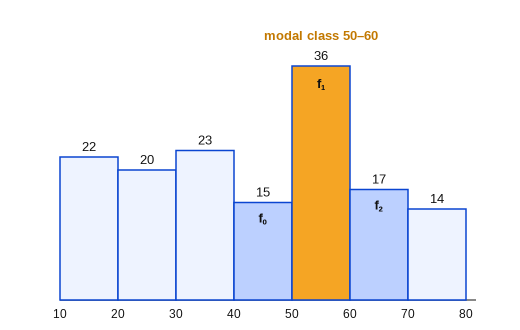
What is the mode of the data given below? [Give your answer correct to 2 decimal places.]
Age in years10-2020-3030-4040-5050-6060-7070-80
No. of patients22202315361714
नीचे दिए गए आँकड़ों का बहुलक क्या है? [अपना उत्तर दशमलव के 2 स्थानों तक दीजिए।]
आयु (वर्षों में)10-2020-3030-4040-5050-6060-7070-80
रोगियों की संख्या22202315361714
  1. A49.91
  2. B59.42
  3. C55.25
  4. D56.88
Show answer

Concept: Mode=l+f1−f02f1−f0−f2×h.

  1. Highest frequency 36 ⇒ modal class 50–60: l=50, h=10.
  2. f1=36, f0=15 (class before), f2=17 (class after).
  3. Mode=50+36−1572−15−17×10=50+2140×10.
  4. =50+5.25=55.25.

Trick: Answer must lie inside the modal class 50–60 – only 55.25 and 56.88 qualify; the formula settles it.

Answer: (C) 55.25

अवधारणा: बहुलक=l+f1−f02f1−f0−f2×h।

  1. सबसे अधिक बारंबारता 36 ⇒ बहुलक वर्ग 50–60: l=50, h=10।
  2. f1=36, f0=15 (पिछला वर्ग), f2=17 (अगला वर्ग)।
  3. बहुलक=50+36−1572−15−17×10=50+2140×10।
  4. =50+5.25=55.25।

ट्रिक: उत्तर बहुलक वर्ग 50–60 के भीतर होगा – केवल 55.25 और 56.88; सूत्र से निर्णय।

उत्तर: (C) 55.25

RRB NTPC Graduate CBT 1MathematicsStatistics – mode of grouped dataRRB NTPC Graduate CBT 1 2024 · 19 Jun Shift 1 →
Q7891.
Rakesh’s salary is ₹12,000 per month. He spends ₹6,000 on house rent, ₹3,000 on bills and the rest of the amount is his monthly savings. Find his savings (in ₹) in a year, if in the month of his birthday, he spent his complete monthly savings for the birthday celebration.
राकेश का वेतन ₹12,000 प्रति माह है। वह ₹6,000 मकान किराए पर, ₹3,000 बिलों पर खर्च करता है और शेष राशि उसकी मासिक बचत है। एक वर्ष में उसकी बचत (₹ में) ज्ञात कीजिए, यदि अपने जन्मदिन वाले महीने में उसने अपनी पूरी मासिक बचत जन्मदिन के उत्सव पर खर्च कर दी।
  1. A33,000
  2. B36,000
  3. C27,000
  4. D30,000
Show answer

Concept: Monthly saving = salary − expenses; the birthday month gives zero saving.

  1. Monthly saving =12000−6000−3000= ₹3,000.
  2. Savings are made in 12−1=11 months.
  3. Yearly saving =11×3000= ₹33,000.

Trick: Full-year saving 36,000 minus one month's 3,000 = 33,000.

Answer: (A) 33,000

अवधारणा: मासिक बचत = वेतन − खर्च; जन्मदिन वाले महीने में बचत शून्य।

  1. मासिक बचत =12000−6000−3000= ₹3,000।
  2. बचत 12−1=11 महीनों में होगी।
  3. वार्षिक बचत =11×3000= ₹33,000।

ट्रिक: पूरे वर्ष की बचत 36,000 में से एक महीने के 3,000 घटाएँ = 33,000।

उत्तर: (A) 33,000

RRB NTPC Graduate CBT 1MathematicsIncome and savingsRRB NTPC Graduate CBT 1 2024 · 19 Jun Shift 1 →
Q7892.
The least number which, when diminished by 8, is divisible by 15, 12, 18 and 29 is:
वह छोटी-से-छोटी संख्या, जिसमें से 8 घटाने पर वह 15, 12, 18 और 29 से विभाज्य हो, कौन-सी है?
  1. A5263
  2. B5275
  3. C5228
  4. D5187
Show answer

Concept: Required number = LCM of the divisors + the amount diminished.

  1. 15=3×5, 12=22×3, 18=2×32, 29 prime.
  2. LCM =22×32×5×29=180×29=5220.
  3. Number =5220+8=5228.

Trick: Check options: 5228−8=5220 is divisible by 29 and 180 – only C works.

Answer: (C) 5228

अवधारणा: अभीष्ट संख्या = भाजकों का LCM + घटाई गई राशि।

  1. 15=3×5, 12=22×3, 18=2×32, 29 अभाज्य।
  2. LCM =22×32×5×29=180×29=5220।
  3. संख्या =5220+8=5228।

ट्रिक: विकल्प जाँचें: 5228−8=5220, 29 और 180 दोनों से विभाज्य – केवल C।

उत्तर: (C) 5228

RRB NTPC Graduate CBT 1MathematicsLCMRRB NTPC Graduate CBT 1 2024 · 19 Jun Shift 1 →
Q7893.
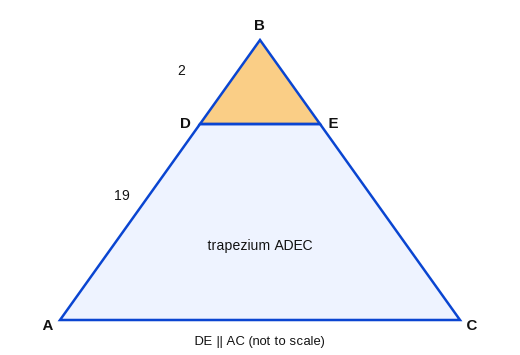
In △ABC, DE∥AC, where D and E are the points on sides AB and BC, respectively. If BD = 2 cm and AD = 19 cm, then what is the ratio of the area of △BDE to the trapezium ADEC?
△ABC में, DE∥AC है, जहाँ D और E क्रमशः भुजाओं AB और BC पर स्थित बिंदु हैं। यदि BD = 2 cm और AD = 19 cm है, तो △BDE के क्षेत्रफल का समलंब ADEC के क्षेत्रफल से अनुपात क्या है?
  1. A12 : 435
  2. B10 : 11
  3. C4 : 437
  4. D13 : 8
Show answer

Concept: If DE∥AC, then △BDE~△BAC and the area ratio is the square of the side ratio.

  1. AB=BD+AD=2+19=21 cm.
  2. ar(△BDE)ar(△BAC)=(BDBA)2=4441.
  3. Trapezium ADEC =441−4=437 parts.
  4. Required ratio =4:437.

Trick: Small triangle : trapezium =a2:(b2−a2) with a=2, b=21.

Answer: (C) 4:437

अवधारणा: यदि DE∥AC तो △BDE~△BAC, और क्षेत्रफल अनुपात भुजाओं के अनुपात का वर्ग होता है।

  1. AB=BD+AD=2+19=21 cm।
  2. ar(△BDE)ar(△BAC)=(BDBA)2=4441।
  3. समलंब ADEC =441−4=437 भाग।
  4. अभीष्ट अनुपात =4:437।

ट्रिक: छोटा त्रिभुज : समलंब =a2:(b2−a2), जहाँ a=2, b=21।

उत्तर: (C) 4:437

RRB NTPC Graduate CBT 1MathematicsBasic proportionality – area ratioRRB NTPC Graduate CBT 1 2024 · 19 Jun Shift 1 →
Q7894.
A boat takes 90 minutes to go 49.2 km upstream. The ratio of the speed of the boat in still water to that of the stream is 3 : 2. How much total time (in hours) will the boat take to go 44.8 km upstream and 71.2 km downstream?
एक नाव को धारा के प्रतिकूल 49.2 km जाने में 90 मिनट लगते हैं। स्थिर जल में नाव की चाल और धारा की चाल का अनुपात 3 : 2 है। नाव को धारा के प्रतिकूल 44.8 km और धारा के अनुकूल 71.2 km जाने में कुल कितना समय (घंटों में) लगेगा?
  1. A5.4
  2. B0.1
  3. C1.8
  4. D3.8
Show answer

Concept: Upstream speed =b−s, downstream speed =b+s.

  1. Upstream speed =49.21.5=32.8km/h.
  2. b:s=3:2 ⇒ upstream =3−2=1 part =32.8; downstream =3+2=5 parts =164km/h.
  3. Time =44.832.8+71.2164=5641+89205=280+89205.
  4. =369205=1.8 hours.

Trick: Downstream speed is 5 × upstream, so 71.2 km down = 14.24 km up; total 44.8+14.2432.8=1.8.

Answer: (C) 1.8

अवधारणा: धारा के विरुद्ध चाल =b−s, धारा के अनुकूल चाल =b+s।

  1. धारा के विरुद्ध चाल =49.21.5=32.8km/h।
  2. b:s=3:2 ⇒ विरुद्ध =3−2=1 भाग =32.8; अनुकूल =3+2=5 भाग =164km/h।
  3. समय =44.832.8+71.2164=5641+89205=280+89205।
  4. =369205=1.8 घंटे।

ट्रिक: अनुकूल चाल = 5 × विरुद्ध चाल, अतः 71.2 km अनुकूल = 14.24 km विरुद्ध; कुल 44.8+14.2432.8=1.8।

उत्तर: (C) 1.8

RRB NTPC Graduate CBT 1MathematicsBoats and streamsRRB NTPC Graduate CBT 1 2024 · 19 Jun Shift 1 →
Q7895.
Yashika buys 6 apples and 6 mangoes for ₹216. When the cost of an apple is decreased by 30% and that of a mango remains the same, then the cost of 5 apples and 8 mangoes is ₹162. What is the original cost of 7 apples and 2 mangoes?
यशिका ₹216 में 6 सेब और 6 आम खरीदती है। जब एक सेब का मूल्य 30% कम हो जाता है और आम का मूल्य समान रहता है, तो 5 सेब और 8 आमों का मूल्य ₹162 होता है। 7 सेब और 2 आमों का मूल मूल्य क्या है?
  1. A₹211
  2. B₹217
  3. C₹212
  4. D₹214
Show answer

Concept: Form two equations in the prices a (apple) and m (mango) and solve.

  1. 6a+6m=216⇒a+m=36.
  2. New apple price =0.7a: 5(0.7a)+8m=162⇒3.5a+8m=162.
  3. Put m=36−a: 3.5a+288−8a=162⇒4.5a=126⇒a=28, m=8.
  4. 7a+2m=196+16= ₹212.

Trick: Check a=28, m=8: 5×19.6+64=98+64=162 ✔.

Answer: (C) ₹212

अवधारणा: सेब का मूल्य a और आम का m मानकर दो समीकरण बनाकर हल करें।

  1. 6a+6m=216⇒a+m=36।
  2. सेब का नया मूल्य =0.7a: 5(0.7a)+8m=162⇒3.5a+8m=162।
  3. m=36−a रखें: 3.5a+288−8a=162⇒4.5a=126⇒a=28, m=8।
  4. 7a+2m=196+16= ₹212।

ट्रिक: जाँच a=28, m=8: 5×19.6+64=98+64=162 ✔।

उत्तर: (C) ₹212

RRB NTPC Graduate CBT 1MathematicsLinear equations – costRRB NTPC Graduate CBT 1 2024 · 19 Jun Shift 1 →
Q7896.
KARJ is related to NDUM in a certain way based on the English alphabetical order. In the same way, PLBF is related to SOEI. To which of the following is SCHQ related, following the same logic?
अंग्रेज़ी वर्णमाला क्रम के आधार पर KARJ एक निश्चित प्रकार से NDUM से संबंधित है। उसी प्रकार, PLBF, SOEI से संबंधित है। समान तर्क का अनुसरण करते हुए, SCHQ निम्नलिखित में से किससे संबंधित है?
  1. AUFNR
  2. BVELT
  3. CVFKT
  4. DUEMR
Show answer

Concept: Find the position shift between corresponding letters.

  1. K→N, A→D, R→U, J→M: each letter moves +3.
  2. Check: P→S, L→O, B→E, F→I — also +3.
  3. Apply to SCHQ: S→V, C→F, H→K, Q→T.

Trick: Same shift for all four letters → just add the shift once to each letter.

Answer: (C) VFKT

अवधारणा: संगत अक्षरों के बीच स्थान का अंतर ज्ञात करें।

  1. K→N, A→D, R→U, J→M: हर अक्षर +3 आगे।
  2. जाँच: P→S, L→O, B→E, F→I — यहाँ भी +3।
  3. SCHQ पर लागू करें: S→V, C→F, H→K, Q→T।

ट्रिक: चारों अक्षरों में एक-सा अंतर हो तो हर अक्षर में वही अंतर जोड़ दें।

उत्तर: (C) VFKT

RRB NTPC Graduate CBT 1General Intelligence and ReasoningLetter AnalogyRRB NTPC Graduate CBT 1 2024 · 19 Jun Shift 1 →
Q7897.
What should come in place of the question mark (?) in the given series?
327, 304, 271, ?, 175, 112
दी गई श्रृंखला में प्रश्न चिह्न (?) के स्थान पर क्या आना चाहिए?
327, 304, 271, ?, 175, 112
  1. A248
  2. B218
  3. C228
  4. D238
Show answer

Concept: Check differences between consecutive terms.

  1. 327−304=23, 304−271=33 — differences increase by 10.
  2. Next difference 43: 271−43=228.
  3. Check: 228−53=175, 175−63=112 ✓

Trick: Differences 23, 33, 43, 53, 63 — an arithmetic pattern of differences.

Answer: (C) 228

अवधारणा: क्रमागत पदों का अंतर देखें।

  1. 327−304=23, 304−271=33 — अंतर 10-10 बढ़ रहा है।
  2. अगला अंतर 43: 271−43=228।
  3. जाँच: 228−53=175, 175−63=112 ✓

ट्रिक: अंतर 23, 33, 43, 53, 63 — अंतरों में समान वृद्धि।

उत्तर: (C) 228

RRB NTPC Graduate CBT 1General Intelligence and ReasoningNumber SeriesRRB NTPC Graduate CBT 1 2024 · 19 Jun Shift 1 →
Q7898.
If 1 is added to each odd digit and 2 is subtracted from each even digit in the number 7643185, what will be difference between the highest and lowest digits in the number thus formed?
यदि संख्या 7643185 में प्रत्येक विषम अंक में 1 जोड़ा जाए और प्रत्येक सम अंक में से 2 घटाया जाए, तो इस प्रकार बनी संख्या के सबसे बड़े और सबसे छोटे अंकों के बीच का अंतर क्या होगा?
  1. A4
  2. B7
  3. C5
  4. D6
Show answer

Concept: Apply the rule digit by digit.

  1. 7643185: odd digits 7, 3, 1, 5 → 8, 4, 2, 6; even digits 6, 4, 8 → 4, 2, 6.
  2. New number: 8 4 2 4 2 6 6.
  3. Highest =8, lowest =2; difference =8−2=6.

Trick: Write the new digits directly under the old ones to avoid mistakes.

Answer: (D) 6

अवधारणा: नियम को हर अंक पर अलग-अलग लगाएँ।

  1. 7643185: विषम अंक 7, 3, 1, 5 → 8, 4, 2, 6; सम अंक 6, 4, 8 → 4, 2, 6।
  2. नई संख्या: 8 4 2 4 2 6 6।
  3. सबसे बड़ा =8, सबसे छोटा =2; अंतर =8−2=6।

ट्रिक: पुराने अंकों के ठीक नीचे नए अंक लिखें — गलती नहीं होगी।

उत्तर: (D) 6

RRB NTPC Graduate CBT 1General Intelligence and ReasoningDigit OperationsRRB NTPC Graduate CBT 1 2024 · 19 Jun Shift 1 →
Q7899.
Based on the English alphabetical order, three of the following four letter-cluster pairs are alike in a certain way and thus form a group. Which is the letter-cluster pair that DOES NOT belong to that group?
(Note: The odd one out is not based on the number of consonants/vowels or their position in the letter-cluster.)
अंग्रेज़ी वर्णमाला क्रम के आधार पर, निम्नलिखित चार अक्षर-समूह युग्मों में से तीन किसी निश्चित प्रकार से एकसमान हैं और इस प्रकार एक समूह बनाते हैं। वह कौन-सा अक्षर-समूह युग्म है जो उस समूह से संबंधित नहीं है?
(नोट: असंगत अक्षर-समूह, उस अक्षर-समूह में व्यंजनों/स्वरों की संख्या या उनके स्थान पर आधारित नहीं है।)
  1. AIJ - DE
  2. BGH - BC
  3. CLM - GH
  4. DMN - PD
Show answer

Concept: Compare the shift from the first cluster to the second.

  1. IJ→DE: each letter −5; GH→BC: −5; LM→GH: −5.
  2. MN→PD: M→P is +3, N→D is −10 — no common rule.

Trick: Check only the first letters: I→D, G→B, L→G all −5; M→P breaks it.

Answer: (D) MN - PD

अवधारणा: पहले समूह से दूसरे समूह तक अक्षरों का खिसकाव देखें।

  1. IJ→DE: हर अक्षर −5; GH→BC: −5; LM→GH: −5।
  2. MN→PD: M→P +3, N→D −10 — कोई समान नियम नहीं।

ट्रिक: केवल पहले अक्षर देखें: I→D, G→B, L→G सभी −5; M→P अलग।

उत्तर: (D) MN - PD

RRB NTPC Graduate CBT 1General Intelligence and ReasoningOdd One Out – LettersRRB NTPC Graduate CBT 1 2024 · 19 Jun Shift 1 →
Q7900.
Two sets of numbers are given below. In each set of numbers, certain mathematical operation(s) on the first number results in the second number. Similarly, certain mathematical operation(s) on the second number results in the third number and so on. Which of the given options follows the same set of operations as in the given sets? (NOTE: Operations should be performed on the whole numbers, without breaking down the numbers into their constituent digits. E.g. 13 – Operations on 13 such as adding / subtracting / multiplying to 13 can be performed. Breaking down 13 into 1 and 3 and then performing mathematical operations on 1 and 3 is not allowed.)
11 - 22 - 44 - 45; 3 - 6 - 12 - 13
नीचे संख्याओं के दो समुच्चय दिए गए हैं। संख्याओं के प्रत्येक समुच्चय में, पहली संख्या पर कुछ निश्चित गणितीय संक्रिया/संक्रियाएँ करने पर दूसरी संख्या प्राप्त होती है। इसी प्रकार, दूसरी संख्या पर कुछ निश्चित गणितीय संक्रिया/संक्रियाएँ करने पर तीसरी संख्या प्राप्त होती है, और इसी तरह आगे भी। दिए गए विकल्पों में से कौन-सा विकल्प दिए गए समुच्चयों की तरह संक्रियाओं के समान समुच्चय का अनुसरण करता है? (नोट: संख्याओं को उनके घटक अंकों में तोड़े बिना, संक्रियाएँ पूर्ण संख्याओं पर की जानी चाहिए। उदाहरण 13 – 13 पर संक्रियाएँ जैसे 13 में जोड़ना/घटाना/गुणा करना आदि किया जा सकता है। 13 को 1 और 3 में तोड़कर फिर 1 और 3 पर गणितीय संक्रियाएँ करने की अनुमति नहीं है।)
11 - 22 - 44 - 45; 3 - 6 - 12 - 13
  1. A1 - 2 - 3 - 6
  2. B19 - 20 - 22 - 44
  3. C4 - 8 - 16 - 17
  4. D13 - 14 - 15 - 20
Show answer

Concept: Find the operation chain from the given sets.

  1. 11×2=22, 22×2=44, 44+1=45; 3×2=6, 6×2=12, 12+1=13.
  2. Rule: ×2, ×2, +1.
  3. 4×2=8, 8×2=16, 16+1=17 ✓ — others fail at the first step.

Trick: Test only the first step (×2): 1→2 ✓ but 2→3 ✗; 4→8 works throughout.

Answer: (C) 4 - 8 - 16 - 17

अवधारणा: दिए गए समूहों से संक्रिया-क्रम ज्ञात करें।

  1. 11×2=22, 22×2=44, 44+1=45; 3×2=6, 6×2=12, 12+1=13।
  2. नियम: ×2, ×2, +1।
  3. 4×2=8, 8×2=16, 16+1=17 ✓ — बाकी विकल्प पहले/दूसरे चरण में ही गलत।

ट्रिक: पहले दो चरण (×2) जाँचें — 4-8-16 ही चलता है।

उत्तर: (C) 4 - 8 - 16 - 17

RRB NTPC Graduate CBT 1General Intelligence and ReasoningNumber Set OperationsRRB NTPC Graduate CBT 1 2024 · 19 Jun Shift 1 →