Question bank

Q&A: practice questions with answers

Search questions on any topic. Filter by exam category, exam, subject and topic, try the question, then open the answer and explanation.

Courses – airGurukul

20,719 questions found.

Q7981.
Find the simplified value of [525 ÷ {19 + 7 × (3 - 5)}].
[525 ÷ {19 + 7 × (3 - 5)}] का सरलीकृत मान ज्ञात कीजिए।
  1. A102
  2. B105
  3. C108
  4. D104
Show answer

Concept: Solve innermost brackets first, then multiplication, then addition, then division outside.

  1. (3−5)=−2.
  2. 7×(−2)=−14.
  3. {19−14}=5.
  4. 525÷5=105.

Trick: Order: ( ) → { } → [ ].

Answer: (B) 105

अवधारणा: सबसे अंदर का कोष्ठक पहले, फिर गुणा, फिर जोड़, अंत में बाहर का भाग।

  1. (3−5)=−2।
  2. 7×(−2)=−14।
  3. {19−14}=5।
  4. 525÷5=105।

ट्रिक: क्रम: ( ) → { } → [ ]।

उत्तर: (B) 105
RRB NTPC Graduate CBT 1MathematicsSimplification (BODMAS)RRB NTPC Graduate CBT 1 2024 · 18 Jun Shift 3 →
Q7982.
If sinA=34, then calculate cosAcotA.
यदि sinA=34 है, तो cosAcotA की गणना कीजिए।
  1. A127
  2. B712
  3. C67
  4. D76
Show answer

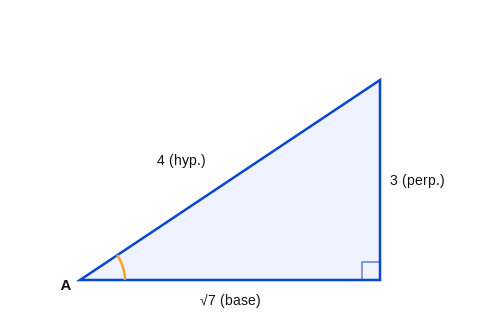
Concept: Use sinA=perpendicularhypotenuse to build a right triangle, then cosAcotA=cos2AsinA.

  1. Perpendicular 3, hypotenuse 4 → base =16−9=7.
  2. cosA=74, cotA=73.
  3. cosAcotA=74×73=712.

Trick: cos2AsinA=1−91634=716×43=712.

Answer: (B) 712

अवधारणा: sinA=लंबकर्ण से समकोण त्रिभुज बनाएँ, फिर cosAcotA=cos2AsinA।

  1. लंब 3, कर्ण 4 → आधार =16−9=7।
  2. cosA=74, cotA=73।
  3. cosAcotA=74×73=712।

ट्रिक: cos2AsinA=1−91634=716×43=712।

उत्तर: (B) 712

RRB NTPC Graduate CBT 1MathematicsTrigonometry – ratiosRRB NTPC Graduate CBT 1 2024 · 18 Jun Shift 3 →
Q7983.
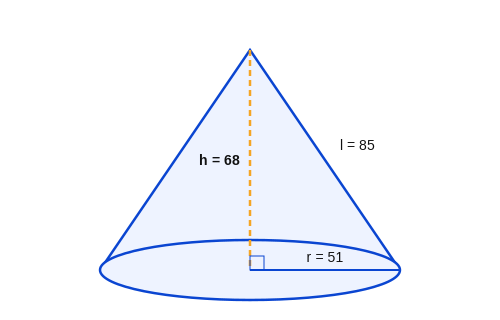
The curved surface area of a right circular cone is 4335π cm2, and the diameter of its base is 102 cm. Find the height (in cm) of the cone.
एक लंब वृत्तीय शंकु का वक्र पृष्ठीय क्षेत्रफल 4335π cm2 है, और इसके आधार का व्यास 102 cm है। शंकु की ऊँचाई (cm में) ज्ञात कीजिए।
  1. A68
  2. B64
  3. C63
  4. D69
Show answer

Concept: Curved surface area of a cone =πrl and h=l2−r2.

  1. r=1022=51cm.
  2. π×51×l=4335π⇒l=433551=85cm.
  3. h=852−512=7225−2601=4624=68cm.

Trick: 51:68:85=17×(3:4:5) — a Pythagorean triplet.

Answer: (A) 68

अवधारणा: शंकु का वक्र पृष्ठीय क्षेत्रफल =πrl तथा h=l2−r2।

  1. r=1022=51cm।
  2. π×51×l=4335π⇒l=433551=85cm।
  3. h=852−512=7225−2601=4624=68cm।

ट्रिक: 51:68:85=17×(3:4:5) — पाइथागोरस त्रिक।

उत्तर: (A) 68

RRB NTPC Graduate CBT 1MathematicsMensuration – coneRRB NTPC Graduate CBT 1 2024 · 18 Jun Shift 3 →
Q7984.
Find the smallest number by which 4232 must be multiplied to make it a perfect square.
वह सबसे छोटी संख्या ज्ञात कीजिए जिससे 4232 को गुणा करने पर वह एक पूर्ण वर्ग बन जाए।
  1. A23
  2. B3
  3. C11
  4. D2
Show answer

Concept: Write the prime factorisation; a perfect square has every prime with an even power.

  1. 4232=2×2116=23×529=23×232.
  2. 23 already has an even power; 2 has power 3 (odd).
  3. Multiply by 2: 24×232=8464=922.

Trick: Pair up primes; the unpaired ones give the smallest multiplier.

Answer: (D) 2

अवधारणा: अभाज्य गुणनखंड लिखें; पूर्ण वर्ग में हर अभाज्य की घात सम होती है।

  1. 4232=2×2116=23×529=23×232।
  2. 23 की घात पहले से सम है; 2 की घात 3 (विषम) है।
  3. 2 से गुणा: 24×232=8464=922।

ट्रिक: अभाज्यों के जोड़े बनाएँ; बिना जोड़े वाले ही सबसे छोटा गुणक देते हैं।

उत्तर: (D) 2

RRB NTPC Graduate CBT 1MathematicsPerfect squaresRRB NTPC Graduate CBT 1 2024 · 18 Jun Shift 3 →
Q7985.
If the quadratic equations 6x2 − 7x − 20 = 0 and 6x2 + bx −10 = 0 have one root in common, find the value of b.
यदि द्विघात समीकरणों 6x2 − 7x − 20 = 0 और 6x2 + bx −10 = 0 का एक मूल उभयनिष्ठ है, तो b का मान ज्ञात कीजिए।
  1. A−11
  2. B11
  3. C10
  4. D−10
Show answer

Concept: Find the roots of the first equation and substitute each into the second.

  1. 6x2−7x−20=(2x−5)(3x+4)=0⇒x=52 or −43.
  2. x=52: 6×254+5b2−10=0⇒27.5+2.5b=0⇒b=−11.
  3. x=−43 gives b=12, which is not among the options.

Trick: Factor first (6×(−20)=−120=−15×8), then test roots.

Answer: (A) −11

अवधारणा: पहले समीकरण के मूल ज्ञात कर दूसरे में रखें।

  1. 6x2−7x−20=(2x−5)(3x+4)=0⇒x=52 या −43।
  2. x=52: 6×254+5b2−10=0⇒27.5+2.5b=0⇒b=−11।
  3. x=−43 से b=12 आता है, जो विकल्पों में नहीं है।

ट्रिक: पहले गुणनखंड करें (6×(−20)=−120=−15×8), फिर मूल जाँचें।

उत्तर: (A) −11

RRB NTPC Graduate CBT 1MathematicsQuadratic equations – common rootRRB NTPC Graduate CBT 1 2024 · 18 Jun Shift 3 →
Q7986.
The population of a town in 1968 was 4,85,000. If its population increased in two successive decades by 20% in each decade, the population of the town in 1988 was:
1968 में एक कस्बे की जनसंख्या 4,85,000 थी। यदि लगातार दो दशकों में प्रत्येक दशक में इसकी जनसंख्या 20% बढ़ी, तो 1988 में कस्बे की जनसंख्या थी:
  1. A6,98,405
  2. B6,98,395
  3. C6,98,400
  4. D6,98,397
Show answer

Concept: Successive growth: Pn=P0(1+r100)n.

  1. P=485000×(1+20100)2=485000×1.44.
  2. 485000×1.44=698400.

Trick: Two successive 20% rises = 20+20+20×20100=44% rise.

Answer: (C) 6,98,400

अवधारणा: क्रमिक वृद्धि: Pn=P0(1+r100)n।

  1. P=485000×(1+20100)2=485000×1.44।
  2. 485000×1.44=698400।

ट्रिक: दो क्रमिक 20% वृद्धि = 20+20+20×20100=44% वृद्धि।

उत्तर: (C) 6,98,400

RRB NTPC Graduate CBT 1MathematicsPopulation growthRRB NTPC Graduate CBT 1 2024 · 18 Jun Shift 3 →
Q7987.
3 men and 14 women can complete a piece of work in 18 days, and 11 men and 8 women can complete the same work in 12 days. The work of how many women is equivalent to that of one man?
3 पुरुष और 14 महिलाएँ एक कार्य को 18 दिनों में पूरा कर सकते हैं, और 11 पुरुष और 8 महिलाएँ उसी कार्य को 12 दिनों में पूरा कर सकते हैं। कितनी महिलाओं का कार्य एक पुरुष के कार्य के बराबर है?
  1. A5
  2. B2
  3. C3
  4. D4
Show answer

Concept: Total work is the same, so (workers × days) are equal in both cases.

  1. 18(3m+14w)=12(11m+8w)
  2. 54m+252w=132m+96w
  3. 156w=78m⇒m=2w

Trick: Divide by 6 first: 3(3m+14w)=2(11m+8w)⇒26w=13m.

Answer: (B) 2

अवधारणा: कुल कार्य समान है, अतः दोनों स्थितियों में (कर्मचारी × दिन) बराबर होंगे।

  1. 18(3m+14w)=12(11m+8w)
  2. 54m+252w=132m+96w
  3. 156w=78m⇒m=2w

ट्रिक: पहले 6 से भाग दें: 3(3m+14w)=2(11m+8w)⇒26w=13m।

उत्तर: (B) 2

RRB NTPC Graduate CBT 1MathematicsTime and WorkRRB NTPC Graduate CBT 1 2024 · 18 Jun Shift 3 →
Q7988.
What is the median of the following distribution?
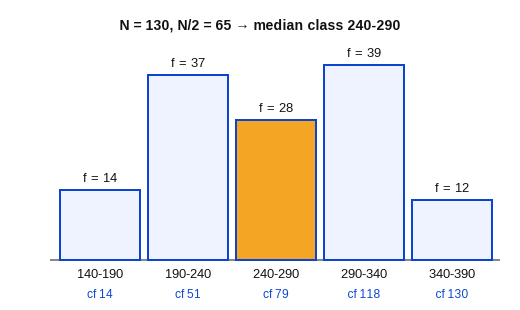
Class140-190190-240240-290290-340340-390
Frequency1437283912
निम्नलिखित बंटन की माध्यिका क्या है?
वर्ग140-190190-240240-290290-340340-390
बारंबारता1437283912
  1. A265
  2. B251
  3. C275
  4. D250
Show answer

Concept: Grouped median =L+N2−cff×h.

  1. N=14+37+28+39+12=130, N2=65.
  2. Cumulative frequencies: 14,51,79,118,130 → 65 lies in 240-290.
  3. L=240, cf=51, f=28, h=50.
  4. Median =240+65−5128×50=240+25=265.

Trick: 65 is exactly midway between 51 and 79, so median ≈ middle of the class = 265.

Answer: (A) 265

अवधारणा: वर्गीकृत माध्यिका =L+N2−cff×h।

  1. N=14+37+28+39+12=130, N2=65।
  2. संचयी बारंबारता: 14,51,79,118,130 → 65 वर्ग 240-290 में है।
  3. L=240, cf=51, f=28, h=50।
  4. माध्यिका =240+65−5128×50=240+25=265।

ट्रिक: 65 ठीक 51 और 79 के बीच में है, इसलिए माध्यिका ≈ वर्ग का मध्य = 265।

उत्तर: (A) 265

RRB NTPC Graduate CBT 1MathematicsStatistics – MedianRRB NTPC Graduate CBT 1 2024 · 18 Jun Shift 3 →
Q7989.
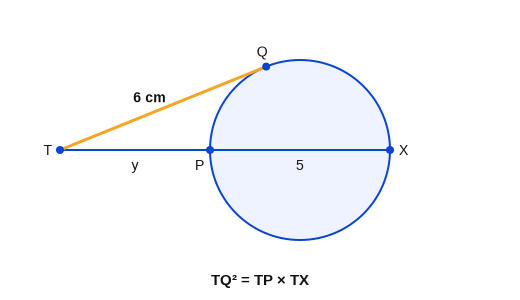
TQ=6 cm is a tangent to the circle and TPX is a secant. If TP=y cm and PX=5 cm, find y.
TQ=6 cm वृत्त की एक स्पर्श रेखा है और TPX एक छेदक रेखा है। यदि TP=y cm और PX=5 cm है, तो y ज्ञात कीजिए।
  1. A4
  2. B6
  3. C5
  4. D3
Show answer

Concept: Tangent-secant theorem: TQ2=TP×TX.

  1. TX=TP+PX=y+5.
  2. 62=y(y+5)⇒y2+5y−36=0.
  3. (y+9)(y−4)=0⇒y=4 (length is positive).

Trick: Check options: 4×9=36=62 ✓.

Answer: (A) 4

अवधारणा: स्पर्श रेखा-छेदक प्रमेय: TQ2=TP×TX।

  1. TX=TP+PX=y+5।
  2. 62=y(y+5)⇒y2+5y−36=0।
  3. (y+9)(y−4)=0⇒y=4 (लंबाई धनात्मक)।

ट्रिक: विकल्प जाँचें: 4×9=36=62 ✓।

उत्तर: (A) 4

RRB NTPC Graduate CBT 1MathematicsCircles – Tangent & SecantRRB NTPC Graduate CBT 1 2024 · 18 Jun Shift 3 →
Q7990.
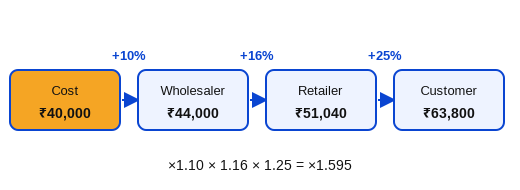
If the manufacturer gains 10%, the wholesale gains 16% and the retailer gains 25%, then find the cost of production of a table (in ₹), whose retail price for the customer is ₹63,800.
(NOTE: Manufacturer sells to wholesaler, wholesaler sells to retailer and retailer sells to customer.)
यदि निर्माता को 10%, थोक विक्रेता को 16% और खुदरा विक्रेता को 25% लाभ होता है, तो उस मेज़ की उत्पादन लागत (₹ में) ज्ञात कीजिए, जिसका ग्राहक के लिए खुदरा मूल्य ₹63,800 है।
(नोट: निर्माता थोक विक्रेता को बेचता है, थोक विक्रेता खुदरा विक्रेता को बेचता है और खुदरा विक्रेता ग्राहक को बेचता है।)
  1. A40,000
  2. B50,000
  3. C44,000
  4. D46,400
Show answer

Concept: Successive gains multiply: Price=C×110100×116100×125100.

  1. C×1.1×1.16×1.25=63800
  2. 1.595C=63800
  3. C=638001.595=40000

Trick: Check: 40000→44000→51040→63800 ✓.

Answer: (A) 40,000

अवधारणा: क्रमिक लाभ गुणा होते हैं: मूल्य=C×110100×116100×125100।

  1. C×1.1×1.16×1.25=63800
  2. 1.595C=63800
  3. C=638001.595=40000

ट्रिक: जाँच: 40000→44000→51040→63800 ✓।

उत्तर: (A) 40,000

RRB NTPC Graduate CBT 1MathematicsProfit and Loss – Successive GainsRRB NTPC Graduate CBT 1 2024 · 18 Jun Shift 3 →
Q7991.
A and B can do a piece of work in 13 days and 52 days, respectively. Both work for 2 days and then A goes away. How long (in days) will B take to complete the remaining work?
A और B एक कार्य को क्रमशः 13 दिनों और 52 दिनों में कर सकते हैं। दोनों 2 दिनों तक कार्य करते हैं और फिर A चला जाता है। शेष कार्य को पूरा करने में B को कितना समय (दिनों में) लगेगा?
  1. A42
  2. B44
  3. C43
  4. D41
Show answer

Concept: Take total work = LCM(13, 52) = 52 units.

  1. A = 5213=4 units/day, B = 1 unit/day.
  2. In 2 days together: 2×(4+1)=10 units.
  3. Remaining =52−10=42 units; B alone takes 421=42 days.

Trick: LCM method avoids fractions completely.

Answer: (A) 42

अवधारणा: कुल कार्य = LCM(13, 52) = 52 इकाई मानें।

  1. A = 5213=4 इकाई/दिन, B = 1 इकाई/दिन।
  2. 2 दिन साथ में: 2×(4+1)=10 इकाई।
  3. शेष =52−10=42 इकाई; B अकेले 421=42 दिन लेगा।

ट्रिक: LCM विधि से भिन्नों से बचें।

उत्तर: (A) 42

RRB NTPC Graduate CBT 1MathematicsTime and WorkRRB NTPC Graduate CBT 1 2024 · 18 Jun Shift 3 →
Q7992.
A man has to cover a distance of 549 km in 8 hours. If he covers 23 of this distance in 34 of the time, then what should be his speed (in km/hr) to cover the remaining distance in the time left?
एक व्यक्ति को 8 घंटे में 549 km की दूरी तय करनी है। यदि वह इस दूरी का 23 भाग, समय के 34 भाग में तय करता है, तो शेष दूरी को शेष समय में तय करने के लिए उसकी चाल (km/hr में) कितनी होनी चाहिए?
  1. A91.5
  2. B96.5
  3. C71.5
  4. D82.5
Show answer

Concept: Required speed =remaining distanceremaining time.

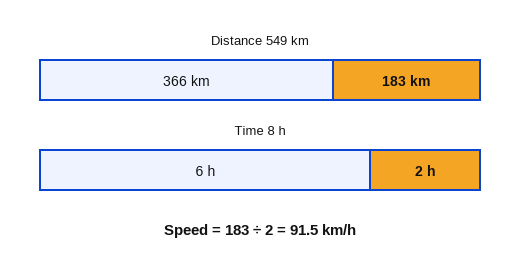
  1. Distance covered =23×549=366 km; remaining =549−366=183 km.
  2. Time used =34×8=6 h; time left =2 h.
  3. Speed =1832=91.5km/h.

Trick: Remaining distance =13×549=183 directly.

Answer: (A) 91.5

अवधारणा: आवश्यक चाल =शेष दूरीशेष समय।

  1. तय दूरी =23×549=366 km; शेष =549−366=183 km।
  2. लगा समय =34×8=6 घंटे; बचा समय =2 घंटे।
  3. चाल =1832=91.5km/h।

ट्रिक: शेष दूरी सीधे =13×549=183।

उत्तर: (A) 91.5

RRB NTPC Graduate CBT 1MathematicsSpeed, Time and DistanceRRB NTPC Graduate CBT 1 2024 · 18 Jun Shift 3 →
Q7993.
An article’s cost price is ₹285, and the marked price is mentioned as ₹1,140. What is the profit percentage of the seller if he sells it by allowing a discount of 70% on the marked price?
एक वस्तु का क्रय मूल्य ₹285 है, और अंकित मूल्य ₹1,140 बताया गया है। यदि विक्रेता अंकित मूल्य पर 70% की छूट देकर इसे बेचता है, तो उसका लाभ प्रतिशत कितना है?
  1. A17%
  2. B19%
  3. C23%
  4. D20%
Show answer

Concept: SP after discount =MP×100−d100; Profit%=SP−CPCP×100.

  1. SP=1140×30100=342
  2. Profit =342−285=57
  3. Profit%=57285×100=20%

Trick: 285×1.2=342 – quick check.

Answer: (D) 20%

अवधारणा: छूट के बाद विक्रय मूल्य =MP×100−d100; लाभ%=SP−CPCP×100।

  1. SP=1140×30100=342
  2. लाभ =342−285=57
  3. लाभ%=57285×100=20%

ट्रिक: 285×1.2=342 – त्वरित जाँच।

उत्तर: (D) 20%

RRB NTPC Graduate CBT 1MathematicsProfit, Loss and DiscountRRB NTPC Graduate CBT 1 2024 · 18 Jun Shift 3 →
Q7994.
The length, breadth and height of a cuboid are (2x−5y+3) m, (5x+7y−7) m and (x+y+3) m, respectively. Find the perimeter of the cuboid.
एक घनाभ की लंबाई, चौड़ाई और ऊँचाई क्रमशः (2x−5y+3) m, (5x+7y−7) m और (x+y+3) m है। घनाभ का परिमाप ज्ञात कीजिए।
  1. A(32x+12y+4) m
  2. B(32x+12y−4) m
  3. C(16x−12y+8) m
  4. D(16x−12y−8) m
Show answer

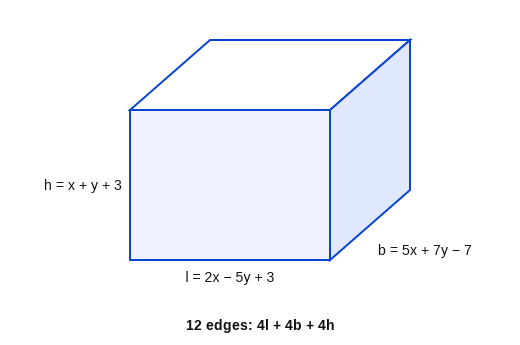
Concept: A cuboid has 12 edges (4 of each dimension), so perimeter =4(l+b+h).

  1. l+b+h=(2x−5y+3)+(5x+7y−7)+(x+y+3)
  2. =8x+3y−1
  3. Perimeter =4(8x+3y−1)=32x+12y−4 m.

Trick: Constants: 3−7+3=−1, so the answer must end in −4.

Answer: (B) (32x+12y−4) m

अवधारणा: घनाभ के 12 किनारे (हर विमा के 4) होते हैं, इसलिए परिमाप =4(l+b+h)।

  1. l+b+h=(2x−5y+3)+(5x+7y−7)+(x+y+3)
  2. =8x+3y−1
  3. परिमाप =4(8x+3y−1)=32x+12y−4 m।

ट्रिक: अचर पद: 3−7+3=−1, अतः उत्तर −4 पर समाप्त होगा।

उत्तर: (B) (32x+12y−4) m

RRB NTPC Graduate CBT 1MathematicsMensuration – CuboidRRB NTPC Graduate CBT 1 2024 · 18 Jun Shift 3 →
Q7995.
If a2+b2=163, a×b=27 and a>b, then find the value of a−ba+b.
यदि a2+b2=163, a×b=27 और a>b है, तो a−ba+b का मान ज्ञात कीजिए।
  1. A109217
  2. B109217
  3. C119227
  4. D119227
Show answer

Concept: (a±b)2=a2+b2±2ab.

  1. (a−b)2=163−2×27=109.
  2. (a+b)2=163+2×27=217.
  3. Since a>b, a−ba+b=109217.

Trick: Squares give 109 and 217, so the ratio keeps a square root.

Answer: (A) 109217

अवधारणा: (a±b)2=a2+b2±2ab।

  1. (a−b)2=163−2×27=109।
  2. (a+b)2=163+2×27=217।
  3. चूँकि a>b, a−ba+b=109217।

ट्रिक: वर्ग 109 और 217 देते हैं, इसलिए अनुपात में वर्गमूल रहेगा।

उत्तर: (A) 109217

RRB NTPC Graduate CBT 1MathematicsAlgebraic IdentitiesRRB NTPC Graduate CBT 1 2024 · 18 Jun Shift 3 →
Q7996.
Mr. Yanki starts from Point A and drives 17 km towards the South. He then takes a right turn, drives 19 km, turns right and drives 29 km. He then takes a right turn and drives 15 km, turns right drives 1 km. He then takes a left turn drives 6 km. He takes a final right turn, drives 11 km and stops at Point P. How far (shortest distance) and towards which direction should he drive in order to reach Point A again? (All turns are 90 degrees turns only unless specified.)
श्री यांकी बिंदु A से चलना शुरू करते हैं और दक्षिण की ओर 17 km गाड़ी चलाते हैं। फिर वे दाएँ मुड़ते हैं, 19 km गाड़ी चलाते हैं, दाएँ मुड़ते हैं और 29 km गाड़ी चलाते हैं। फिर वे दाएँ मुड़ते हैं और 15 km गाड़ी चलाते हैं, दाएँ मुड़कर 1 km गाड़ी चलाते हैं। फिर वे बाएँ मुड़कर 6 km गाड़ी चलाते हैं। वे अंतिम बार दाएँ मुड़ते हैं, 11 km गाड़ी चलाते हैं और बिंदु P पर रुक जाते हैं। बिंदु A पर फिर से पहुँचने के लिए उन्हें कितनी दूरी (न्यूनतम दूरी) और किस दिशा में गाड़ी चलानी चाहिए? (जब तक निर्दिष्ट न हो, सभी मोड़ केवल 90 डिग्री के मोड़ हैं।)
  1. A4 km to the Southदक्षिण की ओर 4 km
  2. B2 km to the Westपश्चिम की ओर 2 km
  3. C6 km to the Eastपूर्व की ओर 6 km
  4. D8 km to the Northउत्तर की ओर 8 km
Show answer

Concept: Track the position on a coordinate grid (East +x, North +y); a right turn while facing South points West.

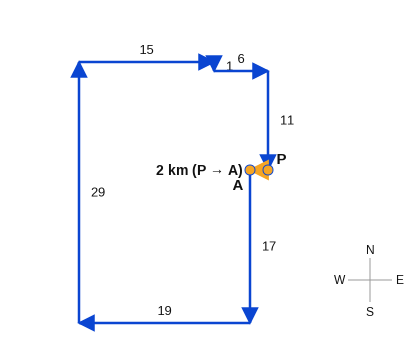
  1. Take A = (0,0). 17 km South → (0,−17); right (West) 19 → (−19,−17).
  2. Right (North) 29 → (−19,12); right (East) 15 → (−4,12); right (South) 1 → (−4,11).
  3. Left (East) 6 → (2,11); right (South) 11 → P =(2,0).
  4. P is 2 km East of A, so he must drive 2 km towards the West.

Trick: Net x: −19+15+6=2, net y: −17+29−1−11=0 → only 2 km East displacement.

Answer: (B) 2 km to the West

अवधारणा: स्थिति को निर्देशांक (East +x, North +y) में लिखें; दक्षिण की ओर मुँह हो तो दायाँ मोड़ = पश्चिम।

  1. A =(0,0)। 17 km दक्षिण → (0,−17); दाएँ (पश्चिम) 19 → (−19,−17)।
  2. दाएँ (उत्तर) 29 → (−19,12); दाएँ (पूर्व) 15 → (−4,12); दाएँ (दक्षिण) 1 → (−4,11)।
  3. बाएँ (पूर्व) 6 → (2,11); दाएँ (दक्षिण) 11 → P =(2,0)।
  4. P, A से 2 km पूर्व में है, अतः उसे 2 km पश्चिम जाना होगा।

ट्रिक: कुल x: −19+15+6=2, कुल y: −17+29−1−11=0 → केवल 2 km पूर्व का विस्थापन।

उत्तर: (B) 2 km पश्चिम की ओर

RRB NTPC Graduate CBT 1General Intelligence and ReasoningDirection and distanceRRB NTPC Graduate CBT 1 2024 · 18 Jun Shift 3 →
Q7997.
Select the letter-cluster from among the given options that can replace the question mark (?) in the following series.
RCX TDS VEN XFI ?
दिए गए विकल्पों में से वह अक्षर-समूह चुनिए जो निम्नलिखित शृंखला में प्रश्न चिह्न (?) के स्थान पर आ सकता है।
RCX TDS VEN XFI ?
  1. AZHE
  2. BZIE
  3. CZIF
  4. DZGD
Show answer

Concept: Check each letter position of the clusters separately.

  1. 1st letters: R, T, V, X → +2 each → Z.
  2. 2nd letters: C, D, E, F → +1 each → G.
  3. 3rd letters: X, S, N, I → −5 each → I −5 = D.
  4. Next cluster = ZGD.

Trick: Write positions: X(24), S(19), N(14), I(9) → 4 = D.

Answer: (D) ZGD

अवधारणा: प्रत्येक समूह के अक्षरों को स्थान के अनुसार अलग-अलग जाँचें।

  1. पहले अक्षर: R, T, V, X → हर बार +2 → Z।
  2. दूसरे अक्षर: C, D, E, F → हर बार +1 → G।
  3. तीसरे अक्षर: X, S, N, I → हर बार −5 → I −5 = D।
  4. अगला समूह = ZGD।

ट्रिक: स्थानांक लिखें: X(24), S(19), N(14), I(9) → 4 = D।

उत्तर: (D) ZGD

RRB NTPC Graduate CBT 1General Intelligence and ReasoningLetter seriesRRB NTPC Graduate CBT 1 2024 · 18 Jun Shift 3 →
Q7998.
Refer to the following number and symbol series and answer the question that follows. Counting to be done from left to right only.
(NOTE: All numbers are single digit numbers only)
(Left) & # 9 % 6 4 % © @ & 6 4 6 7 © 9 8 5 % 9 © 7 (Right)
How many such numbers are there each of which is immediately preceded by a symbol and also immediately followed by a symbol?
निम्नलिखित संख्या और प्रतीक शृंखला को देखिए और उसके बाद दिए गए प्रश्न का उत्तर दीजिए। गिनती केवल बाएँ से दाएँ की जानी है।
(नोट: सभी संख्याएँ केवल एक अंक वाली संख्याएँ हैं)
(बाएँ) & # 9 % 6 4 % © @ & 6 4 6 7 © 9 8 5 % 9 © 7 (दाएँ)
ऐसी कितनी संख्याएँ हैं जिनमें से प्रत्येक के ठीक पहले एक प्रतीक है और ठीक बाद में भी एक प्रतीक है?
  1. A3
  2. B4
  3. C2
  4. D1
Show answer

Concept: Find each number whose left neighbour and right neighbour are both symbols.

  1. Series: & # 9 % 6 4 % © @ & 6 4 6 7 © 9 8 5 % 9 © 7.
  2. # 9 % → qualifies; % 9 © → qualifies.
  3. All other numbers have a number on at least one side (e.g. % 6 4, © 9 8), and the last 7 has nothing after it.
  4. Count = 2.

Trick: Look only for the pattern 'symbol – number – symbol'.

Answer: (C) 2

अवधारणा: ऐसी संख्याएँ खोजें जिनके बाएँ और दाएँ दोनों ओर प्रतीक हों।

  1. श्रृंखला: & # 9 % 6 4 % © @ & 6 4 6 7 © 9 8 5 % 9 © 7।
  2. # 9 % → सही; % 9 © → सही।
  3. अन्य सभी संख्याओं के कम से कम एक ओर संख्या है (जैसे % 6 4, © 9 8), और अंतिम 7 के बाद कुछ नहीं है।
  4. कुल = 2।

ट्रिक: केवल 'प्रतीक – संख्या – प्रतीक' पैटर्न देखें।

उत्तर: (C) 2

RRB NTPC Graduate CBT 1General Intelligence and ReasoningSymbol-number seriesRRB NTPC Graduate CBT 1 2024 · 18 Jun Shift 3 →
Q7999.
L is the mother of two sons, namely, P and J. F is the wife of P. Q is the daughter of J. How is L related to Q?
L के दो पुत्र हैं, जिनके नाम P और J हैं। F, P की पत्नी है। Q, J की पुत्री है। L का Q से क्या संबंध है?
  1. AHusband's motherपति की माँ
  2. BFather's motherपिता की माँ
  3. CMother's motherमाँ की माँ
  4. DMotherमाँ
Show answer

Concept: Draw the family tree generation by generation and read the relation from Q upward.

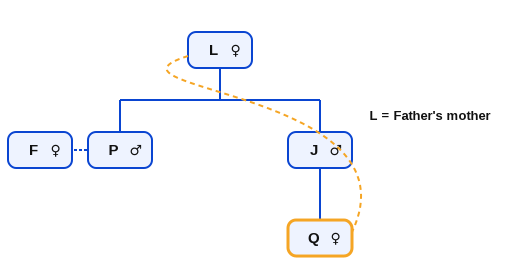
  1. L is the mother of sons P and J.
  2. Q is the daughter of J, so J is Q's father.
  3. L is the mother of Q's father → L is Q's father's mother (paternal grandmother).
  4. F (P's wife) is only a distractor.

Trick: Go up the tree: Q → father J → his mother L.

Answer: (B) Father's mother

अवधारणा: पीढ़ी-दर-पीढ़ी वंश-वृक्ष बनाएँ और Q से ऊपर की ओर संबंध पढ़ें।

  1. L, पुत्रों P और J की माँ है।
  2. Q, J की पुत्री है, अतः J, Q का पिता है।
  3. L, Q के पिता की माँ है → L, Q की दादी (Father's mother) है।
  4. F (P की पत्नी) केवल भ्रमित करने के लिए है।

ट्रिक: वृक्ष में ऊपर जाएँ: Q → पिता J → उसकी माँ L।

उत्तर: (B) Father's mother (पिता की माँ)

RRB NTPC Graduate CBT 1General Intelligence and ReasoningBlood relationsRRB NTPC Graduate CBT 1 2024 · 18 Jun Shift 3 →
Q8000.
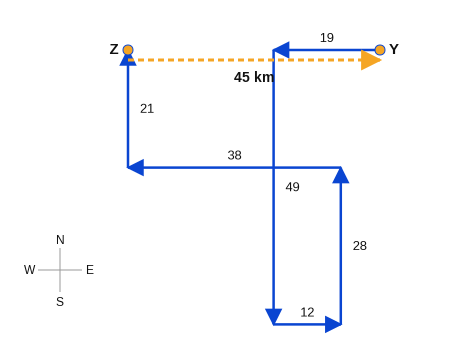
Fenil starts from Point Y and drives 19 km towards the west. He then takes a left turn, drives 49 km, turns left and drives 12 km. He then takes a left turn and drives 28 km. He takes a left turn and drives 38 km. He then turns right and drives 21 km to stop at Point Z. How far (shortest distance) and towards which direction should he drive in order to reach Point Y again? (All turns are 90 degree turns only unless specified.)
फ़ेनिल बिंदु Y से चलना शुरू करता है और पश्चिम की ओर 19 km गाड़ी चलाता है। फिर वह बाएँ मुड़ता है, 49 km गाड़ी चलाता है, बाएँ मुड़ता है और 12 km गाड़ी चलाता है। फिर वह बाएँ मुड़ता है और 28 km गाड़ी चलाता है। वह बाएँ मुड़ता है और 38 km गाड़ी चलाता है। फिर वह दाएँ मुड़ता है और 21 km गाड़ी चलाकर बिंदु Z पर रुक जाता है। बिंदु Y पर फिर से पहुँचने के लिए उसे कितनी दूरी (न्यूनतम दूरी) और किस दिशा में गाड़ी चलानी चाहिए? (जब तक निर्दिष्ट न हो, सभी मोड़ केवल 90 डिग्री के मोड़ हैं।)
  1. A51 km towards the southदक्षिण की ओर 51 km
  2. B39 km towards the westपश्चिम की ओर 39 km
  3. C41 km towards the southदक्षिण की ओर 41 km
  4. D45 km towards the eastपूर्व की ओर 45 km
Show answer

Concept: Track the position on a coordinate grid (East +x, North +y); a left turn while facing West points South.

  1. Y = (0,0). 19 km West → (−19,0); left (South) 49 → (−19,−49).
  2. Left (East) 12 → (−7,−49); left (North) 28 → (−7,−21).
  3. Left (West) 38 → (−45,−21); right (North) 21 → Z =(−45,0).
  4. Z is 45 km West of Y, so he must drive 45 km towards the East.

Trick: Net x: −19+12−38=−45, net y: −49+28+21=0.

Answer: (D) 45 km towards the east

अवधारणा: स्थिति को निर्देशांक (East +x, North +y) में लिखें; पश्चिम की ओर मुँह हो तो बायाँ मोड़ = दक्षिण।

  1. Y =(0,0)। 19 km पश्चिम → (−19,0); बाएँ (दक्षिण) 49 → (−19,−49)।
  2. बाएँ (पूर्व) 12 → (−7,−49); बाएँ (उत्तर) 28 → (−7,−21)।
  3. बाएँ (पश्चिम) 38 → (−45,−21); दाएँ (उत्तर) 21 → Z =(−45,0)।
  4. Z, Y से 45 km पश्चिम में है, अतः उसे 45 km पूर्व जाना होगा।

ट्रिक: कुल x: −19+12−38=−45, कुल y: −49+28+21=0।

उत्तर: (D) 45 km पूर्व की ओर

RRB NTPC Graduate CBT 1General Intelligence and ReasoningDirection and distanceRRB NTPC Graduate CBT 1 2024 · 18 Jun Shift 3 →