Question bank

Q&A: practice questions with answers

Search questions on any topic. Filter by exam category, exam, subject and topic, try the question, then open the answer and explanation.

Courses – airGurukul

20,719 questions found.

Q8001.
In a certain code language, ‘FISH’ is coded as ‘6458’ and ‘HAVE’ is coded as ‘5723’. What is the code for ‘H’ in the given code language?
एक निश्चित कूट भाषा में, ‘FISH’ को ‘6458’ और ‘HAVE’ को ‘5723’ के रूप में कूटबद्ध किया जाता है। दी गई कूट भाषा में ‘H’ का कूट क्या है?
  1. A5
  2. B7
  3. C8
  4. D2
Show answer

Concept: A letter common to both words gets the digit common to both codes.

  1. FISH → {6, 4, 5, 8}; HAVE → {5, 7, 2, 3}.
  2. Common letter: H; common digit: 5.
  3. So H = 5.

Trick: Common letter ↔ common digit (order of digits does not matter).

Answer: (A) 5

अवधारणा: दोनों शब्दों में उभयनिष्ठ अक्षर का कोड दोनों कोडों में उभयनिष्ठ अंक होता है।

  1. FISH → {6, 4, 5, 8}; HAVE → {5, 7, 2, 3}।
  2. उभयनिष्ठ अक्षर: H; उभयनिष्ठ अंक: 5।
  3. अतः H = 5।

ट्रिक: उभयनिष्ठ अक्षर ↔ उभयनिष्ठ अंक (अंकों का क्रम मायने नहीं रखता)।

उत्तर: (A) 5
RRB NTPC Graduate CBT 1General Intelligence and ReasoningCoding-decodingRRB NTPC Graduate CBT 1 2024 · 18 Jun Shift 3 →
Q8002.
Select the pair that follows the same pattern as that followed by the two pairs given below. Both pairs follow the same pattern.
HKO : FJM
DPY : BOW
उस युग्म का चयन कीजिए जो उसी पैटर्न का अनुसरण करता है जिसका अनुसरण नीचे दिए गए दो युग्म करते हैं। दोनों युग्म एक ही पैटर्न का अनुसरण करते हैं।
HKO : FJM
DPY : BOW
  1. AWGO : SCJ
  2. BBPS : AKI
  3. CTRK : RQI
  4. DBZI : WVD
Show answer

Concept: Find the shift applied to each letter position in the given pairs.

  1. HKO → FJM: H−2=F, K−1=J, O−2=M.
  2. DPY → BOW: D−2=B, P−1=O, Y−2=W.
  3. TRK → RQI: T−2=R, R−1=Q, K−2=I ✓.
  4. Others fail, e.g. WGO → SCJ is −4,−4,−5.

Trick: Pattern: −2,−1,−2.

Answer: (C) TRK : RQI

अवधारणा: दिए गए युग्मों में हर अक्षर-स्थान पर लगा अंतर ज्ञात करें।

  1. HKO → FJM: H−2=F, K−1=J, O−2=M।
  2. DPY → BOW: D−2=B, P−1=O, Y−2=W।
  3. TRK → RQI: T−2=R, R−1=Q, K−2=I ✓।
  4. अन्य मेल नहीं खाते, जैसे WGO → SCJ में −4,−4,−5।

ट्रिक: पैटर्न: −2,−1,−2।

उत्तर: (C) TRK : RQI

RRB NTPC Graduate CBT 1General Intelligence and ReasoningLetter analogyRRB NTPC Graduate CBT 1 2024 · 18 Jun Shift 3 →
Q8003.
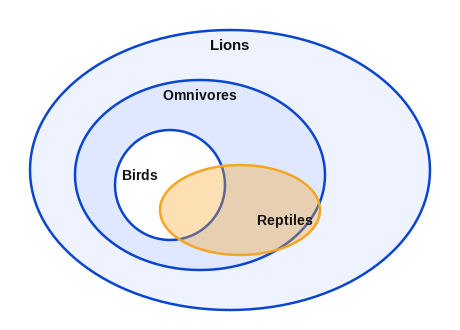
Read the given statements and conclusions carefully. Assuming that the information given in the statements is true, even if it appears to be at variance with commonly known facts, decide which of the given conclusion(s) logically follow(s) from the statements.
Statements:
All birds are omnivores.
All omnivores are lions.
Some birds are reptiles.
Conclusions:
(I) Some omnivores are reptiles.
(II) Some reptiles are lions.
दिए गए कथनों और निष्कर्षों को ध्यानपूर्वक पढ़िए। यह मानते हुए कि कथनों में दी गई जानकारी सत्य है, भले ही वह सामान्यतः ज्ञात तथ्यों से भिन्न प्रतीत होती हो, निर्णय कीजिए कि दिए गए निष्कर्षों में से कौन-सा/कौन-से निष्कर्ष तार्किक रूप से कथनों का अनुसरण करता है/करते हैं।
कथन:
सभी पक्षी सर्वाहारी हैं।
सभी सर्वाहारी शेर हैं।
कुछ पक्षी सरीसृप हैं।
निष्कर्ष:
(I) कुछ सर्वाहारी सरीसृप हैं।
(II) कुछ सरीसृप शेर हैं।
  1. ABoth conclusions (I) and (II) follow.निष्कर्ष (I) और (II) दोनों अनुसरण करते हैं।
  2. BOnly conclusion (I) follows.केवल निष्कर्ष (I) अनुसरण करता है।
  3. COnly conclusion (II) follows.केवल निष्कर्ष (II) अनुसरण करता है।
  4. DEither conclusion (I) or (II) follows.या तो निष्कर्ष (I) या (II) अनुसरण करता है।
Show answer

Concept: Draw the least-overlap Venn diagram consistent with all statements.

  1. Birds ⊂ Omnivores ⊂ Lions.
  2. Some birds are reptiles — that common part is inside Omnivores and Lions as well.
  3. (I) Those reptile-birds are omnivores → Some omnivores are reptiles ✓.
  4. (II) Those reptile-birds are also lions → Some reptiles are lions ✓.

Trick: 'All A are B' + 'Some A are C' ⇒ 'Some B are C' always.

Answer: (A) Both conclusions (I) and (II) follow.

अवधारणा: सभी कथनों के अनुरूप न्यूनतम ओवरलैप वाला वेन आरेख बनाएँ।

  1. Birds ⊂ Omnivores ⊂ Lions।
  2. कुछ Birds, Reptiles हैं — यह साझा भाग Omnivores और Lions के अंदर भी है।
  3. (I) वे reptile-birds omnivores हैं → कुछ omnivores, reptiles हैं ✓।
  4. (II) वे reptile-birds lions भी हैं → कुछ reptiles, lions हैं ✓।

ट्रिक: 'सभी A, B हैं' + 'कुछ A, C हैं' ⇒ 'कुछ B, C हैं' सदैव।

उत्तर: (A) दोनों निष्कर्ष (I) और (II) अनुसरण करते हैं।

RRB NTPC Graduate CBT 1General Intelligence and ReasoningSyllogismRRB NTPC Graduate CBT 1 2024 · 18 Jun Shift 3 →
Q8004.
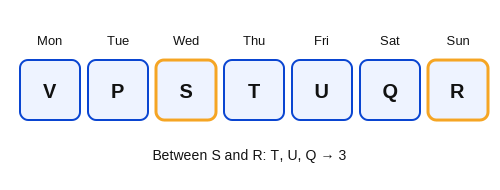
Each of P, Q, R, S, T, U and V has an exam on a different day of a week starting from Monday and ending on Sunday of the same week.
No one has the exam before V. Only four people have exams between P and R. Q has the exam immediately before R. T has the exam before U but after S.
How many people have exams between S and R?
P, Q, R, S, T, U और V में से प्रत्येक की परीक्षा एक ही सप्ताह के सोमवार से शुरू होकर रविवार को समाप्त होने वाले सप्ताह के अलग-अलग दिन है।
V से पहले किसी की परीक्षा नहीं है। P और R के बीच केवल चार व्यक्तियों की परीक्षाएँ हैं। Q की परीक्षा R से ठीक पहले है। T की परीक्षा U से पहले लेकिन S के बाद है।
S और R के बीच कितने व्यक्तियों की परीक्षाएँ हैं?
  1. AThreeतीन
  2. BFourचार
  3. COneएक
  4. DTwoदो
Show answer

Concept: Fix the definite positions first, then place the people with relative conditions.

  1. No one before V → V = Monday.
  2. 4 people between P and R → they are on Tue and Sun.
  3. Q immediately before R: R cannot be Tue (Mon is V), so P = Tue, R = Sun, Q = Sat.
  4. S, T, U fill Wed, Thu, Fri with S before T before U → S Wed, T Thu, U Fri.
  5. Between S (Wed) and R (Sun): T, U, Q = 3.

Trick: With V on Monday, the only gap of 4 is Tue–Sun.

Answer: (A) Three

अवधारणा: पहले निश्चित स्थान तय करें, फिर सापेक्ष शर्तों वाले लोगों को रखें।

  1. V से पहले कोई नहीं → V = सोमवार।
  2. P और R के बीच 4 लोग → वे मंगलवार और रविवार को हैं।
  3. Q, R से ठीक पहले: R मंगलवार नहीं हो सकता (सोमवार V है), अतः P = मंगल, R = रवि, Q = शनि।
  4. S, T, U बुध, गुरु, शुक्र में; S < T < U → S बुध, T गुरु, U शुक्र।
  5. S (बुध) और R (रवि) के बीच: T, U, Q = 3।

ट्रिक: V सोमवार पर हो तो 4 का अंतर केवल मंगल–रवि में बनता है।

उत्तर: (A) तीन

RRB NTPC Graduate CBT 1General Intelligence and ReasoningScheduling puzzleRRB NTPC Graduate CBT 1 2024 · 18 Jun Shift 3 →
Q8005.
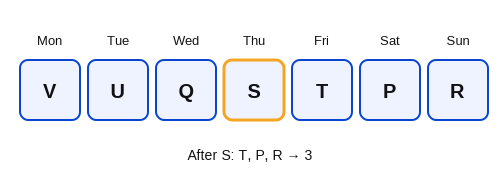
Each of P, Q, R, S, T, U and V has an exam on a different day of a week starting from Monday and ending on Sunday of the same week. T has an exam on Friday. Exactly 3 people have an exam between P and U, neither of whom has on exam on Sunday. S has an exam immediately after Q. V has an exam immediately before U. How many people have an exam after S?
P, Q, R, S, T, U और V में से प्रत्येक की परीक्षा एक ही सप्ताह के सोमवार से शुरू होकर रविवार को समाप्त होने वाले सप्ताह के अलग-अलग दिन है। T की परीक्षा शुक्रवार को है। P और U के बीच ठीक 3 व्यक्तियों की परीक्षाएँ हैं, इन दोनों में से किसी की भी परीक्षा रविवार को नहीं है। S की परीक्षा Q के ठीक बाद है। V की परीक्षा U से ठीक पहले है। S के बाद कितने व्यक्तियों की परीक्षा है?
  1. A3
  2. B1
  3. C4
  4. D2
Show answer

Concept: Number the days Mon = 1 … Sun = 7 and test the possible P–U positions.

  1. T = Fri (5). Exactly 3 between P and U, none on Sunday → pairs (1, 5) or (2, 6); (1, 5) clashes with T.
  2. So P, U are on 2 and 6. V is immediately before U: U = 6 needs V = 5 (T) ✗, hence U = Tue, V = Mon, P = Sat.
  3. Q–S consecutive in the free days Wed, Thu, Sun → Q Wed, S Thu; R = Sun.
  4. After S (Thu): T, P, R = 3.

Trick: Order: V U Q S T P R.

Answer: (A) 3

अवधारणा: दिनों को सोम = 1 … रवि = 7 मानें और P–U के संभावित स्थान जाँचें।

  1. T = शुक्र (5)। P और U के बीच ठीक 3, कोई रविवार पर नहीं → (1, 5) या (2, 6); (1, 5) में T से टकराव।
  2. अतः P, U दिन 2 और 6 पर। V, U से ठीक पहले: U = 6 हो तो V = 5 (T) ✗, अतः U = मंगल, V = सोम, P = शनि।
  3. Q–S लगातार, खाली दिन बुध, गुरु, रवि → Q बुध, S गुरु; R = रवि।
  4. S (गुरु) के बाद: T, P, R = 3।

ट्रिक: क्रम: V U Q S T P R।

उत्तर: (A) 3

RRB NTPC Graduate CBT 1General Intelligence and ReasoningScheduling puzzleRRB NTPC Graduate CBT 1 2024 · 18 Jun Shift 3 →
Q8006.
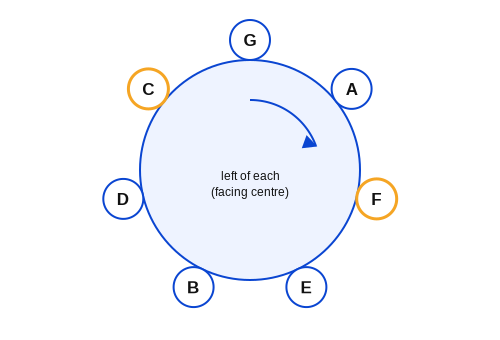
A, B, C, D, E, F, and G are sitting around a circular table facing the centre.
A sits to the immediate left of G. D sits to the immediate left of B. B sits second to the left of F. E sits third to the left of G.
How many people sit between C and F when counted from the left of C?
A, B, C, D, E, F और G एक वृत्ताकार मेज़ के चारों ओर केंद्र की ओर मुख करके बैठे हैं।
A, G के ठीक बाएँ बैठा है। D, B के ठीक बाएँ बैठा है। B, F के बाएँ से दूसरे स्थान पर बैठा है। E, G के बाएँ से तीसरे स्थान पर बैठा है।
C के बाएँ से गिनने पर C और F के बीच कितने व्यक्ति बैठे हैं?
  1. ATwoदो
  2. BOneएक
  3. CThreeतीन
  4. DFourचार
Show answer

Concept: For people facing the centre, 'left' means the clockwise direction.

  1. Fix G. A is immediately left of G; E is third to the left of G.
  2. B is second left of F and D is immediately left of B → F, _, B, D occupy consecutive clockwise seats.
  3. Only free run: F next to A, then E, B, D; C takes the last seat (right of G).
  4. Clockwise order: G, A, F, E, B, D, C.
  5. From C going left: G, A, then F → 2 people between.

Trick: F–B–D form a block of 'skip one, then two together'; fit it into the free seats.

Answer: (A) Two

अवधारणा: केंद्र की ओर मुख वाले व्यक्तियों के लिए 'बायाँ' = घड़ी की सुई की दिशा (clockwise)।

  1. G को स्थिर करें। A, G के ठीक बाएँ; E, G के बाएँ तीसरे स्थान पर।
  2. B, F के बाएँ दूसरे तथा D, B के ठीक बाएँ → F, _, B, D लगातार clockwise सीटें।
  3. एकमात्र स्थान: A के बाद F, फिर E, B, D; C अंतिम सीट (G के दाएँ) पर।
  4. Clockwise क्रम: G, A, F, E, B, D, C।
  5. C से बाईं ओर: G, A, फिर F → बीच में 2 व्यक्ति।

ट्रिक: F–B–D ब्लॉक ('एक छोड़कर फिर दो साथ') को खाली सीटों में बैठाएँ।

उत्तर: (A) दो

RRB NTPC Graduate CBT 1General Intelligence and ReasoningCircular seating arrangementRRB NTPC Graduate CBT 1 2024 · 18 Jun Shift 3 →
Q8007.
What should come in place of the question mark (?) in the given series?
319, 296, 263, ?, 167, 104
दी गई शृंखला में प्रश्न चिह्न (?) के स्थान पर क्या आना चाहिए?
319, 296, 263, ?, 167, 104
  1. A220
  2. B200
  3. C210
  4. D230
Show answer

Concept: Look at the differences between consecutive terms.

  1. 319−296=23, 296−263=33 → differences grow by 10.
  2. Next difference 43: 263−43=220.
  3. Check: 220−53=167, 167−63=104 ✓.

Trick: Differences: −23,−33,−43,−53,−63.

Answer: (A) 220

अवधारणा: क्रमागत पदों के अंतर देखें।

  1. 319−296=23, 296−263=33 → अंतर 10-10 बढ़ता है।
  2. अगला अंतर 43: 263−43=220।
  3. जाँच: 220−53=167, 167−63=104 ✓।

ट्रिक: अंतर: −23,−33,−43,−53,−63।

उत्तर: (A) 220

RRB NTPC Graduate CBT 1General Intelligence and ReasoningNumber seriesRRB NTPC Graduate CBT 1 2024 · 18 Jun Shift 3 →
Q8008.
In a certain code language, ‘NEAR’ is coded as ‘3571’ and ‘WINK’ is coded as ‘2346’. What is the code for ‘N’ in the given code language?
एक निश्चित कूट भाषा में, ‘NEAR’ को ‘3571’ और ‘WINK’ को ‘2346’ के रूप में कूटबद्ध किया जाता है। दी गई कूट भाषा में ‘N’ का कूट क्या है?
  1. A7
  2. B4
  3. C1
  4. D3
Show answer

Concept: A letter common to both words gets the digit common to both codes.

  1. NEAR → {3, 5, 7, 1}; WINK → {2, 3, 4, 6}.
  2. Common letter: N; common digit: 3.
  3. So N = 3.

Trick: Common letter ↔ common digit.

Answer: (D) 3

अवधारणा: दोनों शब्दों में उभयनिष्ठ अक्षर का कोड दोनों कोडों में उभयनिष्ठ अंक होता है।

  1. NEAR → {3, 5, 7, 1}; WINK → {2, 3, 4, 6}।
  2. उभयनिष्ठ अक्षर: N; उभयनिष्ठ अंक: 3।
  3. अतः N = 3।

ट्रिक: उभयनिष्ठ अक्षर ↔ उभयनिष्ठ अंक।

उत्तर: (D) 3

RRB NTPC Graduate CBT 1General Intelligence and ReasoningCoding-decodingRRB NTPC Graduate CBT 1 2024 · 18 Jun Shift 3 →
Q8009.
What will come in the place of the question mark (?) in the following equation, if ‘+’ and ‘−’ are interchanged and ‘×’ and ‘÷’ are interchanged?
117 ÷ 7 + 426 × 6 − 66 = ?
यदि ‘+’ और ‘−’ को आपस में बदल दिया जाए तथा ‘×’ और ‘÷’ को आपस में बदल दिया जाए, तो निम्नलिखित समीकरण में प्रश्न चिह्न (?) के स्थान पर क्या आएगा?
117 ÷ 7 + 426 × 6 − 66 = ?
  1. A811
  2. B804
  3. C809
  4. D814
Show answer

Concept: Interchange the signs first, then solve using BODMAS.

  1. After interchange: 117×7−426÷6+66.
  2. 117×7=819; 426÷6=71.
  3. 819−71+66=814.

Trick: Swap signs on paper before calculating — most errors come from mixing old and new signs.

Answer: (D) 814

अवधारणा: पहले चिह्न बदलें, फिर BODMAS से हल करें।

  1. बदलने के बाद: 117×7−426÷6+66।
  2. 117×7=819; 426÷6=71।
  3. 819−71+66=814।

ट्रिक: गणना से पहले चिह्न बदलकर लिख लें — अधिकतर गलतियाँ पुराने-नए चिह्न मिलाने से होती हैं।

उत्तर: (D) 814

RRB NTPC Graduate CBT 1General Intelligence and ReasoningMathematical operationsRRB NTPC Graduate CBT 1 2024 · 18 Jun Shift 3 →
Q8010.
This question is based on the five, three-digit numbers given below.
(Left) 853 628 981 217 132 (Right)
(Example- 697 – First digit = 6, second digit = 9 and third digit = 7)
(NOTE: All operations to be done from left to right.)
What will be the resultant if the second digit of the highest number is added to the first digit of the lowest number?
यह प्रश्न नीचे दी गई तीन अंकों वाली पाँच संख्याओं पर आधारित है।
(बाएँ) 853 628 981 217 132 (दाएँ)
(उदाहरण- 697 – पहला अंक = 6, दूसरा अंक = 9 और तीसरा अंक = 7)
(नोट: सभी संक्रियाएँ बाएँ से दाएँ की जानी हैं।)
यदि सबसे बड़ी संख्या के दूसरे अंक को सबसे छोटी संख्या के पहले अंक में जोड़ा जाए, तो परिणाम क्या होगा?
  1. A12
  2. B9
  3. C8
  4. D10
Show answer

Concept: Identify the highest and lowest numbers, then pick the required digits.

  1. Highest number = 981 → second digit = 8.
  2. Lowest number = 132 → first digit = 1.
  3. 8+1=9.

Trick: Compare the hundreds digits first: 9 is highest, 1 is lowest.

Answer: (B) 9

अवधारणा: सबसे बड़ी और सबसे छोटी संख्या पहचानें, फिर अपेक्षित अंक लें।

  1. सबसे बड़ी संख्या = 981 → दूसरा अंक = 8।
  2. सबसे छोटी संख्या = 132 → पहला अंक = 1।
  3. 8+1=9।

ट्रिक: पहले सैकड़े के अंक की तुलना करें: 9 सबसे बड़ा, 1 सबसे छोटा।

उत्तर: (B) 9

RRB NTPC Graduate CBT 1General Intelligence and ReasoningNumber operationsRRB NTPC Graduate CBT 1 2024 · 18 Jun Shift 3 →
Q8011.
Which of the following letter-number clusters will replace the question mark (?) in the given series to make it logically complete?
KDG 19 LEH 30 MFI 41 NGJ 52 ?
निम्नलिखित में से कौन-सा अक्षर-संख्या समूह दी गई शृंखला में प्रश्न चिह्न (?) का स्थान लेकर उसे तार्किक रूप से पूर्ण करेगा?
KDG 19 LEH 30 MFI 41 NGJ 52 ?
  1. AOHL 64
  2. BOHK 64
  3. COHK 63
  4. DOHL 63
Show answer

Concept: Each letter moves +1 and the number increases by 11.

  1. First letters: K, L, M, N → O; second: D, E, F, G → H; third: G, H, I, J → K.
  2. Numbers: 19,30,41,52 (each +11) → 52+11=63.
  3. Next term = OHK 63.

Trick: Check the number first: only options with 63 survive, then the third letter K.

Answer: (C) OHK 63

अवधारणा: हर अक्षर +1 आगे बढ़ता है और संख्या 11 बढ़ती है।

  1. पहला अक्षर: K, L, M, N → O; दूसरा: D, E, F, G → H; तीसरा: G, H, I, J → K।
  2. संख्याएँ: 19,30,41,52 (हर बार +11) → 52+11=63।
  3. अगला पद = OHK 63।

ट्रिक: पहले संख्या जाँचें: 63 वाले विकल्प बचे, फिर तीसरा अक्षर K।

उत्तर: (C) OHK 63

RRB NTPC Graduate CBT 1General Intelligence and ReasoningLetter-Number SeriesRRB NTPC Graduate CBT 1 2024 · 18 Jun Shift 3 →
Q8012.
Which of the following letter-clusters should replace # and % so that the pattern and relationship followed between the letter-cluster pair on the left side of :: is the same as that on the right side of :: ?
# : IKO :: TVZ : %
निम्नलिखित में से कौन-से अक्षर-समूह # और % का स्थान लेंगे, ताकि :: के बाईं ओर के अक्षर-समूह युग्म के बीच का पैटर्न और संबंध वही हो जो :: के दाईं ओर के अक्षर-समूह युग्म के बीच है?
# : IKO :: TVZ : %
  1. A# = EGK , % = XZD
  2. B# = FGK , % = XZD
  3. C# = ELK , % = XZD
  4. D# = EGK , % = YZD
Show answer

Concept: Find the rule from the complete pair: each letter moves +4.

  1. Test (A): E +4 = I, G +4 = K, K +4 = O → EGK : IKO ✓.
  2. Same rule on right side: T +4 = X, V +4 = Z, Z +4 = D (wrap-around) → TVZ : XZD ✓.
  3. Also EGK and TVZ both have gaps +2,+4, matching IKO.

Trick: Z + 4 wraps to D (Z→A→B→C→D).

Answer: (A) # = EGK , % = XZD

अवधारणा: पूरे युग्म से नियम निकालें: हर अक्षर +4 आगे।

  1. (A) जाँचें: E +4 = I, G +4 = K, K +4 = O → EGK : IKO ✓।
  2. दाईं ओर वही नियम: T +4 = X, V +4 = Z, Z +4 = D (घूमकर) → TVZ : XZD ✓।
  3. EGK और TVZ दोनों में अंतर +2,+4 है, जैसा IKO में।

ट्रिक: Z + 4 घूमकर D बनता है (Z→A→B→C→D)।

उत्तर: (A) # = EGK , % = XZD

RRB NTPC Graduate CBT 1General Intelligence and ReasoningLetter AnalogyRRB NTPC Graduate CBT 1 2024 · 18 Jun Shift 3 →
Q8013.
In a certain code language, ‘BEAR’ is coded as ‘4567’ and ‘RUIN’ is coded as ‘1234’. What is the code for ‘R’ in the given code language?
एक निश्चित कूट भाषा में, ‘BEAR’ को ‘4567’ और ‘RUIN’ को ‘1234’ के रूप में कूटबद्ध किया जाता है। दी गई कूट भाषा में ‘R’ का कूट क्या है?
  1. A4
  2. B7
  3. C2
  4. D1
Show answer

Concept: A letter common to two words gets the digit common to their codes.

  1. BEAR → 4567 and RUIN → 1234.
  2. Common letter: R only. Common digit: 4 only.
  3. Hence R = 4.

Trick: Common letter ↔ common digit – no need to fix the order.

Answer: (A) 4

अवधारणा: दो शब्दों में उभयनिष्ठ अक्षर का कोड, उनके कोड का उभयनिष्ठ अंक होता है।

  1. BEAR → 4567 और RUIN → 1234।
  2. उभयनिष्ठ अक्षर: केवल R; उभयनिष्ठ अंक: केवल 4।
  3. अतः R = 4।

ट्रिक: उभयनिष्ठ अक्षर ↔ उभयनिष्ठ अंक – क्रम देखने की ज़रूरत नहीं।

उत्तर: (A) 4

RRB NTPC Graduate CBT 1General Intelligence and ReasoningCoding-DecodingRRB NTPC Graduate CBT 1 2024 · 18 Jun Shift 3 →
Q8014.
What will come in the place of the question mark (?) in the following equation, if ‘+’ is replaced by ‘−’ and ‘×’ and ‘÷’ are interchanged?
44 ÷ 8 + 5 × 1 + 7 = ?
यदि ‘+’ को ‘−’ से बदल दिया जाए तथा ‘×’ और ‘÷’ को आपस में बदल दिया जाए, तो निम्नलिखित समीकरण में प्रश्न चिह्न (?) के स्थान पर क्या आएगा?
44 ÷ 8 + 5 × 1 + 7 = ?
  1. A340
  2. B300
  3. C400
  4. D250
Show answer

Concept: Replace the signs first, then apply BODMAS.

  1. 44÷8+5×1+7 becomes 44×8−5÷1−7.
  2. =352−5−7
  3. =340

Trick: Rewrite the whole expression with new signs before calculating.

Answer: (A) 340

अवधारणा: पहले चिह्न बदलें, फिर BODMAS लगाएँ।

  1. 44÷8+5×1+7 बनता है 44×8−5÷1−7।
  2. =352−5−7
  3. =340

ट्रिक: गणना से पहले पूरा व्यंजक नए चिह्नों के साथ लिख लें।

उत्तर: (A) 340

RRB NTPC Graduate CBT 1General Intelligence and ReasoningMathematical OperationsRRB NTPC Graduate CBT 1 2024 · 18 Jun Shift 3 →
Q8015.
If 2 is added to each odd digit and 1 is subtracted from each even digit in the number 5634812, how many digits will appear more than once in the new number thus formed?
यदि संख्या 5634812 में प्रत्येक विषम अंक में 2 जोड़ दिया जाए और प्रत्येक सम अंक में से 1 घटा दिया जाए, तो इस प्रकार बनी नई संख्या में कितने अंक एक से अधिक बार आएँगे?
  1. A1
  2. B3
  3. C2
  4. D0
Show answer

Concept: Odd digit → +2, even digit → −1.

  1. 5634812: 5→7, 6→5, 3→5, 4→3, 8→7, 1→3, 2→1.
  2. New number = 7553731.
  3. 7 appears twice, 5 twice, 3 twice; 1 once → 3 digits repeat.

Trick: Write the new digits in a row and tally – avoid mental shortcuts.

Answer: (B) 3

अवधारणा: विषम अंक → +2, सम अंक → −1।

  1. 5634812: 5→7, 6→5, 3→5, 4→3, 8→7, 1→3, 2→1।
  2. नई संख्या = 7553731।
  3. 7 दो बार, 5 दो बार, 3 दो बार; 1 एक बार → 3 अंक दोहराए गए।

ट्रिक: नए अंक एक पंक्ति में लिखकर गिनें – मन में गणना न करें।

उत्तर: (B) 3

RRB NTPC Graduate CBT 1General Intelligence and ReasoningNumber OperationsRRB NTPC Graduate CBT 1 2024 · 18 Jun Shift 3 →
Q8016.
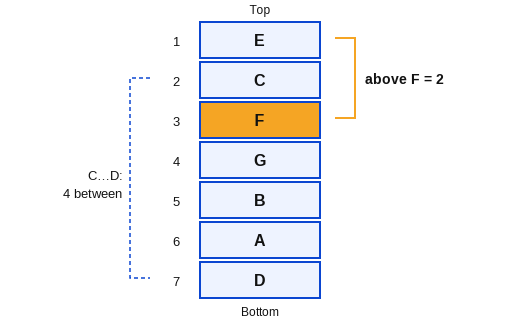
Seven boxes, A, B, C, D, E, F and G, are kept one over the other, but not necessarily in the same order. Only four boxes are kept between C and D. Only E is kept above C. Only two boxes are kept between F and A. G is kept immediately above B. A is not kept immediately above G. How many boxes are kept above F?
सात डिब्बे, A, B, C, D, E, F और G, एक के ऊपर एक रखे गए हैं, परंतु आवश्यक नहीं कि इसी क्रम में हों। C और D के बीच केवल चार डिब्बे रखे गए हैं। C के ऊपर केवल E रखा गया है। F और A के बीच केवल दो डिब्बे रखे गए हैं। G, B के ठीक ऊपर रखा गया है। A, G के ठीक ऊपर नहीं रखा गया है। F के ऊपर कितने डिब्बे रखे गए हैं?
  1. A4
  2. B1
  3. C2
  4. D3
Show answer

Concept: Number positions 1 (top) to 7 (bottom) and place the fixed clues first.

  1. Only E above C → E = 1, C = 2. Four boxes between C and D → D = 7.
  2. G immediately above B: (G, B) can be (4, 5) only, since F and A need two boxes between them in the remaining slots 3 and 6.
  3. A is not immediately above G (G = 4) → A ≠ 3, so A = 6, F = 3.
  4. Above F: E and C → 2 boxes.

Trick: Fix "only one above" type clues first – they lock the top positions.

Answer: (C) 2

अवधारणा: स्थान 1 (ऊपर) से 7 (नीचे) तक मानें और पहले निश्चित संकेत रखें।

  1. केवल E, C के ऊपर → E = 1, C = 2। C और D के बीच चार बॉक्स → D = 7।
  2. G ठीक B के ऊपर: (G, B) केवल (4, 5) हो सकते हैं, क्योंकि F और A के बीच दो बॉक्स चाहिए – शेष स्थान 3 और 6।
  3. A ठीक G (4) के ऊपर नहीं → A ≠ 3, अतः A = 6, F = 3।
  4. F के ऊपर: E और C → 2 बॉक्स।

ट्रिक: "केवल एक ऊपर" जैसे संकेत पहले लगाएँ – वे ऊपरी स्थान तय कर देते हैं।

उत्तर: (C) 2

RRB NTPC Graduate CBT 1General Intelligence and ReasoningBox ArrangementRRB NTPC Graduate CBT 1 2024 · 18 Jun Shift 3 →
Q8017.
GF 7 is related to EA -10 in a certain way. In the same way, UG 14 is related to SB -3. To which of the given options is LN 2 related, following the same logic?
GF 7 एक निश्चित प्रकार से EA -10 से संबंधित है। उसी प्रकार, UG 14, SB -3 से संबंधित है। समान तर्क का अनुसरण करते हुए, LN 2 दिए गए विकल्पों में से किससे संबंधित है?
  1. AII -13
  2. BJJ -14
  3. CIJ -15
  4. DJI -15
Show answer

Concept: First letter −2, second letter −5, number −17.

  1. GF 7 → EA −10: G−2=E, F−5=A, 7−17=−10.
  2. UG 14 → SB −3: U−2=S, G−5=B, 14−17=−3.
  3. LN 2 → L−2=J, N−5=I, 2−17=−15 → JI −15.

Trick: Number part alone gives −15; then pick J first, I second.

Answer: (D) JI −15

अवधारणा: पहला अक्षर −2, दूसरा अक्षर −5, संख्या −17।

  1. GF 7 → EA −10: G−2=E, F−5=A, 7−17=−10।
  2. UG 14 → SB −3: U−2=S, G−5=B, 14−17=−3।
  3. LN 2 → L−2=J, N−5=I, 2−17=−15 → JI −15।

ट्रिक: केवल संख्या से −15 मिलता है; फिर पहले J, फिर I चुनें।

उत्तर: (D) JI −15

RRB NTPC Graduate CBT 1General Intelligence and ReasoningLetter-Number AnalogyRRB NTPC Graduate CBT 1 2024 · 18 Jun Shift 3 →
Q8018.
Based on the English alphabetical order, three of the following four letter-cluster pairs are alike in a certain way and thus form a group. Which letter-cluster pair DOES NOT belong to that group?
(Note: The odd one out is not based on the number of consonants/vowels or their position in the letter-cluster.)
अंग्रेज़ी वर्णमाला क्रम के आधार पर, निम्नलिखित चार अक्षर-समूह युग्मों में से तीन किसी निश्चित प्रकार से एक समान हैं और इस प्रकार एक समूह बनाते हैं। कौन-सा अक्षर-समूह युग्म उस समूह से संबंधित नहीं है?
(नोट: असंगत अक्षर-समूह, अक्षर-समूह में व्यंजनों/स्वरों की संख्या या उनके स्थान पर आधारित नहीं है।)
  1. AVP – DX
  2. BZT – HB
  3. CDX – LE
  4. DHB – PJ
Show answer

Concept: In each pair, every letter of the first cluster moves +8 to give the second cluster.

  1. VP – DX: V+8=D, P+8=X ✓; ZT – HB: Z+8=H, T+8=B ✓.
  2. HB – PJ: H+8=P, B+8=J ✓.
  3. DX – LE: D+8=L but X+8=F, not E ✗ → odd one.

Trick: Use wrap-around: X(24) +8=32−26=6 = F.

Answer: (C) DX – LE

अवधारणा: हर युग्म में पहले समूह का प्रत्येक अक्षर +8 आगे जाकर दूसरा समूह बनाता है।

  1. VP – DX: V+8=D, P+8=X ✓; ZT – HB: Z+8=H, T+8=B ✓।
  2. HB – PJ: H+8=P, B+8=J ✓।
  3. DX – LE: D+8=L पर X+8=F, E नहीं ✗ → विषम।

ट्रिक: घुमाव (wrap-around): X(24) +8=32−26=6 = F।

उत्तर: (C) DX – LE

RRB NTPC Graduate CBT 1General Intelligence and ReasoningLetter-Cluster Odd One OutRRB NTPC Graduate CBT 1 2024 · 18 Jun Shift 3 →
Q8019.
This question is based on the five, three-digit numbers given below.
(Left) 441 317 999 155 444 (Right)
(Example- 697 – First digit = 6, second digit = 9 and third digit = 7)
(NOTE: All operations to be done from left to right.)
What will be the resultant if the third digit of the highest number is subtracted from the first digit of the lowest number?
यह प्रश्न नीचे दी गई तीन अंकों वाली पाँच संख्याओं पर आधारित है।
(बाएँ) 441 317 999 155 444 (दाएँ)
(उदाहरण- 697 – पहला अंक = 6, दूसरा अंक = 9 और तीसरा अंक = 7)
(नोट: सभी संक्रियाएँ बाएँ से दाएँ की जानी हैं।)
यदि सबसे बड़ी संख्या के तीसरे अंक को सबसे छोटी संख्या के पहले अंक में से घटाया जाए, तो परिणाम क्या होगा?
  1. A−8
  2. B−9
  3. C−5
  4. D−7
Show answer

Concept: Identify the highest and lowest numbers, then pick the asked digits.

  1. Highest number = 999 → third digit = 9.
  2. Lowest number = 155 → first digit = 1.
  3. "Third digit of highest subtracted from first digit of lowest" =1−9=−8.

Trick: "A subtracted from B" means B−A.

Answer: (A) −8

अवधारणा: सबसे बड़ी और सबसे छोटी संख्या पहचानें, फिर पूछे गए अंक लें।

  1. सबसे बड़ी संख्या = 999 → तीसरा अंक = 9।
  2. सबसे छोटी संख्या = 155 → पहला अंक = 1।
  3. "सबसे बड़ी का तीसरा अंक, सबसे छोटी के पहले अंक में से घटाएँ" =1−9=−8।

ट्रिक: "A को B में से घटाना" अर्थात B−A।

उत्तर: (A) −8

RRB NTPC Graduate CBT 1General Intelligence and ReasoningNumber PuzzleRRB NTPC Graduate CBT 1 2024 · 18 Jun Shift 3 →
Q8020.
LIQM is related to JGOK in a certain way based on the English alphabetical order. In the same way, IFNJ is related to GDLH. To which of the given options is OLTP related, following the same logic?
अंग्रेज़ी वर्णमाला क्रम के आधार पर LIQM एक निश्चित प्रकार से JGOK से संबंधित है। उसी प्रकार, IFNJ, GDLH से संबंधित है। समान तर्क का अनुसरण करते हुए, OLTP दिए गए विकल्पों में से किससे संबंधित है?
  1. AJMRN
  2. BJMNR
  3. CMJNR
  4. DMJRN
Show answer

Concept: Each letter moves 2 steps back.

  1. LIQM → JGOK: L−2=J, I−2=G, Q−2=O, M−2=K.
  2. IFNJ → GDLH: same −2 rule ✓.
  3. OLTP → O−2=M, L−2=J, T−2=R, P−2=N → MJRN.

Trick: Only option starting with M and ending with N in order MJ_N: MJRN.

Answer: (D) MJRN

अवधारणा: हर अक्षर 2 स्थान पीछे जाता है।

  1. LIQM → JGOK: L−2=J, I−2=G, Q−2=O, M−2=K।
  2. IFNJ → GDLH: वही −2 नियम ✓।
  3. OLTP → O−2=M, L−2=J, T−2=R, P−2=N → MJRN।

ट्रिक: M से शुरू और N पर खत्म, क्रम MJ_N: MJRN।

उत्तर: (D) MJRN

RRB NTPC Graduate CBT 1General Intelligence and ReasoningLetter AnalogyRRB NTPC Graduate CBT 1 2024 · 18 Jun Shift 3 →