Question bank

Q&A: practice questions with answers

Search questions on any topic. Filter by exam category, exam, subject and topic, try the question, then open the answer and explanation.

Courses – airGurukul

20,719 questions found.

Q8181.
If the selling price of a bed is 2-times of initial, then the profit is 6-times of initial. Find the initial profit percentage (in %).
यदि एक पलंग का विक्रय मूल्य प्रारंभिक का 2 गुना हो, तो लाभ प्रारंभिक का 6 गुना हो जाता है। प्रारंभिक लाभ प्रतिशत (% में) ज्ञात कीजिए।
  1. A33.33
  2. B300
  3. C200
  4. D25
Show answer

Concept: Cost price stays the same; profit = SP − CP.

  1. Let CP =C, SP =S. New SP =2S, new profit =6(S−C).
  2. 2S−C=6S−6C⇒5C=4S⇒S=54C
  3. Initial profit =S−CC×100=14×100=25%

Trick: Test option: CP 100, SP 125, profit 25; SP 250 → profit 150 = 6 × 25 ✓.

Answer: (D) 25

अवधारणा: क्रय मूल्य वही रहता है; लाभ = SP − CP।

  1. माना CP =C, SP =S। नया SP =2S, नया लाभ =6(S−C)।
  2. 2S−C=6S−6C⇒5C=4S⇒S=54C
  3. प्रारंभिक लाभ =S−CC×100=14×100=25%

ट्रिक: विकल्प जाँचें: CP 100, SP 125, लाभ 25; SP 250 → लाभ 150 = 6 × 25 ✓।

उत्तर: (D) 25
RRB NTPC Graduate CBT 1MathematicsProfit PercentageRRB NTPC Graduate CBT 1 2024 · 18 Jun Shift 1 →
Q8182.
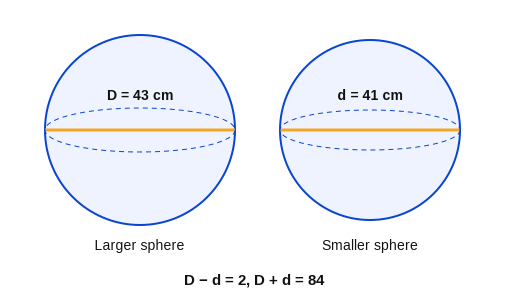
The diameter of a sphere is 2 cm more than the diameter of a smaller sphere. The surface area of the larger sphere is 528 cm2 more than the surface area of the smaller sphere. What is the diameter (in cm) of the larger sphere?
(Use π=227)
एक गोले का व्यास एक छोटे गोले के व्यास से 2 cm अधिक है। बड़े गोले का पृष्ठीय क्षेत्रफल छोटे गोले के पृष्ठीय क्षेत्रफल से 528 cm2 अधिक है। बड़े गोले का व्यास (cm में) क्या है?
(π=227 का प्रयोग कीजिए)
  1. A43
  2. B41
  3. C39
  4. D45
Show answer

Concept: Surface area of a sphere =4πr2=πD2 (since D=2r).

  1. Let diameters be D (larger) and d (smaller); D−d=2.
  2. πD2−πd2=528⇒227(D−d)(D+d)=528.
  3. (D+d)=528×722×2=84.
  4. D=84+22=43cm.

Trick: Use π(D2−d2) directly with diameters – avoids halving radii.

Answer: (A) 43

अवधारणा: गोले का पृष्ठीय क्षेत्रफल =4πr2=πD2 (क्योंकि D=2r)।

  1. बड़े व छोटे गोले के व्यास D और d; D−d=2।
  2. πD2−πd2=528⇒227(D−d)(D+d)=528।
  3. (D+d)=528×722×2=84।
  4. D=84+22=43cm।

ट्रिक: व्यास के साथ सीधे π(D2−d2) लगाएँ – त्रिज्या निकालने की ज़रूरत नहीं।

उत्तर: (A) 43

RRB NTPC Graduate CBT 1MathematicsMensuration – SphereRRB NTPC Graduate CBT 1 2024 · 18 Jun Shift 1 →
Q8183.
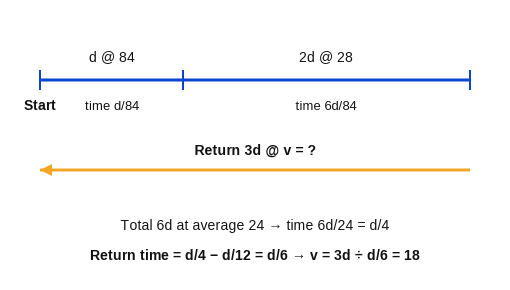
Amita travels a certain distance at a speed of 84 km/hr and double the earlier distance at 28 km/hr. She then returns to the starting point through the same route. If her average speed for the entire journey is 24 km/hr, then what is her speed (in km/hr) for the return journey?
अमिता एक निश्चित दूरी 84 km/hr की चाल से और उससे दोगुनी दूरी 28 km/hr की चाल से तय करती है। फिर वह उसी मार्ग से आरंभिक बिंदु पर लौटती है। यदि पूरी यात्रा के लिए उसकी औसत चाल 24 km/hr है, तो वापसी यात्रा में उसकी चाल (km/hr में) क्या है?
  1. A17.2
  2. B16
  3. C18
  4. D21.5
Show answer

Concept: Average speed =total distancetotal time.

  1. Forward: d at 84 and 2d at 28; time =d84+2d28=7d84=d12.
  2. Return distance =3d, so total distance =6d; total time =6d24=d4.
  3. Return time =d4−d12=d6.
  4. Return speed =3dd/6=18km/h.

Trick: Take d=84: forward time =1+6=7 h, total time =50424=21 h, return =14 h for 252 km → 18.

Answer: (C) 18

अवधारणा: औसत चाल =कुल दूरीकुल समय।

  1. जाते समय: d दूरी 84 पर और 2d दूरी 28 पर; समय =d84+2d28=d12।
  2. वापसी दूरी =3d, कुल दूरी =6d; कुल समय =6d24=d4।
  3. वापसी समय =d4−d12=d6।
  4. वापसी चाल =3dd/6=18km/h।

ट्रिक: d=84 मानें: जाने का समय =1+6=7 घंटे, कुल समय =21 घंटे, वापसी =14 घंटे में 252 km → 18।

उत्तर: (C) 18

RRB NTPC Graduate CBT 1MathematicsSpeed, distance and time – Average speedRRB NTPC Graduate CBT 1 2024 · 18 Jun Shift 1 →
Q8184.
If α and β are the roots of the equation x2 − 6x − 5 = 0, then find the equation having the roots 3α and 3β.
यदि α और β समीकरण x2 − 6x − 5 = 0 के मूल हैं, तो वह समीकरण ज्ञात कीजिए जिसके मूल 3α और 3β हैं।
  1. Ax2−18x−48=0
  2. Bx2−18x−45=0
  3. Cx2−15x+48=0
  4. Dx2−15x+45=0
Show answer

Concept: A quadratic with roots p,q is x2−(p+q)x+pq=0.

  1. For x2−6x−5=0: α+β=6, αβ=−5.
  2. New sum =3α+3β=18.
  3. New product =9αβ=−45.
  4. Equation: x2−18x−45=0.

Trick: Roots multiplied by k: replace x by xk → x2−6(3)x−5(9)=0.

Answer: (B) x2−18x−45=0

अवधारणा: मूल p,q वाला द्विघात समीकरण x2−(p+q)x+pq=0 होता है।

  1. x2−6x−5=0 से: α+β=6, αβ=−5।
  2. नया योग =3α+3β=18।
  3. नया गुणनफल =9αβ=−45।
  4. समीकरण: x2−18x−45=0।

ट्रिक: मूलों को k गुना करने पर x की जगह xk रखें → x2−6(3)x−5(9)=0।

उत्तर: (B) x2−18x−45=0

RRB NTPC Graduate CBT 1MathematicsAlgebra – Quadratic equationsRRB NTPC Graduate CBT 1 2024 · 18 Jun Shift 1 →
Q8185.
The present cost of an apartment is ₹1,70,014. After a year, its cost increased to ₹1,93,900. The percentage increase (rounded off to the nearest integer) in the cost of the apartment is:
एक अपार्टमेंट का वर्तमान मूल्य ₹1,70,014 है। एक वर्ष बाद, इसका मूल्य बढ़कर ₹1,93,900 हो गया। अपार्टमेंट के मूल्य में प्रतिशत वृद्धि (निकटतम पूर्णांक तक पूर्णांकित) है:
  1. A28%
  2. B3%
  3. C14%
  4. D22%
Show answer

Concept: Increase%=increaseoriginal×100.

  1. Increase =193900−170014=23886.
  2. %=23886170014×100≈14.05%.
  3. Rounded: 14%.

Trick: 10% of 170014 ≈ 17000, 15% ≈ 25500; 23886 lies just below 15% → 14%.

Answer: (C) 14%

अवधारणा: वृद्धि%=वृद्धिमूल×100।

  1. वृद्धि =193900−170014=23886।
  2. %=23886170014×100≈14.05%।
  3. पूर्णांकित: 14%।

ट्रिक: 170014 का 10% ≈ 17000, 15% ≈ 25500; 23886 15% से थोड़ा कम → 14%।

उत्तर: (C) 14%

RRB NTPC Graduate CBT 1MathematicsPercentage – IncreaseRRB NTPC Graduate CBT 1 2024 · 18 Jun Shift 1 →
Q8186.
The equivalent fraction of 6.555... is:
6.555... का समतुल्य भिन्न है:
  1. A599
  2. B613
  3. C5613
  4. D5317
Show answer

Concept: A pure recurring decimal 0.a―=a9.

  1. 6.555…=6+0.5―.
  2. 0.5―=59.
  3. 6+59=54+59=599.

Trick: Check: 59÷9=6.555… ✓

Answer: (A) 599

अवधारणा: शुद्ध आवर्ती दशमलव 0.a―=a9।

  1. 6.555…=6+0.5―।
  2. 0.5―=59।
  3. 6+59=54+59=599।

ट्रिक: जाँच: 59÷9=6.555… ✓

उत्तर: (A) 599

RRB NTPC Graduate CBT 1MathematicsNumber system – Recurring decimalsRRB NTPC Graduate CBT 1 2024 · 18 Jun Shift 1 →
Q8187.
The median of the observations 59, 67, 17, 38, 88, 61, 80, 91, 30, 48 and 80 is:
प्रेक्षणों 59, 67, 17, 38, 88, 61, 80, 91, 30, 48 और 80 की माध्यिका है:
  1. A61
  2. B59
  3. C67
  4. D58
Show answer

Concept: For n (odd) observations in order, median =(n+12)th value.

  1. Ascending order: 17, 30, 38, 48, 59, 61, 67, 80, 80, 88, 91.
  2. n=11, so median is the 11+12=6th value.
  3. 6th value =61.

Trick: Always sort first – the unsorted middle value (88) is a trap.

Answer: (A) 61

अवधारणा: n (विषम) प्रेक्षणों को क्रम में रखने पर माध्यिका =(n+12)वाँ मान।

  1. आरोही क्रम: 17, 30, 38, 48, 59, 61, 67, 80, 80, 88, 91।
  2. n=11, अतः माध्यिका 11+12=6ठा मान।
  3. 6ठा मान =61।

ट्रिक: पहले क्रम में लगाएँ – बिना क्रम का बीच वाला मान (88) जाल है।

उत्तर: (A) 61

RRB NTPC Graduate CBT 1MathematicsStatistics – MedianRRB NTPC Graduate CBT 1 2024 · 18 Jun Shift 1 →
Q8188.
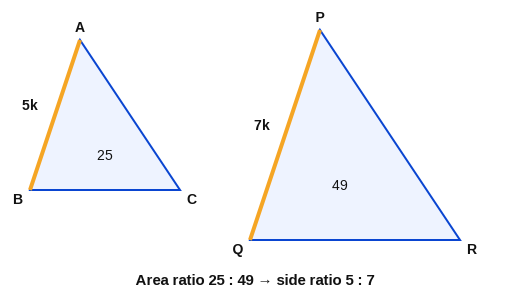
If ΔABC~ΔPQR and area(ΔABC)area(ΔPQR)=2549, then what is the value of AB : PQ?
यदि ΔABC~ΔPQR और area(ΔABC)area(ΔPQR)=2549 है, तो AB : PQ का मान क्या है?
  1. A3 : 7
  2. B2 : 7
  3. C5 : 7
  4. D4 : 7
Show answer

Concept: For similar triangles, ratio of areas = (ratio of corresponding sides)2.

  1. (ABPQ)2=2549.
  2. ABPQ=2549=57.
  3. AB:PQ=5:7.

Trick: Sides = square root of area ratio; area = square of side ratio.

Answer: (C) 5:7

अवधारणा: समरूप त्रिभुजों में क्षेत्रफलों का अनुपात = (संगत भुजाओं का अनुपात)2।

  1. (ABPQ)2=2549।
  2. ABPQ=2549=57।
  3. AB:PQ=5:7।

ट्रिक: भुजा अनुपात = क्षेत्रफल अनुपात का वर्गमूल।

उत्तर: (C) 5:7

RRB NTPC Graduate CBT 1MathematicsGeometry – Similar trianglesRRB NTPC Graduate CBT 1 2024 · 18 Jun Shift 1 →
Q8189.
Simplify: [(22×6)×{8÷4×(15−114)}]
सरल कीजिए: [(22×6)×{8÷4×(15−114)}]
  1. A3277
  2. B3234
  3. C3262
  4. D3275
Show answer

Concept: Solve the innermost bracket first, then ÷ and × from left to right.

  1. 15−114=60−114=494.
  2. 8÷4×494=2×494=492.
  3. 22×6=132.
  4. 132×492=66×49=3234.

Trick: 66×49=66×50−66=3300−66=3234.

Answer: (B) 3234

अवधारणा: पहले सबसे भीतरी कोष्ठक, फिर बाएँ से दाएँ ÷ और ×।

  1. 15−114=60−114=494।
  2. 8÷4×494=2×494=492।
  3. 22×6=132।
  4. 132×492=66×49=3234।

ट्रिक: 66×49=66×50−66=3300−66=3234।

उत्तर: (B) 3234

RRB NTPC Graduate CBT 1MathematicsSimplification – BODMASRRB NTPC Graduate CBT 1 2024 · 18 Jun Shift 1 →
Q8190.
13 men and 3 women can complete a piece of work in 7 days, and 5 men and 6 women can complete the same work in 18 days. The work of how many women is equivalent to that of one man?
13 पुरुष और 3 महिलाएँ एक कार्य को 7 दिनों में पूरा कर सकते हैं, और 5 पुरुष और 6 महिलाएँ उसी कार्य को 18 दिनों में पूरा कर सकते हैं। कितनी महिलाओं का कार्य एक पुरुष के कार्य के बराबर है?
  1. A87
  2. B84
  3. C88
  4. D90
Show answer

Concept: Same work: (workers × days) must be equal.

  1. (13m+3w)×7=(5m+6w)×18.
  2. 91m+21w=90m+108w.
  3. m=87w.
  4. So 1 man = 87 women.

Trick: Cross-multiply efficiencies with days, collect m on one side, w on the other.

Answer: (A) 87

अवधारणा: समान कार्य के लिए (श्रमिक × दिन) बराबर होता है।

  1. (13m+3w)×7=(5m+6w)×18।
  2. 91m+21w=90m+108w।
  3. m=87w।
  4. अतः 1 पुरुष = 87 महिलाएँ।

ट्रिक: दिनों से गुणा करें, m एक ओर और w दूसरी ओर रखें।

उत्तर: (A) 87

RRB NTPC Graduate CBT 1MathematicsTime and work – Men and womenRRB NTPC Graduate CBT 1 2024 · 18 Jun Shift 1 →
Q8191.
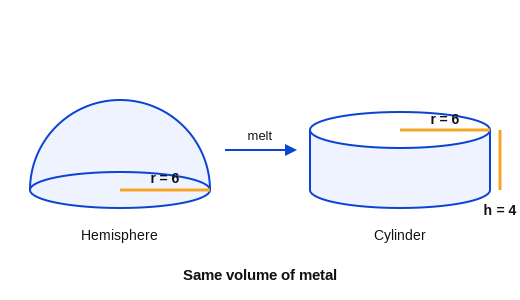
A solid metal hemisphere has a radius of 6 cm. If the metal of the hemisphere is melted and recast into a cylindrical shape with the same radius, find the height of the cylinder.
धातु के एक ठोस अर्धगोले की त्रिज्या 6 cm है। यदि अर्धगोले की धातु को पिघलाकर समान त्रिज्या वाले एक बेलन के आकार में ढाला जाता है, तो बेलन की ऊँचाई ज्ञात कीजिए।
  1. A12 cm
  2. B8 cm
  3. C6 cm
  4. D4 cm
Show answer

Concept: On melting and recasting, volume stays the same. Hemisphere =23πr3, cylinder =πr2h.

  1. πr2h=23πr3.
  2. h=23r=23×6.
  3. h=4cm.

Trick: Same radius: cylinder height =23 of radius (for hemisphere).

Answer: (D) 4cm

अवधारणा: पिघलाकर दोबारा ढालने पर आयतन समान रहता है। अर्धगोला =23πr3, बेलन =πr2h।

  1. πr2h=23πr3।
  2. h=23r=23×6।
  3. h=4cm।

ट्रिक: समान त्रिज्या: बेलन की ऊँचाई = त्रिज्या का 23 (अर्धगोले से)।

उत्तर: (D) 4cm

RRB NTPC Graduate CBT 1MathematicsMensuration – Recasting solidsRRB NTPC Graduate CBT 1 2024 · 18 Jun Shift 1 →
Q8192.
5 times the present age of Sujatha is 5 years more than 2 times the present age of Vanita. After 4 years, 3 times the age of Vanita will be 8 years less than 5 times the age of Sujatha. The age of Vanita is k years more than that of Sujatha. What is the value of k?
सुजाता की वर्तमान आयु का 5 गुना, वनिता की वर्तमान आयु के 2 गुने से 5 वर्ष अधिक है। 4 वर्ष बाद, वनिता की आयु का 3 गुना, सुजाता की आयु के 5 गुने से 8 वर्ष कम होगा। वनिता की आयु सुजाता की आयु से k वर्ष अधिक है। k का मान क्या है?
  1. A2
  2. B3
  3. C4
  4. D5
Show answer

Concept: Write present ages as variables and form two equations.

  1. Let Sujatha =S, Vanita =V. Then 5S=2V+5.
  2. After 4 years: 3(V+4)=5(S+4)−8⇒3V=5S.
  3. So 3V=2V+5⇒V=5, and 5S=15⇒S=3.
  4. k=V−S=5−3=2.

Trick: Substitute 5S from the first equation into the second – one step.

Answer: (A) 2

अवधारणा: वर्तमान आयु को चर मानकर दो समीकरण बनाएँ।

  1. सुजाता =S, वनिता =V। तब 5S=2V+5।
  2. 4 वर्ष बाद: 3(V+4)=5(S+4)−8⇒3V=5S।
  3. अतः 3V=2V+5⇒V=5, और 5S=15⇒S=3।
  4. k=V−S=5−3=2।

ट्रिक: पहले समीकरण से 5S सीधे दूसरे में रखें।

उत्तर: (A) 2

RRB NTPC Graduate CBT 1MathematicsProblems on agesRRB NTPC Graduate CBT 1 2024 · 18 Jun Shift 1 →
Q8193.
A student scores 80 marks in a subject with a weightage of 3 and 90 marks in another subject with a weightage of 2. What is the weighted average score of the student?
एक छात्र 3 भारांक (weightage) वाले एक विषय में 80 अंक और 2 भारांक वाले दूसरे विषय में 90 अंक प्राप्त करता है। छात्र का भारित औसत अंक क्या है?
  1. A84
  2. B88
  3. C86
  4. D82
Show answer

Concept: Weighted average=∑(marks×weight)∑weights.

  1. 80×3+90×2=240+180=420.
  2. Total weight =3+2=5.
  3. Weighted average =4205=84.

Trick: Answer lies nearer 80 (bigger weight): 80+25×10=84.

Answer: (A) 84

अवधारणा: भारित औसत=∑(अंक×भार)∑भार।

  1. 80×3+90×2=240+180=420।
  2. कुल भार =3+2=5।
  3. भारित औसत =4205=84।

ट्रिक: उत्तर 80 के निकट (अधिक भार): 80+25×10=84।

उत्तर: (A) 84

RRB NTPC Graduate CBT 1MathematicsAverage – Weighted averageRRB NTPC Graduate CBT 1 2024 · 18 Jun Shift 1 →
Q8194.
Two banks, A and B, offered loans at 3.5% and 6.5% per annum, respectively. Keshav borrowed an amount of ₹2,00,000 from each bank. Find the positive difference between the amounts of simple interest paid to the two banks by Keshav after 2 years.
दो बैंक, A और B, क्रमशः 3.5% और 6.5% वार्षिक दर पर ऋण प्रदान करते हैं। केशव ने प्रत्येक बैंक से ₹2,00,000 की राशि उधार ली। 2 वर्ष बाद केशव द्वारा दोनों बैंकों को चुकाए गए साधारण ब्याज की राशियों के बीच धनात्मक अंतर ज्ञात कीजिए।
  1. A13,500
  2. B13,000
  3. C11,500
  4. D12,000
Show answer

Concept: SI=P×R×T100; with equal P and T, difference depends only on the rate difference.

  1. Rate difference =6.5%−3.5%=3%.
  2. Difference =200000×3×2100.
  3. =12000.

Trick: Use the rate gap directly instead of finding both interests.

Answer: (D) ₹12,000

अवधारणा: SI=P×R×T100; P और T समान होने पर अंतर केवल दरों के अंतर पर निर्भर है।

  1. दरों का अंतर =6.5%−3.5%=3%।
  2. अंतर =200000×3×2100।
  3. =12000।

ट्रिक: दोनों ब्याज अलग निकालने के बजाय सीधे दर-अंतर लें।

उत्तर: (D) ₹12,000

RRB NTPC Graduate CBT 1MathematicsSimple interestRRB NTPC Graduate CBT 1 2024 · 18 Jun Shift 1 →
Q8195.
The average marks of 30 students in a mathematics test were found to be 55. However, it was later discovered that a mark of 72 was mistakenly recorded as 27, and another mark of 64 was mistakenly recorded as 46. What is the actual average score?
गणित की एक परीक्षा में 30 छात्रों के औसत अंक 55 पाए गए। हालाँकि, बाद में पता चला कि 72 अंक को गलती से 27 और एक अन्य 64 अंक को गलती से 46 दर्ज कर दिया गया था। वास्तविक औसत अंक क्या है?
  1. A60.2
  2. B55.5
  3. C63.4
  4. D57.1
Show answer

Concept: Correct total = wrong total + (correct values − wrong values).

  1. Wrong total =30×55=1650.
  2. Correction =(72−27)+(64−46)=45+18=63.
  3. Correct total =1713; average =171330=57.1.

Trick: Change in average =6330=2.1 → 55+2.1=57.1.

Answer: (D) 57.1

अवधारणा: सही योग = गलत योग + (सही मान − गलत मान)।

  1. गलत योग =30×55=1650।
  2. सुधार =(72−27)+(64−46)=45+18=63।
  3. सही योग =1713; औसत =171330=57.1।

ट्रिक: औसत में परिवर्तन =6330=2.1 → 55+2.1=57.1।

उत्तर: (D) 57.1

RRB NTPC Graduate CBT 1MathematicsAverage – Correction of errorsRRB NTPC Graduate CBT 1 2024 · 18 Jun Shift 1 →
Q8196.
In a certain code language,
'A + B' means ‘A is the mother of B’
'A – B' means ‘A is the brother of B’
'A x B' means ‘A is the wife of B’
'A ÷ B' means ‘A is the father of B’
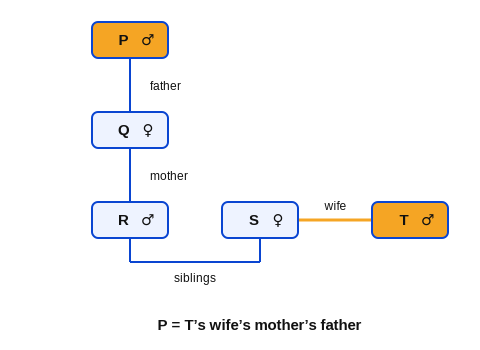
Based on the above, how is P related to T if ‘P ÷ Q + R – S x T’?
एक निश्चित कूट भाषा में,
'A + B' का अर्थ है ‘A, B की माता है’
'A – B' का अर्थ है ‘A, B का भाई है’
'A x B' का अर्थ है ‘A, B की पत्नी है’
'A ÷ B' का अर्थ है ‘A, B का पिता है’
उपर्युक्त के आधार पर, यदि ‘P ÷ Q + R – S x T’ है, तो P का T से क्या संबंध है?
  1. AWIfe's mother's fatherपत्नी की माता का पिता
  2. BWife's sister's husbandपत्नी की बहन का पति
  3. CSon's daughter's husbandपुत्र की पुत्री का पति
  4. DWife's father's motherपत्नी के पिता की माता
Show answer

Concept: Decode each symbol and build the family tree from P to T.

  1. P ÷ Q: P is the father of Q.
  2. Q + R: Q is the mother of R.
  3. R – S: R is the brother of S, so S is Q’s daughter.
  4. S × T: S is the wife of T.
  5. So, T’s wife (S) → her mother (Q) → her father (P).

Trick: Read the chain backwards from T: wife → mother → father.

Answer: (A) Wife’s mother’s father

अवधारणा: हर चिह्न का अर्थ लिखकर P से T तक वंश-वृक्ष बनाइए।

  1. P ÷ Q: P, Q का पिता है।
  2. Q + R: Q, R की माँ है।
  3. R – S: R, S का भाई है, अतः S भी Q की बेटी है।
  4. S × T: S, T की पत्नी है।
  5. अतः T की पत्नी (S) → उसकी माँ (Q) → उसके पिता (P)।

ट्रिक: T से उल्टा पढ़ें: पत्नी → माँ → पिता।

उत्तर: (A) Wife’s mother’s father (पत्नी की माँ के पिता)

RRB NTPC Graduate CBT 1General Intelligence and ReasoningCoded Blood RelationsRRB NTPC Graduate CBT 1 2024 · 18 Jun Shift 1 →
Q8197.
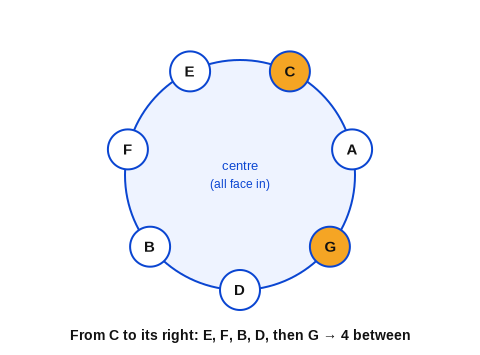
A, B, C, D, E, F, and G are sitting around a circular table facing the centre.
Only C sits between A and E. E sits third to the left of D. B sits to the immediate left of D. G is not an immediate neighbour of E.
How many people sit between C and G when counted from the right of C?
A, B, C, D, E, F और G एक वृत्ताकार मेज़ के चारों ओर केंद्र की ओर मुख करके बैठे हैं।
केवल C, A और E के बीच बैठा है। E, D के बाएँ से तीसरे स्थान पर बैठा है। B, D के ठीक बाएँ बैठा है। G, E का निकटतम पड़ोसी नहीं है।
C के दाएँ से गिनने पर C और G के बीच कितने व्यक्ति बैठे हैं?
  1. AFourचार
  2. BTwoदो
  3. CThreeतीन
  4. DOneएक
Show answer

Concept: When people face the centre, "left" is clockwise and "right" is anticlockwise.

  1. Fix D. B is immediately to the left of D; E is third to the left of D (D → B → _ → E).
  2. Only C sits between A and E; the seat next to E on B’s side is not free for A, so C is the next seat after E and A after C.
  3. The two remaining seats go to F and G; G is not a neighbour of E, so F sits between B and E and G sits between A and D.
  4. From C moving to the right: E, F, B, D, then G → 4 people in between.

Trick: Place the most fixed person (D) first, then fill seats using “third to the left / immediate left” clues.

Answer: (A) Four

अवधारणा: केंद्र की ओर मुख होने पर "बाएँ" = घड़ी की दिशा (clockwise) और "दाएँ" = वामावर्त (anticlockwise)।

  1. D को स्थिर करें। B, D के ठीक बाएँ; E, D के बाएँ तीसरे स्थान पर (D → B → _ → E)।
  2. A और E के बीच केवल C है; अतः E के बाद C और फिर A बैठेगा।
  3. बचे दो स्थान F और G के; G, E का पड़ोसी नहीं, अतः F, B और E के बीच तथा G, A और D के बीच।
  4. C के दाएँ गिनने पर: E, F, B, D, फिर G → बीच में 4 व्यक्ति।

ट्रिक: सबसे निश्चित व्यक्ति (D) को पहले रखें, फिर "बाएँ तीसरा / ठीक बाएँ" संकेतों से भरें।

उत्तर: (A) चार

RRB NTPC Graduate CBT 1General Intelligence and ReasoningCircular Seating ArrangementRRB NTPC Graduate CBT 1 2024 · 18 Jun Shift 1 →
Q8198.
Select the pair that follows the same pattern as that followed by the two pairs given below. Both pairs follow the same pattern.
KNR : HKS
TGK : QDL
उस युग्म का चयन कीजिए जो उसी पैटर्न का अनुसरण करता है जिसका अनुसरण नीचे दिए गए दो युग्म करते हैं। दोनों युग्म एक ही पैटर्न का अनुसरण करते हैं।
KNR : HKS
TGK : QDL
  1. ALOQ : FJU
  2. BFXL : CUM
  3. CHMI : DKL
  4. DGCP : EHR
Show answer

Concept: Compare positions of corresponding letters: here the pattern is −3,−3,+1.

  1. KNR → HKS: K−3=H,N−3=K,R+1=S.
  2. TGK → QDL: T−3=Q,G−3=D,K+1=L.
  3. FXL → CUM: F−3=C,X−3=U,L+1=M ✓.
  4. LOQ → FJU fails at once (L−6=F).

Trick: Check only the first letter (−3) to cut options quickly: only F → C works.

Answer: (B) FXL : CUM

अवधारणा: संगत अक्षरों की स्थिति की तुलना करें: पैटर्न −3,−3,+1 है।

  1. KNR → HKS: K−3=H,N−3=K,R+1=S।
  2. TGK → QDL: T−3=Q,G−3=D,K+1=L।
  3. FXL → CUM: F−3=C,X−3=U,L+1=M ✓।
  4. LOQ → FJU पहले अक्षर पर ही गलत (L−6=F)।

ट्रिक: केवल पहला अक्षर (−3) जाँचें – सिर्फ F → C सही बैठता है।

उत्तर: (B) FXL : CUM

RRB NTPC Graduate CBT 1General Intelligence and ReasoningLetter AnalogyRRB NTPC Graduate CBT 1 2024 · 18 Jun Shift 1 →
Q8199.
What should come in place of the question mark (?) in the given series?
282, 259, 226, ?, 130, 67
दी गई शृंखला में प्रश्न चिह्न (?) के स्थान पर क्या आना चाहिए?
282, 259, 226, ?, 130, 67
  1. A173
  2. B183
  3. C193
  4. D186
Show answer

Concept: Look at the differences between consecutive terms.

  1. 282−259=23,259−226=33 → differences grow by 10.
  2. Next difference 43: 226−43=183
  3. Check: 183−53=130,130−63=67 ✓

Trick: Differences 23, 33, 43, 53, 63 – constant jump of 10.

Answer: (B) 183

अवधारणा: क्रमागत पदों का अंतर देखें।

  1. 282−259=23,259−226=33 → अंतर 10-10 बढ़ रहा है।
  2. अगला अंतर 43: 226−43=183
  3. जाँच: 183−53=130,130−63=67 ✓

ट्रिक: अंतर 23, 33, 43, 53, 63 – हर बार 10 की वृद्धि।

उत्तर: (B) 183

RRB NTPC Graduate CBT 1General Intelligence and ReasoningNumber SeriesRRB NTPC Graduate CBT 1 2024 · 18 Jun Shift 1 →
Q8200.
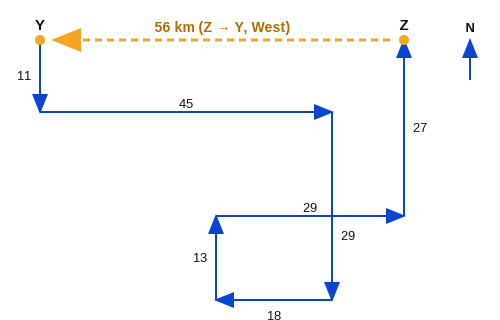
Gyanesh starts from Point Y and drives 11 km towards the south. He then takes a left turn, drives 45 km, turns right and drives 29 km. He then takes a right turn and drives 18 km. He takes a right turn, drives 13 km. He then turns right, drives 29 km, turns left and drives 27 km to stop at Point Z. How far (shortest distance) and towards which direction should he drive in order to reach Point Y again? (All turns are 90-degree turns only unless specified.)
ज्ञानेश बिंदु Y से चलना शुरू करता है और दक्षिण की ओर 11 km ड्राइव करता है। फिर वह बाएँ मुड़ता है, 45 km ड्राइव करता है, दाएँ मुड़ता है और 29 km ड्राइव करता है। फिर वह दाएँ मुड़ता है और 18 km ड्राइव करता है। वह दाएँ मुड़ता है, 13 km ड्राइव करता है। फिर वह दाएँ मुड़ता है, 29 km ड्राइव करता है, बाएँ मुड़ता है और 27 km ड्राइव करके बिंदु Z पर रुकता है। बिंदु Y पर पुनः पहुँचने के लिए उसे कितनी दूरी (न्यूनतम दूरी) और किस दिशा में ड्राइव करना चाहिए? (जब तक निर्दिष्ट न हो, सभी मोड़ केवल 90 डिग्री के हैं।)
  1. A53 km towards the northउत्तर की ओर 53 km
  2. B61 km towards the westपश्चिम की ओर 61 km
  3. C56 km towards the westपश्चिम की ओर 56 km
  4. D51 km towards the eastपूर्व की ओर 51 km
Show answer

Concept: Track the position with coordinates (East +x, North +y), turning left/right relative to the current direction.

  1. Y(0, 0) → South 11 → (0, −11); left = East 45 → (45, −11).
  2. Right = South 29 → (45, −40); right = West 18 → (27, −40).
  3. Right = North 13 → (27, −27); right = East 29 → (56, −27).
  4. Left = North 27 → Z(56, 0). Y is 56 km due West of Z.

Trick: Net N–S: −11−29+13+27=0, so the answer is purely East–West: 45−18+29=56 km.

Answer: (C) 56 km towards the west

अवधारणा: निर्देशांक लें (पूर्व +x, उत्तर +y) और हर मोड़ को वर्तमान दिशा के सापेक्ष लें।

  1. Y(0, 0) → दक्षिण 11 → (0, −11); बाएँ = पूर्व 45 → (45, −11)।
  2. दाएँ = दक्षिण 29 → (45, −40); दाएँ = पश्चिम 18 → (27, −40)।
  3. दाएँ = उत्तर 13 → (27, −27); दाएँ = पूर्व 29 → (56, −27)।
  4. बाएँ = उत्तर 27 → Z(56, 0)। Y, Z से 56 km पश्चिम में है।

ट्रिक: शुद्ध उत्तर–दक्षिण: −11−29+13+27=0, अतः केवल पूर्व–पश्चिम: 45−18+29=56 km।

उत्तर: (C) 56 km पश्चिम की ओर

RRB NTPC Graduate CBT 1General Intelligence and ReasoningDirection and DistanceRRB NTPC Graduate CBT 1 2024 · 18 Jun Shift 1 →