Question bank

Q&A: practice questions with answers

Search questions on any topic. Filter by exam category, exam, subject and topic, try the question, then open the answer and explanation.

Courses – airGurukul

20,719 questions found.

Q8201.
Based on the English alphabetical order, three of the following four letter-cluster pairs are alike in a certain way and thus form a group. Which is the letter-cluster pair that DOES NOT belong to that group?
(Note: The odd one out is not based on the number of consonants/vowels or their position in the letter-cluster.)
अंग्रेज़ी वर्णमाला क्रम के आधार पर, निम्नलिखित चार अक्षर-समूह युग्मों में से तीन किसी निश्चित प्रकार से एकसमान हैं और इस प्रकार एक समूह बनाते हैं। कौन-सा अक्षर-समूह युग्म उस समूह से संबंधित नहीं है?
(ध्यान दें: असंगत अक्षर-समूह, उस अक्षर-समूह में व्यंजनों/स्वरों की संख्या या उनके स्थान पर आधारित नहीं है।)
  1. AOJ - NL
  2. BIK - PR
  3. CHJ - OQ
  4. DGI - NP
Show answer

Concept: Write alphabet positions and check the gap within each cluster and between the clusters.

  1. IK - PR: 9,11|16,18 → +2 inside, +7 between.
  2. HJ - OQ: 8,10|15,17 and GI - NP: 7,9|14,16 → same pattern.
  3. OJ - NL: 15,10|14,12 → pattern broken.

Trick: Check the first letters of the two clusters: +7 (I→P, H→O, G→N) but O→N is −1.

Answer: (A) OJ - NL

अवधारणा: अक्षरों की स्थिति लिखें और क्लस्टर के अंदर तथा दोनों क्लस्टरों के बीच अंतर देखें।

  1. IK - PR: 9,11|16,18 → अंदर +2, बीच +7।
  2. HJ - OQ: 8,10|15,17 और GI - NP: 7,9|14,16 → वही पैटर्न।
  3. OJ - NL: 15,10|14,12 → पैटर्न टूटा।

ट्रिक: दोनों क्लस्टरों के पहले अक्षर देखें: +7 (I→P, H→O, G→N) पर O→N = −1।

उत्तर: (A) OJ - NL
RRB NTPC Graduate CBT 1General Intelligence and ReasoningOdd One Out – Letter PairsRRB NTPC Graduate CBT 1 2024 · 18 Jun Shift 1 →
Q8202.
Which of the following letter-clusters should replace # and % so that the pattern and relationship followed between the letter-cluster pair on the left side of :: is the same as that on the right side of :: ?
# : VXB :: GIM : %
निम्नलिखित में से कौन-से अक्षर-समूह # और % को प्रतिस्थापित करें ताकि :: के बाईं ओर के अक्षर-समूह युग्म के बीच का पैटर्न और संबंध, :: के दाईं ओर के अक्षर-समूह युग्म के समान हो?
# : VXB :: GIM : %
  1. A# = SUY , % = LLP
  2. B# = SUY , % = JLP
  3. C# = SEY , % = JLP
  4. D# = SUY , % = JLL
Show answer

Concept: Each cluster follows +2,+4 inside; the pair relation is the same shift applied to every letter.

  1. GIM: 7,9,13 → +2,+4; VXB: 22,24,2 (i.e. 28) → +2,+4.
  2. # = SUY (19,21,25) and SUY → VXB is +3 on each letter.
  3. So GIM +3 → J, L, P: % = JLP.

Trick: Find # first from the internal +2,+4 pattern, then apply the same shift (+3) to GIM.

Answer: (B) # = SUY , % = JLP

अवधारणा: हर समूह के अंदर +2,+4 है; युग्म का संबंध हर अक्षर पर समान खिसकाव है।

  1. GIM: 7,9,13 → +2,+4; VXB: 22,24,2 (अर्थात 28) → +2,+4।
  2. # = SUY (19,21,25) और SUY → VXB हर अक्षर पर +3।
  3. अतः GIM +3 → J, L, P: % = JLP।

ट्रिक: पहले +2,+4 से # निकालें, फिर वही खिसकाव (+3) GIM पर लगाएँ।

उत्तर: (B) # = SUY , % = JLP

RRB NTPC Graduate CBT 1General Intelligence and ReasoningLetter Cluster AnalogyRRB NTPC Graduate CBT 1 2024 · 18 Jun Shift 1 →
Q8203.
Two sets of numbers are given below. In each set of numbers, certain mathematical operation(s) on the first number results in the second number. Similarly, certain mathematical operation(s) on the second number results in the third number and so on. Which of the given options follows the same set of operations as in the given sets? (NOTE: Operations should be performed on the whole numbers, without breaking down the numbers into their constituent digits. E.g. 13 – Operations on 13 such as adding / subtracting / multiplying to 13 can be performed. Breaking down 13 into 1 and 3 and then performing mathematical operations on 1 and 3 is not allowed.)
12 - 14 - 16 - 20; 14 - 16 - 18 - 22
नीचे संख्याओं के दो समुच्चय दिए गए हैं। संख्याओं के प्रत्येक समुच्चय में, पहली संख्या पर कुछ गणितीय संक्रिया(एँ) करने पर दूसरी संख्या प्राप्त होती है। इसी प्रकार, दूसरी संख्या पर कुछ गणितीय संक्रिया(एँ) करने पर तीसरी संख्या प्राप्त होती है, और इसी तरह आगे भी। दिए गए विकल्पों में से कौन-सा विकल्प दिए गए समुच्चयों के समान संक्रियाओं के समुच्चय का अनुसरण करता है? (ध्यान दें: संख्याओं को उनके घटक अंकों में विभाजित किए बिना, पूर्ण संख्याओं पर संक्रियाएँ की जानी चाहिए। उदाहरण के लिए 13 – 13 पर संक्रियाएँ जैसे 13 में जोड़ना/घटाना/गुणा करना आदि की जा सकती हैं। 13 को 1 और 3 में विभाजित करना और फिर 1 और 3 पर गणितीय संक्रियाएँ करना वर्जित है।)
12 - 14 - 16 - 20; 14 - 16 - 18 - 22
  1. A3 - 5 - 7 - 11
  2. B13 - 15 - 17 - 32
  3. C4 - 8 - 16 - 32
  4. D19 - 20 - 22 - 44
Show answer

Concept: Find the operations between successive numbers in the given sets.

  1. 12 - 14 - 16 - 20: +2,+2,+4; 14 - 16 - 18 - 22: +2,+2,+4.
  2. 3 - 5 - 7 - 11: +2,+2,+4 ✓
  3. 4 - 8 - 16 - 32 is ×2; 13 - 15 - 17 - 32 ends +15; 19 - 20 - 22 - 44 is +1,+2,×2.

Trick: Only check the last step (+4) – it eliminates three options at once.

Answer: (A) 3 - 5 - 7 - 11

अवधारणा: दिए गए समूहों में क्रमागत संख्याओं के बीच संक्रियाएँ खोजें।

  1. 12 - 14 - 16 - 20: +2,+2,+4; 14 - 16 - 18 - 22: +2,+2,+4।
  2. 3 - 5 - 7 - 11: +2,+2,+4 ✓
  3. 4 - 8 - 16 - 32 में ×2; 13 - 15 - 17 - 32 में अंत +15; 19 - 20 - 22 - 44 में +1,+2,×2।

ट्रिक: केवल अंतिम चरण (+4) जाँचें – तीन विकल्प तुरंत हट जाते हैं।

उत्तर: (A) 3 - 5 - 7 - 11

RRB NTPC Graduate CBT 1General Intelligence and ReasoningNumber Set PatternRRB NTPC Graduate CBT 1 2024 · 18 Jun Shift 1 →
Q8204.
Based on the English alphabetical order, three of the following four letter-clusters are alike in a certain way and thus form a group. Which letter-cluster DOES NOT belong to that group?
(Note: The odd one out is not based on the number of consonants/vowels or their position in the letter-cluster.)
अंग्रेज़ी वर्णमाला क्रम के आधार पर, निम्नलिखित चार अक्षर-समूहों में से तीन किसी निश्चित प्रकार से एकसमान हैं और इस प्रकार एक समूह बनाते हैं। कौन-सा अक्षर-समूह उस समूह से संबंधित नहीं है?
(ध्यान दें: असंगत अक्षर-समूह, उस अक्षर-समूह में व्यंजनों/स्वरों की संख्या या उनके स्थान पर आधारित नहीं है।)
  1. AMOJ
  2. BGID
  3. CKMG
  4. DIKF
Show answer

Concept: Write positions and check the steps from 1st → 2nd → 3rd letter.

  1. MOJ: 13,15,10 → +2,−5
  2. GID: 7,9,4 → +2,−5; IKF: 9,11,6 → +2,−5
  3. KMG: 11,13,7 → +2,−6 ✗

Trick: Third letter is 3 places before the first in the group (M→J, G→D, I→F), but K→G is 4.

Answer: (C) KMG

अवधारणा: स्थितियाँ लिखें और पहले → दूसरे → तीसरे अक्षर का अंतर देखें।

  1. MOJ: 13,15,10 → +2,−5
  2. GID: 7,9,4 → +2,−5; IKF: 9,11,6 → +2,−5
  3. KMG: 11,13,7 → +2,−6 ✗

ट्रिक: समूह में तीसरा अक्षर पहले से 3 पीछे (M→J, G→D, I→F), पर K→G 4 पीछे।

उत्तर: (C) KMG

RRB NTPC Graduate CBT 1General Intelligence and ReasoningOdd One Out – Letter ClustersRRB NTPC Graduate CBT 1 2024 · 18 Jun Shift 1 →
Q8205.
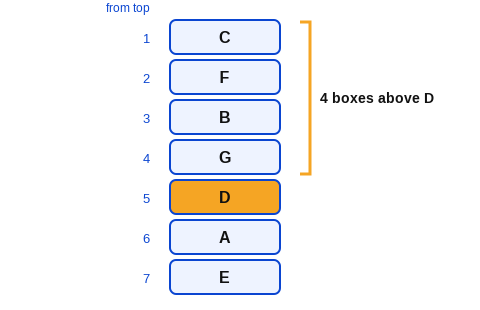
Seven boxes, A, B, C, D, E, F and G, are kept one over the other, but not necessarily in the same order. Only three boxes are kept above G. Only one box is kept between A and G. Only three boxes are kept between A and F. F is kept at some place above G. B is kept immediately below F. D is kept at one of the places above E. C is not kept immediately above or below A. How many boxes are kept above D?
सात बक्से, A, B, C, D, E, F और G, एक के ऊपर एक रखे गए हैं, लेकिन आवश्यक नहीं कि इसी क्रम में हों। G के ऊपर केवल तीन बक्से रखे हैं। A और G के बीच केवल एक बक्सा रखा है। A और F के बीच केवल तीन बक्से रखे हैं। F, G के ऊपर किसी स्थान पर रखा है। B, F के ठीक नीचे रखा है। D, E के ऊपर के स्थानों में से किसी एक पर रखा है। C, A के ठीक ऊपर या ठीक नीचे नहीं रखा है। D के ऊपर कितने बक्से रखे हैं?
  1. A2
  2. B3
  3. C1
  4. D4
Show answer

Concept: Number positions 1 (top) to 7 (bottom) and place the fixed boxes first.

  1. Three boxes above G → G at 4. One box between A and G → A at 2 or 6.
  2. Three boxes between A and F with F above G → A = 6, F = 2; B just below F → B = 3.
  3. Left: 1, 5, 7. C not next to A (6) → C = 1; D above E → D = 5, E = 7.
  4. Boxes above D: C, F, B, G = 4.

Trick: Use the clue "F above G" to choose between the two cases for A instantly.

Answer: (D) 4

अवधारणा: स्थान 1 (ऊपर) से 7 (नीचे) तक क्रमांकित करें और निश्चित डिब्बे पहले रखें।

  1. G के ऊपर तीन डिब्बे → G = 4। A और G के बीच एक → A = 2 या 6।
  2. A और F के बीच तीन, तथा F, G के ऊपर → A = 6, F = 2; B, F के ठीक नीचे → B = 3।
  3. शेष: 1, 5, 7। C, A (6) के पास नहीं → C = 1; D, E के ऊपर → D = 5, E = 7।
  4. D के ऊपर: C, F, B, G = 4।

ट्रिक: "F, G के ऊपर" संकेत से A के दो मामलों में तुरंत चयन करें।

उत्तर: (D) 4

RRB NTPC Graduate CBT 1General Intelligence and ReasoningFloor/Box ArrangementRRB NTPC Graduate CBT 1 2024 · 18 Jun Shift 1 →
Q8206.
If 1 is added to each odd digit and 2 is subtracted from each even digit in the number 1385762, then what will the sum of the digits that are second from the left and third from the right in the new number thus formed be?
यदि संख्या 1385762 के प्रत्येक विषम अंक में 1 जोड़ा जाए और प्रत्येक सम अंक में से 2 घटाया जाए, तो इस प्रकार बनी नई संख्या में बाएँ से दूसरे और दाएँ से तीसरे अंकों का योग क्या होगा?
  1. A13
  2. B11
  3. C10
  4. D12
Show answer

Concept: Change each digit by the rule (odd +1, even −2) and keep positions.

  1. 1385762 → 1→2, 3→4, 8→6, 5→6, 7→8, 6→4, 2→0
  2. New number: 2466840
  3. 2nd from left = 4; 3rd from right = 8
  4. Sum =4+8=12

Trick: Only transform the two digits needed: 2nd from left (3→4) and 3rd from right (7→8).

Answer: (D) 12

अवधारणा: नियम से हर अंक बदलें (विषम +1, सम −2) और स्थान वही रखें।

  1. 1385762 → 1→2, 3→4, 8→6, 5→6, 7→8, 6→4, 2→0
  2. नई संख्या: 2466840
  3. बाएँ से दूसरा = 4; दाएँ से तीसरा = 8
  4. योग =4+8=12

ट्रिक: केवल ज़रूरी दो अंक बदलें: बाएँ से दूसरा (3→4) और दाएँ से तीसरा (7→8)।

उत्तर: (D) 12

RRB NTPC Graduate CBT 1General Intelligence and ReasoningNumber OperationsRRB NTPC Graduate CBT 1 2024 · 18 Jun Shift 1 →
Q8207.
Read the given statements and conclusions carefully. Assuming that the information given in the statements is true, even if it appears to be at variance with commonly known facts, decide which of the given conclusion(s) logically follow(s) from the statements.
Statements:
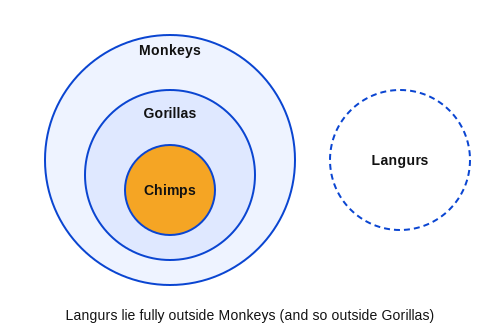
All chimpanzees are gorilla.
All gorillas are monkeys.
No monkey is a langur.
Conclusion:
(I) Some langurs are gorillas.
(II) Some monkeys are chimpanzees.
दिए गए कथनों और निष्कर्षों को ध्यानपूर्वक पढ़िए। यह मानते हुए कि कथनों में दी गई जानकारी सत्य है, भले ही वह सामान्य रूप से ज्ञात तथ्यों से भिन्न प्रतीत होती हो, निर्णय कीजिए कि दिए गए निष्कर्षों में से कौन-सा/से निष्कर्ष तार्किक रूप से कथनों का अनुसरण करता है/करते हैं।
कथन:
सभी चिंपैंज़ी, गोरिल्ला हैं।
सभी गोरिल्ला, बंदर हैं।
कोई बंदर, लंगूर नहीं है।
निष्कर्ष:
(I) कुछ लंगूर, गोरिल्ला हैं।
(II) कुछ बंदर, चिंपैंज़ी हैं।
  1. ANeither Conclusion (I) nor (II) followsन तो निष्कर्ष (I) और न ही (II) अनुसरण करता है
  2. BBoth Conclusions (I) and (II) followनिष्कर्ष (I) और (II) दोनों अनुसरण करते हैं
  3. COnly Conclusion (I) followsकेवल निष्कर्ष (I) अनुसरण करता है
  4. DOnly Conclusion (II) followsकेवल निष्कर्ष (II) अनुसरण करता है
Show answer

Concept: Draw the minimal Venn diagram: Chimpanzees ⊂ Gorillas ⊂ Monkeys, and Langurs completely outside Monkeys.

  1. Since no monkey is a langur and all gorillas are monkeys, no gorilla is a langur → (I) "Some langurs are gorillas" is false.
  2. All chimpanzees are monkeys, so some monkeys are certainly chimpanzees → (II) follows.

Trick: All A are B ⇒ Some B are A always follows (conversion).

Answer: (D) Only Conclusion (II) follows

अवधारणा: न्यूनतम वेन आरेख: चिंपैंज़ी ⊂ गोरिल्ला ⊂ बंदर, और लंगूर पूरी तरह बंदर के बाहर।

  1. कोई बंदर लंगूर नहीं और सभी गोरिल्ला बंदर हैं, अतः कोई गोरिल्ला लंगूर नहीं → (I) "कुछ लंगूर गोरिल्ला हैं" गलत।
  2. सभी चिंपैंज़ी बंदर हैं, अतः कुछ बंदर अवश्य चिंपैंज़ी हैं → (II) अनुसरण करता है।

ट्रिक: सभी A, B हैं ⇒ कुछ B, A हैं – हमेशा सत्य (परिवर्तन)।

उत्तर: (D) केवल निष्कर्ष (II) अनुसरण करता है

RRB NTPC Graduate CBT 1General Intelligence and ReasoningSyllogismRRB NTPC Graduate CBT 1 2024 · 18 Jun Shift 1 →
Q8208.
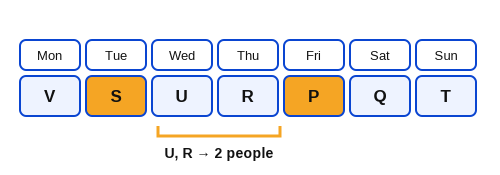
Each of P, Q, R, S, T, U and V has an exam on a different day of a week starting from Monday and ending on Sunday of the same week.
Only three people have exams after R. P has the exam immediately after R, but before Q. S has the exam before U but after V. T has the exam on Sunday.
How many people have exams between P and S?
P, Q, R, S, T, U और V में से प्रत्येक की परीक्षा एक ही सप्ताह के सोमवार से शुरू होकर रविवार को समाप्त होने वाले सप्ताह के अलग-अलग दिन है।
R के बाद केवल तीन व्यक्तियों की परीक्षा है। P की परीक्षा R के ठीक बाद, लेकिन Q से पहले है। S की परीक्षा U से पहले लेकिन V के बाद है। T की परीक्षा रविवार को है।
P और S के बीच कितने व्यक्तियों की परीक्षा है?
  1. ATwoदो
  2. BOneएक
  3. CFourचार
  4. DThreeतीन
Show answer

Concept: Fix the days Monday (1) to Sunday (7) and place the definite clues first.

  1. T = Sunday. Only three after R → R = Thursday.
  2. P immediately after R → P = Friday; Q after P → Q = Saturday.
  3. V < S < U in Mon–Wed → V = Monday, S = Tuesday, U = Wednesday.
  4. Between S (Tue) and P (Fri): U, R → 2 people.

Trick: "Only three after" fixes the position immediately: 7−3=4th day.

Answer: (A) Two

अवधारणा: सोमवार (1) से रविवार (7) तक दिन तय करें और निश्चित संकेत पहले रखें।

  1. T = रविवार। R के बाद केवल तीन → R = गुरुवार।
  2. P, R के ठीक बाद → P = शुक्रवार; Q, P के बाद → Q = शनिवार।
  3. V < S < U, सोम–बुध में → V = सोमवार, S = मंगलवार, U = बुधवार।
  4. S (मंगल) और P (शुक्र) के बीच: U, R → 2 व्यक्ति।

ट्रिक: "बाद में केवल तीन" से स्थान तुरंत: 7−3=4था दिन।

उत्तर: (A) दो

RRB NTPC Graduate CBT 1General Intelligence and ReasoningScheduling PuzzleRRB NTPC Graduate CBT 1 2024 · 18 Jun Shift 1 →
Q8209.
In a certain code language, ‘RACE’ is coded as ‘6259’ and ‘ANTS’ is coded as ‘7941’. What is the code for ‘A’ in the given code language?
एक निश्चित कूट भाषा में, ‘RACE’ को ‘6259’ के रूप में कूटबद्ध किया जाता है और ‘ANTS’ को ‘7941’ के रूप में कूटबद्ध किया जाता है। उसी कूट भाषा में ‘A’ के लिए कूट क्या है?
  1. A7
  2. B9
  3. C1
  4. D2
Show answer

Concept: When two words share a letter, the code digit common to both codes belongs to that letter (codes may be in jumbled order).

  1. RACE → 6259 and ANTS → 7941.
  2. The only letter common to both words is A.
  3. The only digit common to both codes is 9.
  4. Hence A = 9.

Trick: Common letter ↔ common digit – no need to decode the full word.

Answer: (B) 9

अवधारणा: जब दो शब्दों में एक अक्षर उभयनिष्ठ हो, तो दोनों कोड में उभयनिष्ठ अंक उसी अक्षर का कोड होता है (क्रम बदला हो सकता है)।

  1. RACE → 6259 और ANTS → 7941।
  2. दोनों शब्दों में उभयनिष्ठ अक्षर केवल A है।
  3. दोनों कोड में उभयनिष्ठ अंक केवल 9 है।
  4. अतः A = 9।

ट्रिक: उभयनिष्ठ अक्षर ↔ उभयनिष्ठ अंक – पूरा शब्द डिकोड करने की ज़रूरत नहीं।

उत्तर: (B) 9

RRB NTPC Graduate CBT 1General Intelligence and ReasoningCoding-decoding (common letters)RRB NTPC Graduate CBT 1 2024 · 18 Jun Shift 1 →
Q8210.
What should come in place of the question mark (?) in the given series?
7 9 13 21 37 ?
दी गई शृंखला में प्रश्न चिह्न (?) के स्थान पर क्या आना चाहिए?
7 9 13 21 37 ?
  1. A71
  2. B66
  3. C69
  4. D65
Show answer

Concept: Check the differences between consecutive terms.

  1. Differences: 9−7=2, 13−9=4, 21−13=8, 37−21=16.
  2. Differences double each time: 2,4,8,16, next 32.
  3. Next term =37+32=69.

Trick: Differences in powers of 2 → keep doubling the gap.

Answer: (C) 69

अवधारणा: क्रमागत पदों का अंतर देखें।

  1. अंतर: 9−7=2, 13−9=4, 21−13=8, 37−21=16।
  2. अंतर हर बार दोगुना: 2,4,8,16, अगला 32।
  3. अगला पद =37+32=69।

ट्रिक: अंतर 2 की घातों में → अंतर दोगुना करते जाएँ।

उत्तर: (C) 69

RRB NTPC Graduate CBT 1General Intelligence and ReasoningNumber seriesRRB NTPC Graduate CBT 1 2024 · 18 Jun Shift 1 →
Q8211.
Select the letter-cluster from among the given options that can replace the question mark (?) in the following series.
TPY URS VTM WVG ?
दिए गए विकल्पों में से उस अक्षर-समूह का चयन कीजिए जो निम्नलिखित शृंखला में प्रश्न चिह्न (?) को प्रतिस्थापित कर सकता है।
TPY URS VTM WVG ?
  1. AXXB
  2. BXXA
  3. CXWA
  4. DXWZ
Show answer

Concept: Track each letter position of the clusters separately.

  1. 1st letters: T, U, V, W → +1 → X.
  2. 2nd letters: P, R, T, V → +2 → X.
  3. 3rd letters: Y, S, M, G → −6 each → G − 6 = A (wrapping: G=7, 7 − 6 = 1 = A).
  4. Answer cluster: XXA.

Trick: Write positions: Y25, S19, M13, G7 → step −6 → 1 = A.

Answer: (B) XXA

अवधारणा: हर समूह के प्रत्येक अक्षर-स्थान को अलग-अलग देखें।

  1. पहले अक्षर: T, U, V, W → +1 → X।
  2. दूसरे अक्षर: P, R, T, V → +2 → X।
  3. तीसरे अक्षर: Y, S, M, G → हर बार −6 → G(7) − 6 = 1 = A।
  4. उत्तर समूह: XXA।

ट्रिक: स्थान लिखें: Y25, S19, M13, G7 → −6 → 1 = A।

उत्तर: (B) XXA

RRB NTPC Graduate CBT 1General Intelligence and ReasoningLetter seriesRRB NTPC Graduate CBT 1 2024 · 18 Jun Shift 1 →
Q8212.
If 1 is added to each odd digit and 2 is subtracted from each even digit in the number 4275613, how many digits will appear more than once in the new number thus formed?
यदि संख्या 4275613 के प्रत्येक विषम अंक में 1 जोड़ा जाए और प्रत्येक सम अंक में से 2 घटाया जाए, तो इस प्रकार बनी नई संख्या में कितने अंक एक से अधिक बार आएँगे?
  1. A0
  2. B1
  3. C2
  4. D3
Show answer

Concept: Apply the rule digit by digit: odd digit → +1, even digit → −2.

  1. 4275613: 4→2, 2→0, 7→8, 5→6, 6→4, 1→2, 3→4.
  2. New number: 2086424.
  3. Repeated digits: 2 (twice) and 4 (twice).
  4. So 2 digits appear more than once.

Trick: Write the new digits below the old ones and tick repeats – fast and error-free.

Answer: (C) 2

अवधारणा: नियम हर अंक पर लगाएँ: विषम अंक → +1, सम अंक → −2।

  1. 4275613: 4→2, 2→0, 7→8, 5→6, 6→4, 1→2, 3→4।
  2. नई संख्या: 2086424।
  3. दोहराए गए अंक: 2 (दो बार) और 4 (दो बार)।
  4. अतः 2 अंक एक से अधिक बार आते हैं।

ट्रिक: नए अंक पुराने के नीचे लिखें और दोहराव पर निशान लगाएँ।

उत्तर: (C) 2

RRB NTPC Graduate CBT 1General Intelligence and ReasoningDigit operationsRRB NTPC Graduate CBT 1 2024 · 18 Jun Shift 1 →
Q8213.
GCKH is related to EAIF in a certain way based on the English alphabetical order. In the same way, JFNK is related to HDLI. To which of the given options is MIQN related, following the same logic?
अंग्रेज़ी वर्णमाला क्रम के आधार पर GCKH एक निश्चित प्रकार से EAIF से संबंधित है। उसी प्रकार, JFNK, HDLI से संबंधित है। समान तर्क का अनुसरण करते हुए, MIQN दिए गए विकल्पों में से किससे संबंधित है?
  1. AKGLO
  2. BKGOL
  3. CGKLO
  4. DGKOL
Show answer

Concept: Find the letter-wise shift in the given pairs and apply it.

  1. GCKH → EAIF: G−2=E, C−2=A, K−2=I, H−2=F.
  2. JFNK → HDLI: each letter −2 again.
  3. MIQN: M−2=K, I−2=G, Q−2=O, N−2=L → KGOL.

Trick: Constant shift for every letter → just move each letter 2 steps back.

Answer: (B) KGOL

अवधारणा: दिए गए युग्मों में प्रत्येक अक्षर का विस्थापन ज्ञात कर लागू करें।

  1. GCKH → EAIF: G−2=E, C−2=A, K−2=I, H−2=F।
  2. JFNK → HDLI: फिर हर अक्षर −2।
  3. MIQN: M−2=K, I−2=G, Q−2=O, N−2=L → KGOL।

ट्रिक: हर अक्षर पर समान विस्थापन → प्रत्येक अक्षर 2 पीछे करें।

उत्तर: (B) KGOL

RRB NTPC Graduate CBT 1General Intelligence and ReasoningAnalogy – Letter shiftingRRB NTPC Graduate CBT 1 2024 · 18 Jun Shift 1 →
Q8214.
If + means −, − means ×, × means ÷, ÷ means +, then what will come in place of the question mark (?) in the following equation?
96 × 6 − 8 ÷ 71 + 26 = ?
यदि + का अर्थ −, − का अर्थ ×, × का अर्थ ÷ और ÷ का अर्थ + है, तो निम्नलिखित समीकरण में प्रश्न चिह्न (?) के स्थान पर क्या आएगा?
96 × 6 − 8 ÷ 71 + 26 = ?
  1. A186
  2. B194
  3. C173
  4. D181
Show answer

Concept: Replace the symbols as per the given code, then use BODMAS.

  1. 96×6−8÷71+26 becomes 96÷6×8+71−26.
  2. 96÷6=16; 16×8=128.
  3. 128+71−26=173.

Trick: Rewrite the whole expression first, then calculate – never mix the two steps.

Answer: (C) 173

अवधारणा: दिए गए कोड के अनुसार चिह्न बदलें, फिर BODMAS लगाएँ।

  1. 96×6−8÷71+26 बन जाता है 96÷6×8+71−26।
  2. 96÷6=16; 16×8=128।
  3. 128+71−26=173।

ट्रिक: पहले पूरा व्यंजक बदलकर लिखें, फिर गणना करें।

उत्तर: (C) 173

RRB NTPC Graduate CBT 1General Intelligence and ReasoningMathematical operationsRRB NTPC Graduate CBT 1 2024 · 18 Jun Shift 1 →
Q8215.
What should come in place of the question mark (?) in the given series based on the English alphabetical order?
PIL NGJ LEH JCF ?
अंग्रेज़ी वर्णमाला क्रम के आधार पर दी गई शृंखला में प्रश्न चिह्न (?) के स्थान पर क्या आना चाहिए?
PIL NGJ LEH JCF ?
  1. AHBD
  2. BHAD
  3. CHAE
  4. DHBE
Show answer

Concept: Track each position of the clusters separately.

  1. 1st letters: P, N, L, J → −2 → H.
  2. 2nd letters: I, G, E, C → −2 → A.
  3. 3rd letters: L, J, H, F → −2 → D.
  4. Next cluster: HAD.

Trick: All three positions move −2 → shift JCF back by 2: HAD.

Answer: (B) HAD

अवधारणा: हर समूह के प्रत्येक स्थान को अलग-अलग देखें।

  1. पहले अक्षर: P, N, L, J → −2 → H।
  2. दूसरे अक्षर: I, G, E, C → −2 → A।
  3. तीसरे अक्षर: L, J, H, F → −2 → D।
  4. अगला समूह: HAD।

ट्रिक: तीनों स्थान −2 चलते हैं → JCF को 2 पीछे करें: HAD।

उत्तर: (B) HAD

RRB NTPC Graduate CBT 1General Intelligence and ReasoningLetter seriesRRB NTPC Graduate CBT 1 2024 · 18 Jun Shift 1 →
Q8216.
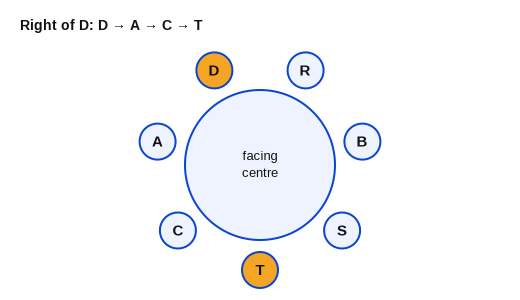
A, B, C, D, R, S and T are sitting around a circular table facing the centre of the table. Only three people sit between T and R when counted from the left of T. Only three people sit between A and S when counted from the right of S. C sits to the immediate right of A. B is an immediate neighbour of S as well as R. Who sits third to the right of D?
A, B, C, D, R, S और T एक वृत्ताकार मेज़ के चारों ओर मेज़ के केंद्र की ओर मुख करके बैठे हैं। T के बाएँ से गिनने पर T और R के बीच केवल तीन व्यक्ति बैठे हैं। S के दाएँ से गिनने पर A और S के बीच केवल तीन व्यक्ति बैठे हैं। C, A के ठीक दाएँ बैठा है। B, S और R दोनों का निकटतम पड़ोसी है। D के दाएँ से तीसरे स्थान पर कौन बैठा है?
  1. AC
  2. BT
  3. CS
  4. DA
Show answer

Concept: Facing the centre: right = anticlockwise, left = clockwise. 7 people, so "three between" means the 4th seat.

  1. Fix T. Going left of T, R is the 4th seat, so R is 3rd to the right of T.
  2. B sits between S and R. If S is next to T (on T's right) and B next, then A is 4th to the right of S.
  3. C is immediate right of A, and D takes the last seat (between R and A).
  4. Order to the right from T: T, S, B, R, D, A, C. Third to the right of D: A, C, T → T.

Trick: In a 7-seat circle, "3 between" on one side = "2 between" on the other – use whichever is quicker.

Answer: (B) T

अवधारणा: केंद्र की ओर मुख होने पर: दायाँ = वामावर्त, बायाँ = दक्षिणावर्त। 7 व्यक्ति हैं, अतः "बीच में तीन" का अर्थ चौथा स्थान।

  1. T को स्थिर करें। T के बाएँ से गिनने पर R चौथे स्थान पर, यानी R, T के दाएँ तीसरा।
  2. B, S और R के बीच बैठता है। S, T के ठीक दाएँ और फिर B; तब A, S के दाएँ चौथे स्थान पर।
  3. C, A के ठीक दाएँ और D बचे स्थान (R और A के बीच) पर।
  4. T से दाएँ क्रम: T, S, B, R, D, A, C। D के दाएँ तीसरा: A, C, T → T।

ट्रिक: 7 सीटों वाले वृत्त में एक ओर "3 बीच में" = दूसरी ओर "2 बीच में"।

उत्तर: (B) T

RRB NTPC Graduate CBT 1General Intelligence and ReasoningSeating arrangement – CircularRRB NTPC Graduate CBT 1 2024 · 18 Jun Shift 1 →
Q8217.
In a certain code language, ‘BOLT’ is coded as ‘4195’ and ‘TOLD’ is coded as ‘4529’. What is the code for ‘D’ in the given code language?
एक निश्चित कूट भाषा में, ‘BOLT’ को ‘4195’ के रूप में कूटबद्ध किया जाता है और ‘TOLD’ को ‘4529’ के रूप में कूटबद्ध किया जाता है। उसी कूट भाषा में ‘D’ के लिए कूट क्या है?
  1. A4
  2. B2
  3. C5
  4. D9
Show answer

Concept: Letters common to both words share the digits common to both codes; the leftover letter takes the leftover digit.

  1. BOLT → 4195, TOLD → 4529.
  2. Common letters O, L, T ↔ common digits 4, 5, 9.
  3. Remaining in BOLT: B ↔ 1. Remaining in TOLD: D ↔ 2.
  4. So D = 2.

Trick: Cancel the common part – the odd letter matches the odd digit.

Answer: (B) 2

अवधारणा: दोनों शब्दों के उभयनिष्ठ अक्षरों के कोड दोनों कोड के उभयनिष्ठ अंक होते हैं; बचा अक्षर बचे अंक से मेल खाता है।

  1. BOLT → 4195, TOLD → 4529।
  2. उभयनिष्ठ अक्षर O, L, T ↔ उभयनिष्ठ अंक 4, 5, 9।
  3. BOLT में बचा: B ↔ 1; TOLD में बचा: D ↔ 2।
  4. अतः D = 2।

ट्रिक: उभयनिष्ठ भाग हटाएँ – बचा अक्षर = बचा अंक।

उत्तर: (B) 2

RRB NTPC Graduate CBT 1General Intelligence and ReasoningCoding-decoding (common letters)RRB NTPC Graduate CBT 1 2024 · 18 Jun Shift 1 →
Q8218.
Refer to the following number and symbol series and answer the question that follows. Counting to be done from left to right only.
(NOTE: All numbers are single digit numbers only.)
(Left) * # 8 # 5 # 3 3 € 6 7 & # 3 $ € @ 9 # 7 £ 9 (Right)
How many such symbols are there each of which is immediately preceded by a number and also immediately followed by a symbol?
निम्नलिखित संख्या और प्रतीक शृंखला को देखिए और उसके बाद दिए गए प्रश्न का उत्तर दीजिए। गिनती केवल बाएँ से दाएँ की जानी है।
(ध्यान दें: सभी संख्याएँ केवल एक अंक वाली संख्याएँ हैं।)
(बाएँ) * # 8 # 5 # 3 3 € 6 7 & # 3 $ € @ 9 # 7 £ 9 (दाएँ)
ऐसे कितने प्रतीक हैं जिनमें से प्रत्येक के ठीक पहले एक संख्या है और ठीक बाद में भी एक प्रतीक है?
  1. A2
  2. B3
  3. C1
  4. D4
Show answer

Concept: Find symbols with the pattern: number – symbol – symbol.

  1. Check every symbol that has a number just before it: # (8 # 5), # (5 # 3), € (3 € 6), & (7 & #), $ (3 $ €), # (9 # 7), £ (7 £ 9).
  2. Only "7 & #" and "3 $ €" have a symbol after them.
  3. Count = 2.

Trick: Scan for "digit + two symbols together" – only those spots can qualify.

Answer: (A) 2

अवधारणा: पैटर्न ढूँढें: संख्या – प्रतीक – प्रतीक।

  1. जिन प्रतीकों से ठीक पहले संख्या है: # (8 # 5), # (5 # 3), € (3 € 6), & (7 & #), $ (3 $ €), # (9 # 7), £ (7 £ 9)।
  2. इनमें केवल "7 & #" और "3 $ €" के बाद प्रतीक है।
  3. संख्या = 2।

ट्रिक: "अंक + लगातार दो प्रतीक" वाले स्थान ही देखें।

उत्तर: (A) 2

RRB NTPC Graduate CBT 1General Intelligence and ReasoningNumber–symbol seriesRRB NTPC Graduate CBT 1 2024 · 18 Jun Shift 1 →
Q8219.
TX 12 is related to RS 23 in a certain way. In the same way, GW 2 is related to ER 13. To which of the given options is NR -5 related, following the same logic?
TX 12 एक निश्चित प्रकार से RS 23 से संबंधित है। उसी प्रकार, GW 2, ER 13 से संबंधित है। समान तर्क का अनुसरण करते हुए, NR -5 दिए गए विकल्पों में से किससे संबंधित है?
  1. ALL 4
  2. BLM 6
  3. CKL 6
  4. DKM 4
Show answer

Concept: Find the change in each part of the pair separately.

  1. TX 12 → RS 23: T−2=R, X−5=S, 12+11=23.
  2. GW 2 → ER 13: G−2=E, W−5=R, 2+11=13.
  3. NR −5: N−2=L, R−5=M, −5+11=6 → LM 6.

Trick: Three independent rules: 1st letter −2, 2nd letter −5, number +11.

Answer: (B) LM 6

अवधारणा: युग्म के हर भाग में परिवर्तन अलग-अलग ज्ञात करें।

  1. TX 12 → RS 23: T−2=R, X−5=S, 12+11=23।
  2. GW 2 → ER 13: G−2=E, W−5=R, 2+11=13।
  3. NR −5: N−2=L, R−5=M, −5+11=6 → LM 6।

ट्रिक: तीन अलग नियम: पहला अक्षर −2, दूसरा −5, संख्या +11।

उत्तर: (B) LM 6

RRB NTPC Graduate CBT 1General Intelligence and ReasoningAnalogy – Letters and numbersRRB NTPC Graduate CBT 1 2024 · 18 Jun Shift 1 →
Q8220.
In a certain code language, ‘OILY’ is coded as ‘1357’ and ‘LACE’ is coded as ‘8643’. What is the code for ‘L’ in the given language?
एक निश्चित कूट भाषा में, ‘OILY’ को ‘1357’ के रूप में कूटबद्ध किया जाता है और ‘LACE’ को ‘8643’ के रूप में कूटबद्ध किया जाता है। उसी भाषा में ‘L’ के लिए कूट क्या है?
  1. A3
  2. B5
  3. C7
  4. D8
Show answer

Concept: The letter common to both words takes the digit common to both codes.

  1. OILY → 1357 and LACE → 8643.
  2. Common letter: L.
  3. Common digit: 3.
  4. So L = 3.

Trick: One common letter ↔ one common digit.

Answer: (A) 3

अवधारणा: दोनों शब्दों के उभयनिष्ठ अक्षर का कोड दोनों कोड का उभयनिष्ठ अंक होता है।

  1. OILY → 1357 और LACE → 8643।
  2. उभयनिष्ठ अक्षर: L।
  3. उभयनिष्ठ अंक: 3।
  4. अतः L = 3।

ट्रिक: एक उभयनिष्ठ अक्षर ↔ एक उभयनिष्ठ अंक।

उत्तर: (A) 3

RRB NTPC Graduate CBT 1General Intelligence and ReasoningCoding-decoding (common letters)RRB NTPC Graduate CBT 1 2024 · 18 Jun Shift 1 →