Question bank

Q&A: practice questions with answers

Search questions on any topic. Filter by exam category, exam, subject and topic, try the question, then open the answer and explanation.

Courses – airGurukul

20,719 questions found.

Q8281.
Two taps can fill a cistern in 3 hours and 57 hours, respectively. A third tap can empty it in 3 hours. How long (in hours) will it take to fill one-third of the empty cistern, if all of them are opened together?
दो नल एक टंकी को क्रमशः 3 घंटे और 57 घंटे में भर सकते हैं। एक तीसरा नल इसे 3 घंटे में खाली कर सकता है। यदि तीनों नल एक साथ खोल दिए जाएँ, तो खाली टंकी का एक-तिहाई भाग भरने में कितना समय (घंटों में) लगेगा?
  1. A19
  2. B58
  3. C57
  4. D20
Show answer

Concept: Net rate = sum of filling rates − emptying rate.

  1. Net rate =13+157−13=157 per hour.
  2. Full cistern takes 57 hours.
  3. One-third takes 573=19 hours.

Trick: The 3-hour filler and 3-hour emptier cancel each other – only the 57-hour tap works.

Answer: (A) 19

अवधारणा: शुद्ध दर = भरने वाली दरों का योग − खाली करने की दर।

  1. शुद्ध दर =13+157−13=157 प्रति घंटा।
  2. पूरी टंकी 57 घंटे में भरेगी।
  3. एक-तिहाई भाग 573=19 घंटे में।

ट्रिक: 3 घंटे वाला भरने वाला नल और 3 घंटे वाला खाली करने वाला नल एक-दूसरे को निरस्त कर देते हैं।

उत्तर: (A) 19
RRB NTPC Graduate CBT 1MathematicsPipes and CisternsRRB NTPC Graduate CBT 1 2024 · 17 Jun Shift 3 →
Q8282.
For 7x2 − 4x + k = 0, determine the value of k so that the equation has equal roots.
7x2 − 4x + k = 0 के लिए, k का मान ज्ञात कीजिए ताकि समीकरण के मूल समान हों।
  1. A47
  2. B45
  3. C37
  4. D411
Show answer

Concept: Equal roots when discriminant D=b2−4ac=0.

  1. Here a=7, b=−4, c=k.
  2. (−4)2−4×7×k=0
  3. 16=28k⇒k=1628=47

Trick: For equal roots, k=b24a=1628.

Answer: (A) 47

अवधारणा: समान मूलों के लिए विविक्तकर (discriminant) D=b2−4ac=0।

  1. यहाँ a=7, b=−4, c=k।
  2. (−4)2−4×7×k=0
  3. 16=28k⇒k=1628=47

ट्रिक: समान मूलों के लिए k=b24a=1628।

उत्तर: (A) 47

RRB NTPC Graduate CBT 1MathematicsQuadratic EquationsRRB NTPC Graduate CBT 1 2024 · 17 Jun Shift 3 →
Q8283.
A person saves 30% of his income. If his expenditure is ₹560, then his income (in ₹) is:
एक व्यक्ति अपनी आय का 30% बचाता है। यदि उसका व्यय ₹560 है, तो उसकी आय (₹ में) है:
  1. A840
  2. B800
  3. C168
  4. D392
Show answer

Concept: Income = Saving + Expenditure.

  1. Saving =30%, so expenditure =70% of income.
  2. 70%=560⇒1%=8
  3. Income =100×8=800

Trick: 560×107=800.

Answer: (B) 800

अवधारणा: आय = बचत + व्यय।

  1. बचत =30%, अतः व्यय =70%।
  2. 70%=560⇒1%=8
  3. आय =100×8=800

ट्रिक: 560×107=800।

उत्तर: (B) 800

RRB NTPC Graduate CBT 1MathematicsPercentageRRB NTPC Graduate CBT 1 2024 · 17 Jun Shift 3 →
Q8284.
If sinA=45, then find the value of (2+tanA)(4+cosA).
यदि sinA=45 है, तो (2+tanA)(4+cosA) का मान ज्ञात कीजिए।
  1. A346
  2. B15208
  3. C463
  4. D20815
Show answer

Concept: Use the 3-4-5 right triangle.

  1. sinA=45⇒cosA=35, tanA=43
  2. 2+tanA=103, 4+cosA=235
  3. Product =103×235=463

Trick: Value is clearly greater than 2×4=8, so only 463 or 20815 fit – compute once.

Answer: (C) 463

अवधारणा: 3-4-5 समकोण त्रिभुज का प्रयोग करें।

  1. sinA=45⇒cosA=35, tanA=43
  2. 2+tanA=103, 4+cosA=235
  3. गुणनफल =103×235=463

ट्रिक: मान 2×4=8 से बड़ा होगा, इसलिए केवल 463 या 20815 संभव – एक बार गणना करें।

उत्तर: (C) 463

RRB NTPC Graduate CBT 1MathematicsTrigonometryRRB NTPC Graduate CBT 1 2024 · 17 Jun Shift 3 →
Q8285.
4 times the present age of P exceeds the present age of Q by 35 years. After 8 years, 2 times the age of Q will be 40 years less than 6 times the age of P. The present age of Q (in years) is:
P की वर्तमान आयु का 4 गुना, Q की वर्तमान आयु से 35 वर्ष अधिक है। 8 वर्ष बाद, Q की आयु का 2 गुना, P की आयु के 6 गुने से 40 वर्ष कम होगा। Q की वर्तमान आयु (वर्षों में) है:
  1. A84
  2. B97
  3. C89
  4. D80
Show answer

Concept: Form two linear equations in present ages P and Q.

  1. 4P−Q=35 …(i)
  2. After 8 years: 2(Q+8)=6(P+8)−40⇒2Q=6P−8⇒Q=3P−4 …(ii)
  3. Put (ii) in (i): 4P−3P+4=35⇒P=31
  4. Q=3×31−4=89

Trick: Check options: Q=89⇒P=89+354=31; then 2×97=194=6×39−40 ✓.

Answer: (C) 89

अवधारणा: वर्तमान आयु P और Q में दो रैखिक समीकरण बनाएँ।

  1. 4P−Q=35 …(i)
  2. 8 वर्ष बाद: 2(Q+8)=6(P+8)−40⇒2Q=6P−8⇒Q=3P−4 …(ii)
  3. (ii) को (i) में रखें: 4P−3P+4=35⇒P=31
  4. Q=3×31−4=89

ट्रिक: विकल्प जाँचें: Q=89⇒P=89+354=31; फिर 2×97=194=6×39−40 ✓।

उत्तर: (C) 89

RRB NTPC Graduate CBT 1MathematicsAgesRRB NTPC Graduate CBT 1 2024 · 17 Jun Shift 3 →
Q8286.
The average score of 10 players was initially recorded as 55. However, it was later discovered that a score of 84 had been mistakenly read as 48. Determine the correct average score.
10 खिलाड़ियों का औसत स्कोर प्रारंभ में 55 दर्ज किया गया था। हालाँकि, बाद में पता चला कि 84 के एक स्कोर को गलती से 48 पढ़ लिया गया था। सही औसत स्कोर ज्ञात कीजिए।
  1. A50
  2. B55.5
  3. C48.5
  4. D58.6
Show answer

Concept: Correct total = wrong total − wrong value + correct value.

  1. Wrong total =10×55=550
  2. Correct total =550−48+84=586
  3. Correct average =58610=58.6

Trick: Change in average =84−4810=3.6, so 55+3.6=58.6.

Answer: (D) 58.6

अवधारणा: सही योग = गलत योग − गलत मान + सही मान।

  1. गलत योग =10×55=550
  2. सही योग =550−48+84=586
  3. सही औसत =58610=58.6

ट्रिक: औसत में बदलाव =84−4810=3.6, अतः 55+3.6=58.6।

उत्तर: (D) 58.6

RRB NTPC Graduate CBT 1MathematicsAverageRRB NTPC Graduate CBT 1 2024 · 17 Jun Shift 3 →
Q8287.
Ramesh can complete a piece of work alone in 16 days and Suresh can complete the same piece of work alone in 10 days. They started the work together, but Ramesh had to leave 4 days before the completion of the work. In how many days will the work get completed?
रमेश अकेले किसी कार्य को 16 दिनों में पूरा कर सकता है और सुरेश अकेले उसी कार्य को 10 दिनों में पूरा कर सकता है। उन्होंने एक साथ कार्य शुरू किया, लेकिन रमेश को कार्य पूरा होने से 4 दिन पहले छोड़कर जाना पड़ा। कार्य कितने दिनों में पूरा होगा?
  1. A7513 days7513 दिन
  2. B7913 days7913 दिन
  3. C7813 days7813 दिन
  4. D7213 days7213 दिन
Show answer

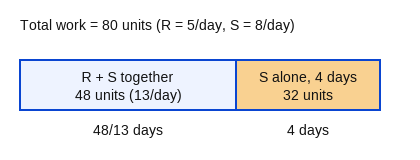
Concept: Take total work = LCM of days; work backwards from the end.

  1. Total work =LCM(16,10)=80 units; Ramesh =5, Suresh =8 units/day.
  2. Last 4 days Suresh alone: 4×8=32 units.
  3. Remaining 80−32=48 units done together at 13 units/day: 4813 days.
  4. Total =4813+4=10013=7913 days.

Trick: "Leaves x days before completion" → subtract the other person's x-day work first.

Answer: (B) 7913 days

अवधारणा: कुल कार्य = दिनों का LCM लें; अंत से उल्टा हल करें।

  1. कुल कार्य =LCM(16,10)=80 इकाई; रमेश =5, सुरेश =8 इकाई/दिन।
  2. अंतिम 4 दिन केवल सुरेश: 4×8=32 इकाई।
  3. शेष 80−32=48 इकाई दोनों ने 13 इकाई/दिन से: 4813 दिन।
  4. कुल =4813+4=10013=7913 दिन।

ट्रिक: "समाप्ति से x दिन पहले छोड़ा" → पहले दूसरे व्यक्ति का x दिन का कार्य घटाएँ।

उत्तर: (B) 7913 दिन

RRB NTPC Graduate CBT 1MathematicsTime and WorkRRB NTPC Graduate CBT 1 2024 · 17 Jun Shift 3 →
Q8288.
The sum of five numbers is 655. The average of the first two numbers is 77 and the third number is 101. Find the average of the remaining two numbers.
पाँच संख्याओं का योग 655 है। पहली दो संख्याओं का औसत 77 है और तीसरी संख्या 101 है। शेष दो संख्याओं का औसत ज्ञात कीजिए।
  1. A178
  2. B201
  3. C200
  4. D179
Show answer

Concept: Sum = average × count.

  1. First two numbers: 2×77=154
  2. Remaining two =655−154−101=400
  3. Average =4002=200

Trick: Subtract known parts from the total, then divide by how many are left.

Answer: (C) 200

अवधारणा: योग = औसत × संख्या।

  1. पहली दो संख्याएँ: 2×77=154
  2. शेष दो =655−154−101=400
  3. औसत =4002=200

ट्रिक: कुल में से ज्ञात भाग घटाएँ, फिर शेष संख्याओं से भाग दें।

उत्तर: (C) 200

RRB NTPC Graduate CBT 1MathematicsAverageRRB NTPC Graduate CBT 1 2024 · 17 Jun Shift 3 →
Q8289.
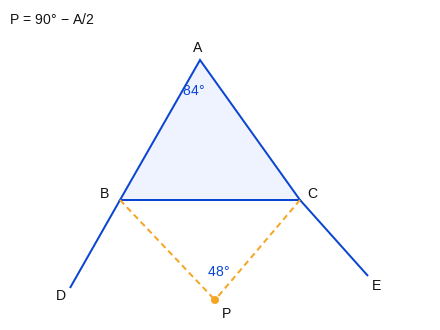
The side AB and AC of △ABC are produced to points D and E, respectively. The bisectors of ∠CBD and ∠BCE meet at P. If ∠A=84∘, then the measure of ∠P is:
△ABC की भुजाओं AB और AC को क्रमशः बिंदुओं D और E तक बढ़ाया गया है। ∠CBD और ∠BCE के समद्विभाजक P पर मिलते हैं। यदि ∠A=84∘ है, तो ∠P का माप है:
  1. A66∘
  2. B56∘
  3. C48∘
  4. D36∘
Show answer

Concept: Exterior angle bisectors at B and C meet at the excentre P, and ∠P=90∘−∠A2.

  1. ∠CBD=180∘−B, ∠BCE=180∘−C; halves are 90∘−B2 and 90∘−C2.
  2. In △BPC: ∠P=180∘−(90∘−B2)−(90∘−C2)=B+C2=90∘−A2
  3. ∠P=90∘−42∘=48∘

Trick: Internal bisectors: 90∘+A2; external bisectors: 90∘−A2.

Answer: (C) 48∘

अवधारणा: B और C के बहिष्कोण समद्विभाजक बहिःकेंद्र P पर मिलते हैं और ∠P=90∘−∠A2।

  1. ∠CBD=180∘−B, ∠BCE=180∘−C; इनके आधे 90∘−B2 और 90∘−C2।
  2. △BPC में: ∠P=180∘−(90∘−B2)−(90∘−C2)=B+C2=90∘−A2
  3. ∠P=90∘−42∘=48∘

ट्रिक: अंतः समद्विभाजक: 90∘+A2; बाह्य समद्विभाजक: 90∘−A2।

उत्तर: (C) 48∘

RRB NTPC Graduate CBT 1MathematicsGeometry – TrianglesRRB NTPC Graduate CBT 1 2024 · 17 Jun Shift 3 →
Q8290.
The median of the observations 60, 43, 24, 61, 72, 26, 39, 62, 49, 95 and 38 is:
प्रेक्षणों 60, 43, 24, 61, 72, 26, 39, 62, 49, 95 और 38 की माध्यिका है:
  1. A43
  2. B60
  3. C62
  4. D49
Show answer

Concept: For n odd, median = (n+12)th value after arranging in order.

  1. Ascending order: 24, 26, 38, 39, 43, 49, 60, 61, 62, 72, 95
  2. n=11, so median is the 6th value.
  3. Median =49

Trick: Always sort first – the 6th number in the given (unsorted) list is not the median.

Answer: (D) 49

अवधारणा: n विषम हो तो माध्यिका = क्रम में लगाने के बाद (n+12)वाँ मान।

  1. आरोही क्रम: 24, 26, 38, 39, 43, 49, 60, 61, 62, 72, 95
  2. n=11, अतः माध्यिका 6ठा मान।
  3. माध्यिका =49

ट्रिक: पहले क्रम में लगाएँ – दी गई अव्यवस्थित सूची का बीच वाला मान माध्यिका नहीं होता।

उत्तर: (D) 49

RRB NTPC Graduate CBT 1MathematicsStatistics – MedianRRB NTPC Graduate CBT 1 2024 · 17 Jun Shift 3 →
Q8291.
If 7 : 14 :: 8.7 : x and 5 : 35 :: 7 : y. What is the ratio of x to y?
यदि 7 : 14 :: 8.7 : x और 5 : 35 :: 7 : y है, तो x का y से अनुपात क्या है?
  1. A91 : 255
  2. B85 : 246
  3. C87 : 245
  4. D88 : 243
Show answer

Concept: In a:b::c:d, product of extremes = product of means.

  1. 7:14::8.7:x⇒x=14×8.77=17.4
  2. 5:35::7:y⇒y=35×75=49
  3. x:y=17.4:49=174:490=87:245

Trick: x=2×8.7 and y=7×7 – the ratios are just "double" and "seven times".

Answer: (C) 87:245

अवधारणा: a:b::c:d में बाह्य पदों का गुणनफल = मध्य पदों का गुणनफल।

  1. 7:14::8.7:x⇒x=14×8.77=17.4
  2. 5:35::7:y⇒y=35×75=49
  3. x:y=17.4:49=174:490=87:245

ट्रिक: x=2×8.7 और y=7×7 – अनुपात "दुगुना" और "सात गुना" है।

उत्तर: (C) 87:245

RRB NTPC Graduate CBT 1MathematicsProportionRRB NTPC Graduate CBT 1 2024 · 17 Jun Shift 3 →
Q8292.
A boat travels 176 km upstream in 16 hours and 85 km downstream in 5 hours. What is the speed of the boat in still water?
एक नाव धारा के प्रतिकूल 176 km की दूरी 16 घंटे में और धारा के अनुकूल 85 km की दूरी 5 घंटे में तय करती है। शांत जल में नाव की चाल क्या है?
  1. A24 km/hr
  2. B20 km/hr
  3. C14 km/hr
  4. D23 km/hr
Show answer

Concept: Speed in still water =downstream+upstream2

  1. Upstream speed =17616=11km/h
  2. Downstream speed =855=17km/h
  3. Boat speed =17+112=14km/h (stream =3km/h)

Trick: Boat = average of the two speeds; stream = half their difference.

Answer: (C) 14km/h

अवधारणा: शांत जल में चाल =अनुप्रवाह+ऊर्ध्वप्रवाह2

  1. ऊर्ध्वप्रवाह चाल =17616=11km/h
  2. अनुप्रवाह चाल =855=17km/h
  3. नाव की चाल =17+112=14km/h (धारा =3km/h)

ट्रिक: नाव = दोनों चालों का औसत; धारा = अंतर का आधा।

उत्तर: (C) 14km/h

RRB NTPC Graduate CBT 1MathematicsBoats and StreamsRRB NTPC Graduate CBT 1 2024 · 17 Jun Shift 3 →
Q8293.
If the manufacturer gains 10%, the wholesale gains 15% and the retailer gains 25%, then find the cost of production of a table (in ₹), whose retail price for the customer is ₹31,900.
(NOTE: Manufacturer sells to wholesaler, wholesaler sells to retailer and retailer sells to customers.)
यदि निर्माता को 10%, थोक विक्रेता को 15% और खुदरा विक्रेता को 25% लाभ होता है, तो एक मेज़ की उत्पादन लागत (₹ में) ज्ञात कीजिए, जिसका ग्राहक के लिए खुदरा मूल्य ₹31,900 है।
(नोट: निर्माता थोक विक्रेता को बेचता है, थोक विक्रेता खुदरा विक्रेता को बेचता है और खुदरा विक्रेता ग्राहकों को बेचता है।)
  1. A20,000
  2. B23,200
  3. C25,000
  4. D22,000
Show answer

Concept: Successive gains multiply: selling price =CP×110100×115100×125100.

  1. Combined factor =1.10×1.15×1.25=1.58125.
  2. Cost of production =319001.58125≈20173.91, i.e. about ₹20,173.91, not a whole number of rupees in the options.
  3. Check each option: 20000×1.58125=31625, 23200×1.58125=36685, 25000×1.58125=39531.25, 22000×1.58125=34787.5; none gives ₹31,900.
  4. So no option is correct as printed.

Note: Multiply the option by the combined factor to check it quickly. In the exam, every candidate gets full marks (bonus) for such a question.

Answer: Bonus – no option is correct as printed; full marks to all.

अवधारणा: क्रमिक लाभ गुणा होते हैं: विक्रय मूल्य =लागत×110100×115100×125100।

  1. संयुक्त गुणक =1.10×1.15×1.25=1.58125।
  2. उत्पादन लागत =319001.58125≈20173.91, अर्थात लगभग ₹20,173.91, जो किसी विकल्प के बराबर नहीं।
  3. हर विकल्प जाँचें: 20000×1.58125=31625, 23200×1.58125=36685, 25000×1.58125=39531.25, 22000×1.58125=34787.5; कोई भी ₹31,900 नहीं देता।
  4. अतः छपे प्रश्न के अनुसार कोई विकल्प सही नहीं।

नोट: विकल्प को संयुक्त गुणक से गुणा करके तुरंत जाँचें। परीक्षा में ऐसे प्रश्न पर सभी अभ्यर्थियों को पूरे अंक (बोनस) दिए जाते हैं।

उत्तर: बोनस – छपे प्रश्न के अनुसार कोई विकल्प सही नहीं; सभी को पूरे अंक।

RRB NTPC Graduate CBT 1MathematicsProfit and Loss – Successive GainsRRB NTPC Graduate CBT 1 2024 · 17 Jun Shift 3 →
Q8294.
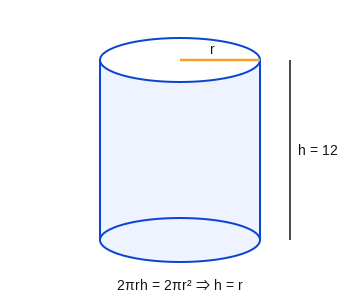
The curved surface area of a cylinder is half of its total surface area. If its height is 12 cm, then find its diameter (in cm).
एक बेलन का वक्र पृष्ठीय क्षेत्रफल उसके कुल पृष्ठीय क्षेत्रफल का आधा है। यदि इसकी ऊँचाई 12 cm है, तो इसका व्यास (cm में) ज्ञात कीजिए।
  1. A24
  2. B20
  3. C33
  4. D22
Show answer

Concept: CSA=2πrh, TSA=2πr(h+r)

  1. 2πrh=12×2πr(h+r)
  2. 2h=h+r⇒r=h=12cm
  3. Diameter =2r=24cm

Trick: CSA = half of TSA means CSA = area of the two ends, i.e. 2πrh=2πr2⇒h=r.

Answer: (A) 24

अवधारणा: वक्र पृष्ठ=2πrh, संपूर्ण पृष्ठ=2πr(h+r)

  1. 2πrh=12×2πr(h+r)
  2. 2h=h+r⇒r=h=12cm
  3. व्यास =2r=24cm

ट्रिक: वक्र पृष्ठ = संपूर्ण पृष्ठ का आधा, अर्थात् वक्र पृष्ठ = दोनों सिरों का क्षेत्रफल: 2πrh=2πr2⇒h=r।

उत्तर: (A) 24

RRB NTPC Graduate CBT 1MathematicsMensuration – CylinderRRB NTPC Graduate CBT 1 2024 · 17 Jun Shift 3 →
Q8295.
Find the simplified value of [81 ÷ {21 + 9 × (5 - 7)}].
[81 ÷ {21 + 9 × (5 - 7)}] का सरलीकृत मान ज्ञात कीजिए।
  1. A27
  2. B26
  3. C24
  4. D25
Show answer

Concept: BODMAS – solve innermost brackets first, then multiplication, then addition, then division.

  1. (5−7)=−2
  2. 9×(−2)=−18
  3. {21−18}=3
  4. 81÷3=27

Trick: Watch the sign: the small bracket is negative, so the curly bracket becomes 21−18.

Answer: (A) 27

अवधारणा: BODMAS – पहले सबसे भीतरी कोष्ठक, फिर गुणा, फिर जोड़, फिर भाग।

  1. (5−7)=−2
  2. 9×(−2)=−18
  3. {21−18}=3
  4. 81÷3=27

ट्रिक: चिह्न पर ध्यान दें: छोटा कोष्ठक ऋणात्मक है, इसलिए मँझला कोष्ठक 21−18 बनता है।

उत्तर: (A) 27

RRB NTPC Graduate CBT 1MathematicsSimplification (BODMAS)RRB NTPC Graduate CBT 1 2024 · 17 Jun Shift 3 →
Q8296.
What will come in the place of the question mark (?) in the following equation, if ‘+’ is replaced by ‘−’ and ‘×’ and ‘÷’ are interchanged?
20 ÷ 5 + 8 × 2 + 1 = ?
यदि ‘+’ को ‘−’ से प्रतिस्थापित कर दिया जाए और ‘×’ तथा ‘÷’ को आपस में बदल दिया जाए, तो निम्नलिखित समीकरण में प्रश्न चिह्न (?) के स्थान पर क्या आएगा?
20 ÷ 5 + 8 × 2 + 1 = ?
  1. A95
  2. B85
  3. C80
  4. D90
Show answer

Concept: After changing signs, solve using BODMAS.

  1. Replace: ‘+’ → ‘−’, ‘×’ ↔ ‘÷’.
  2. New expression: 20×5−8÷2−1
  3. =100−4−1=95

Trick: Rewrite the whole expression first, then apply BODMAS – never solve while changing signs.

Answer: (A) 95

अवधारणा: चिह्न बदलकर BODMAS से हल करें।

  1. ‘+’ → ‘−’ तथा ‘×’ ↔ ‘÷’ करें।
  2. नया व्यंजक: 20×5−8÷2−1
  3. =100−4−1=95

ट्रिक: पहले पूरा व्यंजक दोबारा लिखें, फिर BODMAS लगाएँ।

उत्तर: (A) 95

RRB NTPC Graduate CBT 1General Intelligence and ReasoningMathematical OperationsRRB NTPC Graduate CBT 1 2024 · 17 Jun Shift 3 →
Q8297.
This question is based on the five, three-digit numbers given below.
(Left) 411 559 916 247 769 (Right)
(Example- 697 – First digit = 6, second digit = 9 and third digit = 7)
(NOTE: All operations to be done from left to right.)
What will be the resultant if the first digit of the lowest number is subtracted from the first digit of the highest number?
यह प्रश्न नीचे दी गई तीन अंकों वाली पाँच संख्याओं पर आधारित है।
(बाएँ) 411 559 916 247 769 (दाएँ)
(उदाहरण- 697 – पहला अंक = 6, दूसरा अंक = 9 और तीसरा अंक = 7)
(नोट: सभी संक्रियाएँ बाएँ से दाएँ की जानी हैं।)
यदि सबसे बड़ी संख्या के पहले अंक में से सबसे छोटी संख्या का पहला अंक घटाया जाए, तो परिणाम क्या होगा?
  1. A10
  2. B7
  3. C8
  4. D6
Show answer

Concept: Find the highest and lowest of the given numbers, then use their first digits.

  1. Numbers: 411, 559, 916, 247, 769.
  2. Highest = 916 → first digit 9; Lowest = 247 → first digit 2.
  3. 9−2=7

Trick: Compare only the hundreds digit first – 9 (916) is highest, 2 (247) is lowest.

Answer: (B) 7

अवधारणा: दी गई संख्याओं में सबसे बड़ी और सबसे छोटी संख्या ज्ञात कर उनके पहले अंक लें।

  1. संख्याएँ: 411, 559, 916, 247, 769।
  2. सबसे बड़ी = 916 → पहला अंक 9; सबसे छोटी = 247 → पहला अंक 2।
  3. 9−2=7

ट्रिक: पहले सैकड़े का अंक देखें – 9 सबसे बड़ा, 2 सबसे छोटा।

उत्तर: (B) 7

RRB NTPC Graduate CBT 1General Intelligence and ReasoningNumber AnalysisRRB NTPC Graduate CBT 1 2024 · 17 Jun Shift 3 →
Q8298.
Which of the following letter-clusters should replace # and % so that the pattern and relationship followed between the letter-cluster pair on the left side of :: is the same as that on the right side of :: ?
# : EPV :: RFS : %
निम्नलिखित में से कौन-से अक्षर-समूह # और % को प्रतिस्थापित करें, ताकि :: के बाईं ओर के अक्षर-समूह युग्म के बीच अनुसरित पैटर्न और संबंध वही हो जो :: के दाईं ओर है?
# : EPV :: RFS : %
  1. A# = COW, % = SGQ
  2. B# = DMU, % = SGL
  3. C# = CNU, % = THV
  4. D# = DNU, % = SHT
Show answer

Concept: Find the letter shifts from # to EPV and apply the same to RFS.

  1. Try option (D): D → E (+1), N → P (+2), U → V (+1) gives EPV.
  2. Apply +1, +2, +1 to RFS: R → S, F → H, S → T = SHT.
  3. So # = DNU and % = SHT.

Trick: Check options quickly: only DNU gives EPV with a neat +1, +2, +1 pattern.

Answer: (D) # = DNU, % = SHT

अवधारणा: # से EPV तक का अक्षर-अंतर निकालें और वही RFS पर लगाएँ।

  1. विकल्प (D): D → E (+1), N → P (+2), U → V (+1) = EPV।
  2. RFS पर +1, +2, +1: R → S, F → H, S → T = SHT।
  3. अतः # = DNU, % = SHT।

ट्रिक: विकल्पों से जाँचें – केवल DNU से +1, +2, +1 का नियम बनता है।

उत्तर: (D) # = DNU, % = SHT

RRB NTPC Graduate CBT 1General Intelligence and ReasoningLetter AnalogyRRB NTPC Graduate CBT 1 2024 · 17 Jun Shift 3 →
Q8299.
In a certain code language, ‘MICE’ is coded as ‘6398’ and ‘PEAR’ is coded as ‘3215’. What is the code for ‘E’ in the given code language?
एक निश्चित कूट भाषा में, ‘MICE’ को ‘6398’ और ‘PEAR’ को ‘3215’ के रूप में कूटबद्ध किया जाता है। दी गई कूट भाषा में ‘E’ के लिए कूट क्या है?
  1. A2
  2. B5
  3. C3
  4. D8
Show answer

Concept: A letter common to both words gets the digit common to both codes.

  1. MICE → 6398 and PEAR → 3215.
  2. Common letter: E. Common digit: 3.
  3. So E = 3.

Trick: Common letter ↔ common digit (order of digits does not matter).

Answer: (C) 3

अवधारणा: दोनों शब्दों में उभयनिष्ठ अक्षर का कोड दोनों कोडों में उभयनिष्ठ अंक होता है।

  1. MICE → 6398 तथा PEAR → 3215।
  2. उभयनिष्ठ अक्षर: E; उभयनिष्ठ अंक: 3।
  3. अतः E = 3।

ट्रिक: समान अक्षर ↔ समान अंक।

उत्तर: (C) 3

RRB NTPC Graduate CBT 1General Intelligence and ReasoningCoding-DecodingRRB NTPC Graduate CBT 1 2024 · 17 Jun Shift 3 →
Q8300.
Refer to the following number and symbol series and answer the question that follows. Counting to be done from left to right only.
(NOTE: All numbers are single digit numbers only.)
(Left) 8 9 # 1 9 © 3 5 © € @ # £ @ * © 5 £ € 5 4 4 (Right)
How many such numbers are there each of which is immediately preceded by a number and also immediately followed by a symbol?
निम्नलिखित संख्या और प्रतीक श्रृंखला को देखिए और उसके बाद आने वाले प्रश्न का उत्तर दीजिए। गिनती केवल बाएँ से दाएँ की जानी है।
(नोट: सभी संख्याएँ केवल एक अंक वाली संख्याएँ हैं।)
(बाएँ) 8 9 # 1 9 © 3 5 © € @ # £ @ * © 5 £ € 5 4 4 (दाएँ)
ऐसी कितनी संख्याएँ हैं, जिनमें से प्रत्येक के ठीक पहले एक संख्या है और ठीक बाद एक प्रतीक भी है?
  1. A3
  2. B4
  3. C5
  4. D2
Show answer

Concept: Check each number: the element before it must be a number and the element after it must be a symbol.

  1. 8 9 # → 9 (preceded by 8, followed by #) ✔
  2. 1 9 © → 9 ✔; 3 5 © → 5 ✔
  3. Other numbers fail (e.g. 5 after ©, 4 followed by 4).
  4. Count = 3.

Trick: Scan for the pattern “number–number–symbol”; the middle number is counted.

Answer: (A) 3

अवधारणा: हर संख्या जाँचें: उससे ठीक पहले संख्या और ठीक बाद प्रतीक होना चाहिए।

  1. 8 9 # → 9 (पहले 8, बाद में #) ✔
  2. 1 9 © → 9 ✔; 3 5 © → 5 ✔
  3. बाकी संख्याएँ शर्त पूरी नहीं करतीं।
  4. कुल = 3।

ट्रिक: “संख्या–संख्या–प्रतीक” पैटर्न खोजें; बीच वाली संख्या गिनें।

उत्तर: (A) 3

RRB NTPC Graduate CBT 1General Intelligence and ReasoningNumber-Symbol SeriesRRB NTPC Graduate CBT 1 2024 · 17 Jun Shift 3 →