Question bank

Q&A: practice questions with answers

Search questions on any topic. Filter by exam category, exam, subject and topic, try the question, then open the answer and explanation.

Courses – airGurukul

20,719 questions found.

Q8361.
Not all regions in India equally benefited from the Green Revolution. Which of the following states was least impacted by the first phase of the Green Revolution?
भारत के सभी क्षेत्रों को हरित क्रांति से समान रूप से लाभ नहीं हुआ। निम्नलिखित में से कौन-सा राज्य हरित क्रांति के प्रथम चरण से सबसे कम प्रभावित हुआ?
  1. AOrissaउड़ीसा
  2. BPunjabपंजाब
  3. CHaryanaहरियाणा
  4. DUttar Pradeshउत्तर प्रदेश
Show answer

Concept: The first phase of the Green Revolution (mid-1960s) relied on HYV wheat seeds with assured irrigation, fertilisers and pesticides.

  1. It benefited mainly Punjab, Haryana and western Uttar Pradesh, which had canal/tubewell irrigation.
  2. Eastern states like Orissa (Odisha), with rice-based rain-fed farming, were least impacted.

Yaad rakhein: Green Revolution phase 1 = wheat belt of the north-west.

Answer: (A) Orissa

अवधारणा: हरित क्रांति का पहला चरण (1960 के दशक का मध्य) सुनिश्चित सिंचाई, उर्वरक और कीटनाशकों के साथ गेहूँ के HYV बीजों पर आधारित था।

  1. इसका लाभ मुख्यतः पंजाब, हरियाणा और पश्चिमी उत्तर प्रदेश को मिला, जहाँ नहर/नलकूप सिंचाई थी।
  2. चावल आधारित, वर्षा पर निर्भर पूर्वी राज्य जैसे ओडिशा सबसे कम प्रभावित हुए।

याद रखें: हरित क्रांति प्रथम चरण = उत्तर-पश्चिम का गेहूँ क्षेत्र।

उत्तर: (A) ओडिशा
RRB NTPC Graduate CBT 1General AwarenessEconomy – Green RevolutionRRB NTPC Graduate CBT 1 2024 · 17 Jun Shift 2 →
Q8362.
Which of the following medicines discovered by Paul Ehrlich became the first successful treatment for syphilis?
पॉल एर्लिक (Paul Ehrlich) द्वारा खोजी गई निम्नलिखित में से कौन-सी औषधि सिफलिस का पहला सफल उपचार बनी?
  1. APenicillinपेनिसिलिन
  2. BErythromycinएरिथ्रोमाइसिन
  3. CProntosilप्रोंटोसिल
  4. DSalvarsanसाल्वरसन
Show answer

Concept: Paul Ehrlich pioneered chemotherapy and the 'magic bullet' idea.

  1. In 1909–1910 Ehrlich and Sahachiro Hata developed Salvarsan (arsphenamine, 'compound 606'), the first effective treatment for syphilis.
  2. Penicillin – Alexander Fleming (1928); Prontosil – Gerhard Domagk; Erythromycin – a later antibiotic.

Yaad rakhein: Ehrlich → Salvarsan → syphilis → 'magic bullet'.

Answer: (D) Salvarsan

अवधारणा: पॉल एर्लिक ने कीमोथेरेपी और 'मैजिक बुलेट' की अवधारणा दी।

  1. 1909–1910 में एर्लिक और साहाचिरो हाटा ने सालवार्सन (आर्सफेनामीन, 'यौगिक 606') विकसित किया, जो सिफलिस का पहला प्रभावी उपचार था।
  2. पेनिसिलिन – अलेक्ज़ेंडर फ्लेमिंग (1928); प्रोन्टोसिल – गेरहार्ड डोमाक; एरिथ्रोमाइसिन – बाद का एंटीबायोटिक।

याद रखें: एर्लिक → सालवार्सन → सिफलिस → 'मैजिक बुलेट'।

उत्तर: (D) सालवार्सन

RRB NTPC Graduate CBT 1General AwarenessScience – MedicineRRB NTPC Graduate CBT 1 2024 · 17 Jun Shift 2 →
Q8363.
Kumudini Rajnikant Lakhia was honoured with the Padma Vibhushan in 2025 for her contribution in which field?
कुमुदिनी रजनीकांत लाखिया को 2025 में किस क्षेत्र में उनके योगदान के लिए पद्म विभूषण से सम्मानित किया गया?
  1. AArtsकला
  2. BMedicineचिकित्सा
  3. CPublic Affairsसार्वजनिक मामले
  4. DSportsखेल
Show answer

Concept: Kumudini Lakhia (1930–2025) was a renowned Kathak dancer and choreographer from Ahmedabad.

  1. She founded the Kadamb Centre for Dance (1967) and modernised Kathak choreography.
  2. She received the Padma Vibhushan 2025 in the field of Art (dance).

Yaad rakhein: Kumudini Lakhia = Kathak = Art.

Answer: (A) Arts

अवधारणा: कुमुदिनी लाखिया (1930–2025) अहमदाबाद की प्रसिद्ध कथक नृत्यांगना और कोरियोग्राफर थीं।

  1. उन्होंने 1967 में कदंब सेंटर फॉर डांस की स्थापना की और कथक नृत्य-रचना को आधुनिक रूप दिया।
  2. उन्हें 2025 में कला (नृत्य) क्षेत्र में पद्म विभूषण मिला।

याद रखें: कुमुदिनी लाखिया = कथक = कला।

उत्तर: (A) कला

RRB NTPC Graduate CBT 1General AwarenessAwards – Padma Vibhushan 2025RRB NTPC Graduate CBT 1 2024 · 17 Jun Shift 2 →
Q8364.
In the context of Local Area Networks (LANs), what is the primary purpose of a MAC (Media Access Control) address?
लोकल एरिया नेटवर्क (LANs) के संदर्भ में, MAC (मीडिया एक्सेस कंट्रोल) एड्रेस का प्राथमिक उद्देश्य क्या है?
  1. ATo specify the network protocol being used for communicationसंचार के लिए प्रयुक्त नेटवर्क प्रोटोकॉल को निर्दिष्ट करना
  2. BTo uniquely identify a network interface controller (NIC) at the data link layerडेटा लिंक लेयर पर किसी नेटवर्क इंटरफ़ेस कंट्रोलर (NIC) की विशिष्ट पहचान करना
  3. CTo define the physical layout and cabling of the networkनेटवर्क के भौतिक लेआउट और केबलिंग को परिभाषित करना
  4. DTo provide a logical address for network routingनेटवर्क रूटिंग के लिए एक तार्किक पता (logical address) प्रदान करना
Show answer

Concept: A MAC address is a 48-bit physical (hardware) address burned into a NIC.

  1. It uniquely identifies a network interface at the Data Link layer (Layer 2) of the OSI model; switches use it to deliver frames within a LAN.
  2. Logical addressing for routing is done by the IP address (Network layer, Layer 3) – so option (D) is wrong.

Yaad rakhein: MAC = physical address, Layer 2; IP = logical address, Layer 3.

Answer: (B) To uniquely identify a network interface controller (NIC) at the data link layer

अवधारणा: MAC address एक 48-बिट भौतिक (हार्डवेयर) पता है जो NIC में स्थायी रूप से दर्ज होता है।

  1. यह OSI मॉडल की डेटा लिंक परत (Layer 2) पर नेटवर्क इंटरफ़ेस की अद्वितीय पहचान करता है; LAN में स्विच इसी से फ्रेम भेजते हैं।
  2. रूटिंग के लिए तार्किक पता IP address (नेटवर्क परत, Layer 3) देता है – इसलिए विकल्प (D) गलत है।

याद रखें: MAC = भौतिक पता, Layer 2; IP = तार्किक पता, Layer 3।

उत्तर: (B) डेटा लिंक परत पर NIC की अद्वितीय पहचान करना

RRB NTPC Graduate CBT 1General AwarenessComputer – NetworkingRRB NTPC Graduate CBT 1 2024 · 17 Jun Shift 2 →
Q8365.
Which of the following are the key factors that are favourable for India for making it a key destination for foreign investments?
1. India’s robust economic fundamentals
2. Ongoing structural reforms
3. Decreasing consumer market position
निम्नलिखित में से कौन-से वे प्रमुख कारक हैं जो भारत को विदेशी निवेश का एक प्रमुख गंतव्य बनाने के लिए अनुकूल हैं?
1. भारत के सुदृढ़ आर्थिक मूलाधार
2. जारी संरचनात्मक सुधार
3. घटती उपभोक्ता बाज़ार स्थिति
  1. A2 and 3 onlyकेवल 2 और 3
  2. B1 and 2 onlyकेवल 1 और 2
  3. CAll 1, 2, and 31, 2 और 3 सभी
  4. D1 and 3 onlyकेवल 1 और 3
Show answer

Concept: Investors are attracted by strong fundamentals, reforms and a large, growing market.

  1. Statement 1 – robust economic fundamentals (high growth, stable macro indicators): favourable.
  2. Statement 2 – ongoing structural reforms (GST, IBC, PLI, ease of doing business): favourable.
  3. Statement 3 – a decreasing consumer market would deter investment; India's consumer market is in fact expanding. So 3 is wrong.

Yaad rakhein: Any 'decreasing/weakening' statement is usually the odd one in such questions.

Answer: (B) 1 and 2 only

अवधारणा: निवेशक मज़बूत आर्थिक आधार, सुधारों और बड़े व बढ़ते बाज़ार से आकर्षित होते हैं।

  1. कथन 1 – मज़बूत आर्थिक आधार (उच्च विकास, स्थिर व्यापक-आर्थिक संकेतक): अनुकूल।
  2. कथन 2 – जारी संरचनात्मक सुधार (GST, IBC, PLI, ease of doing business): अनुकूल।
  3. कथन 3 – घटता उपभोक्ता बाज़ार निवेश रोकेगा; वास्तव में भारत का उपभोक्ता बाज़ार बढ़ रहा है। अतः 3 गलत।

याद रखें: ऐसे प्रश्नों में 'घटता/कमज़ोर' वाला कथन प्रायः गलत होता है।

उत्तर: (B) केवल 1 और 2

RRB NTPC Graduate CBT 1General AwarenessEconomy – Foreign InvestmentRRB NTPC Graduate CBT 1 2024 · 17 Jun Shift 2 →
Q8366.
Find a single discount equal to three consecutive discounts of 20%, 13% and 20%.
20%, 13% और 20% की तीन क्रमिक छूटों के बराबर एकल छूट ज्ञात कीजिए।
  1. A44.95%
  2. B42.74%
  3. C48.08%
  4. D44.32%
Show answer

Concept: Successive discounts multiply: net price factor =∏(1−d).

  1. Factor =0.80×0.87×0.80
  2. =0.696×0.80=0.5568
  3. Single discount =1−0.5568=0.4432=44.32%

Trick: Two at a time: 20+20−20×20100=36%; then 36+13−36×13100=44.32%.

Answer: (D) 44.32%

अवधारणा: क्रमिक छूटें गुणा होती हैं: शुद्ध मूल्य गुणक =∏(1−d)।

  1. गुणक =0.80×0.87×0.80
  2. =0.696×0.80=0.5568
  3. एकल छूट =1−0.5568=0.4432=44.32%

ट्रिक: दो-दो करके: 20+20−20×20100=36%; फिर 36+13−36×13100=44.32%।

उत्तर: (D) 44.32%

RRB NTPC Graduate CBT 1MathematicsSuccessive DiscountRRB NTPC Graduate CBT 1 2024 · 17 Jun Shift 2 →
Q8367.
What positive value of X satisfies the equation X176=99X?
X का कौन-सा धनात्मक मान समीकरण X176=99X को संतुष्ट करता है?
  1. A132
  2. B133
  3. C135
  4. D130
Show answer

Concept: Cross-multiply a proportion: X176=99X⇒X2=176×99.

  1. X2=176×99=17424
  2. 176×99=16×11×9×11=(4×3×11)2
  3. X=4×3×11=132

Trick: Factor first: 16×9×112 is a perfect square → X=132.

Answer: (A) 132

अवधारणा: अनुपात में तिरछा गुणा: X176=99X⇒X2=176×99।

  1. X2=176×99=17424
  2. 176×99=16×11×9×11=(4×3×11)2
  3. X=4×3×11=132

ट्रिक: पहले गुणनखंड करें: 16×9×112 पूर्ण वर्ग → X=132।

उत्तर: (A) 132

RRB NTPC Graduate CBT 1MathematicsEquations / Square RootRRB NTPC Graduate CBT 1 2024 · 17 Jun Shift 2 →
Q8368.
What is the median of the following distribution?
Class140-190190-240240-290290-340340-390
Frequency2313242535
निम्नलिखित बंटन की माध्यिका क्या है?
वर्ग140-190190-240240-290290-340340-390
बारंबारता2313242535
  1. A301
  2. B278
  3. C290
  4. D304
Show answer

Concept: Grouped median =l+N2−cff×h.

  1. N=23+13+24+25+35=120, N2=60
  2. Cumulative frequencies: 23, 36, 60, 85, 120 → median class 240–290
  3. l=240, cf=36, f=24, h=50
  4. Median =240+60−3624×50=240+50=290

Trick: When N2 equals a cumulative frequency exactly, the median is that class's upper limit (here 290).

Answer: (C) 290

अवधारणा: वर्गीकृत माध्यिका =l+N2−cff×h।

  1. N=120, N2=60
  2. संचयी बारंबारता: 23, 36, 60, 85, 120 → माध्यिका वर्ग 240–290
  3. l=240, cf=36, f=24, h=50
  4. माध्यिका =240+2424×50=290

ट्रिक: यदि N2 किसी संचयी बारंबारता के बराबर हो, तो माध्यिका उस वर्ग की ऊपरी सीमा होती है।

उत्तर: (C) 290

RRB NTPC Graduate CBT 1MathematicsStatistics – MedianRRB NTPC Graduate CBT 1 2024 · 17 Jun Shift 2 →
Q8369.
If a : b :: b : c; c = 25a and b = 20, find the positive value of c.
यदि a : b :: b : c; c = 25a और b = 20 है, तो c का धनात्मक मान ज्ञात कीजिए।
  1. A99
  2. B98
  3. C100
  4. D101
Show answer

Concept: a:b::b:c⇒b2=ac.

  1. b2=a×25a=25a2⇒b=5a
  2. 20=5a⇒a=4
  3. c=25a=100

Trick: Check: 4:20=20:100 (both =15).

Answer: (C) 100

अवधारणा: a:b::b:c⇒b2=ac।

  1. b2=25a2⇒b=5a
  2. 20=5a⇒a=4
  3. c=25a=100

ट्रिक: जाँच: 4:20=20:100 (दोनों =15)।

उत्तर: (C) 100

RRB NTPC Graduate CBT 1MathematicsMean ProportionalRRB NTPC Graduate CBT 1 2024 · 17 Jun Shift 2 →
Q8370.
If secθ−tanθsecθ+tanθ=35, then 2sinθ is equal to:
यदि secθ−tanθsecθ+tanθ=35 है, तो 2sinθ किसके बराबर है?
  1. A12
  2. B14
  3. C18
  4. D1
Show answer

Concept: Multiply numerator and denominator by cosθ: secθ→1, tanθ→sinθ.

  1. 1−sinθ1+sinθ=35
  2. 5−5sinθ=3+3sinθ⇒8sinθ=2
  3. sinθ=14⇒2sinθ=12

Trick: Componendo-dividendo: sinθ=5−35+3=14.

Answer: (A) 12

अवधारणा: अंश व हर को cosθ से गुणा करें: secθ→1, tanθ→sinθ।

  1. 1−sinθ1+sinθ=35
  2. 5−5sinθ=3+3sinθ⇒sinθ=14
  3. 2sinθ=12

ट्रिक: योगांतरानुपात: sinθ=5−35+3=14।

उत्तर: (A) 12

RRB NTPC Graduate CBT 1MathematicsTrigonometryRRB NTPC Graduate CBT 1 2024 · 17 Jun Shift 2 →
Q8371.
On simple interest, a certain sum of money amounts to ₹1,250 in 2 years and to ₹2,000 in 4 years. Find the rate of interest per annum.
साधारण ब्याज पर, एक निश्चित धनराशि 2 वर्षों में ₹1,250 और 4 वर्षों में ₹2,000 हो जाती है। वार्षिक ब्याज दर ज्ञात कीजिए।
  1. A70%
  2. B75%
  3. C85%
  4. D80%
Show answer

Concept: Under SI, interest per year is constant, so the difference of amounts gives interest for the extra years.

  1. Interest for 2 years =2000−1250=750 → ₹375 per year
  2. Principal =1250−750=500
  3. Rate =375500×100=75%

Trick: R=A2−A1A1·t2−A2·t1×100=7501250×4−2000×2×100=75%.

Answer: (B) 75%

अवधारणा: साधारण ब्याज में हर वर्ष ब्याज समान रहता है, अतः राशियों का अंतर अतिरिक्त वर्षों का ब्याज है।

  1. 2 वर्ष का ब्याज =2000−1250=750 → ₹375 प्रति वर्ष
  2. मूलधन =1250−750=500
  3. दर =375500×100=75%

ट्रिक: R=7501250×4−2000×2×100=75%।

उत्तर: (B) 75%

RRB NTPC Graduate CBT 1MathematicsSimple InterestRRB NTPC Graduate CBT 1 2024 · 17 Jun Shift 2 →
Q8372.
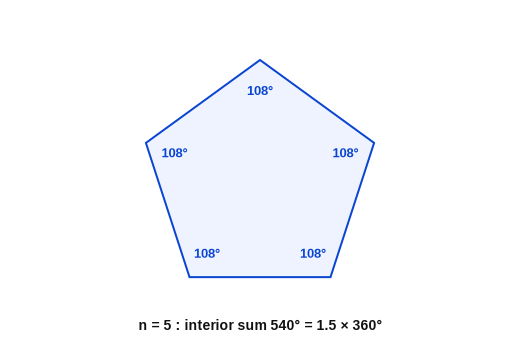
For a regular polygon, the sum of the interior angles is 50% more than the sum of its exterior angles. Each interior angle of the polygon measures x°. What is the value of x?
एक सम बहुभुज के अंतः कोणों का योग उसके बाह्य कोणों के योग से 50% अधिक है। बहुभुज का प्रत्येक अंतः कोण x° का है। x का मान क्या है?
  1. A88
  2. B96
  3. C112
  4. D108
Show answer

Concept: Sum of exterior angles of any polygon =360∘; sum of interior angles =(n−2)×180∘.

  1. Interior sum =1.5×360∘=540∘
  2. (n−2)×180=540⇒n=5
  3. Each interior angle =540∘5=108∘

Trick: Interior sum : exterior sum =(n−2):2 → 1.5=n−22⇒n=5.

Answer: (D) 108

अवधारणा: किसी भी बहुभुज के बाह्य कोणों का योग =360∘; अंतः कोणों का योग =(n−2)×180∘।

  1. अंतः योग =1.5×360∘=540∘
  2. (n−2)×180=540⇒n=5
  3. प्रत्येक अंतः कोण =540∘5=108∘

ट्रिक: अंतः योग : बाह्य योग =(n−2):2 → n=5।

उत्तर: (D) 108

RRB NTPC Graduate CBT 1MathematicsPolygonsRRB NTPC Graduate CBT 1 2024 · 17 Jun Shift 2 →
Q8373.
A company produces two products A and B with prices of ₹156 and ₹220, respectively. If 55% of the products sold are A and 45% of the products sold are B. Find the weighted average price?
एक कंपनी दो उत्पाद A और B बनाती है, जिनके मूल्य क्रमशः ₹156 और ₹220 हैं। यदि बेचे गए उत्पादों में से 55% उत्पाद A हैं और 45% उत्पाद B हैं, तो भारित औसत मूल्य ज्ञात कीजिए।
  1. A₹169.50
  2. B₹184.80
  3. C₹174.60
  4. D₹165.30
Show answer

Concept: Weighted average =∑(price×weight) with weights as fractions.

  1. 0.55×156=85.8
  2. 0.45×220=99
  3. Weighted average =85.8+99=184.8

Trick: 156+0.45×(220−156)=156+28.8=184.8.

Answer: (B) ₹184.80

अवधारणा: भारित औसत =∑(मूल्य×भार)।

  1. 0.55×156=85.8
  2. 0.45×220=99
  3. भारित औसत =85.8+99=184.8

ट्रिक: 156+0.45×(220−156)=156+28.8=184.8।

उत्तर: (B) ₹184.80

RRB NTPC Graduate CBT 1MathematicsWeighted AverageRRB NTPC Graduate CBT 1 2024 · 17 Jun Shift 2 →
Q8374.
The population of a town in 1930 was 3,48,000. If its population increased in two successive decades by 95% in each decade, the population of the town in 1950 was:
1930 में एक कस्बे की जनसंख्या 3,48,000 थी। यदि लगातार दो दशकों में इसकी जनसंख्या में प्रत्येक दशक में 95% की वृद्धि हुई, तो 1950 में कस्बे की जनसंख्या कितनी थी?
  1. A13,23,273
  2. B13,23,270
  3. C13,23,267
  4. D13,23,272
Show answer

Concept: Successive % growth works like compound interest: P(1+r100)n.

  1. Factor =1.952=3.8025
  2. Population 1950 =348000×3.8025
  3. =1323270 → 13,23,270

Trick: Last digits: 348000×3.8025 ends in …270 since 3.8025×1000=3802.5 and 348×3802.5=1323270.

Answer: (B) 13,23,270

अवधारणा: क्रमिक प्रतिशत वृद्धि चक्रवृद्धि जैसी: P(1+r100)n।

  1. गुणक =1.952=3.8025
  2. 1950 की जनसंख्या =348000×3.8025
  3. =1323270 → 13,23,270

ट्रिक: 348×3802.5=1323270 – सीधे गुणा करें।

उत्तर: (B) 13,23,270

RRB NTPC Graduate CBT 1MathematicsPopulation GrowthRRB NTPC Graduate CBT 1 2024 · 17 Jun Shift 2 →
Q8375.
Three persons X, Y, and Z started a business with their shares in the ratio 3 : 4 : 10. After 6 months, Y withdrew his 50% share, while Z withdrew his 40% share 9 months prior to completion of the year. If the total profit at the end of the year is ₹23,400, find the share of Z (in ₹) in the profit.
तीन व्यक्तियों X, Y और Z ने 3 : 4 : 10 के अनुपात में अपने अंशों के साथ एक व्यवसाय शुरू किया। 6 महीने बाद, Y ने अपना 50% अंश निकाल लिया, जबकि Z ने वर्ष पूरा होने से 9 महीने पहले अपना 40% अंश निकाल लिया। यदि वर्ष के अंत में कुल लाभ ₹23,400 है, तो लाभ में Z का हिस्सा (₹ में) ज्ञात कीजिए।
  1. A12,600
  2. B12,366
  3. C12,510
  4. D12,559
Show answer

Concept: Profit share ∝ capital × time (sum over each period).

  1. Take capitals 30, 40, 100. X: 30×12=360
  2. Y: 40×6+20×6=360
  3. Z withdraws 40% after 3 months: 100×3+60×9=840
  4. Ratio 360:360:840=3:3:7; Z =713×23400=12600

Trick: '9 months prior to completion' = after 3 months.

Answer: (A) 12,600

अवधारणा: लाभ हिस्सा ∝ पूँजी × समय।

  1. पूँजी 30, 40, 100 लें। X: 30×12=360
  2. Y: 40×6+20×6=360
  3. Z ने 3 माह बाद 40% निकाला: 100×3+60×9=840
  4. अनुपात 3:3:7; Z =713×23400=12600

ट्रिक: 'वर्ष पूरा होने से 9 माह पहले' = 3 माह बाद।

उत्तर: (A) 12,600

RRB NTPC Graduate CBT 1MathematicsPartnershipRRB NTPC Graduate CBT 1 2024 · 17 Jun Shift 2 →
Q8376.
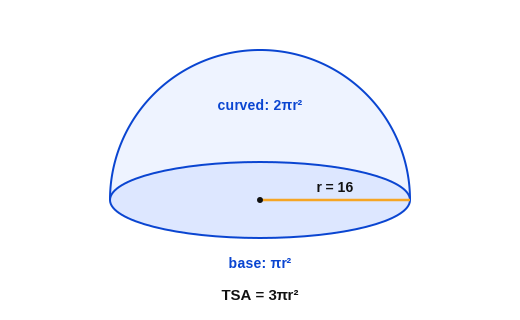
A solid hemisphere has a radius of 16 cm. Find its total surface area.
एक ठोस अर्धगोले की त्रिज्या 16 cm है। इसका संपूर्ण पृष्ठीय क्षेत्रफल ज्ञात कीजिए।
  1. A764π cm2
  2. B760π cm2
  3. C761π cm2
  4. D768π cm2
Show answer

Concept: Solid hemisphere TSA = curved 2πr2 + flat base πr2=3πr2.

  1. r=16cm, r2=256
  2. TSA =3π×256=768πcm2

Trick: Solid hemisphere → 3πr2; hollow (curved only) → 2πr2.

Answer: (D) 768πcm2

अवधारणा: ठोस अर्धगोले का कुल पृष्ठीय क्षेत्रफल = वक्र 2πr2 + समतल आधार πr2=3πr2।

  1. r=16cm, r2=256
  2. TSA =3π×256=768πcm2

ट्रिक: ठोस अर्धगोला → 3πr2; केवल वक्र → 2πr2।

उत्तर: (D) 768πcm2

RRB NTPC Graduate CBT 1MathematicsMensuration – HemisphereRRB NTPC Graduate CBT 1 2024 · 17 Jun Shift 2 →
Q8377.
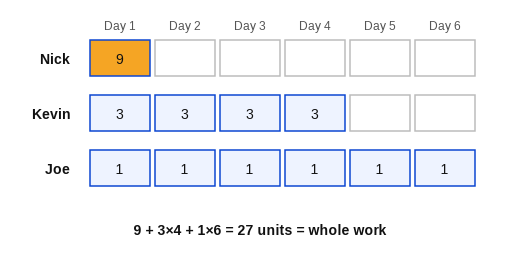
Nick, Kevin, and Joe can finish a certain piece of work in 3, 9, and 27 days respectively. All three of them started the work together. Nick left after working for 1 day, and Kevin left 2 days before the work was completed. Find the total number of days taken to complete the work.
निक, केविन और जो किसी कार्य को क्रमशः 3, 9 और 27 दिनों में पूरा कर सकते हैं। तीनों ने एक साथ कार्य शुरू किया। निक 1 दिन कार्य करने के बाद चला गया, और केविन कार्य पूरा होने से 2 दिन पहले चला गया। कार्य पूरा करने में लगे कुल दिनों की संख्या ज्ञात कीजिए।
  1. A7
  2. B5
  3. C4
  4. D6
Show answer

Concept: Take total work = LCM(3, 9, 27) = 27 units; efficiencies 9, 3, 1 units/day.

  1. Let total days =n. Nick works 1 day → 9 units.
  2. Kevin works n−2 days → 3(n−2); Joe works n days → n.
  3. 9+3(n−2)+n=27⇒4n=24⇒n=6

Trick: All three for n days =13n; subtract absences: 13n−9(n−1)−3×2=27⇒n=6.

Answer: (D) 6

अवधारणा: कुल कार्य = LCM(3, 9, 27) = 27 इकाई; क्षमता 9, 3, 1 इकाई/दिन।

  1. कुल दिन =n। Nick 1 दिन → 9 इकाई।
  2. Kevin n−2 दिन → 3(n−2); Joe n दिन → n।
  3. 9+3(n−2)+n=27⇒4n=24⇒n=6

ट्रिक: कौन कितने दिन काम करता है – उसी से एक-चर समीकरण बनाएँ।

उत्तर: (D) 6

RRB NTPC Graduate CBT 1MathematicsTime and WorkRRB NTPC Graduate CBT 1 2024 · 17 Jun Shift 2 →
Q8378.
The mode of the observations 8, 7, 4, 7, 9, 4, 5, 4, 7, 2, 4, 5, 8, 5, 4 and 5 is:
प्रेक्षणों 8, 7, 4, 7, 9, 4, 5, 4, 7, 2, 4, 5, 8, 5, 4 और 5 का बहुलक है:
  1. A8
  2. B7
  3. C2
  4. D4
Show answer

Concept: Mode = the value that occurs most often.

  1. Counts: 4 → 5 times, 5 → 4 times, 7 → 3 times, 8 → 2 times; 2 and 9 once.
  2. Highest frequency is for 4.

Trick: Tally quickly – mark each value once as you pass.

Answer: (D) 4

अवधारणा: बहुलक = सबसे अधिक बार आने वाला मान।

  1. गिनती: 4 → 5 बार, 5 → 4 बार, 7 → 3 बार, 8 → 2 बार; 2 व 9 एक-एक बार।
  2. सबसे अधिक बारंबारता 4 की।

ट्रिक: मिलान चिह्न (tally) से तेज़ी से गिनें।

उत्तर: (D) 4

RRB NTPC Graduate CBT 1MathematicsStatistics – ModeRRB NTPC Graduate CBT 1 2024 · 17 Jun Shift 2 →
Q8379.
Three numbers are in the ratio 2 : 7 : 13, and their LCM is 3094. Their HCF is ____.
तीन संख्याएँ 2 : 7 : 13 के अनुपात में हैं, और उनका LCM 3094 है। उनका HCF ____ है।
  1. A17
  2. B20
  3. C9
  4. D18
Show answer

Concept: Write the numbers as 2k,7k,13k; since 2, 7, 13 are pairwise co-prime, LCM =2×7×13×k.

  1. LCM =182k=3094
  2. k=3094182=17
  3. HCF =k=17

Trick: Co-prime ratio terms → HCF = the common multiplier k.

Answer: (A) 17

अवधारणा: संख्याएँ 2k,7k,13k; 2, 7, 13 परस्पर अभाज्य, अतः LCM =2×7×13×k।

  1. LCM =182k=3094
  2. k=3094182=17
  3. HCF =k=17

ट्रिक: अनुपात के पद सह-अभाज्य हों तो HCF = k।

उत्तर: (A) 17

RRB NTPC Graduate CBT 1MathematicsHCF and LCMRRB NTPC Graduate CBT 1 2024 · 17 Jun Shift 2 →
Q8380.
Govind bought two items at a total cost of ₹4,800. He sold one item at 34% profit and the other at 10% loss. If Govind sold both the items together for ₹5,442, then what is the difference between the cost price (in ₹) of both the items?
गोविंद ने ₹4,800 की कुल लागत पर दो वस्तुएँ खरीदीं। उसने एक वस्तु 34% लाभ पर और दूसरी 10% हानि पर बेची। यदि गोविंद ने दोनों वस्तुएँ एक साथ ₹5,442 में बेचीं, तो दोनों वस्तुओं के क्रय मूल्य (₹ में) के बीच का अंतर कितना है?
  1. A350
  2. B300
  3. C275
  4. D325
Show answer

Concept: Let one item cost x; the other costs 4800−x. Write the total selling price as an equation.

  1. 1.34x+0.90(4800−x)=5442
  2. 0.44x+4320=5442⇒0.44x=1122⇒x=2550
  3. Other item =4800−2550=2250
  4. Difference =2550−2250=300

Trick: If all were sold at 10% loss, SP would be ₹4320. Extra ₹1122 comes from 34%+10%=44% of item 1, so item 1 =11220.44=2550.

Answer: (B) ₹300

अवधारणा: एक वस्तु का क्रय मूल्य x मानें; दूसरी का 4800−x। कुल विक्रय मूल्य से समीकरण बनाएँ।

  1. 1.34x+0.90(4800−x)=5442
  2. 0.44x+4320=5442⇒0.44x=1122⇒x=2550
  3. दूसरी वस्तु =4800−2550=2250
  4. अंतर =2550−2250=300

ट्रिक: यदि दोनों 10% हानि पर बिकतीं तो विक्रय मूल्य ₹4320 होता। अतिरिक्त ₹1122 पहली वस्तु के 34%+10%=44% से आए, अतः पहली वस्तु =11220.44=2550।

उत्तर: (B) ₹300

RRB NTPC Graduate CBT 1MathematicsProfit and LossRRB NTPC Graduate CBT 1 2024 · 17 Jun Shift 2 →