Question bank

Q&A: practice questions with answers

Search questions on any topic. Filter by exam category, exam, subject and topic, try the question, then open the answer and explanation.

Courses – airGurukul

20,719 questions found.

Q8381.
A bank offers 1.1% compound interest per annum calculated on a half-yearly basis. A customer deposits ₹7,745 each on 1 January and 1 July of a year. At the end of the year, the amount he would have gained by way of interest is ________. (Rounded up to the 2 decimal places.)
एक बैंक अर्धवार्षिक आधार पर परिकलित 1.1% वार्षिक चक्रवृद्धि ब्याज प्रदान करता है। एक ग्राहक किसी वर्ष की 1 जनवरी और 1 जुलाई को प्रत्येक बार ₹7,745 जमा करता है। वर्ष के अंत में, उसे ब्याज के रूप में ________ राशि प्राप्त होगी। (2 दशमलव स्थानों तक पूर्णांकित।)
  1. A₹121.87
  2. B₹128.03
  3. C₹131.93
  4. D₹109.99
Show answer

Concept: Half-yearly compounding: rate per half-year =1.12=0.55%. The January deposit earns for 2 half-years, the July deposit for 1 half-year.

  1. Jan deposit: 7745[(1.0055)2−1]=7745×0.01103025=85.43
  2. July deposit: 7745×0.0055=42.60
  3. Total interest =85.43+42.60=128.03

Trick: CI for 2 periods at r% =2r+r2100=1.1+0.003025=1.103025%; add 0.55% for the second deposit: 1.653025% of 7745 ≈128.03.

Answer: (B) ₹128.03

अवधारणा: अर्धवार्षिक चक्रवृद्धि: प्रति छमाही दर =1.12=0.55%। जनवरी की जमा 2 छमाही, जुलाई की जमा 1 छमाही ब्याज कमाती है।

  1. जनवरी जमा: 7745[(1.0055)2−1]=7745×0.01103025=85.43
  2. जुलाई जमा: 7745×0.0055=42.60
  3. कुल ब्याज =85.43+42.60=128.03

ट्रिक: 2 अवधियों का CI =2r+r2100=1.103025%; दूसरी जमा का 0.55% जोड़ें: 7745 का 1.653025%≈128.03।

उत्तर: (B) ₹128.03

RRB NTPC Graduate CBT 1MathematicsCompound InterestRRB NTPC Graduate CBT 1 2024 · 17 Jun Shift 2 →
Q8382.
Which of the following numbers is divisible by 41?
निम्नलिखित में से कौन-सी संख्या 41 से विभाज्य है?
  1. A9430
  2. B9879
  3. C9249
  4. D10113
Show answer

Concept: Divide each option by 41 and check the remainder.

  1. 9430÷41=230 exactly, since 41×230=9430
  2. 9879=41×240+39; 9249=41×225+24; 10113=41×246+27 – not divisible

Trick: 9430=943×10 and 943=41×23 (since 41×23=943).

Answer: (A) 9430

अवधारणा: प्रत्येक विकल्प को 41 से भाग देकर शेषफल जाँचें।

  1. 9430÷41=230 पूर्णतः, क्योंकि 41×230=9430
  2. 9879=41×240+39; 9249=41×225+24; 10113=41×246+27 – विभाज्य नहीं

ट्रिक: 9430=943×10 और 943=41×23।

उत्तर: (A) 9430

RRB NTPC Graduate CBT 1MathematicsDivisibilityRRB NTPC Graduate CBT 1 2024 · 17 Jun Shift 2 →
Q8383.
The sum of two positive numbers x and y (where x>y) is 15 and their product is 36. Find the difference between the numbers x and y.
दो धनात्मक संख्याओं x और y (जहाँ x>y) का योग 15 है और उनका गुणनफल 36 है। संख्याओं x और y के बीच का अंतर ज्ञात कीजिए।
  1. A10
  2. B9
  3. C12
  4. D8
Show answer

Concept: Use (x−y)2=(x+y)2−4xy.

  1. (x−y)2=152−4×36=225−144=81
  2. x−y=81=9 (positive since x>y)
  3. Check: x=12, y=3 ⇒ 12+3=15, 12×3=36

Trick: Find two numbers with product 36 and sum 15 directly: 12 and 3.

Answer: (B) 9

अवधारणा: सूत्र (x−y)2=(x+y)2−4xy का प्रयोग करें।

  1. (x−y)2=152−4×36=225−144=81
  2. x−y=81=9 (क्योंकि x>y)
  3. जाँच: x=12, y=3 ⇒ 12+3=15, 12×3=36

ट्रिक: गुणनफल 36 और योग 15 वाली संख्याएँ सीधे सोचें: 12 और 3।

उत्तर: (B) 9

RRB NTPC Graduate CBT 1MathematicsAlgebra – Sum and ProductRRB NTPC Graduate CBT 1 2024 · 17 Jun Shift 2 →
Q8384.
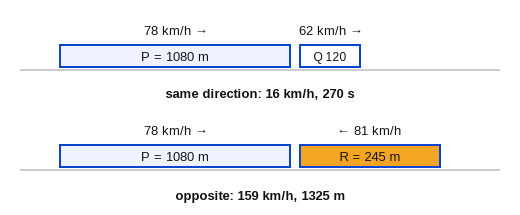
A train P going at the speed of 78 km/hr completely passes train Q of length 120 m, going in the same direction on parallel tracks, at 62 km/hr, in 4.5 minutes. How much time (in seconds) will P take to cross completely train R of length 245 m, going at 81 km/hr in the opposite direction?
78 km/hr की चाल से चल रही एक ट्रेन P, समानांतर पटरियों पर उसी दिशा में 62 km/hr की चाल से चल रही 120 m लंबी ट्रेन Q को 4.5 मिनट में पूरी तरह पार कर लेती है। विपरीत दिशा में 81 km/hr की चाल से चल रही 245 m लंबी ट्रेन R को पूरी तरह पार करने में P को कितना समय (सेकंड में) लगेगा?
  1. A49
  2. B28
  3. C30
  4. D15
Show answer

Concept: Crossing distance = sum of lengths; use relative speed (difference for same direction, sum for opposite).

  1. Same direction: 78−62=16km/h=409m/s; time =4.5×60=270s
  2. LP+120=409×270=1200⇒LP=1080m
  3. Opposite: 78+81=159km/h=159×518=2656m/s
  4. Time =1080+245265/6=1325×6265=30s

Trick: 1325=5×265, so time =5×6=30 s.

Answer: (C) 30

अवधारणा: पार करने की दूरी = दोनों लंबाइयों का योग; सापेक्ष चाल (एक ही दिशा में अंतर, विपरीत दिशा में योग)।

  1. एक ही दिशा: 78−62=16km/h=409m/s; समय =4.5×60=270s
  2. LP+120=409×270=1200⇒LP=1080m
  3. विपरीत दिशा: 78+81=159km/h=2656m/s
  4. समय =1080+245265/6=1325×6265=30s

ट्रिक: 1325=5×265, अतः समय =5×6=30 सेकंड।

उत्तर: (C) 30

RRB NTPC Graduate CBT 1MathematicsTrainsRRB NTPC Graduate CBT 1 2024 · 17 Jun Shift 2 →
Q8385.
A vendor sells 8, 12, 10, 14, and 6 mangoes over five days. What is the average number of mangoes sold per day?
एक विक्रेता पाँच दिनों में 8, 12, 10, 14 और 6 आम बेचता है। प्रति दिन बेचे गए आमों की औसत संख्या क्या है?
  1. A8
  2. B14
  3. C12
  4. D10
Show answer

Concept: Average =sumcount.

  1. Sum =8+12+10+14+6=50
  2. Average =505=10

Trick: Pair the deviations around 10: −2,+2,0,+4,−4 cancel out, so the average is 10.

Answer: (D) 10

अवधारणा: औसत =योगसंख्या।

  1. योग =8+12+10+14+6=50
  2. औसत =505=10

ट्रिक: 10 से विचलन −2,+2,0,+4,−4 आपस में कट जाते हैं, अतः औसत 10।

उत्तर: (D) 10

RRB NTPC Graduate CBT 1MathematicsAverageRRB NTPC Graduate CBT 1 2024 · 17 Jun Shift 2 →
Q8386.
A, B and C alone can do a piece of work in 5, 55 and 66 days, respectively. They all started the work together, but A left after 4 days. In how many days was the whole work completed?
A, B और C अकेले किसी कार्य को क्रमशः 5, 55 और 66 दिनों में कर सकते हैं। सभी ने एक साथ कार्य शुरू किया, लेकिन A 4 दिन बाद चला गया। पूरा कार्य कितने दिनों में पूरा हुआ?
  1. A7
  2. B3
  3. C2
  4. D6
Show answer

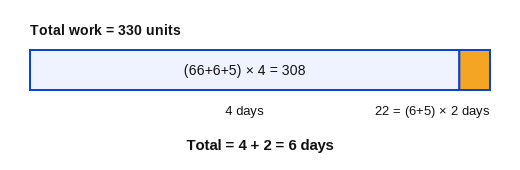
Concept: Take total work = LCM(5, 55, 66) = 330 units.

  1. Efficiencies: A =3305=66, B =33055=6, C =33066=5 units/day
  2. 4 days together: (66+6+5)×4=308 units
  3. Left: 330−308=22 units by B + C at 11/day ⇒ 2211=2 days
  4. Total =4+2=6 days

Trick: Units method avoids fractions – always use LCM as total work.

Answer: (D) 6

अवधारणा: कुल कार्य = LCM(5, 55, 66) = 330 इकाई मानें।

  1. क्षमता: A =3305=66, B =33055=6, C =33066=5 इकाई/दिन
  2. 4 दिन साथ में: (66+6+5)×4=308 इकाई
  3. शेष: 330−308=22 इकाई, B + C 11 प्रतिदिन ⇒ 2211=2 दिन
  4. कुल =4+2=6 दिन

ट्रिक: LCM को कुल कार्य मानने से भिन्नें नहीं आतीं।

उत्तर: (D) 6

RRB NTPC Graduate CBT 1MathematicsTime and WorkRRB NTPC Graduate CBT 1 2024 · 17 Jun Shift 2 →
Q8387.
Namita travels a certain distance at a speed of 88 km/hr and double the earlier distance at 16 km/hr. She then returns to the starting point through the same route. If her average speed for the entire journey is 33 km/hr, then what is her speed (in km/hr) for the return journey?
नमिता एक निश्चित दूरी 88 km/hr की चाल से और उससे दोगुनी दूरी 16 km/hr की चाल से तय करती है। फिर वह उसी मार्ग से प्रारंभिक बिंदु पर लौटती है। यदि पूरी यात्रा के लिए उसकी औसत चाल 33 km/hr है, तो वापसी यात्रा के लिए उसकी चाल (km/hr में) क्या है?
  1. A64
  2. B65.4
  3. C66
  4. D71.2
Show answer

Concept: Average speed =total distancetotal time. Let first part =d, second part =2d.

  1. Onward time =d88+2d16=d88+11d88=12d88=3d22
  2. Total distance =6d; total time =6d33=2d11=4d22
  3. Return time =4d22−3d22=d22
  4. Return speed =3dd/22=66km/h

Trick: Take d=88: onward time 12 h, total time 16 h, return time 4 h for 264 km ⇒ 66 km/h.

Answer: (C) 66

अवधारणा: औसत चाल =कुल दूरीकुल समय। पहला भाग =d, दूसरा =2d मानें।

  1. जाने का समय =d88+2d16=12d88=3d22
  2. कुल दूरी =6d; कुल समय =6d33=4d22
  3. वापसी का समय =4d22−3d22=d22
  4. वापसी चाल =3dd/22=66km/h

ट्रिक: d=88 लें: जाने में 12 घंटे, कुल 16 घंटे, वापसी 4 घंटे में 264 km ⇒ 66 km/h।

उत्तर: (C) 66

RRB NTPC Graduate CBT 1MathematicsAverage SpeedRRB NTPC Graduate CBT 1 2024 · 17 Jun Shift 2 →
Q8388.
Find the circumference (in m) of the largest circle that can be inscribed in a rectangle whose dimensions are given as 112 m and 281 m.
Take π=227
उस सबसे बड़े वृत्त की परिधि (m में) ज्ञात कीजिए जो 112 m और 281 m विमाओं वाले एक आयत के अंदर बनाया जा सकता है।
π=227 लीजिए
  1. A352
  2. B348
  3. C354
  4. D342
Show answer

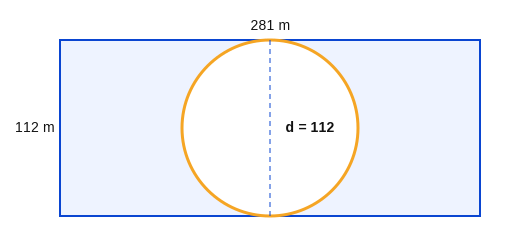
Concept: The largest circle inside a rectangle touches the two longer sides, so its diameter = the shorter side.

  1. Diameter =112m
  2. Circumference =πd=227×112=22×16=352m

Trick: Diameter = smaller side of the rectangle; the longer side (281) is irrelevant.

Answer: (A) 352

अवधारणा: आयत के अंदर सबसे बड़ा वृत्त दो लंबी भुजाओं को छूता है, अतः उसका व्यास = छोटी भुजा।

  1. व्यास =112m
  2. परिधि =πd=227×112=22×16=352m

ट्रिक: व्यास = आयत की छोटी भुजा; लंबी भुजा (281) का कोई उपयोग नहीं।

उत्तर: (A) 352

RRB NTPC Graduate CBT 1MathematicsMensuration – CircleRRB NTPC Graduate CBT 1 2024 · 17 Jun Shift 2 →
Q8389.
Find the value of 0.040.0004:
0.040.0004 का मान ज्ञात कीजिए:
  1. A18
  2. B29
  3. C10
  4. D21
Show answer

Concept: Take square roots of numerator and denominator separately.

  1. 0.04=0.2 and 0.0004=0.02
  2. 0.20.02=10

Trick: 0.040.0004=100=10 in one step.

Answer: (C) 10

अवधारणा: अंश और हर का वर्गमूल अलग-अलग निकालें।

  1. 0.04=0.2 और 0.0004=0.02
  2. 0.20.02=10

ट्रिक: एक ही चरण में: 0.040.0004=100=10।

उत्तर: (C) 10

RRB NTPC Graduate CBT 1MathematicsSquare Roots of DecimalsRRB NTPC Graduate CBT 1 2024 · 17 Jun Shift 2 →
Q8390.
The cost of 8 pens and 2 pencils is ₹96 and the cost of 4 pens and 7 pencils ₹72. The cost of 2 pens and 8 pencils is:
8 पेन और 2 पेंसिल का मूल्य ₹96 है तथा 4 पेन और 7 पेंसिल का मूल्य ₹72 है। 2 पेन और 8 पेंसिल का मूल्य है:
  1. A₹53
  2. B₹55
  3. C₹54
  4. D₹56
Show answer

Concept: Let pen =p, pencil =c and solve the two equations.

  1. 8p+2c=96 and 4p+7c=72
  2. Double the second: 8p+14c=144; subtract: 12c=48⇒c=4
  3. 8p=96−8=88⇒p=11
  4. 2p+8c=22+32=54

Trick: Make the pen coefficients equal (8) and subtract to get pencils first.

Answer: (C) ₹54

अवधारणा: पेन =p, पेंसिल =c मानकर दोनों समीकरण हल करें।

  1. 8p+2c=96 और 4p+7c=72
  2. दूसरे को 2 से गुणा: 8p+14c=144; घटाएँ: 12c=48⇒c=4
  3. 8p=96−8=88⇒p=11
  4. 2p+8c=22+32=54

ट्रिक: पेन के गुणांक बराबर (8) करके घटाएँ, पहले पेंसिल का मान मिलेगा।

उत्तर: (C) ₹54

RRB NTPC Graduate CBT 1MathematicsLinear EquationsRRB NTPC Graduate CBT 1 2024 · 17 Jun Shift 2 →
Q8391.
In a regular polygon with n sides, the sum of the interior angles is 1800°. What is the number of sides (n) of the polygon?
n भुजाओं वाले एक सम बहुभुज में अंतः कोणों का योग 1800° है। बहुभुज की भुजाओं की संख्या (n) क्या है?
  1. A14
  2. B10
  3. C12
  4. D16
Show answer

Concept: Sum of interior angles of an n-sided polygon =(n−2)×180∘.

  1. (n−2)×180=1800
  2. n−2=10⇒n=12

Trick: Divide the sum by 180 and add 2: 1800180+2=12.

Answer: (C) 12

अवधारणा: n भुजाओं वाले बहुभुज के अंतःकोणों का योग =(n−2)×180∘।

  1. (n−2)×180=1800
  2. n−2=10⇒n=12

ट्रिक: योग को 180 से भाग देकर 2 जोड़ें: 1800180+2=12।

उत्तर: (C) 12

RRB NTPC Graduate CBT 1MathematicsPolygonsRRB NTPC Graduate CBT 1 2024 · 17 Jun Shift 2 →
Q8392.
Find the simplified value of [160 ÷ {30 + 7 × (2 - 6)}].
[160 ÷ {30 + 7 × (2 - 6)}] का सरलीकृत मान ज्ञात कीजिए।
  1. A80
  2. B79
  3. C85
  4. D78
Show answer

Concept: Solve innermost brackets first, then multiplication, then addition, then division.

  1. 2−6=−4
  2. 7×(−4)=−28
  3. 30+(−28)=2
  4. 160÷2=80

Trick: Watch the sign: 7×(−4) is negative, so the curly bracket becomes just 2.

Answer: (A) 80

अवधारणा: पहले सबसे भीतरी कोष्ठक, फिर गुणा, फिर जोड़, फिर भाग।

  1. 2−6=−4
  2. 7×(−4)=−28
  3. 30+(−28)=2
  4. 160÷2=80

ट्रिक: चिह्न पर ध्यान दें: 7×(−4) ऋणात्मक है, अतः मझला कोष्ठक केवल 2 बनता है।

उत्तर: (A) 80

RRB NTPC Graduate CBT 1MathematicsSimplification (BODMAS)RRB NTPC Graduate CBT 1 2024 · 17 Jun Shift 2 →
Q8393.
A retailer allows a 22% discount on the marked price. What should be the marked price (in ₹) of an item whose cost price is ₹546, in order to make a profit of 60%?
एक खुदरा विक्रेता अंकित मूल्य पर 22% की छूट देता है। 60% लाभ प्राप्त करने के लिए, ₹546 क्रय मूल्य वाली वस्तु का अंकित मूल्य (₹ में) कितना होना चाहिए?
  1. A1,122
  2. B1,120
  3. C1,118
  4. D1,123
Show answer

Concept: SP=CP×(1+profit) and SP=MP×(1−discount).

  1. SP=546×1.6=873.6
  2. MP×0.78=873.6
  3. MP=873.60.78=1120

Trick: MPCP=100+P100−D=16078, and 546=78×7, so MP =160×7=1120.

Answer: (B) 1,120

अवधारणा: SP=CP×(1+लाभ) और SP=MP×(1−छूट)।

  1. SP=546×1.6=873.6
  2. MP×0.78=873.6
  3. MP=873.60.78=1120

ट्रिक: MPCP=100+P100−D=16078, और 546=78×7, अतः MP =160×7=1120।

उत्तर: (B) 1,120

RRB NTPC Graduate CBT 1MathematicsDiscount and ProfitRRB NTPC Graduate CBT 1 2024 · 17 Jun Shift 2 →
Q8394.
A person saves 30% of his income. If his expenditure is ₹840, then his income (in ₹) is:
एक व्यक्ति अपनी आय का 30% बचाता है। यदि उसका व्यय ₹840 है, तो उसकी आय (₹ में) है:
  1. A1,240
  2. B588
  3. C252
  4. D1,200
Show answer

Concept: Income = Expenditure + Savings. Savings 30% ⇒ expenditure is 70% of income.

  1. 70% of income=840
  2. Income=840×10070=1200

Trick: 70%→840 ⇒ 10%→120 ⇒ 100%→1200.

Answer: (D) 1,200

अवधारणा: आय = व्यय + बचत। बचत 30% ⇒ व्यय आय का 70% है।

  1. आय का 70%=840
  2. आय=840×10070=1200

ट्रिक: 70%→840 ⇒ 10%→120 ⇒ 100%→1200।

उत्तर: (D) 1,200

RRB NTPC Graduate CBT 1MathematicsIncome and SavingsRRB NTPC Graduate CBT 1 2024 · 17 Jun Shift 2 →
Q8395.
If the discriminant of a quadratic equation is negative, then the roots are:
यदि किसी द्विघात समीकरण का विविक्तकर (discriminant) ऋणात्मक है, तो उसके मूल होते हैं:
  1. Areal and distinctवास्तविक और भिन्न
  2. Bcomplex conjugatesसम्मिश्र संयुग्मी (complex conjugates)
  3. Creal and equalवास्तविक और समान
  4. Dreal and negativeवास्तविक और ऋणात्मक
Show answer

Concept: For ax2+bx+c=0, discriminant D=b2−4ac decides the nature of roots.

  1. D>0: real and distinct; D=0: real and equal
  2. D<0: D is imaginary, so roots are −b±i|D|2a – a pair of complex conjugates (for real coefficients).

Trick: Negative D ⇒ no real roots ⇒ complex pair p±iq.

Answer: (B) complex conjugates

अवधारणा: ax2+bx+c=0 के लिए विविक्तकर (discriminant) D=b2−4ac मूलों की प्रकृति तय करता है।

  1. D>0: वास्तविक और भिन्न; D=0: वास्तविक और समान
  2. D<0: D काल्पनिक है, अतः मूल −b±i|D|2a – सम्मिश्र संयुग्मी (complex conjugates) युग्म।

ट्रिक: D ऋणात्मक ⇒ कोई वास्तविक मूल नहीं ⇒ सम्मिश्र युग्म p±iq।

उत्तर: (B) complex conjugates

RRB NTPC Graduate CBT 1MathematicsQuadratic Equations – Nature of RootsRRB NTPC Graduate CBT 1 2024 · 17 Jun Shift 2 →
Q8396.
In a certain code language, ‘CART’ is coded as ‘4268’ and ‘RISE’ is coded as ‘3527’. What is the code for ‘R’ in the given code language?
एक निश्चित कूट भाषा में, ‘CART’ को ‘4268’ और ‘RISE’ को ‘3527’ के रूप में कूटबद्ध किया जाता है। दी गई कूट भाषा में ‘R’ का कूट क्या है?
  1. A2
  2. B6
  3. C7
  4. D3
Show answer

Concept: When two words share a letter, the digit common to both codes is the code of that letter.

  1. CART → 4268 and RISE → 3527.
  2. The only common letter is R.
  3. The only common digit in the two codes is 2.

Trick: Common letter ↔ common digit; ignore order of digits.

Answer: (A) 2

अवधारणा: जब दो शब्दों में एक अक्षर समान हो, तो दोनों कोड में समान अंक उसी अक्षर का कोड होता है।

  1. CART → 4268 और RISE → 3527।
  2. दोनों शब्दों में केवल R समान है।
  3. दोनों कोड में केवल 2 समान अंक है।

ट्रिक: समान अक्षर ↔ समान अंक; अंकों का क्रम मायने नहीं रखता।

उत्तर: (A) 2

RRB NTPC Graduate CBT 1General Intelligence and ReasoningCoding-DecodingRRB NTPC Graduate CBT 1 2024 · 17 Jun Shift 2 →
Q8397.
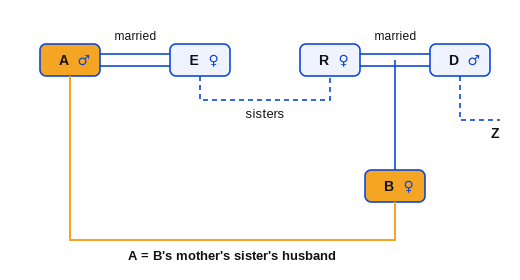
A is married to E. E is the sister of R. R is married to D. D is the only brother of Z. B is the only daughter of R. How is A related to B?
A का विवाह E से हुआ है। E, R की बहन है। R का विवाह D से हुआ है। D, Z का एकमात्र भाई है। B, R की एकमात्र पुत्री है। A का B से क्या संबंध है?
  1. AMother’s sister's husbandमाँ की बहन का पति
  2. BFather's sister's husbandपिता की बहन का पति
  3. CMother's sister's fatherमाँ की बहन का पिता
  4. DMother's brother's wifeमाँ के भाई की पत्नी
Show answer

Concept: Fix genders from marriages and 'brother' clues, then trace the path from B to A.

  1. D is a brother (male), so his wife R is female – B's mother.
  2. E is R's sister, so E is B's mother's sister (maasi).
  3. A is married to E, so A is the husband of B's mother's sister.

Trick: Mother's sister's husband = maasa (मौसा).

Answer: (A) Mother's sister's husband

अवधारणा: विवाह और 'भाई' वाले कथनों से लिंग तय करें, फिर B से A तक का रास्ता देखें।

  1. D भाई (पुरुष) है, अतः उसकी पत्नी R महिला है – B की माँ।
  2. E, R की बहन है, अतः E = B की मौसी।
  3. A का विवाह E से है, अतः A = B की माँ की बहन का पति (मौसा)।

ट्रिक: माँ की बहन का पति = मौसा।

उत्तर: (A) माँ की बहन का पति

RRB NTPC Graduate CBT 1General Intelligence and ReasoningBlood RelationRRB NTPC Graduate CBT 1 2024 · 17 Jun Shift 2 →
Q8398.
In a certain code language, ‘HUNT’ is coded as ‘6438’ and ‘USER’ is coded as ‘5723’. What is the code for ‘U’ in the given code language?
एक निश्चित कूट भाषा में, ‘HUNT’ को ‘6438’ और ‘USER’ को ‘5723’ के रूप में कूटबद्ध किया जाता है। दी गई कूट भाषा में ‘U’ का कूट क्या है?
  1. A3
  2. B5
  3. C7
  4. D4
Show answer

Concept: A letter common to two words takes the digit common to both codes.

  1. HUNT → 6438 and USER → 5723.
  2. Common letter: U.
  3. Common digit: 3.

Trick: Match common letter with common digit.

Answer: (A) 3

अवधारणा: दो शब्दों में समान अक्षर का कोड दोनों कोड में समान अंक होता है।

  1. HUNT → 6438 और USER → 5723।
  2. समान अक्षर: U।
  3. समान अंक: 3।

ट्रिक: समान अक्षर = समान अंक।

उत्तर: (A) 3

RRB NTPC Graduate CBT 1General Intelligence and ReasoningCoding-DecodingRRB NTPC Graduate CBT 1 2024 · 17 Jun Shift 2 →
Q8399.
Refer to the following number and symbol series and answer the question that follows. Counting to be done from left to right only.
(NOTE: All numbers are single digit numbers only.)
(Left) © © 4 3 5 6 7 # * 1 3 % 9 2 7 5 9 & £ @ 7 * (Right)
How many such numbers are there each of which is immediately preceded by a number and also immediately followed by a number?
निम्नलिखित संख्या और प्रतीक श्रृंखला को देखें और उसके बाद दिए गए प्रश्न का उत्तर दें। गणना केवल बाएँ से दाएँ की जानी है।
(नोट: सभी संख्याएँ केवल एक अंक वाली संख्याएँ हैं।)
(बाएँ) © © 4 3 5 6 7 # * 1 3 % 9 2 7 5 9 & £ @ 7 * (दाएँ)
ऐसी कितनी संख्याएँ हैं जिनमें से प्रत्येक के ठीक पहले एक संख्या है और ठीक बाद भी एक संख्या है?
  1. A5
  2. B6
  3. C8
  4. D7
Show answer

Concept: Check each number: the element just before it and just after it must both be numbers.

  1. Run 4 3 5 6 7: inside numbers 3, 5, 6 → 3 qualify.
  2. Run 9 2 7 5 9 (after %): inside numbers 2, 7, 5 → 3 qualify.
  3. 1 3 (between * and %) and lone 7 have a symbol on one side.

Trick: In a run of k consecutive numbers, exactly k−2 qualify: (5−2)+(5−2)=6.

Answer: (B) 6

अवधारणा: प्रत्येक संख्या के ठीक पहले और ठीक बाद दोनों ओर संख्या होनी चाहिए।

  1. क्रम 4 3 5 6 7: बीच की संख्याएँ 3, 5, 6 → 3।
  2. क्रम 9 2 7 5 9 (% के बाद): बीच की 2, 7, 5 → 3।
  3. 1 3 और अकेला 7 – एक ओर प्रतीक है, गिनती नहीं।

ट्रिक: k लगातार संख्याओं के समूह में k−2 संख्याएँ योग्य: (5−2)+(5−2)=6।

उत्तर: (B) 6

RRB NTPC Graduate CBT 1General Intelligence and ReasoningNumber-Symbol SeriesRRB NTPC Graduate CBT 1 2024 · 17 Jun Shift 2 →
Q8400.
Refer to the following number and symbol series and answer the question that follows. Counting to be done from left to right only.
(NOTE: All numbers are single digit numbers only.)
(Left) @ 9 7 8 2 @ @ 9 3 * 2 6 2 © # 9 & 7 8 9 @ 4 (Right)
How many such symbols are there each of which is immediately preceded by a number and also immediately followed by a number?
निम्नलिखित संख्या और प्रतीक श्रृंखला को देखें और उसके बाद दिए गए प्रश्न का उत्तर दें। गणना केवल बाएँ से दाएँ की जानी है।
(नोट: सभी संख्याएँ केवल एक अंक वाली संख्याएँ हैं।)
(बाएँ) @ 9 7 8 2 @ @ 9 3 * 2 6 2 © # 9 & 7 8 9 @ 4 (दाएँ)
ऐसे कितने प्रतीक हैं जिनमें से प्रत्येक के ठीक पहले एक संख्या है और ठीक बाद भी एक संख्या है?
  1. A2
  2. B4
  3. C5
  4. D3
Show answer

Concept: Look only at symbols; each must have a number immediately on both sides.

  1. 3 * 2 → * qualifies.
  2. 9 & 7 → & qualifies.
  3. 9 @ 4 → last @ qualifies; other @, © and # touch another symbol or the end.

Trick: Scan for the pattern number–symbol–number.

Answer: (D) 3

अवधारणा: केवल प्रतीकों को देखें; हर प्रतीक के दोनों ओर तुरंत संख्या होनी चाहिए।

  1. 3 * 2 → * योग्य।
  2. 9 & 7 → & योग्य।
  3. 9 @ 4 → अंतिम @ योग्य; अन्य @, © व # किसी प्रतीक या किनारे से सटे हैं।

ट्रिक: संख्या–प्रतीक–संख्या पैटर्न खोजें।

उत्तर: (D) 3

RRB NTPC Graduate CBT 1General Intelligence and ReasoningNumber-Symbol SeriesRRB NTPC Graduate CBT 1 2024 · 17 Jun Shift 2 →