Question bank

Q&A: practice questions with answers

Search questions on any topic. Filter by exam category, exam, subject and topic, try the question, then open the answer and explanation.

Courses – airGurukul

20,719 questions found.

Q8581.
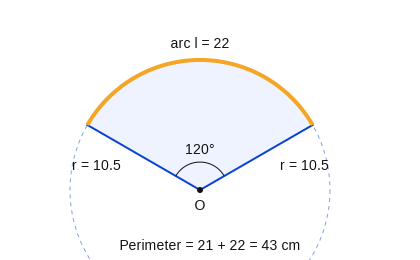
In a circle of radius 10.5 cm, if the angle of a sector is 2π3, then the perimeter of the sector is (in cm):
(Take π=227)
10.5 cm त्रिज्या वाले एक वृत्त में, यदि एक त्रिज्यखंड का कोण 2π3 है, तो त्रिज्यखंड का परिमाप (cm में) कितना है?
(π=227 लीजिए)
  1. A40
  2. B43
  3. C44
  4. D41
Show answer

Concept: Perimeter of a sector =2r+l, where arc length l=rθ (θ in radians).

  1. r=10.5, θ=2π3 (i.e. 120∘).
  2. l=10.5×23×227=7×227=22
  3. Perimeter =2×10.5+22=21+22=43 cm

Trick: 2π3 is one-third of the full circle: circumference =2×227×10.5=66, so arc =663=22.

Answer: (B) 43

अवधारणा: त्रिज्यखंड (sector) का परिमाप =2r+l, जहाँ चाप की लंबाई l=rθ (θ रेडियन में)।

  1. r=10.5, θ=2π3 (अर्थात 120∘)।
  2. l=10.5×23×227=7×227=22
  3. परिमाप =2×10.5+22=21+22=43 cm

ट्रिक: 2π3 पूरे वृत्त का एक-तिहाई है: परिधि =66, अतः चाप =663=22।

उत्तर: (B) 43

RRB NTPC Graduate CBT 1MathematicsMensuration – Sector of a CircleRRB NTPC Graduate CBT 1 2024 · 16 Jun Shift 3 →
Q8582.
On simple interest, a certain sum of money amounts to ₹1,750 in 2 years and to ₹3,000 in 4 years. Find the rate of interest per annum.
साधारण ब्याज पर, एक निश्चित धनराशि 2 वर्षों में ₹1,750 और 4 वर्षों में ₹3,000 हो जाती है। वार्षिक ब्याज दर ज्ञात कीजिए।
  1. A125%
  2. B127%
  3. C126%
  4. D124%
Show answer

Concept: Under simple interest the interest is the same every year, so the difference of two amounts gives the interest for the extra years.

  1. Interest for 2 years =3000−1750=1250, so 1 year =625.
  2. Principal =1750−2×625=500
  3. Rate =625500×100=125%

Trick: Rate =A2−A1A1t2−A2t1×100=12501750×4−3000×2×100=12501000×100=125%

Answer: (A) 125%

अवधारणा: साधारण ब्याज में हर वर्ष ब्याज बराबर होता है, इसलिए दो मिश्रधनों का अंतर अतिरिक्त वर्षों का ब्याज है।

  1. 2 वर्ष का ब्याज =3000−1750=1250, अतः 1 वर्ष का =625।
  2. मूलधन =1750−2×625=500
  3. दर =625500×100=125%

ट्रिक: दर =A2−A1A1t2−A2t1×100=12501000×100=125%

उत्तर: (A) 125%

RRB NTPC Graduate CBT 1MathematicsSimple InterestRRB NTPC Graduate CBT 1 2024 · 16 Jun Shift 3 →
Q8583.
Keshav gets a 4% increase in his sale amount in the first year and a 20% increase in the second year, and with that his present sale is ₹1,56,000. What was his sale (in ₹) two years ago?
केशव की बिक्री राशि में पहले वर्ष 4% और दूसरे वर्ष 20% की वृद्धि होती है, और इसके साथ उसकी वर्तमान बिक्री ₹1,56,000 है। दो वर्ष पहले उसकी बिक्री (₹ में) कितनी थी?
  1. A1,25,000
  2. B1,30,000
  3. C1,05,000
  4. D1,50,000
Show answer

Concept: After successive increases of a% and b%, value =x(1+a100)(1+b100).

  1. x×1.04×1.20=156000
  2. x×1.248=156000
  3. x=1560001.248=125000

Trick: Check options: 125000×1.04=130000, 130000×1.2=156000 ✓

Answer: (A) ₹1,25,000

अवधारणा: a% और b% की क्रमागत वृद्धि के बाद मान =x(1+a100)(1+b100)।

  1. x×1.04×1.20=156000
  2. x×1.248=156000
  3. x=1560001.248=125000

ट्रिक: विकल्प जाँचें: 125000×1.04=130000, 130000×1.2=156000 ✓

उत्तर: (A) ₹1,25,000

RRB NTPC Graduate CBT 1MathematicsSuccessive Percentage IncreaseRRB NTPC Graduate CBT 1 2024 · 16 Jun Shift 3 →
Q8584.
If the polynomial ax3+4x2+3x−4 and x3−7x+a leaves the same remainder, when divided by (x−2), then find the value of a.
यदि बहुपद ax3+4x2+3x−4 और x3−7x+a को (x−2) से विभाजित करने पर समान शेषफल प्राप्त होता है, तो a का मान ज्ञात कीजिए।
  1. A−175
  2. B−247
  3. C−365
  4. D−218
Show answer

Concept: Remainder theorem: when p(x) is divided by (x−k), the remainder is p(k).

  1. p(2)=a(8)+4(4)+3(2)−4=8a+18
  2. q(2)=8−14+a=a−6
  3. Equal remainders: 8a+18=a−6⇒7a=−24
  4. a=−247

Trick: Just put x=2 in both and equate — no long division needed.

Answer: (B) −247

अवधारणा: शेषफल प्रमेय: p(x) को (x−k) से भाग देने पर शेषफल p(k) होता है।

  1. p(2)=a(8)+4(4)+3(2)−4=8a+18
  2. q(2)=8−14+a=a−6
  3. शेषफल बराबर: 8a+18=a−6⇒7a=−24
  4. a=−247

ट्रिक: दोनों में x=2 रखकर बराबर करें — लंबा भाग करने की ज़रूरत नहीं।

उत्तर: (B) −247

RRB NTPC Graduate CBT 1MathematicsRemainder TheoremRRB NTPC Graduate CBT 1 2024 · 16 Jun Shift 3 →
Q8585.
For a regular polygon, the sum of the interior angles is 300% more than the sum of its exterior angles. Each interior angle of the polygon measures x°. What is the value of x?
एक सम बहुभुज के अंतः कोणों का योग उसके बाह्य कोणों के योग से 300% अधिक है। बहुभुज का प्रत्येक अंतः कोण x° है। x का मान क्या है?
  1. A156
  2. B140
  3. C134
  4. D144
Show answer

Concept: Sum of exterior angles of any polygon =360∘; sum of interior angles =(n−2)×180∘.

  1. 300% more than 360 means 4×360=1440∘.
  2. (n−2)×180=1440⇒n−2=8⇒n=10
  3. Each interior angle =144010=144∘

Trick: Interior : exterior sum =4:1 ⇒ each interior : exterior =4:1 ⇒ interior =45×180=144∘.

Answer: (D) 144

अवधारणा: किसी भी बहुभुज के बाह्य कोणों का योग =360∘; अंतः कोणों का योग =(n−2)×180∘।

  1. 360 से 300% अधिक =4×360=1440∘।
  2. (n−2)×180=1440⇒n=10
  3. प्रत्येक अंतः कोण =144010=144∘

ट्रिक: अंतः : बाह्य =4:1 ⇒ अंतः कोण =45×180=144∘।

उत्तर: (D) 144

RRB NTPC Graduate CBT 1MathematicsPolygons – Interior AnglesRRB NTPC Graduate CBT 1 2024 · 16 Jun Shift 3 →
Q8586.
Find the value of 0.0184960.001156
0.0184960.001156 का मान ज्ञात कीजिए।
  1. A19
  2. B18
  3. C12
  4. D4
Show answer

Concept: ab=ab; both decimals have 6 places, so they cancel.

  1. 0.0184960.001156=184961156
  2. 18496=136, 1156=34
  3. 13634=4

Trick: 184961156=16 directly, and 16=4.

Answer: (D) 4

अवधारणा: ab=ab; दोनों में 6 दशमलव स्थान हैं, अतः कट जाते हैं।

  1. 0.0184960.001156=184961156
  2. 18496=136, 1156=34
  3. 13634=4

ट्रिक: 184961156=16 और 16=4।

उत्तर: (D) 4

RRB NTPC Graduate CBT 1MathematicsSquare Roots of DecimalsRRB NTPC Graduate CBT 1 2024 · 16 Jun Shift 3 →
Q8587.
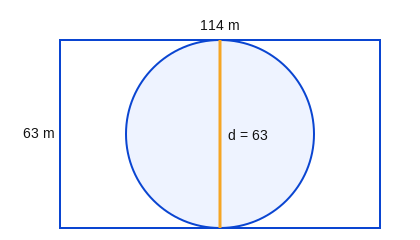
Find the circumference (in m) of the largest circle that can be inscribed in a rectangle whose dimensions are given as 114 m and 63 m.
Take π=227
114 m और 63 m विमाओं वाले एक आयत के अंदर बनाए जा सकने वाले सबसे बड़े वृत्त की परिधि (m में) ज्ञात कीजिए।
π=227 लीजिए
  1. A199
  2. B202
  3. C201
  4. D198
Show answer

Concept: The largest circle inside a rectangle touches the two longer sides, so its diameter equals the shorter side.

  1. Diameter =63 m
  2. Circumference =πd=227×63
  3. =22×9=198 m

Trick: Ignore the longer side (114 m) — only the smaller dimension limits the circle.

Answer: (D) 198

अवधारणा: आयत के अंदर सबसे बड़ा वृत्त छोटी भुजा से सीमित होता है, अतः व्यास = छोटी भुजा।

  1. व्यास =63 m
  2. परिधि =πd=227×63
  3. =22×9=198 m

ट्रिक: लंबी भुजा (114 m) को अनदेखा करें — केवल छोटी भुजा वृत्त को सीमित करती है।

उत्तर: (D) 198

RRB NTPC Graduate CBT 1MathematicsMensuration – Circle in RectangleRRB NTPC Graduate CBT 1 2024 · 16 Jun Shift 3 →
Q8588.
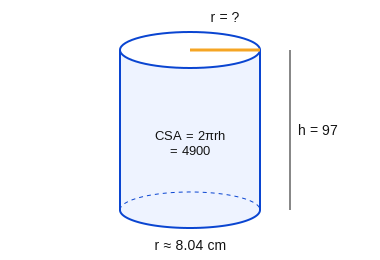
A cylindrical rod has an curved surface area of 4,900 cm2. If the length of the rod is 97 cm, then the radius (in cm) of the rod, correct to two places of decimal, is:
Take π=227
एक बेलनाकार छड़ का वक्र पृष्ठीय क्षेत्रफल 4,900 cm2 है। यदि छड़ की लंबाई 97 cm है, तो दशमलव के दो स्थानों तक सही छड़ की त्रिज्या (cm में) कितनी है?
π=227 लीजिए
  1. A6.97
  2. B8.55
  3. C7.95
  4. D8.04
Show answer

Concept: Curved surface area of a cylinder =2πrh.

  1. 2×227×r×97=4900
  2. r=4900×744×97=343004268
  3. r≈8.036≈8.04 cm

Trick: Estimate: 2πh≈6.29×97≈610; 4900610≈8.04.

Answer: (D) 8.04

अवधारणा: बेलन का वक्र पृष्ठीय क्षेत्रफल =2πrh।

  1. 2×227×r×97=4900
  2. r=4900×744×97=343004268
  3. r≈8.036≈8.04 cm

ट्रिक: अनुमान: 2πh≈610; 4900610≈8.04।

उत्तर: (D) 8.04

RRB NTPC Graduate CBT 1MathematicsMensuration – CylinderRRB NTPC Graduate CBT 1 2024 · 16 Jun Shift 3 →
Q8589.
The greatest number that divides 93 and 190 leaving remainders 5 and 3, respectively, is:
वह सबसे बड़ी संख्या कौन-सी है जिससे 93 और 190 को विभाजित करने पर क्रमशः 5 और 3 शेषफल प्राप्त होते हैं?
  1. A21
  2. B17
  3. C14
  4. D11
Show answer

Concept: Required number = HCF of (number − its remainder).

  1. 93−5=88, 190−3=187
  2. 88=8×11, 187=17×11
  3. HCF =11 (and 11>5, so remainder 5 is valid).

Trick: Check options from the largest: 21, 17, 14 do not divide both 88 and 187; 11 does.

Answer: (D) 11

अवधारणा: अभीष्ट संख्या = (संख्या − शेषफल) का HCF।

  1. 93−5=88, 190−3=187
  2. 88=8×11, 187=17×11
  3. HCF =11 (और 11>5, अतः शेषफल 5 मान्य)।

ट्रिक: विकल्प जाँचें: 21, 17, 14 दोनों (88, 187) को नहीं बाँटते; 11 बाँटता है।

उत्तर: (D) 11

RRB NTPC Graduate CBT 1MathematicsHCF with RemaindersRRB NTPC Graduate CBT 1 2024 · 16 Jun Shift 3 →
Q8590.
A vendor sells oranges at ₹29 each and incurs a loss of 75%. If he wants to make a profit of 75%, at what price (in ₹) should he sell each orange?
एक विक्रेता संतरे ₹29 प्रति संतरा बेचता है और उसे 75% की हानि होती है। यदि वह 75% का लाभ कमाना चाहता है, तो उसे प्रत्येक संतरा किस मूल्य (₹ में) पर बेचना चाहिए?
  1. A201
  2. B206
  3. C203
  4. D205
Show answer

Concept: SP at loss l% =CP×100−l100; SP at profit p% =CP×100+p100.

  1. 29=CP×25100⇒CP=116
  2. Required SP =116×175100=203

Trick: Ratio method: new SP=29×17525=29×7=203.

Answer: (C) ₹203

अवधारणा: l% हानि पर विक्रय मूल्य =CP×100−l100; p% लाभ पर =CP×100+p100।

  1. 29=CP×25100⇒CP=116
  2. अभीष्ट विक्रय मूल्य =116×175100=203

ट्रिक: अनुपात विधि: नया SP=29×17525=29×7=203।

उत्तर: (C) ₹203

RRB NTPC Graduate CBT 1MathematicsProfit and LossRRB NTPC Graduate CBT 1 2024 · 16 Jun Shift 3 →
Q8591.
A shopkeeper marked his goods at X% above their cost price and sold them at a discount of 60%. If he gained 84% profit, then find the value of X.
एक दुकानदार ने अपने सामान पर क्रय मूल्य से X% अधिक मूल्य अंकित किया और उन्हें 60% की छूट पर बेच दिया। यदि उसे 84% लाभ हुआ, तो X का मान ज्ञात कीजिए।
  1. A362
  2. B360
  3. C359
  4. D361
Show answer

Concept: SP=MP×100−d100=CP×100+p100.

  1. Let CP=100; SP=184.
  2. MP×40100=184⇒MP=460
  3. Mark-up X=460−100100×100=360%

Trick: MPCP=100+p100−d=18440=4.6 ⇒ X=360.

Answer: (B) 360

अवधारणा: SP=MP×100−d100=CP×100+p100।

  1. माना CP=100; SP=184।
  2. MP×40100=184⇒MP=460
  3. अंकन X=460−100100×100=360%

ट्रिक: MPCP=100+p100−d=18440=4.6 ⇒ X=360।

उत्तर: (B) 360

RRB NTPC Graduate CBT 1MathematicsMarked Price and DiscountRRB NTPC Graduate CBT 1 2024 · 16 Jun Shift 3 →
Q8592.
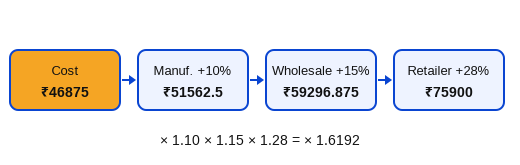
If the manufacturer gains 10%, the wholesaler gains 15%, and the retailer gains 28%, then find the cost of production of a table (in ₹), whose retail price for the customer is ₹75,900. (NOTE: Manufacturer sells to wholesaler, wholesaler sells to retailer and retailer sells to customers.)
यदि निर्माता को 10%, थोक विक्रेता को 15% और खुदरा विक्रेता को 28% लाभ होता है, तो उस मेज़ की उत्पादन लागत (₹ में) ज्ञात कीजिए, जिसका ग्राहक के लिए खुदरा मूल्य ₹75,900 है। (नोट: निर्माता थोक विक्रेता को बेचता है, थोक विक्रेता खुदरा विक्रेता को बेचता है और खुदरा विक्रेता ग्राहकों को बेचता है।)
  1. A60,000
  2. B53,906.25
  3. C46,875
  4. D51,562.5
Show answer

Concept: Each seller’s SP is the next buyer’s CP, so the gains multiply: Retail=C×1.10×1.15×1.28.

  1. 1.10×1.15=1.265; 1.265×1.28=1.6192
  2. C=759001.6192=46875
  3. Check: 46875→51562.5→59296.875→75900 ✓

Trick: Write as fractions: C=75900×1011×2023×2532=46875 — 11 and 23 cancel neatly (75900=11×23×300).

Answer: (C) ₹46,875

अवधारणा: हर विक्रेता का विक्रय मूल्य अगले क्रेता का क्रय मूल्य है, अतः लाभ गुणा होते हैं: खुदरा=C×1.10×1.15×1.28।

  1. 1.10×1.15=1.265; 1.265×1.28=1.6192
  2. C=759001.6192=46875
  3. जाँच: 46875→51562.5→59296.875→75900 ✓

ट्रिक: भिन्न में: C=75900×1011×2023×2532=46875 (75900=11×23×300)।

उत्तर: (C) ₹46,875

RRB NTPC Graduate CBT 1MathematicsSuccessive Profit (Chain)RRB NTPC Graduate CBT 1 2024 · 16 Jun Shift 3 →
Q8593.
What is the median of the following data?
61, 55, 18, 49, 52, 80, 60, 33, 54, 56, 28
निम्नलिखित आँकड़ों की माध्यिका क्या है?
61, 55, 18, 49, 52, 80, 60, 33, 54, 56, 28
  1. A54
  2. B54.5
  3. C55
  4. D53.5
Show answer

Concept: Median = middle value after arranging in order; for odd n it is the (n+12)th value.

  1. Ascending: 18, 28, 33, 49, 52, 54, 55, 56, 60, 61, 80
  2. n=11, so median is the 11+12=6th value.
  3. 6th value =54

Trick: Never take the middle of the unsorted list (it would give 80) — always sort first.

Answer: (A) 54

अवधारणा: माध्यिका = क्रम में लगाने पर बीच का मान; विषम n के लिए (n+12)वाँ पद।

  1. आरोही क्रम: 18, 28, 33, 49, 52, 54, 55, 56, 60, 61, 80
  2. n=11, अतः माध्यिका 11+12=6वाँ पद।
  3. 6वाँ पद =54

ट्रिक: बिना क्रम लगाए बीच का पद न लें — पहले क्रम में लगाएँ।

उत्तर: (A) 54

RRB NTPC Graduate CBT 1MathematicsStatistics – MedianRRB NTPC Graduate CBT 1 2024 · 16 Jun Shift 3 →
Q8594.
Which of the following numbers is divisible by 47?
निम्नलिखित में से कौन-सी संख्या 47 से विभाज्य है?
  1. A3674
  2. B4416
  3. C3995
  4. D3816
Show answer

Concept: Divide each option by 47 or build multiples of 47 near the options.

  1. 47×80=3760, so 3995−3760=235=47×5
  2. 3995=47×85 ✓
  3. Others: 3674=47×78+8, 4416=47×93+45, 3816=47×81+9 — not divisible.

Trick: 47×85=(50−3)×85=4250−255=3995.

Answer: (C) 3995

अवधारणा: हर विकल्प को 47 से भाग दें या 47 के गुणज बनाएँ।

  1. 47×80=3760, अतः 3995−3760=235=47×5
  2. 3995=47×85 ✓
  3. अन्य: 3674=47×78+8, 4416=47×93+45, 3816=47×81+9 — विभाज्य नहीं।

ट्रिक: 47×85=(50−3)×85=4250−255=3995।

उत्तर: (C) 3995

RRB NTPC Graduate CBT 1MathematicsDivisibilityRRB NTPC Graduate CBT 1 2024 · 16 Jun Shift 3 →
Q8595.
Two taps can fill a cistern in 2 hours and 64 hours, respectively. A third tap can empty it in 2 hours. How long (in hours) will it take to fill half of the empty cistern, if all of them are opened together?
दो नल एक टंकी को क्रमशः 2 घंटे और 64 घंटे में भर सकते हैं। एक तीसरा नल इसे 2 घंटे में खाली कर सकता है। यदि तीनों नलों को एक साथ खोल दिया जाए, तो खाली टंकी का आधा भाग भरने में कितना समय (घंटों में) लगेगा?
  1. A96
  2. B32
  3. C128
  4. D64
Show answer

Concept: Net rate = sum of filling rates − emptying rate (part of tank per hour).

  1. Net =12+164−12=164
  2. Full tank takes 64 hours.
  3. Half tank =642=32 hours

Trick: The 2-hour filler and 2-hour emptier cancel out; only the 64-hour tap works.

Answer: (B) 32

अवधारणा: शुद्ध दर = भरने की दरों का योग − खाली करने की दर (प्रति घंटा टंकी का भाग)।

  1. शुद्ध =12+164−12=164
  2. पूरी टंकी 64 घंटे में।
  3. आधी टंकी =642=32 घंटे

ट्रिक: 2 घंटे वाला भरने वाला और 2 घंटे वाला खाली करने वाला नल एक-दूसरे को रद्द करते हैं।

उत्तर: (B) 32

RRB NTPC Graduate CBT 1MathematicsPipes and CisternsRRB NTPC Graduate CBT 1 2024 · 16 Jun Shift 3 →
Q8596.
In a certain code language, ‘BEST’ is coded as ‘4568’ and ‘STAB’ is coded as ‘8965’. What is the code for ‘A’ in the given code language?
एक निश्चित कूट भाषा में, ‘BEST’ को ‘4568’ लिखा जाता है और ‘STAB’ को ‘8965’ लिखा जाता है। उस कूट भाषा में ‘A’ के लिए क्या कूट है?
  1. A6
  2. B5
  3. C9
  4. D8
Show answer

Concept: Letters common to both words share the common digits; the leftover letter gets the leftover digit.

  1. BEST → 4, 5, 6, 8 and STAB → 8, 9, 6, 5.
  2. Common letters: S, T, B → common digits 5, 6, 8.
  3. STAB has the extra letter A, and its extra digit is 9.
  4. So A = 9.

Trick: Cancel common letters and common digits – what remains matches.

Answer: (C) 9

अवधारणा: दोनों शब्दों के सामान्य अक्षरों के कोड भी सामान्य अंक होते हैं; बचे अक्षर का कोड बचा अंक है।

  1. BEST → 4, 5, 6, 8 और STAB → 8, 9, 6, 5।
  2. सामान्य अक्षर S, T, B → सामान्य अंक 5, 6, 8।
  3. STAB में बचा अक्षर A और बचा अंक 9।
  4. अतः A = 9।

ट्रिक: सामान्य अक्षर और सामान्य अंक काटें – जो बचे वही जोड़ी है।

उत्तर: (C) 9

RRB NTPC Graduate CBT 1General Intelligence and ReasoningCoding-DecodingRRB NTPC Graduate CBT 1 2024 · 16 Jun Shift 3 →
Q8597.
What will come in place of the question mark (?) in the following equation, if ‘+’ and ‘–’ are interchanged, and ‘×’ and ‘÷’ are interchanged?
34 + 43 − 17 ÷ 121 × 11 = ?
यदि ‘+’ और ‘–’ को आपस में बदल दिया जाए तथा ‘×’ और ‘÷’ को आपस में बदल दिया जाए, तो निम्नलिखित समीकरण में प्रश्न चिह्न (?) के स्थान पर क्या आएगा?
34 + 43 − 17 ÷ 121 × 11 = ?
  1. A181
  2. B164
  3. C156
  4. D178
Show answer

Concept: Swap the signs first, then apply BODMAS.

  1. After interchange: 34−43+17×121÷11.
  2. 121÷11=11, so 17×11=187.
  3. 34−43+187=178.

Trick: Rewrite the whole expression with new signs before calculating.

Answer: (D) 178

अवधारणा: पहले चिह्न बदलें, फिर BODMAS लगाएँ।

  1. बदलने के बाद: 34−43+17×121÷11।
  2. 121÷11=11, अतः 17×11=187।
  3. 34−43+187=178।

ट्रिक: गणना से पहले पूरा व्यंजक नए चिह्नों के साथ लिख लें।

उत्तर: (D) 178

RRB NTPC Graduate CBT 1General Intelligence and ReasoningMathematical OperationsRRB NTPC Graduate CBT 1 2024 · 16 Jun Shift 3 →
Q8598.
Which of the following letter-clusters should replace # and % so that the pattern and relationship followed between the letter-cluster pair on the left side of :: is the same as that on the right side of :: ?
# : MRN :: HMI : %
निम्नलिखित में से कौन-से अक्षर-समूह # और % को प्रतिस्थापित करने चाहिए ताकि :: के बाईं ओर के अक्षर-समूह युग्म के बीच का पैटर्न और संबंध वही हो जो :: के दाईं ओर है?
# : MRN :: HMI : %
  1. A# = JIQ, % = FDJ
  2. B# = KLJ, % = KHI
  3. C# = LPR, % = JHG
  4. D# = PUQ, % = EJF
Show answer

Concept: Find the rule on the right pair (HMI → %) and apply the same rule to # → MRN.

  1. Option D: P − 3 = M, U − 3 = R, Q − 3 = N → PUQ : MRN.
  2. H − 3 = E, M − 3 = J, I − 3 = F → HMI : EJF.
  3. Both pairs use −3 on every letter.

Trick: Test each option with one letter first; only D gives −3 on both sides.

Answer: (D) # = PUQ, % = EJF

अवधारणा: दाएँ जोड़े में जो नियम है वही बाएँ जोड़े (# → MRN) पर लगाएँ।

  1. विकल्प D: P − 3 = M, U − 3 = R, Q − 3 = N → PUQ : MRN।
  2. H − 3 = E, M − 3 = J, I − 3 = F → HMI : EJF।
  3. दोनों में हर अक्षर में −3।

ट्रिक: हर विकल्प को पहले एक अक्षर से जाँचें; केवल D में दोनों ओर −3 है।

उत्तर: (D) # = PUQ, % = EJF

RRB NTPC Graduate CBT 1General Intelligence and ReasoningLetter AnalogyRRB NTPC Graduate CBT 1 2024 · 16 Jun Shift 3 →
Q8599.
Select the triad that follows the same pattern as that followed by the two triads given below. Both triads follow the same pattern.
GB-IE-LN
KF-MI-PR
उस त्रिक का चयन कीजिए जो उसी पैटर्न का अनुसरण करता है जिसका अनुसरण नीचे दिए गए दो त्रिक करते हैं। दोनों त्रिक एक ही पैटर्न का अनुसरण करते हैं।
GB-IE-LN
KF-MI-PR
  1. APJ-QM-TU
  2. BOJ-QM-TV
  3. COJ-QM-TU
  4. DPJ-QN-TU
Show answer

Concept: Track first letters and second letters separately using place values.

  1. GB-IE-LN: G(7)→I(9)→L(12) is +2, +3; B(2)→E(5)→N(14) is +3, +9.
  2. KF-MI-PR: K→M→P (+2, +3); F→I→R (+3, +9).
  3. OJ-QM-TV: O(15)→Q(17)→T(20) is +2, +3; J(10)→M(13)→V(22) is +3, +9. ✓

Trick: Option A/C fail on the last letter: U = M + 8, not +9.

Answer: (B) OJ-QM-TV

अवधारणा: पहले अक्षरों और दूसरे अक्षरों को स्थानीय मान से अलग-अलग जाँचें।

  1. GB-IE-LN: G(7)→I(9)→L(12) = +2, +3; B(2)→E(5)→N(14) = +3, +9।
  2. KF-MI-PR: K→M→P (+2, +3); F→I→R (+3, +9)।
  3. OJ-QM-TV: O(15)→Q(17)→T(20) = +2, +3; J(10)→M(13)→V(22) = +3, +9 ✓।

ट्रिक: विकल्प A/C अंतिम अक्षर पर गलत: U = M + 8 है, +9 नहीं।

उत्तर: (B) OJ-QM-TV

RRB NTPC Graduate CBT 1General Intelligence and ReasoningLetter TriadsRRB NTPC Graduate CBT 1 2024 · 16 Jun Shift 3 →
Q8600.
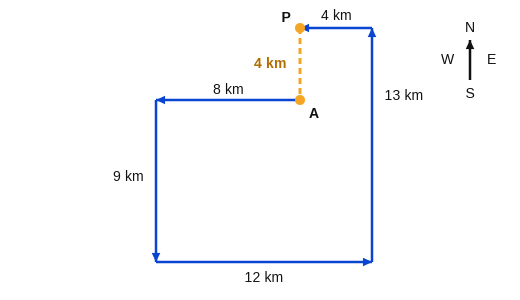
Barun starts from Point A and drives 8 km towards West. He then takes a left turn, drives 9 km, turns left and drives 12 km. He then takes a left turn and drives 13 km. He takes a final left turn, drives 4 km and stops at Point P. How far (shortest distance) and towards which direction should he drive in order to reach Point A again? (All turns are 90° turns only, unless specified.)
बरुण बिंदु A से शुरू करता है और पश्चिम की ओर 8 km गाड़ी चलाता है। फिर वह बाएँ मुड़ता है, 9 km गाड़ी चलाता है, बाएँ मुड़ता है और 12 km गाड़ी चलाता है। फिर वह बाएँ मुड़ता है और 13 km गाड़ी चलाता है। वह अंतिम बार बाएँ मुड़ता है, 4 km गाड़ी चलाता है और बिंदु P पर रुक जाता है। पुनः बिंदु A पर पहुँचने के लिए उसे कितनी दूरी (न्यूनतम दूरी) तक और किस दिशा में गाड़ी चलानी चाहिए? (जब तक निर्दिष्ट न हो, सभी मोड़ केवल 90° के मोड़ हैं।)
  1. A3 km to the southदक्षिण की ओर 3 km
  2. B5 km to the southदक्षिण की ओर 5 km
  3. C4 km to the southदक्षिण की ओर 4 km
  4. D2 km to the southदक्षिण की ओर 2 km
Show answer

Concept: Place A at the origin and track each move (left turn: West→South→East→North→West).

  1. West 8 → (−8,0); left (South) 9 → (−8,−9).
  2. Left (East) 12 → (4,−9); left (North) 13 → (4,4).
  3. Left (West) 4 → P =(0,4).
  4. P is 4 km directly north of A, so he must drive 4 km south.

Trick: Net East–West: −8+12−4=0; net North–South: −9+13=4 North.

Answer: (C) 4 km to the south

अवधारणा: A को मूल बिंदु मानें और हर चाल लिखें (बाएँ मुड़ना: पश्चिम→दक्षिण→पूर्व→उत्तर→पश्चिम)।

  1. पश्चिम 8 → (−8,0); बाएँ (दक्षिण) 9 → (−8,−9)।
  2. बाएँ (पूर्व) 12 → (4,−9); बाएँ (उत्तर) 13 → (4,4)।
  3. बाएँ (पश्चिम) 4 → P =(0,4)।
  4. P, A से 4 km उत्तर में है, अतः 4 km दक्षिण जाना होगा।

ट्रिक: शुद्ध पूर्व–पश्चिम: −8+12−4=0; उत्तर–दक्षिण: −9+13=4 उत्तर।

उत्तर: (C) 4 km to the south

RRB NTPC Graduate CBT 1General Intelligence and ReasoningDirection and DistanceRRB NTPC Graduate CBT 1 2024 · 16 Jun Shift 3 →