Question bank

Q&A: practice questions with answers

Search questions on any topic. Filter by exam category, exam, subject and topic, try the question, then open the answer and explanation.

Courses – airGurukul

20,719 questions found.

Q8801.
​F is the husband of G. G is the mother of H. H is the husband of I. I is the mother of J. How is F related to J?
F, G का पति है। G, H की माता है। H, I का पति है। I, J की माता है। F का J से क्या संबंध है?
  1. AFather's brotherपिता का भाई
  2. BFather's fatherपिता का पिता
  3. C​Mother's brotherमाता का भाई
  4. DMother's fatherमाता का पिता
Show answer

Concept: Build a family tree generation by generation.
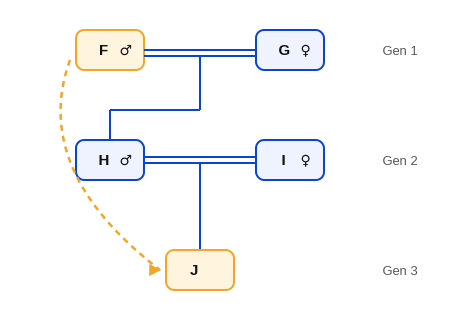
  1. F (male) is the husband of G; G is the mother of H, so F is H's father.
  2. H is the husband of I; I is the mother of J, so H is J's father.
  3. F is the father of J's father.

Trick: Husband of a mother = father; go up two generations = grandfather (father's father).

Answer: (B) Father's father

अवधारणा: पीढ़ी-दर-पीढ़ी वंश-वृक्ष बनाएँ।

  1. F, G का पति है; G, H की माँ है, अतः F, H का पिता है।
  2. H, I का पति है; I, J की माँ है, अतः H, J का पिता है।
  3. F, J के पिता का पिता (दादा) है।

ट्रिक: माँ का पति = पिता; दो पीढ़ी ऊपर = पिता के पिता।

उत्तर: (B) पिता के पिता (Father's father)
RRB NTPC Graduate CBT 1General Intelligence and ReasoningBlood RelationsRRB NTPC Graduate CBT 1 2024 · 16 Jun Shift 1 →
Q8802.
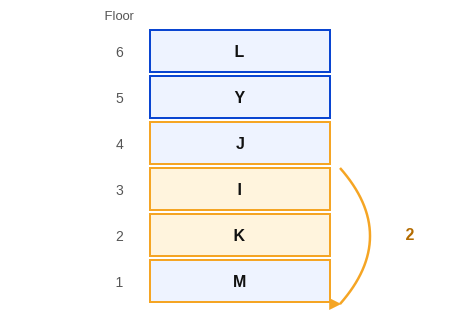
I, J, K, L, M and Y live on six different floors of the same building. The lowermost floor in the building is numbered 1, the floor above it, number 2 and so on, till the topmost floor is numbered 6. Only L lives above Y. I lives on some floor below J. Only M lives below K. How many people live between J and M?
I, J, K, L, M और Y एक ही इमारत की छह अलग-अलग मंज़िलों पर रहते हैं। इमारत की सबसे निचली मंज़िल की संख्या 1 है, उसके ऊपर वाली मंज़िल की संख्या 2 है और इसी प्रकार आगे, सबसे ऊपरी मंज़िल की संख्या 6 है। Y के ऊपर केवल L रहता है। I, J से नीचे किसी मंज़िल पर रहता है। K के नीचे केवल M रहता है। J और M के बीच कितने लोग रहते हैं?
  1. AFourचार
  2. BOneएक
  3. CThreeतीन
  4. DTwoदो
Show answer

Concept: Place the definite clues first ('only' clues fix positions).

  1. Only L lives above Y ⇒ L = 6, Y = 5.
  2. Only M lives below K ⇒ M = 1, K = 2.
  3. I below J in floors 3 and 4 ⇒ I = 3, J = 4.
  4. Between J (4) and M (1): I and K = two persons.

Trick: 'Only X above Y' ⇒ Y is second from top; 'only X below Y' ⇒ Y is second from bottom.

Answer: (D) Two

अवधारणा: पहले निश्चित संकेत रखें ('केवल' वाले संकेत स्थान तय करते हैं)।

  1. केवल L, Y के ऊपर ⇒ L = 6, Y = 5।
  2. केवल M, K के नीचे ⇒ M = 1, K = 2।
  3. शेष 3, 4 में I, J के नीचे ⇒ I = 3, J = 4।
  4. J (4) और M (1) के बीच: I और K = दो व्यक्ति।

ट्रिक: 'केवल X ऊपर' ⇒ ऊपर से दूसरी मंज़िल; 'केवल X नीचे' ⇒ नीचे से दूसरी।

उत्तर: (D) दो

RRB NTPC Graduate CBT 1General Intelligence and ReasoningFloor PuzzleRRB NTPC Graduate CBT 1 2024 · 16 Jun Shift 1 →
Q8803.
Read the given statements and conclusions carefully. Assuming that the information given in the statements is true, even if it appears to be at variance with commonly known facts, decide which of the given conclusion(s) logically follow(s) from the statements.
Statements:
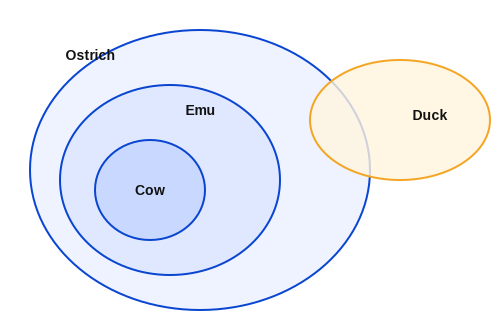
All cows are emu.
All emus are ostrich.
Some ostriches are duck.
Conclusions:
(I) Some ducks are cows.
(II) All ostriches are cows.
दिए गए कथनों और निष्कर्षों को ध्यानपूर्वक पढ़िए। यह मानते हुए कि कथनों में दी गई जानकारी सत्य है, भले ही वह सामान्यतः ज्ञात तथ्यों से भिन्न प्रतीत होती हो, निर्णय लीजिए कि दिए गए निष्कर्षों में से कौन-सा/से निष्कर्ष तार्किक रूप से कथनों का अनुसरण करता है/करते हैं।
कथन:
सभी गायें, एमू हैं।
सभी एमू, शुतुरमुर्ग हैं।
कुछ शुतुरमुर्ग, बत्तख हैं।
निष्कर्ष:
(I) कुछ बत्तखें, गायें हैं।
(II) सभी शुतुरमुर्ग, गायें हैं।
  1. AOnly conclusion (I) followsकेवल निष्कर्ष (I) अनुसरण करता है
  2. BOnly conclusion (II) followsकेवल निष्कर्ष (II) अनुसरण करता है
  3. CBoth conclusions (I) and (II) followनिष्कर्ष (I) और (II) दोनों अनुसरण करते हैं
  4. DNeither conclusion (I) nor conclusion (II) followsन तो निष्कर्ष (I) और न ही निष्कर्ष (II) अनुसरण करता है
Show answer

Concept: Draw the least-overlap Venn diagram and test each conclusion.

  1. Cow ⊂ Emu ⊂ Ostrich.
  2. Duck overlaps Ostrich only somewhere – it may lie outside Emu and Cow, so 'Some ducks are cows' is not certain.
  3. 'All ostriches are cows' is false – Ostrich is the largest set.

Trick: A 'some' link from the outermost circle never reaches the innermost one with certainty.

Answer: (D) Neither conclusion (I) nor conclusion (II) follows

अवधारणा: न्यूनतम ओवरलैप वाला वेन आरेख बनाकर निष्कर्ष जाँचें।

  1. गाय ⊂ एमु ⊂ शुतुरमुर्ग।
  2. बत्तख केवल शुतुरमुर्ग के किसी भाग से जुड़ी है – गाय से बाहर भी हो सकती है, अतः (I) निश्चित नहीं।
  3. 'सभी शुतुरमुर्ग गाय हैं' – गलत, शुतुरमुर्ग सबसे बड़ा समूह है।

ट्रिक: बाहरी वृत्त से 'कुछ' संबंध भीतरी वृत्त तक निश्चित रूप से नहीं पहुँचता।

उत्तर: (D) न तो (I) और न ही (II) अनुसरण करता है

RRB NTPC Graduate CBT 1General Intelligence and ReasoningSyllogismRRB NTPC Graduate CBT 1 2024 · 16 Jun Shift 1 →
Q8804.
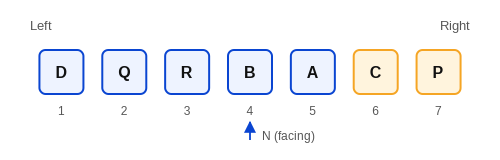
Seven friends, A, B, C, D, P, Q and R, are sitting in a straight line facing north. Only two people sit to the left of R. Only three people sit between R and P. Only one person sits between P and A. D sits to the immediate left of Q. B is not an immediate neighbour of P. How many people sit to the right of C?
सात मित्र, A, B, C, D, P, Q और R, उत्तर की ओर मुख करके एक सीधी पंक्ति में बैठे हैं। R के बाईं ओर केवल दो व्यक्ति बैठे हैं। R और P के बीच केवल तीन व्यक्ति बैठे हैं। P और A के बीच केवल एक व्यक्ति बैठा है। D, Q के ठीक बाईं ओर बैठा है। B, P का निकटतम पड़ोसी नहीं है। C के दाईं ओर कितने व्यक्ति बैठे हैं?
  1. AOneएक
  2. BTwoदो
  3. CFourचार
  4. DThreeतीन
Show answer

Concept: Number seats 1–7 from the left (all face North).

  1. Two people to the left of R ⇒ R = 3.
  2. Three between R and P ⇒ P = 7; one between P and A ⇒ A = 5.
  3. D immediately left of Q: the only adjacent free pair is 1–2 ⇒ D = 1, Q = 2.
  4. B is not next to P ⇒ B = 4, so C = 6. Only P sits to the right of C.

Trick: Fix R and P first; the pair D–Q then has only one place.

Answer: (A) One

अवधारणा: बाएँ से सीट 1–7 मानें (सभी उत्तर की ओर)।

  1. R के बाएँ दो ⇒ R = 3।
  2. R और P के बीच तीन ⇒ P = 7; P और A के बीच एक ⇒ A = 5।
  3. D, Q के ठीक बाएँ: खाली सटी सीटें केवल 1–2 ⇒ D = 1, Q = 2।
  4. B, P का पड़ोसी नहीं ⇒ B = 4, C = 6। C के दाएँ केवल P।

ट्रिक: पहले R और P तय करें; D–Q जोड़ी का एक ही स्थान बचता है।

उत्तर: (A) एक

RRB NTPC Graduate CBT 1General Intelligence and ReasoningLinear Seating ArrangementRRB NTPC Graduate CBT 1 2024 · 16 Jun Shift 1 →
Q8805.
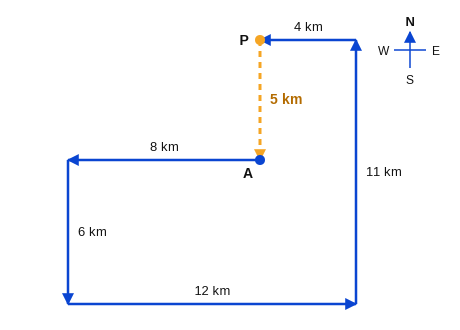
Vinod starts from point A and drives 8 km towards the west. He then takes a left turn, drives 6 km, turns left and drives 12 km. He then takes a left turn and drives 11 km. He takes a final left turn, drives 4 km and stops at point P. How far (shortest distance) and towards which direction should he drive in order to reach point A again? (All turns are 90-degree turns only unless specified.)
विनोद बिंदु A से चलना शुरू करता है और पश्चिम की ओर 8 km गाड़ी चलाता है। फिर वह बाएँ मुड़ता है, 6 km गाड़ी चलाता है, बाएँ मुड़ता है और 12 km गाड़ी चलाता है। फिर वह बाएँ मुड़ता है और 11 km गाड़ी चलाता है। वह अंतिम बार बाएँ मुड़ता है, 4 km गाड़ी चलाता है और बिंदु P पर रुक जाता है। बिंदु A पर फिर से पहुँचने के लिए उसे कितनी दूर (न्यूनतम दूरी) और किस दिशा में गाड़ी चलानी चाहिए? (जब तक निर्दिष्ट न हो, सभी मोड़ केवल 90 डिग्री के मोड़ हैं।)
  1. A5 km to the southदक्षिण की ओर 5 km
  2. B6 km to the southदक्षिण की ओर 6 km
  3. C5 km to the northउत्तर की ओर 5 km
  4. D6 km to the northउत्तर की ओर 6 km
Show answer

Concept: A left turn while facing West makes you face South, and so on.

  1. A =(0,0). West 8 → (−8,0); left (South) 6 → (−8,−6).
  2. Left (East) 12 → (4,−6); left (North) 11 → (4,5).
  3. Left (West) 4 → (0,5) = P.
  4. P is 5 km North of A, so drive 5 km to the South.

Trick: East-West net: −8+12−4=0; North-South net: −6+11=5 North.

Answer: (A) 5 km to the south

अवधारणा: पश्चिम की ओर मुख करके बाएँ मुड़ने पर दक्षिण, आदि।

  1. A =(0,0)। पश्चिम 8 → (−8,0); बाएँ (दक्षिण) 6 → (−8,−6)।
  2. बाएँ (पूर्व) 12 → (4,−6); बाएँ (उत्तर) 11 → (4,5)।
  3. बाएँ (पश्चिम) 4 → (0,5) = P।
  4. P, A से 5 km उत्तर में; अतः 5 km दक्षिण जाना होगा।

ट्रिक: पूर्व-पश्चिम: −8+12−4=0; उत्तर-दक्षिण: −6+11=5 उत्तर।

उत्तर: (A) 5 km दक्षिण

RRB NTPC Graduate CBT 1General Intelligence and ReasoningDirection and DistanceRRB NTPC Graduate CBT 1 2024 · 16 Jun Shift 1 →
Q8806.
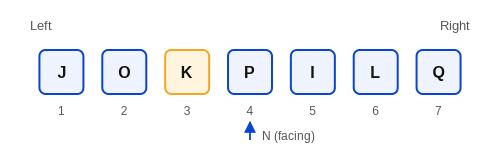
Seven people, I, J, K, L, O, P and Q are sitting in a row, facing north. Only two people sit to the right of I. Only two people sit between I and O. Only two people sit between J and P. P sits to the immediate left of I. Q sits to the immediate right of L. Who sits at third position from the left end of the line?
सात व्यक्ति, I, J, K, L, O, P और Q, उत्तर की ओर मुख करके एक पंक्ति में बैठे हैं। I के दाईं ओर केवल दो व्यक्ति बैठे हैं। I और O के बीच केवल दो व्यक्ति बैठे हैं। J और P के बीच केवल दो व्यक्ति बैठे हैं। P, I के ठीक बाईं ओर बैठा है। Q, L के ठीक दाईं ओर बैठा है। पंक्ति के बाएँ छोर से तीसरे स्थान पर कौन बैठा है?
  1. AI
  2. BO
  3. CQ
  4. DK
Show answer

Concept: Number seats 1–7 from the left (all face North).

  1. Two to the right of I ⇒ I = 5; P immediately left of I ⇒ P = 4.
  2. Two between I and O ⇒ O = 2.
  3. Two between J and P ⇒ J = 1 or 7. If J = 7, seats 1, 3, 6 have no adjacent pair for L–Q, so J = 1.
  4. L = 6, Q = 7, and K = 3.

Trick: Test both cases for J; the L–Q pair rules one out.

Answer: (D) K

अवधारणा: बाएँ से सीट 1–7 मानें (सभी उत्तर की ओर)।

  1. I के दाएँ दो ⇒ I = 5; P, I के ठीक बाएँ ⇒ P = 4।
  2. I और O के बीच दो ⇒ O = 2।
  3. J और P के बीच दो ⇒ J = 1 या 7। J = 7 पर शेष 1, 3, 6 में L–Q की सटी जोड़ी नहीं बनती, अतः J = 1।
  4. L = 6, Q = 7 और K = 3।

ट्रिक: J के दोनों विकल्प जाँचें; L–Q जोड़ी एक को हटा देती है।

उत्तर: (D) K

RRB NTPC Graduate CBT 1General Intelligence and ReasoningLinear Seating ArrangementRRB NTPC Graduate CBT 1 2024 · 16 Jun Shift 1 →
Q8807.
Based on the English alphabetical order, three of the following four letter-cluster pairs are alike in a certain way and thus form a group. Which letter-cluster pair DOES NOT belong to that group?
(Note: The odd one out is not based on the number of consonants/vowels or their position in the letter-cluster.)
अंग्रेज़ी वर्णमाला क्रम के आधार पर, निम्नलिखित चार अक्षर-समूह युग्मों में से तीन किसी निश्चित प्रकार से एक समान हैं और इस प्रकार एक समूह बनाते हैं। कौन-सा अक्षर-समूह युग्म उस समूह से संबंधित नहीं है?
(नोट: असंगत अक्षर-समूह, उस अक्षर-समूह में व्यंजनों/स्वरों की संख्या या उनके स्थान पर आधारित नहीं है।)
  1. AWC – BY
  2. BLR – QM
  3. CHN – MI
  4. DBH – GC
Show answer

Concept: Find the change from first cluster to second for each letter (wrap Z→A).

  1. LR – QM: L→Q (+5), R→M (−5).
  2. HN – MI: H→M (+5), N→I (−5).
  3. BH – GC: B→G (+5), H→C (−5).
  4. WC – BY: W→B (+5) but C→Y (−4) – odd one.

Trick: Pattern is +5,−5; only the second letters need checking.

Answer: (A) WC – BY

अवधारणा: प्रत्येक अक्षर का पहले से दूसरे समूह तक अंतर देखें (Z के बाद A)।

  1. LR – QM: L→Q (+5), R→M (−5)।
  2. HN – MI: H→M (+5), N→I (−5)।
  3. BH – GC: B→G (+5), H→C (−5)।
  4. WC – BY: W→B (+5) पर C→Y (−4) – विषम।

ट्रिक: नियम +5,−5; केवल दूसरे अक्षर जाँचें।

उत्तर: (A) WC – BY

RRB NTPC Graduate CBT 1General Intelligence and ReasoningOdd One Out – Letter PairsRRB NTPC Graduate CBT 1 2024 · 16 Jun Shift 1 →
Q8808.
OJ 9 is related to QM -8 in a certain way. In the same way, JK 14 is related to LN -3. To which of the given options is VP 1 related, following the same logic?
OJ 9 एक निश्चित प्रकार से QM -8 से संबंधित है। उसी प्रकार, JK 14, LN -3 से संबंधित है। समान तर्क का अनुसरण करते हुए, VP 1 दिए गए विकल्पों में से किससे संबंधित है?
  1. AXT -16
  2. BYS -14
  3. CXS -16
  4. DYT -16
Show answer

Concept: Find the rule for each letter and the number.

  1. OJ 9 → QM -8: O→Q (+2), J→M (+3), 9−17=−8.
  2. JK 14 → LN -3: J→L (+2), K→N (+3), 14−17=−3.
  3. VP 1 → V+2 = X, P+3 = S, 1−17=−16 ⇒ XS -16.

Trick: Number rule: subtract 17 in both examples.

Answer: (C) XS -16

अवधारणा: प्रत्येक अक्षर और संख्या का नियम खोजें।

  1. OJ 9 → QM -8: O→Q (+2), J→M (+3), 9−17=−8।
  2. JK 14 → LN -3: (+2), (+3), 14−17=−3।
  3. VP 1 → X, S, 1−17=−16 ⇒ XS -16।

ट्रिक: संख्या में दोनों उदाहरणों में 17 घटता है।

उत्तर: (C) XS -16

RRB NTPC Graduate CBT 1General Intelligence and ReasoningAnalogy – Letters and NumbersRRB NTPC Graduate CBT 1 2024 · 16 Jun Shift 1 →
Q8809.
What should come in place of the question mark (?) in the given series?
13 8 24 19 57 52 156 ?
दी गई श्रृंखला में प्रश्न चिह्न (?) के स्थान पर क्या आना चाहिए?
13 8 24 19 57 52 156 ?
  1. A155
  2. B151
  3. C140
  4. D169
Show answer

Concept: Alternating operations: −5, ×3.

  1. 13−5=8, 8×3=24.
  2. 24−5=19, 19×3=57.
  3. 57−5=52, 52×3=156.
  4. 156−5=151.

Trick: When a series jumps up and down, test two alternating operations.

Answer: (B) 151

अवधारणा: क्रमिक संक्रियाएँ: −5, ×3।

  1. 13−5=8, 8×3=24।
  2. 24−5=19, 19×3=57।
  3. 57−5=52, 52×3=156।
  4. 156−5=151।

ट्रिक: श्रृंखला ऊपर-नीचे हो तो दो बारी-बारी संक्रियाएँ जाँचें।

उत्तर: (B) 151

RRB NTPC Graduate CBT 1General Intelligence and ReasoningNumber SeriesRRB NTPC Graduate CBT 1 2024 · 16 Jun Shift 1 →
Q8810.
Refer to the following number and symbol series and answer the question that follows. Counting to be done from left to right only.
(NOTE: All numbers are single digit numbers only.)
(Left) 5 $ 6 @ 3 * 6 4 & $ 2 9 5 9 € £ 7 8 # 1 & 2 (Right)
How many such numbers are there each of which is immediately preceded by a symbol and also immediately followed by a symbol?
निम्नलिखित संख्या और प्रतीक श्रृंखला को देखिए और उसके बाद दिए गए प्रश्न का उत्तर दीजिए। गिनती केवल बाएँ से दाएँ की जानी है।
(नोट: सभी संख्याएँ केवल एक अंक वाली संख्याएँ हैं।)
(बाएँ) 5 $ 6 @ 3 * 6 4 & $ 2 9 5 9 € £ 7 8 # 1 & 2 (दाएँ)
ऐसी कितनी संख्याएँ हैं, जिनमें से प्रत्येक के ठीक पहले एक प्रतीक है और ठीक बाद भी एक प्रतीक है?
  1. A4
  2. B2
  3. C3
  4. D5
Show answer

Concept: Find the pattern symbol–number–symbol.

  1. $ 6 @ – yes; @ 3 * – yes.
  2. * 6 4, 6 4 &, & $ 2 9 … – no (neighbour is a number).
  3. £ 7 8, 7 8 # – no; # 1 & – yes; last 2 has nothing after it.
  4. Total = 3.

Trick: Scan only the numbers that sit between two symbols.

Answer: (C) 3

अवधारणा: प्रतीक–संख्या–प्रतीक पैटर्न खोजें।

  1. $ 6 @ – हाँ; @ 3 * – हाँ।
  2. * 6 4, 6 4 &, $ 2 9 … – नहीं (पड़ोसी संख्या है)।
  3. £ 7 8, 7 8 # – नहीं; # 1 & – हाँ; अंतिम 2 के बाद कुछ नहीं।
  4. कुल = 3।

ट्रिक: केवल दो प्रतीकों के बीच फँसी संख्याएँ गिनें।

उत्तर: (C) 3

RRB NTPC Graduate CBT 1General Intelligence and ReasoningNumber-Symbol SeriesRRB NTPC Graduate CBT 1 2024 · 16 Jun Shift 1 →
Q8811.
Which of the following letter-clusters should replace # and % so that the pattern and relationship followed between the letter-cluster pair on the left side of :: is the same as that on the right side of :: ?
# : OLR :: LIO : %
निम्नलिखित में से कौन-से अक्षर-समूह # और % को प्रतिस्थापित करने चाहिए, ताकि :: के बाईं ओर के अक्षर-समूह युग्म के बीच अनुसरित पैटर्न और संबंध वही हो जो :: के दाईं ओर है?
# : OLR :: LIO : %
  1. A# = PKI, % = IMJ
  2. B# = ROU, % = IFL
  3. C# = RPO, % = MKP
  4. D# = YTU, % = LKJ
Show answer

Concept: Find the rule from LIO → % and apply it to # → OLR.

  1. In option (B), LIO → IFL: each letter −3 (L→I, I→F, O→L).
  2. Same rule # → OLR: ROU −3 gives O, L, R. ✔
  3. So # = ROU and % = IFL.

Trick: Check the option whose shift is the same on both sides.

Answer: (B) # = ROU, % = IFL

अवधारणा: LIO → % से नियम निकालें और # → OLR पर लगाएँ।

  1. विकल्प (B) में LIO → IFL: प्रत्येक अक्षर −3 (L→I, I→F, O→L)।
  2. # → OLR: ROU में −3 करने पर O, L, R ✔
  3. अतः # = ROU, % = IFL।

ट्रिक: वह विकल्प चुनें जिसमें दोनों ओर समान खिसकाव हो।

उत्तर: (B) # = ROU, % = IFL

RRB NTPC Graduate CBT 1General Intelligence and ReasoningAnalogy – Letter ClustersRRB NTPC Graduate CBT 1 2024 · 16 Jun Shift 1 →
Q8812.
What should come in place of the question mark (?) in the given series?
842 840 836 830 822 ?
दी गई श्रृंखला में प्रश्न चिह्न (?) के स्थान पर क्या आना चाहिए?
842 840 836 830 822 ?
  1. A812
  2. B814
  3. C808
  4. D810
Show answer

Concept: Differences increase by 2.

  1. 842−2=840, 840−4=836, 836−6=830, 830−8=822.
  2. Next: 822−10=812.

Trick: Differences 2,4,6,8,10 – even numbers.

Answer: (A) 812

अवधारणा: अंतर 2-2 से बढ़ रहा है।

  1. 842−2=840, 840−4=836, 836−6=830, 830−8=822।
  2. अगला: 822−10=812।

ट्रिक: अंतर 2,4,6,8,10 – सम संख्याएँ।

उत्तर: (A) 812

RRB NTPC Graduate CBT 1General Intelligence and ReasoningNumber SeriesRRB NTPC Graduate CBT 1 2024 · 16 Jun Shift 1 →
Q8813.
What will come in place of the question mark (?) in the following equation, if ‘+’ and ‘−’ are interchanged and ‘×’ and ‘÷’ are interchanged?
76 ÷ 9 + 818 × 2 − 93 = ?
यदि ‘+’ और ‘−’ को आपस में बदल दिया जाए तथा ‘×’ और ‘÷’ को आपस में बदल दिया जाए, तो निम्नलिखित समीकरण में प्रश्न चिह्न (?) के स्थान पर क्या आएगा?
76 ÷ 9 + 818 × 2 − 93 = ?
  1. A398
  2. B378
  3. C388
  4. D368
Show answer

Concept: Swap the signs, then apply BODMAS.

  1. After swapping: 76×9−818÷2+93.
  2. 76×9=684; 818÷2=409.
  3. 684−409+93=368.

Trick: Rewrite the whole expression first, then calculate.

Answer: (D) 368

अवधारणा: चिह्न बदलें, फिर BODMAS लगाएँ।

  1. बदलने के बाद: 76×9−818÷2+93।
  2. 76×9=684; 818÷2=409।
  3. 684−409+93=368।

ट्रिक: पहले पूरा व्यंजक दोबारा लिखें, फिर गणना करें।

उत्तर: (D) 368

RRB NTPC Graduate CBT 1General Intelligence and ReasoningMathematical Operations – InterchangeRRB NTPC Graduate CBT 1 2024 · 16 Jun Shift 1 →
Q8814.
QQ 3 is related to NU -1 in a certain way. In the same way, OK 11 is related to LO 7. To which of the given options is PL -2 related, following the same logic?
QQ 3 एक निश्चित प्रकार से NU -1 से संबंधित है। उसी प्रकार, OK 11, LO 7 से संबंधित है। समान तर्क का अनुसरण करते हुए, PL -2 दिए गए विकल्पों में से किससे संबंधित है?
  1. ANP -4
  2. BNQ -6
  3. CMQ -4
  4. DMP -6
Show answer

Concept: Find the rule for each letter and the number.

  1. QQ 3 → NU -1: Q→N (−3), Q→U (+4), 3−4=−1.
  2. OK 11 → LO 7: O→L (−3), K→O (+4), 11−4=7.
  3. PL -2 → P−3 = M, L+4 = P, −2−4=−6 ⇒ MP -6.

Trick: Letters −3, +4; number −4.

Answer: (D) MP -6

अवधारणा: प्रत्येक अक्षर और संख्या का नियम खोजें।

  1. QQ 3 → NU -1: (−3), (+4), 3−4=−1।
  2. OK 11 → LO 7: (−3), (+4), 11−4=7।
  3. PL -2 → M, P, −2−4=−6 ⇒ MP -6।

ट्रिक: अक्षर −3, +4; संख्या −4।

उत्तर: (D) MP -6

RRB NTPC Graduate CBT 1General Intelligence and ReasoningAnalogy – Letters and NumbersRRB NTPC Graduate CBT 1 2024 · 16 Jun Shift 1 →
Q8815.
Each of the digits in the number 691478325 is arranged in ascending order from left to right. What will be the sum of the digits that are third from the left and second from the right in the new number thus formed?
संख्या 691478325 के प्रत्येक अंक को बाएँ से दाएँ आरोही क्रम में व्यवस्थित किया जाता है। इस प्रकार बनी नई संख्या में बाएँ से तीसरे और दाएँ से दूसरे अंकों का योग क्या होगा?
  1. A10
  2. B9
  3. C12
  4. D11
Show answer

Concept: Rearrange the digits in ascending order and then read positions.

  1. Digits 6,9,1,4,7,8,3,2,5 in ascending order: 123456789.
  2. 3rd from left = 3; 2nd from right = 8.
  3. Sum =3+8=11.

Trick: All digits 1–9 appear once, so the new number is simply 123456789.

Answer: (D) 11

अवधारणा: अंकों को आरोही क्रम में लगाकर स्थान पढ़ें।

  1. अंक 6,9,1,4,7,8,3,2,5 आरोही क्रम में: 123456789।
  2. बाएँ से तीसरा = 3; दाएँ से दूसरा = 8।
  3. योग =3+8=11।

ट्रिक: 1 से 9 तक सभी अंक एक-एक बार हैं, अतः नई संख्या 123456789 ही है।

उत्तर: (D) 11

RRB NTPC Graduate CBT 1General Intelligence and ReasoningDigit ArrangementRRB NTPC Graduate CBT 1 2024 · 16 Jun Shift 1 →
Q8816.
If 1 is added to each odd digit and 1 is subtracted from each even digit in the number 8631247, what will be the sum of the digits that are third from the left and first from the right?
यदि संख्या 8631247 में प्रत्येक विषम अंक में 1 जोड़ा जाए और प्रत्येक सम अंक में से 1 घटाया जाए, तो बाएँ से तीसरे और दाएँ से पहले अंकों का योग क्या होगा?
  1. A8
  2. B9
  3. C11
  4. D12
Show answer

Concept: Change each digit as per the rule (odd +1, even −1), then read positions.

  1. 8631247 → 8→7, 6→5, 3→4, 1→2, 2→1, 4→3, 7→8.
  2. New number: 7542138.
  3. 3rd from left = 4, 1st from right = 8; sum =4+8=12.

Trick: Only the needed digits change: 3rd digit 3→4, last digit 7→8.

Answer: (D) 12

अवधारणा: नियम अनुसार अंक बदलें (विषम +1, सम −1), फिर स्थान पढ़ें।

  1. 8631247 → 8→7, 6→5, 3→4, 1→2, 2→1, 4→3, 7→8।
  2. नई संख्या: 7542138।
  3. बाएँ से तीसरा = 4, दाएँ से पहला = 8; योग =12।

ट्रिक: केवल ज़रूरी अंक बदलें: तीसरा 3→4, अंतिम 7→8।

उत्तर: (D) 12

RRB NTPC Graduate CBT 1General Intelligence and ReasoningNumber OperationsRRB NTPC Graduate CBT 1 2024 · 16 Jun Shift 1 →
Q8817.
What should come in place of the question mark (?) in the given series based on the English alphabetical order?
XDO BBQ FZS JXU ?
अंग्रेज़ी वर्णमाला क्रम के आधार पर दी गई श्रृंखला में प्रश्न चिह्न (?) के स्थान पर क्या आना चाहिए?
XDO BBQ FZS JXU ?
  1. ALWX
  2. BMUX
  3. CNVW
  4. DOWV
Show answer

Concept: Check each letter position separately.

  1. 1st letters: X, B, F, J → each +4 → N.
  2. 2nd letters: D, B, Z, X → each −2 → V.
  3. 3rd letters: O, Q, S, U → each +2 → W.
  4. Next term: NVW.

Trick: Split the group into three columns and find a separate pattern for each.

Answer: (C) NVW

अवधारणा: हर अक्षर-स्थान को अलग से देखें।

  1. पहला अक्षर: X, B, F, J → +4 → N।
  2. दूसरा अक्षर: D, B, Z, X → −2 → V।
  3. तीसरा अक्षर: O, Q, S, U → +2 → W।
  4. अगला पद: NVW।

ट्रिक: समूह को तीन कॉलम में बाँटकर अलग पैटर्न खोजें।

उत्तर: (C) NVW

RRB NTPC Graduate CBT 1General Intelligence and ReasoningLetter SeriesRRB NTPC Graduate CBT 1 2024 · 16 Jun Shift 1 →
Q8818.
What should come in place of the question mark (?) in the given series based on the English alphabetical order?
TMP RKN PIL NGJ ?
अंग्रेज़ी वर्णमाला क्रम के आधार पर दी गई श्रृंखला में प्रश्न चिह्न (?) के स्थान पर क्या आना चाहिए?
TMP RKN PIL NGJ ?
  1. ALEG
  2. BLFH
  3. CLFG
  4. DLEH
Show answer

Concept: Check each letter position separately.

  1. 1st letters: T, R, P, N → −2 → L.
  2. 2nd letters: M, K, I, G → −2 → E.
  3. 3rd letters: P, N, L, J → −2 → H.
  4. Next term: LEH.

Trick: All three columns move back by 2, so subtract 2 from each letter of NGJ.

Answer: (D) LEH

अवधारणा: हर अक्षर-स्थान को अलग से देखें।

  1. पहला: T, R, P, N → −2 → L।
  2. दूसरा: M, K, I, G → −2 → E।
  3. तीसरा: P, N, L, J → −2 → H।
  4. अगला पद: LEH।

ट्रिक: तीनों कॉलम −2 चल रहे हैं; NGJ के हर अक्षर से 2 घटाएँ।

उत्तर: (D) LEH

RRB NTPC Graduate CBT 1General Intelligence and ReasoningLetter SeriesRRB NTPC Graduate CBT 1 2024 · 16 Jun Shift 1 →
Q8819.
In a certain code language, ‘MUST’ is coded as ‘4268’ and ‘SALE’ is coded as ‘3527’. What is the code for ‘S’ in the given code language?
एक निश्चित कूट भाषा में, ‘MUST’ को ‘4268’ और ‘SALE’ को ‘3527’ के रूप में कूटबद्ध किया जाता है। दी गई कूट भाषा में ‘S’ के लिए कूट क्या है?
  1. A7
  2. B2
  3. C3
  4. D6
Show answer

Concept: A letter common to two words gets the digit common to their codes.

  1. MUST → 4268; SALE → 3527.
  2. Common letter: S. Common digit: 2.
  3. So S = 2.

Trick: Match common letters with common digits – order of digits does not matter.

Answer: (B) 2

अवधारणा: दो शब्दों में उभयनिष्ठ अक्षर का कोड उनके कोड का उभयनिष्ठ अंक होता है।

  1. MUST → 4268; SALE → 3527।
  2. उभयनिष्ठ अक्षर: S; उभयनिष्ठ अंक: 2।
  3. अतः S = 2।

ट्रिक: उभयनिष्ठ अक्षर ↔ उभयनिष्ठ अंक; क्रम मायने नहीं रखता।

उत्तर: (B) 2

RRB NTPC Graduate CBT 1General Intelligence and ReasoningCoding-DecodingRRB NTPC Graduate CBT 1 2024 · 16 Jun Shift 1 →
Q8820.
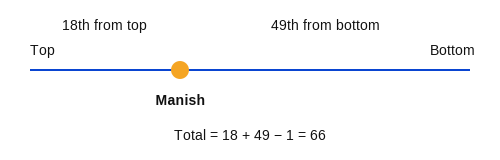
Manish ranked 18th from the top and 49th from the bottom in his class. How many students are there in his class?
मनीष अपनी कक्षा में ऊपर से 18वें और नीचे से 49वें स्थान पर था। उसकी कक्षा में कितने विद्यार्थी हैं?
  1. A65
  2. B67
  3. C66
  4. D64
Show answer

Concept: Total = rank from top + rank from bottom − 1 (the person is counted twice).

  1. Rank from top = 18, from bottom = 49.
  2. Total =18+49−1=66.

Trick: Subtract 1 because Manish is counted in both ranks.

Answer: (C) 66

अवधारणा: कुल = ऊपर से रैंक + नीचे से रैंक − 1 (व्यक्ति दो बार गिना गया)।

  1. ऊपर से 18वाँ, नीचे से 49वाँ।
  2. कुल =18+49−1=66।

ट्रिक: मनीष दोनों गिनती में है, इसलिए 1 घटाएँ।

उत्तर: (C) 66

RRB NTPC Graduate CBT 1General Intelligence and ReasoningRankingRRB NTPC Graduate CBT 1 2024 · 16 Jun Shift 1 →