Question bank

Q&A: practice questions with answers

Search questions on any topic. Filter by exam category, exam, subject and topic, try the question, then open the answer and explanation.

Courses – airGurukul

20,719 questions found.

Q881.
Sapna invested ₹20,300 on simple interest, partly at the rate of 5% per annum and partly at the rate of 9% per annum. If she earns equal interests from the two investments after 7 years, then find the sum invested at the rate of 5% per annum (in ₹).
सपना ने ₹20,300 साधारण ब्याज पर निवेश किए, जिसका एक भाग 5% वार्षिक दर पर और शेष भाग 9% वार्षिक दर पर निवेश किया। यदि 7 वर्ष बाद उसे दोनों निवेशों से बराबर ब्याज प्राप्त होता है, तो 5% वार्षिक दर पर निवेश की गई धनराशि (₹ में) ज्ञात कीजिए।
  1. A13,052
  2. B13,050
  3. C13,051
  4. D13,049
Show answer

Concept: Same time, equal SI → principals are in inverse ratio of rates.

  1. P1:P2=9:5 (inverse of 5%:9%).
  2. Sum at 5%=914×20300=9×1450=13050.
  3. Check: 13050×5%×7=4567.5 and 7250×9%×7=4567.5.

Trick: Equal SI → P∝1R.

Answer: (B) ₹13,050

अवधारणा: समय समान और ब्याज बराबर → मूलधन, दरों के व्युत्क्रम अनुपात में।

  1. P1:P2=9:5।
  2. 5% पर राशि =914×20300=13050।
  3. जाँच: दोनों पर ब्याज =4567.5।

ट्रिक: समान SI → P∝1R।

उत्तर: (B) ₹13,050

RRB NTPC Undergraduate CBT 1MathematicsSimple interest – equal interestRRB NTPC Undergraduate CBT 1 2024 · 29 Aug Shift 3 →
Q882.
3 years ago, the age of a father was 40 years more than twice his son's age. After how many years, from now, will he be twice his son's age?
3 वर्ष पहले, एक पिता की आयु उसके पुत्र की आयु के दोगुने से 40 वर्ष अधिक थी। अब से कितने वर्ष बाद पिता की आयु पुत्र की आयु की दोगुनी होगी?
  1. A37
  2. B32
  3. C33
  4. D38
Show answer

Concept: Form an equation from the past condition, then use the future condition.

  1. 3 years ago: F−3=2(S−3)+40⇒F=2S+37.
  2. After n years: F+n=2(S+n)⇒n=F−2S.
  3. n=37 years.

Trick: When "twice" is asked, n=F−2S directly.

Answer: (A) 37

अवधारणा: भूतकाल की शर्त से समीकरण बनाएँ, फिर भविष्य की शर्त लगाएँ।

  1. 3 वर्ष पहले: F−3=2(S−3)+40⇒F=2S+37।
  2. n वर्ष बाद: F+n=2(S+n)⇒n=F−2S।
  3. n=37 वर्ष।

ट्रिक: "दोगुना" के लिए सीधे n=F−2S।

उत्तर: (A) 37

RRB NTPC Undergraduate CBT 1MathematicsProblems on agesRRB NTPC Undergraduate CBT 1 2024 · 29 Aug Shift 3 →
Q883.
A bus travelling at 84 km/hr completes a journey in 6 hours. What should be its speed to cover the same distance in 12 hours?
84 km/hr की चाल से चलने वाली एक बस एक यात्रा 6 घंटे में पूरी करती है। समान दूरी को 12 घंटे में तय करने के लिए उसकी चाल कितनी होनी चाहिए?
  1. A44 km/hr
  2. B42 km/hr
  3. C32 km/hr
  4. D46 km/hr
Show answer

Concept: For fixed distance, speed ∝1time.

  1. Distance =84×6=504km.
  2. Speed =50412=42km/h.

Trick: Time doubles → speed halves: 842=42.

Answer: (B) 42km/h

अवधारणा: दूरी स्थिर हो तो चाल ∝1समय।

  1. दूरी =84×6=504km।
  2. चाल =50412=42km/h।

ट्रिक: समय दोगुना → चाल आधी।

उत्तर: (B) 42km/h

RRB NTPC Undergraduate CBT 1MathematicsSpeed, time and distanceRRB NTPC Undergraduate CBT 1 2024 · 29 Aug Shift 3 →
Q884.
Pankaj, Juhi and Siddharth invested ₹1,020, ₹1,740 and ₹1,840, respectively to start a business. If the profit at the end of the year is ₹1,050, what is Siddharth's share of the profit?
पंकज, जूही और सिद्धार्थ ने एक व्यवसाय शुरू करने के लिए क्रमशः ₹1,020, ₹1,740 और ₹1,840 का निवेश किया। यदि वर्ष के अंत में लाभ ₹1,050 है, तो लाभ में सिद्धार्थ का हिस्सा कितना है?
  1. A₹423
  2. B₹418
  3. C₹420
  4. D₹422
Show answer

Concept: Same time period → profit shared in ratio of investments.

  1. 1020:1740:1840=51:87:92 (divide by 20); sum =230.
  2. Siddharth =92230×1050=420.

Trick: 1050230×92: 1050230=10523, 92=4×23 → 105×4=420.

Answer: (C) ₹420

अवधारणा: समान अवधि → लाभ निवेश के अनुपात में बँटता है।

  1. 1020:1740:1840=51:87:92; योग =230।
  2. सिद्धार्थ =92230×1050=420।

ट्रिक: 92=4×23 → 105×4=420।

उत्तर: (C) ₹420

RRB NTPC Undergraduate CBT 1MathematicsPartnershipRRB NTPC Undergraduate CBT 1 2024 · 29 Aug Shift 3 →
Q885.
Simplify: sec2ϕcot2ϕ−1tan2ϕ+2(1csc2ϕ+1sec2ϕ)
सरल कीजिए: sec2ϕcot2ϕ−1tan2ϕ+2(1csc2ϕ+1sec2ϕ)
  1. A1
  2. B3
  3. C0
  4. D2
Show answer

Concept: sec2ϕcot2ϕ=csc2ϕ, csc2ϕ−cot2ϕ=1, sin2ϕ+cos2ϕ=1.

  1. sec2ϕcot2ϕ=1cos2ϕ·cos2ϕsin2ϕ=csc2ϕ.
  2. csc2ϕ−1tan2ϕ=csc2ϕ−cot2ϕ=1.
  3. 2(1csc2ϕ+1sec2ϕ)=2(sin2ϕ+cos2ϕ)=2.
  4. Total =1+2=3.

Trick: Put ϕ=45∘: 2×1−1+2(12+12)=3.

Answer: (B) 3

अवधारणा: sec2ϕcot2ϕ=csc2ϕ, csc2ϕ−cot2ϕ=1, sin2ϕ+cos2ϕ=1।

  1. sec2ϕcot2ϕ=csc2ϕ।
  2. csc2ϕ−cot2ϕ=1।
  3. 2(sin2ϕ+cos2ϕ)=2।
  4. कुल =1+2=3।

ट्रिक: ϕ=45∘ रखें: 2−1+2=3।

उत्तर: (B) 3

RRB NTPC Undergraduate CBT 1MathematicsTrigonometric identitiesRRB NTPC Undergraduate CBT 1 2024 · 29 Aug Shift 3 →
Q886.
The average runs scored by a batsman in 23 matches is 44. In the next 10 matches, the batsman scored an average of 13 runs. Find his average (rounded off to two decimals) in all the 33 matches?
एक बल्लेबाज़ द्वारा 23 मैचों में बनाए गए रनों का औसत 44 है। अगले 10 मैचों में बल्लेबाज़ ने औसतन 13 रन बनाए। सभी 33 मैचों में उसका औसत (दो दशमलव स्थानों तक पूर्णांकित) ज्ञात कीजिए।
  1. A35.61
  2. B34.61
  3. C33.61
  4. D36.61
Show answer

Concept: Combined average =total runstotal matches.

  1. First 23 matches: 23×44=1012.
  2. Next 10 matches: 10×13=130.
  3. Average =114233=34.606…≈34.61.

Trick: Deviation method: 44−10×3133=44−9.39=34.61.

Answer: (B) 34.61

अवधारणा: संयुक्त औसत =कुल रनकुल मैच।

  1. 23×44=1012।
  2. 10×13=130।
  3. औसत =114233≈34.61।

ट्रिक: 44−10×3133=34.61।

उत्तर: (B) 34.61

RRB NTPC Undergraduate CBT 1MathematicsAverageRRB NTPC Undergraduate CBT 1 2024 · 29 Aug Shift 3 →
Q887.
Find the H.C.F. and L.C.M. of 0.48, 1.20 and 1.68.
0.48, 1.20 और 1.68 का म.स. (H.C.F.) और ल.स. (L.C.M.) ज्ञात कीजिए।
  1. AH.C.F. = 0.24; L.C.M. = 4.80म.स. = 0.24; ल.स. = 4.80
  2. BH.C.F. = 0.12; L.C.M. = 2.40म.स. = 0.12; ल.स. = 2.40
  3. CH.C.F. = 0.12; L.C.M. = 1.68म.स. = 0.12; ल.स. = 1.68
  4. DH.C.F. = 0.24; L.C.M. = 16.8म.स. = 0.24; ल.स. = 16.8
Show answer

Concept: Make decimal places equal, find HCF/LCM of the whole numbers, then put the decimal back.

  1. Numbers become 48, 120, 168 (two decimal places).
  2. 48=24×3, 120=23×3×5, 168=23×3×7.
  3. HCF =23×3=24⇒0.24; LCM =24×3×5×7=1680⇒16.80.

Trick: LCM must be a multiple of the largest number 1.68: 1.68×10=16.8 fits.

Answer: (D) H.C.F. =0.24; L.C.M. =16.8

अवधारणा: दशमलव स्थान बराबर करें, पूर्ण संख्याओं का HCF/LCM निकालें, फिर दशमलव लगाएँ।

  1. संख्याएँ: 48, 120, 168।
  2. 48=24×3, 120=23×3×5, 168=23×3×7।
  3. HCF =24⇒0.24; LCM =1680⇒16.80।

ट्रिक: LCM सबसे बड़ी संख्या 1.68 का गुणज होना चाहिए: 16.8।

उत्तर: (D) H.C.F. =0.24; L.C.M. =16.8

RRB NTPC Undergraduate CBT 1MathematicsHCF and LCM of decimalsRRB NTPC Undergraduate CBT 1 2024 · 29 Aug Shift 3 →
Q888.
M and N start a business. M invests ₹33,000 more than N for 2 months and N invests for 7 months. M's share is ₹605 more than that of N, out of a total profit of ₹1,815. Find the capital contributed by M.
M और N एक व्यवसाय शुरू करते हैं। M, 2 महीने के लिए N से ₹33,000 अधिक निवेश करता है और N, 7 महीने के लिए निवेश करता है। ₹1,815 के कुल लाभ में से M का हिस्सा N के हिस्से से ₹605 अधिक है। M द्वारा लगाई गई पूँजी ज्ञात कीजिए।
  1. A₹38,500
  2. B₹38,339
  3. C₹38,697
  4. D₹38,300
Show answer

Concept: Profit ratio = capital × time.

  1. M − N =605, M + N =1815 → M =1210, N =605; ratio 2:1.
  2. (N+33000)×2N×7=2⇒N+33000=7N.
  3. N=5500, so M =5500+33000=38500.

Trick: Check: 38500×2:5500×7=77000:38500=2:1.

Answer: (A) ₹38,500

अवधारणा: लाभ अनुपात = पूँजी × समय।

  1. M =1210, N =605; अनुपात 2:1।
  2. (N+33000)×2N×7=2⇒N=5500।
  3. M =38500।

ट्रिक: जाँच: 77000:38500=2:1।

उत्तर: (A) ₹38,500

RRB NTPC Undergraduate CBT 1MathematicsPartnership – capital × timeRRB NTPC Undergraduate CBT 1 2024 · 29 Aug Shift 3 →
Q889.
A can lay railway track between two given stations in 20 days and B can do the same job in 15 days. With the help of C, they did the job in 3 days only. Then, C alone can do the job in
A दो दिए गए स्टेशनों के बीच रेलवे ट्रैक 20 दिनों में बिछा सकता है और B वही कार्य 15 दिनों में कर सकता है। C की सहायता से उन्होंने वह कार्य केवल 3 दिनों में पूरा कर दिया। तो, C अकेले वह कार्य कितने समय में कर सकता है?
  1. A1813 days1813 दिन
  2. B11813 days11813 दिन
  3. C4813 days4813 दिन
  4. D10813 days10813 दिन
Show answer

Concept: One-day works add up: 1A+1B+1C=1together.

  1. 1C=13−120−115.
  2. LCM 60: 20−3−460=1360.
  3. C alone =6013=4813 days.

Trick: Total work =60 units: A 3, B 4, all 20 per day → C =13 → 6013 days.

Answer: (C) 4813 days

अवधारणा: एक दिन के कार्य जुड़ते हैं: 1A+1B+1C=1साथ।

  1. 1C=13−120−115=1360।
  2. C अकेले =6013=4813 दिन।

ट्रिक: कुल कार्य 60 इकाई: A 3, B 4, सभी 20 → C =13।

उत्तर: (C) 4813 दिन

RRB NTPC Undergraduate CBT 1MathematicsTime and workRRB NTPC Undergraduate CBT 1 2024 · 29 Aug Shift 3 →
Q890.
A mobile phone is marked at ₹30,000. Successive discounts of 20% and 10% are applied. What is the final selling price?
एक मोबाइल फ़ोन का अंकित मूल्य ₹30,000 है। उस पर 20% और 10% की क्रमागत छूटें दी जाती हैं। अंतिम विक्रय मूल्य क्या है?
  1. A₹24,000
  2. B₹22,600
  3. C₹21,600
  4. D₹24,600
Show answer

Concept: Apply successive discounts one after another on the reduced price.

  1. After 20%: 30000×0.8=24000.
  2. After 10%: 24000×0.9=21600.

Trick: Net discount =20+10−20×10100=28%; 72% of 30000=21600.

Answer: (C) ₹21,600

अवधारणा: क्रमिक छूट घटे हुए मूल्य पर एक के बाद एक लगती है।

  1. 20% के बाद: 30000×0.8=24000।
  2. 10% के बाद: 24000×0.9=21600।

ट्रिक: कुल छूट =28%; 30000 का 72%=21600।

उत्तर: (C) ₹21,600

RRB NTPC Undergraduate CBT 1MathematicsSuccessive discountsRRB NTPC Undergraduate CBT 1 2024 · 29 Aug Shift 3 →
Q891.
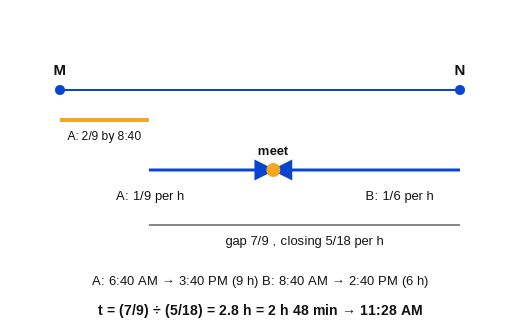
Train A leaves station M at 6:40 AM and reaches station N at 3:40 PM on the same day. Train B leaves station N at 8:40 AM and reaches station M at 2:40 PM on the same day. Find the time when trains A and B meet.
ट्रेन A, स्टेशन M से सुबह 6:40 बजे (6:40 AM) चलती है और उसी दिन दोपहर 3:40 बजे (3:40 PM) स्टेशन N पहुँचती है। ट्रेन B, स्टेशन N से सुबह 8:40 बजे (8:40 AM) चलती है और उसी दिन दोपहर 2:40 बजे (2:40 PM) स्टेशन M पहुँचती है। वह समय ज्ञात कीजिए जब ट्रेन A और B मिलती हैं।
  1. A11:28 AM
  2. B1:28 PM
  3. C11:58 AM
  4. D12:28 PM
Show answer

Concept: Take the distance as 1 unit; speeds are 1journey time. After both are running, they close the gap at the sum of speeds.

  1. A takes 9 h (6:40 AM–3:40 PM) → 19 per h; B takes 6 h → 16 per h.
  2. By 8:40 AM, A has covered 29; gap =79.
  3. Time =79÷(19+16)=79×185=2.8 h =2 h 48 min.
  4. Meeting time = 8:40 AM + 2 h 48 min = 11:28 AM.

Trick: Take distance =18 units (LCM of 9, 6): A 2/h, B 3/h; at 8:40 gap =14; 145=2.8 h.

Answer: (A) 11:28 AM

अवधारणा: दूरी 1 इकाई मानें; चाल =1यात्रा समय। दोनों चलने पर अंतर, चालों के योग से घटता है।

  1. A को 9 h → 19 प्रति h; B को 6 h → 16 प्रति h।
  2. 8:40 AM तक A ने 29 तय किया; शेष 79।
  3. समय =79×185=2.8 h =2 h 48 min।
  4. मिलने का समय = 11:28 AM।

ट्रिक: दूरी 18 इकाई: A 2, B 3 प्रति घंटा; अंतर 14; 145=2.8 h।

उत्तर: (A) 11:28 AM

RRB NTPC Undergraduate CBT 1MathematicsTrains – meeting timeRRB NTPC Undergraduate CBT 1 2024 · 29 Aug Shift 3 →
Q892.
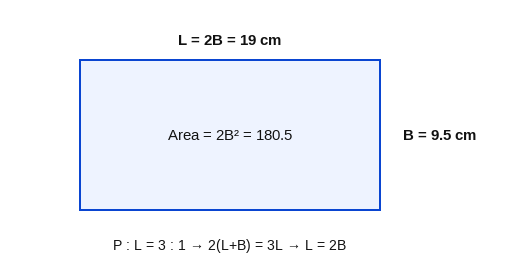
The ratio between the perimeter and the length of a rectangle is 3 : 1. If the area of the rectangle is 180.5 cm2, then what is the breadth of the rectangle?
एक आयत के परिमाप और लंबाई का अनुपात 3 : 1 है। यदि आयत का क्षेत्रफल 180.5 cm2 है, तो आयत की चौड़ाई कितनी है?
  1. A38 cm
  2. B21 cm
  3. C19 cm
  4. D9.5 cm
Show answer

Concept: Perimeter =2(L+B), Area =L×B.

  1. 2(L+B)=3L⇒L=2B.
  2. Area =2B×B=2B2=180.5⇒B2=90.25.
  3. B=9.5cm (and L=19cm).

Trick: Option check: B=9.5, L=19 → 19×9.5=180.5 ✓.

Answer: (D) 9.5cm

अवधारणा: परिमाप =2(L+B), क्षेत्रफल =L×B।

  1. 2(L+B)=3L⇒L=2B।
  2. 2B2=180.5⇒B2=90.25।
  3. B=9.5cm (L=19cm)।

ट्रिक: जाँच: 19×9.5=180.5 ✓।

उत्तर: (D) 9.5cm

RRB NTPC Undergraduate CBT 1MathematicsMensuration – rectangleRRB NTPC Undergraduate CBT 1 2024 · 29 Aug Shift 3 →
Q893.
The product of two consecutive positive natural numbers is 462. The greater of the two numbers is:
दो क्रमागत धनात्मक प्राकृत संख्याओं का गुणनफल 462 है। दोनों संख्याओं में से बड़ी संख्या है:
  1. A22
  2. B24
  3. C23
  4. D21
Show answer

Concept: Product of consecutive numbers n(n+1) is close to n2.

  1. 462≈21.5, so try 21 and 22.
  2. 21×22=462 ✓.
  3. Greater number =22.

Trick: Unit digit 2 of 462 comes from 1×2 → numbers end in 1 and 2.

Answer: (A) 22

अवधारणा: क्रमागत संख्याओं का गुणनफल n(n+1)≈n2।

  1. 462≈21.5 → 21 और 22।
  2. 21×22=462 ✓।
  3. बड़ी संख्या =22।

ट्रिक: इकाई अंक 2 = 1×2 → संख्याएँ 1 और 2 पर समाप्त।

उत्तर: (A) 22

RRB NTPC Undergraduate CBT 1MathematicsNumber system – consecutive numbersRRB NTPC Undergraduate CBT 1 2024 · 29 Aug Shift 3 →
Q894.
8 men can complete a piece of work in 5 days, while 8 women can do it in 15 days. In how many days can 3 women and 4 men complete this work?
8 पुरुष एक कार्य को 5 दिनों में पूरा कर सकते हैं, जबकि 8 महिलाएँ उसे 15 दिनों में कर सकती हैं। 3 महिलाएँ और 4 पुरुष मिलकर इस कार्य को कितने दिनों में पूरा कर सकते हैं?
  1. A5 days5 दिन
  2. B8 days8 दिन
  3. C7 days7 दिन
  4. D9 days9 दिन
Show answer

Concept: Convert to one person’s daily work.

  1. Work =8×5=40 man-days → 1 man does 140 per day.
  2. Work =8×15=120 woman-days → 1 woman does 1120 per day.
  3. 4 men +3 women =440+3120=12+3120=18 per day.
  4. Time =8 days.

Trick: 1 man =3 women; 4 men +3 women =15 women; 12015=8 days.

Answer: (B) 8 days

अवधारणा: एक व्यक्ति का एक दिन का कार्य निकालें।

  1. कार्य =40 पुरुष-दिवस → 1 पुरुष 140 प्रतिदिन।
  2. कार्य =120 महिला-दिवस → 1 महिला 1120 प्रतिदिन।
  3. 440+3120=18 प्रतिदिन।
  4. समय =8 दिन।

ट्रिक: 1 पुरुष =3 महिलाएँ; कुल 15 महिलाएँ; 12015=8।

उत्तर: (B) 8 दिन

RRB NTPC Undergraduate CBT 1MathematicsTime and work – men and womenRRB NTPC Undergraduate CBT 1 2024 · 29 Aug Shift 3 →
Q895.
The H.C.F. and the L.C.M. of two numbers are 4 and 3360 respectively. If one of the numbers is 96, find the other one.
दो संख्याओं का म.स. (H.C.F.) और ल.स. (L.C.M.) क्रमशः 4 और 3360 हैं। यदि उनमें से एक संख्या 96 है, तो दूसरी संख्या ज्ञात कीजिए।
  1. A92
  2. B116
  3. C164
  4. D140
Show answer

Concept: Product of two numbers = HCF × LCM.

  1. Other number =4×336096.
  2. =1344096=140.
  3. Check: HCF(96,140)=4 ✓.

Trick: 336096=35, 35×4=140.

Answer: (D) 140

अवधारणा: दो संख्याओं का गुणनफल = HCF × LCM।

  1. दूसरी संख्या =4×336096=140।
  2. जाँच: HCF(96,140)=4 ✓।

ट्रिक: 336096=35, 35×4=140।

उत्तर: (D) 140

RRB NTPC Undergraduate CBT 1MathematicsHCF and LCMRRB NTPC Undergraduate CBT 1 2024 · 29 Aug Shift 3 →
Q896.
What should come in place of the question mark (?) in the given series?
9 11 19 61 239 ?
दी गई श्रृंखला में प्रश्न चिह्न (?) के स्थान पर क्या आना चाहिए?
9 11 19 61 239 ?
  1. A1201
  2. B1120
  3. C1102
  4. D1021
Show answer

Concept: Each term = previous ×n with alternate +/− of a growing number.

  1. 9×1+2=11, 11×2−3=19, 19×3+4=61.
  2. 61×4−5=239.
  3. Next: 239×5+6=1201.

Trick: Multipliers 1, 2, 3, 4, 5 and adders +2,−3,+4,−5,+6.

Answer: (A) 1201

अवधारणा: हर पद = पिछला ×n, साथ में बारी-बारी +/− बढ़ती संख्या।

  1. 9×1+2=11, 11×2−3=19, 19×3+4=61।
  2. 61×4−5=239।
  3. अगला: 239×5+6=1201।

ट्रिक: गुणक 1,2,3,4,5; जोड़ +2,−3,+4,−5,+6।

उत्तर: (A) 1201

RRB NTPC Undergraduate CBT 1General Intelligence and ReasoningNumber series – mixed operationsRRB NTPC Undergraduate CBT 1 2024 · 29 Aug Shift 3 →
Q897.
What should come in place of the question mark (?) in the given series based on the English alphabetical order?
LEB QJG VOL ATQ ?
अंग्रेज़ी वर्णमाला क्रम के आधार पर दी गई श्रृंखला में प्रश्न चिह्न (?) के स्थान पर क्या आना चाहिए?
LEB QJG VOL ATQ ?
  1. AFYV
  2. BFVY
  3. CFYU
  4. DFRT
Show answer

Concept: Each letter position moves +5 from one cluster to the next.

  1. 1st letters: L → Q → V → A → F.
  2. 2nd letters: E → J → O → T → Y.
  3. 3rd letters: B → G → L → Q → V.

Trick: After Z wrap round: V+5 = A, so T+5 = Y and Q+5 = V.

Answer: (A) FYV

अवधारणा: हर अक्षर अगले समूह में +5 आगे बढ़ता है।

  1. पहले अक्षर: L → Q → V → A → F।
  2. दूसरे: E → J → O → T → Y।
  3. तीसरे: B → G → L → Q → V।

ट्रिक: Z के बाद फिर A से गिनें।

उत्तर: (A) FYV

RRB NTPC Undergraduate CBT 1General Intelligence and ReasoningAlphabet seriesRRB NTPC Undergraduate CBT 1 2024 · 29 Aug Shift 3 →
Q898.
Read the given statements and conclusions carefully. Assuming that the information given in the statements is true, even if it appears to be at variance with commonly known facts, decide which of the given conclusion(s) logically follow(s) from the statements.
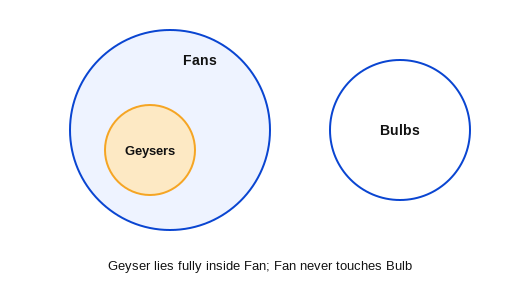
Statements: All geysers are fans. No fan is a bulb.
Conclusions (I): No geyser is a bulb.
Conclusions (II): Some fans are geysers.
दिए गए कथनों और निष्कर्षों को ध्यानपूर्वक पढ़िए। कथनों में दी गई जानकारी को सत्य मानते हुए, भले ही वह सामान्यतः ज्ञात तथ्यों से भिन्न प्रतीत होती हो, निर्णय कीजिए कि दिए गए निष्कर्षों में से कौन-सा/कौन-से निष्कर्ष तार्किक रूप से कथनों का अनुसरण करता/करते है/हैं।
कथन: सभी गीज़र, पंखे हैं। कोई पंखा, बल्ब नहीं है।
निष्कर्ष (I): कोई गीज़र, बल्ब नहीं है।
निष्कर्ष (II): कुछ पंखे, गीज़र हैं।
  1. ANeither conclusion (I) nor (II) follows.न तो निष्कर्ष (I) और न ही (II) अनुसरण करता है।
  2. BOnly conclusion (I) follows.केवल निष्कर्ष (I) अनुसरण करता है।
  3. COnly conclusion (II) follows.केवल निष्कर्ष (II) अनुसरण करता है।
  4. DBoth conclusions (I) and (II) follow.निष्कर्ष (I) और (II) दोनों अनुसरण करते हैं।
Show answer

Concept: Draw the least-overlap Venn diagram allowed by the statements.

  1. All geysers are inside fans; no fan touches bulbs → no geyser can be a bulb. (I) follows.
  2. "All geysers are fans" converts to "Some fans are geysers". (II) follows.

Yaad rakhein: All A are B + No B is C ⇒ No A is C (always definite).

Answer: (D) Both conclusions (I) and (II) follow.

अवधारणा: कथनों के अनुसार न्यूनतम ओवरलैप वाला वेन आरेख बनाएँ।

  1. सभी गीज़र, पंखों के अंदर हैं; कोई पंखा बल्ब नहीं → कोई गीज़र बल्ब नहीं। (I) सही।
  2. "सभी गीज़र पंखे हैं" का रूपांतरण "कुछ पंखे गीज़र हैं"। (II) सही।

याद रखें: सभी A, B हैं + कोई B, C नहीं ⇒ कोई A, C नहीं।

उत्तर: (D) दोनों निष्कर्ष (I) और (II) अनुसरण करते हैं।

RRB NTPC Undergraduate CBT 1General Intelligence and ReasoningSyllogismRRB NTPC Undergraduate CBT 1 2024 · 29 Aug Shift 3 →
Q899.
If ‘A’ stands for ‘÷’, ‘B’ stands for ‘×’, ‘C’ stands for ‘+’ and ‘D’ stands for ‘−’, then what will come in place of the question mark (?) in the following equation?
48 A 3 C 21 D 8 B 3 = ?
यदि ‘A’ का अर्थ ‘÷’, ‘B’ का अर्थ ‘×’, ‘C’ का अर्थ ‘+’ और ‘D’ का अर्थ ‘−’ है, तो निम्नलिखित समीकरण में प्रश्न चिह्न (?) के स्थान पर क्या आएगा?
48 A 3 C 21 D 8 B 3 = ?
  1. A2
  2. B13
  3. C6
  4. D10
Show answer

Concept: Replace letters by signs, then apply BODMAS.

  1. 48 A 3 C 21 D 8 B 3 → 48÷3+21−8×3.
  2. =16+21−24.
  3. =13.

Trick: Do ÷ and × first: 16 and 24.

Answer: (B) 13

अवधारणा: अक्षरों के स्थान पर चिह्न रखें, फिर BODMAS लगाएँ।

  1. 48÷3+21−8×3।
  2. =16+21−24=13।

ट्रिक: पहले ÷ और ×: 16 और 24।

उत्तर: (B) 13

RRB NTPC Undergraduate CBT 1General Intelligence and ReasoningMathematical operations – symbol substitutionRRB NTPC Undergraduate CBT 1 2024 · 29 Aug Shift 3 →
Q900.
What should come in place of the question mark (?) in the given series?
38 41 47 59 83 ?
दी गई श्रृंखला में प्रश्न चिह्न (?) के स्थान पर क्या आना चाहिए?
38 41 47 59 83 ?
  1. A131
  2. B121
  3. C132
  4. D145
Show answer

Concept: Look at differences between consecutive terms.

  1. Differences: 3,6,12,24 (each doubles).
  2. Next difference =48.
  3. 83+48=131.

Trick: Difference series ×2 each time.

Answer: (A) 131

अवधारणा: क्रमागत पदों का अंतर देखें।

  1. अंतर: 3,6,12,24 (हर बार दोगुना)।
  2. अगला अंतर =48।
  3. 83+48=131।

ट्रिक: अंतर हर बार ×2।

उत्तर: (A) 131

RRB NTPC Undergraduate CBT 1General Intelligence and ReasoningNumber series – doubling differencesRRB NTPC Undergraduate CBT 1 2024 · 29 Aug Shift 3 →