Question bank

Q&A: practice questions with answers

Search questions on any topic. Filter by exam category, exam, subject and topic, try the question, then open the answer and explanation.

Courses – airGurukul

20,719 questions found.

Q961.
By when has India aimed to achieve its defence production of ₹3 lakh crore, which will strengthen its position as a global defence manufacturing hub?
भारत ने ₹3 लाख करोड़ का रक्षा उत्पादन किस वर्ष तक प्राप्त करने का लक्ष्य रखा है, जिससे वैश्विक रक्षा विनिर्माण केंद्र के रूप में इसकी स्थिति मज़बूत होगी?
  1. A2032
  2. B2029
  3. C2028
  4. D2030
Show answer

Concept: India's annual defence production crossed about ₹1.27 lakh crore in 2023-24.

  1. The government (Defence Minister Rajnath Singh) set a target of ₹3 lakh crore defence production by 2029.
  2. A defence-export target of ₹50,000 crore by 2029 was also announced.

Yaad rakhein: 2029 → ₹3 lakh crore production, ₹50,000 crore exports.

Answer: (B) 2029

अवधारणा: भारत का वार्षिक रक्षा उत्पादन 2023-24 में लगभग ₹1.27 लाख करोड़ पार कर गया।

  1. सरकार (रक्षा मंत्री राजनाथ सिंह) ने 2029 तक ₹3 लाख करोड़ रक्षा उत्पादन का लक्ष्य रखा।
  2. साथ ही 2029 तक ₹50,000 करोड़ रक्षा निर्यात का लक्ष्य भी है।

याद रखें: 2029 → ₹3 लाख करोड़ उत्पादन, ₹50,000 करोड़ निर्यात।

उत्तर: (B) 2029
RRB NTPC Undergraduate CBT 1General AwarenessDefence production targetRRB NTPC Undergraduate CBT 1 2024 · 29 Aug Shift 2 →
Q962.
Which initiative was launched to provide reliable electricity to all households in India, especially in rural areas?
भारत में सभी परिवारों, विशेषकर ग्रामीण क्षेत्रों में, विश्वसनीय बिजली उपलब्ध कराने के लिए कौन-सी पहल शुरू की गई थी?
  1. AUJALA Schemeउजाला योजना
  2. BShakti Schemeशक्ति योजना
  3. CSaubhagya Schemeसौभाग्य योजना
  4. DGARV DashboardGARV डैशबोर्ड
Show answer

Concept: Pradhan Mantri Sahaj Bijli Har Ghar Yojana – 'Saubhagya' – was launched in 2017.

  1. It aimed at universal household electrification: last-mile connections to all un-electrified households in rural and urban areas.
  2. UJALA distributes LED bulbs (energy efficiency); GARV was a dashboard for village electrification.

Yaad rakhein: Saubhagya = 'Har Ghar Bijli'; UJALA = LED bulbs.

Answer: (C) Saubhagya Scheme

अवधारणा: प्रधानमंत्री सहज बिजली हर घर योजना – 'सौभाग्य' – 2017 में शुरू हुई।

  1. उद्देश्य: सभी बिना बिजली वाले घरों (ग्रामीण और शहरी) को बिजली कनेक्शन देना।
  2. UJALA – LED बल्ब (ऊर्जा दक्षता); GARV – गाँव विद्युतीकरण का डैशबोर्ड।

याद रखें: सौभाग्य = 'हर घर बिजली'; उजाला = LED बल्ब।

उत्तर: (C) सौभाग्य योजना

RRB NTPC Undergraduate CBT 1General AwarenessSaubhagya SchemeRRB NTPC Undergraduate CBT 1 2024 · 29 Aug Shift 2 →
Q963.
Who among the following passed an Act in 1898, making it an offence to provoke people against the British rulers?
निम्नलिखित में से किसने 1898 में एक अधिनियम पारित किया, जिसके द्वारा लोगों को ब्रिटिश शासकों के विरुद्ध भड़काना अपराध बना दिया गया?
  1. ALord Curzonलॉर्ड कर्ज़न
  2. BLord Northbrookलॉर्ड नॉर्थब्रुक
  3. CLord Elginलॉर्ड एल्गिन
  4. DLord Mayoलॉर्ड मेयो
Show answer

Concept: In 1898 the Indian Penal Code was amended (Act IV of 1898) to widen Section 124A (sedition) and add Section 153A, making it an offence to excite disaffection or enmity against the British government.

  1. It was passed in 1898, during the viceroyalty of Lord Elgin II (1894–1899), after the Tilak sedition trial of 1897.
  2. Lord Curzon became Viceroy only in January 1899; Northbrook (1872–76) and Mayo (1869–72) were much earlier.

Yaad rakhein: Viceroy order: Elgin II (1894–99) → Curzon (1899–1905).

Answer: (C) Lord Elgin

अवधारणा: 1898 में भारतीय दंड संहिता में संशोधन (1898 का अधिनियम IV) करके धारा 124A (राजद्रोह) का विस्तार और धारा 153A जोड़ी गई, जिससे ब्रिटिश सरकार के विरुद्ध असंतोष भड़काना अपराध बना।

  1. यह 1898 में लॉर्ड एल्गिन द्वितीय (1894–1899) के वायसराय काल में, 1897 के तिलक राजद्रोह मुक़दमे के बाद पारित हुआ।
  2. लॉर्ड कर्ज़न जनवरी 1899 में वायसराय बने; नॉर्थब्रुक (1872–76) और मेयो (1869–72) बहुत पहले थे।

याद रखें: वायसराय क्रम: एल्गिन द्वितीय (1894–99) → कर्ज़न (1899–1905)।

उत्तर: (C) लॉर्ड एल्गिन

RRB NTPC Undergraduate CBT 1General AwarenessSedition law of 1898RRB NTPC Undergraduate CBT 1 2024 · 29 Aug Shift 2 →
Q964.
The process of planet formation through collision and sticking of small celestial bodies is called:
छोटे खगोलीय पिंडों के टकराने और आपस में चिपकने के माध्यम से ग्रह निर्माण की प्रक्रिया को क्या कहा जाता है?
  1. AFragmentationविखंडन (fragmentation)
  2. BDegassingगैस उत्सर्जन (degassing)
  3. CDifferentiationविभेदन (differentiation)
  4. DAccretionअभिवृद्धि (accretion)
Show answer

Concept: According to the planetesimal theory, planets grew inside the solar nebula from tiny dust grains.

  1. Small bodies (planetesimals) collided and stuck together, gradually building larger bodies – this is accretion.
  2. Differentiation is the later separation of an Earth into core, mantle and crust; degassing released gases forming the early atmosphere.

Yaad rakhein: Accretion = add-on growth by collisions.

Answer: (D) Accretion

अवधारणा: ग्रहाणु (planetesimal) सिद्धांत के अनुसार ग्रह सौर नीहारिका में छोटे धूल कणों से बने।

  1. छोटे पिंड (ग्रहाणु) टकराकर आपस में चिपकते गए और बड़े पिंड बने – यही अभिवृद्धि (Accretion) है।
  2. विभेदन (Differentiation) – पृथ्वी का क्रोड, मेंटल, भूपर्पटी में बँटना; गैस-निष्कासन (Degassing) से आरंभिक वायुमंडल बना।

याद रखें: Accretion = टकराकर जुड़ते-जुड़ते बढ़ना।

उत्तर: (D) अभिवृद्धि (Accretion)

RRB NTPC Undergraduate CBT 1General AwarenessAccretionRRB NTPC Undergraduate CBT 1 2024 · 29 Aug Shift 2 →
Q965.
Lok Adalats in India have statutory status under which of the following enactments?
भारत में लोक अदालतों को निम्नलिखित में से किस अधिनियम के अंतर्गत वैधानिक दर्जा प्राप्त है?
  1. AThe Civil Procedure Code, 1908सिविल प्रक्रिया संहिता, 1908
  2. BThe Indian Penal Code, 1860भारतीय दंड संहिता, 1860
  3. CThe Legal Services Authorities Act, 1987विधिक सेवा प्राधिकरण अधिनियम, 1987
  4. DThe Arbitration and Conciliation Act, 1996माध्यस्थम् और सुलह अधिनियम, 1996
Show answer

Concept: Lok Adalats ('people's courts') settle disputes by compromise, outside the regular court process.

  1. They were given statutory status by the Legal Services Authorities Act, 1987 (in force from 1995).
  2. An award of a Lok Adalat is deemed a civil-court decree and is final – no appeal lies against it.

Yaad rakhein: 1987 Act → NALSA, Lok Adalats; Article 39A = free legal aid.

Answer: (C) The Legal Services Authorities Act, 1987

अवधारणा: लोक अदालतें ('जन अदालत') नियमित न्यायालय प्रक्रिया के बाहर समझौते द्वारा विवाद निपटाती हैं।

  1. इन्हें विधिक सेवा प्राधिकरण अधिनियम, 1987 (1995 से लागू) द्वारा वैधानिक दर्जा मिला।
  2. लोक अदालत का निर्णय दीवानी न्यायालय की डिक्री माना जाता है और अंतिम होता है – उसके विरुद्ध अपील नहीं होती।

याद रखें: 1987 अधिनियम → NALSA, लोक अदालत; अनुच्छेद 39A = निःशुल्क विधिक सहायता।

उत्तर: (C) विधिक सेवा प्राधिकरण अधिनियम, 1987

RRB NTPC Undergraduate CBT 1General AwarenessLok AdalatRRB NTPC Undergraduate CBT 1 2024 · 29 Aug Shift 2 →
Q966.
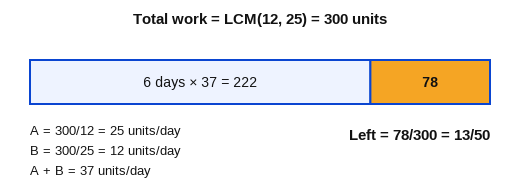
A can do a work in 12 days and B can do the same work in 25 days. If they work on it together for 6 days, then what fraction of the work is left?
A किसी कार्य को 12 दिनों में और B उसी कार्य को 25 दिनों में कर सकता है। यदि वे 6 दिनों तक एक साथ कार्य करते हैं, तो कार्य का कितना भाग शेष रह जाता है?
  1. A950
  2. B1750
  3. C1350
  4. D2150
Show answer

Concept: Take total work = LCM of the days; one-day work = total ÷ days.

  1. Total work =LCM(12,25)=300 units; A =25, B =12 units/day.
  2. Together =37 units/day; in 6 days =6×37=222 units.
  3. Left =300−222=78 units =78300=1350.

Trick: Fraction done =6(112+125)=6×37300=3750, so left =1350.

Answer: (C) 1350

अवधारणा: कुल कार्य = दिनों का LCM लें; एक दिन का कार्य = कुल ÷ दिन।

  1. कुल कार्य =LCM(12,25)=300 इकाई; A =25, B =12 इकाई/दिन।
  2. दोनों मिलकर =37 इकाई/दिन; 6 दिन में =6×37=222 इकाई।
  3. शेष =300−222=78 इकाई =78300=1350।

ट्रिक: किया गया भाग =6(112+125)=3750, शेष =1350।

उत्तर: (C) 1350

RRB NTPC Undergraduate CBT 1MathematicsTime and workRRB NTPC Undergraduate CBT 1 2024 · 29 Aug Shift 2 →
Q967.
Evaluate: (-9) - (-60) ÷ (-10) + (-3) × 9
मान ज्ञात कीजिए: (-9) - (-60) ÷ (-10) + (-3) × 9
  1. A-42
  2. B-44
  3. C-45
  4. D-41
Show answer

Concept: Follow BODMAS: division and multiplication before addition and subtraction; take care of signs.

  1. (−60)÷(−10)=6 and (−3)×9=−27.
  2. Expression =(−9)−6+(−27).
  3. =−9−6−27=−42.

Trick: Minus a positive or plus a negative both move left on the number line: −9→−15→−42.

Answer: (A) −42

अवधारणा: BODMAS का पालन करें: पहले भाग और गुणा, फिर जोड़ और घटाना; चिह्नों का ध्यान रखें।

  1. (−60)÷(−10)=6 और (−3)×9=−27।
  2. व्यंजक =(−9)−6+(−27)।
  3. =−9−6−27=−42।

ट्रिक: धनात्मक घटाना या ऋणात्मक जोड़ना – दोनों संख्या रेखा पर बाएँ: −9→−15→−42।

उत्तर: (A) −42

RRB NTPC Undergraduate CBT 1MathematicsBODMAS with integersRRB NTPC Undergraduate CBT 1 2024 · 29 Aug Shift 2 →
Q968.
The HCF and the LCM of two numbers are 18 and 216, respectively. If one of the numbers is 72, find the other one.
दो संख्याओं का महत्तम समापवर्तक (HCF) और लघुत्तम समापवर्त्य (LCM) क्रमशः 18 और 216 हैं। यदि उनमें से एक संख्या 72 है, तो दूसरी संख्या ज्ञात कीजिए।
  1. A25
  2. B10
  3. C54
  4. D5
Show answer

Concept: For two numbers: HCF×LCM=First number×Second number.

  1. 18×216=72×x.
  2. x=18×21672=388872=54.
  3. Check: HCF(72,54)=18, LCM(72,54)=216 ✓.

Trick: 21672=3, so x=18×3=54.

Answer: (C) 54

अवधारणा: दो संख्याओं के लिए: HCF×LCM=पहली संख्या×दूसरी संख्या।

  1. 18×216=72×x।
  2. x=18×21672=388872=54।
  3. जाँच: HCF(72,54)=18, LCM(72,54)=216 ✓।

ट्रिक: 21672=3, अतः x=18×3=54।

उत्तर: (C) 54

RRB NTPC Undergraduate CBT 1MathematicsHCF and LCMRRB NTPC Undergraduate CBT 1 2024 · 29 Aug Shift 2 →
Q969.
If the 6-digit number N36M77 is divisible by 11, then which of the options below can give a possible correct relation between M and N?
यदि 6-अंकीय संख्या N36M77, 11 से विभाज्य है, तो नीचे दिए गए विकल्पों में से कौन-सा M और N के बीच संभावित सही संबंध दर्शा सकता है?
  1. AM + N = -3
  2. BM - N = 3
  3. CM - N = 1
  4. DM = N
Show answer

Concept: A number is divisible by 11 if (sum of digits at odd places) − (sum of digits at even places) is 0 or a multiple of 11.

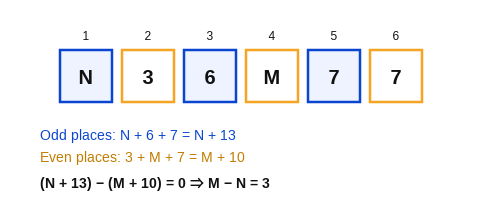
  1. Digits N, 3, 6, M, 7, 7: odd places N+6+7=N+13; even places 3+M+7=M+10.
  2. Difference =(N+13)−(M+10)=N−M+3.
  3. For N−M+3=0: M−N=3 (e.g. N=1,M=4 gives 136477 =11×12407).

Trick: Alternate sum =0 or ±11; digits are 0–9, so N−M+3=0 is the workable case here.

Answer: (B) M−N=3

अवधारणा: कोई संख्या 11 से विभाज्य है यदि (विषम स्थानों के अंकों का योग) − (सम स्थानों के अंकों का योग) 0 या 11 का गुणज हो।

  1. अंक N, 3, 6, M, 7, 7: विषम स्थान N+6+7=N+13; सम स्थान 3+M+7=M+10।
  2. अंतर =(N+13)−(M+10)=N−M+3।
  3. N−M+3=0 से M−N=3 (जैसे N=1,M=4: 136477 =11×12407)।

ट्रिक: एकांतर योग =0 या ±11; अंक 0–9 हैं, अतः यहाँ N−M+3=0 उपयुक्त है।

उत्तर: (B) M−N=3

RRB NTPC Undergraduate CBT 1MathematicsDivisibility by 11RRB NTPC Undergraduate CBT 1 2024 · 29 Aug Shift 2 →
Q970.
The product of two positive numbers is 245. If the first number is five times the second number, then the sum of the two numbers is:
दो धनात्मक संख्याओं का गुणनफल 245 है। यदि पहली संख्या दूसरी संख्या की पाँच गुनी है, तो दोनों संख्याओं का योग है:
  1. A38
  2. B51
  3. C40
  4. D42
Show answer

Concept: Let the second number be x; then the first is 5x.

  1. 5x×x=245⇒x2=49⇒x=7.
  2. First number =35, second =7.
  3. Sum =35+7=42.

Trick: Sum =6x; 245=5×72 gives x=7 directly, so sum =42.

Answer: (D) 42

अवधारणा: माना दूसरी संख्या x है; तो पहली 5x है।

  1. 5x×x=245⇒x2=49⇒x=7।
  2. पहली संख्या =35, दूसरी =7।
  3. योग =35+7=42।

ट्रिक: योग =6x; 245=5×72 से सीधे x=7, योग =42।

उत्तर: (D) 42

RRB NTPC Undergraduate CBT 1MathematicsNumbers – product and ratioRRB NTPC Undergraduate CBT 1 2024 · 29 Aug Shift 2 →
Q971.
Train A leaves station M at 8:35 AM and reaches station N at 3:35 PM on the same day. Train B leaves station N at 10:35 AM and reaches station M at 3:35 PM on the same day. Find the time when trains A and B meet.
ट्रेन A स्टेशन M से 8:35 AM पर चलती है और उसी दिन 3:35 PM पर स्टेशन N पर पहुँचती है। ट्रेन B स्टेशन N से 10:35 AM पर चलती है और उसी दिन 3:35 PM पर स्टेशन M पर पहुँचती है। वह समय ज्ञात कीजिए जब ट्रेन A और B एक-दूसरे से मिलती हैं।
  1. A11:50 AM
  2. B12:40 PM
  3. C12:10 PM
  4. D12:50 PM
Show answer

Concept: Take the distance MN as the LCM of the journey times; then the trains close the gap at the sum of their speeds.

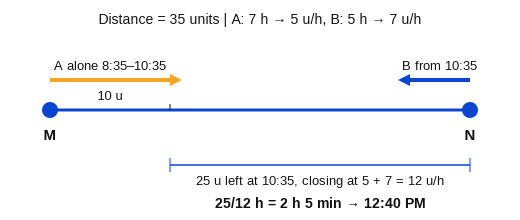
  1. A: 8:35 AM to 3:35 PM =7h; B: 10:35 AM to 3:35 PM =5h. Let MN =35 units: A =5, B =7 units/h.
  2. By 10:35 A has run 2h: 10 units; gap =25 units.
  3. Relative speed =5+7=12 units/h; time =2512h=2h5min.
  4. Meeting time = 10:35 + 2 h 5 min = 12:40 PM.

Trick: Always start both trains at the same clock time: move the early one ahead first.

Answer: (B) 12:40 PM

अवधारणा: दूरी MN को यात्रा-समयों का LCM मानें; फिर दोनों रेलगाड़ियाँ चालों के योग से अंतर घटाती हैं।

  1. A: 8:35 AM से 3:35 PM =7h; B: 10:35 AM से 3:35 PM =5h। MN =35 इकाई: A =5, B =7 इकाई/घंटा।
  2. 10:35 तक A 2h चली: 10 इकाई; शेष दूरी =25 इकाई।
  3. सापेक्ष चाल =5+7=12 इकाई/घंटा; समय =2512h=2h5min।
  4. मिलने का समय = 10:35 + 2 घंटे 5 मिनट = 12:40 PM।

ट्रिक: पहले जल्दी चली गाड़ी को आगे बढ़ाएँ, फिर दोनों को एक ही समय से चलाएँ।

उत्तर: (B) 12:40 PM

RRB NTPC Undergraduate CBT 1MathematicsTrains – meeting timeRRB NTPC Undergraduate CBT 1 2024 · 29 Aug Shift 2 →
Q972.
If the third proportional of 8 and 16 be x, then what is the value of x?
यदि 8 और 16 का तृतीयानुपाती x हो, तो x का मान क्या है?
  1. A31
  2. B34
  3. C32
  4. D35
Show answer

Concept: If a:b=b:x, then x is the third proportional of a and b: x=b2a.

  1. 8:16=16:x.
  2. x=1628=2568=32.

Trick: Third proportional continues the ratio: 8→16→32 (each ×2).

Answer: (C) 32

अवधारणा: यदि a:b=b:x हो, तो x, a और b का तृतीयानुपाती है: x=b2a।

  1. 8:16=16:x।
  2. x=1628=2568=32।

ट्रिक: तृतीयानुपाती अनुपात को आगे बढ़ाता है: 8→16→32 (हर बार ×2)।

उत्तर: (C) 32

RRB NTPC Undergraduate CBT 1MathematicsThird proportionalRRB NTPC Undergraduate CBT 1 2024 · 29 Aug Shift 2 →
Q973.
A bus travelling at 10 km/hr completes a journey in 16 hours. At what speed will it have to cover the same distance in 8 hours?
10 km/hr की चाल से चलने वाली एक बस एक यात्रा 16 घंटे में पूरी करती है। समान दूरी 8 घंटे में तय करने के लिए उसे किस चाल से चलना होगा?
  1. A14 km/hr
  2. B10 km/hr
  3. C20 km/hr
  4. D25 km/hr
Show answer

Concept: Distance=Speed×Time; for a fixed distance, speed is inversely proportional to time.

  1. Distance =10×16=160km.
  2. Required speed =1608=20km/h.

Trick: Time halves (16 → 8 h) ⇒ speed doubles: 10×2=20.

Answer: (C) 20km/h

अवधारणा: दूरी=चाल×समय; दूरी स्थिर हो तो चाल समय के व्युत्क्रमानुपाती है।

  1. दूरी =10×16=160km।
  2. आवश्यक चाल =1608=20km/h।

ट्रिक: समय आधा (16 → 8 घंटे) ⇒ चाल दोगुनी: 10×2=20।

उत्तर: (C) 20km/h

RRB NTPC Undergraduate CBT 1MathematicsSpeed, time and distanceRRB NTPC Undergraduate CBT 1 2024 · 29 Aug Shift 2 →
Q974.
Praveen and Hemant start a business. Praveen invests ₹78,000 more than Hemant for 5 months and Hemant invests for 6 months. Praveen's share is ₹1,360 more than that of Hemant, out of a total profit of ₹5,440. Find the capital contributed by Praveen.
प्रवीण और हेमंत एक व्यवसाय शुरू करते हैं। प्रवीण, हेमंत से ₹78,000 अधिक 5 महीने के लिए निवेश करता है और हेमंत 6 महीने के लिए निवेश करता है। ₹5,440 के कुल लाभ में से प्रवीण का हिस्सा हेमंत के हिस्से से ₹1,360 अधिक है। प्रवीण द्वारा लगाई गई पूँजी ज्ञात कीजिए।
  1. A₹1,56,000
  2. B₹1,55,955
  3. C₹1,55,875
  4. D₹1,56,185
Show answer

Concept: Profit is shared in the ratio of capital×time.

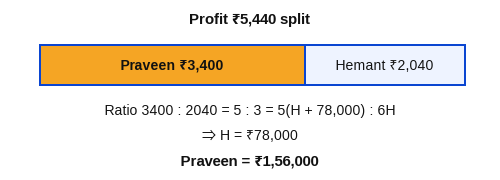
  1. Praveen's share =5440+13602=3400; Hemant's =2040. Ratio =3400:2040=5:3.
  2. Let Hemant's capital =H: 5(H+78000)6H=53.
  3. 15H+1170000=30H⇒H=78000.
  4. Praveen's capital =78000+78000= ₹1,56,000.

Trick: Check option: ₹1,56,000 × 5 : ₹78,000 × 6 =780000:468000=5:3 ✓.

Answer: (A) ₹1,56,000

अवधारणा: लाभ पूँजी×समय के अनुपात में बँटता है।

  1. प्रवीण का हिस्सा =5440+13602=3400; हेमंत का =2040। अनुपात =3400:2040=5:3।
  2. माना हेमंत की पूँजी =H: 5(H+78000)6H=53।
  3. 15H+1170000=30H⇒H=78000।
  4. प्रवीण की पूँजी =78000+78000= ₹1,56,000।

ट्रिक: विकल्प जाँचें: ₹1,56,000 × 5 : ₹78,000 × 6 =780000:468000=5:3 ✓।

उत्तर: (A) ₹1,56,000

RRB NTPC Undergraduate CBT 1MathematicsPartnershipRRB NTPC Undergraduate CBT 1 2024 · 29 Aug Shift 2 →
Q975.
Sapna invested ₹22,800 on simple interest, partly at 5% per annum and partly at 11% per annum. If she earns equal interests from the two investments after 4 years, then find the sum invested at 5% per annum (in ₹).
सपना ने ₹22,800 साधारण ब्याज पर निवेश किए, कुछ भाग 5% वार्षिक दर पर और कुछ भाग 11% वार्षिक दर पर। यदि 4 वर्ष बाद उसे दोनों निवेशों से समान ब्याज प्राप्त होता है, तो 5% वार्षिक दर पर निवेश की गई राशि (₹ में) ज्ञात कीजिए।
  1. A15,676
  2. B15,675
  3. C15,678
  4. D15,677
Show answer

Concept: With the same time, equal SI means P1×R1=P2×R2, so principals are in the inverse ratio of rates.

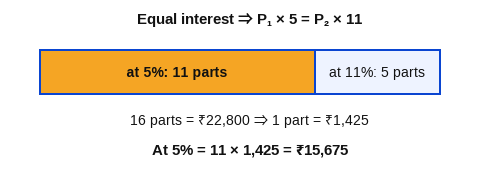
  1. P1×5×4=P2×11×4⇒P1:P2=11:5.
  2. 16 parts =22800⇒ 1 part =1425.
  3. Sum at 5% =11×1425=15675.

Trick: Principal at lower rate gets the larger share: rates 5:11 ⇒ sums 11:5.

Answer: (B) 15,675

अवधारणा: समय समान हो तो समान साधारण ब्याज का अर्थ P1×R1=P2×R2, अतः मूलधन दरों के व्युत्क्रम अनुपात में होंगे।

  1. P1×5×4=P2×11×4⇒P1:P2=11:5।
  2. 16 भाग =22800⇒ 1 भाग =1425।
  3. 5% पर राशि =11×1425=15675।

ट्रिक: कम दर पर अधिक राशि: दरें 5:11 ⇒ राशियाँ 11:5।

उत्तर: (B) 15,675

RRB NTPC Undergraduate CBT 1MathematicsSimple interest – equal interestRRB NTPC Undergraduate CBT 1 2024 · 29 Aug Shift 2 →
Q976.
Simplify: (sinθ−cosθ)(1+tanθ+cotθ)1+sinθcosθ+sinθ1+cosθ+1+cosθsinθ
सरल कीजिए: (sinθ−cosθ)(1+tanθ+cotθ)1+sinθcosθ+sinθ1+cosθ+1+cosθsinθ
  1. Acscθ+secθ
  2. Bsinθ+cosθ
  3. Ctanθ+secθ
  4. Dsinθsecθ
Show answer

Concept: Write everything in sinθ and cosθ; use a3−b3=(a−b)(a2+ab+b2) and sin2θ+cos2θ=1.

  1. 1+tanθ+cotθ=sinθcosθ+sin2θ+cos2θsinθcosθ=1+sinθcosθsinθcosθ
  2. First term =(sinθ−cosθ)sinθcosθ=1cosθ−1sinθ=secθ−cscθ
  3. sinθ1+cosθ+1+cosθsinθ=sin2θ+1+2cosθ+cos2θsinθ(1+cosθ)=2(1+cosθ)sinθ(1+cosθ)=2cscθ
  4. Total =secθ−cscθ+2cscθ=cscθ+secθ

Trick: Put θ=45∘: expression =0+12+1+(2+1)=22, and only csc45∘+sec45∘=22.

Answer: (A) cscθ+secθ

अवधारणा: सब कुछ sinθ और cosθ में लिखें; a3−b3=(a−b)(a2+ab+b2) और sin2θ+cos2θ=1 का प्रयोग करें।

  1. 1+tanθ+cotθ=1+sinθcosθsinθcosθ
  2. पहला पद =sinθ−cosθsinθcosθ=secθ−cscθ
  3. sinθ1+cosθ+1+cosθsinθ=2(1+cosθ)sinθ(1+cosθ)=2cscθ
  4. कुल =secθ−cscθ+2cscθ=cscθ+secθ

ट्रिक: θ=45∘ रखें: मान =22 आता है, जो केवल csc45∘+sec45∘ से मिलता है।

उत्तर: (A) cscθ+secθ

RRB NTPC Undergraduate CBT 1MathematicsTrigonometric simplificationRRB NTPC Undergraduate CBT 1 2024 · 29 Aug Shift 2 →
Q977.
The value of 43+(11+27)−23 is
43+(11+27)−23 का मान है
  1. A1619
  2. B49
  3. C139
  4. D58
Show answer

Concept: Solve the inner bracket first (BODMAS), then add/subtract with a common denominator.

  1. 1+27=97, so 19/7=79
  2. 43−23=23=69
  3. 69+79=139

Trick: Group the like fractions first: 43−23 is instantly 23.

Answer: (C) 139

अवधारणा: पहले भीतरी कोष्ठक हल करें (BODMAS), फिर समान हर लेकर जोड़ें/घटाएँ।

  1. 1+27=97, अतः 19/7=79
  2. 43−23=23=69
  3. 69+79=139

ट्रिक: समान हर वाली भिन्नें पहले मिलाएँ: 43−23=23।

उत्तर: (C) 139

RRB NTPC Undergraduate CBT 1MathematicsSimplification of fractionsRRB NTPC Undergraduate CBT 1 2024 · 29 Aug Shift 2 →
Q978.
The average of first 159 even numbers is
प्रथम 159 सम संख्याओं का औसत है
  1. A161
  2. B160.5
  3. C159.5
  4. D160
Show answer

Concept: Sum of first n even numbers =n(n+1), so their average =n+1.

  1. Here n=159
  2. Average =159×160159=159+1=160

Yaad rakhein: Average of first n even numbers =n+1; of first n odd numbers =n.

Answer: (D) 160

अवधारणा: प्रथम n सम संख्याओं का योग =n(n+1), अतः औसत =n+1।

  1. यहाँ n=159
  2. औसत =159×160159=160

याद रखें: प्रथम n सम संख्याओं का औसत =n+1; प्रथम n विषम संख्याओं का औसत =n।

उत्तर: (D) 160

RRB NTPC Undergraduate CBT 1MathematicsAverage of even numbersRRB NTPC Undergraduate CBT 1 2024 · 29 Aug Shift 2 →
Q979.
Given that 1120.57 = x, 1120.8= y and xz = y6, then the value of z is close to:
दिया गया है कि 1120.57 = x, 1120.8= y और xz = y6 है, तो z का मान लगभग है:
  1. A10.14
  2. B9.12
  3. C8.45
  4. D8.42
Show answer

Concept: (am)n=amn; equal bases ⇒ equal powers.

  1. xz=(1120.57)z=1120.57z
  2. y6=(1120.8)6=1124.8
  3. 0.57z=4.8⇒z=4.80.57=48057≈8.42

Trick: Just compare exponents: z=6×0.80.57.

Answer: (D) 8.42

अवधारणा: (am)n=amn; आधार समान हों तो घातें बराबर।

  1. xz=1120.57z
  2. y6=1120.8×6=1124.8
  3. 0.57z=4.8⇒z=48057≈8.42

ट्रिक: सीधे घातें मिलाएँ: z=6×0.80.57।

उत्तर: (D) 8.42

RRB NTPC Undergraduate CBT 1MathematicsLaws of exponentsRRB NTPC Undergraduate CBT 1 2024 · 29 Aug Shift 2 →
Q980.
Find the effective discount for the scheme – Buy 12, get 8 free.
योजना – 12 खरीदें, 8 मुफ़्त पाएँ – के लिए प्रभावी छूट ज्ञात कीजिए।
  1. A10%
  2. B21%
  3. C40%
  4. D20%
Show answer

Concept: In "Buy a get b free", you pay for a but receive a+b items. Discount%=ba+b×100.

  1. Items received =12+8=20; items paid for =12
  2. Free items =8
  3. Discount =820×100=40%

Trick: Divide free items by TOTAL items (not by bought items): 820, not 812.

Answer: (C) 40%

अवधारणा: "a खरीदें b मुफ़्त" में भुगतान a का होता है पर वस्तुएँ a+b मिलती हैं। छूट%=ba+b×100।

  1. मिली वस्तुएँ =12+8=20; भुगतान 12 का
  2. मुफ़्त वस्तुएँ =8
  3. छूट =820×100=40%

ट्रिक: मुफ़्त वस्तुओं को कुल वस्तुओं से भाग दें: 820, न कि 812।

उत्तर: (C) 40%

RRB NTPC Undergraduate CBT 1MathematicsEffective discount (Buy-Get offer)RRB NTPC Undergraduate CBT 1 2024 · 29 Aug Shift 2 →