Question bank

Q&A: practice questions with answers

Search questions on any topic. Filter by exam category, exam, subject and topic, try the question, then open the answer and explanation.

Courses – airGurukul

20,719 questions found.

Q981.
Pipe P can fill 38 part of a tank in 30 hours, and pipe Q can fill 45 part of the same tank in 16 hours. Both P and Q were kept open for 4 hours, then both were closed. Pipe R alone was then opened and it emptied the water in the tank in 8 hours. Pipes P, Q and R together can fill the empty tank in:
पाइप P किसी टंकी के 38 भाग को 30 घंटे में भर सकता है, और पाइप Q उसी टंकी के 45 भाग को 16 घंटे में भर सकता है। P और Q दोनों को 4 घंटे तक खुला रखा गया, फिर दोनों को बंद कर दिया गया। इसके बाद केवल पाइप R को खोला गया और उसने टंकी का पानी 8 घंटे में खाली कर दिया। पाइप P, Q और R एक साथ मिलकर खाली टंकी को कितने समय में भर सकते हैं?
  1. A35 hours35 घंटे
  2. B40 hours40 घंटे
  3. C21 hours21 घंटे
  4. D32 hours32 घंटे
Show answer

Concept: Find each pipe’s full-tank time, then add rates (filling +, emptying −).

  1. P: 38 tank in 30 h ⇒ full tank in 30×83=80 h; Q: 45 in 16 h ⇒ 20 h
  2. In 4 h, P and Q fill 4(180+120)=4×580=14 tank
  3. R empties 14 tank in 8 h ⇒ full tank in 32 h
  4. Together: 180+120−132=2+8−5160=132 ⇒ 32 h

Trick: Take LCM 160 as tank capacity: P =2, Q =8, R =−5 units/h; net 5 ⇒ 1605=32 h.

Answer: (D) 32 hours

अवधारणा: हर पाइप का पूरी टंकी भरने/खाली करने का समय निकालें, फिर दरें जोड़ें (भरना +, खाली करना −)।

  1. P: 38 टंकी 30 घंटे में ⇒ पूरी 80 घंटे; Q: 45 टंकी 16 घंटे में ⇒ पूरी 20 घंटे
  2. 4 घंटे में P और Q भरते हैं 4×580=14 टंकी
  3. R 14 टंकी 8 घंटे में खाली करता है ⇒ पूरी 32 घंटे
  4. तीनों साथ: 180+120−132=5160=132 ⇒ 32 घंटे

ट्रिक: क्षमता =160 इकाई लें: P =2, Q =8, R =−5; शुद्ध 5 इकाई/घंटा ⇒ 32 घंटे।

उत्तर: (D) 32 घंटे

RRB NTPC Undergraduate CBT 1MathematicsPipes and cisternsRRB NTPC Undergraduate CBT 1 2024 · 29 Aug Shift 2 →
Q982.
If 4 times a son's age is added to his father's age, the sum is 46 years. If 2.8 times the father's age is added to the son's age, the sum is 88 years. What is the father's age (in years)?
यदि पुत्र की आयु के 4 गुने को उसके पिता की आयु में जोड़ा जाए, तो योग 46 वर्ष होता है। यदि पिता की आयु के 2.8 गुने को पुत्र की आयु में जोड़ा जाए, तो योग 88 वर्ष होता है। पिता की आयु (वर्षों में) क्या है?
  1. A35
  2. B25
  3. C28
  4. D30
Show answer

Concept: Let son =s, father =f and form two equations.

  1. 4s+f=46 ⇒ f=46−4s
  2. s+2.8f=88 ⇒ s+2.8(46−4s)=88
  3. s+128.8−11.2s=88 ⇒ 10.2s=40.8 ⇒ s=4
  4. f=46−16=30

Trick: Check options: f=30 ⇒ s=46−304=4, and 4+2.8×30=88 ✓.

Answer: (D) 30

अवधारणा: पुत्र =s, पिता =f मानकर दो समीकरण बनाएँ।

  1. 4s+f=46 ⇒ f=46−4s
  2. s+2.8(46−4s)=88
  3. 10.2s=40.8 ⇒ s=4
  4. f=46−16=30

ट्रिक: विकल्प जाँचें: f=30 ⇒ s=4, और 4+2.8×30=88 ✓।

उत्तर: (D) 30

RRB NTPC Undergraduate CBT 1MathematicsProblems on ages (linear equations)RRB NTPC Undergraduate CBT 1 2024 · 29 Aug Shift 2 →
Q983.
If the radius of the base of a right circular cylinder is decreased by 46% and its height is increased by 261%, then what is the percentage increase (closest integer) in its volume?
यदि किसी लंब वृत्तीय बेलन के आधार की त्रिज्या में 46% की कमी की जाए और उसकी ऊँचाई में 261% की वृद्धि की जाए, तो उसके आयतन में प्रतिशत वृद्धि (निकटतम पूर्णांक) कितनी होगी?
  1. A5%
  2. B35%
  3. C17%
  4. D19%
Show answer

Concept: V=πr2h, so new V = old V×(factor of r)2×(factor of h).

  1. r factor =1−0.46=0.54; h factor =1+2.61=3.61
  2. New/old =0.542×3.61=0.2916×3.61=1.0527
  3. Increase ≈5.27%≈5%

Trick: Note 3.61=1.92, so factor =(0.54×1.9)2=1.0262≈1.053.

Answer: (A) 5%

अवधारणा: V=πr2h, अतः नया V = पुराना V×(r का गुणक)2×(h का गुणक)।

  1. r गुणक =0.54; h गुणक =1+2.61=3.61
  2. नया/पुराना =0.2916×3.61=1.0527
  3. वृद्धि ≈5.27%≈5%

ट्रिक: 3.61=1.92, अतः गुणक =(0.54×1.9)2=1.0262≈1.053।

उत्तर: (A) 5%

RRB NTPC Undergraduate CBT 1MathematicsVolume of cylinder – percentage changeRRB NTPC Undergraduate CBT 1 2024 · 29 Aug Shift 2 →
Q984.
Vijay got an increase of 4% in his sales amount in the first year and 25% in the second year; also with this, his current sales are ₹1,50,800, what was his sales (in ₹) two years ago?
विजय की बिक्री राशि में पहले वर्ष 4% और दूसरे वर्ष 25% की वृद्धि हुई; इसके साथ उसकी वर्तमान बिक्री ₹1,50,800 है, तो दो वर्ष पहले उसकी बिक्री (₹ में) कितनी थी?
  1. A₹1,20,640
  2. B₹96,000
  3. C₹1,16,000
  4. D₹1,45,000
Show answer

Concept: Present value = original ×(1+a100)(1+b100); reverse it to get the original.

  1. Combined factor =1.04×1.25=1.3
  2. Original =1508001.3=116000

Trick: Combined % =4+25+4×25100=30% ⇒ divide by 1.3.

Answer: (C) ₹1,16,000

अवधारणा: वर्तमान मान = मूल ×(1+a100)(1+b100); उल्टा करके मूल निकालें।

  1. संयुक्त गुणक =1.04×1.25=1.3
  2. मूल बिक्री =1508001.3=116000

ट्रिक: संयुक्त % =4+25+4×25100=30% ⇒ 1.3 से भाग दें।

उत्तर: (C) ₹1,16,000

RRB NTPC Undergraduate CBT 1MathematicsSuccessive percentage increaseRRB NTPC Undergraduate CBT 1 2024 · 29 Aug Shift 2 →
Q985.
The marks scored by 10 students are given below.
20, 16, 16, 19, 16, 12, 19, 10, 14, 18
The mode of the given data is:
10 विद्यार्थियों द्वारा प्राप्त अंक नीचे दिए गए हैं।
20, 16, 16, 19, 16, 12, 19, 10, 14, 18
दिए गए आँकड़ों का बहुलक है:
  1. A19
  2. B12
  3. C16
  4. D20
Show answer

Concept: Mode is the value that occurs most often.

  1. Counts: 16→3 times, 19→2 times, all others once
  2. Highest frequency is for 16

Yaad rakhein: Arrange data: 10,12,14,16,16,16,18,19,19,20 – the longest run is the mode.

Answer: (C) 16

अवधारणा: बहुलक वह मान है जो सबसे अधिक बार आता है।

  1. गिनती: 16→3 बार, 19→2 बार, बाकी एक-एक बार
  2. सबसे अधिक बारंबारता 16 की

याद रखें: आँकड़े क्रम में लिखें – सबसे लंबा दोहराव ही बहुलक है।

उत्तर: (C) 16

RRB NTPC Undergraduate CBT 1MathematicsModeRRB NTPC Undergraduate CBT 1 2024 · 29 Aug Shift 2 →
Q986.
A store offers a discount of 14% on a television marked at ₹78,000. During a sale, an additional 8% discount is offered on the already discounted price. What is the total discount percentage?
एक दुकान ₹78,000 अंकित मूल्य वाले एक टेलीविज़न पर 14% की छूट देती है। सेल के दौरान, पहले से छूट वाले मूल्य पर 8% की अतिरिक्त छूट दी जाती है। कुल छूट प्रतिशत कितना है?
  1. A18.23%
  2. B20.88%
  3. C22.48%
  4. D21.62%
Show answer

Concept: Two successive discounts a% and b% equal one discount of (a+b−ab100)%.

  1. a=14, b=8
  2. Total =14+8−14×8100=22−1.12=20.88%
  3. (Marked price ₹78,000 is not needed.)

Trick: Successive discount is always a little less than a+b – here less than 22%.

Answer: (B) 20.88%

अवधारणा: क्रमिक छूट a% व b% = एकल छूट (a+b−ab100)%।

  1. a=14, b=8
  2. कुल =22−1.12=20.88%
  3. (अंकित मूल्य ₹78,000 की आवश्यकता नहीं।)

ट्रिक: क्रमिक छूट सदैव a+b से थोड़ी कम होती है।

उत्तर: (B) 20.88%

RRB NTPC Undergraduate CBT 1MathematicsSuccessive discountsRRB NTPC Undergraduate CBT 1 2024 · 29 Aug Shift 2 →
Q987.
If the sum of the measures of all the interior angles of a regular polygon is 2520°, then what is the exterior angle of the polygon?
यदि किसी सम बहुभुज के सभी अंतः कोणों के मापों का योग 2520° है, तो बहुभुज का बाह्य कोण क्या है?
  1. A42.5°
  2. B22.5°
  3. C37.5°
  4. D90°
Show answer

Concept: Sum of interior angles =(n−2)×180∘; exterior angle =360∘n.

  1. (n−2)×180=2520 ⇒ n−2=14 ⇒ n=16
  2. Exterior angle =360∘16=22.5∘

Trick: Exterior =180∘−interior; interior =252016=157.5∘ ⇒ 22.5∘.

Answer: (B) 22.5∘

अवधारणा: अंतः कोणों का योग =(n−2)×180∘; बाह्य कोण =360∘n।

  1. (n−2)×180=2520 ⇒ n=16
  2. बाह्य कोण =360∘16=22.5∘

ट्रिक: बाह्य =180∘−अंतः; अंतः =252016=157.5∘।

उत्तर: (B) 22.5∘

RRB NTPC Undergraduate CBT 1MathematicsAngles of a regular polygonRRB NTPC Undergraduate CBT 1 2024 · 29 Aug Shift 2 →
Q988.
An amount of ₹570 is divided among three persons in the ratio of 2 : 12 : 11. The difference between the largest and the smallest shares (in ₹) in the distribution is:
₹570 की राशि को तीन व्यक्तियों में 2 : 12 : 11 के अनुपात में बाँटा जाता है। इस वितरण में सबसे बड़े और सबसे छोटे हिस्सों (₹ में) का अंतर है:
  1. A166
  2. B228
  3. C293
  4. D284
Show answer

Concept: Value of one ratio part =totalsum of ratio terms.

  1. Sum of terms =2+12+11=25; one part =57025=22.8
  2. Largest − smallest =12−2=10 parts
  3. Difference =10×22.8=228

Trick: Difference =1025×570=25×570=228.

Answer: (B) 228

अवधारणा: एक भाग का मान =कुलअनुपात पदों का योग।

  1. पदों का योग =25; एक भाग =57025=22.8
  2. सबसे बड़ा − सबसे छोटा =10 भाग
  3. अंतर =10×22.8=228

ट्रिक: अंतर =1025×570=228।

उत्तर: (B) 228

RRB NTPC Undergraduate CBT 1MathematicsRatio and proportionRRB NTPC Undergraduate CBT 1 2024 · 29 Aug Shift 2 →
Q989.
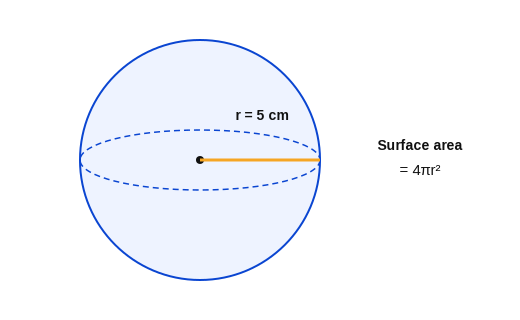
Find the surface area of a sphere with a radius of 5 cm.
(Use π = 3.14)
5 cm त्रिज्या वाले एक गोले का पृष्ठीय क्षेत्रफल ज्ञात कीजिए।
(π = 3.14 का प्रयोग कीजिए)
  1. A628 cm2
  2. B3140 cm2
  3. C31.4 cm2
  4. D314 cm2
Show answer

Concept: Surface area of a sphere =4πr2.

  1. r=5cm, r2=25
  2. 4×3.14×25=100×3.14=314cm2

Trick: 4×25=100, so the answer is just 100π.

Answer: (D) 314cm2

अवधारणा: गोले का पृष्ठीय क्षेत्रफल =4πr2।

  1. r=5cm, r2=25
  2. 4×3.14×25=314cm2

ट्रिक: 4×25=100, अतः उत्तर 100π ही है।

उत्तर: (D) 314cm2

RRB NTPC Undergraduate CBT 1MathematicsSurface area of sphereRRB NTPC Undergraduate CBT 1 2024 · 29 Aug Shift 2 →
Q990.
A sum of money triples itself at a certain rate of compound interest in 15 years. In how many years will it amount to 27 times of itself?
कोई धनराशि चक्रवृद्धि ब्याज की एक निश्चित दर पर 15 वर्षों में स्वयं की तीन गुनी हो जाती है। कितने वर्षों में यह स्वयं की 27 गुनी हो जाएगी?
  1. A39 years39 वर्ष
  2. B45 years45 वर्ष
  3. C55 years55 वर्ष
  4. D36 years36 वर्ष
Show answer

Concept: Under compound interest, if money becomes k times in T years, it becomes kn times in nT years.

  1. 3 times in 15 years
  2. 27=33 ⇒ time =3×15=45 years

Trick: CI multiplies: 3→9→27 takes 15+15+15 years. (In SI it would add, not multiply.)

Answer: (B) 45 years

अवधारणा: चक्रवृद्धि ब्याज में यदि राशि T वर्ष में k गुना होती है, तो nT वर्ष में kn गुना होती है।

  1. 15 वर्ष में 3 गुना
  2. 27=33 ⇒ समय =3×15=45 वर्ष

ट्रिक: CI में गुणा होता है: 3→9→27, हर चरण 15 वर्ष।

उत्तर: (B) 45 वर्ष

RRB NTPC Undergraduate CBT 1MathematicsCompound interest – multiplesRRB NTPC Undergraduate CBT 1 2024 · 29 Aug Shift 2 →
Q991.
An article is sold at a profit of 57%. If the cost price is increased by ₹20 and the selling price is reduced by ₹18, then the profit would be 47.5%. What is the original cost price (in ₹) of the article?
एक वस्तु को 57% लाभ पर बेचा जाता है। यदि क्रय मूल्य में ₹20 की वृद्धि की जाए और विक्रय मूल्य में ₹18 की कमी की जाए, तो लाभ 47.5% होगा। वस्तु का मूल क्रय मूल्य (₹ में) क्या है?
  1. A200
  2. B500
  3. C300
  4. D400
Show answer

Concept: Let CP =x; write the new SP =(1+new profit%)× new CP.

  1. SP =1.57x
  2. New CP =x+20, new SP =1.57x−18
  3. 1.57x−18=1.475(x+20)=1.475x+29.5
  4. 0.095x=47.5 ⇒ x=500

Trick: Check: CP 500, SP 785; new CP 520, new SP 767, profit 247520=47.5% ✓.

Answer: (B) ₹500

अवधारणा: क्रय मूल्य (CP) =x मानें; नया SP =(1+नया लाभ%)× नया CP।

  1. SP =1.57x
  2. नया CP =x+20, नया SP =1.57x−18
  3. 1.57x−18=1.475x+29.5
  4. 0.095x=47.5 ⇒ x=500

ट्रिक: जाँच: CP 500, SP 785; नया CP 520, नया SP 767, लाभ 47.5% ✓।

उत्तर: (B) ₹500

RRB NTPC Undergraduate CBT 1MathematicsProfit and lossRRB NTPC Undergraduate CBT 1 2024 · 29 Aug Shift 2 →
Q992.
A number, when increased by 60%, gives 3610. The number is:
एक संख्या में 60% की वृद्धि करने पर 3610 प्राप्त होता है। वह संख्या है:
  1. A2256.25
  2. B4512.5
  3. C1128.125
  4. D6768.75
Show answer

Concept: If a number increased by r% gives N, the number =N1+r100.

  1. Number ×1.6=3610
  2. Number =36101.6=2256.25

Trick: Increase by 60% = multiply by 85, so reverse by ×58: 3610×58=2256.25.

Answer: (A) 2256.25

अवधारणा: यदि कोई संख्या r% बढ़कर N होती है, तो संख्या =N1+r100।

  1. संख्या ×1.6=3610
  2. संख्या =36101.6=2256.25

ट्रिक: 60% वृद्धि =×85; उल्टा ×58 करें।

उत्तर: (A) 2256.25

RRB NTPC Undergraduate CBT 1MathematicsPercentage – finding original numberRRB NTPC Undergraduate CBT 1 2024 · 29 Aug Shift 2 →
Q993.
88 tube lights were purchased for ₹88, and 46 tube lights broke in transit. The trader sold the remaining tube lights at ₹3.10 each. Find his profit.
88 ट्यूबलाइटें ₹88 में खरीदी गईं, और परिवहन के दौरान 46 ट्यूबलाइटें टूट गईं। व्यापारी ने शेष ट्यूबलाइटें ₹3.10 प्रति ट्यूबलाइट की दर से बेचीं। उसका लाभ ज्ञात कीजिए।
  1. A₹47.10
  2. B₹48.20
  3. C₹42.20
  4. D₹36.60
Show answer

Concept: Profit = total SP of items actually sold − total CP of all items bought.

  1. CP of 88 lights = ₹88
  2. Lights left =88−46=42
  3. SP =42×3.10= ₹130.20
  4. Profit =130.20−88= ₹42.20

Trick: Broken items add to cost but earn nothing – count only the 42 sold.

Answer: (C) ₹42.20

अवधारणा: लाभ = बेची गई वस्तुओं का कुल विक्रय मूल्य − सभी खरीदी गई वस्तुओं का कुल क्रय मूल्य।

  1. 88 ट्यूबलाइट का CP = ₹88
  2. बचीं =88−46=42
  3. SP =42×3.10= ₹130.20
  4. लाभ =130.20−88= ₹42.20

ट्रिक: टूटी वस्तुएँ लागत में जुड़ती हैं, आय में नहीं – केवल 42 बिकीं।

उत्तर: (C) ₹42.20

RRB NTPC Undergraduate CBT 1MathematicsProfit and lossRRB NTPC Undergraduate CBT 1 2024 · 29 Aug Shift 2 →
Q994.
Simplify the following.
2((32)x2−20x+17)−3(x2+7x−15)
निम्नलिखित को सरल कीजिए।
2((32)x2−20x+17)−3(x2+7x−15)
  1. A61x + 79
  2. B61x − 79
  3. C−61x + 79
  4. D−61x − 79
Show answer

Concept: Open brackets carefully (sign of the outside number multiplies every term), then combine like terms.

  1. 2(32x2−20x+17)=3x2−40x+34
  2. −3(x2+7x−15)=−3x2−21x+45
  3. Sum =0·x2−61x+79=−61x+79

Trick: The x2 terms cancel (3−3=0); only the signs of x and constant decide the option.

Answer: (C) −61x+79

अवधारणा: कोष्ठक ध्यान से खोलें (बाहर की संख्या का चिह्न हर पद से गुणा होता है), फिर समान पद मिलाएँ।

  1. 2(32x2−20x+17)=3x2−40x+34
  2. −3(x2+7x−15)=−3x2−21x+45
  3. योग =−61x+79

ट्रिक: x2 वाले पद कट जाते हैं; केवल चिह्न देखकर विकल्प चुनें।

उत्तर: (C) −61x+79

RRB NTPC Undergraduate CBT 1MathematicsAlgebraic simplificationRRB NTPC Undergraduate CBT 1 2024 · 29 Aug Shift 2 →
Q995.
Which of the following numbers divides 393064111?
निम्नलिखित में से कौन-सी संख्या 393064111 को विभाजित करती है?
  1. A11
  2. B14
  3. C15
  4. D10
Show answer

Concept: Divisible by 11 if (sum of digits at odd places) − (sum at even places) is 0 or a multiple of 11.

  1. Digits of 393064111 from right: 1,1,1,4,6,0,3,9,3
  2. Odd places: 1+1+6+3+3=14; even places: 1+4+0+9=14
  3. Difference =0 ⇒ divisible by 11

Trick: Last digit 1 is odd ⇒ not divisible by 10, 14 (even) or 15 (needs 0/5 at end) – only 11 remains.

Answer: (A) 11

अवधारणा: 11 से विभाज्य: (विषम स्थानों के अंकों का योग) − (सम स्थानों का योग) =0 या 11 का गुणज।

  1. दाएँ से अंक: 1,1,1,4,6,0,3,9,3
  2. विषम स्थान: 14; सम स्थान: 14
  3. अंतर =0 ⇒ 11 से विभाज्य

ट्रिक: अंतिम अंक 1 विषम है ⇒ 10, 14, 15 से विभाज्य नहीं – केवल 11 बचता है।

उत्तर: (A) 11

RRB NTPC Undergraduate CBT 1MathematicsDivisibility rulesRRB NTPC Undergraduate CBT 1 2024 · 29 Aug Shift 2 →
Q996.
Read the given statements and conclusions carefully. Assuming that the information given in the statements is true, even if it appears to be at variance with commonly known facts, decide which of the given conclusions logically follow(s) from the statements.
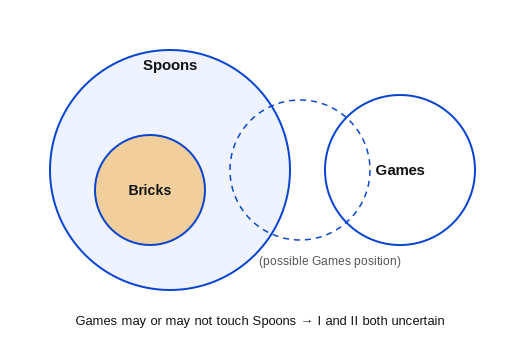
Statements: All bricks are spoons. No brick is a game.
Conclusions (I): Some games are spoons.
Conclusions (II): All spoons are games.
दिए गए कथनों और निष्कर्षों को ध्यानपूर्वक पढ़िए। कथनों में दी गई जानकारी को सत्य मानते हुए, भले ही वह सामान्य रूप से ज्ञात तथ्यों से भिन्न प्रतीत होती हो, निर्णय कीजिए कि दिए गए निष्कर्षों में से कौन-सा/से निष्कर्ष तार्किक रूप से कथनों का अनुसरण करता है/करते हैं।
कथन: सभी ईंटें, चम्मच हैं। कोई ईंट, खेल नहीं है।
निष्कर्ष (I): कुछ खेल, चम्मच हैं।
निष्कर्ष (II): सभी चम्मच, खेल हैं।
  1. AOnly conclusion (II) follows.केवल निष्कर्ष (II) अनुसरण करता है।
  2. BBoth conclusions (I) and (II) follow.निष्कर्ष (I) और (II) दोनों अनुसरण करते हैं।
  3. CNeither conclusion (I) nor (II) follows.न तो निष्कर्ष (I) और न ही (II) अनुसरण करता है।
  4. DOnly conclusion (I) follows.केवल निष्कर्ष (I) अनुसरण करता है।
Show answer

Concept: Draw the least-overlap Venn diagram; a conclusion follows only if it is true in every possible diagram.

  1. Bricks lie inside Spoons; Games lie fully outside Bricks.
  2. I: Games may lie completely outside Spoons too ⇒ "Some games are spoons" is not certain.
  3. II: "All spoons are games" is impossible to prove (bricks are spoons but not games) ⇒ false.

Trick: "All A are B" + "No A is C" gives only "Some B are not C" – nothing positive about B and C.

Answer: (C) Neither conclusion (I) nor (II) follows.

अवधारणा: न्यूनतम ओवरलैप वाला वेन आरेख बनाएँ; निष्कर्ष तभी अनुसरण करता है जब वह हर संभव आरेख में सत्य हो।

  1. Bricks, Spoons के भीतर; Games, Bricks से पूर्णतः बाहर।
  2. I: Games, Spoons से भी पूरी तरह बाहर हो सकता है ⇒ निश्चित नहीं।
  3. II: Bricks spoons हैं पर games नहीं ⇒ "सभी spoons games हैं" गलत।

ट्रिक: "सभी A, B हैं" + "कोई A, C नहीं" से केवल "कुछ B, C नहीं हैं" निकलता है।

उत्तर: (C) न तो निष्कर्ष (I) और न ही (II) अनुसरण करता है।

RRB NTPC Undergraduate CBT 1General Intelligence and ReasoningSyllogismRRB NTPC Undergraduate CBT 1 2024 · 29 Aug Shift 2 →
Q997.
Read the given statements and conclusions carefully. Assuming that the information given in the statements is true, even if it appears to be at variance with commonly known facts, decide which of the given conclusions logically follow(s) from the statements.
Statements:
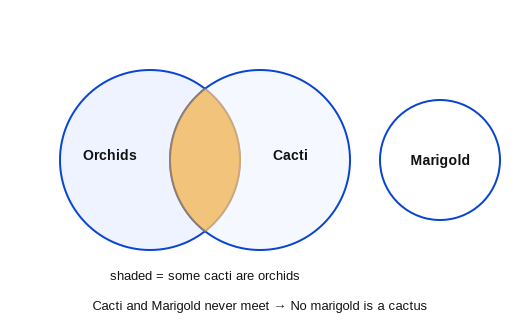
Some orchids are cacti.
No cactus is a marigold.
Conclusions:
(I) No marigold is a cactus.
(II) Some cacti are orchids.
दिए गए कथनों और निष्कर्षों को ध्यानपूर्वक पढ़िए। कथनों में दी गई जानकारी को सत्य मानते हुए, भले ही वह सामान्य रूप से ज्ञात तथ्यों से भिन्न प्रतीत होती हो, निर्णय कीजिए कि दिए गए निष्कर्षों में से कौन-सा/से निष्कर्ष तार्किक रूप से कथनों का अनुसरण करता है/करते हैं।
कथन:
कुछ ऑर्किड, कैक्टस हैं।
कोई कैक्टस, गेंदा नहीं है।
निष्कर्ष:
(I) कोई गेंदा, कैक्टस नहीं है।
(II) कुछ कैक्टस, ऑर्किड हैं।
  1. AOnly conclusion (II) follows.केवल निष्कर्ष (II) अनुसरण करता है।
  2. BNeither conclusion (I) nor (II) follows.न तो निष्कर्ष (I) और न ही (II) अनुसरण करता है।
  3. COnly conclusion (I) follows.केवल निष्कर्ष (I) अनुसरण करता है।
  4. DBoth conclusions (I) and (II) follow.निष्कर्ष (I) और (II) दोनों अनुसरण करते हैं।
Show answer

Concept: "Some A are B" converts to "Some B are A"; "No A is B" converts to "No B is A".

  1. Some orchids are cacti ⇒ Some cacti are orchids: II follows.
  2. No cactus is a marigold ⇒ No marigold is a cactus: I follows.

Yaad rakhein: Both conclusions are just the converses of the two statements – E and I type statements convert fully.

Answer: (D) Both conclusions (I) and (II) follow.

अवधारणा: "कुछ A, B हैं" का परिवर्तन "कुछ B, A हैं"; "कोई A, B नहीं" का परिवर्तन "कोई B, A नहीं"।

  1. कुछ orchids cacti हैं ⇒ कुछ cacti orchids हैं: II अनुसरण करता है।
  2. कोई cactus marigold नहीं ⇒ कोई marigold cactus नहीं: I अनुसरण करता है।

याद रखें: दोनों निष्कर्ष कथनों के सीधे परिवर्तन (converse) हैं।

उत्तर: (D) निष्कर्ष (I) और (II) दोनों अनुसरण करते हैं।

RRB NTPC Undergraduate CBT 1General Intelligence and ReasoningSyllogismRRB NTPC Undergraduate CBT 1 2024 · 29 Aug Shift 2 →
Q998.
If ‘A’ stands for ‘÷’, ‘B’ stands for ‘×’, ‘C’ stands for ‘+’ and ‘D’ stands for ‘−’, then the resultant of which of the following would be 9?
यदि 'A' का अर्थ '÷', 'B' का अर्थ '×', 'C' का अर्थ '+' और 'D' का अर्थ '−' है, तो निम्नलिखित में से किसका परिणाम 9 होगा?
  1. A41 C 13 B 3 A 35 D 5
  2. B41 B 13 C 3 D 35 A 5
  3. C41 D 13 B 3 C 35 A 5
  4. D41 A 13 C 3 B 35 D 5
Show answer

Concept: Replace letters by signs (A ÷, B ×, C +, D −) and apply BODMAS.

  1. (C): 41−13×3+35÷5
  2. =41−39+7=9 ✓
  3. (A) gives 41+39÷35−5≈37.1; (B) gives 533+3−7=529

Trick: Look for the option where a big product nearly cancels 41: 13×3=39.

Answer: (C) 41 D 13 B 3 C 35 A 5

अवधारणा: अक्षरों को चिह्नों से बदलें (A ÷, B ×, C +, D −) और BODMAS लगाएँ।

  1. (C): 41−13×3+35÷5
  2. =41−39+7=9 ✓
  3. (B): 533+3−7=529 – गलत

ट्रिक: वह विकल्प खोजें जहाँ गुणनफल 41 के करीब हो: 13×3=39।

उत्तर: (C) 41 D 13 B 3 C 35 A 5

RRB NTPC Undergraduate CBT 1General Intelligence and ReasoningMathematical operations (symbol substitution)RRB NTPC Undergraduate CBT 1 2024 · 29 Aug Shift 2 →
Q999.
Seven boxes, A, B, C, D, E, F and G, are kept one over the other but not necessarily in the same order.
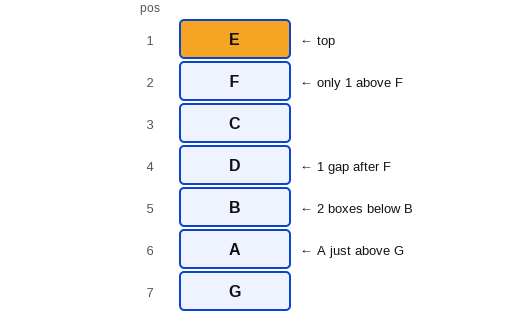
Only two boxes are kept below B. Only one box is kept above F. Only one box is kept between F and D. A is kept immediately above G. C is kept at some place below E. Which box is kept at the top?
सात बक्से, A, B, C, D, E, F और G, एक के ऊपर एक रखे गए हैं, लेकिन आवश्यक नहीं कि इसी क्रम में हों।
B के नीचे केवल दो बक्से रखे गए हैं। F के ऊपर केवल एक बक्सा रखा गया है। F और D के बीच केवल एक बक्सा रखा गया है। A, G के ठीक ऊपर रखा गया है। C, E के नीचे किसी स्थान पर रखा गया है। सबसे ऊपर कौन-सा बक्सा रखा गया है?
  1. AC
  2. BE
  3. CG
  4. DA
Show answer

Concept: Number positions 1 (top) to 7 (bottom) and fix the definite clues first.

  1. Two below B ⇒ B at 5; one above F ⇒ F at 2
  2. One box between F and D ⇒ D at 4
  3. A just above G: only free pair is 6,7 ⇒ A 6, G 7
  4. C below E in 1,3 ⇒ E 1, C 3

Trick: Fix "only n above/below" clues first – they give exact positions.

Answer: (B) E

अवधारणा: स्थान 1 (ऊपर) से 7 (नीचे) तक मानें और पहले निश्चित संकेत लगाएँ।

  1. B के नीचे दो ⇒ B 5 पर; F के ऊपर एक ⇒ F 2 पर
  2. F और D के बीच एक ⇒ D 4 पर
  3. A ठीक G के ऊपर: खाली जोड़ी 6,7 ⇒ A 6, G 7
  4. C, E के नीचे (1,3 में) ⇒ E 1, C 3

ट्रिक: "केवल n ऊपर/नीचे" वाले संकेत पहले लगाएँ।

उत्तर: (B) E

RRB NTPC Undergraduate CBT 1General Intelligence and ReasoningVertical arrangement (boxes)RRB NTPC Undergraduate CBT 1 2024 · 29 Aug Shift 2 →
Q1000.
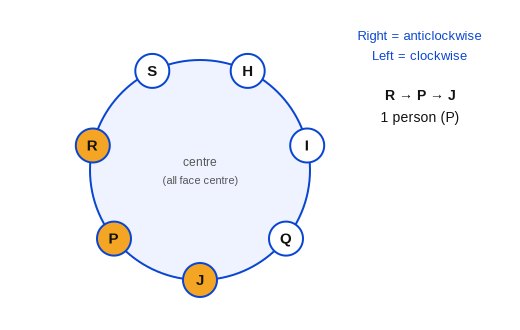
H, I, J, P, Q, R and S are sitting around a circular table facing the centre of the table. Q sits to the immediate right of J. Only three people sit between Q and S when counted from the left of Q. Only three people sit between J and H. P sits to the immediate right of R.
How many people sit between J and R when counted from the right of R?
H, I, J, P, Q, R और S एक वृत्ताकार मेज़ के चारों ओर मेज़ के केंद्र की ओर मुख करके बैठे हैं। Q, J के ठीक दाईं ओर बैठा है। Q के बाईं ओर से गिनने पर Q और S के बीच केवल तीन व्यक्ति बैठे हैं। J और H के बीच केवल तीन व्यक्ति बैठे हैं। P, R के ठीक दाईं ओर बैठा है।
R के दाईं ओर से गिनने पर J और R के बीच कितने व्यक्ति बैठे हैं?
  1. AOneएक
  2. BTwoदो
  3. CThreeतीन
  4. DFourचार
Show answer

Concept: Facing the centre: right = anticlockwise, left = clockwise.

  1. Q is immediate right of J; going left from Q, S is after 3 people (opposite side)
  2. H is 4 places from J (other side of S)
  3. Remaining seats: R and P adjacent with P to R’s right; I takes the last seat
  4. From R going right: R → P → J ⇒ one person (P)

Trick: In a 7-seat circle, "3 between" from one side means 2 between from the other side.

Answer: (A) One

अवधारणा: केंद्र की ओर मुख: दायाँ = वामावर्त (anticlockwise), बायाँ = दक्षिणावर्त (clockwise)।

  1. Q, J के ठीक दाएँ; Q के बाएँ से गिनने पर 3 लोगों के बाद S
  2. H, J से 4 स्थान दूर (S के दूसरी ओर)
  3. R और P पास-पास, P, R के दाएँ; I शेष स्थान पर
  4. R के दाएँ से: R → P → J ⇒ एक व्यक्ति (P)

ट्रिक: 7 सीटों में एक ओर से "3 बीच में" = दूसरी ओर से 2 बीच में।

उत्तर: (A) एक

RRB NTPC Undergraduate CBT 1General Intelligence and ReasoningCircular seating arrangementRRB NTPC Undergraduate CBT 1 2024 · 29 Aug Shift 2 →