Question bank

Q&A: practice questions with answers

Search questions on any topic. Filter by exam category, exam, subject and topic, try the question, then open the answer and explanation.

Courses – airGurukul

20,719 questions found.

Q10061.
Which of the following is a key reason for judicial review in India?
निम्नलिखित में से कौन-सा भारत में न्यायिक पुनरावलोकन (judicial review) का एक प्रमुख कारण है?
  1. ATo allow the judiciary to make lawsन्यायपालिका को कानून बनाने की अनुमति देना
  2. BTo maintain federal balance between Centre and Statesकेंद्र और राज्यों के बीच संघीय संतुलन बनाए रखना
  3. CTo ensure the supremacy of the Parliamentसंसद की सर्वोच्चता सुनिश्चित करना
  4. DTo protect the supremacy of the Constitution and fundamental rightsसंविधान और मौलिक अधिकारों की सर्वोच्चता की रक्षा करना
Show answer

Concept: Judicial review is the power of courts to examine laws and executive actions and strike down those that violate the Constitution.

  1. In India it flows from Articles 13, 32 and 226; it is part of the basic structure (Minerva Mills, 1980).
  2. Its key purpose is to uphold the supremacy of the Constitution and protect fundamental rights.
  3. It does not let courts make laws or make Parliament supreme; federal balance is only one area where it is used.

Yaad rakhein: India follows constitutional supremacy, not parliamentary supremacy (as in the UK).

Answer: (D) To protect the supremacy of the Constitution and fundamental rights

अवधारणा: न्यायिक पुनरावलोकन न्यायालयों की वह शक्ति है जिससे वे कानूनों और कार्यपालिका के कार्यों की जाँच कर असंवैधानिक को रद्द कर सकते हैं।

  1. भारत में यह अनुच्छेद 13, 32 और 226 से प्राप्त है; यह मूल ढाँचे का भाग है (मिनर्वा मिल्स, 1980)।
  2. इसका मुख्य उद्देश्य संविधान की सर्वोच्चता और मौलिक अधिकारों की रक्षा है।
  3. इससे न्यायालय कानून नहीं बनाते, न ही संसद सर्वोच्च होती है; संघीय संतुलन इसका केवल एक उपयोग-क्षेत्र है।

याद रखें: भारत में संविधान सर्वोच्च है, संसद नहीं (जैसा ब्रिटेन में)।

उत्तर: (D) संविधान की सर्वोच्चता और मौलिक अधिकारों की रक्षा
RRB NTPC Graduate CBT 1General AwarenessPolity – Judicial ReviewRRB NTPC Graduate CBT 1 2024 · 10 Jun Shift 2 →
Q10062.
You have applied a specific character style to several instances of a product name throughout a lengthy MS Word document. If you need to change the font and color of all these instances, what is the most efficient method?
आपने एक लंबे MS Word दस्तावेज़ में किसी उत्पाद के नाम के कई स्थानों पर एक विशिष्ट कैरेक्टर स्टाइल (character style) लागू की है। यदि आपको इन सभी स्थानों का फ़ॉन्ट और रंग बदलना हो, तो सबसे कुशल विधि कौन-सी है?
  1. ACopying the formatting from one instance using the 'Format Painter' and applying it to others'Format Painter' का उपयोग करके एक स्थान से फ़ॉर्मेटिंग कॉपी करना और उसे अन्य स्थानों पर लागू करना
  2. BUsing the 'Find and Replace' function with formatting optionsफ़ॉर्मेटिंग विकल्पों के साथ 'Find and Replace' फ़ंक्शन का उपयोग करना
  3. CModifying the definition of the character styleकैरेक्टर स्टाइल की परिभाषा को संशोधित करना
  4. DManually selecting each instance and applying the new formattingप्रत्येक स्थान को मैन्युअल रूप से चुनकर नई फ़ॉर्मेटिंग लागू करना
Show answer

Concept: A style in MS Word is a saved set of formatting linked to every text it is applied to.

  1. When a character style's definition is modified (Home → Styles → right-click → Modify), every instance using that style updates automatically.
  2. Format Painter or manual selection must be repeated for each instance; Find and Replace works but needs more setup and can miss or catch wrong text.

Trick: Change the style once → the whole document follows. That is why styles exist.

Answer: (C) Modifying the definition of the character style

अवधारणा: MS Word में style स्वरूपण (formatting) का सहेजा हुआ समूह है जो उन सभी टेक्स्ट से जुड़ा रहता है जिन पर लगाया गया है।

  1. character style की परिभाषा बदलने पर (Home → Styles → right-click → Modify) उस style वाले सभी स्थान अपने-आप बदल जाते हैं।
  2. Format Painter या हाथ से चयन हर स्थान पर दोहराना पड़ता है; Find and Replace में अधिक सेटअप लगता है और गलत टेक्स्ट भी बदल सकता है।

ट्रिक: Style एक बार बदलें → पूरा दस्तावेज़ बदल जाता है।

उत्तर: (C) Character style की परिभाषा बदलना

RRB NTPC Graduate CBT 1General AwarenessComputer – MS Word StylesRRB NTPC Graduate CBT 1 2024 · 10 Jun Shift 2 →
Q10063.
Which of the following was NOT a tribal revolt?
निम्नलिखित में से कौन-सा जनजातीय विद्रोह नहीं था?
  1. ATamar Revoltsतमार विद्रोह
  2. BKherwar Movementखेरवार आंदोलन
  3. CSanthal Revoltसंथाल विद्रोह
  4. DFarazi Movement​फ़राज़ी आंदोलन
Show answer

Concept: Tribal revolts were led by tribal communities against colonial rule, outsiders and loss of land.

  1. Tamar revolts (1789–1832) – Munda/Oraon tribes of Chotanagpur; Kherwar movement (1870s) – Santhals; Santhal revolt (1855–56) – Sidhu and Kanhu.
  2. Farazi movement (Bengal, from 1818) was an Islamic religious-reform and peasant movement started by Haji Shariatullah and led by Dudu Miyan – not a tribal revolt.

Yaad rakhein: Farazi & Wahabi = religious reform/peasant movements; Santhal, Munda, Kol, Tamar, Kherwar = tribal.

Answer: (D) Farazi Movement

अवधारणा: आदिवासी विद्रोह आदिवासी समुदायों ने औपनिवेशिक शासन, बाहरी लोगों और भूमि छिनने के विरुद्ध किए।

  1. तमाड़ विद्रोह (1789–1832) – छोटानागपुर के मुंडा/उरांव; खेरवार आंदोलन (1870 का दशक) – संथाल; संथाल विद्रोह (1855–56) – सिद्धू और कान्हू।
  2. फ़राज़ी आंदोलन (बंगाल, 1818 से) हाजी शरीअतुल्लाह द्वारा शुरू और दूदू मियाँ के नेतृत्व में इस्लामी धार्मिक-सुधार व किसान आंदोलन था – आदिवासी विद्रोह नहीं।

याद रखें: फ़राज़ी व वहाबी = धार्मिक सुधार/किसान आंदोलन; संथाल, मुंडा, कोल, तमाड़, खेरवार = आदिवासी।

उत्तर: (D) फ़राज़ी आंदोलन

RRB NTPC Graduate CBT 1General AwarenessModern History – RevoltsRRB NTPC Graduate CBT 1 2024 · 10 Jun Shift 2 →
Q10064.
Which Indian state has the largest number of tribal communities classified under Particularly Vulnerable Tribal Groups (PVTGs) as of December 2022?
दिसंबर 2022 तक, विशेष रूप से कमज़ोर जनजातीय समूहों (PVTGs) के अंतर्गत वर्गीकृत जनजातीय समुदायों की सबसे अधिक संख्या किस भारतीय राज्य में है?
  1. AJharkhandझारखंड
  2. BMadhya Pradeshमध्य प्रदेश
  3. COdishaओडिशा
  4. DChhattisgarhछत्तीसगढ़
Show answer

Concept: India has 75 Particularly Vulnerable Tribal Groups (PVTGs) across 18 States and one UT.

  1. Odisha has the largest number – 13 PVTGs (e.g., Bonda, Dongria Khond, Juang, Lodha, Saora).
  2. Andhra Pradesh (12) and Bihar/Jharkhand (9) follow; Madhya Pradesh has 7 and Chhattisgarh 5.

Yaad rakhein: PVTGs: total 75, highest Odisha (13).

Answer: (C) Odisha

अवधारणा: भारत में 18 राज्यों और एक केंद्रशासित प्रदेश में 75 विशेष रूप से कमज़ोर जनजातीय समूह (PVTGs) हैं।

  1. ओडिशा में सर्वाधिक – 13 PVTGs (जैसे बोंडा, डोंगरिया खोंड, जुआंग, लोढ़ा, सौरा)।
  2. इसके बाद आंध्र प्रदेश (12) और बिहार/झारखंड (9); मध्य प्रदेश में 7 और छत्तीसगढ़ में 5।

याद रखें: PVTGs: कुल 75, सर्वाधिक ओडिशा (13)।

उत्तर: (C) ओडिशा

RRB NTPC Graduate CBT 1General AwarenessTribes of India – PVTGsRRB NTPC Graduate CBT 1 2024 · 10 Jun Shift 2 →
Q10065.
Chandragupta Maurya is said to have converted to:
कहा जाता है कि चंद्रगुप्त मौर्य ने किस धर्म को अपना लिया था?
  1. AChristianityईसाई धर्म
  2. BJainismजैन धर्म
  3. CZoroastrianismपारसी धर्म (Zoroastrianism)
  4. DBuddhismबौद्ध धर्म
Show answer

Concept: Jain tradition records the later life of Chandragupta Maurya.

  1. Chandragupta gave up his throne, became a disciple of the Jain monk Bhadrabahu and went to Shravanabelagola (Karnataka).
  2. He is said to have died there by sallekhana (fasting unto death); Chandragiri hill is named after him.
  3. Buddhism is linked with his grandson Ashoka, not with Chandragupta.

Yaad rakhein: Chandragupta – Jainism (Bhadrabahu); Ashoka – Buddhism (Upagupta); Bindusara – Ajivika.

Answer: (B) Jainism

अवधारणा: जैन परंपरा चंद्रगुप्त मौर्य के अंतिम जीवन का वर्णन करती है।

  1. चंद्रगुप्त ने सिंहासन त्यागकर जैन मुनि भद्रबाहु का शिष्यत्व लिया और श्रवणबेलगोला (कर्नाटक) गए।
  2. कहा जाता है कि वहाँ उन्होंने सल्लेखना (उपवास द्वारा देह-त्याग) की; चंद्रगिरि पहाड़ी उन्हीं के नाम पर है।
  3. बौद्ध धर्म उनके पौत्र अशोक से जुड़ा है, चंद्रगुप्त से नहीं।

याद रखें: चंद्रगुप्त – जैन (भद्रबाहु); अशोक – बौद्ध (उपगुप्त); बिंदुसार – आजीवक।

उत्तर: (B) जैन धर्म

RRB NTPC Graduate CBT 1General AwarenessAncient History – MauryasRRB NTPC Graduate CBT 1 2024 · 10 Jun Shift 2 →
Q10066.
C is the third proportional of 44 and B. If B is the sum of the first three even natural numbers, then find the value of C.
(Round off your answer to two decimal places)
C, 44 और B का तृतीयानुपाती है। यदि B पहली तीन सम प्राकृत संख्याओं का योग है, तो C का मान ज्ञात कीजिए।
(अपना उत्तर दशमलव के दो स्थानों तक पूर्णांकित कीजिए)
  1. A3.27
  2. B0.98
  3. C1.98
  4. D4.58
Show answer

Concept: If a:b=b:c, then c is the third proportional: c=b2a.

  1. First three even natural numbers: 2+4+6=12, so B=12.
  2. C=B244=14444.
  3. 14444=3611=3.2727…≈3.27.

Trick: Third proportional =(middle)2first.

Answer: (A) 3.27

अवधारणा: यदि a:b=b:c हो, तो c तृतीय समानुपाती है: c=b2a।

  1. पहली तीन सम प्राकृत संख्याएँ: 2+4+6=12, अतः B=12।
  2. C=B244=14444।
  3. 14444=3611=3.2727…≈3.27।

ट्रिक: तृतीय समानुपाती =(मध्य)2प्रथम।

उत्तर: (A) 3.27

RRB NTPC Graduate CBT 1MathematicsThird proportionalRRB NTPC Graduate CBT 1 2024 · 10 Jun Shift 2 →
Q10067.
Two pipes can fill a cistern, individually, in 98 min and 28 min, respectively. There is a pipe located at the bottom of the cistern to empty it. If all the three pipes are opened simultaneously, then the empty cistern gets filled in 21 min. How long will the pipe at the bottom of the cistern take to empty the completely filled cistern if no other pipe is then open?
दो पाइप अलग-अलग किसी टंकी को क्रमशः 98 मिनट और 28 मिनट में भर सकते हैं। टंकी को खाली करने के लिए उसके तल में एक पाइप लगा है। यदि तीनों पाइप एक साथ खोल दिए जाएँ, तो खाली टंकी 21 मिनट में भर जाती है। यदि कोई अन्य पाइप खुला न हो, तो टंकी के तल में लगा पाइप पूरी भरी टंकी को खाली करने में कितना समय लेगा?
  1. A583 min583 मिनट
  2. B606 min606 मिनट
  3. C588 min588 मिनट
  4. D577 min577 मिनट
Show answer

Concept: Take capacity =LCM(98,28,21)=588 units. A pipe that empties the tank lowers the combined rate, so with the outlet open the tank must fill slower than with the two inlets alone.

  1. Inlet 1: 58898=6 units/min; inlet 2: 58828=21 units/min; together =27 units/min.
  2. All three pipes: 58821=28 units/min.
  3. Outlet rate =27−28=−1 units/min. The negative value means the third pipe would be adding water, not draining it.
  4. So an emptying pipe cannot give a filling time of 21 min; the time asked has no valid value and none of 583, 606, 588, 577 min is correct.
  5. If the third pipe were also a filling pipe, it alone would fill the tank in 5881=588 min.

Note: Quick check: two inlets alone take 58827 min, which is more than 21 min, so the third pipe cannot be an outlet. In the exam, every candidate gets full marks (bonus) for such a question.

Answer: Bonus – no option is correct as printed; full marks to all.

अवधारणा: टंकी की क्षमता =LCM(98,28,21)=588 इकाई मानें। खाली करने वाला पाइप कुल दर घटाता है, इसलिए उसके खुले रहने पर टंकी केवल दो भरने वाले पाइपों की तुलना में धीरे भरनी चाहिए।

  1. पहला पाइप: 58898=6 इकाई/मिनट; दूसरा: 58828=21 इकाई/मिनट; दोनों मिलकर =27 इकाई/मिनट।
  2. तीनों पाइप साथ: 58821=28 इकाई/मिनट।
  3. निकास पाइप की दर =27−28=−1 इकाई/मिनट। ऋणात्मक मान का अर्थ है कि तीसरा पाइप पानी भर रहा है, निकाल नहीं रहा।
  4. अतः खाली करने वाले पाइप के साथ टंकी 21 मिनट में नहीं भर सकती; पूछे गए समय का कोई मान्य उत्तर नहीं, विकल्प 583, 606, 588, 577 min में से कोई सही नहीं।
  5. यदि तीसरा पाइप भी भरने वाला होता, तो वह अकेले टंकी को 5881=588 मिनट में भरता।

नोट: त्वरित जाँच: केवल दो भरने वाले पाइप 58827 मिनट लेते हैं, जो 21 मिनट से अधिक है, अतः तीसरा पाइप निकास पाइप नहीं हो सकता। परीक्षा में ऐसे प्रश्न पर सभी अभ्यर्थियों को पूरे अंक (बोनस) दिए जाते हैं।

उत्तर: बोनस – छपे प्रश्न के अनुसार कोई विकल्प सही नहीं; सभी को पूरे अंक।

RRB NTPC Graduate CBT 1MathematicsPipes and CisternsRRB NTPC Graduate CBT 1 2024 · 10 Jun Shift 2 →
Q10068.
If α and β are the roots of the quadratic equation y2−9y+8=0, then find the value of α+β−αβ.
यदि α और β द्विघात समीकरण y2−9y+8=0 के मूल हैं, तो α+β−αβ का मान ज्ञात कीजिए।
  1. A4
  2. B1
  3. C3
  4. D2
Show answer

Concept: For ay2+by+c=0: sum of roots α+β=−ba and product αβ=ca.

  1. Here a=1, b=−9, c=8.
  2. α+β=9 and αβ=8.
  3. α+β−αβ=9−8=1.

Trick: Roots are actually 1 and 8 (since 1+8=9, 1×8=8): 9−8=1.

Answer: (B) 1

अवधारणा: ay2+by+c=0 के लिए: मूलों का योग α+β=−ba और गुणनफल αβ=ca।

  1. यहाँ a=1, b=−9, c=8।
  2. α+β=9 और αβ=8।
  3. α+β−αβ=9−8=1।

ट्रिक: मूल 1 और 8 हैं (1+8=9, 1×8=8): 9−8=1।

उत्तर: (B) 1

RRB NTPC Graduate CBT 1MathematicsQuadratic equationsRRB NTPC Graduate CBT 1 2024 · 10 Jun Shift 2 →
Q10069.
If the ratio of two numbers is 18 : 5 and the product of their LCM and their HCF is 360, then the sum of the reciprocals of the LCM and the HCF is:
यदि दो संख्याओं का अनुपात 18 : 5 है और उनके LCM और HCF का गुणनफल 360 है, तो LCM और HCF के व्युत्क्रमों का योग है:
  1. A91180
  2. B91185
  3. C91204
  4. D91193
Show answer

Concept: Product of two numbers =LCM×HCF.

  1. Let the numbers be 18k and 5k; product =90k2=360, so k2=4, k=2.
  2. Numbers: 36 and 10; HCF =2, LCM =180 (check: 180×2=360).
  3. 1180+12=1+90180=91180.

Trick: Since 18 and 5 are co-prime, HCF =k and LCM =90k.

Answer: (A) 91180

अवधारणा: दो संख्याओं का गुणनफल =LCM×HCF।

  1. संख्याएँ 18k और 5k; गुणनफल =90k2=360, अतः k2=4, k=2।
  2. संख्याएँ 36 और 10; HCF =2, LCM =180 (जाँच: 180×2=360)।
  3. 1180+12=1+90180=91180।

ट्रिक: 18 और 5 सह-अभाज्य हैं, अतः HCF =k और LCM =90k।

उत्तर: (A) 91180

RRB NTPC Graduate CBT 1MathematicsHCF and LCMRRB NTPC Graduate CBT 1 2024 · 10 Jun Shift 2 →
Q10070.
Gopal gets a 2% increase in his sale amount in the first year and a 20% increase in the second year, and with that his present sale is ₹1,83,600. What was his sale (in ₹) two years ago?
गोपाल की बिक्री राशि में पहले वर्ष 2% और दूसरे वर्ष 20% की वृद्धि होती है, और इसके साथ उसकी वर्तमान बिक्री ₹1,83,600 है। दो वर्ष पहले उसकी बिक्री (₹ में) कितनी थी?
  1. A1,50,000
  2. B1,80,000
  3. C1,53,000
  4. D1,30,000
Show answer

Concept: After increases of a% and b%: present =original×(1+a100)(1+b100).

  1. original×1.02×1.20=183600.
  2. 1.02×1.20=1.224.
  3. Original =1836001.224=150000.

Trick: Check options: 150000×1.02=153000; 153000×1.2=183600 ✓.

Answer: (A) ₹1,50,000

अवधारणा: a% और b% वृद्धि के बाद: वर्तमान =मूल×(1+a100)(1+b100)।

  1. मूल×1.02×1.20=183600।
  2. 1.02×1.20=1.224।
  3. मूल =1836001.224=150000।

ट्रिक: विकल्प जाँचें: 150000×1.02=153000; 153000×1.2=183600 ✓।

उत्तर: (A) ₹1,50,000

RRB NTPC Graduate CBT 1MathematicsSuccessive percentage increaseRRB NTPC Graduate CBT 1 2024 · 10 Jun Shift 2 →
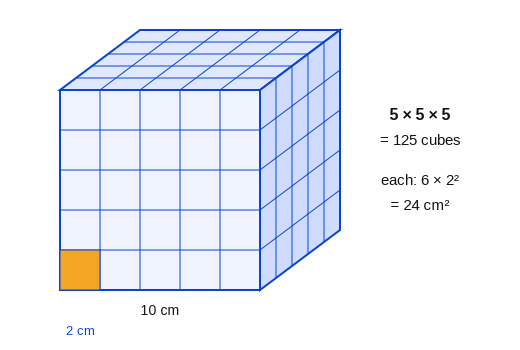
Q10071.
A cube of side 10 cm is cut into cubes of side 2 cm. Calculate the total surface area (in cm2) of all the small cubes:
10 cm भुजा वाले एक घन को 2 cm भुजा वाले घनों में काटा जाता है। सभी छोटे घनों का कुल पृष्ठीय क्षेत्रफल (cm2 में) ज्ञात कीजिए:
  1. A3000
  2. B3008
  3. C3002
  4. D3010
Show answer

Concept: Number of small cubes =(big sidesmall side)3; surface area of one cube =6a2.

  1. Number of cubes =(102)3=125.
  2. TSA of one small cube =6×22=24cm2.
  3. Total =125×24=3000cm2.

Trick: Total TSA =original TSA×102=600×5=3000.

Answer: (A) 3000

अवधारणा: छोटे घनों की संख्या =(बड़ी भुजाछोटी भुजा)3; एक घन का पृष्ठीय क्षेत्रफल =6a2।

  1. घनों की संख्या =(102)3=125।
  2. एक छोटे घन का TSA =6×22=24cm2।
  3. कुल =125×24=3000cm2।

ट्रिक: कुल TSA =मूल TSA×102=600×5=3000।

उत्तर: (A) 3000

RRB NTPC Graduate CBT 1MathematicsMensuration – cubesRRB NTPC Graduate CBT 1 2024 · 10 Jun Shift 2 →
Q10072.
The simplified value of 118 - 5 × (10 + 20) + 55 is:
118 - 5 × (10 + 20) + 55 का सरलीकृत मान है:
  1. A17
  2. B23
  3. C33
  4. D20
Show answer

Concept: BODMAS: Brackets → Of → Division/Multiplication → Addition/Subtraction.

  1. Bracket: 10+20=30.
  2. Multiplication: 5×30=150.
  3. 118−150+55=23.

Trick: Do 118+55=173 first, then 173−150=23.

Answer: (B) 23

अवधारणा: BODMAS: कोष्ठक → का → भाग/गुणा → जोड़/घटाव।

  1. कोष्ठक: 10+20=30।
  2. गुणा: 5×30=150।
  3. 118−150+55=23।

ट्रिक: पहले 118+55=173, फिर 173−150=23।

उत्तर: (B) 23

RRB NTPC Graduate CBT 1MathematicsSimplification (BODMAS)RRB NTPC Graduate CBT 1 2024 · 10 Jun Shift 2 →
Q10073.
Two numbers are respectively 30% and 18% more than a third number. The ratio of the two numbers is:
दो संख्याएँ एक तीसरी संख्या से क्रमशः 30% और 18% अधिक हैं। दोनों संख्याओं का अनुपात है:
  1. A55 : 64
  2. B58 : 63
  3. C65 : 59
  4. D73 : 74
Show answer

Concept: If two numbers are a% and b% more than the same number, their ratio is (100+a):(100+b).

  1. Let the third number =100.
  2. First =130, second =118.
  3. Ratio =130:118=65:59.

Trick: Take the base as 100 and simplify.

Answer: (C) 65:59

अवधारणा: यदि दो संख्याएँ किसी एक संख्या से a% और b% अधिक हैं, तो अनुपात (100+a):(100+b)।

  1. तीसरी संख्या =100 मानें।
  2. पहली =130, दूसरी =118।
  3. अनुपात =130:118=65:59।

ट्रिक: आधार 100 मानकर सरल करें।

उत्तर: (C) 65:59

RRB NTPC Graduate CBT 1MathematicsPercentage and ratioRRB NTPC Graduate CBT 1 2024 · 10 Jun Shift 2 →
Q10074.
The median of the observations 49, 91, 24, 46, 90, 20, 21, 14, 66, 32 and 92 is:
प्रेक्षणों 49, 91, 24, 46, 90, 20, 21, 14, 66, 32 और 92 की माध्यिका है:
  1. A46
  2. B24
  3. C49
  4. D32
Show answer

Concept: Arrange data in ascending order; for odd n, median =(n+12)th term.

  1. Ascending: 14, 20, 21, 24, 32, 46, 49, 66, 90, 91, 92.
  2. n=11, so median =(11+12)th=6th term.
  3. 6th term =46.

Trick: Five values below and five above the median.

Answer: (A) 46

अवधारणा: आँकड़ों को आरोही क्रम में लिखें; विषम n के लिए माध्यिका =(n+12)वाँ पद।

  1. आरोही: 14, 20, 21, 24, 32, 46, 49, 66, 90, 91, 92।
  2. n=11, अतः माध्यिका =(11+12) वाँ =6 वाँ पद।
  3. छठा पद =46।

ट्रिक: माध्यिका के नीचे पाँच और ऊपर पाँच मान।

उत्तर: (A) 46

RRB NTPC Graduate CBT 1MathematicsMedianRRB NTPC Graduate CBT 1 2024 · 10 Jun Shift 2 →
Q10075.
What will the amount after 1 year be, if ₹2,400 is invested at 20% compound interest per annum, compounded half-yearly?
यदि ₹2,400 को 20% वार्षिक चक्रवृद्धि ब्याज पर निवेश किया जाए, जिसमें ब्याज अर्धवार्षिक रूप से संयोजित होता है, तो 1 वर्ष बाद मिश्रधन कितना होगा?
  1. A₹2,460
  2. B₹2,904
  3. C₹3,071
  4. D₹2,950
Show answer

Concept: Half-yearly compounding: rate =R2 per half-year and time =2n half-years; A=P(1+r100)t.

  1. Rate =202=10% per half-year, periods =2.
  2. A=2400×(1.1)2=2400×1.21.
  3. A=2904.

Trick: 10% twice: 2400→2640→2904.

Answer: (B) ₹2,904

अवधारणा: अर्धवार्षिक चक्रवृद्धि: दर =R2 प्रति छमाही और समय =2n छमाही; A=P(1+r100)t।

  1. दर =202=10% प्रति छमाही, अवधियाँ =2।
  2. A=2400×(1.1)2=2400×1.21।
  3. A=2904।

ट्रिक: दो बार 10%: 2400→2640→2904।

उत्तर: (B) ₹2,904

RRB NTPC Graduate CBT 1MathematicsCompound interestRRB NTPC Graduate CBT 1 2024 · 10 Jun Shift 2 →
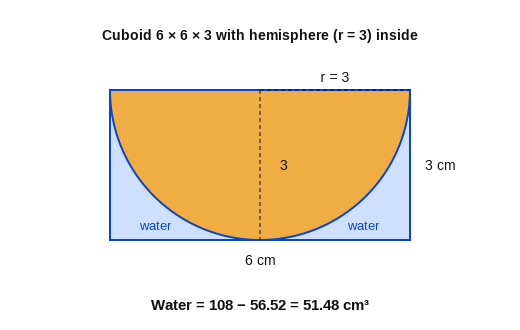
Q10076.
If a hemisphere of radius 3 cm is fitted inside a cuboid and then water is filled inside the cuboid, the amount of water (in cm3) present in the cuboid is:
(Take π = 3.14)
यदि 3 cm त्रिज्या वाले एक अर्धगोले को एक घनाभ के अंदर फिट किया जाए और फिर घनाभ में पानी भरा जाए, तो घनाभ में उपस्थित पानी की मात्रा (cm3 में) है:
(π = 3.14 लीजिए)
  1. A57.64
  2. B49.81
  3. C51.48
  4. D55.28
Show answer

Concept: The smallest cuboid holding a hemisphere of radius r is 2r×2r×r. Water = cuboid volume − hemisphere volume (23πr3).

  1. Cuboid =6×6×3=108cm3.
  2. Hemisphere =23×3.14×27=56.52cm3.
  3. Water =108−56.52=51.48cm3.

Trick: Water =r3(4−2π3)=27×1.9067≈51.48.

Answer: (C) 51.48

अवधारणा: त्रिज्या r के अर्धगोले को रखने वाला सबसे छोटा घनाभ 2r×2r×r है। पानी = घनाभ आयतन − अर्धगोला आयतन (23πr3)।

  1. घनाभ =6×6×3=108cm3।
  2. अर्धगोला =23×3.14×27=56.52cm3।
  3. पानी =108−56.52=51.48cm3।

ट्रिक: पानी =r3(4−2π3)=27×1.9067≈51.48।

उत्तर: (C) 51.48

RRB NTPC Graduate CBT 1MathematicsMensuration – hemisphere in cuboidRRB NTPC Graduate CBT 1 2024 · 10 Jun Shift 2 →
Q10077.
A man covers distances of 100 km, 408 km, and 1460 km at the speeds of 20 km/hr, x km/hr, and 20 km/hr, respectively. If his average speed for the whole journey is 20 km/hr, then what is the value of x?
एक व्यक्ति 100 km, 408 km और 1460 km की दूरियाँ क्रमशः 20 km/hr, x km/hr और 20 km/hr की चाल से तय करता है। यदि पूरी यात्रा के लिए उसकी औसत चाल 20 km/hr है, तो x का मान क्या है?
  1. A22
  2. B25
  3. C20
  4. D15
Show answer

Concept: Average speed =total distancetotal time.

  1. Total distance =100+408+1460=1968km; total time =196820=98.4h.
  2. Time for 1st and 3rd parts =10020+146020=5+73=78h.
  3. Time for 2nd part =98.4−78=20.4h, so x=40820.4=20.

Trick: If the average equals the speed of the other parts (20), the middle speed must also be 20.

Answer: (C) 20

अवधारणा: औसत चाल =कुल दूरीकुल समय।

  1. कुल दूरी =100+408+1460=1968km; कुल समय =196820=98.4h।
  2. पहले और तीसरे भाग का समय =10020+146020=5+73=78h।
  3. दूसरे भाग का समय =98.4−78=20.4h, अतः x=40820.4=20।

ट्रिक: यदि औसत चाल बाकी भागों की चाल (20) के बराबर है, तो बीच वाली चाल भी 20 होगी।

उत्तर: (C) 20

RRB NTPC Graduate CBT 1MathematicsAverage speedRRB NTPC Graduate CBT 1 2024 · 10 Jun Shift 2 →
Q10078.
One pipe can fill the tank in 8 minutes while another pipe can empty the completely filled tank in 11 minutes. If both the pipes are operated together on empty tank, how long (in minutes) will it take to fill three-fourth of the tank?
एक पाइप टंकी को 8 मिनट में भर सकता है जबकि दूसरा पाइप पूरी भरी टंकी को 11 मिनट में खाली कर सकता है। यदि दोनों पाइपों को खाली टंकी पर एक साथ चलाया जाए, तो टंकी का तीन-चौथाई भाग भरने में कितना समय (मिनट में) लगेगा?
  1. A22
  2. B45
  3. C44
  4. D23
Show answer

Concept: Net rate = filling rate − emptying rate; time =worknet rate.

  1. Net rate =18−111=11−888=388 tank per minute.
  2. Time for 34 tank =34÷388=34×883=22 min.

Trick: Full tank needs 883 min; three-fourth of it =22 min.

Answer: (A) 22

अवधारणा: शुद्ध दर = भरने की दर − खाली करने की दर; समय =कार्यशुद्ध दर।

  1. शुद्ध दर =18−111=11−888=388 टंकी प्रति मिनट।
  2. 34 टंकी का समय =34÷388=34×883=22 मिनट।

ट्रिक: पूरी टंकी 883 मिनट; उसका तीन-चौथाई =22 मिनट।

उत्तर: (A) 22

RRB NTPC Graduate CBT 1MathematicsPipes and cisternRRB NTPC Graduate CBT 1 2024 · 10 Jun Shift 2 →
Q10079.
Find the value of 38a2−4a+1+17a, when a=2.
38a2−4a+1+17a का मान ज्ञात कीजिए, जब a=2 है।
  1. A42
  2. B49
  3. C53
  4. D46
Show answer

Concept: Substitute the value of a and simplify inside the root first.

  1. 8a2−4a+1=8×4−8+1=25.
  2. 325=3×5=15.
  3. 17a=34; total =15+34=49.

Trick: A perfect square under the root (25) confirms the substitution is right.

Answer: (B) 49

अवधारणा: a का मान रखें और पहले वर्गमूल के अंदर सरल करें।

  1. 8a2−4a+1=8×4−8+1=25।
  2. 325=3×5=15।
  3. 17a=34; कुल =15+34=49।

ट्रिक: वर्गमूल के अंदर पूर्ण वर्ग (25) आना जाँच की पुष्टि है।

उत्तर: (B) 49

RRB NTPC Graduate CBT 1MathematicsAlgebraic substitutionRRB NTPC Graduate CBT 1 2024 · 10 Jun Shift 2 →
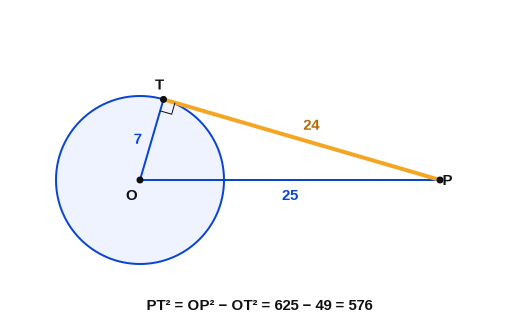
Q10080.
A tangent is drawn from point P to a circle with centre O. The radius of the circle is 7 cm, and the distance from point P to the centre O is 25 cm. What is the length of the tangent from point P to the point of tangency?
केंद्र O वाले एक वृत्त पर बिंदु P से एक स्पर्शरेखा खींची जाती है। वृत्त की त्रिज्या 7 cm है, और बिंदु P से केंद्र O की दूरी 25 cm है। बिंदु P से स्पर्श बिंदु तक स्पर्शरेखा की लंबाई कितनी है?
  1. A24 cm
  2. B27 cm
  3. C31 cm
  4. D21 cm
Show answer

Concept: A tangent is perpendicular to the radius at the point of contact, so OTP is a right triangle with OP as hypotenuse.

  1. PT2=OP2−OT2=252−72.
  2. PT2=625−49=576.
  3. PT=576=24cm.

Trick: Triplet (7,24,25).

Answer: (A) 24 cm

अवधारणा: स्पर्शरेखा, स्पर्श बिंदु पर त्रिज्या के लंबवत होती है, अतः OTP समकोण त्रिभुज है जिसका कर्ण OP है।

  1. PT2=OP2−OT2=252−72।
  2. PT2=625−49=576।
  3. PT=576=24cm।

ट्रिक: त्रिक (7,24,25)।

उत्तर: (A) 24 cm

RRB NTPC Graduate CBT 1MathematicsCircle – tangentRRB NTPC Graduate CBT 1 2024 · 10 Jun Shift 2 →