Question bank

Q&A: practice questions with answers

Search questions on any topic. Filter by exam category, exam, subject and topic, try the question, then open the answer and explanation.

Courses – airGurukul

20,719 questions found.

Q10181.
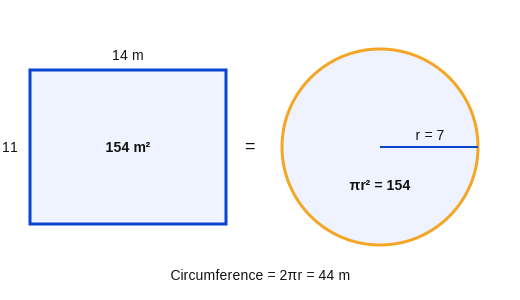
The sides of a rectangular field are 11 m and 14 m long. Its area is equal to the area of a circular field. What is the circumference (in m) of the circular field?
Take π=227
एक आयताकार मैदान की भुजाएँ 11 m और 14 m लंबी हैं। इसका क्षेत्रफल एक वृत्ताकार मैदान के क्षेत्रफल के बराबर है। वृत्ताकार मैदान की परिधि (m में) क्या है?
π=227 लीजिए
  1. A19
  2. B44
  3. C85
  4. D79
Show answer

Concept: Equal areas: πr2=l×b; then circumference =2πr.

  1. Area of rectangle =11×14=154m2.
  2. 227r2=154 → r2=49 → r=7 m.
  3. Circumference =2×227×7=44 m.

Trick: Area 154 with π=227 → r=7 (a very common pair to remember).

Answer: (B) 44

अवधारणा: क्षेत्रफल बराबर: πr2=l×b; फिर परिधि =2πr।

  1. आयत का क्षेत्रफल =11×14=154m2।
  2. 227r2=154 → r2=49 → r=7 m।
  3. परिधि =2×227×7=44 m।

ट्रिक: क्षेत्रफल 154 और π=227 → r=7 (याद रखने योग्य जोड़ी)।

उत्तर: (B) 44
RRB NTPC Graduate CBT 1MathematicsMensuration – circle and rectangleRRB NTPC Graduate CBT 1 2024 · 10 Jun Shift 1 →
Q10182.
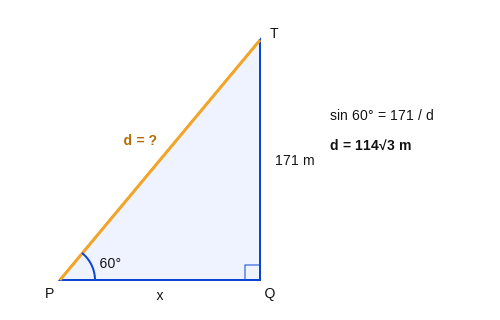
The angle of elevation of the top of a hill from a point on the ground is 60∘. If the hill is 171 m high, find the distance from the given point to the top of the hill.
भूमि पर स्थित एक बिंदु से एक पहाड़ी की चोटी का उन्नयन कोण 60∘ है। यदि पहाड़ी 171 m ऊँची है, तो दिए गए बिंदु से पहाड़ी की चोटी तक की दूरी ज्ञात कीजिए।
  1. A1712 m
  2. B1142 m
  3. C342 m
  4. D1143 m
Show answer

Concept: Distance from the point to the top of the hill is the hypotenuse of the right triangle; use sinθ=perpendicularhypotenuse.

  1. Height =171m, angle =60∘.
  2. sin60∘=171d⇒32=171d
  3. d=3423=34233=1143m

Trick: With 60∘, hypotenuse =23× height; 171=57×3, so d=2×573.

Answer: (D) 1143m

अवधारणा: बिंदु से पहाड़ी की चोटी तक की दूरी समकोण त्रिभुज का कर्ण है; sinθ=लंबकर्ण।

  1. ऊँचाई =171m, कोण =60∘।
  2. sin60∘=171d⇒32=171d
  3. d=3423=1143m

ट्रिक: 60∘ पर कर्ण =23× ऊँचाई; 171=57×3, अतः d=2×573।

उत्तर: (D) 1143m

RRB NTPC Graduate CBT 1MathematicsHeights and DistancesRRB NTPC Graduate CBT 1 2024 · 10 Jun Shift 1 →
Q10183.
X is directly proportional to A2 and A is inversely proportional to Y. If X is 39 when Y is 20, find X when Y is 2.
X, A2 के अनुक्रमानुपाती है और A, Y के व्युत्क्रमानुपाती है। यदि Y के 20 होने पर X का मान 39 है, तो Y के 2 होने पर X ज्ञात कीजिए।
  1. A3902
  2. B3901
  3. C3897
  4. D3900
Show answer

Concept: X∝A2 and A∝1Y together give X∝1Y2, i.e. XY2=k.

  1. k=39×202=39×400=15600
  2. When Y=2: X=1560022=156004=3900

Trick: Y becomes 110 times, so X becomes 102=100 times: 39×100=3900.

Answer: (D) 3900

अवधारणा: X∝A2 और A∝1Y से X∝1Y2, अर्थात् XY2=k।

  1. k=39×202=39×400=15600
  2. Y=2 पर: X=156004=3900

ट्रिक: Y, 110 गुना हुआ तो X, 102=100 गुना: 39×100=3900।

उत्तर: (D) 3900

RRB NTPC Graduate CBT 1MathematicsVariation / ProportionRRB NTPC Graduate CBT 1 2024 · 10 Jun Shift 1 →
Q10184.
3 years ago from now, the age of father was 30 years more than twice his son's age. After how many years, from now, will he be twice his son's age?
अब से 3 वर्ष पहले, पिता की आयु उसके पुत्र की आयु के दोगुने से 30 वर्ष अधिक थी। अब से कितने वर्ष बाद, उसकी आयु उसके पुत्र की आयु की दोगुनी होगी?
  1. A23
  2. B24
  3. C29
  4. D27
Show answer

Concept: Write present ages in one variable, then form the future equation.

  1. 3 years ago: son =x, father =2x+30.
  2. Now: son =x+3, father =2x+33.
  3. After n years: 2x+33+n=2(x+3+n)
  4. 33+n=6+2n⇒n=27

Trick: The x cancels, so you can test with any son age, e.g. son 0 then: father 30 → now 33 and 3 → 33+n=2(3+n) gives 27.

Answer: (D) 27

अवधारणा: वर्तमान आयु को एक चर में लिखें, फिर भविष्य का समीकरण बनाएँ।

  1. 3 वर्ष पहले: पुत्र =x, पिता =2x+30।
  2. अभी: पुत्र =x+3, पिता =2x+33।
  3. n वर्ष बाद: 2x+33+n=2(x+3+n)
  4. 33+n=6+2n⇒n=27

ट्रिक: x कट जाता है; पुत्र की आयु 0 मानकर भी: अभी 33 और 3 → 33+n=2(3+n) से 27।

उत्तर: (D) 27

RRB NTPC Graduate CBT 1MathematicsProblems on AgesRRB NTPC Graduate CBT 1 2024 · 10 Jun Shift 1 →
Q10185.
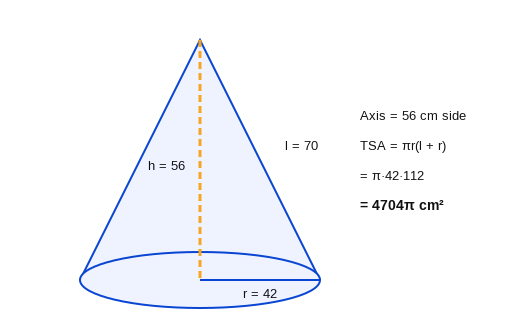
A right triangle with sides 56 cm, 42 cm and 70 cm is rotated about the side of 56 cm to form a cone. The total surface area (in cm2) of the cone so formed is:
56 cm, 42 cm और 70 cm भुजाओं वाले एक समकोण त्रिभुज को 56 cm वाली भुजा के परितः घुमाकर एक शंकु बनाया जाता है। इस प्रकार बने शंकु का कुल पृष्ठीय क्षेत्रफल (cm2 में) है:
  1. A3446π
  2. B4704π
  3. C7056π
  4. D5760π
Show answer

Concept: Rotating a right triangle about one leg makes a cone: that leg is the height, the other leg is the radius, the hypotenuse is the slant height.

  1. h=56, r=42, l=70cm (check: 422+562=702).
  2. TSA=πr(l+r)=π×42×(70+42)
  3. =π×42×112=4704πcm2

Trick: Sides are 14×(3,4,5); the side you rotate about is always the height.

Answer: (B) 4704π

अवधारणा: समकोण त्रिभुज को एक भुजा के परितः घुमाने पर शंकु बनता है: वह भुजा ऊँचाई, दूसरी भुजा त्रिज्या और कर्ण तिर्यक ऊँचाई।

  1. h=56, r=42, l=70cm (422+562=702)।
  2. TSA=πr(l+r)=π×42×112
  3. =4704πcm2

ट्रिक: भुजाएँ 14×(3,4,5) हैं; जिस भुजा के परितः घुमाया, वही ऊँचाई।

उत्तर: (B) 4704π

RRB NTPC Graduate CBT 1MathematicsMensuration – ConeRRB NTPC Graduate CBT 1 2024 · 10 Jun Shift 1 →
Q10186.
A person saves 50% of his income. If his expenditure is ₹320, then his income (in ₹) is:
एक व्यक्ति अपनी आय का 50% बचाता है। यदि उसका व्यय ₹320 है, तो उसकी आय (₹ में) है:
  1. A160
  2. B640
  3. C680
  4. D600
Show answer

Concept: Income = Savings + Expenditure.

  1. Savings =50%, so expenditure =50% of income.
  2. 50% of income = ₹320 → income =320×2= ₹640.

Trick: If savings and expenditure are equal, income is just double the expenditure.

Answer: (B) 640

अवधारणा: आय = बचत + व्यय।

  1. बचत =50%, अतः व्यय भी आय का 50%।
  2. आय का 50% = ₹320 → आय =320×2= ₹640।

ट्रिक: बचत और व्यय बराबर हों तो आय = व्यय का दोगुना।

उत्तर: (B) 640

RRB NTPC Graduate CBT 1MathematicsPercentage – Income and SavingsRRB NTPC Graduate CBT 1 2024 · 10 Jun Shift 1 →
Q10187.
After allowing a discount of 76%, the value of a ceiling fan is ₹3,330. If no discount is allowed, then the shopkeeper gains 50%. Find the cost price (in ₹) of the ceiling fan.
76% की छूट देने के बाद, एक सीलिंग फ़ैन का मूल्य ₹3,330 है। यदि कोई छूट नहीं दी जाती है, तो दुकानदार को 50% का लाभ होता है। सीलिंग फ़ैन का क्रय मूल्य (₹ में) ज्ञात कीजिए।
  1. A9,247
  2. B9,248
  3. C9,252
  4. D9,250
Show answer

Concept: Selling price after discount =MP×(100−d)%; with no discount, SP = MP.

  1. MP×24100=3330⇒MP=3330×10024=13875
  2. With no discount, gain 50%: MP=1.5×CP
  3. CP=138751.5=9250

Trick: CP=33300.24×1.5=33300.36=9250.

Answer: (D) 9,250

अवधारणा: छूट के बाद विक्रय मूल्य =MP×(100−d)%; बिना छूट के SP = MP।

  1. MP×24100=3330⇒MP=13875
  2. बिना छूट 50% लाभ: MP=1.5×CP
  3. CP=138751.5=9250

ट्रिक: CP=33300.24×1.5=33300.36=9250।

उत्तर: (D) 9,250

RRB NTPC Graduate CBT 1MathematicsProfit, Loss and DiscountRRB NTPC Graduate CBT 1 2024 · 10 Jun Shift 1 →
Q10188.
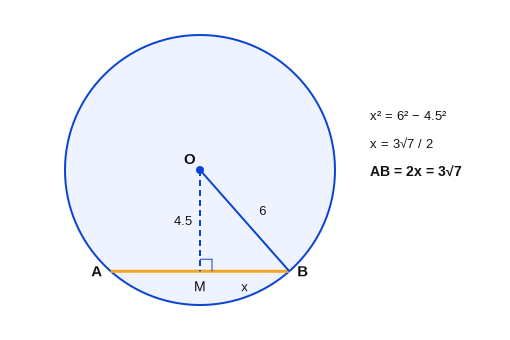
A chord AB is drawn in a circle with centre O and radius 6 cm. If the shortest distance between the centre and the chord is 4.5 cm, then find the length of chord AB.
केंद्र O और 6 cm त्रिज्या वाले एक वृत्त में एक जीवा AB खींची गई है। यदि केंद्र और जीवा के बीच की न्यूनतम दूरी 4.5 cm है, तो जीवा AB की लंबाई ज्ञात कीजिए।
  1. A2√7 cm
  2. B4√7 cm
  3. C3√7 cm
  4. D√7 cm
Show answer

Concept: The perpendicular from the centre bisects the chord; use Pythagoras in the half-chord triangle.

  1. OB=6, OM=4.5, MB=x.
  2. x2=62−4.52=36−20.25=15.75=634
  3. x=632=372
  4. AB=2x=37cm

Trick: AB=2r2−d2=4(36−20.25)=63=37.

Answer: (C) 37cm

अवधारणा: केंद्र से जीवा पर डाला गया लंब जीवा को समद्विभाजित करता है; आधी जीवा वाले त्रिभुज में पाइथागोरस लगाएँ।

  1. OB=6, OM=4.5, MB=x।
  2. x2=36−20.25=15.75=634
  3. x=372
  4. AB=2x=37cm

ट्रिक: AB=2r2−d2=63=37।

उत्तर: (C) 37cm

RRB NTPC Graduate CBT 1MathematicsGeometry – Circle ChordRRB NTPC Graduate CBT 1 2024 · 10 Jun Shift 1 →
Q10189.
The average of first 12 natural numbers is:
प्रथम 12 प्राकृत संख्याओं का औसत है:
  1. A6
  2. B6.5
  3. C7
  4. D7.5
Show answer

Concept: Average of first n natural numbers =n+12.

  1. Sum =12×132=78
  2. Average =7812=6.5

Trick: Average of consecutive numbers = (first + last) ÷ 2 =1+122=6.5.

Answer: (B) 6.5

अवधारणा: प्रथम n प्राकृत संख्याओं का औसत =n+12।

  1. योग =12×132=78
  2. औसत =7812=6.5

ट्रिक: लगातार संख्याओं का औसत = (पहली + अंतिम) ÷ 2 =1+122=6.5।

उत्तर: (B) 6.5

RRB NTPC Graduate CBT 1MathematicsAverageRRB NTPC Graduate CBT 1 2024 · 10 Jun Shift 1 →
Q10190.
Find the simple interest (in ₹) on ₹900 at an interest rate of 6% per month in 12 months.
₹900 पर 6% प्रति माह की ब्याज दर से 12 महीनों का साधारण ब्याज (₹ में) ज्ञात कीजिए।
  1. A108
  2. B648
  3. C54
  4. D74
Show answer

Concept: SI=P×R×T100, with rate and time in the same unit (here per month).

  1. P=900, R=6% per month, T=12 months.
  2. SI=900×6×12100=648

Trick: 6% per month = 72% per year; 72% of 900 =648.

Answer: (B) 648

अवधारणा: SI=P×R×T100; दर और समय एक ही इकाई (यहाँ मासिक) में हों।

  1. P=900, R=6% प्रति माह, T=12 माह।
  2. SI=900×6×12100=648

ट्रिक: 6% मासिक = 72% वार्षिक; 900 का 72%=648।

उत्तर: (B) 648

RRB NTPC Graduate CBT 1MathematicsSimple InterestRRB NTPC Graduate CBT 1 2024 · 10 Jun Shift 1 →
Q10191.
By selling an article for ₹112, a man loses 30%. At what price (in ₹) should he sell it to gain 15%?
एक वस्तु को ₹112 में बेचने पर एक व्यक्ति को 30% की हानि होती है। 15% लाभ प्राप्त करने के लिए उसे वह वस्तु किस मूल्य (₹ में) पर बेचनी चाहिए?
  1. A184
  2. B194
  3. C174
  4. D204
Show answer

Concept: SP=CP×100±%100.

  1. Loss 30%: CP×0.7=112⇒CP=160
  2. Gain 15%: SP=160×1.15=184

Trick: New SP=112×11570=16×11510=184.

Answer: (A) 184

अवधारणा: SP=CP×100±%100।

  1. 30% हानि: CP×0.7=112⇒CP=160
  2. 15% लाभ: SP=160×1.15=184

ट्रिक: नया SP=112×11570=184।

उत्तर: (A) 184

RRB NTPC Graduate CBT 1MathematicsProfit and LossRRB NTPC Graduate CBT 1 2024 · 10 Jun Shift 1 →
Q10192.
The downstream speed is 41 km/hr and the upstream speed is 20.5 km/hr. It takes a boat a total of 13 hours to go to a place and come back. What is the total distance travelled by the boat?
धारा के अनुकूल चाल 41 km/hr है और धारा के प्रतिकूल चाल 20.5 km/hr है। एक नाव को किसी स्थान तक जाने और वापस आने में कुल 13 घंटे लगते हैं। नाव द्वारा तय की गई कुल दूरी कितनी है?
  1. A5294 km
  2. B10863 km
  3. C5333 km
  4. D10663 km
Show answer

Concept: Time =DistanceSpeed; one-way distance d is covered once downstream and once upstream.

  1. d41+d20.5=13
  2. d41+2d41=3d41=13⇒d=5333km
  3. Total distance =2d=10663km

Trick: 5333 is only one way — the question asks total distance, so double it.

Answer: (D) 10663km

अवधारणा: समय =दूरीचाल; एक तरफ़ की दूरी d एक बार धारा के साथ और एक बार विपरीत तय होती है।

  1. d41+d20.5=13
  2. 3d41=13⇒d=5333km
  3. कुल दूरी =2d=10663km

ट्रिक: 5333 केवल एक तरफ़ की दूरी है — कुल दूरी के लिए दोगुना करें।

उत्तर: (D) 10663km

RRB NTPC Graduate CBT 1MathematicsBoats and StreamsRRB NTPC Graduate CBT 1 2024 · 10 Jun Shift 1 →
Q10193.
The average of eight numbers is 124. Find the least number if it is one-sixteenth of the sum of the numbers.
आठ संख्याओं का औसत 124 है। सबसे छोटी संख्या ज्ञात कीजिए, यदि वह संख्याओं के योग का सोलहवाँ भाग है।
  1. A64
  2. B65
  3. C62
  4. D63
Show answer

Concept: Sum = Average × Count.

  1. Sum =124×8=992
  2. Least number =116×992=62

Trick: 8×12416=1242=62 — half the average.

Answer: (C) 62

अवधारणा: योग = औसत × संख्या।

  1. योग =124×8=992
  2. सबसे छोटी संख्या =116×992=62

ट्रिक: 8×12416=1242=62 — औसत का आधा।

उत्तर: (C) 62

RRB NTPC Graduate CBT 1MathematicsAverageRRB NTPC Graduate CBT 1 2024 · 10 Jun Shift 1 →
Q10194.
C is the third proportional of 57 and B. If B is the sum of the first three even natural numbers, then find the value of C.
(Rounded off to two decimal places)
C, 57 और B का तृतीयानुपाती है। यदि B प्रथम तीन सम प्राकृत संख्याओं का योग है, तो C का मान ज्ञात कीजिए।
(दशमलव के दो स्थानों तक पूर्णांकित)
  1. A2.53
  2. B1.33
  3. C0.65
  4. D0.07
Show answer

Concept: Third proportional of a and b: a:b=b:c⇒c=b2a.

  1. B=2+4+6=12
  2. C=12257=14457
  3. =2.526…≈2.53

Trick: 14457=4819; 19×2.5=47.5 so the answer is just above 2.5.

Answer: (A) 2.53

अवधारणा: a और b का तृतीयानुपाती: a:b=b:c⇒c=b2a।

  1. B=2+4+6=12
  2. C=14457
  3. =2.526…≈2.53

ट्रिक: 14457=4819; 19×2.5=47.5, अतः उत्तर 2.5 से थोड़ा अधिक।

उत्तर: (A) 2.53

RRB NTPC Graduate CBT 1MathematicsRatio and ProportionRRB NTPC Graduate CBT 1 2024 · 10 Jun Shift 1 →
Q10195.
A can do a certain work at the same time in which B and C together can do it. If A and B together can do it in 7 days and C alone in 9 days, then B alone can do it in ______ days.
A किसी कार्य को उतने ही समय में कर सकता है जितने समय में B और C मिलकर उसे कर सकते हैं। यदि A और B मिलकर उसे 7 दिनों में और C अकेले 9 दिनों में कर सकता है, तो B अकेले उसे ______ दिनों में कर सकता है।
  1. A252
  2. B63
  3. C189
  4. D126
Show answer

Concept: Work per day adds up; A's rate = B's rate + C's rate.

  1. A+B=17, C=19, A=B+19
  2. 2B+19=17⇒2B=9−763=263
  3. B=163 → B alone takes 63 days.

Trick: Total work =63 units: A+B=9, C=7, A=B+7⇒2B=2, B=1 unit/day → 63 days.

Answer: (B) 63

अवधारणा: प्रतिदिन का कार्य जुड़ता है; A की दर = B की दर + C की दर।

  1. A+B=17, C=19, A=B+19
  2. 2B+19=17⇒2B=263
  3. B=163 → B अकेला 63 दिन लेगा।

ट्रिक: कुल कार्य =63 इकाई: A+B=9, C=7, A=B+7⇒2B=2, B=1 → 63 दिन।

उत्तर: (B) 63

RRB NTPC Graduate CBT 1MathematicsTime and WorkRRB NTPC Graduate CBT 1 2024 · 10 Jun Shift 1 →
Q10196.
Based on the English alphabetical order, three of the following four letter-clusters are alike in a certain way and thus form a group. Which letter-cluster DOES NOT belong to that group?
(Note: The odd one out is not based on the number of consonants/vowels or their position in the letter-cluster.)
अंग्रेज़ी वर्णमाला क्रम के आधार पर, निम्नलिखित चार अक्षर-समूहों में से तीन किसी निश्चित प्रकार से एकसमान हैं और इस प्रकार एक समूह बनाते हैं। कौन-सा अक्षर-समूह उस समूह से संबंधित नहीं है?
(ध्यान दें: असंगत अक्षर-समूह, उस अक्षर-समूह में व्यंजनों/स्वरों की संख्या या उनके स्थान पर आधारित नहीं है।)
  1. APXR
  2. BLTO
  3. CNVQ
  4. DHPK
Show answer

Concept: Check the gaps between consecutive letters using alphabet positions.

  1. LTO: 12→20→15 → +8,−5; NVQ: 14→22→17 → +8,−5.
  2. HPK: 8→16→11 → +8,−5.
  3. PXR: 16→24→18 → +8,−6 ✗ — the pattern breaks.

Trick: Pehla gap sab me same (+8) ho to doosra gap check karo.

Answer: (A) PXR

अवधारणा: क्रमागत अक्षरों के बीच अंतर वर्णमाला स्थान से देखें।

  1. LTO: 12→20→15 → +8,−5; NVQ: 14→22→17 → +8,−5।
  2. HPK: 8→16→11 → +8,−5।
  3. PXR: 16→24→18 → +8,−6 ✗ — पैटर्न टूटता है।

ट्रिक: पहला अंतर सबमें समान (+8) हो तो दूसरा अंतर जाँचें।

उत्तर: (A) PXR

RRB NTPC Graduate CBT 1General Intelligence and ReasoningOdd one out – letter clustersRRB NTPC Graduate CBT 1 2024 · 10 Jun Shift 1 →
Q10197.
Select the set in which the numbers are related in the same way as are the numbers of the following sets.
(NOTE: Operations should be performed on the whole numbers, without breaking down the numbers into their constituent digits. E.g. 13 – Operations on 13 such as
adding/subtracting/multiplying to 13 can be performed. Breaking down 13 into 1 and 3 and then performing mathematical operations on 1 and 3 is not allowed.)
(43, 48, 5)
(49, 70, 21)
उस समुच्चय का चयन कीजिए जिसमें संख्याएँ उसी प्रकार संबंधित हैं जिस प्रकार निम्नलिखित समुच्चयों की संख्याएँ संबंधित हैं।
(ध्यान दें: संख्याओं को उनके घटक अंकों में विभाजित किए बिना, पूर्ण संख्याओं पर संक्रियाएँ की जानी चाहिए। उदाहरण के लिए 13 – 13 पर की जाने वाली संक्रियाएँ, जैसे
13 में जोड़ना/घटाना/गुणा करना आदि की जा सकती हैं। 13 को 1 और 3 में विभाजित करना और फिर 1 और 3 पर गणितीय संक्रियाएँ करना वर्जित है।)
(43, 48, 5)
(49, 70, 21)
  1. A(36, 52, 13)
  2. B(45, 52, 4)
  3. C(20, 34, 14)
  4. D(48, 71, 20)
Show answer

Concept: Find the relation among the three numbers of the given sets.

  1. (43,48,5): 48−43=5; (49,70,21): 70−49=21. So third = second − first.
  2. (C) (20,34,14): 34−20=14 ✓.
  3. (A) 52−36=16≠13; (B) 52−45=7≠4; (D) 71−48=23≠20.

Trick: Pehle simplest relation (difference) try karo.

Answer: (C) (20, 34, 14)

अवधारणा: दिए गए समूहों की तीनों संख्याओं के बीच संबंध खोजें।

  1. (43,48,5): 48−43=5; (49,70,21): 70−49=21। अतः तीसरी = दूसरी − पहली।
  2. (C) (20,34,14): 34−20=14 ✓।
  3. (A) 52−36=16≠13; (B) 52−45=7≠4; (D) 71−48=23≠20।

ट्रिक: पहले सबसे सरल संबंध (अंतर) आज़माएँ।

उत्तर: (C) (20, 34, 14)

RRB NTPC Graduate CBT 1General Intelligence and ReasoningNumber set analogyRRB NTPC Graduate CBT 1 2024 · 10 Jun Shift 1 →
Q10198.
What should come in place of the question mark (?) in the given series?
49 55 63 73 85 99 ?
दी गई श्रृंखला में प्रश्नचिह्न (?) के स्थान पर क्या आना चाहिए?
49 55 63 73 85 99 ?
  1. A129
  2. B115
  3. C120
  4. D111
Show answer

Concept: Look at the differences between consecutive terms.

  1. Differences: 55−49=6, 8, 10, 12, 14 — increasing by 2.
  2. Next difference =16.
  3. Missing term =99+16=115.

Trick: Differences in AP (+2 each time) → just add the next even number.

Answer: (B) 115

अवधारणा: क्रमागत पदों के अंतर देखें।

  1. अंतर: 55−49=6, 8, 10, 12, 14 — हर बार 2 बढ़ रहा है।
  2. अगला अंतर =16।
  3. लुप्त पद =99+16=115।

ट्रिक: अंतर समांतर श्रेणी में (+2) हों → अगली सम संख्या जोड़ दें।

उत्तर: (B) 115

RRB NTPC Graduate CBT 1General Intelligence and ReasoningNumber seriesRRB NTPC Graduate CBT 1 2024 · 10 Jun Shift 1 →
Q10199.
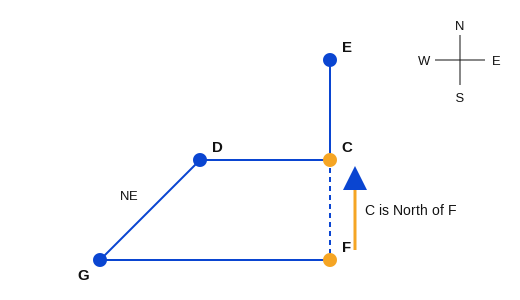
Town C is to the east of Town D. Town E is to the north of Town C. Town F is to the south of Town E. Town G is to the west of Town F. Town D is to the north-east of Town G. What is the position of Town C with respect to Town F?
कस्बा C, कस्बा D के पूर्व में है। कस्बा E, कस्बा C के उत्तर में है। कस्बा F, कस्बा E के दक्षिण में है। कस्बा G, कस्बा F के पश्चिम में है। कस्बा D, कस्बा G के उत्तर-पूर्व में है। कस्बा F के सापेक्ष कस्बा C की स्थिति क्या है?
  1. AWestपश्चिम
  2. BSouthदक्षिण
  3. CNorthउत्तर
  4. DEastपूर्व
Show answer

Concept: Place the towns step by step on a grid.

  1. Put G at the start; D is north-east of G; C is east of D (so C is north-east side of G, one level above).
  2. E is north of C; F is south of E, and G is west of F → F lies on the same horizontal level as G, directly below C.
  3. C and F are on the same vertical line, with C above F → C is North of F.

Trick: Start from the town that links the most statements (G) and draw.

Answer: (C) North

अवधारणा: कस्बों को चरण-दर-चरण ग्रिड पर रखें।

  1. G को आरंभ में रखें; D, G के उत्तर-पूर्व में; C, D के पूर्व में (G से एक स्तर ऊपर)।
  2. E, C के उत्तर में; F, E के दक्षिण में और G, F के पश्चिम में → F, G के स्तर पर C के ठीक नीचे है।
  3. C और F एक ही ऊर्ध्व रेखा पर हैं, C ऊपर → C, F के उत्तर में है।

ट्रिक: जिस कस्बे से सबसे अधिक कथन जुड़ें (G), वहीं से चित्र बनाना शुरू करें।

उत्तर: (C) उत्तर

RRB NTPC Graduate CBT 1General Intelligence and ReasoningDirection senseRRB NTPC Graduate CBT 1 2024 · 10 Jun Shift 1 →
Q10200.
In a certain code language, ‘HEIR’ is coded as ‘2468’ and ‘EASY’ is coded as ‘1327’. What is the code for ‘E’ in the given code language?
एक निश्चित कूट भाषा में, ‘HEIR’ को ‘2468’ के रूप में और ‘EASY’ को ‘1327’ के रूप में कूटबद्ध किया जाता है। दी गई कूट भाषा में ‘E’ के लिए कूट क्या है?
  1. A1
  2. B2
  3. C4
  4. D7
Show answer

Concept: A letter common to two words takes the digit common to their codes.

  1. HEIR → {2, 4, 6, 8}; EASY → {1, 3, 2, 7}.
  2. Common letter: E; common digit: 2.
  3. So E = 2.

Trick: Common letter ↔ common digit.

Answer: (B) 2

अवधारणा: दो शब्दों में उभयनिष्ठ अक्षर का कोड उनके कोड में उभयनिष्ठ अंक होता है।

  1. HEIR → {2, 4, 6, 8}; EASY → {1, 3, 2, 7}।
  2. उभयनिष्ठ अक्षर: E; उभयनिष्ठ अंक: 2।
  3. अतः E = 2।

ट्रिक: उभयनिष्ठ अक्षर ↔ उभयनिष्ठ अंक।

उत्तर: (B) 2

RRB NTPC Graduate CBT 1General Intelligence and ReasoningCoding-decodingRRB NTPC Graduate CBT 1 2024 · 10 Jun Shift 1 →