Question bank

Q&A: practice questions with answers

Search questions on any topic. Filter by exam category, exam, subject and topic, try the question, then open the answer and explanation.

Courses – airGurukul

20,719 questions found.

Q10281.
Simplify: 369×(74+12)+99
सरल कीजिए: 369×(74+12)+99
  1. A446
  2. B449
  3. C444
  4. D443
Show answer

Concept: Apply BODMAS: bracket first, then division/multiplication, then addition.

  1. Bracket: 74+12=86.
  2. 369=4, so 4×86=344.
  3. 344+99=443.

Trick: Last digit check: 4×6=24→4, 4+9=13→3 – only 443 ends in 3.

Answer: (D) 443

अवधारणा: BODMAS लगाएँ: पहले कोष्ठक, फिर भाग/गुणा, फिर जोड़।

  1. कोष्ठक: 74+12=86।
  2. 369=4, अतः 4×86=344।
  3. 344+99=443।

ट्रिक: इकाई अंक जाँच: 4×6=24→4, 4+9=13→3 – केवल 443।

उत्तर: (D) 443

RRB NTPC Graduate CBT 1MathematicsSimplification (BODMAS)RRB NTPC Graduate CBT 1 2024 · 9 Jun Shift 3 →
Q10282.
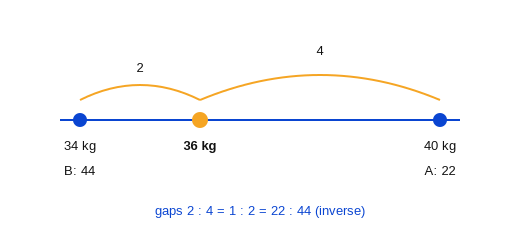
There are two sections A and B of a class, consisting of 22 and 44 students,
respectively. If the average weight of section A is 40 kg and that of section B is 34 kg, find the average weight of the whole class (in kg).
एक कक्षा के दो वर्ग A और B हैं, जिनमें क्रमशः 22 और 44 विद्यार्थी हैं।
यदि वर्ग A का औसत वज़न 40 kg और वर्ग B का औसत वज़न 34 kg है, तो पूरी कक्षा का औसत वज़न (kg में) ज्ञात कीजिए।
  1. A35.5
  2. B36
  3. C37
  4. D36.5
Show answer

Concept: Combined average =n1a1+n2a2n1+n2.

  1. Total weight of A =22×40=880kg.
  2. Total weight of B =44×34=1496kg.
  3. Average =880+149666=237666=36kg.

Trick: Students are in ratio 1:2, so the average divides the gap 6 in ratio 2:1 from 34: 34+2=36.

Answer: (B) 36

अवधारणा: संयुक्त औसत =n1a1+n2a2n1+n2।

  1. A का कुल भार =22×40=880kg।
  2. B का कुल भार =44×34=1496kg।
  3. औसत =880+149666=237666=36kg।

ट्रिक: छात्र अनुपात 1:2, अतः अंतर 6 को उल्टे अनुपात में बाँटें: 34+2=36।

उत्तर: (B) 36

RRB NTPC Graduate CBT 1MathematicsAverage – WeightedRRB NTPC Graduate CBT 1 2024 · 9 Jun Shift 3 →
Q10283.
If a:b=3:4 and b:c=4:7, then a+b+cc is equal to:
यदि a:b=3:4 और b:c=4:7 है, तो a+b+cc किसके बराबर है?
  1. A72
  2. B143
  3. C14
  4. D2
Show answer

Concept: Combine ratios using the common term b.

  1. a:b=3:4 and b:c=4:7; b is already 4 in both, so a:b:c=3:4:7.
  2. Let a=3k, b=4k, c=7k.
  3. a+b+cc=14k7k=2.

Trick: Sum of ratio terms ÷ c's term =147=2.

Answer: (D) 2

अवधारणा: उभयनिष्ठ पद b से अनुपात मिलाएँ।

  1. a:b=3:4 और b:c=4:7; दोनों में b=4, अतः a:b:c=3:4:7।
  2. मान लें a=3k, b=4k, c=7k।
  3. a+b+cc=14k7k=2।

ट्रिक: अनुपात पदों का योग ÷ c का पद =147=2।

उत्तर: (D) 2

RRB NTPC Graduate CBT 1MathematicsRatio and ProportionRRB NTPC Graduate CBT 1 2024 · 9 Jun Shift 3 →
Q10284.
2 men or 9 women can do a job in 14 days. 2 men work for 9 days and leave. The number of women required to complete the remaining work in 9 days is:
2 पुरुष या 9 महिलाएँ किसी काम को 14 दिनों में कर सकते हैं। 2 पुरुष 9 दिनों तक काम करते हैं और छोड़ देते हैं। शेष काम को 9 दिनों में पूरा करने के लिए आवश्यक महिलाओं की संख्या है:
  1. A2
  2. B3
  3. C5
  4. D4
Show answer

Concept: Convert men into women using 2M=9W, then count work in woman-days.

  1. Total work =9×14=126 woman-days.
  2. 2 men for 9 days =9 women×9=81 woman-days.
  3. Remaining =126−81=45 woman-days.
  4. Women needed in 9 days =459=5.

Trick: Replace '2 men' by '9 women' everywhere – the answer is just 9×(14−9)9=5.

Answer: (C) 5

अवधारणा: 2M=9W से पुरुषों को महिलाओं में बदलें और कार्य को महिला-दिवस में गिनें।

  1. कुल कार्य =9×14=126 महिला-दिवस।
  2. 2 पुरुष 9 दिन =9 महिलाएँ×9=81 महिला-दिवस।
  3. शेष =126−81=45 महिला-दिवस।
  4. 9 दिन में आवश्यक महिलाएँ =459=5।

ट्रिक: '2 पुरुष' की जगह '9 महिलाएँ' रखें – उत्तर 9×(14−9)9=5।

उत्तर: (C) 5

RRB NTPC Graduate CBT 1MathematicsTime and WorkRRB NTPC Graduate CBT 1 2024 · 9 Jun Shift 3 →
Q10285.
A shopkeeper marked his goods at X% above their cost price and sold them at a discount of 16%. If he gained 68% profit, then find the value of X.
एक दुकानदार ने अपने सामान पर क्रय मूल्य से X% अधिक मूल्य अंकित किया और उसे 16% की छूट पर बेचा। यदि उसे 68% लाभ हुआ, तो X का मान ज्ञात कीजिए।
  1. A101
  2. B100
  3. C99
  4. D102
Show answer

Concept: SP=MP×(1−discount)=CP×(1+profit).

  1. Let CP =100. SP with 68% profit =168.
  2. MP×84100=168⇒MP=200.
  3. Mark-up X=200−100100×100=100.

Trick: MPCP=100+P%100−D%=16884=2 → 100% above.

Answer: (B) 100

अवधारणा: विक्रय मूल्य=अंकित मूल्य×(1−छूट)=क्रय मूल्य×(1+लाभ)।

  1. माना क्रय मूल्य =100; 68% लाभ पर विक्रय मूल्य =168।
  2. अंकित मूल्य×84100=168⇒अंकित मूल्य=200।
  3. X=200−100100×100=100।

ट्रिक: MPCP=100+P%100−D%=16884=2 → 100% अधिक।

उत्तर: (B) 100

RRB NTPC Graduate CBT 1MathematicsProfit, Loss and DiscountRRB NTPC Graduate CBT 1 2024 · 9 Jun Shift 3 →
Q10286.
Walking at 25 of his normal speed, Abhijeet is 18 minutes late in reaching his office. The usual time taken by him to cover the distance between his home and his office is:
अपनी सामान्य चाल की 25 चाल से चलने पर, अभिजीत अपने कार्यालय 18 मिनट देर से पहुँचता है। उसके द्वारा अपने घर और कार्यालय के बीच की दूरी तय करने में लिया जाने वाला सामान्य समय है:
  1. A12 minutes12 मिनट
  2. B2 minutes2 मिनट
  3. C9 minutes9 मिनट
  4. D11 minutes11 मिनट
Show answer

Concept: For fixed distance, time ∝ 1speed.

  1. Speed becomes 25 ⇒ time becomes 52 of usual time T.
  2. Extra time =52T−T=32T=18 min.
  3. T=18×23=12 min.

Trick: Usual time =late52−1=181.5=12.

Answer: (A) 12 minutes

अवधारणा: निश्चित दूरी पर, समय ∝ 1चाल।

  1. चाल 25 ⇒ समय सामान्य समय T का 52 गुना।
  2. अतिरिक्त समय =52T−T=32T=18 मिनट।
  3. T=18×23=12 मिनट।

ट्रिक: सामान्य समय =देरी52−1=181.5=12।

उत्तर: (A) 12 मिनट

RRB NTPC Graduate CBT 1MathematicsSpeed, Time and DistanceRRB NTPC Graduate CBT 1 2024 · 9 Jun Shift 3 →
Q10287.
Raj has ₹1,218 with him. He divided it amongst his sons Varun and Ashish and asked them to invest it at 10% rate of interest per annum, compounded annually. It was seen that Varun and Ashish got the same amount after 13 and 14 years, respectively. How much (in ₹) did Raj give to Ashish?
राज के पास ₹1,218 हैं। उसने इसे अपने पुत्रों वरुण और आशीष के बीच बाँट दिया और उन्हें इसे वार्षिक रूप से चक्रवृद्धि होने वाली 10% वार्षिक ब्याज दर पर निवेश करने को कहा। यह देखा गया कि वरुण और आशीष को क्रमशः 13 और 14 वर्ष बाद समान राशि प्राप्त हुई। राज ने आशीष को कितनी राशि (₹ में) दी?
  1. A₹580
  2. B₹638
  3. C₹738
  4. D₹430
Show answer

Concept: If amounts are equal after different periods, P1(1+r)n1=P2(1+r)n2.

  1. V(1.1)13=A(1.1)14⇒V=1.1A.
  2. V:A=11:10, total =21 parts =1218.
  3. Ashish =1021×1218=580.

Trick: Ratio of shares =(1+r100)difference in years:1=11:10.

Answer: (A) ₹580

अवधारणा: यदि भिन्न अवधियों के बाद मिश्रधन बराबर हो, तो P1(1+r)n1=P2(1+r)n2।

  1. V(1.1)13=A(1.1)14⇒V=1.1A।
  2. V:A=11:10, कुल =21 भाग =1218।
  3. आशीष =1021×1218=580।

ट्रिक: हिस्सों का अनुपात =(1+r100)वर्षों का अंतर:1=11:10।

उत्तर: (A) ₹580

RRB NTPC Graduate CBT 1MathematicsCompound Interest – Equal AmountsRRB NTPC Graduate CBT 1 2024 · 9 Jun Shift 3 →
Q10288.
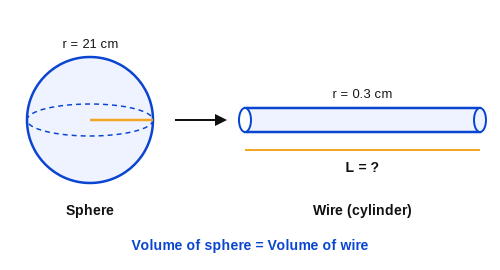
The diameter of a metallic solid sphere is 42 cm. It is melted and drawn into a wire with a cross-sectional diameter of 0.6 cm. Find the length (in metre) of the wire.
एक धात्विक ठोस गोले का व्यास 42 cm है। इसे पिघलाकर 0.6 cm अनुप्रस्थ-काट व्यास वाले तार में खींचा जाता है। तार की लंबाई (मीटर में) ज्ञात कीजिए।
  1. A1372
  2. B1367
  3. C1362
  4. D1364
Show answer

Concept: When a solid is melted and recast, volume stays the same.

  1. Sphere: r=21cm, V=43π(21)3.
  2. Wire (cylinder): r=0.3cm, V=π(0.3)2L.
  3. L=43×92610.09=123480.09=137200cm.
  4. L=1372m.

Trick: π cancels: L=4R33r2 – no need to multiply by 227.

Answer: (A) 1372

अवधारणा: ठोस को पिघलाकर नया आकार देने पर आयतन समान रहता है।

  1. गोला: r=21cm, V=43π(21)3।
  2. तार (बेलन): r=0.3cm, V=π(0.3)2L।
  3. L=43×92610.09=123480.09=137200cm।
  4. L=1372m।

ट्रिक: π कट जाता है: L=4R33r2।

उत्तर: (A) 1372

RRB NTPC Graduate CBT 1MathematicsMensuration – RecastingRRB NTPC Graduate CBT 1 2024 · 9 Jun Shift 3 →
Q10289.
If x + y = 10, product of x and y is 16, then the value of x4 + y4 is:
यदि x + y = 10 है, x और y का गुणनफल 16 है, तो x4 + y4 का मान है:
  1. A4092
  2. B4175
  3. C4073
  4. D4112
Show answer

Concept: x2+y2=(x+y)2−2xy and x4+y4=(x2+y2)2−2x2y2.

  1. x2+y2=102−2×16=68.
  2. x4+y4=682−2×162=4624−512=4112.

Trick: Square twice, subtract 2(xy)power each time.

Answer: (D) 4112

अवधारणा: x2+y2=(x+y)2−2xy तथा x4+y4=(x2+y2)2−2x2y2।

  1. x2+y2=102−2×16=68।
  2. x4+y4=682−2×162=4624−512=4112।

ट्रिक: दो बार वर्ग करें, हर बार 2(xy)घात घटाएँ।

उत्तर: (D) 4112

RRB NTPC Graduate CBT 1MathematicsAlgebraic IdentitiesRRB NTPC Graduate CBT 1 2024 · 9 Jun Shift 3 →
Q10290.
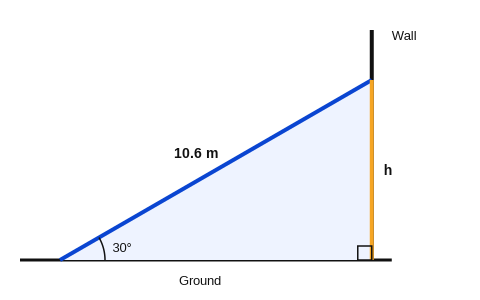
A ladder 10.6 m long is leaning against a wall. It makes an angle of 30owith the ground. How high does the ladder reach on the wall?
10.6 m लंबी एक सीढ़ी एक दीवार के सहारे टिकी है। यह भूमि के साथ 30o का कोण बनाती है। सीढ़ी दीवार पर कितनी ऊँचाई तक पहुँचती है?
  1. A5.32 m
  2. B5.6 m
  3. C5.33 m
  4. D5.3 m
Show answer

Concept: The ladder is the hypotenuse; height on wall is the side opposite the 30∘ angle.

  1. sin30∘=h10.6.
  2. h=10.6×12=5.3m.

Trick: Side opposite 30∘ = half the hypotenuse.

Answer: (D) 5.3m

अवधारणा: सीढ़ी कर्ण है; दीवार पर ऊँचाई 30∘ कोण के सामने की भुजा है।

  1. sin30∘=h10.6।
  2. h=10.6×12=5.3m।

ट्रिक: 30∘ के सामने की भुजा = कर्ण का आधा।

उत्तर: (D) 5.3m

RRB NTPC Graduate CBT 1MathematicsHeights and DistancesRRB NTPC Graduate CBT 1 2024 · 9 Jun Shift 3 →
Q10291.
20 dual desks and 12 chairs were bought for ₹79,600. If the average cost of a dual desk was ₹3,500, find the average cost of a chair.
₹79,600 में 20 डुअल डेस्क और 12 कुर्सियाँ खरीदी गईं। यदि एक डुअल डेस्क का औसत मूल्य ₹3,500 था, तो एक कुर्सी का औसत मूल्य ज्ञात कीजिए।
  1. A₹850
  2. B₹920
  3. C₹950
  4. D₹800
Show answer

Concept: Total cost = desks' cost + chairs' cost.

  1. Desks: 20×3500=70000.
  2. Chairs total =79600−70000=9600.
  3. Average per chair =960012=800.

Trick: Subtract the known part, divide the rest.

Answer: (D) ₹800

अवधारणा: कुल लागत = डेस्क की लागत + कुर्सियों की लागत।

  1. डेस्क: 20×3500=70000।
  2. कुर्सियाँ कुल =79600−70000=9600।
  3. प्रति कुर्सी औसत =960012=800।

ट्रिक: ज्ञात भाग घटाएँ, शेष को बाँटें।

उत्तर: (D) ₹800

RRB NTPC Graduate CBT 1MathematicsAverageRRB NTPC Graduate CBT 1 2024 · 9 Jun Shift 3 →
Q10292.
How long (in years) will it take for ₹1,680 to become ₹2,100 at a rate of 4% per annum simple interest?
4% वार्षिक साधारण ब्याज की दर से ₹1,680 को ₹2,100 होने में कितना समय (वर्षों में) लगेगा?
  1. A6.25
  2. B7.25
  3. C8.25
  4. D5.25
Show answer

Concept: SI=P×R×T100.

  1. SI=2100−1680=420.
  2. T=420×1001680×4=420006720=6.25 years.

Trick: Interest is 4201680=25% of principal; 254=6.25 years.

Answer: (A) 6.25

अवधारणा: साधारण ब्याज=P×R×T100।

  1. ब्याज=2100−1680=420।
  2. T=420×1001680×4=420006720=6.25 वर्ष।

ट्रिक: ब्याज मूलधन का 4201680=25%; 254=6.25 वर्ष।

उत्तर: (A) 6.25

RRB NTPC Graduate CBT 1MathematicsSimple InterestRRB NTPC Graduate CBT 1 2024 · 9 Jun Shift 3 →
Q10293.
If a2+b2=144, a×b=24 and a>b, then find the value of a−ba+b.
यदि a2+b2=144, a×b=24 और a>b है, तो a−ba+b का मान ज्ञात कीजिए।
  1. A12
  2. B12
  3. C13
  4. D13
Show answer

Concept: (a±b)2=a2+b2±2ab.

  1. (a−b)2=144−48=96, (a+b)2=144+48=192.
  2. (a−ba+b)2=96192=12.
  3. Since a>b and a+b>0, a−ba+b=12.

Trick: Square the required ratio – no need to find a and b.

Answer: (B) 12

अवधारणा: (a±b)2=a2+b2±2ab।

  1. (a−b)2=144−48=96, (a+b)2=144+48=192।
  2. (a−ba+b)2=96192=12।
  3. a>b तथा a+b>0, अतः a−ba+b=12।

ट्रिक: माँगे गए अनुपात का वर्ग करें – a, b निकालने की ज़रूरत नहीं।

उत्तर: (B) 12

RRB NTPC Graduate CBT 1MathematicsAlgebraic IdentitiesRRB NTPC Graduate CBT 1 2024 · 9 Jun Shift 3 →
Q10294.
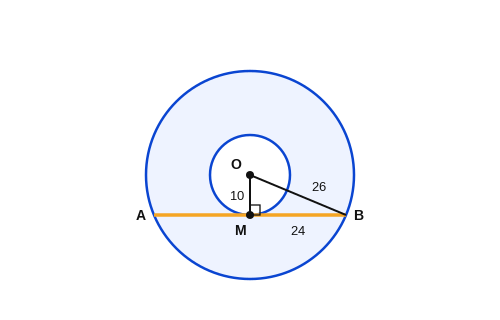
Two concentric circles have radii of 10 cm and 26 cm. Find the length of the chord of the larger circle that is tangent to the smaller circle.
दो संकेंद्री वृत्तों की त्रिज्याएँ 10 cm और 26 cm हैं। बड़े वृत्त की उस जीवा की लंबाई ज्ञात कीजिए जो छोटे वृत्त को स्पर्श करती है।
  1. A20 cm
  2. B48 cm
  3. C50 cm
  4. D52 cm
Show answer

Concept: The radius to the point of tangency is perpendicular to the tangent, and the perpendicular from the centre bisects a chord.

  1. In right △OMB: OM=10, OB=26.
  2. MB=262−102=676−100=24.
  3. Chord AB=2×24=48cm.

Trick: Triplet (5,12,13)×2=(10,24,26).

Answer: (B) 48 cm

अवधारणा: स्पर्श बिंदु तक त्रिज्या स्पर्शरेखा पर लंब होती है और केंद्र से लंब जीवा को समद्विभाजित करता है।

  1. समकोण △OMB में: OM=10, OB=26।
  2. MB=262−102=676−100=24।
  3. जीवा AB=2×24=48cm।

ट्रिक: त्रिक (5,12,13)×2=(10,24,26)।

उत्तर: (B) 48 cm

RRB NTPC Graduate CBT 1MathematicsGeometry – CirclesRRB NTPC Graduate CBT 1 2024 · 9 Jun Shift 3 →
Q10295.
What is the mean of the following distribution?
Marks1327596197
No. of Students9557809873
निम्नलिखित बंटन का माध्य क्या है?
अंक1327596197
विद्यार्थियों की संख्या9557809873
  1. A31
  2. B45
  3. C51
  4. D74
Show answer

Concept: Mean =∑fx∑f.

  1. ∑fx=13×95+27×57+59×80+61×98+97×73.
  2. =1235+1539+4720+5978+7081=20553.
  3. ∑f=95+57+80+98+73=403.
  4. Mean =20553403=51.

Trick: 403×50=20150; remainder 403 → exactly 51.

Answer: (C) 51

अवधारणा: माध्य =∑fx∑f।

  1. ∑fx=13×95+27×57+59×80+61×98+97×73।
  2. =1235+1539+4720+5978+7081=20553।
  3. ∑f=95+57+80+98+73=403।
  4. माध्य =20553403=51।

ट्रिक: 403×50=20150; शेष 403 → ठीक 51।

उत्तर: (C) 51

RRB NTPC Graduate CBT 1MathematicsStatistics – MeanRRB NTPC Graduate CBT 1 2024 · 9 Jun Shift 3 →
Q10296.
The cost of 5 shirts and 7 trousers together is ₹6,150 and the cost of 3 shirts is equal to the cost of 4 trousers. What is the cost (in ₹) of 2 shirts and 2 trousers together?
5 कमीज़ों और 7 पतलूनों का कुल मूल्य ₹6,150 है तथा 3 कमीज़ों का मूल्य 4 पतलूनों के मूल्य के बराबर है। 2 कमीज़ों और 2 पतलूनों का कुल मूल्य (₹ में) क्या है?
  1. A2,150
  2. B2,400
  3. C2,100
  4. D2,250
Show answer

Concept: Use the ratio 3S=4T to write everything in one unit.

  1. S:T=4:3; let S=4k, T=3k.
  2. 5(4k)+7(3k)=41k=6150⇒k=150.
  3. S=600, T=450; 2S+2T=2(1050)=2100.

Trick: 2S+2T=14k → 14×150=2100.

Answer: (C) 2,100

अवधारणा: अनुपात 3S=4T से सबको एक इकाई में लिखें।

  1. S:T=4:3; माना S=4k, T=3k।
  2. 5(4k)+7(3k)=41k=6150⇒k=150।
  3. S=600, T=450; 2S+2T=2(1050)=2100।

ट्रिक: 2S+2T=14k → 14×150=2100।

उत्तर: (C) 2,100

RRB NTPC Graduate CBT 1MathematicsLinear EquationsRRB NTPC Graduate CBT 1 2024 · 9 Jun Shift 3 →
Q10297.
In a certain code language,
A + B means ‘A is the mother of B’
A – B means ‘A is the brother of B’
A × B means ‘A is the wife of B’ and
A ÷ B means ‘A is the father of B’.
How is M related to Q if ‘M + N ÷ O – P × Q’?
एक निश्चित कूट भाषा में,
A + B का अर्थ है 'A, B की माँ है'
A – B का अर्थ है 'A, B का भाई है'
A × B का अर्थ है 'A, B की पत्नी है' और
A ÷ B का अर्थ है 'A, B का पिता है'।
यदि 'M + N ÷ O – P × Q' है, तो M का Q से क्या संबंध है?
  1. AWife's father's sisterपत्नी के पिता की बहन
  2. B​Wife's mother's motherपत्नी की माँ की माँ
  3. CWife's mother's sisterपत्नी की माँ की बहन
  4. DWife's father's motherपत्नी के पिता की माँ
Show answer

Concept: Decode each symbol and build the family tree from M to Q.

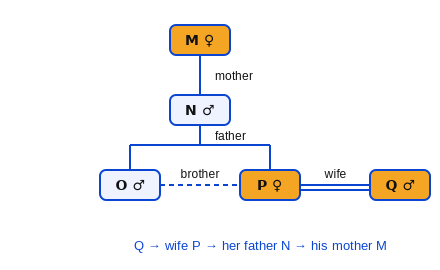
  1. M + N: M is the mother of N.
  2. N ÷ O: N is the father of O, so N is male.
  3. O – P: O is the brother of P, so N is also P's father.
  4. P × Q: P is the wife of Q. So N is Q's wife's father and M is N's mother.

Trick: Read the chain backward from Q: wife (P) → her father (N) → his mother (M).

Answer: (D) Wife's father's mother

अवधारणा: प्रत्येक चिह्न को डिकोड करके M से Q तक परिवार-वृक्ष (family tree) बनाइए।

  1. M + N: M, N की माँ है।
  2. N ÷ O: N, O का पिता है, अतः N पुरुष है।
  3. O – P: O, P का भाई है, इसलिए N, P का भी पिता है।
  4. P × Q: P, Q की पत्नी है। अतः N = Q की पत्नी का पिता, और M = N की माँ।

ट्रिक: Q से उल्टा पढ़ें: पत्नी (P) → उसके पिता (N) → उनकी माँ (M)।

उत्तर: (D) Wife's father's mother (पत्नी के पिता की माँ)

RRB NTPC Graduate CBT 1General Intelligence and ReasoningBlood Relations (Coded)RRB NTPC Graduate CBT 1 2024 · 9 Jun Shift 3 →
Q10298.
Town E is to the east of Town F. Town F is to the south of Town G. Town G is to the east of Town H. Town H is to the west of Town I. Town E is to the south-west of Town I. What is the position of Town G with respect to Town I?
नगर E, नगर F के पूर्व में है। नगर F, नगर G के दक्षिण में है। नगर G, नगर H के पूर्व में है। नगर H, नगर I के पश्चिम में है। नगर E, नगर I के दक्षिण-पश्चिम में है। नगर I के सापेक्ष नगर G की स्थिति क्या है?
  1. AEastपूर्व
  2. BNorthउत्तर
  3. CSouthदक्षिण
  4. DWestपश्चिम
Show answer

Concept: Place the towns on a grid one statement at a time.

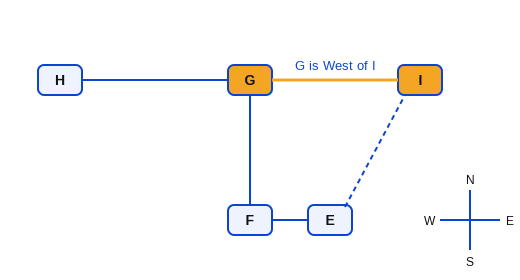
  1. G is east of H, and I is also east of H – G and I lie on the same east–west line as H.
  2. F is south of G and E is east of F.
  3. E is south-west of I, so I is further east than E, which is east of F (below G).
  4. Hence G lies to the left of I on the same line: G is to the west of I.

Trick: A point that is south-west of I but east of G's column puts G west of I.

Answer: (D) West

अवधारणा: कथनों के अनुसार कस्बों को एक-एक करके ग्रिड पर रखिए।

  1. G, H के पूर्व में है और I भी H के पूर्व में है – G और I, H वाली पूर्व–पश्चिम रेखा पर हैं।
  2. F, G के दक्षिण में है और E, F के पूर्व में है।
  3. E, I के दक्षिण-पश्चिम में है, अतः I, E से भी अधिक पूर्व में है।
  4. इसलिए G, I के बाईं ओर है: G, I के पश्चिम में है।

ट्रिक: E का I के दक्षिण-पश्चिम में होना बताता है कि I सबसे पूर्व में है, अतः G पश्चिम में।

उत्तर: (D) West (पश्चिम)

RRB NTPC Graduate CBT 1General Intelligence and ReasoningDirection SenseRRB NTPC Graduate CBT 1 2024 · 9 Jun Shift 3 →
Q10299.
This question is based on the five, three-digit numbers given below.
(Left) 898 740 280 169 993 (Right)
(Example: 697 – First digit = 6, second digit = 9 and third digit = 7)
(NOTE: All operations to be done from left to right.)
What will be the resultant if the first digit of the highest number is added to the third digit of the lowest number?
यह प्रश्न नीचे दी गई तीन अंकों वाली पाँच संख्याओं पर आधारित है।
(बाएँ) 898 740 280 169 993 (दाएँ)
(उदाहरण: 697 – पहला अंक = 6, दूसरा अंक = 9 और तीसरा अंक = 7)
(नोट: सभी संक्रियाएँ बाएँ से दाएँ की जानी हैं।)
यदि सबसे बड़ी संख्या के पहले अंक को सबसे छोटी संख्या के तीसरे अंक में जोड़ा जाए, तो परिणाम क्या होगा?
  1. A17
  2. B18
  3. C21
  4. D19
Show answer

Concept: Find the highest and lowest numbers, then pick the asked digits.

  1. Highest number =993; its first digit =9.
  2. Lowest number =169; its third digit =9.
  3. Sum =9+9=18.

Trick: Just compare the hundreds digits: 9 (993) is highest, 1 (169) is lowest.

Answer: (B) 18

अवधारणा: सबसे बड़ी और सबसे छोटी संख्या ज्ञात करके माँगे गए अंक लें।

  1. सबसे बड़ी संख्या =993; पहला अंक =9।
  2. सबसे छोटी संख्या =169; तीसरा अंक =9।
  3. योग =9+9=18।

ट्रिक: केवल सैकड़े का अंक तुलना करें: 993 सबसे बड़ी, 169 सबसे छोटी।

उत्तर: (B) 18

RRB NTPC Graduate CBT 1General Intelligence and ReasoningNumber ArrangementRRB NTPC Graduate CBT 1 2024 · 9 Jun Shift 3 →
Q10300.
Refer to the following number and symbol series and answer the question that follows. Counting to be done from left to right only.
(Left) 8 £ 6 @ & % 4 6 @ 8 $ 7 & 3 Ω 9 # 1 * 4 5 (Right)
How many such symbols are there each of which is immediately preceded by an even number and also immediately followed by an odd number?
निम्नलिखित संख्या और प्रतीक श्रृंखला को देखिए और उसके बाद आने वाले प्रश्न का उत्तर दीजिए। गिनती केवल बाएँ से दाएँ की जानी है।
(बाएँ) 8 £ 6 @ & % 4 6 @ 8 $ 7 & 3 Ω 9 # 1 * 4 5 (दाएँ)
ऐसे कितने प्रतीक हैं जिनमें से प्रत्येक के ठीक पहले एक सम संख्या है और ठीक बाद एक विषम संख्या भी है?
  1. AFourचार
  2. BTwoदो
  3. COneएक
  4. DThreeतीन
Show answer

Concept: Check every symbol: the element just before must be an even number and just after an odd number.

  1. £ (8 before, 6 after – even) ✗; @ (6 before, & after) ✗; &, % (symbol before) ✗.
  2. Second @ (6 before, 8 after – even) ✗.
  3. $ (8 before, 7 after – odd) ✓.
  4. &, Ω, #, * all have odd numbers before them ✗.

Trick: First list symbols preceded by an even number (£, @, @, $), then test the follower.

Answer: (C) One

अवधारणा: हर प्रतीक जाँचें: ठीक पहले सम संख्या और ठीक बाद विषम संख्या होनी चाहिए।

  1. £ (पहले 8, बाद में 6 – सम) ✗; @ (पहले 6, बाद में &) ✗; &, % (पहले प्रतीक) ✗।
  2. दूसरा @ (पहले 6, बाद में 8 – सम) ✗।
  3. $ (पहले 8, बाद में 7 – विषम) ✓।
  4. &, Ω, #, * के पहले विषम संख्याएँ हैं ✗।

ट्रिक: पहले वे प्रतीक छाँटें जिनके पहले सम संख्या है (£, @, @, $), फिर बाद वाली संख्या देखें।

उत्तर: (C) One (एक)

RRB NTPC Graduate CBT 1General Intelligence and ReasoningSymbol–Number SeriesRRB NTPC Graduate CBT 1 2024 · 9 Jun Shift 3 →