Question bank

Q&A: practice questions with answers

Search questions on any topic. Filter by exam category, exam, subject and topic, try the question, then open the answer and explanation.

Courses – airGurukul

20,719 questions found.

Q10401.
Two sets of numbers are given below. In each set of numbers, certain mathematical operation(s) on the first number result(s) in the second number. Similarly, certain mathematical operation(s) on the second number result(s) in the third number and so on. Which of the given options follows the same set of operations as in the given sets? (NOTE: Operations should be performed on the whole numbers, without breaking down the numbers into their constituent digits. E.g. 13 – Operations on 13 such as adding / subtracting /multiplying to 13 can be performed. Breaking down 13 into 1 and 3 and then performing mathematical operations on 1 and 3 is not allowed.)
10 - 20 - 40 - 80 ; 3 - 6 - 12 - 24
नीचे संख्याओं के दो समुच्चय दिए गए हैं। संख्याओं के प्रत्येक समुच्चय में, पहली संख्या पर कुछ गणितीय संक्रिया/संक्रियाएँ करने पर दूसरी संख्या प्राप्त होती है। इसी प्रकार, दूसरी संख्या पर कुछ गणितीय संक्रिया/संक्रियाएँ करने पर तीसरी संख्या प्राप्त होती है और इसी प्रकार आगे भी। दिए गए विकल्पों में से कौन-सा विकल्प दिए गए समुच्चयों के समान संक्रियाओं के समुच्चय का अनुसरण करता है? (ध्यान दें: संख्याओं को उनके घटक अंकों में विभाजित किए बिना, संक्रियाएँ पूर्ण संख्याओं पर की जानी चाहिए। उदाहरण के लिए 13 – 13 पर संक्रियाएँ जैसे 13 में जोड़ना/घटाना/गुणा करना आदि की जा सकती हैं। 13 को 1 और 3 में विभाजित करना और फिर 1 और 3 पर गणितीय संक्रियाएँ करना वर्जित है।)
10 - 20 - 40 - 80 ; 3 - 6 - 12 - 24
  1. A5 - 10 - 20 - 30
  2. B8 - 10 - 20 - 40
  3. C4 - 8 - 12 - 24
  4. D6 - 12 - 24 - 48
Show answer

Concept: Find the operation between consecutive numbers.

  1. 10→20→40→80: each ×2.
  2. 3→6→12→24: each ×2.
  3. 6→12→24→48: each ×2 ✓.

Trick: Option A ends 20→30, C has 8→12 – they break the doubling.

Answer: (D) 6 - 12 - 24 - 48

अवधारणा: क्रमागत संख्याओं के बीच संक्रिया खोजें।

  1. 10→20→40→80: हर बार ×2।
  2. 3→6→12→24: ×2।
  3. 6→12→24→48: ×2 ✓।

ट्रिक: A में 20→30, C में 8→12 – दोगुना नियम टूटता है।

उत्तर: (D) 6 - 12 - 24 - 48
RRB NTPC Graduate CBT 1General Intelligence and ReasoningNumber set patternRRB NTPC Graduate CBT 1 2024 · 9 Jun Shift 2 →
Q10402.
If ‘A’ stands for ‘÷’, ‘B’ stands for ‘×’, ‘C’ stands for ‘+’ and ‘D’ stands for ‘−’, then the resultant of which of the following would be 5?
यदि ‘A’ का अर्थ ‘÷’, ‘B’ का अर्थ ‘×’, ‘C’ का अर्थ ‘+’ और ‘D’ का अर्थ ‘−’ है, तो निम्नलिखित में से किसका परिणाम 5 होगा?
  1. A96 C 12 B 45 A 3 D 14
  2. B96 B 12 D 45 A 3 C 14
  3. C96 A 12 D 45 C 3 B 14
  4. D96 D 12 C 45 B 3 A 14
Show answer

Concept: Replace letters by operators and apply BODMAS.

  1. Option C: 96÷12−45+3×14.
  2. =8−45+42.
  3. =5 ✓.

Trick: Try the option with ÷ on 96 and 12 first – it gives a small number like 8.

Answer: (C) 96 A 12 D 45 C 3 B 14

अवधारणा: अक्षरों की जगह चिह्न रखें और BODMAS लगाएँ।

  1. विकल्प C: 96÷12−45+3×14।
  2. =8−45+42।
  3. =5 ✓।

ट्रिक: 96 ÷ 12 वाला विकल्प पहले जाँचें – छोटी संख्या 8 मिलती है।

उत्तर: (C) 96 A 12 D 45 C 3 B 14

RRB NTPC Graduate CBT 1General Intelligence and ReasoningSymbol substitutionRRB NTPC Graduate CBT 1 2024 · 9 Jun Shift 2 →
Q10403.
What should come in place of the question mark (?) in the given series?
501 500 497 492 485 ?
दी गई शृंखला में प्रश्न चिह्न (?) के स्थान पर क्या आना चाहिए?
501 500 497 492 485 ?
  1. A471
  2. B475
  3. C473
  4. D476
Show answer

Concept: Check the differences between consecutive terms.

  1. 501−1=500, 500−3=497, 497−5=492, 492−7=485.
  2. Subtracted numbers are consecutive odd numbers.
  3. Next: 485−9=476.

Trick: Also 501−n2: 501−0,501−1,501−4,…,501−25=476.

Answer: (D) 476

अवधारणा: क्रमागत पदों का अंतर देखें।

  1. घटाए गए: 1, 3, 5, 7 (क्रमागत विषम)।
  2. अगला घटाव 9।
  3. 485−9=476।

ट्रिक: 501−n2: 501−25=476।

उत्तर: (D) 476

RRB NTPC Graduate CBT 1General Intelligence and ReasoningNumber series – differencesRRB NTPC Graduate CBT 1 2024 · 9 Jun Shift 2 →
Q10404.
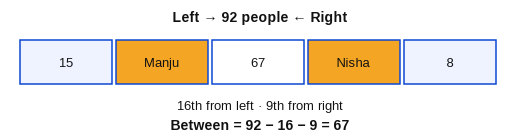
All 92 people are standing in a row facing north. Manju is 16th from the left end while Nisha is 9th from the right end. How many people are there between Manju and Nisha?
सभी 92 व्यक्ति उत्तर की ओर मुख करके एक पंक्ति में खड़े हैं। मंजू बाएँ छोर से 16वें स्थान पर है जबकि निशा दाएँ छोर से 9वें स्थान पर है। मंजू और निशा के बीच कितने व्यक्ति हैं?
  1. A58
  2. B48
  3. C65
  4. D67
Show answer

Concept: People between = Total − (position from left + position from right), when they do not overlap.

  1. Manju has 15 people on her left; Nisha has 8 on her right.
  2. 16+9=25<92, so they do not overlap.
  3. Between =92−16−9=67.

Trick: No overlap → Total − sum of positions.

Answer: (D) 67

अवधारणा: यदि स्थान आपस में न टकराएँ तो बीच के लोग = कुल − (बाएँ से स्थान + दाएँ से स्थान)।

  1. मंजू बाएँ से 16वीं, निशा दाएँ से 9वीं।
  2. 16+9=25<92, अतः ओवरलैप नहीं।
  3. बीच में =92−16−9=67।

ट्रिक: ओवरलैप नहीं → कुल − स्थानों का योग।

उत्तर: (D) 67

RRB NTPC Graduate CBT 1General Intelligence and ReasoningRanking in a rowRRB NTPC Graduate CBT 1 2024 · 9 Jun Shift 2 →
Q10405.
IV 17 is related to FR 6 in a certain way. In the same way, KJ 12 is related to HF 1. To which of the given options is OE −6 related, following the same logic?
IV 17 एक निश्चित प्रकार से FR 6 से संबंधित है। उसी प्रकार, KJ 12, HF 1 से संबंधित है। समान तर्क का अनुसरण करते हुए, OE −6 दिए गए विकल्पों में से किससे संबंधित है?
  1. AKI −13
  2. BLA −17
  3. CTR −29
  4. DPA −21
Show answer

Concept: Find the change in each letter and in the number.

  1. IV 17 → FR 6: I−3=F, V−4=R, 17−11=6.
  2. KJ 12 → HF 1: K−3=H, J−4=F, 12−11=1.
  3. OE −6 → O−3=L, E−4=A, −6−11=−17 → LA −17.

Trick: Rule: −3, −4, number −11.

Answer: (B) LA −17

अवधारणा: हर अक्षर और संख्या में परिवर्तन देखें।

  1. IV 17 → FR 6: −3, −4, −11।
  2. KJ 12 → HF 1: वही।
  3. OE −6 → L, A, −6−11=−17।

ट्रिक: नियम: −3, −4, संख्या −11।

उत्तर: (B) LA −17

RRB NTPC Graduate CBT 1General Intelligence and ReasoningAnalogy – letters and numbersRRB NTPC Graduate CBT 1 2024 · 9 Jun Shift 2 →
Q10406.
In a certain code language, ‘PAID’ is coded as ‘3517’ and ‘ARCS’ is coded as ‘2458’. What is the code for ‘A’ in the given code language?
एक निश्चित कूट भाषा में, ‘PAID’ को ‘3517’ के रूप में और ‘ARCS’ को ‘2458’ के रूप में कूटबद्ध किया जाता है। दी गई कूट भाषा में ‘A’ का कूट क्या है?
  1. A2
  2. B7
  3. C8
  4. D5
Show answer

Concept: A letter common to two words gets the digit common to both codes (order may be jumbled).

  1. PAID = 3517, ARCS = 2458.
  2. Common letter: A.
  3. Common digit: 5 → A = 5.

Trick: Match common letters with common digits.

Answer: (D) 5

अवधारणा: दोनों शब्दों में उभयनिष्ठ अक्षर को दोनों कोड का उभयनिष्ठ अंक मिलता है।

  1. PAID = 3517, ARCS = 2458।
  2. उभयनिष्ठ अक्षर: A।
  3. उभयनिष्ठ अंक: 5 → A = 5।

ट्रिक: उभयनिष्ठ अक्षर ↔ उभयनिष्ठ अंक।

उत्तर: (D) 5

RRB NTPC Graduate CBT 1General Intelligence and ReasoningCoding – common letterRRB NTPC Graduate CBT 1 2024 · 9 Jun Shift 2 →
Q10407.
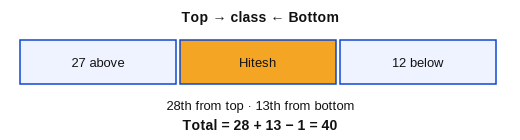
Hitesh ranked 28th from the top and 13th from the bottom in his class. How many students are there in his class?
हितेश अपनी कक्षा में ऊपर से 28वें और नीचे से 13वें स्थान पर है। उसकी कक्षा में कितने विद्यार्थी हैं?
  1. A42
  2. B40
  3. C41
  4. D39
Show answer

Concept: Total = rank from top + rank from bottom − 1.

  1. 28+13−1=40.
  2. 27 students above Hitesh, 12 below, plus Hitesh himself.

Trick: Subtract 1 because the person is counted twice.

Answer: (B) 40

अवधारणा: कुल = ऊपर से स्थान + नीचे से स्थान − 1।

  1. 28+13−1=40।
  2. हितेश के ऊपर 27, नीचे 12, और स्वयं हितेश।

ट्रिक: 1 घटाएँ क्योंकि व्यक्ति दो बार गिना गया।

उत्तर: (B) 40

RRB NTPC Graduate CBT 1General Intelligence and ReasoningRanking – total countRRB NTPC Graduate CBT 1 2024 · 9 Jun Shift 2 →
Q10408.
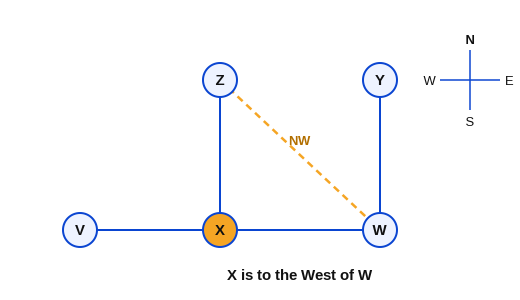
Town V is to the west of Town W. Town X is to the east of Town V. Town Y is to the north of Town W. Town Z is to the north of Town X. Town Z is to the north-west of Town W. What is the position of Town X with respect to Town W?
शहर V, शहर W के पश्चिम में है। शहर X, शहर V के पूर्व में है। शहर Y, शहर W के उत्तर में है। शहर Z, शहर X के उत्तर में है। शहर Z, शहर W के उत्तर-पश्चिम में है। शहर W के सापेक्ष शहर X की स्थिति क्या है?
  1. ANorthउत्तर
  2. BEastपूर्व
  3. CWestपश्चिम
  4. DSouthदक्षिण
Show answer

Concept: Place towns one by one on a grid.

  1. V is west of W; Y is north of W.
  2. Z is north of X and also north-west of W – so Z (and X below it) must lie to the west of W.
  3. X is east of V and on the same line as V and W, so X lies between V and W → X is west of W.

Trick: If Z is NW of W and X is directly below Z, X is due West of W.

Answer: (C) West

अवधारणा: शहरों को एक-एक करके ग्रिड पर रखें।

  1. V, W के पश्चिम में; Y, W के उत्तर में।
  2. Z, X के उत्तर में और W के उत्तर-पश्चिम में – अतः Z (और उसके नीचे X) W के पश्चिम में।
  3. X, V के पूर्व में और V–W रेखा पर → X, W के पश्चिम में।

ट्रिक: Z, W के NW में और X ठीक Z के नीचे → X, W के पश्चिम में।

उत्तर: (C) पश्चिम

RRB NTPC Graduate CBT 1General Intelligence and ReasoningDirection senseRRB NTPC Graduate CBT 1 2024 · 9 Jun Shift 2 →
Q10409.
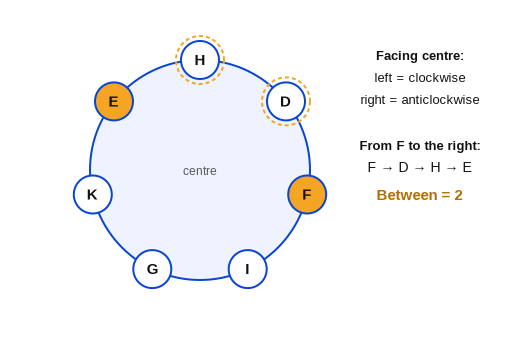
D, E, F, G, H, I and K are sitting around a circular table facing the centre of the table. I sits third to the left of H. E sits second to the left of G. Only H sits between D and E. K is not an immediate neighbour of I. How many people sit between F and E when counted from the right of F?
D, E, F, G, H, I और K एक वृत्ताकार मेज़ के चारों ओर मेज़ के केंद्र की ओर मुख करके बैठे हैं। I, H के बाएँ से तीसरे स्थान पर बैठा है। E, G के बाएँ से दूसरे स्थान पर बैठा है। D और E के बीच केवल H बैठा है। K, I का निकटतम पड़ोसी नहीं है। F के दाएँ से गिनने पर F और E के बीच कितने व्यक्ति बैठे हैं?
  1. AThreeतीन
  2. BFourचार
  3. COneएक
  4. DTwoदो
Show answer

Concept: Facing the centre: left = clockwise, right = anticlockwise.

  1. Fix H; I is 3rd to the left of H. D and E are the two neighbours of H.
  2. If E were to H's left, G (two to E's right) would clash with D – so D is H's immediate left, E is H's immediate right, and G sits second to the right of E, next to I.
  3. F and K fill the last two seats; K is not next to I, so F sits next to I. Order (clockwise): H, D, F, I, G, K, E.
  4. From F going right: D, H, then E → 2 people between.

Trick: Seat the fixed-distance clues (I, then D–H–E) first, then test the two cases.

Answer: (D) Two

अवधारणा: केंद्र की ओर मुख: बायाँ = दक्षिणावर्त, दायाँ = वामावर्त।

  1. H को स्थिर करें; I, H के बाएँ तीसरा। D और E, H के दोनों पड़ोसी।
  2. E को H के बाएँ रखने पर G का स्थान D से टकराता है – अतः D, H के ठीक बाएँ और E ठीक दाएँ; G, I के बगल में।
  3. K, I का पड़ोसी नहीं, अतः F, I के बगल में। क्रम (दक्षिणावर्त): H, D, F, I, G, K, E।
  4. F से दाईं ओर: D, H, फिर E → बीच में 2 लोग।

ट्रिक: पहले निश्चित दूरी वाले संकेत (I, फिर D–H–E) रखें, फिर दोनों स्थितियाँ जाँचें।

उत्तर: (D) दो

RRB NTPC Graduate CBT 1General Intelligence and ReasoningCircular seating arrangementRRB NTPC Graduate CBT 1 2024 · 9 Jun Shift 2 →
Q10410.
What should come in place of the question mark (?) in the given series?
34 46 58 70 ? 94 106
दी गई शृंखला में प्रश्न चिह्न (?) के स्थान पर क्या आना चाहिए?
34 46 58 70 ? 94 106
  1. A88
  2. B86
  3. C80
  4. D82
Show answer

Concept: Constant difference series.

  1. 46−34=12, 58−46=12, 70−58=12.
  2. Next: 70+12=82.
  3. Check: 82+12=94 ✓.

Trick: Verify with the term after the blank.

Answer: (D) 82

अवधारणा: अचर अंतर वाली श्रृंखला।

  1. अंतर 12।
  2. 70+12=82।
  3. जाँच: 82+12=94 ✓।

ट्रिक: खाली स्थान के बाद वाले पद से जाँचें।

उत्तर: (D) 82

RRB NTPC Graduate CBT 1General Intelligence and ReasoningNumber series – APRRB NTPC Graduate CBT 1 2024 · 9 Jun Shift 2 →
Q10411.
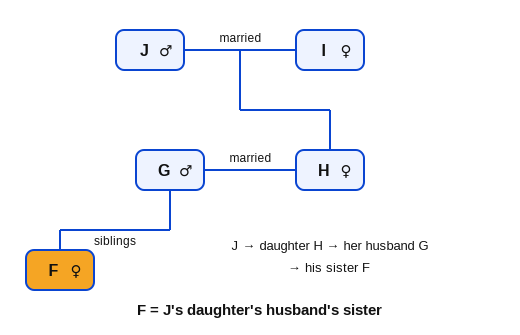
​F is the sister of G. G is the husband of H. H is the daughter of I. I is the wife of J. How is F related to J?
F, G की बहन है। G, H का पति है। H, I की पुत्री है। I, J की पत्नी है। F का J से क्या संबंध है?
  1. ADaughter's husband's motherपुत्री के पति की माता
  2. BSisterबहन
  3. CDaughter's husband's sisterपुत्री के पति की बहन
  4. DMotherमाता
Show answer

Concept: Build the family tree step by step.

  1. I is J's wife and H is their daughter.
  2. G is H's husband, i.e. J's son-in-law (daughter's husband).
  3. F is G's sister → F is J's daughter's husband's sister.

Trick: Trace the path J → H → G → F and read it in words.

Answer: (C) Daughter's husband's sister

अवधारणा: क्रमशः परिवार वृक्ष बनाएँ।

  1. I, J की पत्नी है और H उनकी बेटी।
  2. G, H का पति = J का दामाद।
  3. F, G की बहन → F, J की बेटी के पति की बहन।

ट्रिक: रास्ता J → H → G → F पढ़ें।

उत्तर: (C) Daughter's husband's sister

RRB NTPC Graduate CBT 1General Intelligence and ReasoningBlood relationsRRB NTPC Graduate CBT 1 2024 · 9 Jun Shift 2 →
Q10412.
A group of numbers/symbols is coded using letter codes as per the codes given below and the conditions that follow. If none of the conditions apply, then codes for the respective number/symbol to be followed directly as given in the table.
Number/S38@&275%19∆46 ymbol
CodeLEZMDWAPRTFBK Conditions:
(i) If the first element and the last element is a number, the codes for these two (the first and the last elements) are to be interchanged.
(ii) If the first element is an odd number and the last an even number, the first and last elements are to be coded as ©.
(iii) If both the second and third elements are perfect squares, the third element is to be coded as the code for the second element.
What will be the code for the following group?
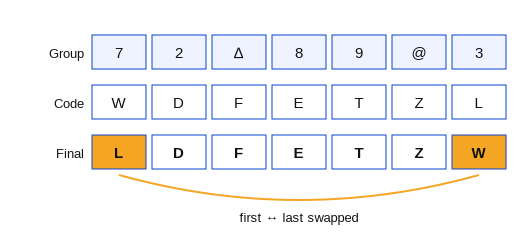
7 2 ∆ 8 9 @ 3
संख्याओं/प्रतीकों के एक समूह को नीचे दिए गए कूटों और उसके बाद दी गई शर्तों के अनुसार अक्षर कूटों का उपयोग करके कूटबद्ध किया जाता है। यदि कोई भी शर्त लागू नहीं होती है, तो संबंधित संख्या/प्रतीक के लिए तालिका में दिए गए कूटों का सीधे अनुसरण किया जाना है।
संख्या/प्र38@&275%19∆46 तीक
कूटLEZMDWAPRTFBK शर्तें:
(i) यदि पहला तत्व और अंतिम तत्व एक संख्या है, तो इन दोनों (पहले और अंतिम तत्वों) के कूट आपस में बदल दिए जाने हैं।
(ii) यदि पहला तत्व एक विषम संख्या है और अंतिम एक सम संख्या है, तो पहले और अंतिम तत्वों को © के रूप में कूटबद्ध किया जाना है।
(iii) यदि दूसरा और तीसरा दोनों तत्व पूर्ण वर्ग हैं, तो तीसरे तत्व को दूसरे तत्व के कूट के रूप में कूटबद्ध किया जाना है।
निम्नलिखित समूह का कूट क्या होगा?
7 2 ∆ 8 9 @ 3
  1. AW D F L T Z W
  2. BW D F E T Z L
  3. CL D F E Z T W
  4. DL D F E T Z W
Show answer

Concept: Write the table code of each element, then test the conditions one by one; apply only the one that holds.

  1. Table codes: 7→W, 2→D, ∆→F, 8→E, 9→T, @→Z, 3→L, so plain coding gives W D F E T Z L.
  2. Condition (i): first element 7 and last element 3 are both numbers → their codes are interchanged.
  3. Condition (ii) fails (last element 3 is odd, not even); condition (iii) fails (2 and ∆ are not perfect squares).
  4. Final code: L D F E T Z W.

Trick: Check condition (ii) right after (i) — it needs odd first and even last; here both ends are odd, so only the swap applies.

Answer: (D) L D F E T Z W

अवधारणा: हर तत्व का तालिका वाला कोड लिखें, फिर शर्तें एक-एक कर जाँचें; केवल लागू होने वाली शर्त अपनाएँ।

  1. तालिका कोड: 7→W, 2→D, ∆→F, 8→E, 9→T, @→Z, 3→L; सामान्य कोड W D F E T Z L।
  2. शर्त (i): पहला 7 और अंतिम 3 दोनों संख्याएँ हैं → इनके कोड आपस में बदल जाएँगे।
  3. शर्त (ii) लागू नहीं (अंतिम 3 विषम है, सम नहीं); शर्त (iii) भी नहीं (2 और ∆ पूर्ण वर्ग नहीं)।
  4. अंतिम कोड: L D F E T Z W।

ट्रिक: शर्त (ii) के लिए पहला विषम और अंतिम सम चाहिए; यहाँ दोनों सिरे विषम हैं, इसलिए केवल अदला-बदली होगी।

उत्तर: (D) L D F E T Z W

RRB NTPC Graduate CBT 1General Intelligence and ReasoningCoding with ConditionsRRB NTPC Graduate CBT 1 2024 · 9 Jun Shift 2 →
Q10413.
KQRL is related to OTTM in a certain way based on the English alphabetical order. In the same way, SWVN is related to WZXO. To which of the given options is ACZP related, following the same logic?
अंग्रेज़ी वर्णमाला क्रम के आधार पर KQRL एक निश्चित प्रकार से OTTM से संबंधित है। उसी प्रकार, SWVN, WZXO से संबंधित है। समान तर्क का अनुसरण करते हुए, ACZP दिए गए विकल्पों में से किससे संबंधित है?
  1. ADEAP
  2. BDGBP
  3. CFDZR
  4. DEFBQ
Show answer

Concept: Compare each letter of the first cluster with the corresponding letter of the second using alphabet positions.

  1. KQRL → OTTM: K+4=O, Q+3=T, R+2=T, L+1=M.
  2. SWVN → WZXO: S+4=W, W+3=Z, V+2=X, N+1=O (same pattern +4, +3, +2, +1).
  3. ACZP: A+4=E, C+3=F, Z+2=B (wraps around), P+1=Q → EFBQ.

Trick: Pattern +4, +3, +2, +1; after Z continue from A (Z+2 = B).

Answer: (D) EFBQ

अवधारणा: अक्षरों की वर्णमाला स्थिति से पहले समूह के प्रत्येक अक्षर की तुलना दूसरे समूह के संगत अक्षर से करें।

  1. KQRL → OTTM: K+4=O, Q+3=T, R+2=T, L+1=M।
  2. SWVN → WZXO: S+4=W, W+3=Z, V+2=X, N+1=O (वही पैटर्न +4, +3, +2, +1)।
  3. ACZP: A+4=E, C+3=F, Z+2=B (Z के बाद फिर A से), P+1=Q → EFBQ।

ट्रिक: पैटर्न +4, +3, +2, +1; Z के बाद गिनती A से शुरू (Z+2 = B)।

उत्तर: (D) EFBQ

RRB NTPC Graduate CBT 1General Intelligence and ReasoningLetter AnalogyRRB NTPC Graduate CBT 1 2024 · 9 Jun Shift 2 →
Q10414.
A, B, C, D, E and F live on six different floors of the same building. The lowermost floor in the building is numbered 1, the floor above it, number 2 and so on till the topmost floor is numbered 6.
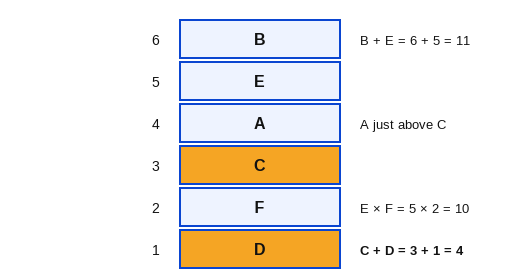
The product of floors on which E and F live is 10. A lives immediately above C. The sum of floors on which B and E live is 11.
What is the sum of floors on which C and D live?
A, B, C, D, E और F एक ही इमारत की छह अलग-अलग मंज़िलों पर रहते हैं। इमारत की सबसे निचली मंज़िल की संख्या 1 है, उसके ऊपर वाली मंज़िल की संख्या 2 है और इसी प्रकार सबसे ऊपरी मंज़िल की संख्या 6 है।
E और F जिन मंज़िलों पर रहते हैं, उनका गुणनफल 10 है। A, C के ठीक ऊपर रहता है। B और E जिन मंज़िलों पर रहते हैं, उनका योग 11 है।
C और D जिन मंज़िलों पर रहते हैं, उनका योग क्या है?
  1. A6
  2. B4
  3. C5
  4. D7
Show answer

Concept: Fix the persons with numeric clues first, then place the rest.

  1. E×F=10 with floors 1–6 ⇒{E,F}={2,5}.
  2. B+E=11: if E=2, B=9 (impossible); so E=5, B=6, F=2.
  3. Remaining floors 1, 3, 4: A immediately above C ⇒ C = 3, A = 4, so D = 1.
  4. C+D=3+1=4.

Trick: A product of 10 among 1–6 can only be 2 × 5 — start from there.

Answer: (B) 4

अवधारणा: पहले संख्यात्मक संकेतों वाले व्यक्तियों को तय करें, फिर बाकी को रखें।

  1. E×F=10, मंज़िलें 1–6 ⇒{E,F}={2,5}।
  2. B+E=11: यदि E=2 तो B=9 (संभव नहीं); अतः E=5, B=6, F=2।
  3. बची मंज़िलें 1, 3, 4: A ठीक C के ऊपर ⇒ C = 3, A = 4, तो D = 1।
  4. C+D=3+1=4।

ट्रिक: 1–6 में गुणनफल 10 केवल 2 × 5 से बनता है — वहीं से शुरू करें।

उत्तर: (B) 4

RRB NTPC Graduate CBT 1General Intelligence and ReasoningFloor PuzzleRRB NTPC Graduate CBT 1 2024 · 9 Jun Shift 2 →
Q10415.
Based on the English alphabetical order, three of the following four letter-cluster pairs are alike in a certain way and thus form a group. Which letter-cluster pair DOES NOT belong to that group?
(Note: The odd one out is not based on the number of consonants/vowels or their position in the letter-cluster.)
अंग्रेज़ी वर्णमाला क्रम के आधार पर, निम्नलिखित चार अक्षर-समूह युग्मों में से तीन किसी निश्चित प्रकार से समान हैं और इस प्रकार एक समूह बनाते हैं। कौन-सा अक्षर-समूह युग्म उस समूह से संबंधित नहीं है?
(ध्यान दें: असंगत अक्षर-समूह, उस अक्षर-समूह में व्यंजनों/स्वरों की संख्या या उनकी स्थिति पर आधारित नहीं है।)
  1. AJM - IL
  2. BNQ - MP
  3. CFI - EH
  4. DNT - JK
Show answer

Concept: Find the rule linking the two clusters of each pair using alphabet positions.

  1. JM – IL: J−1 = I, M−1 = L.
  2. NQ – MP: N−1 = M, Q−1 = P; FI – EH: F−1 = E, I−1 = H.
  3. NT – JK: N−4 = J, T−9 = K — the −1, −1 rule breaks.

Trick: In the three alike pairs both clusters also have a gap of 3 (J_M, N_Q, F_I); NT has a gap of 6.

Answer: (D) NT - JK

अवधारणा: हर युग्म के दोनों समूहों का संबंध अक्षरों की वर्णमाला स्थिति से जाँचें।

  1. JM – IL: J−1 = I, M−1 = L।
  2. NQ – MP: N−1 = M, Q−1 = P; FI – EH: F−1 = E, I−1 = H।
  3. NT – JK: N−4 = J, T−9 = K — −1, −1 का नियम टूट गया।

ट्रिक: तीन समान युग्मों में पहले समूह में अक्षरों का अंतर 3 है (J_M, N_Q, F_I); NT में 6 है।

उत्तर: (D) NT - JK

RRB NTPC Graduate CBT 1General Intelligence and ReasoningOdd One Out – Letter PairsRRB NTPC Graduate CBT 1 2024 · 9 Jun Shift 2 →
Q10416.
In a certain code language, ‘good morning all’ is coded as ‘cx fg zq’ and ‘all students present’ is coded as ‘zq nr vk’. How is ‘all’ coded in the given language?
एक निश्चित कूट भाषा में, ‘good morning all’ को ‘cx fg zq’ के रूप में और ‘all students present’ को ‘zq nr vk’ के रूप में कूटबद्ध किया जाता है। दी गई भाषा में ‘all’ को किस प्रकार कूटबद्ध किया जाता है?
  1. Azq
  2. Bnr
  3. Cfg
  4. Dvk
Show answer

Concept: A word common to two sentences gets the code common to both coded sentences.

  1. ‘good morning all’ → ‘cx fg zq’; ‘all students present’ → ‘zq nr vk’.
  2. Common word: ‘all’; common code: ‘zq’.

Trick: Match common word with common code.

Answer: (A) zq

अवधारणा: दोनों वाक्यों में उभयनिष्ठ शब्द का कोड दोनों कोडित वाक्यों में उभयनिष्ठ कोड होता है।

  1. ‘good morning all’ → ‘cx fg zq’; ‘all students present’ → ‘zq nr vk’।
  2. उभयनिष्ठ शब्द ‘all’; उभयनिष्ठ कोड ‘zq’।

ट्रिक: उभयनिष्ठ शब्द = उभयनिष्ठ कोड।

उत्तर: (A) zq

RRB NTPC Graduate CBT 1General Intelligence and ReasoningCoding–Decoding (Common Word)RRB NTPC Graduate CBT 1 2024 · 9 Jun Shift 2 →
Q10417.
This question is based on the five, three-digit numbers given below.
(Left) 210 878 407 692 140 (Right)
(Example: 697 – First digit = 6, second digit = 9 and third digit = 7)
(NOTE: All operations to be done from left to right.)
What will be the resultant if the third digit of the highest number is subtracted from the first digit of the lowest number?
यह प्रश्न नीचे दी गई पाँच, तीन-अंकीय संख्याओं पर आधारित है।
(बाएँ) 210 878 407 692 140 (दाएँ)
(उदाहरण: 697 – पहला अंक = 6, दूसरा अंक = 9 और तीसरा अंक = 7)
(ध्यान दें: सभी संक्रियाएँ बाएँ से दाएँ की जानी हैं।)
यदि सबसे बड़ी संख्या के तीसरे अंक को सबसे छोटी संख्या के पहले अंक में से घटाया जाए, तो परिणाम क्या होगा?
  1. A−6
  2. B−7
  3. C−8
  4. D−4
Show answer

Concept: Identify the required numbers first, then pick the asked digits.

  1. Numbers: 210, 878, 407, 692, 140. Highest = 878, lowest = 140.
  2. Third digit of 878 = 8; first digit of 140 = 1.
  3. “8 subtracted from 1”: 1−8=−7.

Trick: “A subtracted from B” means B − A — watch the order.

Answer: (B) −7

अवधारणा: पहले आवश्यक संख्याएँ पहचानें, फिर पूछे गए अंक चुनें।

  1. संख्याएँ: 210, 878, 407, 692, 140। सबसे बड़ी = 878, सबसे छोटी = 140।
  2. 878 का तीसरा अंक = 8; 140 का पहला अंक = 1।
  3. “8 को 1 में से घटाना”: 1−8=−7।

ट्रिक: “A को B में से घटाना” = B − A; क्रम का ध्यान रखें।

उत्तर: (B) −7

RRB NTPC Graduate CBT 1General Intelligence and ReasoningNumber Arrangement – DigitsRRB NTPC Graduate CBT 1 2024 · 9 Jun Shift 2 →
Q10418.
If 2 is added to each odd digit and 1 is subtracted from each even digit in the number 2645783, what will be the sum of the highest and lowest digits in the new number thus formed?
यदि संख्या 2645783 में प्रत्येक विषम अंक में 2 जोड़ा जाए और प्रत्येक सम अंक में से 1 घटाया जाए, तो इस प्रकार बनी नई संख्या में सबसे बड़े और सबसे छोटे अंकों का योग क्या होगा?
  1. A10
  2. B14
  3. C12
  4. D16
Show answer

Concept: Change every digit as per its odd/even nature, then read the new number.

  1. 2645783: 2→1, 6→5, 4→3, 5→7, 7→9, 8→7, 3→5.
  2. New number: 1537975.
  3. Highest digit 9, lowest digit 1; sum =9+1=10.

Trick: Only the extremes matter: largest odd 7 → 9, smallest even 2 → 1.

Answer: (A) 10

अवधारणा: प्रत्येक अंक को उसके विषम/सम होने के अनुसार बदलें, फिर नई संख्या पढ़ें।

  1. 2645783: 2→1, 6→5, 4→3, 5→7, 7→9, 8→7, 3→5।
  2. नई संख्या: 1537975।
  3. सबसे बड़ा अंक 9, सबसे छोटा 1; योग =9+1=10।

ट्रिक: केवल सिरे देखें: सबसे बड़ा विषम 7 → 9, सबसे छोटा सम 2 → 1।

उत्तर: (A) 10

RRB NTPC Graduate CBT 1General Intelligence and ReasoningDigit OperationsRRB NTPC Graduate CBT 1 2024 · 9 Jun Shift 2 →
Q10419.
If + means −, − means ×, × means ÷, and ÷ means +, then what will come in place of the question mark (?) in the following equation?
30 − 5 ÷ 2 + 10 × 2 = ?
यदि + का अर्थ −, − का अर्थ ×, × का अर्थ ÷ और ÷ का अर्थ + है, तो निम्नलिखित समीकरण में प्रश्न चिह्न (?) के स्थान पर क्या आएगा?
30 − 5 ÷ 2 + 10 × 2 = ?
  1. A150
  2. B147
  3. C100
  4. D125
Show answer

Concept: Replace each symbol with its meaning, then solve using BODMAS.

  1. 30−5÷2+10×2 becomes 30×5+2−10÷2.
  2. =150+2−5=147

Trick: Rewrite the full expression first; do not substitute and solve at the same time.

Answer: (B) 147

अवधारणा: हर चिह्न को उसके अर्थ से बदलें, फिर BODMAS से हल करें।

  1. 30−5÷2+10×2 बन जाता है 30×5+2−10÷2।
  2. =150+2−5=147

ट्रिक: पहले पूरा व्यंजक दोबारा लिखें; बदलना और हल करना एक साथ न करें।

उत्तर: (B) 147

RRB NTPC Graduate CBT 1General Intelligence and ReasoningMathematical OperationsRRB NTPC Graduate CBT 1 2024 · 9 Jun Shift 2 →
Q10420.
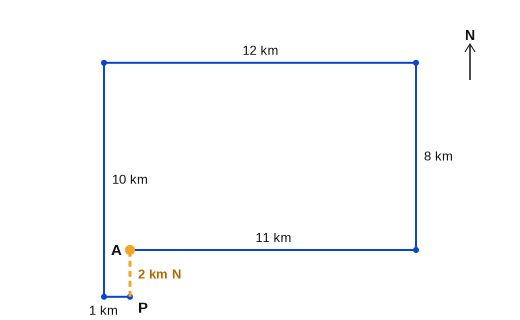
Sunny starts from point A and drives 11 km towards the east. He then takes a left turn, drives 8 km, turns left and drives 12 km. He then takes a left turn and drives 10 km. He takes a final left turn, drives 1 km and stops at point P. How far (shortest distance) and towards which direction should he drive in order to reach point A again? (All turns are 90 degree turns only unless specified.)
सनी बिंदु A से चलना शुरू करता है और पूर्व की ओर 11 km गाड़ी चलाता है। फिर वह बाएँ मुड़ता है, 8 km गाड़ी चलाता है, बाएँ मुड़ता है और 12 km गाड़ी चलाता है। फिर वह बाएँ मुड़ता है और 10 km गाड़ी चलाता है। वह अंतिम बार बाएँ मुड़ता है, 1 km गाड़ी चलाता है और बिंदु P पर रुक जाता है। पुनः बिंदु A तक पहुँचने के लिए उसे कितनी दूरी (न्यूनतम दूरी) तक और किस दिशा में गाड़ी चलानी चाहिए? (जब तक निर्दिष्ट न किया जाए, सभी मोड़ केवल 90 डिग्री के मोड़ हैं।)
  1. A2 km to the southदक्षिण की ओर 2 km
  2. B2 km to the northउत्तर की ओर 2 km
  3. C1 km to the southदक्षिण की ओर 1 km
  4. D4 km to the southदक्षिण की ओर 4 km
Show answer

Concept: Track the position on coordinate axes (east = +x, north = +y), turning left each time.

  1. Start A (0, 0) → 11 km east → (11, 0).
  2. Left (north) 8 km → (11, 8); left (west) 12 km → (−1, 8).
  3. Left (south) 10 km → (−1, −2); left (east) 1 km → P (0, −2).
  4. P is 2 km directly south of A, so he must drive 2 km north.

Trick: Net east–west: 11 − 12 + 1 = 0; net north–south: 8 − 10 = −2 → P is 2 km south of A.

Answer: (B) 2 km to the north

अवधारणा: स्थिति को निर्देशांक पर देखें (पूर्व = +x, उत्तर = +y), हर बार बाएँ मुड़ना है।

  1. प्रारंभ A (0, 0) → 11 km पूर्व → (11, 0)।
  2. बाएँ (उत्तर) 8 km → (11, 8); बाएँ (पश्चिम) 12 km → (−1, 8)।
  3. बाएँ (दक्षिण) 10 km → (−1, −2); बाएँ (पूर्व) 1 km → P (0, −2)।
  4. P, A से ठीक 2 km दक्षिण में है, अतः उसे 2 km उत्तर जाना होगा।

ट्रिक: शुद्ध पूर्व–पश्चिम: 11 − 12 + 1 = 0; शुद्ध उत्तर–दक्षिण: 8 − 10 = −2 → P, A से 2 km दक्षिण में।

उत्तर: (B) 2 km उत्तर की ओर

RRB NTPC Graduate CBT 1General Intelligence and ReasoningDirection and DistanceRRB NTPC Graduate CBT 1 2024 · 9 Jun Shift 2 →