Question bank

Q&A: practice questions with answers

Search questions on any topic. Filter by exam category, exam, subject and topic, try the question, then open the answer and explanation.

Courses – airGurukul

20,719 questions found.

Q10481.
The value of 3 + tan2∅ + cot2∅ − sec2∅ cosec2∅ is:
3 + tan2∅ + cot2∅ − sec2∅ cosec2∅ का मान है:
  1. A1
  2. B2
  3. C−1
  4. D0
Show answer

Concept: Use sec2θcosec2θ=sec2θ+cosec2θ (since 1sin2θcos2θ=sin2θ+cos2θsin2θcos2θ).

  1. sec2θ+cosec2θ=(1+tan2θ)+(1+cot2θ)=2+tan2θ+cot2θ.
  2. Expression =3+tan2θ+cot2θ−2−tan2θ−cot2θ.
  3. =1.

Trick: Put θ=45∘: 3+1+1−2×2=1.

Answer: (A) 1

अवधारणा: sec2θcosec2θ=sec2θ+cosec2θ का प्रयोग करें।

  1. sec2θ+cosec2θ=(1+tan2θ)+(1+cot2θ)=2+tan2θ+cot2θ।
  2. व्यंजक =3+tan2θ+cot2θ−2−tan2θ−cot2θ।
  3. =1।

ट्रिक: θ=45∘ रखें: 3+1+1−2×2=1।

उत्तर: (A) 1

RRB NTPC Graduate CBT 1MathematicsTrigonometric IdentitiesRRB NTPC Graduate CBT 1 2024 · 9 Jun Shift 1 →
Q10482.
Find roots of 5m2+18m+16=0
5m2+18m+16=0 के मूल ज्ञात कीजिए।
  1. A−85 and 4−85 और 4
  2. B85 and −485 और −4
  3. C85 and 285 और 2
  4. D−85 and −2−85 और −2
Show answer

Concept: Solve 5m2+18m+16=0 by splitting the middle term.

  1. 5×16=80; 10+8=18, 10×8=80.
  2. 5m2+10m+8m+16=5m(m+2)+8(m+2)=(5m+8)(m+2).
  3. m=−85 or m=−2.

Trick: All coefficients positive ⇒ both roots negative; sum =−185, product =165.

Answer: (D) −85 and −2

अवधारणा: मध्य पद विभाजन से 5m2+18m+16=0 हल करें।

  1. 5×16=80; 10+8=18, 10×8=80।
  2. 5m2+10m+8m+16=5m(m+2)+8(m+2)=(5m+8)(m+2)।
  3. m=−85 या m=−2।

ट्रिक: सभी गुणांक धनात्मक ⇒ दोनों मूल ऋणात्मक; योग =−185, गुणनफल =165।

उत्तर: (D) −85 और −2

RRB NTPC Graduate CBT 1MathematicsQuadratic EquationsRRB NTPC Graduate CBT 1 2024 · 9 Jun Shift 1 →
Q10483.
If x−1x=3, then the value of x4+1x4 is:
यदि x−1x=3 है, तो x4+1x4 का मान है:
  1. A19
  2. B196
  3. C176
  4. D119
Show answer

Concept: Square step by step: (x−1x)2=x2+1x2−2 and (x2+1x2)2=x4+1x4+2.

  1. x2+1x2=32+2=11.
  2. x4+1x4=112−2=121−2=119.

Trick: Minus-form: add 2 first, then subtract 2: (9+2)2−2.

Answer: (D) 119

अवधारणा: क्रमशः वर्ग करें: (x−1x)2=x2+1x2−2 और (x2+1x2)2=x4+1x4+2।

  1. x2+1x2=32+2=11।
  2. x4+1x4=112−2=121−2=119।

ट्रिक: ऋण-रूप में: पहले 2 जोड़ें, फिर 2 घटाएँ: (9+2)2−2।

उत्तर: (D) 119

RRB NTPC Graduate CBT 1MathematicsAlgebraic IdentitiesRRB NTPC Graduate CBT 1 2024 · 9 Jun Shift 1 →
Q10484.
X is directly proportional to A2 and A is inversely proportional to Y. If X is 97 when Y is 6, find X when Y is 2.
X, A2 के अनुक्रमानुपाती है और A, Y के व्युत्क्रमानुपाती है। यदि Y के 6 होने पर X का मान 97 है, तो Y के 2 होने पर X का मान ज्ञात कीजिए।
  1. A873
  2. B871
  3. C872
  4. D875
Show answer

Concept: Combine the two variations: X∝A2 and A∝1Y give X∝1Y2, i.e. XY2=k.

  1. k=97×62=97×36.
  2. When Y=2: X=97×364=97×9.
  3. X=873.

Trick: Y becomes 13, so X becomes 32=9 times.

Answer: (A) 873

अवधारणा: दोनों विचरण मिलाएँ: X∝A2 और A∝1Y से X∝1Y2, यानी XY2=k।

  1. k=97×62=97×36।
  2. Y=2 पर: X=97×364=97×9।
  3. X=873।

ट्रिक: Y एक-तिहाई हुआ, तो X 32=9 गुना।

उत्तर: (A) 873

RRB NTPC Graduate CBT 1MathematicsVariationRRB NTPC Graduate CBT 1 2024 · 9 Jun Shift 1 →
Q10485.
A person saves 40% of his income. If his expenditure is ₹960, then his income (in ₹) is:
एक व्यक्ति अपनी आय का 40% बचाता है। यदि उसका व्यय ₹960 है, तो उसकी आय (₹ में) है:
  1. A1,640
  2. B576
  3. C1,600
  4. D384
Show answer

Concept: Expenditure = Income − Savings.

  1. Savings 40% ⇒ expenditure =60% of income.
  2. 0.6×I=960⇒I=9600.6=1600.

Trick: 60%=960⇒10%=160⇒100%=1600.

Answer: (C) ₹1,600

अवधारणा: व्यय = आय − बचत।

  1. बचत 40% ⇒ व्यय =60% आय।
  2. 0.6×I=960⇒I=9600.6=1600।

ट्रिक: 60%=960⇒10%=160⇒100%=1600।

उत्तर: (C) ₹1,600

RRB NTPC Graduate CBT 1MathematicsPercentageRRB NTPC Graduate CBT 1 2024 · 9 Jun Shift 1 →
Q10486.
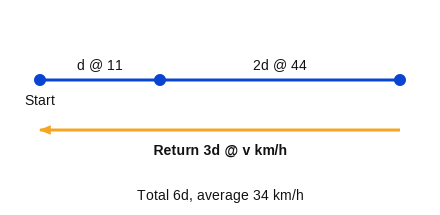
Babita travels a certain distance at a speed of 11 km/hr and double the earlier distance at 44 km/hr. She then returns to the starting point through the same route. If her average speed for the entire journey is 34 km/hr, then what is her speed (in km/hr) for the return journey?
बबीता एक निश्चित दूरी 11 km/hr की चाल से और उससे दोगुनी दूरी 44 km/hr की चाल से तय करती है। फिर वह उसी मार्ग से प्रारंभिक बिंदु पर लौटती है। यदि पूरी यात्रा के लिए उसकी औसत चाल 34 km/hr है, तो वापसी यात्रा के लिए उसकी चाल (km/hr में) कितनी है?
  1. A70
  2. B79
  3. C74.8
  4. D76.8
Show answer

Concept: Average speed =total distancetotal time.

  1. Onward time =d11+2d44=3d22.
  2. Return 3d at v: time =3dv. Total distance =6d.
  3. 6d3d22+3dv=34⇒122+1v=117.
  4. 1v=22−17374=5374⇒v=74.8km/h.

Trick: Onward average =3d3d/22=22; equal legs ⇒ 2×22v22+v=34.

Answer: (C) 74.8

अवधारणा: औसत चाल =कुल दूरीकुल समय।

  1. जाने का समय =d11+2d44=3d22।
  2. वापसी 3d, चाल v: समय =3dv। कुल दूरी =6d।
  3. 6d3d22+3dv=34⇒122+1v=117।
  4. 1v=22−17374=5374⇒v=74.8km/h।

ट्रिक: जाने की औसत चाल 22; बराबर दूरी ⇒ 2×22v22+v=34।

उत्तर: (C) 74.8

RRB NTPC Graduate CBT 1MathematicsAverage SpeedRRB NTPC Graduate CBT 1 2024 · 9 Jun Shift 1 →
Q10487.
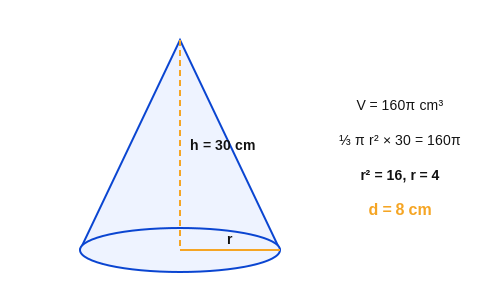
If the volume of a right circular cone of height 30 cm is 160π cm3, find the diameter of its base.
यदि 30 cm ऊँचाई वाले एक लंब वृत्तीय शंकु का आयतन 160π cm3 है, तो इसके आधार का व्यास ज्ञात कीजिए।
  1. A13 cm
  2. B16 cm
  3. C8 cm
  4. D7 cm
Show answer

Concept: Volume of cone =13πr2h.

  1. 13πr2×30=160π.
  2. 10r2=160⇒r2=16⇒r=4cm.
  3. Diameter =2r=8cm.

Trick: Cancel π first: r2=3×16030=16.

Answer: (C) 8 cm

अवधारणा: शंकु का आयतन =13πr2h।

  1. 13πr2×30=160π।
  2. 10r2=160⇒r2=16⇒r=4cm।
  3. व्यास =2r=8cm।

ट्रिक: पहले π काटें: r2=3×16030=16।

उत्तर: (C) 8 cm

RRB NTPC Graduate CBT 1MathematicsMensuration – ConeRRB NTPC Graduate CBT 1 2024 · 9 Jun Shift 1 →
Q10488.
A man bought 8 shirts at ₹550 each,10 pants at ₹1,000 each and 12 pairs of shoes at ₹850 each pair. What is the average expenditure per article?
एक व्यक्ति ने ₹550 प्रति शर्ट की दर से 8 शर्ट, ₹1,000 प्रति पैंट की दर से 10 पैंट और ₹850 प्रति जोड़ी की दर से 12 जोड़ी जूते खरीदे। प्रति वस्तु औसत व्यय कितना है?
  1. A₹820
  2. B₹840
  3. C₹826
  4. D₹836
Show answer

Concept: Average per article =total costtotal articles.

  1. Shirts 8×550=4400; pants 10×1000=10000; shoes 12×850=10200.
  2. Total =24600 for 8+10+12=30 articles.
  3. Average =2460030=820.

Trick: Count articles carefully: pairs of shoes are counted as 12 articles.

Answer: (A) ₹820

अवधारणा: प्रति वस्तु औसत =कुल खर्चकुल वस्तुएँ।

  1. शर्ट 8×550=4400; पैंट 10×1000=10000; जूते 12×850=10200।
  2. कुल =24600, वस्तुएँ 8+10+12=30।
  3. औसत =2460030=820।

ट्रिक: जूतों के 12 जोड़े = 12 वस्तुएँ गिनें।

उत्तर: (A) ₹820

RRB NTPC Graduate CBT 1MathematicsAverageRRB NTPC Graduate CBT 1 2024 · 9 Jun Shift 1 →
Q10489.
The average weight of A, B and C is 45 kg. If the average weight of A and B is 40 kg and that of B and C is 42 kg, then the weight of B (in kg) is:
A, B और C का औसत भार 45 kg है। यदि A और B का औसत भार 40 kg है और B और C का औसत भार 42 kg है, तो B का भार (kg में) है:
  1. A39
  2. B44
  3. C29
  4. D19
Show answer

Concept: Convert averages to sums: the overlapping member B is counted twice.

  1. A+B+C=3×45=135.
  2. A+B=80, B+C=84.
  3. (A+B)+(B+C)−(A+B+C)=B=80+84−135=29.

Trick: Middle person = sum of two pair-totals − grand total.

Answer: (C) 29

अवधारणा: औसत को योग में बदलें: साझा सदस्य B दो बार गिना जाता है।

  1. A+B+C=3×45=135।
  2. A+B=80, B+C=84।
  3. (A+B)+(B+C)−(A+B+C)=B=80+84−135=29।

ट्रिक: बीच वाला = दोनों जोड़ी-योग − कुल योग।

उत्तर: (C) 29

RRB NTPC Graduate CBT 1MathematicsAverageRRB NTPC Graduate CBT 1 2024 · 9 Jun Shift 1 →
Q10490.
Rakesh invests a sum of ₹5,000 and Shivam invests a sum of ₹9,000 at the same rate of simple interest per annum. If, at the end of 3 years, Shivam gets ₹360 more interest than Rakesh, then find the rate of interest per annum (in percentage).
राकेश ₹5,000 की राशि और शिवम ₹9,000 की राशि समान वार्षिक साधारण ब्याज दर पर निवेश करते हैं। यदि 3 वर्ष के अंत में शिवम को राकेश से ₹360 अधिक ब्याज मिलता है, तो वार्षिक ब्याज दर (प्रतिशत में) ज्ञात कीजिए।
  1. A1%
  2. B2%
  3. C3%
  4. D5%
Show answer

Concept: SI=P×R×T100; the interest difference comes from the principal difference.

  1. Principal difference =9000−5000=4000.
  2. 4000×R×3100=360.
  3. 120R=360⇒R=3%.

Trick: Difference in SI depends only on difference in principal.

Answer: (C) 3%

अवधारणा: SI=P×R×T100; ब्याज का अंतर मूलधन के अंतर से आता है।

  1. मूलधन का अंतर =9000−5000=4000।
  2. 4000×R×3100=360।
  3. 120R=360⇒R=3%।

ट्रिक: SI का अंतर केवल मूलधन के अंतर पर निर्भर।

उत्तर: (C) 3%

RRB NTPC Graduate CBT 1MathematicsSimple InterestRRB NTPC Graduate CBT 1 2024 · 9 Jun Shift 1 →
Q10491.
The original price of a music set is ₹8,000. The price is decreased by 12% and then raised by 25%. What is its new price (in ₹)?
एक म्यूज़िक सेट का मूल मूल्य ₹8,000 है। मूल्य में 12% की कमी की जाती है और फिर 25% की वृद्धि की जाती है। इसका नया मूल्य (₹ में) क्या है?
  1. A8,100
  2. B8,300
  3. C8,800
  4. D9,300
Show answer

Concept: Successive changes multiply: new price = original × (1 − decrease) × (1 + increase).

  1. 8000×0.88=7040.
  2. 7040×1.25=8800.

Trick: Net change =−12+25−12×25100=+10% → 8000×1.1=8800.

Answer: (C) ₹8,800

अवधारणा: क्रमिक परिवर्तन गुणा होते हैं: नया मूल्य = मूल × (1 − कमी) × (1 + वृद्धि)।

  1. 8000×0.88=7040।
  2. 7040×1.25=8800।

ट्रिक: शुद्ध परिवर्तन =−12+25−12×25100=+10% → 8000×1.1=8800।

उत्तर: (C) ₹8,800

RRB NTPC Graduate CBT 1MathematicsSuccessive PercentageRRB NTPC Graduate CBT 1 2024 · 9 Jun Shift 1 →
Q10492.
What is the mean of the following distribution?
Marks1426446184
No. of Students9178953698
निम्नलिखित बंटन का माध्य क्या है?
अंक1426446184
विद्यार्थियों की संख्या9178953698
  1. A45
  2. B46
  3. C54
  4. D69
Show answer

Concept: Mean of a frequency distribution =∑fx∑f.

  1. ∑fx=1274+2028+4180+2196+8232=17910.
  2. ∑f=91+78+95+36+98=398.
  3. Mean =17910398=45.

Trick: Check: 398×45=17910 exactly.

Answer: (A) 45

अवधारणा: बारंबारता बंटन का माध्य =∑fx∑f।

  1. ∑fx=1274+2028+4180+2196+8232=17910।
  2. ∑f=91+78+95+36+98=398।
  3. माध्य =17910398=45।

ट्रिक: जाँच: 398×45=17910 ठीक।

उत्तर: (A) 45

RRB NTPC Graduate CBT 1MathematicsStatistics – MeanRRB NTPC Graduate CBT 1 2024 · 9 Jun Shift 1 →
Q10493.
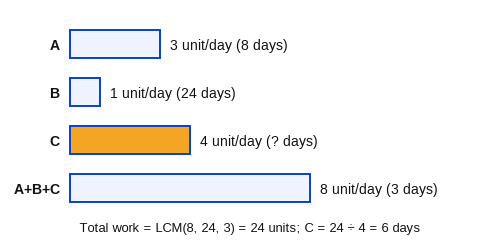
A can lay a railway track between two given stations in 8 days and B can do the same job in 24 days. With the help of C, they can do the job in 3 days. C alone can do the job in:
A दो दिए गए स्टेशनों के बीच रेलवे ट्रैक 8 दिनों में बिछा सकता है और B वही कार्य 24 दिनों में कर सकता है। C की सहायता से, वे यह कार्य 3 दिनों में कर सकते हैं। C अकेले यह कार्य कितने दिनों में कर सकता है?
  1. A7 days7 दिन
  2. B8 days8 दिन
  3. C6 days6 दिन
  4. D9 days9 दिन
Show answer

Concept: Take total work = LCM of days and compare daily work.

  1. LCM(8,24,3)=24 units.
  2. A =248=3, B =2424=1, A+B+C =243=8 units/day.
  3. C =8−3−1=4 units/day.
  4. C alone =244=6 days.

Trick: 13−18−124=8−3−124=16.

Answer: (C) 6 days

अवधारणा: कुल कार्य = दिनों का LCM लें और दैनिक कार्य की तुलना करें।

  1. LCM(8,24,3)=24 इकाई।
  2. A =248=3, B =2424=1, A+B+C =243=8 इकाई/दिन।
  3. C =8−3−1=4 इकाई/दिन।
  4. C अकेला =244=6 दिन।

ट्रिक: 13−18−124=8−3−124=16।

उत्तर: (C) 6 दिन

RRB NTPC Graduate CBT 1MathematicsTime and WorkRRB NTPC Graduate CBT 1 2024 · 9 Jun Shift 1 →
Q10494.
The value of 173−102+(2613)2−12+20×12=
173−102+(2613)2−12+20×12= का मान
  1. A5040
  2. B5046
  3. C5055
  4. D5045
Show answer

Concept: Evaluate powers and brackets first (BODMAS).

  1. 173=4913, 102=100, (2613)2=22=4, 20×12=240.
  2. 4913−100+4−12+240.
  3. =5045.

Trick: Unit digit check: 3−0+4−2+0=5 → only 5055 or 5045; size check gives 5045.

Answer: (D) 5045

अवधारणा: पहले घात और कोष्ठक हल करें (BODMAS)।

  1. 173=4913, 102=100, (2613)2=22=4, 20×12=240।
  2. 4913−100+4−12+240।
  3. =5045।

ट्रिक: इकाई अंक: 3−0+4−2+0=5 → 5055 या 5045; आगे गणना से 5045।

उत्तर: (D) 5045

RRB NTPC Graduate CBT 1MathematicsSimplificationRRB NTPC Graduate CBT 1 2024 · 9 Jun Shift 1 →
Q10495.
The arithmetic mean of the observations 79, 92, 39, 57, 91, 28, 74, 90 and 44 is:
प्रेक्षणों 79, 92, 39, 57, 91, 28, 74, 90 और 44 का समांतर माध्य है:
  1. A59
  2. B61
  3. C66
  4. D71
Show answer

Concept: Arithmetic mean =sum of observationsnumber of observations.

  1. Sum =79+92+39+57+91+28+74+90+44=594.
  2. Number of observations =9.
  3. Mean =5949=66.

Trick: Pair to round numbers: (79+91)+(92+28)+(57+44)+(39+74)+90.

Answer: (C) 66

अवधारणा: समांतर माध्य =प्रेक्षणों का योगप्रेक्षणों की संख्या।

  1. योग =79+92+39+57+91+28+74+90+44=594।
  2. प्रेक्षणों की संख्या =9।
  3. माध्य =5949=66।

ट्रिक: जोड़ी बनाएँ: (79+91)+(92+28)+(57+44)+(39+74)+90।

उत्तर: (C) 66

RRB NTPC Graduate CBT 1MathematicsStatistics – MeanRRB NTPC Graduate CBT 1 2024 · 9 Jun Shift 1 →
Q10496.
Which of the following letter-clusters should replace # and % so that the pattern and relationship followed between the letter-cluster pair on the left side of :: is the same as that on the right side of ::?
# : QVR :: CHD : %
निम्नलिखित में से कौन-से अक्षर-समूह # और % को प्रतिस्थापित करेंगे ताकि :: के बाईं ओर के अक्षर-समूह युग्म के बीच अनुसरित पैटर्न और संबंध वही हो जो :: के दाईं ओर है?
# : QVR :: CHD : %
  1. A# = LQM, % = HMI
  2. B# = PMM, % = JUY
  3. C# = LJM, % = NHG
  4. D# = GYT, % = NYU
Show answer

Concept: Find the shift from the first cluster to the second on the right side, then apply it to the left side.

  1. CHD → %: try option (A) HMI: C+5=H, H+5=M, D+5=I. Each letter moves +5.
  2. Left side: # → QVR, so # = QVR moved back by 5.
  3. Q−5=L, V−5=Q, R−5=M → # = LQM.
  4. Option (A) gives # = LQM and % = HMI – both fit.

Trick: Write positions: L(12)→Q(17), C(3)→H(8): same +5 on every letter.

Answer: (A) # = LQM, % = HMI

अवधारणा: दाईं ओर के पहले समूह से दूसरे समूह में अक्षरों का खिसकाव ज्ञात करें और बाईं ओर लगाएँ।

  1. CHD → %: विकल्प (A) HMI: C+5=H, H+5=M, D+5=I, यानी हर अक्षर +5।
  2. बाईं ओर # → QVR, अतः # = QVR को 5 पीछे करें।
  3. Q−5=L, V−5=Q, R−5=M → # = LQM।
  4. विकल्प (A) में # = LQM और % = HMI दोनों सही बैठते हैं।

ट्रिक: स्थान लिखें: L(12)→Q(17), C(3)→H(8): हर अक्षर पर +5।

उत्तर: (A) # = LQM, % = HMI

RRB NTPC Graduate CBT 1General Intelligence and ReasoningLetter analogyRRB NTPC Graduate CBT 1 2024 · 9 Jun Shift 1 →
Q10497.
Read the given statements and conclusions carefully. Assuming that the information given in the statements is true, even if it appears to be at variance with commonly known facts, decide which of the given conclusions logically follow(s) from the statements.
Statements:
All jams are bands.
All bands are sacks.
No sack is a can.
Conclusions:
(I) No jam is a can.
(II) Some sacks are jams.
दिए गए कथनों और निष्कर्षों को ध्यानपूर्वक पढ़िए। यह मानते हुए कि कथनों में दी गई जानकारी सत्य है, भले ही वह सामान्यतः ज्ञात तथ्यों से भिन्न प्रतीत होती हो, निर्णय कीजिए कि दिए गए निष्कर्षों में से कौन-सा/कौन-से निष्कर्ष कथनों का तार्किक रूप से अनुसरण करता है/करते हैं।
कथन:
सभी जैम, बैंड हैं।
सभी बैंड, बोरे हैं।
कोई बोरा, डिब्बा नहीं है।
निष्कर्ष:
(I) कोई जैम, डिब्बा नहीं है।
(II) कुछ बोरे, जैम हैं।
  1. ANeither conclusion (I) nor (II) follows.न तो निष्कर्ष (I) और न ही (II) अनुसरण करता है।
  2. BOnly conclusion (I) follows.केवल निष्कर्ष (I) अनुसरण करता है।
  3. COnly conclusion (II) follows.केवल निष्कर्ष (II) अनुसरण करता है।
  4. DBoth conclusions (I) and (II) follow.दोनों निष्कर्ष (I) और (II) अनुसरण करते हैं।
Show answer

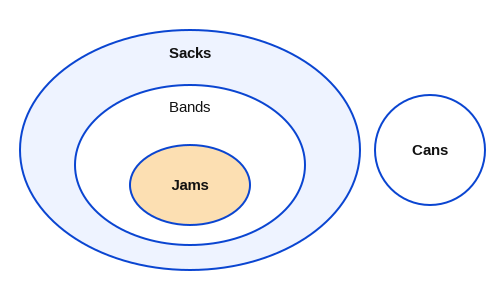
Concept: Draw the smallest possible Venn diagram that satisfies all statements.

  1. All jams are bands and all bands are sacks → Jams ⊂ Bands ⊂ Sacks.
  2. No sack is a can → the Cans circle lies fully outside Sacks, so it is outside Jams too → (I) No jam is a can follows.
  3. All jams are sacks, so some sacks are certainly jams → (II) follows.

Trick: "All A are B" always gives "Some B are A" (conversion).

Answer: (D) Both conclusions (I) and (II) follow.

अवधारणा: सभी कथनों को संतुष्ट करने वाला न्यूनतम वेन आरेख बनाइए।

  1. सभी jams, bands हैं और सभी bands, sacks हैं → Jams ⊂ Bands ⊂ Sacks।
  2. कोई sack, can नहीं है → Cans का वृत्त Sacks से पूरा बाहर, अतः Jams से भी बाहर → (I) "कोई jam, can नहीं" सही।
  3. सभी jams, sacks हैं, अतः कुछ sacks अवश्य jams हैं → (II) सही।

ट्रिक: "सभी A, B हैं" से हमेशा "कुछ B, A हैं" निकलता है (conversion)।

उत्तर: (D) निष्कर्ष (I) और (II) दोनों अनुसरण करते हैं।

RRB NTPC Graduate CBT 1General Intelligence and ReasoningSyllogismRRB NTPC Graduate CBT 1 2024 · 9 Jun Shift 1 →
Q10498.
Select the set in which the numbers are related in the same way as are the numbers of the following sets.
(NOTE: Operations should be performed on the whole numbers, without breaking down the numbers into their constituent digits. E.g. 13 – Operations on 13 such as
adding/subtracting/multiplying to 13 can be performed. Breaking down 13 into 1 and 3 and then performing mathematical operations on 1 and 3 is not allowed.)
(33, 429, 13)
(44, 220, 5)
उस समुच्चय का चयन कीजिए जिसमें संख्याएँ उसी प्रकार संबंधित हैं जिस प्रकार निम्नलिखित समुच्चयों की संख्याएँ संबंधित हैं।
(ध्यान दें: संक्रियाएँ संख्याओं को उनके घटक अंकों में तोड़े बिना, पूर्ण संख्याओं पर की जानी चाहिए। उदाहरण के लिए 13 – 13 पर संक्रियाएँ जैसे
13 में जोड़ना/घटाना/गुणा करना आदि किया जा सकता है। 13 को 1 और 3 में तोड़ना और फिर 1 और 3 पर गणितीय संक्रियाएँ करना वर्जित है।)
(33, 429, 13)
(44, 220, 5)
  1. A(20, 363, 18)
  2. B(43, 903, 21)
  3. C(30, 363, 12)
  4. D(4, 23, 5)
Show answer

Concept: Look for one operation linking the three numbers of each set.

  1. (33,429,13): 33×13=429.
  2. (44,220,5): 44×5=220.
  3. Rule: first × third = second.
  4. Check (B): 43×21=903 ✓. Others: 20×18=360, 30×12=360, 4×5=20 – fail.

Trick: Middle number much bigger than both? Test product of the outer two first.

Answer: (B) (43, 903, 21)

अवधारणा: हर समूह की तीनों संख्याओं को जोड़ने वाली एक संक्रिया खोजें।

  1. (33,429,13): 33×13=429।
  2. (44,220,5): 44×5=220।
  3. नियम: पहली × तीसरी = दूसरी।
  4. (B) जाँचें: 43×21=903 ✓। बाकी: 20×18=360, 30×12=360, 4×5=20 – गलत।

ट्रिक: बीच की संख्या बहुत बड़ी हो तो पहले बाहरी दोनों का गुणनफल जाँचें।

उत्तर: (B) (43, 903, 21)

RRB NTPC Graduate CBT 1General Intelligence and ReasoningNumber set relationRRB NTPC Graduate CBT 1 2024 · 9 Jun Shift 1 →
Q10499.
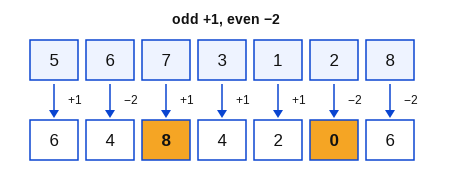
If 1 is added to each odd digit and 2 is subtracted from each even digit in the number 5673128, what will be the difference between the digits which are third from the left and second from the right in the new number thus formed?
यदि संख्या 5673128 में प्रत्येक विषम अंक में 1 जोड़ा जाए और प्रत्येक सम अंक में से 2 घटाया जाए, तो इस प्रकार बनी नई संख्या में बाएँ से तीसरे और दाएँ से दूसरे अंकों के बीच का अंतर क्या होगा?
  1. A9
  2. B6
  3. C7
  4. D8
Show answer

Concept: Change each digit by the rule (odd → +1, even → −2) and then read the asked positions.

  1. 5673128 → 6 4 8 4 2 0 6, i.e. new number 6484206.
  2. Third from left = 8.
  3. Second from right = 0.
  4. Difference =8−0=8.

Trick: Write the new digits in boxes under the old ones – positions can then be read without error.

Answer: (D) 8

अवधारणा: हर अंक पर नियम लगाएँ (विषम → +1, सम → −2) और फिर पूछे गए स्थान पढ़ें।

  1. 5673128 → 6 4 8 4 2 0 6, नई संख्या 6484206।
  2. बाएँ से तीसरा = 8।
  3. दाएँ से दूसरा = 0।
  4. अंतर =8−0=8।

ट्रिक: नए अंक पुराने अंकों के नीचे खानों में लिखें – स्थान पढ़ने में गलती नहीं होगी।

उत्तर: (D) 8

RRB NTPC Graduate CBT 1General Intelligence and ReasoningDigit operationsRRB NTPC Graduate CBT 1 2024 · 9 Jun Shift 1 →
Q10500.
What should come in place of the question mark (?) in the given series based on the English alphabetical order?
NTZ LRX JPV HNT ?
अंग्रेज़ी वर्णमाला क्रम के आधार पर दी गई श्रृंखला में प्रश्न चिह्न (?) के स्थान पर क्या आना चाहिए?
NTZ LRX JPV HNT ?
  1. ARLF
  2. BFRL
  3. CFLR
  4. DRFL
Show answer

Concept: Track each letter position separately.

  1. 1st letters: N, L, J, H → each −2 → F.
  2. 2nd letters: T, R, P, N → each −2 → L.
  3. 3rd letters: Z, X, V, T → each −2 → R.
  4. Next term = FLR.

Trick: All three positions move back by 2 together – just shift the last term HNT by −2.

Answer: (C) FLR

अवधारणा: हर स्थान के अक्षर को अलग-अलग देखें।

  1. पहले अक्षर: N, L, J, H → हर बार −2 → F।
  2. दूसरे अक्षर: T, R, P, N → −2 → L।
  3. तीसरे अक्षर: Z, X, V, T → −2 → R।
  4. अगला पद = FLR।

ट्रिक: तीनों स्थान एक साथ 2 पीछे – अंतिम पद HNT को −2 करें।

उत्तर: (C) FLR

RRB NTPC Graduate CBT 1General Intelligence and ReasoningLetter seriesRRB NTPC Graduate CBT 1 2024 · 9 Jun Shift 1 →