Question bank

Q&A: practice questions with answers

Search questions on any topic. Filter by exam category, exam, subject and topic, try the question, then open the answer and explanation.

Courses – airGurukul

20,719 questions found.

Q10501.
A, B, C, D, E and F live on six different floors of the same building. The lowermost floor in the building is numbered 1, the floor above it, number 2 and so on till the topmost floor is numbered 6.
The product of floors on which F and D live is 15. E lives immediately above C .The sum of floors on which A and D live is 7.
What is the sum of floors on which A and E live?
A, B, C, D, E और F एक ही इमारत की छह अलग-अलग मंज़िलों पर रहते हैं। इमारत की सबसे निचली मंज़िल की संख्या 1 है, उसके ऊपर की मंज़िल की संख्या 2 है और इसी प्रकार सबसे ऊपरी मंज़िल की संख्या 6 है।
F और D जिन मंज़िलों पर रहते हैं, उनका गुणनफल 15 है। E, C के ठीक ऊपर रहता है। A और D जिन मंज़िलों पर रहते हैं, उनका योग 7 है।
A और E जिन मंज़िलों पर रहते हैं, उनका योग क्या है?
  1. A6
  2. B5
  3. C8
  4. D7
Show answer

Concept: Use the product clue first – it allows only a few floor pairs.
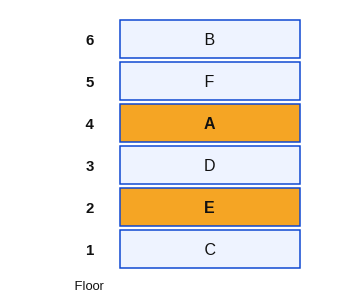
  1. F×D=15 → floors {3,5}.
  2. If D=5: A=2, left floors 1, 4, 6 – no two consecutive for C and E. Rejected.
  3. So D=3, F=5, A=7−3=4. Left floors 1, 2, 6 → C = 1, E = 2, B = 6.
  4. A+E=4+2=6.

Trick: Product clues (15=3×5) fix two people at once – always start with them.

Answer: (A) 6

अवधारणा: पहले गुणनफल वाला संकेत लें – इससे केवल कुछ ही मंज़िल जोड़े संभव हैं।

  1. F×D=15 → मंज़िल {3,5}।
  2. यदि D=5: A=2, बची मंज़िलें 1, 4, 6 – C व E के लिए लगातार मंज़िल नहीं। अस्वीकार।
  3. अतः D=3, F=5, A=7−3=4। बची 1, 2, 6 → C = 1, E = 2, B = 6।
  4. A+E=4+2=6।

ट्रिक: गुणनफल संकेत (15=3×5) दो लोगों को एक साथ तय करता है – उसी से शुरू करें।

उत्तर: (A) 6
RRB NTPC Graduate CBT 1General Intelligence and ReasoningFloor puzzleRRB NTPC Graduate CBT 1 2024 · 9 Jun Shift 1 →
Q10502.
If 1 is added to each odd digit and 2 is subtracted from each even digit in the number 8271634, how many digits will appear more than once in the new number thus formed?
यदि संख्या 8271634 में प्रत्येक विषम अंक में 1 जोड़ा जाए और प्रत्येक सम अंक में से 2 घटाया जाए, तो इस प्रकार बनी नई संख्या में कितने अंक एक से अधिक बार आएँगे?
  1. ATwoदो
  2. BNoneकोई नहीं
  3. COneएक
  4. DThreeतीन
Show answer

Concept: Apply odd → +1, even → −2 to every digit, then count repeated digits.

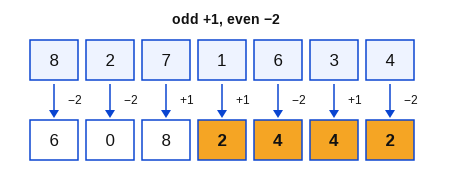
  1. 8271634 → 6 0 8 2 4 4 2, i.e. 6082442.
  2. Digit 2 appears twice, digit 4 appears twice.
  3. 6, 0, 8 appear once each.
  4. So two digits appear more than once.

Trick: Count digits, not occurrences: 2 and 4 → answer "Two".

Answer: (A) Two

अवधारणा: हर अंक पर विषम → +1, सम → −2 लगाएँ और दोहराए अंक गिनें।

  1. 8271634 → 6 0 8 2 4 4 2, यानी 6082442।
  2. अंक 2 दो बार और अंक 4 दो बार आता है।
  3. 6, 0, 8 एक-एक बार।
  4. अतः दो अंक एक से अधिक बार आते हैं।

ट्रिक: अंक गिनें, बार नहीं: 2 और 4 → उत्तर "दो"।

उत्तर: (A) Two (दो)

RRB NTPC Graduate CBT 1General Intelligence and ReasoningDigit operationsRRB NTPC Graduate CBT 1 2024 · 9 Jun Shift 1 →
Q10503.
Which of the following letter-number clusters will replace the question mark (?) in the given series to make it logically complete?
NQ31, MP40, LO49, KN58, ?
निम्नलिखित में से कौन-सा अक्षर-संख्या समूह दी गई श्रृंखला में प्रश्न चिह्न (?) का स्थान लेकर उसे तार्किक रूप से पूर्ण करेगा?
NQ31, MP40, LO49, KN58, ?
  1. AJN66
  2. BJN67
  3. CJM67
  4. DJM66
Show answer

Concept: Each part of the term follows its own rule.

  1. 1st letter: N, M, L, K → −1 → J.
  2. 2nd letter: Q, P, O, N → −1 → M.
  3. Number: 31, 40, 49, 58 → +9 → 67.
  4. Next term = JM67.

Trick: Options differ only in M or N and 66 or 67 – check just those two parts.

Answer: (C) JM67

अवधारणा: पद का हर भाग अपने नियम से चलता है।

  1. पहला अक्षर: N, M, L, K → −1 → J।
  2. दूसरा अक्षर: Q, P, O, N → −1 → M।
  3. संख्या: 31, 40, 49, 58 → +9 → 67।
  4. अगला पद = JM67।

ट्रिक: विकल्प केवल M या N और 66 या 67 में अलग हैं – बस यही दो जाँचें।

उत्तर: (C) JM67

RRB NTPC Graduate CBT 1General Intelligence and ReasoningAlphanumeric seriesRRB NTPC Graduate CBT 1 2024 · 9 Jun Shift 1 →
Q10504.
In a certain code language, ‘how are you’ is coded as ‘jp zl rc’ and ‘are they coming’ is coded as ‘zl qn bt’. How is ‘are’ coded in the given language?
एक निश्चित कूट भाषा में, ‘how are you’ को ‘jp zl rc’ लिखा जाता है और ‘are they coming’ को ‘zl qn bt’ लिखा जाता है। दी गई भाषा में ‘are’ को किस प्रकार लिखा जाता है?
  1. Azl
  2. Bbt
  3. Cjp
  4. Dqn
Show answer

Concept: A word common to two sentences gets the code common to both codes.

  1. "how are you" → jp zl rc.
  2. "are they coming" → zl qn bt.
  3. Common word: "are"; common code: zl.
  4. So are = zl.

Trick: Common word ↔ common code.

Answer: (A) zl

अवधारणा: दो वाक्यों में उभयनिष्ठ शब्द का कोड दोनों कोडों में उभयनिष्ठ होता है।

  1. "how are you" → jp zl rc।
  2. "are they coming" → zl qn bt।
  3. उभयनिष्ठ शब्द "are", उभयनिष्ठ कोड zl।
  4. अतः are = zl।

ट्रिक: उभयनिष्ठ शब्द ↔ उभयनिष्ठ कोड।

उत्तर: (A) zl

RRB NTPC Graduate CBT 1General Intelligence and ReasoningCoding-decodingRRB NTPC Graduate CBT 1 2024 · 9 Jun Shift 1 →
Q10505.
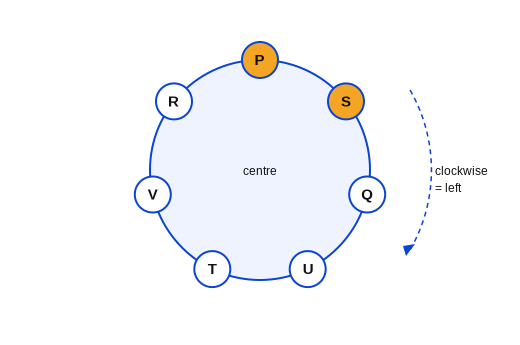
P, Q, R, S, T, U and V are sitting around a circular table facing the centre. Only one person sits between P and V when counted from the right of P. Only one person sits between V and U. Only one person sits between P and Q. Only two people sit between R and U. Only one person sits between T and Q. How many people sit between S and P when counted from the left of S?
P, Q, R, S, T, U और V एक वृत्ताकार मेज़ के चारों ओर केंद्र की ओर मुख करके बैठे हैं। P के दाईं ओर से गिनने पर P और V के बीच केवल एक व्यक्ति बैठा है। V और U के बीच केवल एक व्यक्ति बैठा है। P और Q के बीच केवल एक व्यक्ति बैठा है। R और U के बीच केवल दो व्यक्ति बैठे हैं। T और Q के बीच केवल एक व्यक्ति बैठा है। S के बाईं ओर से गिनने पर S और P के बीच कितने व्यक्ति बैठे हैं?
  1. A2
  2. B0
  3. C3
  4. D5
Show answer

Concept: Facing the centre: moving to a person's right = anticlockwise, to the left = clockwise.

  1. Fix P. One person between P and V on P's right → V is 2 seats anticlockwise from P.
  2. Combining "one between V and U", "one between P and Q", "one between T and Q" and "two between R and U", the only arrangement (clockwise from P) is P, S, Q, U, T, V, R.
  3. From S going left (clockwise): Q, U, T, V, R, then P.
  4. So 5 people sit between S and P.

Trick: With 7 seats, "2 between" one way = "3 between" the other way – use it to test both sides quickly.

Answer: (D) 5

अवधारणा: केंद्र की ओर मुख: किसी के दाएँ जाना = वामावर्त (anticlockwise), बाएँ = दक्षिणावर्त (clockwise)।

  1. P को स्थिर करें। P के दाएँ से P और V के बीच एक व्यक्ति → V, P से 2 स्थान वामावर्त।
  2. "V-U के बीच एक", "P-Q के बीच एक", "T-Q के बीच एक" और "R-U के बीच दो" मिलाने पर एकमात्र व्यवस्था (P से दक्षिणावर्त): P, S, Q, U, T, V, R।
  3. S से बाएँ (दक्षिणावर्त): Q, U, T, V, R, फिर P।
  4. अतः S और P के बीच 5 व्यक्ति।

ट्रिक: 7 सीटों में एक ओर "2 बीच में" = दूसरी ओर "3 बीच में" – दोनों ओर जल्दी जाँचें।

उत्तर: (D) 5

RRB NTPC Graduate CBT 1General Intelligence and ReasoningCircular seating arrangementRRB NTPC Graduate CBT 1 2024 · 9 Jun Shift 1 →
Q10506.
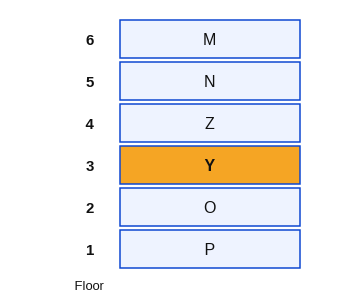
M, N, O, P, Y and Z live on six different floors of the same building. The lowermost floor in the building is numbered 1, the floor above it, number 2 and so on till the topmost floor is numbered 6. Only M lives above N.Z lives immediately below N. Only P lives below O. Who lives on floor numbered 3?
M, N, O, P, Y और Z एक ही इमारत की छह अलग-अलग मंज़िलों पर रहते हैं। इमारत की सबसे निचली मंज़िल की संख्या 1 है, उसके ऊपर की मंज़िल की संख्या 2 है और इसी प्रकार सबसे ऊपरी मंज़िल की संख्या 6 है। N के ऊपर केवल M रहता है। Z, N के ठीक नीचे रहता है। O के नीचे केवल P रहता है। मंज़िल संख्या 3 पर कौन रहता है?
  1. AZ
  2. BY
  3. CM
  4. DO
Show answer

Concept: "Only X lives above Y" puts Y on the second-highest floor; "only P lives below O" puts O on floor 2.

  1. Only M above N → M = 6, N = 5.
  2. Z immediately below N → Z = 4.
  3. Only P below O → P = 1, O = 2.
  4. Remaining Y → floor 3.

Trick: "Only one above" = 5th floor; "only one below" = 2nd floor.

Answer: (B) Y

अवधारणा: "केवल X, Y के ऊपर" से Y दूसरी सबसे ऊँची मंज़िल पर; "केवल P, O के नीचे" से O मंज़िल 2 पर।

  1. केवल M, N के ऊपर → M = 6, N = 5।
  2. Z, N के ठीक नीचे → Z = 4।
  3. केवल P, O के नीचे → P = 1, O = 2।
  4. बचा Y → मंज़िल 3।

ट्रिक: "केवल एक ऊपर" = 5वीं मंज़िल; "केवल एक नीचे" = दूसरी मंज़िल।

उत्तर: (B) Y

RRB NTPC Graduate CBT 1General Intelligence and ReasoningFloor puzzleRRB NTPC Graduate CBT 1 2024 · 9 Jun Shift 1 →
Q10507.
Based on the English alphabetical order, three of the following four letter-cluster pairs are alike in a certain way and thus form a group. Which letter-cluster pair DOES NOT belong to that group? (Note: The odd one out is not based on the number of
consonants/vowels or their position in the letter cluster)
अंग्रेज़ी वर्णमाला क्रम के आधार पर, निम्नलिखित चार अक्षर-समूह युग्मों में से तीन किसी निश्चित प्रकार से एकसमान हैं और इस प्रकार एक समूह बनाते हैं। कौन-सा अक्षर-समूह युग्म उस समूह से संबंधित नहीं है? (ध्यान दें: असंगत युग्म, व्यंजनों/स्वरों की संख्या या
अक्षर-समूह में उनके स्थान पर आधारित नहीं है)
  1. AMO - KM
  2. BCG - LP
  3. CSU - QS
  4. DQS - OQ
Show answer

Concept: Compare letter gaps inside each cluster and between the two clusters.

  1. MO – KM: M +2 O; K +2 M; and each letter of the 2nd cluster is 2 behind the 1st (M→K, O→M).
  2. SU – QS and QS – OQ follow the same: +2 inside, −2 from the 1st to the 2nd cluster.
  3. CG – LP: C +4 G and L +4 P; C → L is +9. Different.

Trick: Here the second cluster equals the first shifted by −2 – spot the one that breaks it.

Answer: (B) CG - LP

अवधारणा: हर समूह के अंदर और दोनों समूहों के बीच अक्षर अंतर देखें।

  1. MO – KM: M +2 O; K +2 M; दूसरे समूह का हर अक्षर पहले से 2 पीछे (M→K, O→M)।
  2. SU – QS और QS – OQ भी यही: अंदर +2, पहले से दूसरे समूह में −2।
  3. CG – LP: C +4 G और L +4 P; C → L +9। अलग।

ट्रिक: यहाँ दूसरा समूह = पहला समूह −2 – जो इसे तोड़े वही विषम।

उत्तर: (B) CG - LP

RRB NTPC Graduate CBT 1General Intelligence and ReasoningOdd one out – letter pairsRRB NTPC Graduate CBT 1 2024 · 9 Jun Shift 1 →
Q10508.
A group of numbers/symbols is coded using letter codes as per the codes given below and the conditions that follow. If none of the conditions apply, then codes for the respective number/symbol to be followed directly as given in the table.
Number/Symbol89@&572%13∆46
CodeLCZNDWAPRTFBK
Conditions:
(i) If the first element is a symbol and the last a number, the codes for these two (the first and the last elements) are to be interchanged.
(ii) If the first element is an odd number and the last an even number, the first and last elements are to be coded as ©.
(iii) If both the second and third elements are perfect squares, the third element is to be coded as the code for the second element.
What will be the code for the following group?
7 6 @ 1 3 &
संख्याओं/प्रतीकों के एक समूह को नीचे दिए गए कूटों और उसके बाद दी गई शर्तों के अनुसार अक्षर कूटों का उपयोग करके कूटबद्ध किया जाता है। यदि कोई भी शर्त लागू नहीं होती है, तो संबंधित संख्या/प्रतीक के लिए सीधे तालिका में दिए गए कूटों का अनुसरण किया जाना है।
संख्या/प्रतीक89@&572%13∆46
कूटLCZNDWAPRTFBK
शर्तें:
(i) यदि पहला अवयव एक प्रतीक है और अंतिम अवयव एक संख्या है, तो इन दोनों (पहले और अंतिम अवयवों) के कूट आपस में बदल दिए जाने हैं।
(ii) यदि पहला अवयव एक विषम संख्या है और अंतिम अवयव एक सम संख्या है, तो पहले और अंतिम अवयवों को © के रूप में कूटबद्ध किया जाना है।
(iii) यदि दूसरा और तीसरा दोनों अवयव पूर्ण वर्ग हैं, तो तीसरे अवयव को दूसरे अवयव के कूट के रूप में कूटबद्ध किया जाना है।
निम्नलिखित समूह का कूट क्या होगा?
7 6 @ 1 3 &
  1. AW K Z R T W
  2. BW K R Z T N
  3. CN K Z R T N
  4. DW K Z R T N
Show answer

Concept: Check each condition on the given group; if none applies, code element by element from the table.

  1. Group: 7 6 @ 1 3 &.
  2. (i) First element 7 is a number, not a symbol → no. (ii) Last element & is not an even number → no. (iii) Second (6) and third (@) are not perfect squares → no.
  3. Direct codes: 7 = W, 6 = K, @ = Z, 1 = R, 3 = T, & = N.
  4. Code = W K Z R T N.

Trick: Test conditions in order; usually one quick check (first/last element type) rules them out.

Answer: (D) W K Z R T N

अवधारणा: दिए समूह पर हर शर्त जाँचें; कोई लागू न हो तो तालिका से सीधा कोड लिखें।

  1. समूह: 7 6 @ 1 3 &।
  2. (i) पहला 7 संख्या है, प्रतीक नहीं → नहीं। (ii) अंतिम & सम संख्या नहीं → नहीं। (iii) दूसरा (6) और तीसरा (@) पूर्ण वर्ग नहीं → नहीं।
  3. सीधे कोड: 7 = W, 6 = K, @ = Z, 1 = R, 3 = T, & = N।
  4. कोड = W K Z R T N।

ट्रिक: शर्तें क्रम से जाँचें; अक्सर पहले/अंतिम तत्व का प्रकार देखकर ही वे हट जाती हैं।

उत्तर: (D) W K Z R T N

RRB NTPC Graduate CBT 1General Intelligence and ReasoningCoding with conditionsRRB NTPC Graduate CBT 1 2024 · 9 Jun Shift 1 →
Q10509.
Based on the English alphabetical order, three of the following four letter-cluster pairs are alike in a certain way and thus form a group. Which letter-cluster pair DOES NOT belong to that group?
(Note: The odd one out is not based on the number of consonants/vowels or their position in the letter-cluster.)
अंग्रेज़ी वर्णमाला क्रम के आधार पर, निम्नलिखित चार अक्षर-समूह युग्मों में से तीन किसी निश्चित प्रकार से एकसमान हैं और इस प्रकार एक समूह बनाते हैं। कौन-सा अक्षर-समूह युग्म उस समूह से संबंधित नहीं है?
(ध्यान दें: असंगत युग्म, व्यंजनों/स्वरों की संख्या या अक्षर-समूह में उनके स्थान पर आधारित नहीं है।)
  1. APS - MP
  2. BGJ - DG
  3. CEH - BE
  4. DRK - JH
Show answer

Concept: Find the gap inside each cluster and the shift between the two clusters.

  1. PS – MP: P +3 S, M +3 P; P → M is −3.
  2. GJ – DG and EH – BE: same (+3 inside, −3 shift).
  3. RK – JH: R → K is −7, J → H is −2. Different.

Trick: In the group, the last letter of the 2nd cluster equals the first letter of the 1st (PS–MP).

Answer: (D) RK - JH

अवधारणा: हर समूह के अंदर अंतर और दोनों समूहों के बीच खिसकाव देखें।

  1. PS – MP: P +3 S, M +3 P; P → M −3।
  2. GJ – DG और EH – BE: वही (+3 अंदर, −3 खिसकाव)।
  3. RK – JH: R → K −7, J → H −2। अलग।

ट्रिक: समूह में दूसरे भाग का अंतिम अक्षर = पहले भाग का पहला अक्षर (PS–MP)।

उत्तर: (D) RK - JH

RRB NTPC Graduate CBT 1General Intelligence and ReasoningOdd one out – letter pairsRRB NTPC Graduate CBT 1 2024 · 9 Jun Shift 1 →
Q10510.
Which of the following letter-clusters should replace # and % so that the pattern and relationship followed between the letter-cluster pair on the left side of :: is the same as that on the right side of ::?
# : QYE :: BHP : %
निम्नलिखित में से कौन-से अक्षर-समूह # और % को प्रतिस्थापित करेंगे ताकि :: के बाईं ओर के अक्षर-समूह युग्म के बीच अनुसरित पैटर्न और संबंध वही हो जो :: के दाईं ओर है?
# : QYE :: BHP : %
  1. A# = RNF, % = WKK
  2. B# = LBZ, % = GEU
  3. C# = WKK, % = LBZ
  4. D# = GEU, % = RNF
Show answer

Concept: Find the position-wise shift from the right-side pair and apply it to the left.

  1. Try (B): BHP → GEU: B +5 G, H −3 E, P +5 U. Rule: +5,−3,+5.
  2. Left side: # → QYE with the same rule: L +5 Q, B −3 Y (B→A→Z→Y), Z +5 E (Z→…→E).
  3. So # = LBZ and % = GEU.

Trick: When shifts cross A or Z, count in a circle (Z is followed by A).

Answer: (B) # = LBZ, % = GEU

अवधारणा: दाईं ओर के युग्म से स्थानवार खिसकाव निकालें और बाईं ओर लगाएँ।

  1. (B) आज़माएँ: BHP → GEU: B +5 G, H −3 E, P +5 U। नियम: +5,−3,+5।
  2. बाईं ओर # → QYE वही नियम: L +5 Q, B −3 Y (B→A→Z→Y), Z +5 E।
  3. अतः # = LBZ और % = GEU।

ट्रिक: A या Z पार होने पर वृत्ताकार गिनें (Z के बाद A)।

उत्तर: (B) # = LBZ, % = GEU

RRB NTPC Graduate CBT 1General Intelligence and ReasoningLetter analogyRRB NTPC Graduate CBT 1 2024 · 9 Jun Shift 1 →
Q10511.
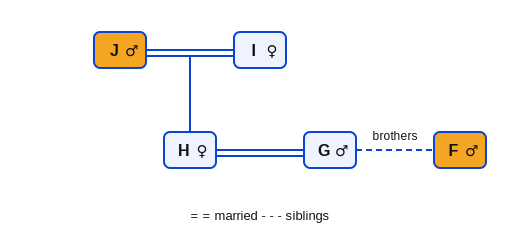
​F is the brother of G.
G is the husband of H.
H is the daughter of I.
I is the wife of J.
How is F related to J?
F, G का भाई है।
G, H का पति है।
H, I की बेटी है।
I, J की पत्नी है।
F का J से क्या संबंध है?
  1. ADaughter's husband's brotherबेटी के पति का भाई
  2. BBrotherभाई
  3. CFatherपिता
  4. DDaughter's husband's fatherबेटी के पति का पिता
Show answer

Concept: Build the family tree from the bottom statement up.

  1. I is the wife of J; H is the daughter of I (and J).
  2. G is the husband of H → G is J's daughter's husband (son-in-law).
  3. F is G's brother.
  4. So F is J's daughter's husband's brother.

Trick: Walk the path J → daughter H → her husband G → his brother F.

Answer: (A) Daughter's husband's brother

अवधारणा: अंतिम कथन से शुरू करके परिवार वृक्ष बनाइए।

  1. I, J की पत्नी है; H, I (और J) की बेटी है।
  2. G, H का पति है → G, J का दामाद (बेटी का पति)।
  3. F, G का भाई है।
  4. अतः F, J की बेटी के पति का भाई है।

ट्रिक: रास्ता: J → बेटी H → उसका पति G → उसका भाई F।

उत्तर: (A) Daughter's husband's brother (बेटी के पति का भाई)

RRB NTPC Graduate CBT 1General Intelligence and ReasoningBlood relationsRRB NTPC Graduate CBT 1 2024 · 9 Jun Shift 1 →
Q10512.
In the following triads, each group of letters is related to the subsequent one following a certain logic. Select from the given options, the one that follows the same logic. BAIL - ALIB - LIAB
DEAF - EFAD - FAED
निम्नलिखित त्रिकों में, अक्षरों का प्रत्येक समूह एक निश्चित तर्क का अनुसरण करते हुए अगले समूह से संबंधित है। दिए गए विकल्पों में से उस विकल्प का चयन कीजिए जो समान तर्क का अनुसरण करता है। BAIL - ALIB - LIAB
DEAF - EFAD - FAED
  1. ALEAN - ELAN - NEAL
  2. BGOLD - ODLG - LGOD
  3. CMEAN - MAEN - NAEM
  4. DBOLD - ODLB - DLOB
Show answer

Concept: Write letter positions 1 2 3 4 and track where each goes.

  1. BAIL (1234) → ALIB = positions 2, 4, 3, 1.
  2. ALIB → LIAB = positions 2, 3, 1, 4 of ALIB.
  3. DEAF → EFAD → FAED follows the same two steps.
  4. BOLD → (2,4,3,1) ODLB → (2,3,1,4) DLOB ✓.

Trick: Apply step 1 to the first word of each option; only (B) and (D) survive, then test step 2.

Answer: (D) BOLD - ODLB - DLOB

अवधारणा: अक्षरों की स्थिति 1 2 3 4 लिखें और देखें हर अक्षर कहाँ जाता है।

  1. BAIL (1234) → ALIB = स्थिति 2, 4, 3, 1।
  2. ALIB → LIAB = ALIB की स्थिति 2, 3, 1, 4।
  3. DEAF → EFAD → FAED भी इन्हीं दो चरणों से।
  4. BOLD → (2,4,3,1) ODLB → (2,3,1,4) DLOB ✓।

ट्रिक: हर विकल्प के पहले शब्द पर चरण 1 लगाएँ; केवल (B) व (D) बचते हैं, फिर चरण 2 जाँचें।

उत्तर: (D) BOLD - ODLB - DLOB

RRB NTPC Graduate CBT 1General Intelligence and ReasoningLetter rearrangementRRB NTPC Graduate CBT 1 2024 · 9 Jun Shift 1 →
Q10513.
Select the triad that follows the same pattern as that followed by the two triads given below. Both triads follow the same pattern.
KF-MH-OQ
ID-KF-MO
उस त्रिक का चयन कीजिए जो नीचे दिए गए दो त्रिकों द्वारा अनुसरित पैटर्न का ही अनुसरण करता है। दोनों त्रिक एक ही पैटर्न का अनुसरण करते हैं।
KF-MH-OQ
ID-KF-MO
  1. AGB-ID-KN
  2. BHB-ID-KN
  3. CHB-IC-KN
  4. DGB-ID-KM
Show answer

Concept: Track the first letters and the second letters of the three pairs separately.

  1. KF-MH-OQ: first letters K, M, O (+2, +2); second letters F, H, Q (+2, +9).
  2. ID-KF-MO: I, K, M (+2, +2); D, F, O (+2, +9).
  3. (D) GB-ID-KM: G, I, K (+2, +2); B, D, M (+2, +9) ✓.
  4. (A) ends in N (+10), (B) and (C) break the first-letter steps.

Trick: Only the last letter differs among options – check the +9 step.

Answer: (D) GB-ID-KM

अवधारणा: तीनों युग्मों के पहले अक्षर और दूसरे अक्षर अलग-अलग देखें।

  1. KF-MH-OQ: पहले अक्षर K, M, O (+2, +2); दूसरे F, H, Q (+2, +9)।
  2. ID-KF-MO: I, K, M (+2, +2); D, F, O (+2, +9)।
  3. (D) GB-ID-KM: G, I, K (+2, +2); B, D, M (+2, +9) ✓।
  4. (A) में N (+10); (B) व (C) में पहले अक्षर का क्रम टूटता है।

ट्रिक: विकल्पों में मुख्य अंतर अंतिम अक्षर – +9 वाला चरण जाँचें।

उत्तर: (D) GB-ID-KM

RRB NTPC Graduate CBT 1General Intelligence and ReasoningLetter triadsRRB NTPC Graduate CBT 1 2024 · 9 Jun Shift 1 →
Q10514.
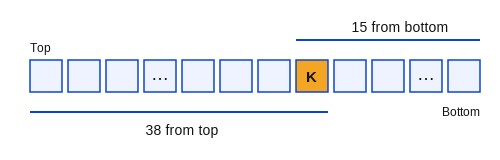
Kavish ranked 38th from the top and 15th from the bottom in his class. How many students are there in his class?
कविश अपनी कक्षा में ऊपर से 38वें और नीचे से 15वें स्थान पर है। उसकी कक्षा में कितने विद्यार्थी हैं?
  1. A50
  2. B52
  3. C53
  4. D51
Show answer

Concept: Total = rank from top + rank from bottom −1 (the person is counted twice).

  1. Rank from top =38, from bottom =15.
  2. Total =38+15−1=52.

Trick: Always subtract 1 – Kavish is included in both counts.

Answer: (B) 52

अवधारणा: कुल = ऊपर से रैंक + नीचे से रैंक −1 (व्यक्ति दो बार गिना जाता है)।

  1. ऊपर से रैंक =38, नीचे से =15।
  2. कुल =38+15−1=52।

ट्रिक: हमेशा 1 घटाएँ – कविश दोनों गिनती में शामिल है।

उत्तर: (B) 52

RRB NTPC Graduate CBT 1General Intelligence and ReasoningRankingRRB NTPC Graduate CBT 1 2024 · 9 Jun Shift 1 →
Q10515.
In a certain code language, ‘FUSE’ is coded as ‘3517’ and ‘SING’ is coded as ‘2458’. What is the code for ‘S’ in the given code language?
एक निश्चित कूट भाषा में, ‘FUSE’ को ‘3517’ लिखा जाता है और ‘SING’ को ‘2458’ लिखा जाता है। दी गई कूट भाषा में ‘S’ का कूट क्या है?
  1. A5
  2. B1
  3. C8
  4. D2
Show answer

Concept: In letter-to-digit coding (order jumbled), a letter common to two words takes the digit common to both codes.

  1. FUSE → 3517 and SING → 2458.
  2. Common letter: only S.
  3. Common digit: only 5.
  4. So S = 5.

Trick: Match the common letter with the common digit.

Answer: (A) 5

अवधारणा: अक्षर-अंक कोडिंग (क्रम बदला हुआ) में दोनों शब्दों के समान अक्षर का कोड दोनों कोडों का समान अंक होता है।

  1. FUSE → 3517 और SING → 2458।
  2. समान अक्षर: केवल S।
  3. समान अंक: केवल 5।
  4. अतः S = 5।

ट्रिक: समान अक्षर ↔ समान अंक।

उत्तर: (A) 5

RRB NTPC Graduate CBT 1General Intelligence and ReasoningCoding-DecodingRRB NTPC Graduate CBT 1 2024 · 9 Jun Shift 1 →
Q10516.
Refer to the following letter and symbol series and answer the question that follows. Counting to be done from left to right only.
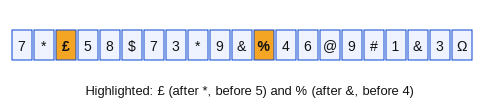
(Left) 7 * £ 5 8 $ 7 3 * 9 & % 4 6 @ 9 # 1 & 3 Ω (Right)
How many such symbols are there each of which is immediately preceded by a symbol and also immediately followed by a number?
निम्नलिखित अक्षर और प्रतीक श्रृंखला को देखिए और उसके बाद दिए गए प्रश्न का उत्तर दीजिए। गिनती केवल बाएँ से दाएँ की जानी है।
(बाएँ) 7 * £ 5 8 $ 7 3 * 9 & % 4 6 @ 9 # 1 & 3 Ω (दाएँ)
ऐसे कितने प्रतीक हैं जिनमें से प्रत्येक के ठीक पहले एक प्रतीक है और ठीक बाद एक संख्या भी है?
  1. AFourचार
  2. BTwoदो
  3. COneएक
  4. DThreeतीन
Show answer

Concept: Find pattern: symbol – symbol – number.

  1. Check every symbol: * £ 5 → £ qualifies.
  2. & % 4 → % qualifies.
  3. Others fail: $ (after 8), * (after 3), & (after 9), @ (after 6), # (after 9), & (after 1), Ω (after 3).
  4. Total = 2.

Trick: Scan only the symbols and look at both neighbours.

Answer: (B) Two

अवधारणा: पैटर्न खोजें: प्रतीक – प्रतीक – संख्या।

  1. हर प्रतीक जाँचें: * £ 5 → £ सही।
  2. & % 4 → % सही।
  3. शेष असफल: $ (8 के बाद), * (3 के बाद), & (9 के बाद), @ (6 के बाद), # (9 के बाद), & (1 के बाद), Ω (3 के बाद)।
  4. कुल = 2।

ट्रिक: केवल प्रतीकों को देखें और दोनों पड़ोसी जाँचें।

उत्तर: (B) दो

RRB NTPC Graduate CBT 1General Intelligence and ReasoningSymbol-Number SeriesRRB NTPC Graduate CBT 1 2024 · 9 Jun Shift 1 →
Q10517.
This question is based on the five, three-digit numbers given below.
(Left) 535 647 232 804 152 (Right)
(Example: 697 – First digit = 6, second digit = 9 and third digit = 7)
(NOTE: All operations to be done from left to right.)
What will be the resultant if the second digit of the highest number is subtracted from the third digit of the lowest number?
यह प्रश्न नीचे दी गई तीन अंकों वाली पाँच संख्याओं पर आधारित है।
(बाएँ) 535 647 232 804 152 (दाएँ)
(उदाहरण: 697 – पहला अंक = 6, दूसरा अंक = 9 और तीसरा अंक = 7)
(ध्यान दें: सभी संक्रियाएँ बाएँ से दाएँ की जानी हैं।)
यदि सबसे बड़ी संख्या के दूसरे अंक को सबसे छोटी संख्या के तीसरे अंक में से घटाया जाए, तो परिणाम क्या होगा?
  1. A3
  2. B1
  3. C5
  4. D2
Show answer

Concept: Pick the highest and lowest numbers, then take the required digits.

  1. Highest = 804 → second digit 0.
  2. Lowest = 152 → third digit 2.
  3. 2−0=2.

Trick: Read digits carefully: second = middle, third = last.

Answer: (D) 2

अवधारणा: सबसे बड़ी और सबसे छोटी संख्या चुनें, फिर आवश्यक अंक लें।

  1. सबसे बड़ी = 804 → दूसरा अंक 0।
  2. सबसे छोटी = 152 → तीसरा अंक 2।
  3. 2−0=2।

ट्रिक: दूसरा = बीच का अंक, तीसरा = अंतिम अंक।

उत्तर: (D) 2

RRB NTPC Graduate CBT 1General Intelligence and ReasoningNumber OperationsRRB NTPC Graduate CBT 1 2024 · 9 Jun Shift 1 →
Q10518.
Refer to the following number and symbol series and answer the question that follows. Counting to be done from left to right only.
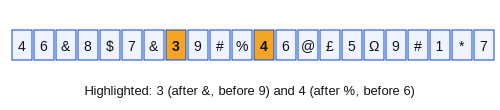
(Left) 4 6 & 8 $ 7 & 3 9 # % 4 6 @ £ 5 Ω 9 # 1 * 7 (Right)
How many such numbers are there each of which is immediately preceded by a symbol and also immediately followed by another number?
निम्नलिखित संख्या और प्रतीक श्रृंखला को देखिए और उसके बाद दिए गए प्रश्न का उत्तर दीजिए। गिनती केवल बाएँ से दाएँ की जानी है।
(बाएँ) 4 6 & 8 $ 7 & 3 9 # % 4 6 @ £ 5 Ω 9 # 1 * 7 (दाएँ)
ऐसी कितनी संख्याएँ हैं जिनमें से प्रत्येक के ठीक पहले एक प्रतीक है और ठीक बाद एक अन्य संख्या भी है?
  1. AOneएक
  2. BThreeतीन
  3. CTwoदो
  4. DFourचार
Show answer

Concept: Find pattern: symbol – number – number.

  1. & 3 9 → 3 qualifies.
  2. % 4 6 → 4 qualifies.
  3. Others fail: 8 (followed by $), 7 (followed by &), 5 (followed by Ω), 9 (followed by #), 1 (followed by *), last 7 (nothing after).
  4. Total = 2.

Trick: Take each number that comes right after a symbol and check only its next element.

Answer: (C) Two

अवधारणा: पैटर्न खोजें: प्रतीक – संख्या – संख्या।

  1. & 3 9 → 3 सही।
  2. % 4 6 → 4 सही।
  3. शेष असफल: 8 (बाद में $), 7 (बाद में &), 5 (बाद में Ω), 9 (बाद में #), 1 (बाद में *), अंतिम 7 (बाद में कुछ नहीं)।
  4. कुल = 2।

ट्रिक: प्रतीक के ठीक बाद आने वाली संख्या लें और केवल उसका अगला अवयव जाँचें।

उत्तर: (C) दो

RRB NTPC Graduate CBT 1General Intelligence and ReasoningSymbol-Number SeriesRRB NTPC Graduate CBT 1 2024 · 9 Jun Shift 1 →
Q10519.
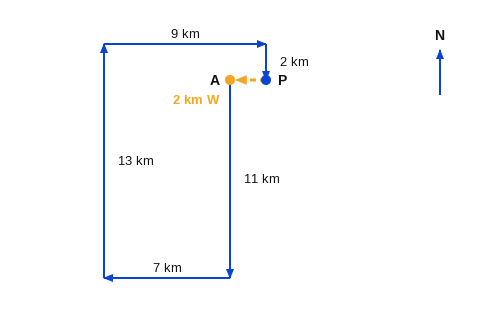
Prakesh starts from point A and drives 11 km towards the south. He then takes a right turn, drives 7 km, turns right and drives 13 km. He then takes a right turn and drives 9 km. He takes a final right turn, drives 2 km and stops at point P. How far (shortest distance) and towards which direction should he drive in order to reach point A again? (All turns are 90 degree turns only unless specified.)
प्रकेश बिंदु A से चलना शुरू करता है और दक्षिण की ओर 11 km गाड़ी चलाता है। फिर वह दाएँ मुड़ता है, 7 km गाड़ी चलाता है, दाएँ मुड़ता है और 13 km गाड़ी चलाता है। फिर वह दाएँ मुड़ता है और 9 km गाड़ी चलाता है। वह अंतिम बार दाएँ मुड़ता है, 2 km गाड़ी चलाता है और बिंदु P पर रुक जाता है। बिंदु A पर फिर से पहुँचने के लिए उसे कितनी दूरी (न्यूनतम दूरी) तक और किस दिशा में गाड़ी चलानी चाहिए? (जब तक निर्दिष्ट न हो, सभी मोड़ केवल 90 डिग्री के मोड़ हैं।)
  1. A3 km to the westपश्चिम की ओर 3 km
  2. B2 km to the eastपूर्व की ओर 2 km
  3. C2 km to the westपश्चिम की ओर 2 km
  4. D1 km to the westपश्चिम की ओर 1 km
Show answer

Concept: Track coordinates with A at (0, 0); east and north positive.

  1. 11 km south → (0, −11). Right turn faces west: 7 km → (−7, −11).
  2. Right → north 13 km → (−7, 2). Right → east 9 km → (2, 2).
  3. Right → south 2 km → P (2, 0).
  4. P is 2 km east of A, so he must drive 2 km west.

Trick: Net E–W: 9−7=2 east; net N–S: 13−11−2=0.

Answer: (C) 2 km to the west

अवधारणा: A को (0, 0) मानकर निर्देशांक लें; पूर्व और उत्तर धनात्मक।

  1. 11 km दक्षिण → (0, −11)। दाएँ मुड़कर पश्चिम: 7 km → (−7, −11)।
  2. दाएँ → उत्तर 13 km → (−7, 2)। दाएँ → पूर्व 9 km → (2, 2)।
  3. दाएँ → दक्षिण 2 km → P (2, 0)।
  4. P, A से 2 km पूर्व है, अतः 2 km पश्चिम जाना होगा।

ट्रिक: शुद्ध पूर्व–पश्चिम: 9−7=2 पूर्व; शुद्ध उत्तर–दक्षिण: 13−11−2=0।

उत्तर: (C) 2 km पश्चिम की ओर

RRB NTPC Graduate CBT 1General Intelligence and ReasoningDirection SenseRRB NTPC Graduate CBT 1 2024 · 9 Jun Shift 1 →
Q10520.
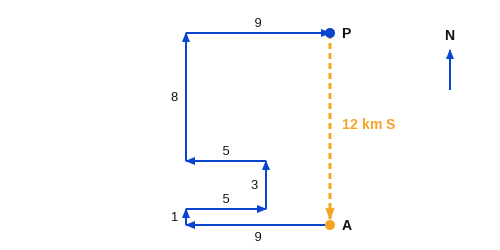
Kapil starts from point A and drives 9 km towards west. He then takes a right turn, drives 1 km, turns right and drives 5 km. He then takes a left turn and drives 3 km. He then takes a left turn and drive 5 km. He then takes a right turn and drives 8 km. He takes a final right turn, drives 9 km and stops at point P. How far (shortest distance) and towards which direction should he drive in order to reach point A again (all turns are 90° turns only unless specified)?
कपिल बिंदु A से चलना शुरू करता है और पश्चिम की ओर 9 km गाड़ी चलाता है। फिर वह दाएँ मुड़ता है, 1 km गाड़ी चलाता है, दाएँ मुड़ता है और 5 km गाड़ी चलाता है। फिर वह बाएँ मुड़ता है और 3 km गाड़ी चलाता है। फिर वह बाएँ मुड़ता है और 5 km गाड़ी चलाता है। फिर वह दाएँ मुड़ता है और 8 km गाड़ी चलाता है। वह अंतिम बार दाएँ मुड़ता है, 9 km गाड़ी चलाता है और बिंदु P पर रुक जाता है। बिंदु A पर फिर से पहुँचने के लिए उसे कितनी दूरी (न्यूनतम दूरी) तक और किस दिशा में गाड़ी चलानी चाहिए (जब तक निर्दिष्ट न हो, सभी मोड़ केवल 90° के मोड़ हैं)?
  1. A12 km north12 km उत्तर
  2. B10 km south10 km दक्षिण
  3. C12 km south12 km दक्षिण
  4. D11 km north11 km उत्तर
Show answer

Concept: Track coordinates with A at (0, 0); east and north positive.

  1. 9 W → (−9, 0); right → N 1 → (−9, 1); right → E 5 → (−4, 1).
  2. Left → N 3 → (−4, 4); left → W 5 → (−9, 4).
  3. Right → N 8 → (−9, 12); right → E 9 → P (0, 12).
  4. P is 12 km north of A, so he must drive 12 km south.

Trick: Net E–W: 5+9−9−5=0; net N–S: 1+3+8=12 north.

Answer: (C) 12 km south

अवधारणा: A को (0, 0) मानकर निर्देशांक लें; पूर्व और उत्तर धनात्मक।

  1. 9 पश्चिम → (−9, 0); दाएँ → उत्तर 1 → (−9, 1); दाएँ → पूर्व 5 → (−4, 1)।
  2. बाएँ → उत्तर 3 → (−4, 4); बाएँ → पश्चिम 5 → (−9, 4)।
  3. दाएँ → उत्तर 8 → (−9, 12); दाएँ → पूर्व 9 → P (0, 12)।
  4. P, A से 12 km उत्तर है, अतः 12 km दक्षिण जाना होगा।

ट्रिक: शुद्ध पूर्व–पश्चिम: 5+9−9−5=0; शुद्ध उत्तर–दक्षिण: 1+3+8=12 उत्तर।

उत्तर: (C) 12 km दक्षिण

RRB NTPC Graduate CBT 1General Intelligence and ReasoningDirection SenseRRB NTPC Graduate CBT 1 2024 · 9 Jun Shift 1 →